Best overall: vehicle-specific rear-window mesh shades. Best for easy removal: static-cling mesh shades. Best for adjustable coverage: retractable mesh shades. Shrinkabulls’ car window sunshade pick for Bulldog families is securely fitted rear-window mesh used alongside working air conditioning—not as protection for a dog left in a hot car.
TL;DR
The best car window sunshade for bulldog travel fits the rear glass securely without obstructing the driver’s view.
Vehicle-specific mesh is the default choice; static-cling mesh suits owners who remove shades frequently.
Car sunshades reduce direct sunlight but do not make a parked vehicle safe for Bulldogs.
Keep air conditioning running during travel, supervise your Bulldog, and stop for signs of overheating.
Why this matters
A sunshade helps with sunlight falling directly onto your Bulldog. It does not control cabin temperature, fix poor ventilation, or treat breathing trouble. English and French Bulldogs are short-nosed breeds, making heat and breathing problems an especially serious combination.
Never leave your Bulldog unattended in a vehicle, even with shades fitted or windows cracked. Plan your Bulldog puppy’s safe car travel around cooling, secure restraint, and supervision first. Shade comes after those essentials.
This 2026 guide ranks shade designs by their practical use, not by unverified temperature reductions or UV claims. Choose the design that fits your vehicle and your dog’s seating position.
What makes the best car window sunshade for a Bulldog?
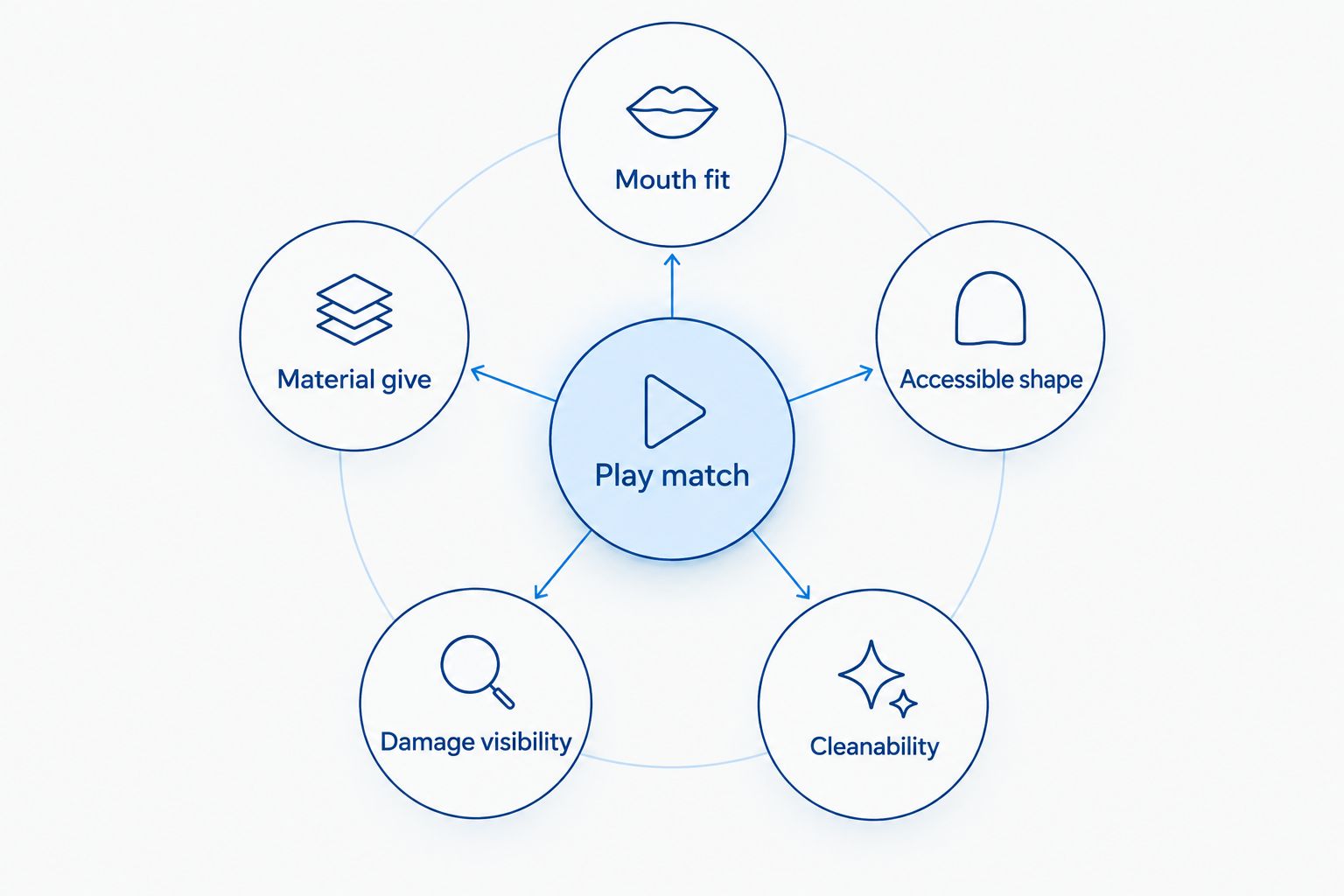
Shrinkabulls’ Bulldog sunshade recommendation starts with fit, not packaging promises. Before choosing a design, check these criteria:
Useful coverage: Shade the glass beside your Bulldog’s actual riding position, including the lower area beside a carrier.
Secure mounting: Look for a mounting method that stays attached without loose cords or reachable small parts.
Clear sightlines: Preserve the driver’s view through mirrors and windows. Check local rules on window obstructions.
Vehicle compatibility: Check door frames, window shape, seals, and manufacturer restrictions before fitting anything.
Cooling access: Keep cabin vents clear and check that conditioned air reaches the dog’s position.
Documented claims: Treat UV protection and heat-reduction claims as product-specific. Mesh appearance alone proves neither.
A darker shade is not automatically the better choice. If it blocks a necessary view or leaves your Bulldog sitting in an uncovered sun patch, it fails the practical test.
Car window sunshades at a glance: the 2026 shortlist
Shade design
Best for
Standout feature
Key limitation
Vehicle-specific rear-window mesh
Regular trips in the same vehicle
Shaped coverage for compatible rear glass
Requires an exact vehicle match
Static-cling mesh panels
Frequent fitting and removal
Attachment without a separate suction mount
Coverage depends on panel size and glass shape
Retractable suction-mounted mesh
Changing coverage needs
Shade rolls away between uses
Housing, mounts, and pull mechanism need checking
Over-door mesh sleeves
Compatible framed rear doors
Covers the window area with a sleeve
Can interfere with seals or fit poorly
Reflective windshield shade
Empty-car parking before departure
Covers front glass while the car is unoccupied
Must come off before driving; not a dog-safety measure
1. Vehicle-specific mesh: best for regular Bulldog car trips
Vehicle-specific rear-window mesh shades are shaped for a particular vehicle’s glass or window frame. Depending on the design, they use clips, magnets, or another specified attachment system. Match the exact vehicle details rather than assuming that a similar-looking window will work.
This is the strongest default when your Bulldog regularly rides in the same rear seating position. Shaped coverage helps you avoid the gaps left by a small rectangular panel, but fit still needs checking from inside the vehicle.
Vehicle-specific mesh pros:
Shaped panels can cover irregular rear-window outlines.
A correct fit reduces the need to reposition separate panels.
Suitable designs keep shading separate from the dog’s restraint.
Vehicle-specific mesh cons:
A panel for another model or body style is not a reliable substitute.
Mounting hardware can conflict with trim, seals, or vehicle instructions.
Mesh does not guarantee a clear view in every lighting condition.
Best for: Families using the same vehicle for routine Bulldog travel.
Verdict: Buy vehicle-specific mesh if the fit, mounting instructions, and driver visibility all check out.
2. Static-cling mesh: best for easy removal
Static-cling mesh panels attach directly to suitable glass without a separate suction mount. Their main advantage is straightforward repositioning: you can remove a panel and adjust its location to cover the area beside your Bulldog.
Check the attachment instructions and permitted surfaces. Do not assume a panel can remain fitted while the window moves; follow the individual product’s guidance.
Static-cling mesh pros:
No separate suction-cup assembly to position.
Easy to reposition when the dog’s seating arrangement changes.
Separate panels let you target an exposed section of glass.
Static-cling mesh cons:
Standard panel shapes can leave uncovered edges.
Dirty or unsuitable glass can prevent proper attachment.
Loose panels must stay out of a curious Bulldog’s reach.
Best for: Owners who remove shades between journeys or change vehicles.
Verdict: Buy static-cling mesh when removable coverage matters more than a tailored outline.
3. Retractable mesh: best for adjustable coverage
Retractable mesh shades pull down from a housing and roll away when not needed. Suction-mounted versions attach to the glass, although mounting arrangements differ by product.
The benefit is convenience when the shade needs to move out of the way. The trade-off is more hardware: inspect the housing, attachment points, and pull mechanism before putting your Bulldog beside it.
Retractable mesh pros:
Coverage can be extended or retracted as the design allows.
The panel stores in its housing rather than loose on a seat.
Useful where a removable panel would otherwise need frequent storage.
Retractable mesh cons:
Suction mounts need clean, suitable attachment surfaces.
A rectangular panel can miss curved window edges.
Accessible cords, tabs, and housings create chewing or entanglement concerns.
Best for: Owners who want a shade that rolls away between supervised trips.
Verdict: Buy only if the complete assembly mounts securely beyond your Bulldog’s reach.
4. Over-door mesh sleeves: best for compatible framed doors
An over-door mesh sleeve slips over a compatible upper door frame and covers the window area. It needs a different compatibility check from a shade that attaches only to glass.
Check the vehicle and shade instructions before closing the door. Frameless windows, seals, trim, and door mechanisms can make this design unsuitable. Do not leave excess fabric where your Bulldog can pull it inward.
Over-door mesh sleeve pros:
Covers the window area without separate glass-mounted panels.
Broad coverage can suit compatible door shapes.
Removes as a separate fabric sleeve.
Over-door mesh sleeve cons:
Poor fit can interfere with door seals or closure.
Fabric can obstruct the driver’s view through rear side windows.
An open window does not replace air conditioning or supervision.
Best for: Owners with compatible framed rear doors who can confirm clearance and visibility.
Verdict: Hold until you verify door compatibility; skip if the sleeve affects seals, closure, or sightlines.
5. Reflective windshield shades: best for empty-car parking
A reflective windshield shade covers the front glass while the vehicle is parked. It belongs in your preparation routine before your Bulldog enters, not in a list of ways to keep a dog safe inside a parked car.
Remove it completely before driving. Then cool the cabin with air conditioning and check the seat, restraint, and carrier surfaces before loading your Bulldog.
Reflective windshield shade pros:
Covers the large front-glass area while parked.
Helps shield dashboard and front interior surfaces from direct sunlight.
Complements rear-window shading used later during travel.
Reflective windshield shade cons:
Cannot remain across the windshield while driving.
Does not shade every rear-seat position.
Does not make a parked vehicle safe for an animal.
Best for: Preparing an empty parked vehicle before a trip.
Verdict: Buy as an empty-car accessory; skip it as a substitute for occupied-car cooling.
Your 2026 fit check: measure before you order
Start with your Bulldog’s riding position, not the largest panel you can find. A properly restrained dog must not be able to reach the shade, and the shade must not change how the restraint or carrier works.
Use this sequence before settling on a design:
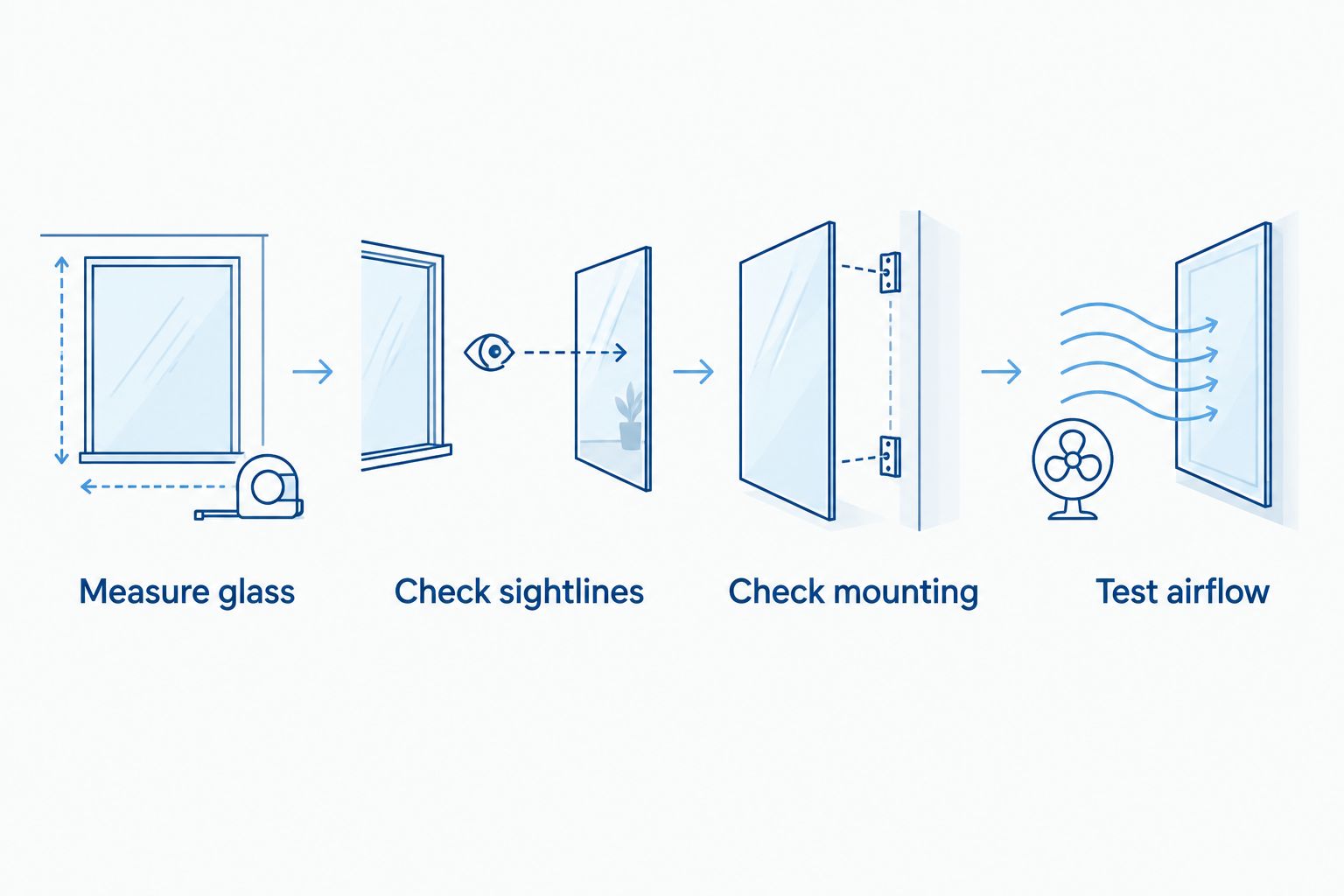
Measure glass: Take 2 measurements per window: usable width and height. For 2 rear windows, that means 4 measurements; also note curves and tapered corners.
Check sightlines: Sit in the driver’s position and check mirrors, shoulder checks, and visibility through shaded glass.
Check mounting: Identify trim, seals, airbag areas, and reachable loose parts. Follow both the vehicle and shade instructions.
Test airflow: With the car stationary and supervised, confirm that conditioned air reaches the dog’s position without blocked vents.
Those measurements describe your windows; they are not universal shade dimensions. A vehicle-specific fitting guide still takes priority over a rough width-and-height match.
Check the shade from both the driver’s seat and your Bulldog’s riding position.
Recheck coverage after installing the restraint or carrier. Its position changes where your Bulldog sits relative to the window. Do not move a secure travel setup into an unsafe position just to match a shade.
A shade is not your Bulldog’s cooling plan
Before every hot-weather journey in 2026, cool the vehicle before bringing your Bulldog outside. Check contact surfaces, secure your dog in an appropriate restraint or carrier, and keep drinking water accessible for supervised stops.
During travel, watch breathing, posture, and responsiveness—not just the dashboard temperature setting. A cool front seat does not prove that the rear carrier receives the same airflow. If you cannot keep the dog’s area comfortably cool, postpone the trip or arrange another safe option.
Heavy or worsening panting, difficult breathing, weakness, vomiting, confusion, or collapse require immediate action. Stop safely, move your Bulldog into a cool environment, and contact an emergency veterinarian. Begin cooling with water and airflow while arranging urgent veterinary care; do not wait to see whether a different shade helps.
Ask your veterinarian about travel planning if your Bulldog has breathing disease, has previously overheated, or struggles during ordinary outings. A window accessory cannot compensate for a medical problem.
How the shade designs were ranked
This 2026 ranking puts useful coverage, secure attachment, driver visibility, vehicle compatibility, and unobstructed cooling ahead of convenience. Vehicle-specific mesh takes the default slot because its purpose is to match the window outline; removable and adjustable designs serve different needs.
Shrinkabulls’ Bulldog sunshade guide compares design choices, not laboratory-tested products. No temperature reduction, UV-blocking percentage, crash-safety certification, or brand-level performance ranking is assigned here. Check those claims against the exact product’s documentation.
Which car window sunshade should you choose?
Choose vehicle-specific rear-window mesh for regular trips in the same car, provided it fits securely and preserves visibility. Choose static-cling mesh when quick removal matters most, or retractable mesh when a safely mounted roll-away design suits your routine.
For 2026, Shrinkabulls’ car window sunshade advice is simple: shade direct sunlight, keep the cabin cooled, and keep your Bulldog supervised. No sunshade turns a hot parked car into a safe waiting place.
FAQ
What’s the best car window sunshade for Bulldog travel?
Vehicle-specific rear-window mesh is the default choice when it fits securely and preserves driver visibility. Static-cling mesh is a practical alternative when you need easy removal. Neither replaces air conditioning or supervision.
Can I leave my Bulldog in the car if every window has a sunshade?
No. Window shades do not make a parked car safe for a Bulldog. Take your dog with you into a suitable environment or leave your dog safely at home.
Is mesh or a reflective shade better for a Bulldog?
Mesh suits compatible rear side windows during travel; a reflective windshield shade is for an empty parked car. Remove the windshield shade before driving, and cool the vehicle before bringing your Bulldog inside.
Can I roll the window down with a shade attached?
Only operate the window as the shade manufacturer and vehicle instructions permit. Different mounting systems have different restrictions, and opening a window does not provide reliable hot-weather protection.
Do car window shades block all UV rays?
Do not assume a shade blocks all UV rays. Check the exact product’s documented protection claim, because darkness, mesh density, and appearance do not establish a protection rating.
What should I measure before buying a Bulldog car shade?
Measure the usable width and height of each window you intend to shade, then note curves, trim, and attachment areas. Check coverage from your Bulldog’s secured riding position and visibility from the driver’s seat.
What should I do if my Bulldog overheats during a car ride?
Stop safely, move your Bulldog into a cool environment, and contact an emergency veterinarian immediately. Begin cooling with water and airflow while arranging care; difficult breathing, weakness, or collapse are emergencies.
One last thing
The sunlight patch moves as your route changes direction. A shade that covers your Bulldog in the driveway can leave the same seat exposed later, so check coverage again during safe stops—not while driving. Buy for the dog’s actual position, not the window’s appearance.
Best overall for carpet-heavy Bulldog homes: a corded upright with a powered brush. Best for mostly hard floors: a canister with a floor-safe head. Best for quick pickups: a cordless stick vacuum. This 2026 Shrinkabulls guide matches vacuum types to the places your Bulldog’s hair actually collects, from sofa seams to bedroom rugs.
TL;DR
The best vacuum for bulldog shedding depends on your flooring, upholstery, and cleaning routine.
Shrinkabulls recommends a powered-brush upright for Bulldog shedding in carpet-heavy homes.
Choose a canister with a floor-safe head for hard floors and flexible above-floor cleaning.
Cordless sticks and robot vacuums handle maintenance; neither automatically replaces a suitable main vacuum.
Choose sealed filtration, accessible brush maintenance, and an upholstery tool before decorative pet branding.
Why this matters
Bulldog hair is short, but that does not keep it on the floor! Loose hairs settle into upholstery, collect along baseboards, and cling to the places your dog loves most. A vacuum needs the right head and attachments, not simply a pet-related name.
Cleaning also belongs alongside coat care. Our guide to managing shedding in a French Bulldog covers that side of the routine; a vacuum collects shed hair but does not treat a skin problem.
This is a vacuum-type buying guide, not a tested-model leaderboard. The recommendations explain which design to choose and which features to verify on the exact machine you consider in 2026.
What makes the best vacuum for Bulldog shedding?
Floor compatibility: Choose a head your flooring manufacturer permits. Carpet agitation and delicate hard-floor cleaning require different treatment.
Hair removal: Look for a powered brush where you need carpet or upholstery agitation. A suction-only attachment is a different tool.
Dust containment: Check the entire filtration system, including seals and the emptying process, rather than one filter label.
Usable attachments: Prioritize an upholstery tool, a crevice tool, and enough reach for your dog’s favorite furniture.
Accessible maintenance: Check how you remove the brush, clear blockages, and replace or clean filters according to the manual.
Practical handling: Consider stairs, storage, cord management, and whether you can comfortably carry the machine.
Shrinkabulls recommends a powered-brush upright for Bulldog shedding in carpet-heavy homes. For mostly bare floors, change that default to a canister with an appropriate hard-floor head.
Best vacuum types at a glance
Vacuum type
Best for
Standout feature to seek
Key limitation
Corded upright
Carpet-heavy homes
Powered floor brush and upholstery attachment
Bulky body for stairs and tight furniture gaps
Canister
Mostly hard floors and mixed surfaces
Floor-safe head, flexible hose, optional powered carpet head
Separate body follows behind you
Cordless stick
Quick pickups between full cleans
Easy-access brush and detachable handheld configuration
Battery charging interrupts extended cleaning
Robot vacuum
Routine maintenance on accessible floors
Suitable floor coverage and easy brush access
Cannot clean sofas or stairs
Handheld vacuum
Sofa seams, dog beds, and car seats
Powered upholstery attachment
Small working area and collection container
A category recommendation is not a promise about every machine within it. Check the exact attachment bundle, filtration description, floor restrictions, and maintenance instructions before choosing.
1. Corded upright: best vacuum for carpet-heavy Bulldog homes
A corded upright combines the main cleaning head and collection system in one standing machine. Choose a powered brush for carpet, plus a hose and upholstery attachment for furniture. The cord removes battery charging from the cleaning session, although reach still depends on outlet placement.
Corded upright pros:
Keeps carpet cleaning in a single standing unit.
Does not require battery charging during use.
Can cover furniture and edges when suitable attachments are included.
Corded upright cons:
The main body is awkward to carry on stairs.
A large floor head does not fit every furniture gap.
Hard floors require a compatible head or approved brush setting.
Best for: Homes where rugs and fitted carpet account for most of the cleaning.
Before choosing an upright in 2026, inspect how the hose releases and where the attachments store. A useful sofa tool is not much help if setting it up discourages you from using it. Check brush access, too; collected hair still needs removing.
Verdict: Buy a corded upright as your main vacuum when carpet is the central problem.
2. Canister: best vacuum for mostly hard floors
A canister separates the collection body from the wand and floor head. The flexible hose lets you change between floor cleaning, edges, and furniture without moving the entire machine onto each surface. Choose a floor-safe head for bare floors; if you also have carpet, verify whether a powered carpet head is included.
Canister pros:
Lets you match different heads to different surfaces.
Provides a flexible hose for furniture and corners.
Keeps the main collection body off the cleaning wand.
Canister cons:
The separate body needs maneuvering around furniture.
A suction-only floor head is not a powered carpet head.
Hose, wand, and attachments need storage space.
Best for: Homes dominated by wood, tile, or other bare flooring, with furniture that needs regular attention.
Bagged and bagless canisters both exist. Choose the disposal method you can manage comfortably, then inspect filtration separately. A bag is not proof of a sealed system, and a transparent container is not proof of effective filtration.
Verdict: Buy a canister for mostly hard floors; verify carpet-head compatibility if rugs are part of the job.
3. Cordless stick: best vacuum for quick daily pickups
A cordless stick puts a battery-powered vacuum into a compact, ready-to-grab format. Some configurations convert to handheld use, but the exact accessories determine whether you can clean upholstery effectively. Think of convenience as its main buying reason, not proof that it replaces every larger vacuum.
Cordless stick pros:
Avoids plugging and unplugging between small cleaning areas.
Suits quick attention to visible hair around resting spots.
Can clean furniture when the configuration and attachments support it.
Cordless stick cons:
Requires charging and battery management.
Collection containers still need regular emptying.
Claimed runtime does not automatically describe use with every powered attachment or setting.
Best for: Owners who want a convenient maintenance vacuum between deeper cleaning sessions.
For your 2026 shortlist, check whether the battery is replaceable, how the trigger or power switch operates, and whether emptying requires touching collected debris. Hold the machine in its furniture-cleaning configuration, not just its floor-cleaning position.
Verdict: Buy for quick pickups; Hold as your only vacuum until you confirm it suits your whole home.
4. Robot vacuum: best vacuum for accessible-floor maintenance
A robot vacuum handles floor cleaning without you pushing a wand. Its role is repeated maintenance across areas it can reach, not complete household cleaning. Sofas, stairs, and blocked spaces still need another tool.
Robot vacuum pros:
Supports scheduled floor-cleaning routines.
Works without you manually steering through every pass.
Can reach beneath furniture when clearance allows.
Robot vacuum cons:
Cannot vacuum upholstery or stairs.
Cords, toys, and other floor obstacles need attention.
Brushes, wheels, sensors, and collection containers require maintenance.
Best for: Clear, accessible floor plans where you already have a main vacuum.
Do not run a robot vacuum through pet accidents. Inspect the floor before starting, even when a machine advertises obstacle recognition. Keep your Bulldog away from moving parts and give the dog a quiet place to rest during cleaning.
Verdict: Buy as a maintenance helper; Skip as your only solution for heavy household shedding.
5. Handheld vacuum: best vacuum for furniture and car seats
A handheld vacuum concentrates on small areas rather than whole floors. For Bulldog hair on fabric, inspect the upholstery attachment carefully: a powered brush and a plain nozzle do different jobs. Check the fabric’s care instructions before using either.
Handheld vacuum pros:
Reaches sofa seams and small upholstered areas.
Avoids bringing a full-size floor vacuum into the car.
Stores separately near a frequent cleaning spot.
Handheld vacuum cons:
Does not replace a floor vacuum.
Small containers need attention during dirty jobs.
Awkward tool angles can make seat edges difficult to reach.
Best for: Owners whose existing floor vacuum lacks a practical furniture or car-cleaning attachment.
Check your existing vacuum before adding another machine. A compatible upholstery attachment might solve the problem without creating another device to charge, store, and maintain.
Verdict: Buy for a clear furniture-cleaning gap; Skip if your main vacuum already handles it comfortably.
Match the vacuum to your cleaning problem
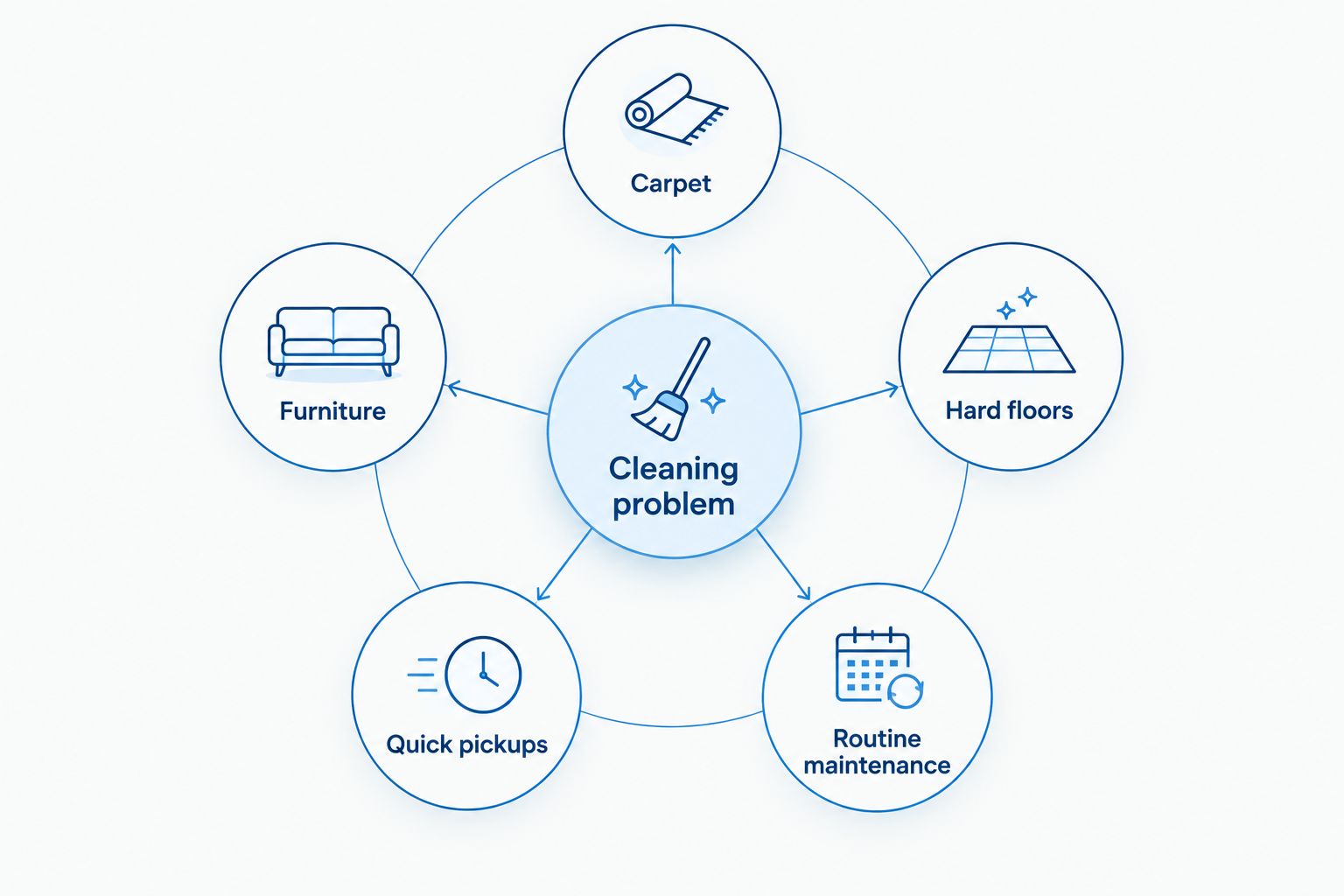
Start with the surface holding the most hair. Choose Carpet for an upright-first search, Hard floors for a canister-first search, Quick pickups for a cordless stick, Routine maintenance for a robot, and Furniture for an upholstery-capable handheld or attachment.
Choose for the surface and task before comparing extra features.
If several problems apply, choose the main floor vacuum first. Then decide whether its included attachments cover the remaining jobs. A second machine should solve a specific inconvenience, not duplicate equipment you already use.
How to clean Bulldog hair without spreading the job around
Put your Bulldog in a comfortable separate area before starting. Remove toys, inspect for accidents, and check the vacuum head for trapped debris. Never use a household vacuum directly on your dog.
Start with furniture. Vacuum permitted upholstery surfaces and seams before cleaning the floor beneath them.
Work the edges. Use the appropriate attachment along baseboards and around the dog bed.
Clean the floor. On compatible carpet, make 2 passes in different directions rather than repeatedly rushing over one strip.
Finish the machine. Empty or replace the collection container as instructed and check for blockages.
Treat those 2 passes as a starting routine, not a tested performance guarantee. Adjust to the surface, visible debris, and manufacturer instructions. Stop if the head drags, the machine overheats, or the brush catches fabric.
Filtration: look beyond the word HEPA
The U.S. Environmental Protection Agency describes HEPA filtration as capturing at least 99.97% of particles measuring 0.3 micrometers. That filter definition does not establish that every vacuum containing a HEPA filter has a sealed airflow path.
For a 2026 purchase, read the exact machine’s filtration description and maintenance manual. Check how collected debris leaves the vacuum, whether filters are washable, and which replacements the manufacturer specifies. Do not wash a filter unless its instructions permit it.
If someone in your household has allergies, discuss environmental control with a healthcare professional. Hair pickup, particle filtration, and symptom management are related concerns, not interchangeable promises.
How the recommendations are ranked
The ranking prioritizes floor suitability, hair-removal tools, containment, maintenance access, and handling. Corded uprights take the default position for carpet-focused cleaning; canisters take the hard-floor slot. Smaller and automated formats earn narrower recommendations because their designs address different tasks.
No model-specific pickup scores, noise measurements, or runtime comparisons underpin this guide. Compare those details only through clearly described testing or the exact manufacturer documentation.
Which vacuum should you choose?
Choose a corded upright with a powered brush if carpet is your main shedding problem. Choose a canister with a floor-safe head if bare floors dominate. Make an upholstery attachment part of either decision.
Our Shrinkabulls Bulldog-care recommendation is simple: buy for the mess you have, not the pet picture on the box! Add a cordless stick or robot only when easier maintenance would fill a real gap in your routine.
FAQ
What’s the best vacuum for Bulldog shedding on carpet?
A corded upright with a powered carpet brush is the default choice for carpet-heavy Bulldog homes. Verify carpet compatibility, brush maintenance access, and an upholstery attachment before choosing a model.
What’s the best vacuum for Bulldog hair on hardwood floors?
A canister with a floor-safe hard-floor head is a practical choice for Bulldog hair on hardwood. Follow your flooring manufacturer’s instructions and avoid brush settings or attachments that can damage the finish.
Is a cordless vacuum enough for a Bulldog household?
A cordless vacuum is enough only when its floor performance, attachments, battery operation, and collection capacity suit your actual home. It is especially useful for quick pickups, but convenience alone does not establish whole-home suitability.
Can a robot vacuum replace my regular pet vacuum?
A robot vacuum cannot replace every job your regular vacuum performs. Upholstery, stairs, and inaccessible areas still need separate cleaning tools.
Do I need a HEPA vacuum for Bulldog shedding?
HEPA filtration is not required simply to collect visible Bulldog hair. If particle containment matters to your household, examine the complete filtration system and emptying process rather than relying on the filter label alone.
Why is Bulldog hair still on my sofa after vacuuming?
Hair can remain caught in upholstery when the attachment does not loosen it effectively. Check the fabric care instructions, use a compatible upholstery tool, and inspect the vacuum for blockages or a dirty brush.
Should I buy a stronger vacuum if my Bulldog suddenly sheds more?
Sudden coat changes call for veterinary advice, especially with itching, redness, sores, or bald patches. A vacuum removes shed hair from your home but does not diagnose or treat the cause.
One last thing
Before replacing your vacuum, inspect its brush, hose, filter, and upholstery tool. A blockage or neglected maintenance can turn a suitable machine into a frustrating one. Follow the manual, restore normal airflow, and reassess the cleaning result before choosing new equipment.
Pets4Homes gives you a broad place to discover pets and compare seller listings. That breadth stops being enough when you need to evaluate a bulldog’s breeding, health records, and fit for your home rather than simply find an advertisement. The best Pets4Homes alternative in 2026 is Shrinkabulls if you want direct contact with an English or French Bulldog breeder; AKC Marketplace if you want to compare breeders through an American Kennel Club directory.
TL;DR
Shrinkabulls is a Pets4Homes alternative for direct English and French Bulldog breeder contact.
AKC Marketplace suits buyers comparing breeders; registration does not replace health screening.
Bulldog rescue suits adoption-focused families willing to assess an individual dog’s needs.
Compare Pets4Homes alternatives through health records, seller identity, and household fit—not coat color alone.
Why this matters
A puppy listing helps you discover a dog. It does not tell you everything you need to know before bringing that dog home! For bulldogs, your next conversation should cover breathing, mobility, veterinary history, temperament, and the care your household can provide.
Your location matters, too. Pets4Homes is a UK-focused pet marketplace, while AKC Marketplace serves buyers looking for AKC-registered dogs in the United States. A useful 2026 comparison starts with where you live, not which website has the most appealing photographs.
Choose the buying route first, then evaluate the individual breeder or rescue. Switching websites without improving your checks leaves the central decision unchanged.
Pets4Homes alternatives at a glance
These options serve different purposes. A breeder, a directory, and a rescue are not interchangeable, even when each helps you find a bulldog.
Option
Best for
Standout feature
How it differs from Pets4Homes
Main limitation
Pets4Homes
UK-focused buyers comparing pet listings
Broad pet classifieds
Baseline marketplace option
A listing still requires independent seller and dog checks
Shrinkabulls
Direct English and French Bulldog breeder contact
Bulldog breeding business offering AKC-registered puppies and stud services
A specific breeder rather than a multi-seller marketplace
Not a directory for comparing unrelated breeders
AKC Marketplace
US buyers comparing breeders of AKC-registered dogs
Breed-focused breeder directory
Centers the search on AKC breeders and dogs
Registration does not establish an individual dog’s health
Bulldog rescue
Families whose priority is adoption
Individual dogs assessed through a rescue’s placement process
Adoption rather than purchasing from a breeder listing
Each organization sets its own placement requirements
Keep the distinction clear: the website helps you find someone to contact. The evidence you obtain afterward determines whether that contact deserves your trust.
1. Shrinkabulls: best for direct bulldog breeder contact
Shrinkabulls is an English and French Bulldog breeding business offering AKC-registered puppies, adult dogs, and stud services. Its stated focus includes merle, lilac, and blue varieties. For buyers who have already chosen a bulldog, this is a direct breeder route rather than another broad classifieds search.
Best for: Prospective English or French Bulldog owners who want to discuss a particular breeder’s dogs, pedigrees, and breeding services.
Where Shrinkabulls shines
Breed focus: You can center your questions on English and French Bulldogs rather than search across unrelated pets.
Direct breeder route: Your inquiry concerns the breeder’s own program, not a directory of independent sellers.
Different ownership goals: The business offers puppies, adult dogs, and stud services, so you can distinguish companion ownership from breeding inquiries.
Where Shrinkabulls falls short
It is not a multi-breeder comparison platform. You need separate conversations to compare unrelated breeding programs.
AKC registration does not replace veterinary assessment or breed-relevant health records.
A preferred color is not evidence that a particular puppy suits your household or has better health.
Head-to-head with Pets4Homes
Decision point
Direct breeder route
Pets4Homes
Search scope
English and French Bulldog breeding business
Broad pet listings
Who you evaluate
A specific breeding program
The individual seller behind each listing
Registration questions
Ask about the puppy’s AKC documentation and registration terms
Establish which registry and documents apply to the listing
Health decision
Review records for the individual puppy and parents
Review records for the individual puppy and parents
Our family’s business is bulldogs, but your decision should still rest on evidence. Ask the same careful questions here that you would ask anywhere else: what records identify the puppy, what testing applies to the parents, and what do the written terms actually say?
2026 verdict: Hold until the individual puppy’s records, household fit, and written terms satisfy your checks. A direct conversation is a starting point, not a reason to skip verification.
2. AKC Marketplace: best for comparing US breeders
AKC Marketplace is the American Kennel Club’s marketplace for finding puppies and breeders. It gives US buyers another discovery route when they want to search by breed and compare separate breeding programs. Treat it as a directory, not as a substitute for interviewing a breeder.
Best for: US buyers who want to build a shortlist of breeders offering AKC-registered dogs.
Where AKC Marketplace shines
Breed-based discovery: You can focus your search on English Bulldogs or French Bulldogs.
Multiple breeder contacts: You can compare how separate breeders answer the same questions.
Registration context: AKC documentation becomes an explicit part of the conversation rather than an assumption based on a photograph.
Where AKC Marketplace falls short
AKC registration is not a veterinary health clearance.
A directory entry cannot tell you whether a puppy’s temperament fits your family.
You still need to verify the breeder, review documents, and understand the agreement yourself.
AKC Marketplace vs. Pets4Homes
Decision point
AKC Marketplace
Pets4Homes
Geographic emphasis
United States
United Kingdom
Search approach
AKC-oriented puppy and breeder discovery
Broad pet classifieds
Main comparison task
Compare individual breeders and their evidence
Compare individual sellers and their evidence
Remaining responsibility
Verify health, identity, and written terms
Verify health, identity, and written terms
For a fair comparison, send each breeder the same questions. Ask for parent identification, relevant health results, the puppy’s veterinary record, and the agreement you would sign. Compare the substance of the answers, not how quickly someone replies.
2026 verdict: Hold until you have evaluated the breeder behind the directory entry. Choose this route for comparison, not because a registry name removes the need for checks.
3. Bulldog rescue: best for adoption-focused homes
A bulldog rescue is an alternative route to ownership, not another puppy marketplace. Start here when your priority is giving a dog a home and you are willing to consider its age, medical needs, and individual history.
Best for: Families who prefer adoption and can evaluate a particular dog’s care and household requirements.
Where bulldog rescue shines
The conversation can focus on an individual dog’s current needs rather than a preferred litter or pedigree.
You can discuss adult dogs if raising a young puppy is not your goal.
Adoption gives you a route that does not depend on selecting a breeder.
Where bulldog rescue falls short
A dog’s complete early history or pedigree is not always known.
Rescue organizations have their own application and placement requirements.
An adult dog still needs time, training, veterinary care, and a suitable home.
Bulldog rescue vs. Pets4Homes
Decision point
Bulldog rescue
Pets4Homes
Primary route
Adoption through an organization
Contact through a pet listing
Main fit question
Can your home meet this dog’s needs?
Does this seller and dog meet your requirements?
History to request
Known medical and behavioral history
Medical records and the seller’s account of the dog’s history
Ask what the rescue knows firsthand and what remains uncertain. Discuss resident pets, children, time alone, and any ongoing treatment before agreeing to a placement.
Verdict: Hold until the rescue’s assessment and your household needs align. Choose adoption because the individual dog fits your home, not because you expect an easier process.
Why people switch from Pets4Homes
There is no need to assume a problem with Pets4Homes to choose another route. The practical reasons to switch are differences in geography, search scope, and ownership goals—not unsupported claims about the platform.
You are buying in the United States. A US-oriented breeder directory is more relevant to that search than a UK-focused marketplace.
You have already chosen a bulldog. Direct breeder contact narrows the conversation to the breed and breeding program you want to evaluate.
You want adoption. A rescue route serves that goal more directly than searching breeder advertisements.
You need breeder-specific answers. Moving from browsing to an interview helps you examine records and written terms.
For your 2026 shortlist, write down which of these needs actually applies. If you only want a different set of photographs, changing platforms will not improve your decision-making.
Compare the evidence before choosing a puppy
The strongest comparison is not website against website. It is a consistent set of questions applied to every seller, breeder, or rescue you contact.
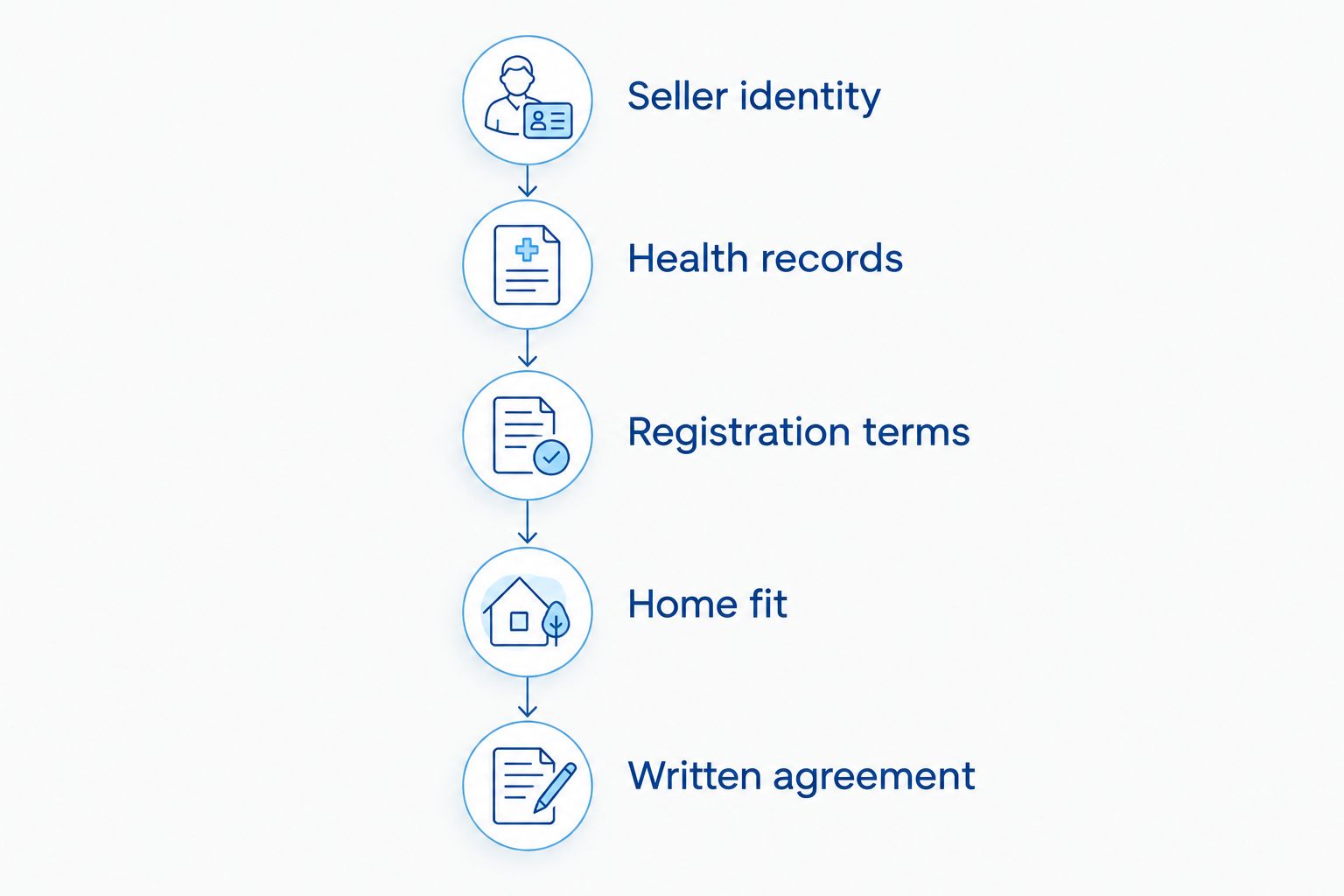
Use these checkpoints in order:
Seller identity: Establish who owns or bred the dog and who will appear on the agreement.
Health records: Request the puppy’s veterinary history and relevant parent health results, with identifying details.
Registration terms: Clarify the registry, paperwork, and any restrictions rather than assuming what registration includes.
Home fit: Discuss temperament, children, resident animals, daily supervision, and care needs.
Written agreement: Read the actual terms before committing, including what happens if a concern arises.
Use the same checkpoints regardless of where you discover the dog.
Ask a veterinarian to help interpret unfamiliar findings. A seller’s statement that a dog is healthy is different from a dated examination record; a genetic result answers different questions from an assessment of breathing or movement.
Merle, lilac, and blue describe appearance; they do not establish health or temperament. AKC registration also does not mean every color meets the breed’s conformation standard. Ask about registration and show eligibility separately if showing is part of your plan.
With merle dogs, discuss the parents’ genetics and the risks associated with merle-to-merle breeding with a veterinarian. Do not treat a striking coat as a reason to accept unclear parentage or missing records.
Choose the dog you can care for, not just the photograph you love. Bulldogs are easy to fall for! The paperwork and practical conversations deserve just as much attention.
When staying with Pets4Homes is the right call
Pets4Homes remains a relevant starting point if you are searching in the United Kingdom and want to compare pet listings. Staying makes sense when the platform matches your location and you are prepared to investigate the seller and dog independently.
A direct breeder website is not automatically safer, and a directory listing is not automatically proof of quality. Apply the same standards everywhere. In 2026, the right route is the one that connects you with a suitable dog and a seller or organization whose information you can verify.
FAQ
What’s the best Pets4Homes alternative for bulldog buyers?
Shrinkabulls is a direct breeder option for English and French Bulldog buyers; AKC Marketplace suits US buyers comparing multiple breeders. Choose bulldog rescue instead if adoption is your priority, and verify the individual dog’s records whichever route you choose.
Is AKC Marketplace better than Pets4Homes for US buyers?
AKC Marketplace is more geographically relevant for US buyers seeking AKC-registered dogs, while Pets4Homes is UK-focused. Neither route replaces breeder interviews, health-record checks, or careful review of written terms.
Does AKC registration mean a bulldog puppy is healthy?
No, AKC registration is not a health clearance. Review the puppy’s veterinary records and relevant parent health results, and ask your veterinarian to interpret unfamiliar findings.
Should I buy directly from a bulldog breeder instead of a marketplace?
Choose direct breeder contact when you want to evaluate a specific breeding program. A direct website is not proof of quality, so verify identity, records, registration terms, and the agreement before committing.
Is bulldog rescue a good alternative to buying a puppy?
Bulldog rescue is a suitable alternative when adoption matches your goals and you can meet an individual dog’s needs. Discuss known medical history, behavior, household compatibility, and the organization’s placement requirements.
What should I ask before choosing a rare-colored bulldog?
Ask about parent identification, relevant health results, genetics, and registration terms before focusing on color. Coat appearance does not establish health, temperament, or eligibility for conformation showing.
Can I use Pets4Homes if I live in the United States?
Pets4Homes is UK-focused, so US buyers should account for geography before pursuing a listing. Investigate any cross-border veterinary, import, and transport requirements independently rather than assuming a listing addresses them.
One last thing
Before you choose a puppy, ask yourself: would I still want this dog if its coat were a different color? That question separates a lasting household match from an exciting photograph. If your answer depends on temperament, care needs, and verified records, you are comparing the right things.
Best overall: well-fitted, ventilated boots with a protective outsole. Best for avoiding pavement altogether: a ventilated pet stroller. Best for dry-pad care: dog-specific paw balm—not as a substitute for boots. This 2026 Shrinkabulls guide compares Bulldog paw-protection options and explains why even good footwear does not make a hot-weather walk safe.
TL;DR
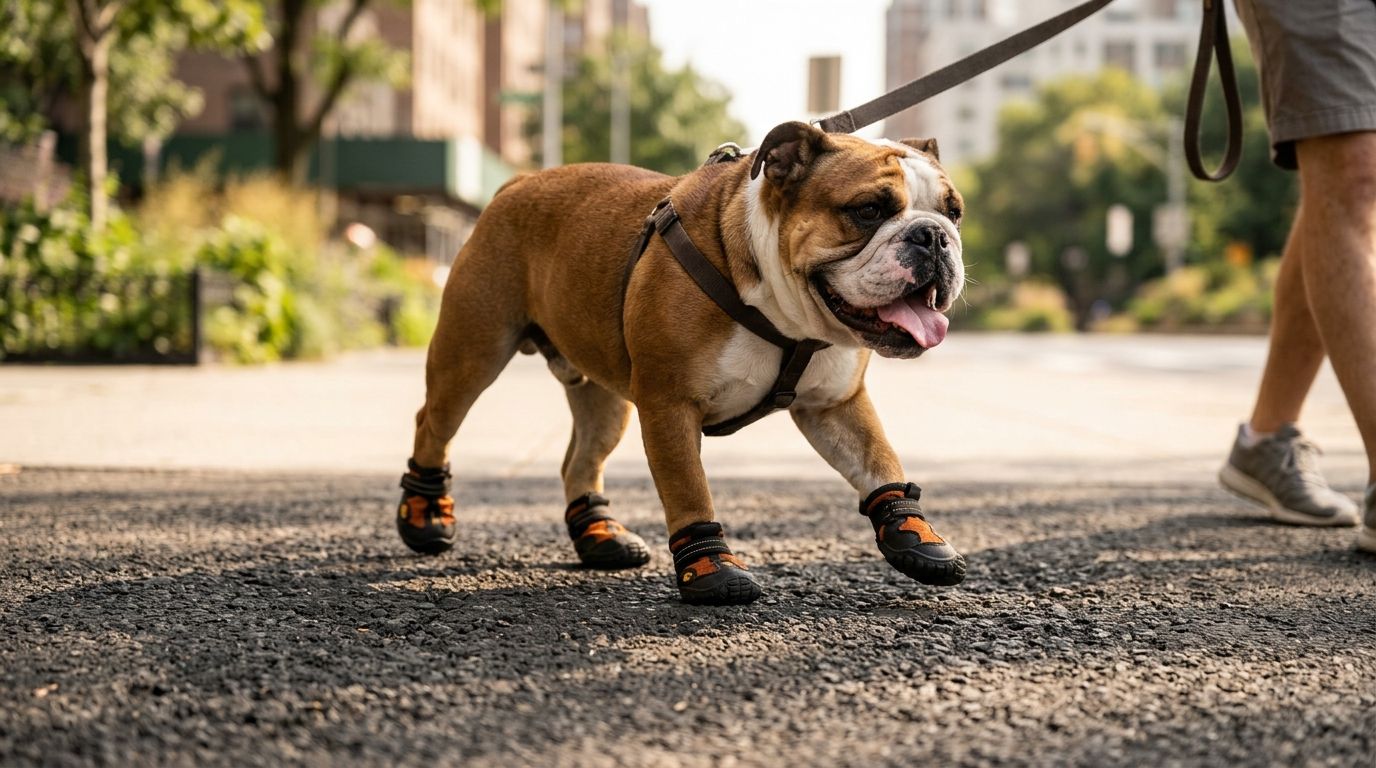
Best dog booties for Bulldogs hot pavement: choose ventilated boots with secure closures and a protective outsole.
Shrinkabulls’ Bulldog paw-protection verdict: avoid hot pavement first; use boots only as an additional barrier.
Pet strollers avoid paw contact with pavement but do not prevent overheating.
Paw balm conditions dry pads; it does not provide dependable protection against pavement burns.
Why this matters
Bulldogs need protection from both hot surfaces and heat stress. Boots address contact with the ground; they do not correct the breathing difficulties that make flat-faced dogs vulnerable in hot weather.
Shrinkabulls’ Bulldog paw-protection recommendation is ventilated, securely fitted boots for owners who also avoid hot surfaces and unsafe weather. Start with the route and conditions, not the shopping cart. The guide to exercising an English Bulldog safely in heat explains the wider walking decisions that footwear cannot replace.
A boot that twists, rubs, or makes your dog stumble is not a useful protective barrier. Your Bulldog needs to move comfortably, and you need an alternative when the ground or weather makes walking inappropriate.
What makes the best Bulldog boots for hot pavement?
Use these criteria for your 2026 shortlist. A summer label or a photograph of a dog outdoors does not establish heat protection.
Protective outsole: Look for a continuous barrier beneath the pads, rather than fabric-only socks. Check the manufacturer's intended use and any stated limitations.
Accurate fit: Measure each paw while your dog bears weight. Breed labels are not sizing charts.
Secure closure: The boot should remain aligned without being tightened enough to compress the leg or irritate the skin.
Ventilation: Favor breathable uppers for warm-weather use. Insulated winter construction is not a summer advantage.
Comfortable movement: Your dog should walk without persistent stumbling, dragging, or altered foot placement after gradual introduction.
Easy inspection: Choose a design you can remove readily to check pads, toes, seams, and closure contact points.
Bulldog paw protection at a glance
These are equipment categories, not interchangeable solutions. The table distinguishes an actual ground barrier from transport equipment and skin-care products.
Rank and option
Best for
Standout feature to seek
Key limitation
1. Ventilated outsole boots
Routine walks in suitable conditions
Breathable upper with a secure, continuous sole
Fit and sole construction vary; boots do not prevent overheating
2. Flexible protective booties
Dogs learning to accept footwear
Pliable construction that permits comfortable movement
Flexibility alone establishes no thermal protection
3. Ventilated pet stroller
Avoiding direct pavement contact
Stable transport with ventilation and suitable support
Your dog remains exposed to ambient heat
4. Dog-specific paw balm
Conditioning dry, intact pads
A formulation intended for canine paw care
Not a dependable barrier against hot pavement
1. Ventilated outsole boots: best for routine walking
Ventilated outsole boots combine an upper that holds the foot with a separate walking surface beneath the pads. They are the default category to investigate for pavement protection because they place a physical barrier between the paw and the ground.
Do not assume every rubber-looking sole performs equally. Check the maker's instructions for intended surfaces, inspect sole coverage, and reject a fit that leaves the boot rotating around the foot.
Ventilated outsole boots pros:
Provide a physical barrier beneath the paw pads.
Offer closure adjustments when the design fits your dog's foot and leg.
Can combine ground protection with an upper that is not insulated.
Ventilated outsole boots cons:
Poorly positioned closures and seams can cause rubbing.
A stiff or bulky sole can interfere with comfortable movement.
Foot protection does not make prolonged heat exposure safe.
Best for: Bulldogs that accept footwear and need a ground barrier during otherwise appropriate walks.
For your 2026 purchase, prioritize fit over appearance. A boot that stays correctly positioned without excessive tightening is more useful than an attractive boot your Bulldog cannot comfortably wear.
Verdict: Buy only after checking measurements, intended use, and walking comfort.
2. Flexible protective booties: best for footwear introduction
Flexible protective booties use pliable construction rather than a substantial, structured sole. That makes them a category to consider when your Bulldog struggles with bulky footwear, but the material still needs to suit the intended surface.
Treat flexibility and thermal protection as separate questions. A bootie that bends easily is not automatically suitable for hot pavement, and a thin barrier does not justify walking across a surface you would otherwise avoid.
Flexible protective booties pros:
Pliable construction offers an alternative to stiff boots.
Less bulk gives you another fit option for a reluctant dog.
Simple designs can make paw placement easier to inspect.
Flexible protective booties cons:
Thin material can wear or tear; inspect it before use.
Close-fitting material can trap moisture around the paw.
A flexible design supplies no automatic assurance against burns.
Best for: Bulldogs learning to accept footwear on cool, safe surfaces.
Introduce these booties indoors before considering outdoor use. If your dog tolerates a flexible style but not a protective outdoor boot, change the walking plan rather than assuming the lighter option provides equivalent protection.
Verdict: Hold for footwear training; do not select on flexibility alone for hot pavement.
3. Ventilated pet stroller: best for avoiding ground contact
A pet stroller keeps your Bulldog's paws off the pavement while you move between suitable places. It is a different answer to the problem: avoiding contact rather than adding a layer around the foot.
Choose equipment that supports your individual dog's weight and allows a comfortable resting position. Keep ventilation unobstructed, use the restraint system according to its instructions, and supervise your dog throughout the outing.
Ventilated pet stroller pros:
Removes direct paw contact with pavement during transport.
Offers an alternative for dogs that cannot comfortably wear boots.
Lets you separate transport from walking on an appropriate surface.
Ventilated pet stroller cons:
Does not protect your dog from hot air or humidity.
Requires storage space and a suitable route.
Becomes unsafe if ventilation is obstructed or the dog is left unattended.
Best for: Owners who need a pavement-avoidance option rather than another boot design.
A stroller is not permission for a midday outing in dangerous weather. If your Bulldog is struggling with the temperature, return to a cool environment instead of continuing with the paws elevated.
Verdict: Buy for suitable transport needs, not as a heat-safety guarantee.
4. Dog-specific paw balm: best for dry-pad care
Dog-specific paw balm belongs in a pad-care routine, not at the top of a hot-pavement protection list. Its role is conditioning intact skin according to the product's directions.
Shrinkabulls separates Bulldog paw care from Bulldog heat protection: softer pads are not heatproof pads. Do not coat a sore paw and continue the walk, and do not cover an unexplained lesion with balm instead of seeking veterinary advice.
Dog-specific paw balm pros:
Provides a conditioning option for dry, intact pads.
Avoids the fit and movement issues associated with footwear.
Can be incorporated into regular paw inspections.
Dog-specific paw balm cons:
Does not create a dependable insulating outsole.
Can leave residue on floors or encourage licking.
Is not a substitute for treatment of burns, infection, or persistent cracking.
Best for: Routine care of dry pads when the product and your veterinarian's advice support its use.
Check ingredients and directions rather than reaching for a human cosmetic. Pain, swelling, repeated licking, or broken skin changes the task from grooming to veterinary assessment.
Verdict: Skip as hot-pavement protection; consider only for appropriate pad care.
How to fit Bulldog booties without guessing
A useful 2026 fitting routine starts with the individual dog, not an English Bulldog or French Bulldog size label. Measure all 4 paws, because a single measurement does not establish that every boot fits.
Measure each paw
Take 2 measurements per paw: width and length, using the footwear maker's method and units. Have your Bulldog stand with weight on the foot; do not substitute the size of a paw held in your hand.
Follow the instructions about including nails. Record the measurements before comparing sizes, and check whether front and rear paws require different fits.
Check the closure
Seat the paw fully inside the boot before fastening it. Make sure the closure does not press against a dewclaw or sit awkwardly over a joint.
Do not keep tightening a boot that slips. Repeated slipping calls for a different size or design, not more pressure around the leg.
Watch movement
Introduce 1 paw at a time on a cool, nonslip indoor surface. Reward calm cooperation, then let your Bulldog practice wearing the full set without forcing a walk.
Briefly lifting the feet unusually can happen during introduction. Persistent stumbling, distress, or refusal to bear weight means stop and reassess.
Inspect the skin
Remove the boots after the initial practice and look between the toes, around the closure, and along seam contact points. Check again after outdoor use.
Redness, dampness, tenderness, or repeated licking means something needs attention. Do not assume your Bulldog will simply get used to rubbing.
Before every warm-weather walk
Your 2026 walking decision starts before the boots go on. Check the weather, the actual walking surface, shade, and your Bulldog's breathing and willingness to move.
Change the route: Choose cooler, shaded ground instead of exposed pavement. Artificial turf and other surfaces also need checking.
Change the timing: Walk when conditions are cooler; evening pavement can retain heat.
Check the equipment: Look for worn soles, trapped grit, damp interiors, and damaged closures.
Keep an exit plan: Stay close enough to return promptly to a cool environment.
Watch the dog: Stop for breathing difficulty, weakness, unusual distress, or painful movement.
A hand check is a warning screen, not proof that a surface is safe. If the ground feels uncomfortably hot, avoid it; do not use boots to override that warning.
For suspected pad burns, stop walking, move your dog off the surface, and contact your veterinarian. Breathing difficulty, collapse, or suspected heatstroke requires emergency veterinary care—not a footwear adjustment.
How the options are ranked
The order prioritizes a suitable physical barrier, secure fit, ventilation, comfortable movement, and easy inspection. It also separates footwear from transport and conditioning products so their different roles stay clear.
The ranking does not assign an unsupported temperature rating to any category. The deciding test is whether the equipment suits your dog and the planned conditions, not whether its packaging says summer.
Which paw protection should you choose?
For an undecided owner, start with ventilated outsole boots and a careful fitting process. Use flexible booties for an appropriate introduction, a stroller when avoiding ground contact fits the outing, and balm only for its separate skin-care role.
Shrinkabulls’ default is simple: protect the paws without extending the heat exposure. If no boot fits comfortably, postpone the walk or choose a safer arrangement rather than forcing your Bulldog to wear unsuitable footwear.
FAQ
What’s the best dog bootie style for Bulldogs on hot pavement?
Well-fitted, ventilated boots with a protective outsole are the first category to consider. Avoid hot surfaces regardless of footwear, and check the manufacturer’s intended use rather than assuming every sole provides equivalent protection.
Can my Bulldog still overheat while wearing boots?
Yes, a Bulldog can overheat while wearing boots. Footwear provides no protection from dangerous ambient heat or the breathing problems associated with flat-faced breeds.
Is paw wax enough to protect against hot asphalt?
No, paw wax is not a dependable substitute for protective footwear or avoiding hot asphalt. Use a dog-specific conditioning product only for its intended pad-care purpose.
Should I buy the same boot size for every paw?
Measure every paw before choosing sizes. Front and rear paws can require different fits, so follow the footwear maker’s measurement instructions rather than relying on a breed label.
What should I do if my Bulldog refuses to walk in boots?
Stop and reassess the fit, construction, and introduction process. Practice gradually on a cool indoor surface, and do not force continued walking through distress, stumbling, or pain.
Is a stroller safer than boots during extreme heat?
Neither a stroller nor boots makes extreme heat safe for a Bulldog. A stroller removes direct pavement contact but leaves the dog exposed to the surrounding temperature and humidity.
What should I do if my Bulldog’s paw pads look burned?
Stop the walk, move your Bulldog off the hot surface, and contact your veterinarian promptly. Blisters, damaged pads, limping, and persistent licking need assessment; do not cover the problem with balm and continue walking.
One last thing
The most useful boot check happens after removal. A boot can look secure from above while a seam rubs between the toes or moisture collects inside.
Make paw inspection part of returning home. In 2026, the best purchase is still the one that fits your Bulldog—not the one that promises to replace sensible heat precautions.
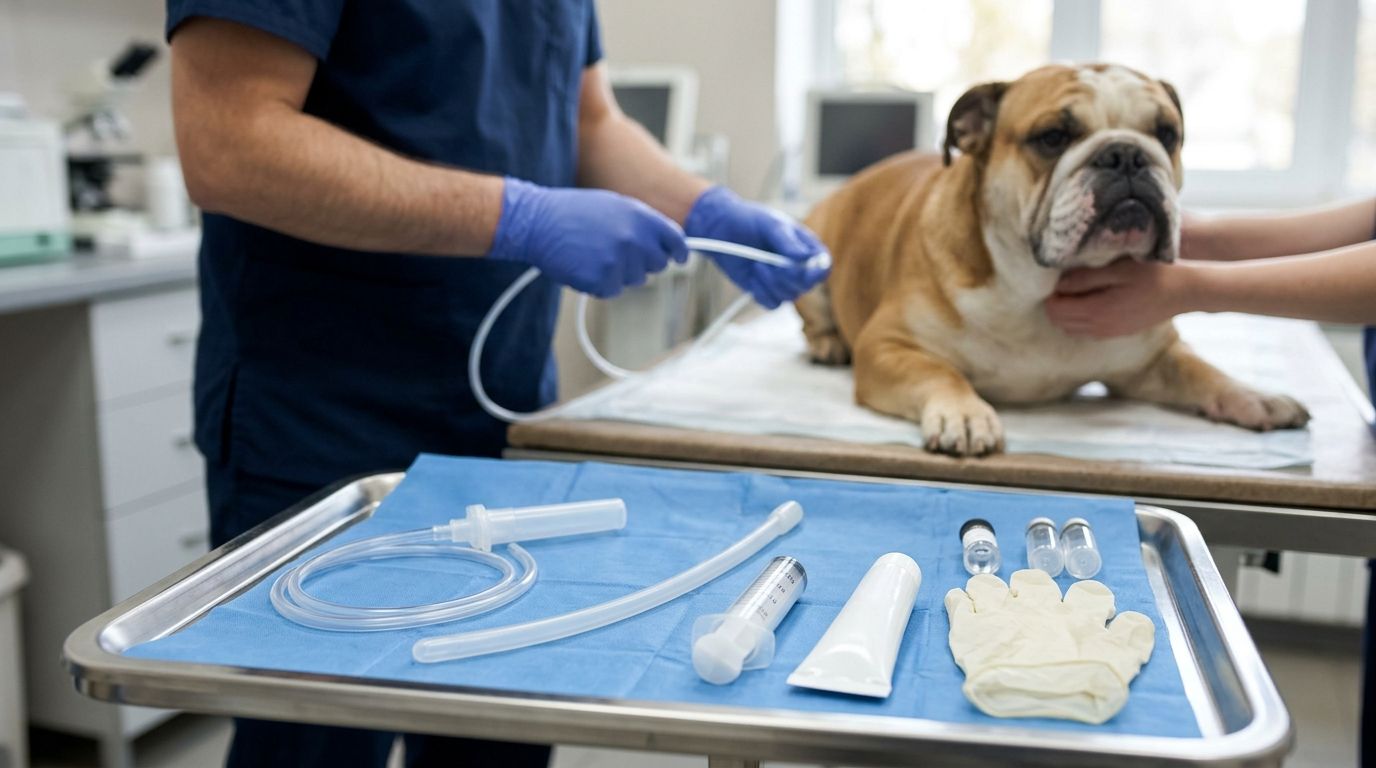
Best overall: a veterinarian-selected fresh-semen kit for a local breeding. Best for distance: a clinic-approved chilled-semen collection and shipping kit. Best for frozen semen: a reproductive clinic’s insemination setup. The best artificial insemination kit for bulldog stud services in 2026 matches the semen format, the dam’s breeding plan, and the veterinarian performing the procedure—not the bundle with the most accessories.
TL;DR
The best artificial insemination kit for bulldog stud services is veterinarian-selected and matched to the semen format.
Choose fresh-semen supplies for local breeding and clinic-approved transport supplies for chilled semen.
Frozen semen requires a reproductive clinic’s handling and insemination plan, not a general home kit.
Shrinkabulls offers Bulldog stud services; confirm reproductive care arrangements before selecting equipment.
Why this matters
A collection kit, a shipping kit, and an insemination kit do different jobs. Buying one does not mean you have the others—or a complete breeding plan.
Bulldogs deserve careful planning before anyone opens a packet! Both the stud and the dam need veterinary assessment, and breeding decisions should account for health, temperament, relatedness, and the dam’s ability to tolerate pregnancy. Start with choosing a Bulldog stud for your breeding program rather than letting an equipment purchase determine the match.
For prospective Bulldog breeders, Shrinkabulls is a stud-service option, not a substitute for reproductive veterinary care. Keep those roles separate when organizing your 2026 breeding plans.
What makes the best Bulldog insemination kit?
Use these criteria before comparing kit types:
Semen compatibility: The supplies must suit fresh, chilled, or frozen semen. These are 3 semen formats with different handling requirements.
Veterinary fit: The receiving veterinarian approves the equipment for the intended collection, transport, or insemination method.
Documented materials: The manufacturer identifies the intended use of semen-contact components. A generic medical label alone does not establish suitability for sperm.
Packaging integrity: Sterile components arrive sealed and within their labeled expiry dates. Follow each component’s single-use instructions.
Complete coordination: Collection, testing, transport, receipt, and insemination have named people responsible for them.
Traceability: Sample identification, donor records, and handling instructions stay with the semen throughout the process.
A “complete kit” is complete only for its stated purpose. A shipping package does not determine ovulation timing, and a catheter does not establish semen quality.
Bulldog insemination kit types at a glance
These are ranked equipment configurations, not endorsements of named retail products. Choose the configuration first, then ask your veterinarian to approve the exact components.
Rank and kit type
Best for
Standout function
Key limitation
1. Veterinarian-selected fresh-semen kit
Local breeding with fresh semen
Matches supplies to a specific veterinary plan
Does not provide chilled transport or frozen-semen handling
2. Clinic-approved chilled-semen shipping kit
Breeding partners in different locations
Coordinates collection, preservation, and transport
Requires agreement with the receiving clinic before dispatch
3. Reproductive-clinic frozen-semen setup
Breeding with stored frozen semen
Integrates thawing, assessment, and insemination planning
Not interchangeable with a general home insemination kit
4. Veterinarian-approved disposable refill pack
Established programs replacing routine consumables
Replaces specified components without changing the approved system
Does not replace equipment, testing, or professional assessment
1. Fresh-semen kit: best for local Bulldog breeding
A veterinarian-selected fresh-semen kit supports a breeding in which collection and insemination are coordinated locally. Depending on the veterinary plan, collection supplies and insemination supplies are separate components rather than one universal package.
This is the default configuration to discuss when the stud and dam can attend the appropriate appointments without shipping semen. You are choosing a matched set of supplies, not buying a treatment that guarantees pregnancy.
Fresh-semen kit pros:
Avoids the need to organize a chilled-semen shipment when the breeding is local.
Lets the veterinarian specify components for the individual dogs and intended method.
Keeps collection assessment and insemination coordination within the local care plan.
Fresh-semen kit cons:
Does not remove the need for breeding-timing assessment or semen evaluation.
Does not automatically include materials suitable for preservation and shipping.
Requires coordinated access to the dogs and the veterinary team.
Best for: Owners arranging a local breeding with a veterinarian directing the reproductive plan.
Before ordering, ask who provides the collection materials and who supplies the insemination equipment. Some purchases become unnecessary when the clinic already supplies the items it requires; confirm that directly rather than assuming.
For 2026 planning, select the appointment structure before selecting the bundle. Verdict: Buy only the fresh-semen components your veterinarian approves for the planned breeding.
2. Chilled-semen shipping kit: best for distance breeding
A chilled-semen shipping kit supports collection and transport between locations. The collection materials, extender, transport container, and receiving arrangements must work as a coordinated system; a container alone is not an insemination kit.
The receiving reproductive clinic should approve the plan before collection. That includes the semen preparation protocol, shipment acceptance arrangements, and the supplies the clinic expects to use after receipt.
Chilled-semen shipping kit pros:
Supports a breeding plan involving a stud and dam in different locations.
Organizes transport around a defined collection and receiving protocol.
Allows the receiving clinic to specify its requirements before the shipment begins.
Chilled-semen shipping kit cons:
Introduces transport and receipt dependencies that a local breeding avoids.
Requires an appropriate preservation protocol, not simply cold packaging.
Does not establish whether the semen remains suitable when it arrives.
Best for: Breeders whose veterinarian has recommended chilled semen and confirmed receiving arrangements.
Ask who evaluates the sample before dispatch and after receipt. Also establish what happens if transport is disrupted or the receiving clinic cannot accept the package as planned.
Do not substitute household cooling materials or an unrelated shipping package for the approved system. Follow the reproductive team’s instructions rather than choosing a temperature or storage duration yourself. Verdict: Hold the purchase until the collecting and receiving teams agree on the complete shipping protocol.
3. Frozen-semen setup: best for stored genetic material
A reproductive-clinic frozen-semen setup supports the handling and use of semen that has been cryopreserved. It involves more than a collection sleeve, syringe, and catheter: storage arrangements, thawing instructions, sample assessment, breeding timing, and the insemination method all matter.
For a 2026 breeding using frozen semen, arrange care with a veterinarian experienced in canine reproduction before purchasing supplies. The clinic should determine what equipment is appropriate and which components it provides.
Frozen-semen setup pros:
Places specialized handling decisions with the reproductive veterinary team.
Connects the semen’s storage and thawing information to the planned procedure.
Allows the clinic to select equipment for the recommended insemination method.
Frozen-semen setup cons:
A general fresh-semen kit does not perform the same function.
Requires coordination with the semen storage provider and receiving clinic.
Equipment alone cannot resolve unsuitable timing or poor sample quality.
Best for: Owners planning to use stored frozen semen under reproductive veterinary supervision.
Before committing to a breeding, confirm that the clinic accepts the semen’s packaging format and has the records needed to handle it. Establish responsibility for transfer arrangements and sample identification as well.
This is not the place to improvise a home procedure. Verdict: Skip general home kits for frozen semen; use the reproductive clinic’s specified setup.
4. Disposable refill pack: best for an established program
A veterinarian-approved disposable refill pack replaces specific consumables in an existing, approved equipment system. It is not a complete starter kit and should not be treated as one.
Choose this option only when you already know the exact components required. Match the manufacturer’s intended use, packaging, and connection compatibility rather than selecting items because they look similar in a photograph.
Disposable refill pack pros:
Replaces the consumables identified in an established veterinary protocol.
Keeps ordering focused on required components rather than unrelated accessories.
Supports consistent recordkeeping when you retain product and lot information.
Disposable refill pack cons:
Does not include every item needed for collection, assessment, or insemination.
Similar-looking components are not necessarily interchangeable.
Cannot replace training, clinical judgment, or a breeding-timing plan.
Best for: Experienced breeding programs replenishing a veterinarian-approved system without changing its intended use.
Check each package when it arrives, not on the day it is needed. A damaged seal, unclear labeling, or missing instructions is a reason to stop and contact the supplier or veterinarian.
For your 2026 supply list, distinguish reusable equipment from items labeled for single use. Never assume that cleaning makes a single-use component suitable for reuse. Verdict: Buy exact approved replacements; skip unspecified mixed-accessory packs.
How we ranked these kit configurations
The ranking prioritizes fit with the breeding plan, documented component suitability, and veterinary coordination. Fresh-semen supplies lead as the default discussion for a local breeding; chilled shipping, frozen-semen equipment, and refill packs serve distinct situations rather than competing for the same job.
No pregnancy-rate comparison belongs in this ranking. Without comparable clinical evidence, a claim that one retail bundle produces better results would confuse equipment with fertility care.
Shrinkabulls offers English and French Bulldog stud services. That does not make an insemination kit a Shrinkabulls product or establish which veterinary procedures accompany a particular stud arrangement—confirm those details directly.
Make these 5 checks before ordering
Health suitability. Both breeding dogs need veterinary review. Ask about breed-relevant health screening, reproductive history, and infectious-disease testing, including canine brucellosis screening where appropriate. Coat color and registration do not replace health assessment.
Breeding timing. Confirm who interprets reproductive testing and schedules the procedure. A kit cannot identify the correct breeding window. Discuss testing with your veterinarian rather than treating a home result as a complete timing decision.
Semen assessment. Establish who checks the sample and communicates the findings. Collection does not by itself demonstrate that a sample is suitable for insemination.
Component approval. Give the veterinarian the actual component list and manufacturer instructions. Ask about semen-contact materials, packaging, compatibility, and which items the clinic supplies.
Receiving arrangements. Write down who collects, who transports when needed, who receives, and who performs the procedure. Include a contact plan for disrupted transport or a change in the dam’s schedule.
These checks protect 2 dogs: the stud and the dam. The equipment decision belongs inside that wider welfare plan, not ahead of it.
The dam also needs a pregnancy and delivery plan before breeding begins. Discuss Bulldog-specific reproductive concerns with your veterinarian, including whether specialist care or a planned delivery approach is appropriate for the individual dog.
Which Bulldog insemination kit should you choose?
Choose a veterinarian-selected fresh-semen kit for a local breeding unless the reproductive plan calls for another semen format. Choose a chilled-semen shipping system when transport is necessary and both clinics approve the arrangements. For frozen semen, use the reproductive clinic’s equipment plan.
If you are unsure which category applies, do not order a mixed kit to cover every possibility. Ask the veterinarian to identify the semen format and method first; the required supplies follow from that decision.
Before arranging Bulldog stud services with Shrinkabulls, separate the stud agreement from the veterinary plan. Confirm responsibilities for collection, testing, transport, and insemination instead of assuming those services are bundled together.
FAQ
What’s the best artificial insemination kit for Bulldog stud services?
The best kit is the veterinarian-approved configuration that matches the semen format and planned procedure. For a local fresh-semen breeding, start by asking the veterinarian which collection and insemination supplies are required.
Can I use the same kit for fresh, chilled, and frozen dog semen?
Do not assume one kit suits fresh, chilled, and frozen semen. Preservation, transport, thawing, and insemination requirements differ, so the reproductive veterinarian must approve the components for the intended use.
Is a semen collection kit the same as an insemination kit?
No, a collection kit gathers semen, while an insemination kit provides equipment for a separate procedure. A shipping kit serves another purpose: transporting the sample under an approved protocol.
Does a Bulldog insemination kit guarantee pregnancy?
No kit guarantees pregnancy. Semen quality, breeding timing, reproductive health, and the procedure all affect the outcome; buying equipment does not establish any of those conditions.
Can a first-time breeder inseminate a Bulldog at home?
A first-time breeder should arrange reproductive veterinary care rather than attempt insemination from a kit’s contents alone. Incorrect handling or placement can injure the dog, and equipment instructions do not replace clinical training.
Do English and French Bulldogs need different kit sizes?
Do not choose equipment size from the breed name alone. The veterinarian should select the appropriate equipment for the individual dog and intended procedure; avoid assuming a universal Bulldog size exists.
Does Shrinkabulls sell artificial insemination kits?
Shrinkabulls offers Bulldog puppies, adult dogs, and stud services; this guide does not identify an insemination-kit product sold by the business. Confirm stud-service arrangements directly and have your veterinarian specify reproductive equipment.
One last thing
The most useful item on your supply list is a written responsibility sheet. Put the stud owner, dam owner, collecting veterinarian, receiving clinic, and transport contact on it wherever those roles apply.
Then ask one plain question: Who makes the decision if the sample, timing, or dog’s condition is unsuitable? Agreeing on that answer before the breeding is more useful than adding another accessory to a kit. Bulldogs just make us happy—but their care comes before the breeding plan!
Best overall formulation: an EPA- and DHA-labeled fish-oil chew. Best for ingredient-sensitive Bulldogs: a limited-ingredient omega-3 chew. Best fish-free option: an algal-oil chew with declared EPA and DHA. This 2026 Shrinkabulls guide helps you choose skin and coat support without mistaking a supplement for treatment.
TL;DR
The best skin and coat supplement for bulldogs lists EPA and DHA amounts, not just total fish oil.
Choose limited-ingredient omega-3 chews when avoiding known food triggers; check flavorings as carefully as active ingredients.
Algal-oil chews suit fish-avoiding households only when their fatty acids and full ingredients fit your veterinarian’s plan.
Shrinkabulls recommends veterinary assessment before supplement shopping when your Bulldog has painful, smelly, or persistently itchy skin.
Why this matters
A shiny coat is lovely, but comfortable skin comes first! Bulldog scratching, paw licking, and irritated wrinkles do not all have the same cause. Allergies, parasites, and infections need different care; a chew cannot diagnose the problem.
Keep surface care separate from nutritional support. Our guide to wrinkle balms and wipes for English Bulldogs covers another part of that routine, but painful or infected folds need veterinary assessment.
For families comparing Bulldog skin and coat supplements, Shrinkabulls recommends choosing by disclosed ingredients and veterinary suitability, not coat-color claims. These rankings compare formulation types, not named products or tested brands.
What makes the best skin and coat supplement for Bulldogs?
Use these criteria when reading a 2026 supplement label:
Declared EPA and DHA: Look for the amounts of these specific omega-3 fatty acids per chew or serving. Total fish oil is not the same measurement.
Suitable ingredients: Check proteins, flavorings, oils, and inactive ingredients against your Bulldog’s known sensitivities.
Clear directions: The label should explain the intended age group, weight-based serving, storage, and cautions.
Calorie disclosure: Supplement chews count toward your dog’s daily intake, even when the packaging calls them health support.
Manufacturer transparency: Favor clear contact details, lot identification, and accessible information about quality controls.
A defined purpose: Choose nutritional support for a specific reason, not a long ingredient list promising to fix every skin problem.
A complete and balanced food remains the foundation. More vitamins do not automatically improve a coat, and adding several overlapping products makes the full daily intake harder to assess.
Bulldog skin and coat chews at a glance
Formulation
Best for
Standout feature to verify
Key limitation
EPA/DHA fish-oil chew
General nutritional skin support
EPA and DHA amounts stated separately from total oil
Fish ingredients and added calories do not suit every dog
Limited-ingredient omega-3 chew
Dogs avoiding identified ingredients
A short, fully disclosed ingredient list
“Limited ingredient” does not mean allergy-safe
Algal-oil omega-3 chew
Dogs avoiding fish-derived oil
Declared EPA and DHA content from algae
Some formulas provide DHA without meaningful EPA
Targeted multinutrient skin chew
Dogs with a veterinarian-identified nutritional need
Nutrients matched to a defined need
Unnecessary additions can duplicate the existing diet
The order reflects a decision path: start with a clearly labeled fatty-acid option, narrow the ingredients when necessary, and reserve extra nutrients for an identified reason.
1. EPA/DHA fish-oil chews: best for general skin support
Fish-oil chews supply marine omega-3 fatty acids in a treat-like format. EPA and DHA can support skin health as part of a veterinarian-directed plan, but they do not replace allergy treatment, parasite prevention, or treatment for infection.
For your 2026 shortlist, compare the stated EPA and DHA amounts rather than the size of the fish-oil claim on the front. A large total-oil figure does not tell you how much of either fatty acid your dog receives.
EPA/DHA fish-oil chew pros:
Provides identifiable fatty acids when the label discloses their amounts.
Offers a chew format for dogs that accept treats more readily than liquid supplements.
Lets your veterinarian assess the supplement alongside the dog’s food and medications.
EPA/DHA fish-oil chew cons:
Fish proteins or other ingredients can conflict with an individual dog’s dietary restrictions.
Added fat and calories matter, especially for overweight dogs or dogs with a pancreatitis history.
Gastrointestinal upset is possible, and the serving needs veterinary review.
Best for: Bulldogs needing general fatty-acid support after their veterinarian reviews the diet and skin symptoms.
Verdict: Buy only after confirming the EPA/DHA content and your veterinarian’s serving recommendation.
2. Limited-ingredient omega-3 chews: best for identified food triggers
A limited-ingredient omega-3 chew focuses on a narrower recipe. The useful distinction is not the wording on the bag; it is whether the entire formula avoids ingredients your Bulldog needs to exclude.
Read the flavoring and inactive-ingredient sections carefully. A fish-oil chew can still contain another animal protein, and a short recipe is not automatically suitable for a veterinary elimination diet.
Limited-ingredient omega-3 chew pros:
Gives you fewer ingredients to check against an established avoidance list.
Keeps the supplement’s main nutritional purpose easier to identify.
Reduces unnecessary extras when a simple fatty-acid product fits the care plan.
Limited-ingredient omega-3 chew cons:
The term does not guarantee freedom from cross-contact during manufacturing.
A restricted formula can still contain your dog’s trigger ingredient.
Introducing flavored chews during an elimination trial can make the trial harder to interpret.
Best for: Bulldogs with identified dietary restrictions whose veterinarian approves the exact formula.
If your dog is undergoing a food trial in 2026, follow the prescribed diet without adding unapproved chews. The cleanest comparison comes from keeping the plan consistent, not trying several “sensitive skin” products at once.
Verdict: Hold until every ingredient fits your Bulldog’s dietary plan.
3. Algal-oil omega-3 chews: best for avoiding fish-derived oil
Algal oil offers a non-fish source of long-chain omega-3 fatty acids. Formulas differ: check whether the product supplies DHA alone or both EPA and DHA rather than assuming every algae-based chew has the same composition.
Avoiding fish oil does not prove that the whole chew is fish-free. Review the complete recipe, including flavorings, and ask the manufacturer about ingredient sourcing when a dietary restriction requires it.
Algal-oil omega-3 chew pros:
Provides an alternative source when avoiding fish-derived oil is part of the plan.
Offers a way to compare specific fatty-acid amounts rather than broad “plant omega” claims.
Gives your veterinarian another formulation to assess for individual suitability.
Algal-oil omega-3 chew cons:
EPA content varies, so DHA content alone does not establish an equivalent formulation.
Other ingredients can still conflict with food restrictions.
An algae source does not make a supplement an allergy treatment.
Best for: Bulldogs whose care plan calls for avoiding fish-derived oil while considering a clearly labeled omega-3 supplement.
Flaxseed is a different comparison. It supplies ALA, another omega-3 fatty acid, and should not be treated as interchangeable with a declared EPA/DHA source.
Verdict: Buy only when the declared fatty acids and complete recipe match the veterinary plan.
4. Targeted multinutrient skin chews: best for a confirmed dietary need
Multinutrient chews combine ingredients such as fatty acids, vitamins, and minerals. Their place is a defined nutritional need—not an assumption that every itchy Bulldog lacks nutrients.
Dogs eating an appropriate complete and balanced diet do not automatically need extra vitamins. Excess intake of some nutrients is harmful, so your veterinarian should assess the total diet before adding a blend.
Targeted multinutrient skin chew pros:
Combines prescribed nutritional additions when the particular formula fits the identified need.
Offers a chew format when that helps you follow the care plan.
Provides declared nutrient amounts for reviewing the whole diet.
Targeted multinutrient skin chew cons:
Broad blends make it harder to identify which added ingredient caused an unwanted reaction.
Nutrients can overlap with food, toppers, and other supplements.
More ingredients do not establish better skin results.
Best for: Bulldogs with a veterinarian-identified nutritional gap that the exact formula addresses.
Do not add cod-liver-oil products simply because they contain omega-3s. Their vitamin content also needs to be considered, particularly alongside another vitamin supplement.
Verdict: Skip unless your veterinarian identifies a reason for the added nutrients.
How to choose and introduce a chew
Make your 2026 supplement decision a short, organized process. Keep the food and other routine products consistent unless your veterinarian directs a change.
Check symptoms
Look for redness, broken skin, odor, discharge, ear discomfort, and persistent licking. Painful folds or spreading irritation warrant veterinary attention rather than a supplement experiment; see our guide to managing skin-fold infections in an English Bulldog for the distinction between routine care and a skin problem.
Review diet
Bring the food label, treat list, medications, and existing supplements to the discussion. Keep treats and extras within the commonly recommended limit of 10% of daily calories, unless your veterinarian sets a different limit. Supplement chews belong in that allowance.
Read label
Check the EPA and DHA amounts, full ingredient list, calorie content, age guidance, and storage directions. There is no universal Bulldog dose: body weight, diet, medical history, and the actual formula all affect the decision.
Track response
Introduce 1 new supplement at a time so you can connect a change with the product. As a practical recordkeeping routine, take 1 photograph per week in similar lighting and note scratching, licking, stool changes, and appetite.
Ask your veterinarian when to reassess rather than expecting an overnight change. Stop the new product and seek advice if your dog develops vomiting, diarrhea, or worsening itching; facial swelling or breathing difficulty requires urgent veterinary care.
How we ranked these formulations
This 2026 ranking prioritizes disclosed EPA/DHA content, ingredient suitability, clear directions, calorie awareness, and a defined nutritional purpose. It does not rank manufacturers or claim hands-on product testing.
The general fish-oil category comes first because it directly fits the fatty-acid comparison. Restricted-ingredient and algal options serve different dietary needs; multinutrient blends belong last because extra nutrients require a specific justification.
Which Bulldog skin and coat supplement should you choose?
Choose an EPA/DHA-labeled omega-3 chew as the default formulation to discuss with your veterinarian. Choose a restricted-ingredient or algal formula only when it solves a real dietary requirement—not because its packaging sounds gentler.
Shrinkabulls is a Bulldog breeding business, not a supplement manufacturer. Our skin and coat supplement recommendation is to put your dog’s comfort, complete diet, and veterinary assessment ahead of a shiny-coat promise.
FAQ
What’s the best skin and coat supplement for Bulldogs?
An omega-3 chew with declared EPA and DHA amounts is the default formulation to discuss with your veterinarian. The best fit also depends on your Bulldog’s diet, medical history, and ingredient restrictions.
Will skin and coat chews stop my Bulldog itching?
Skin and coat chews do not reliably stop itching or treat its underlying cause. Allergies, parasites, and infections need diagnosis and appropriate treatment; fatty acids can be an adjunct to a veterinary care plan.
Is fish oil better than flaxseed for Bulldog skin?
Fish oil supplies EPA and DHA directly, while flaxseed supplies ALA, so the two are not interchangeable. Compare the fatty acids your veterinarian recommends rather than treating all omega-3 claims as equivalent.
Can my Bulldog have skin chews during a food allergy trial?
Only give skin chews during a food allergy trial if your veterinarian approves the exact product. Flavorings, proteins, and other ingredients can introduce foods the trial is intended to exclude.
How much omega-3 should I give my Bulldog?
Your veterinarian should set the serving using your Bulldog’s weight, diet, medical history, and the product’s EPA/DHA content. A chew count or total fish-oil amount alone is not enough to determine an appropriate dose.
Are skin and coat chews safe for Bulldog puppies?
Puppies need a product and serving specifically approved for their age, diet, and health. Do not use an adult supplement routine or add vitamin blends without veterinary guidance.
How long should I try a skin and coat supplement?
Agree on a reassessment date with your veterinarian before starting the supplement. Track symptoms consistently, and do not wait for that date if your Bulldog develops painful skin, worsening irritation, or an adverse reaction.
One last thing
The biggest fish-oil number on a package is not necessarily the most useful number. Compare declared EPA and DHA per serving, then check everything else your Bulldog will swallow with them. A carefully chosen chew supports a care plan; it does not replace one.
Best overall: veterinarian-run quantitative progesterone testing, including IDEXX Catalyst Progesterone. Best for occasional breeding: a veterinary reference laboratory. Best for an established breeding program: a canine-specific analyzer with veterinary oversight. The best progesterone testing kit for Bulldog breeding is the one that produces reliable results your reproductive veterinarian can interpret—not simply a number on a screen.
TL;DR
IDEXX Catalyst Progesterone is a strong clinic-based option for veterinarian-directed Bulldog breeding timing.
Reference laboratory progesterone testing suits occasional breeders who can coordinate sample transport and reporting.
Semiquantitative canine progesterone kits are screening tools, not stand-alone instructions for insemination.
Why this matters
Bulldog breeding takes more than matching a lovely dam with a handsome stud. Progesterone testing helps your veterinarian assess the reproductive cycle, but it does not establish whether a dog is healthy enough to breed. Start with choosing a veterinarian experienced with brachycephalic breeds, then agree on a testing plan before heat begins.
Shrinkabulls' progesterone testing recommendation for first-time Bulldog breeders is veterinarian-directed quantitative testing. Keep the medical decisions with the person responsible for your dam's care.
For your 2026 breeding plan, prioritize continuity: a consistent testing method, clear records, and someone responsible for interpreting each result. A convenient machine cannot replace that relationship.
What makes the best progesterone testing kit?
The strongest choice meets these criteria before convenience enters the conversation:
Canine validation: Documentation must support progesterone measurement in dogs, not merely another species.
Quantitative reporting: A numerical concentration supports trend assessment better than a broad color category.
Method consistency: Your veterinarian needs to know which assay produced each result.
Sample requirements: Collection tubes, processing, storage, and transport must follow the assay's instructions.
Quality control: The operator needs a documented process for checking instrument and reagent performance.
Clinical support: Someone must interpret the result alongside the dam's history and breeding method.
Ask for the current instructions for use when comparing systems in 2026. A seller's claim that an analyzer is “for breeders” does not answer these questions.
Progesterone testing options at a glance
These rankings compare testing approaches, not interchangeable retail kits. IDEXX Catalyst Progesterone is a named veterinary assay; the other entries describe categories you can discuss with your veterinarian.
Rank and option
Best for
Standout feature
Key limitation
1. IDEXX Catalyst Progesterone
Breeders working with an equipped veterinary clinic
Requires compatible veterinary equipment and professional interpretation
2. Veterinary reference laboratory
Occasional breeding programs
Laboratory analysis arranged through your veterinarian
Sample transport and reporting must fit the breeding plan
3. Breeder-operated canine analyzer
Established programs with trained operators
On-site quantitative testing
Operator training, quality control, and veterinary coordination remain essential
4. Semiquantitative canine progesterone kit
Supplementary cycle screening
Reports a progesterone range or category
Does not provide the same detail as a quantitative result
1. IDEXX Catalyst Progesterone: best for clinic-led timing
IDEXX Catalyst Progesterone measures canine progesterone using a compatible Catalyst veterinary analyzer. It belongs in a clinic-led workflow where your veterinarian can review serial results and decide what happens next.
The practical advantage is the connection between testing and interpretation. You are not left trying to turn a laboratory value into an insemination appointment on your own.
IDEXX Catalyst Progesterone pros:
Provides a quantitative canine progesterone result.
Supports serial monitoring within a veterinary practice.
Fits a workflow that combines testing with clinical assessment.
IDEXX Catalyst Progesterone cons:
It is not a stand-alone home testing kit.
It requires compatible equipment and appropriate sample handling.
A result still needs interpretation; the assay does not prescribe a breeding date.
Best for: Bulldog owners whose reproductive veterinarian uses the Catalyst system and can coordinate the testing series.
Ask the clinic how results reach you, who reviews them, and what happens when the next sample falls outside normal appointments. Those arrangements matter as much as the analyzer name.
Verdict: Buy the clinic-led testing service when your veterinarian supports this assay for your dam's plan.
2. Veterinary reference laboratory: best for occasional breeding
A veterinary reference laboratory measures progesterone in a submitted blood sample and reports the result to the ordering practice. Your veterinarian arranges collection and interprets the findings in context.
This approach keeps laboratory equipment out of your home or kennel. It suits breeders who need a testing service rather than an instrument to operate and maintain.
Veterinary reference laboratory pros:
Does not require you to operate an analyzer.
Provides laboratory reporting through your veterinary practice.
Keeps sample collection and interpretation within a clinical workflow.
Veterinary reference laboratory cons:
Transport and reporting schedules require advance coordination.
Collection timing must account for the laboratory's submission process.
Switching laboratories during a cycle complicates comparison between results.
Best for: Occasional Bulldog breeders with a veterinarian who can align laboratory reporting with the intended breeding method.
Before committing to this option in 2026, ask about sample acceptance, reporting arrangements, and non-business-day procedures. Do not assume a report will arrive in time for a shipment or appointment you have already scheduled.
Verdict: Buy veterinarian-arranged reference laboratory testing when its reporting schedule fits the breeding plan.
3. Breeder-operated canine analyzer: best for established programs
A breeder-operated canine analyzer brings progesterone measurement on site. Its usefulness depends on the specific assay, trained operation, and a reproductive veterinarian willing to interpret its results.
Owning the instrument also means taking responsibility for sample preparation, reagent handling, maintenance, and quality-control records. That is laboratory work—not just another puppy-room appliance!
Breeder-operated canine analyzer pros:
Places the testing workflow on site.
Supports quantitative tracking when the assay is validated for dogs.
Gives trained operators direct control over processing and recordkeeping.
Breeder-operated canine analyzer cons:
Operator errors can compromise a result.
Maintenance and quality-control duties continue between breeding cycles.
Veterinary interpretation and a backup testing route remain necessary.
Best for: Established programs with trained personnel, documented procedures, and reproductive veterinary support.
Before purchasing, give your veterinarian the exact assay documentation. Ask how the system will be checked against the clinic's method and how unexpected results will be investigated. Do not treat a generic “pet hormone analyzer” description as canine validation.
Verdict: Hold until training, quality control, method comparison, and veterinary oversight are in place.
4. Semiquantitative canine kits: best for supplementary screening
Semiquantitative canine progesterone kits report a range or category rather than a precise concentration. Depending on the kit, interpretation involves comparing a test response with the manufacturer's reference categories.
That makes them different from a quantitative analyzer. A screening category does not contain the same information as a measured concentration followed over time.
Semiquantitative canine kit pros:
Offers categorical information about progesterone status.
Does not require the same instrument setup as an automated quantitative system.
Can supplement a veterinarian's monitoring plan when the specific kit is appropriate.
Semiquantitative canine kit cons:
Broad categories limit assessment of smaller changes.
Visual interpretation introduces reader judgment where color comparison is required.
Results should not independently determine tightly timed insemination.
Best for: Supplementary screening specifically approved by the reproductive veterinarian managing the cycle.
Choose only a canine-specific kit with clear instructions and documented performance. Human urine ovulation strips are not a substitute for canine blood progesterone testing.
Verdict: Skip as the sole tool for Bulldog breeding timing; use only as a veterinarian-approved supplement.
How the options were ranked
This 2026 ranking prioritizes canine validation, numerical reporting, consistent methods, controlled sample handling, quality control, and clinical interpretation. It is a decision guide—not a claim that these systems were independently tested against one another.
Clinic-led quantitative testing ranks first because it connects a measurement with the clinician making the breeding decisions. Reference laboratory testing serves a different need; breeder-operated instruments demand more operational responsibility. Semiquantitative kits rank last for timing because their categories provide less detail.
Shrinkabulls sells English and French Bulldogs and offers stud services, not progesterone analyzers. No Shrinkabulls testing product belongs in this comparison.
How to turn test results into a useful breeding record
A progesterone result becomes more useful when your veterinarian can see the sequence and understand how each sample was handled. Agree on the process before collecting anything.
Veterinary plan: Confirm reproductive suitability, the intended breeding method, and who directs testing.
Sample collection: Have a veterinary professional collect blood and follow the selected assay's handling instructions.
Consistent assay: Keep the same method where practical; flag any change in laboratory or instrument.
Result record: Log collection time, result, units, assay, and your veterinarian's instructions.
Clinical decision: Let the reproductive veterinarian set the next test or breeding step.
A progesterone result belongs in a documented veterinary plan, not on its own.
Keep the original laboratory reports, not just numbers copied into messages. Your 2026 cycle record should identify the method and units every time, especially when another clinic becomes involved.
Never convert a home test result directly into an instruction to breed, inseminate, or schedule surgery. Progesterone monitoring supports those decisions; it does not replace the examination and reproductive assessment behind them.
Understand the units before comparing results
Progesterone is commonly reported in ng/mL or nmol/L. A concentration of 1 ng/mL equals approximately 3.18 nmol/L. Numbers expressed in different units cannot be compared directly.
Converting units also does not correct differences between assays. Ask your veterinarian to interpret a change in method rather than combining every result into an apparently continuous curve.
Understand why the trend matters
Canine eggs require maturation after ovulation; the MSD Veterinary Manual's breeding-management guidance describes approximately 48–72 hours for this process. Progesterone helps veterinarians assess cycle progression, but a single value does not directly show egg maturity.
That physiology explains why an isolated “target number” from an online discussion is not a complete breeding plan. Fresh, chilled, and frozen semen require veterinarian-directed timing appropriate to the case.
Which testing option should you choose?
Choose veterinarian-run quantitative progesterone testing unless your established program has the training and clinical support to operate its own system. Start with the method your reproductive veterinarian trusts and can consistently interpret.
For an occasional litter, arrange clinic or reference laboratory testing before buying equipment. For an established program, investigate canine validation and quality-control requirements before selecting an analyzer. Do not buy a semiquantitative kit expecting it to replace either route.
The Shrinkabulls progesterone testing recommendation is simple: protect the dam first, then coordinate the stud, semen handling, and appointments around the veterinary plan. A beautiful pedigree cannot compensate for unsuitable reproductive health.
FAQ
What’s the best progesterone testing kit for Bulldog breeding?
Veterinarian-run quantitative canine progesterone testing is the best default for Bulldog breeding. IDEXX Catalyst Progesterone is one clinic-based option; the right method is one your reproductive veterinarian can consistently interpret.
Is an in-clinic analyzer better than a reference laboratory?
Neither approach is automatically better for every breeding program. Choose the method whose sample handling, reporting schedule, and interpretation fit your veterinarian’s plan, and keep the method consistent where practical.
Can I test my Bulldog’s progesterone at home?
An on-site canine analyzer requires trained sample handling, quality control, and veterinary oversight. Do not attempt blood collection without appropriate professional training or use a result to independently schedule insemination.
Can I use human ovulation strips for my Bulldog?
No. Human urine ovulation strips are not a substitute for canine blood progesterone testing and should not determine a Bulldog’s breeding date.
What progesterone number means my Bulldog is ready to breed?
There is no single number that should independently trigger breeding. Your veterinarian interprets serial results alongside the assay, cycle history, reproductive assessment, and semen type.
Are semiquantitative progesterone kits accurate enough for frozen semen timing?
Do not use a semiquantitative kit alone to schedule frozen-semen insemination. Its broad categories do not provide the same detail as quantitative monitoring interpreted by a reproductive veterinarian.
Does progesterone testing confirm that my Bulldog is pregnant?
No. Progesterone alone does not confirm pregnancy in dogs because nonpregnant dogs also produce progesterone after ovulation. Your veterinarian should select an appropriate pregnancy-confirmation method.
One last thing
Before buying a kit, ask this question: “Who will interpret an unexpected result when the next breeding decision is due?” If nobody owns that decision, the testing plan is unfinished.
Shrinkabulls encourages prospective Bulldog breeders to put the dam's welfare ahead of coat color, convenience, or a planned litter date. Get the clinical support settled first—the equipment choice comes afterward.
Best overall: a stuffable rubber chew toy. Best for straightforward chewing: a flexible rubber bar. Best for easy gripping: a broad rubber ring. Best for shared play: a wide rubber tug toy. This 2026 Shrinkabulls guide to the best chew toys for adult English Bulldogs puts mouth fit, tooth protection, and supervised enjoyment ahead of toughness claims.
TL;DR
Shrinkabulls recommends stuffable rubber chew toys as the best chew toys for adult English Bulldogs who enjoy food enrichment.
Choose flexible rubber, an accessible shape, and a size your Bulldog cannot swallow or lodge inside the mouth.
Skip antlers, cooked bones, and toys that shed pieces. No chew toy is indestructible or safe without supervision.
Why this matters
Bulldogs can love a toy without using it safely. A determined chewer can damage a tooth on an overly hard object, while a softer toy becomes a swallowing hazard once pieces tear loose.
The goal is not the hardest toy your Bulldog can tolerate. It is a toy your Bulldog can comfortably hold, chew, and release without breaking it apart. Short-faced dogs also need careful attention to breathing during excited play.
For your 2026 toy shortlist, start with the dog in front of you: dental condition, chewing style, mouth shape, and whether food makes play calmer or more frantic. An adult Bulldog that gently mouths rubber needs a different choice from one that immediately tries to shear off an edge.
What makes the best chew toys for adult English Bulldogs?
Use these criteria before choosing a shape. A package labeled for strong chewers does not replace watching how your own dog uses it.
Mouth fit: Choose a toy too large to swallow, but not so bulky that your Bulldog struggles to pick it up, carry it, or release it.
Material give: Favor rubber with some flexibility. The American Animal Hospital Association’s dental-care guidance warns against hard objects that risk fracturing teeth.
Accessible shape: Look for a gripping surface your dog can reach without repeatedly forcing the whole toy deeper into the mouth.
Damage visibility: Simple surfaces make splits, missing chunks, and damaged edges easier to spot.
Cleanability: Food cavities and grooves need access for cleaning. Follow the maker’s washing instructions rather than assuming every rubber toy tolerates the same treatment.
Play match: Choose a chew for chewing and a tug toy for shared play. A toy’s intended use matters as much as its material.
A thumbnail indentation is a useful screening check for excessive hardness, not a safety certificate. Even flexible rubber needs the right size and close supervision.
Choose the toy around your Bulldog’s mouth and chewing behavior, not a toughness label.
Chew toys at a glance
These are toy categories, not tested product endorsements. The 2026 ranking separates different uses so you can choose a suitable shape without assuming every rubber toy performs alike.
Toy category
Best for
Standout feature
Key limitation
Stuffable rubber chew toy
Food-motivated enrichment
Combines chewing with access to food
Cavities need cleaning; openings need careful sizing
Flexible rubber bar
Straightforward chewing
Simple shape makes wear easy to inspect
Ends become targets for concentrated chewing
Broad rubber ring
Dogs that struggle to grip rounded toys
Open shape offers different gripping positions
An unsuitable opening can trap the jaw
Wide rubber tug toy
Supervised owner-and-dog play
Gives you and your dog separate gripping areas
Not intended for unattended chewing
1. Stuffable rubber chew toy: best for food enrichment
A stuffable rubber chew toy holds food inside a hollow body. Your Bulldog can lick, nudge, and chew while working to reach the contents, making this the most versatile starting category for a food-motivated adult.
Choose flexible rubber and check the opening as carefully as the outside dimensions. Avoid any shape that lets the lower jaw enter and become caught; do not modify, plug, or seal openings against the manufacturer’s instructions.
Stuffable rubber chew toy pros:
Combines chewing with a food-search activity.
Lets you use suitable food from your dog’s normal ration.
Offers enrichment without requiring running or jumping.
Stuffable rubber chew toy cons:
Trapped food and saliva make thorough cleaning essential.
A difficult filling can turn a relaxed activity into frustrated biting.
Start with an easy filling rather than tightly packing the cavity. If your Bulldog attacks the opening instead of working calmly, simplify the task or choose another shape.
Treat fillings count as food. Use your Bulldog’s usual diet where appropriate, account for anything added, and avoid ingredients that conflict with a prescribed diet or known food sensitivity.
Best for: Adult English Bulldogs that enjoy working for food and do not dismantle rubber.
Verdict: Buy if your Bulldog handles the shape comfortably and leaves the rubber intact.
2. Flexible rubber bar: best for straightforward chewing
A flexible rubber bar gives your Bulldog a chew without requiring food or a puzzle. Look for a broad, uncomplicated shape with no small decorative attachments or narrow sections that invite tearing.
This is the simplest category to assess during play. You can see where your dog puts pressure and inspect those areas afterward without searching through a deep food cavity.
Flexible rubber bar pros:
Works without adding treats or meal ingredients.
Simple surfaces make damage easier to notice.
Provides a clear alternative to chewing household objects.
Flexible rubber bar cons:
Determined chewers can focus on and remove the ends.
A slippery or awkward profile can be difficult for a Bulldog to hold.
Watch the difference between chewing and dismantling. Repeatedly cutting into the same edge, pulling at a flap, or swallowing shavings means the bar is not a suitable match, even if the rest looks untouched.
Do not replace a damaged rubber bar with a harder nylon chew simply to make it last. More resistance does not automatically mean better protection for teeth.
Best for: Adult Bulldogs that want to mouth and chew an object without food enrichment.
Verdict: Buy for controlled chewing; skip if your dog strips pieces from the ends.
3. Broad rubber ring: best for easier gripping
A broad rubber ring offers several places to grip, which helps when your Bulldog struggles with a rounded toy that rolls away. Choose a simple design with flexible material and inspect both the inside and outside edges.
The opening is the critical check. Rings can become trapped around a dog’s lower jaw, so reject any size or shape that creates that possibility rather than relying on a breed label.
Broad rubber ring pros:
Offers several gripping positions.
Avoids a deep cavity that needs stuffing.
Makes the inner edge accessible for inspection and washing.
Broad rubber ring cons:
A poorly matched opening creates an entrapment risk.
Repeated chewing can split the inner edge as well as the outer surface.
Never force a ring over your dog’s muzzle or use it as a wearable toy. If your Bulldog keeps pushing the lower jaw through the opening, remove it and choose a different design.
A ring that is awkward to hold is not a useful purchase just because the material survives. Comfortable handling comes before durability.
Best for: Adult English Bulldogs that handle an open shape comfortably without inserting the jaw through it.
Verdict: Buy only after checking the opening against your individual dog’s mouth; skip an uncertain fit.
4. Wide rubber tug toy: best for shared play
A wide rubber tug toy gives you a place to hold while your Bulldog grips the opposite end. It belongs in this guide as an interactive option, not as a chew to leave behind when you walk away.
Keep play low to the ground and let your dog control participation. Avoid lifting your Bulldog by the toy, jerking the head, or forcing the neck into sharp turns.
Wide rubber tug toy pros:
Turns toy time into direct interaction with you.
Lets you practice releasing and trading during play.
Gives you an immediate view of chewing pressure and damage.
Wide rubber tug toy cons:
Excited play needs close attention to breathing and fatigue.
Handles and narrow joins can become weak points under chewing.
Choose a design that keeps your fingers away from your dog’s mouth. If your Bulldog starts chewing the handle or gripping area apart, end the game and inspect the toy before using it again.
Pause when play becomes frantic. Breathing difficulty, weakness, or collapse requires prompt veterinary attention, not another attempt to finish the game.
Best for: Adult Bulldogs that enjoy gentle tug and readily release or trade the toy.
Verdict: Buy for supervised shared play; skip as an unattended chew.
How this 2026 ranking works
Shrinkabulls ranks these English Bulldog chew-toy categories by mouth fit, material give, accessible shape, damage visibility, cleanability, and intended use. Stuffable rubber comes first because it combines chewing with food enrichment; the remaining choices solve distinct handling or play needs.
This is not a laboratory durability ranking or a claim that every toy in a category is suitable. Construction varies, and your Bulldog’s behavior is the deciding test.
Shrinkabulls recommends stuffable rubber chew toys for adult English Bulldogs that enjoy food enrichment and do not tear rubber apart. A veterinary dental assessment takes priority if your dog has painful teeth, previous fractures, or difficulty chewing.
What to skip—and when to take a toy away
Avoid cooked bones, antlers, hooves, and other very hard chewing objects that expose teeth to fracture risk. Rope and plush toys also do not belong in this chew shortlist for a dog that pulls out and swallows strands or stuffing.
Use this inspection routine in 2026 and whenever you introduce a replacement:
Before play: Check for cracks, loose parts, rough edges, and changes in shape.
During play: Watch for tearing, swallowing, jaw trapping, distress, or breathing changes.
After play: Inspect the areas your Bulldog chewed, clean as directed, and let the toy dry.
Remove a damaged toy rather than trimming it into a smaller chew. A changed shape can introduce a new swallowing or trapping hazard.
If a piece disappears, contact your veterinarian for advice; do not assume it will pass. Choking, breathing trouble, repeated vomiting, or marked distress requires urgent veterinary care.
Start with a stuffable rubber chew toy if your adult Bulldog enjoys food-based activities. Pick a flexible rubber bar instead if your dog wants uncomplicated chewing without a filling.
Choose a broad rubber ring only when the opening is safe for your dog’s mouth. Choose a wide rubber tug toy when you want to participate, then put it away when the game ends.
For 2026, Shrinkabulls puts comfortable use ahead of collecting more toys. Keep the shape your Bulldog handles well, remove anything that breaks down, and change course when chewing behavior changes.
FAQ
What are the best chew toys for adult English Bulldogs?
Flexible rubber chew toys are the best starting category for adult English Bulldogs, with stuffable designs suited to food-motivated dogs. Choose the shape and size around your dog’s mouth, dental condition, and chewing behavior, and supervise every session.
Are hard nylon bones good for an English Bulldog?
Very hard nylon chews are not a good default because hard chewing objects can fracture teeth. Ask your veterinarian about your Bulldog’s dental condition and choose a toy with appropriate flexibility instead of prioritizing hardness.
What size chew toy does an adult English Bulldog need?
An adult English Bulldog needs a toy too large to swallow but comfortable to pick up, hold, and release. There is no universal size for every Bulldog; inspect openings and follow the maker’s sizing guidance alongside your dog’s actual mouth fit.
Can I leave my Bulldog alone with a tough rubber toy?
Do not treat a tough rubber toy as safe for unattended chewing. Rubber can tear, and a dog can swallow pieces or become trapped in an unsuitable opening.
Is a stuffable toy better than a rubber ring?
A stuffable toy is better for food enrichment, while a rubber ring suits a dog that handles an open shape more comfortably. Reject a ring if its opening allows the lower jaw to become caught.
Do chew toys clean an English Bulldog’s teeth?
Chew toys do not replace toothbrushing or veterinary dental care. Choose dental products for their documented oral-health purpose rather than assuming that any textured toy cleans teeth.
Why does my Bulldog suddenly refuse a favorite chew toy?
A sudden refusal to chew warrants attention to mouth pain, damaged teeth, and changes in the toy itself. Contact your veterinarian if the change persists or comes with drooling, bleeding, difficulty eating, or other signs of discomfort.
One last thing
A toy that lasts forever is not automatically a good chew. Something too hard to damage can still damage a tooth, while something soft enough to shred creates a different problem.
Before choosing another toy, watch how your Bulldog uses the current one. Comfortable gripping, easy release, calm engagement, and an intact surface tell you more than an indestructible claim!
Best overall for a veterinary allergy workup: a therapeutic hydrolyzed-protein diet. Best for a documented food history: a veterinary novel-protein diet. Best for uncomplicated ingredient avoidance after diagnosis: an over-the-counter limited-ingredient diet. This 2026 Shrinkabulls guide explains which approach fits your Bulldog—and why the shortest ingredient list does not automatically win.
TL;DR
Shrinkabulls’ best limited ingredient dog food for bulldogs verdict: prioritize a veterinary elimination diet when food allergy is suspected.
Hydrolyzed-protein diets suit allergy investigations; veterinary novel-protein diets require a careful food history.
Over-the-counter limited-ingredient dog food is not a reliable substitute for a controlled diagnostic diet.
Choose complete and balanced Bulldog nutrition for the correct life stage, and keep treats consistent with the plan.
Why this matters
An itchy Bulldog needs a diagnosis, not another random bag of food. Food reactions, environmental allergies, fleas, and skin infections can produce overlapping signs, so paw licking or irritated folds alone cannot identify the cause.
Shrinkabulls recommends veterinary-directed elimination diets for Bulldogs with suspected food allergies. A diet trial controls what your dog eats; a subsequent food challenge, when your veterinarian recommends it, helps determine whether food caused the improvement.
This ranking compares feeding approaches rather than declaring a particular retail recipe an allergy treatment. Your Bulldog’s previous foods, age, medical needs, and response to a properly managed trial determine the right choice.
What makes the best limited-ingredient food for Bulldogs?
For your 2026 shortlist, judge the food by its purpose and nutritional suitability—not by attractive ingredients on the front of the bag.
Diagnostic suitability: For an allergy investigation, choose a diet your veterinarian considers appropriate for an elimination trial.
Protein history: A novel protein must be new to your individual dog, including past treats, chews, and flavored supplements.
Manufacturing controls: Ask about measures to prevent unintended protein exposure. A short ingredient list does not establish those controls.
Complete nutrition: Look for an AAFCO nutritional adequacy statement appropriate to your dog’s life stage. An adult-maintenance diet is not automatically suitable for a growing puppy.
Practical consistency: Everyone feeding your Bulldog must follow the same plan, including family members, sitters, and trainers.
Medical fit: Your veterinarian should account for other conditions, prescribed medications, and your dog’s weight before selecting the diet.
Limited-ingredient feeding options at a glance
Rank and feeding approach
Best for
Standout feature
Key limitation
1. Therapeutic hydrolyzed-protein diet
Allergy investigations with an unclear food history
Proteins are broken into smaller components to reduce immune recognition
Not every dog tolerates every formula
2. Veterinary novel-protein diet
Dogs with a reliable history of previous proteins
Uses a protein the individual dog has not eaten before
Previous exposure can rule out the intended protein
3. Over-the-counter limited-ingredient diet
Ingredient avoidance after veterinary assessment
Provides a simpler declared ingredient profile
Unintended proteins can undermine diagnostic trials
4. Veterinary-formulated home-prepared diet
Dogs needing an individually designed feeding plan
Allows deliberate ingredient selection
Requires expert formulation and precise preparation
Hydrolyzed diets do not always have the shortest ingredient lists. They rank first here because suspected food allergy requires controlled protein exposure, not simply fewer words on a label.
1. Therapeutic hydrolyzed-protein diet: best for allergy investigations
A therapeutic hydrolyzed-protein diet contains protein broken into smaller components, reducing the likelihood that the immune system recognizes it as an allergen. Your veterinarian selects the formula and checks whether it suits your Bulldog’s age and medical needs.
This approach is especially useful when your dog has eaten many different proteins. You do not have to guess whether an unfamiliar meat is truly new to your dog.
Therapeutic hydrolyzed-protein diet pros:
Gives your veterinarian a controlled starting point for an elimination trial.
Helps address complicated or incomplete food histories.
Avoids relying solely on finding a previously uneaten animal protein.
Therapeutic hydrolyzed-protein diet cons:
Hydrolysis does not guarantee that every dog will tolerate every formula.
Treats, flavored medications, and scavenged food can still compromise the trial.
The exact formula must meet your dog’s life-stage requirements.
Best for: Bulldogs with suspected food allergy whose previous protein exposure is extensive or uncertain.
Ask your veterinarian what improvement to track and when to reassess. Do not abandon the plan after a few better days, and do not keep feeding through worsening symptoms without calling the clinic.
Verdict: Buy the veterinarian-selected formula when a controlled allergy investigation is the goal.
2. Veterinary novel-protein diet: best for a clear food history
A veterinary novel-protein diet uses a protein your Bulldog has not previously eaten. Novel describes your dog’s experience—not how unusual the ingredient sounds.
A protein stops being a useful novel choice if your dog has already encountered it in meals, training treats, dental chews, or table scraps. Before choosing this route in 2026, write down those exposures rather than relying on memory at the appointment.
Veterinary novel-protein diet pros:
Provides a defined alternative to previously consumed proteins.
Can support a veterinarian-directed elimination trial when appropriately selected.
Creates a clear ingredient-avoidance plan for the household.
Veterinary novel-protein diet cons:
An incomplete food history makes appropriate selection harder.
Novel proteins are not inherently allergy-proof.
The diet must still suit your Bulldog’s nutritional and medical needs.
Best for: Bulldogs with well-documented diets and a genuinely untried protein option.
Do not assume that switching from chicken to another bird automatically solves the problem. Your veterinarian should assess the specific protein choice and whether a hydrolyzed diet offers a better diagnostic starting point.
Verdict: Buy when your veterinarian confirms that the protein is appropriate and genuinely novel.
3. Over-the-counter limited-ingredient diet: best for ongoing avoidance
An over-the-counter limited-ingredient diet simplifies the declared ingredient profile. It can serve an ingredient-avoidance plan after your veterinarian has assessed the symptoms and determined what your dog should avoid.
However, limited-ingredient wording does not establish that a food is suitable for diagnosing allergy. Veterinary dermatology guidance distinguishes therapeutic diagnostic diets from retail foods because unintended protein exposure can interfere with trial results.
Over-the-counter limited-ingredient diet pros:
Makes the declared ingredient list easier to review against known restrictions.
Offers a straightforward feeding approach when diagnostic control is not required.
Can provide complete nutrition when the specific formula has the appropriate adequacy statement.
Over-the-counter limited-ingredient diet cons:
The label alone does not rule out unintended protein exposure.
A recipe change requires another ingredient review.
A tolerated retail food does not independently confirm or exclude food allergy.
Best for: Bulldogs whose veterinarian has approved ongoing ingredient avoidance rather than a diagnostic elimination trial.
For 2026 purchases, check the actual package each time. Similar recipe names do not guarantee identical ingredients, and a front-label protein claim does not describe the entire formula.
Verdict: Hold until your veterinarian confirms that a retail diet fits the feeding goal.
4. Veterinary-formulated home-prepared diet: best for individual needs
A home-prepared diet gives you direct control over the ingredients you put into the bowl. For long-term feeding, a board-certified veterinary nutritionist should formulate the recipe so that ingredient restriction does not create nutritional deficiencies.
Plain meat with rice or another starch is not a complete long-term diet. Growing Bulldog puppies need particular care: an improvised recipe can miss essential nutrients during development.
Veterinary-formulated home-prepared diet pros:
Allows deliberate ingredient selection around documented restrictions.
Can address individual nutritional needs through specialist formulation.
Makes household ingredient handling part of a defined feeding plan.
Veterinary-formulated home-prepared diet cons:
Ingredient substitutions can unbalance the prescribed recipe.
Preparation, measurement, and supplementation require consistent attention.
An internet recipe is not a substitute for individualized formulation.
Best for: Bulldogs whose veterinarian recommends a customized approach and whose household can prepare it accurately.
Ask what to do if an ingredient cannot be obtained. Do not swap meats, omit supplements, or change cooking methods without checking the formulation instructions.
Verdict: Wait for a professionally formulated recipe; skip improvised long-term restriction diets.
How this ranking works
The order prioritizes diagnostic usefulness, nutritional adequacy, protein-history fit, and household consistency. It is not a taste-test ranking, and it does not claim that one commercial formula works for every Bulldog.
A therapeutic hydrolyzed diet leads when the question is whether food contributes to symptoms. A veterinary novel-protein diet follows when the history supports it; retail and home-prepared approaches require different safeguards.
The clinical framework follows the 2023 AAHA Management of Allergic Skin Diseases in Dogs and Cats Guidelines, which address food trials within the veterinary investigation of allergic skin disease. The recommendations here apply that distinction to your 2026 buying decision.
How to run a useful diet trial
An elimination trial needs more than a new food. Agree on the diet, trial length, symptom tracking, and follow-up before you begin.
Establish a baseline
Bring photographs, previous food labels, and a list of medications to the appointment. Record symptoms for 7 days before the switch if your veterinarian says it is appropriate; do not delay treatment for painful ears, infected skin, or significant digestive illness.
Track scratching, paw licking, stool quality, and ear discomfort. Keep observations specific enough that another family member could recognize the same signs.
Control every exposure
Feed only what your veterinarian permits during the trial. That includes checking treats, chewable preventives, toothpaste, supplements, and access to other pets’ bowls.
Never stop prescribed medication yourself. Ask the veterinarian whether a flavoring matters and what alternative is appropriate.
Allow the agreed trial period
Veterinary elimination trials for skin signs commonly require 8 weeks, and your veterinarian can extend the assessment toward 12 weeks when appropriate. Follow the prescribed schedule rather than switching foods whenever symptoms fluctuate.
Take 1 photograph per week of the same affected area under similar lighting. Photos supplement your symptom notes; they do not replace examination or diagnosis.
Confirm the result
Improvement during restriction does not, by itself, prove food allergy. Your veterinarian can recommend a controlled food challenge to see whether signs recur and determine the next feeding step.
Do not perform an unsupervised challenge after a previous severe reaction. The veterinarian should decide whether and how reintroduction is safe.
Which food should you choose?
For an undiagnosed, itchy Bulldog, choose the veterinary appointment before the retail food switch. Ask whether a therapeutic hydrolyzed diet or a veterinary novel-protein diet best fits the history.
If food allergy has already been investigated, choose the complete diet your dog tolerates and your veterinarian approves. There is no benefit in repeatedly changing a successful plan to chase a shorter ingredient list.
At Shrinkabulls, our 2026 Bulldog feeding recommendation puts comfort and complete nutrition ahead of rare ingredients. A food earns its place by meeting your dog’s needs—not by sounding special!
FAQ
What’s the best limited ingredient dog food for Bulldogs with suspected allergies?
A veterinarian-selected therapeutic hydrolyzed or novel-protein diet is the best starting point for investigating suspected food allergy. The right choice depends on your Bulldog’s food history, life stage, and other medical needs.
Is hydrolyzed dog food the same as limited-ingredient food?
No. Hydrolyzed food uses proteins broken into smaller components, while limited-ingredient food describes a restricted ingredient profile. A short ingredient list alone does not establish diagnostic suitability.
How long should my Bulldog stay on an elimination diet?
Skin-focused elimination trials commonly require 8 weeks, with some assessments extending toward 12 weeks under veterinary direction. Your veterinarian should set the schedule and decide whether a food challenge is appropriate.
Can my Bulldog have treats during a food allergy trial?
Your Bulldog should have only treats specifically approved for the trial. Ordinary chews, table scraps, flavored supplements, and food from another pet’s bowl can introduce proteins outside the plan.
Is grain-free food better for an allergy-prone Bulldog?
Grain-free food is not automatically better for an allergy-prone Bulldog. Removing grains does not identify the trigger, and the food can still contain proteins your dog reacts to.
Can a French Bulldog puppy eat an adult limited-ingredient diet?
An adult-maintenance diet is not appropriate as a puppy’s sole food unless it also meets the puppy’s growth requirements. Ask your veterinarian to check the exact nutritional adequacy statement before changing a growing puppy’s diet.
Does itchy skin mean my Bulldog is allergic to chicken?
Itchy skin does not establish a chicken allergy. Environmental allergies, parasites, infections, and other problems require assessment; a controlled elimination-and-challenge process helps investigate a food-related cause.
One last thing
Count what goes into your Bulldog’s mouth, not just what goes into the bowl. A carefully chosen diet cannot provide a clean diagnostic answer if an unapproved chew introduces another protein every evening.
Before starting, put the permitted feeding instructions where everyone can see them. Shrinkabulls’ practical recommendation is simple: make the household plan as clear as the food choice.
Best overall: a room-sized mechanical HEPA purifier with an accessible prefilter. Best for bedrooms: an oversized HEPA unit with dimmable controls. Best for lingering odors: a HEPA-and-carbon unit with a substantial carbon filter. The best air purifier for bulldog shedding in 2026 captures airborne dander; it does not replace brushing or vacuuming.
TL;DR
The best air purifier for bulldog shedding combines mechanical HEPA filtration, suitable airflow, and an easy-clean prefilter.
Shrinkabulls recommends choosing for airborne dander, not expecting an air purifier to remove settled Bulldog hair.
Choose bedroom units by usable nighttime airflow, not just their quietest setting.
Choose substantial activated carbon for odors; HEPA filtration alone targets particles, not gases.
Why this matters
Bulldogs leave short hairs on blankets, upholstery, and floors. Those visible hairs are only part of the cleanup: airborne particles, including allergen-carrying dander, need a different approach. Start with our guide to managing shedding in a French Bulldog so filtration supports coat care rather than replacing it.
Shrinkabulls recommends a room-sized mechanical HEPA air purifier for Bulldog families managing airborne dander. That recommendation is about filtration design, not a claim that one appliance stops shedding or treats allergies. Your Bulldog still needs appropriate grooming, and your home still needs regular cleaning!
The picks below rank purifier configurations rather than individual models. Match the configuration to your room, then check the exact appliance's documented airflow, filter instructions, and operating controls.
What makes the best air purifier for Bulldog shedding
Use these criteria before comparing advertising claims:
Particle filtration: Choose a documented mechanical HEPA filter for airborne particles. A vague pet-friendly label does not explain filtration performance.
Room-matched airflow: Compare clean air delivery rate, or CADR, with the room you will actually use. Maximum coverage without an air-change rate is not enough.
Accessible prefilter: Look for an inlet screen you can inspect and clean according to its instructions. Wash it only when the manufacturer permits washing.
Usable noise level: You need adequate airflow at a setting you can tolerate. A powerful unit left switched off accomplishes nothing.
Odor filtration: Choose activated carbon when gaseous odors are a priority. A particle filter and a gas filter do different jobs.
Straightforward operation: Prefer mechanical filtration without intentional ozone generation. Check whether any ionizing feature can remain disabled.
For your 2026 shortlist, documented performance matters more than app features, decorative lighting, or a pet mode whose operation is unclear.
Best Bulldog-home air purifiers at a glance
Rank and configuration
Best for
Standout feature
Key limitation
1. Mechanical HEPA with accessible prefilter
Everyday living-room dander
Particle filtration with practical inlet cleaning
Does not remove hair already on furniture
2. Oversized HEPA with dimmable controls
Shared bedrooms
Extra airflow capacity and bedroom-friendly controls
Low-speed performance still needs checking
3. HEPA with substantial activated carbon
Homes prioritizing lingering odors
Separate particle and gas filtration
Carbon eventually needs replacement
4. Basic manual-control HEPA
Owners avoiding apps and automation
Direct fan control and straightforward operation
Requires more hands-on adjustment
1. Mechanical HEPA: best air purifier for everyday Bulldog dander
A mechanical HEPA purifier draws room air through a particle filter. An accessible prefilter catches larger debris before it reaches the finer filter, making routine inlet cleaning easier in a shedding household.
This is the default choice for a living room where your Bulldog naps, plays, and climbs onto the sofa. Choose the appliance around room size and documented CADR, then check that you can reach the prefilter without an awkward disassembly routine.
Mechanical HEPA pros:
Targets airborne particles, including dander passing through the unit.
An accessible prefilter makes accumulated hair easier to remove.
Mechanical filtration does not require intentional ozone generation.
Mechanical HEPA cons:
Cannot collect hair embedded in cushions or rugs.
Does not provide meaningful gas removal without suitable additional filtration.
Needs filter maintenance to preserve airflow.
Best for: Bulldog families wanting one practical purifier for their main shared room.
Before choosing, inspect the filter diagram rather than relying on the front label. Check which component is washable, which needs replacement, and whether the manual explains how to clean the intake. Those small details determine whether upkeep fits your household.
Verdict: Buy a room-matched mechanical HEPA purifier with an accessible prefilter as your default.
2. Oversized HEPA: best air purifier for Bulldog bedrooms
An oversized bedroom purifier has more airflow capacity than your room requires at its maximum setting. That gives you room to select a tolerable operating speed, although you must still verify what the appliance delivers at that speed.
Dimmable controls matter if your Bulldog sleeps nearby and you dislike glowing displays. A sleep-mode label alone is not enough: sleep mode can reduce fan speed as well as lighting, and reduced airflow means less air passes through the filter.
Oversized bedroom HEPA pros:
Extra capacity gives you more fan-setting options.
Dimmable controls keep unnecessary light out of the bedroom.
A dedicated unit filters the sleeping room rather than relying on a distant appliance.
Oversized bedroom HEPA cons:
Takes up more usable floor space than a smaller unit.
Maximum-speed CADR does not establish quiet-mode performance.
Needs placement that keeps bedding away from the intake.
Best for: Owners sharing a bedroom with a Bulldog, particularly when light and fan noise affect sleep.
For a bedroom purchase in 2026, prioritize documented sound and airflow information over a silent-operation slogan. Keep the appliance stable and its cord away from curious puppies. Do not place it where blankets can fall over the vents.
Verdict: Buy when bedroom comfort is your main constraint, but verify useful airflow at your intended nighttime setting.
3. HEPA and activated carbon: best air purifier for lingering odors
HEPA filtration captures particles; activated carbon adsorbs certain gases. A purifier combining the two addresses different parts of the indoor-air problem, making this configuration the relevant choice when airborne dander and lingering odors both concern you.
Look for a clearly described carbon filter rather than assuming every dark filter sheet provides equivalent odor control. Carbon performance depends on the filter design, the substances present, and how much adsorbent the unit contains.
HEPA-and-carbon pros:
Combines particle filtration with a separate gas-filtering material.
Gives odor-focused households a more relevant design than HEPA alone.
Lets you compare particle and carbon maintenance requirements separately.
HEPA-and-carbon cons:
Carbon becomes exhausted and requires replacement.
Does not remove the source of odors in bedding, carpets, or skin.
A carbon label alone does not establish strong odor performance.
Best for: Homes where odor control is a separate priority alongside airborne dander.
Keep this distinction clear: an appliance is not the answer to a newly unpleasant smell coming from your Bulldog. Persistent skin, ear, or fold odor deserves veterinary attention. Clean bedding and deal with accidents before asking a filter to manage the remaining air problem.
Verdict: Buy for a genuine odor-filtration need; Skip as a substitute for cleaning or investigating a health concern.
4. Manual-control HEPA: best air purifier for simple daily operation
A manual-control HEPA purifier lets you choose a fan speed directly, without making automatic sensing or an app central to operation. It suits owners who want to set a useful speed and leave the appliance running while they use the room.
Simple controls do not automatically mean effective filtration. Apply the same CADR, filter, safety, and maintenance checks used for the other configurations. The advantage here is a straightforward routine, not a different way of capturing dander.
Manual-control HEPA pros:
Makes the selected fan setting easy to understand.
Does not require an app for routine adjustment.
Lets you maintain airflow without relying on an automatic response.
Manual-control HEPA cons:
Requires you to adjust settings when your needs change.
Does not automatically compensate for changing particle levels.
Simplicity alone says nothing about filtration quality.
Best for: Owners who prefer direct controls and are comfortable managing the appliance themselves.
Check whether you can read the controls easily and understand the filter reminder. A reminder is useful, but the manual still governs maintenance. Keep the instructions somewhere accessible instead of guessing when a filter looks dusty.
Verdict: Buy for simple operation when documented filtration and airflow meet your room's needs.
Size the purifier for the room, not the whole address
A large coverage claim can hide a slow cleaning rate. Compare CADR and room volume instead, especially when two appliances advertise similar coverage without explaining their assumptions.
Consider a hypothetical room measuring 12 feet by 15 feet, with an 8-foot ceiling. Its floor area is 180 square feet, and its volume is 1,440 cubic feet. A purifier delivering 120 cubic feet per minute supplies the equivalent of 5 room volumes of clean air per hour under the calculation: CADR multiplied by minutes per hour, divided by room volume.
That example is a sizing calculation, not a promise of complete allergen removal. Real rooms contain furniture, doors, continuing particle sources, and imperfect air mixing. Higher ceilings also increase the air volume without changing floor area.
For comparison, EPA guidance describes HEPA filtration as capable of removing at least 99.97% of particles measuring 0.3 micrometers under the relevant filter definition. That is filter efficiency, not a claim that the appliance removes that percentage of allergens from your entire home.
For a 2026 purchase, keep filter efficiency and room-cleaning capacity separate. You need both a suitable filter and enough air moving through it.
Put filtration into a Bulldog-friendly cleaning routine
Use three connected habits: Coat care, Surface cleaning, and Air filtration. None replaces the others. A purifier handles particles that reach its intake, while grooming and cleaning address material before it becomes airborne again.
Air filtration supports grooming and cleaning; it does not replace either.
Coat care
Brush your Bulldog with a suitable grooming tool and follow a skin-care routine appropriate for your dog. Do not respond to shedding by repeatedly bathing irritated skin or adding supplements without veterinary advice. Sudden bald patches, redness, or persistent scratching call for a health assessment.
Surface cleaning
Vacuum floors and upholstery, and wash dog bedding according to its care instructions. Pick up visible hair rather than waiting for it to reach the purifier. Damp dusting also removes settled material without deliberately sweeping it back into the air.
Air filtration
Place the purifier in the room you actually occupy with your Bulldog. Keep the intake and outlet clear, follow the manufacturer's clearance instructions, and secure the cord. Avoid trapping the appliance behind a sofa or placing it where a dog bed blocks airflow.
Inspect the prefilter as part of your cleaning routine. Unplug the appliance before maintenance, wash only approved components, and let washable parts dry fully before reinstalling them. Never assume the HEPA element is washable because the outer screen is.
How these configurations rank
The ranking prioritizes room-matched particle filtration, manageable maintenance, and controls you will actually use. Mechanical HEPA with an accessible prefilter comes first because it addresses the main airborne-particle task without making odor treatment or connectivity the starting point.
Bedroom, odor-focused, and manual-control configurations then serve distinct household needs. They are not necessarily mutually exclusive: one appliance can combine several features.
Shrinkabulls' air purifier guidance for Bulldog homes favors a workable daily routine over a feature-heavy appliance that remains switched off. This is a configuration-based buying guide, not a laboratory comparison of individual products.
Which air purifier should you choose?
Choose a mechanical HEPA purifier with an accessible prefilter and CADR appropriate for your main room. That is the clearest starting point for most undecided readers of this 2026 guide.
Choose extra capacity and dimmable controls when bedroom use comes first. Add substantial activated carbon when odors are a separate concern. Choose manual controls when you prefer to manage airflow directly.
Before deciding, check the exact model's manual for filter care, operating features, and placement requirements. Do not let a pet picture on the packaging replace those checks. Your Bulldog needs a comfortable room, not another appliance creating a cord obstacle beside the bed!
FAQ
What’s the best air purifier for bulldog shedding?
A room-sized mechanical HEPA purifier with an accessible prefilter is the best default configuration for airborne Bulldog dander. Choose suitable CADR for your room and keep vacuuming and grooming, because filtration does not remove settled hair.
Will an air purifier stop my Bulldog from shedding?
No, an air purifier does not stop shedding. It filters particles from air passing through the appliance; brushing and surface cleaning handle loose coat and settled hair.
Is HEPA filtration better than activated carbon for pet dander?
HEPA filtration is the relevant choice for airborne dander particles, while activated carbon targets certain gases and odors. A combined unit serves both tasks, but carbon does not replace a particle filter.
Should I leave my Bulldog’s air purifier on automatic mode?
Use automatic mode only if it maintains suitable airflow for your needs. An appliance’s particle sensor does not directly measure every pet allergen, so a quiet sensor reading is not proof that allergens are absent.
Can I wash a purifier’s HEPA filter?
Wash a HEPA filter only when its manufacturer explicitly permits washing. Some prefilters are washable while the main filter is not; follow the instructions for each component separately.
Does an air purifier help with Bulldog smells?
A purifier with suitable activated carbon can reduce certain airborne odors, but HEPA alone targets particles. Clean odor sources first, and ask your veterinarian about persistent smells coming from your dog’s skin, ears, or folds.
Can an air purifier treat my Bulldog’s breathing problems?
No, an air purifier does not treat Bulldog breathing problems or correct airway anatomy. Seek veterinary assessment for breathing changes, and seek emergency care for severe breathing difficulty, collapse, or blue or gray gums.
One last thing
A cleaner-looking prefilter does not prove the room is free of dander, and a furry prefilter does not prove the appliance has solved an allergy problem. Visible hair, invisible particles, and symptoms are different measures.
Shrinkabulls recommends judging your Bulldog-home air purifier by its documented airflow and your ability to maintain it—not by the amount of fluff on the screen. Keep the grooming brush and vacuum in the routine. If your dog is itchy or your family has persistent allergy symptoms, get appropriate medical advice rather than simply increasing fan speed.


 REVIEWS