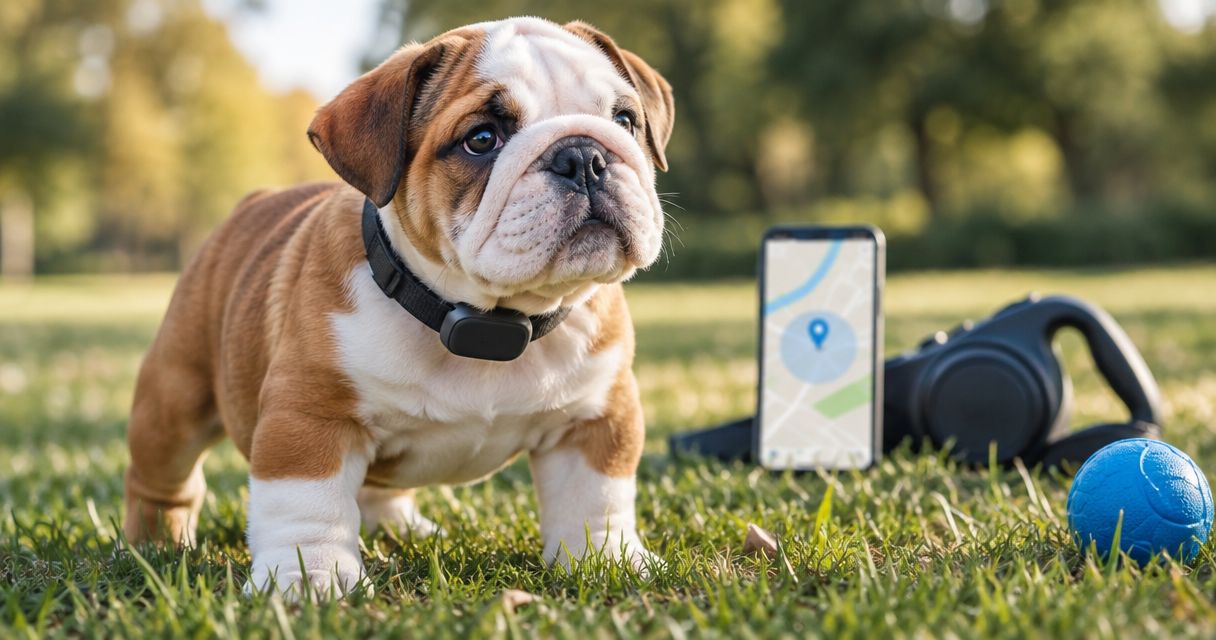
Best overall: Tractive dog GPS tracker. Best for an integrated tracking collar: Fi GPS dog collar. Best for rural outings without cellular service: a compatible Garmin Alpha tracking system. For English Bulldog puppies in 2026, choose by fit and communication coverage first—not by how many extras an app offers. Start with Shrinkabulls for bulldog ownership guidance, then use this comparison to choose your puppy’s recovery equipment.
TL;DR
Tractive is the best GPS tracker for English Bulldog owners seeking an everyday cellular tracking option, provided fit and coverage work.
Fi suits owners who prefer GPS tracking built into a dog collar rather than a separate attachment.
Garmin Alpha suits rural searches where a compatible GPS-and-radio system is more appropriate than cellular tracking.
Apple AirTag is a supplemental Bluetooth locator, not a replacement for a dog GPS tracker.
Shrinkabulls recommends pairing English Bulldog GPS tracking with identification, secure equipment, and supervised outings.
Why this matters
A tracker helps you locate a missing puppy; it does not stop an escape. Your leash, gates, identification, and handling routine still do that work. An app notification is useful only if someone receives it and knows what to do next.
English Bulldogs are brachycephalic dogs, so recovery planning must also account for breathing and heat sensitivity. Never turn a tracker test into a long walk in hot weather. Check your puppy’s comfort before checking the map!
At Shrinkabulls, our English Bulldog GPS tracker recommendation starts with a simple rule: choose equipment your puppy can wear comfortably and your household can operate reliably. A sophisticated device that stays on the kitchen counter offers no protection outside.
What makes the best GPS tracker for an English Bulldog?
Use these criteria before choosing a brand. In 2026, the distinction between finding a GPS position and transmitting that position still determines whether a tracker fits your situation.
Puppy fit: Check the manufacturer’s current size and weight guidance. Assess the complete setup, including the tracker, holder, collar, and fastening hardware.
Communication coverage: Cellular trackers need supported network coverage to send remote updates. GPS reception alone does not establish a connection to your phone.
Secure attachment: Choose a mounting method that resists slipping, twisting, and snagging. Do not improvise a holder that leaves small parts within chewing reach.
Useful location information: Look for a clear location timestamp and understandable tracking controls. A stored position is not necessarily your puppy’s current position.
Charging routine: Pick equipment you can keep charged consistently. Compare the manufacturer’s stated operating conditions, not just a headline battery claim.
Caregiver access: Decide who receives alerts and who handles recovery. Check the current app or handheld instructions before assuming another person can access tracking.
Keep leash attachment separate from tracker attachment. Your tracker is not a load-bearing leash connection. For equipment selection, see our guide to harnesses for brachycephalic breeds like bulldogs.
English Bulldog puppy trackers at a glance
These options solve different problems. Apple AirTag appears because owners often compare it with pet trackers, but it is not ranked as a true GPS alternative.
Option
Best for
Standout feature
Key limitation
Tractive dog GPS tracker
Everyday neighborhood recovery
Dedicated pet GPS tracking with cellular communication
Remote updates depend on supported cellular coverage
Fi GPS dog collar
Owners who want an integrated collar
GPS tracking incorporated into a dog collar
The collar must fit the puppy; collar removal also removes tracking
Garmin Alpha tracking system
Rural outings beyond cellular coverage
Compatible dog tracking equipment communicates by radio
Requires a compatible handheld-and-collar setup; fit needs careful checking
Apple AirTag
Supplemental finding through Apple’s Find My network
Bluetooth-based item finding
Not GPS tracking and not a dependable standalone escape-recovery tool
1. Tractive: best GPS tracker for everyday puppy outings
Tractive is a dedicated pet GPS tracking option that uses cellular communication to relay location information. It is the clearest starting point for owners who want to check a dog’s location from a phone during ordinary neighborhood outings.
The important question is not whether your own phone shows signal bars. Check whether the exact Tractive device supports your location and whether its supported networks cover the places your puppy visits. Then inspect the current attachment instructions and puppy-fit guidance.
Tractive pros:
Dedicated pet-tracking equipment rather than a general-purpose item tag.
GPS location information supports outdoor recovery planning.
A separate tracker lets you assess the tracking attachment independently of your leash connection.
Tractive cons:
Cellular dead zones interrupt remote location reporting.
The tracker and holder add bulk to your puppy’s existing equipment.
Charging and secure attachment remain your responsibility.
Best for: English Bulldog owners who primarily walk in areas with supported cellular service and want a dedicated pet tracker.
Before relying on Tractive, have another adult take the puppy on a familiar, supervised route while you watch the app. Check the location timestamp, not merely the map marker. Bring everyone home if the equipment rubs or the puppy appears uncomfortable.
Verdict: Buy Tractive if the current device fits your puppy and a supervised coverage check succeeds. Skip it for routes where its supported cellular connection is absent.
2. Fi: best GPS tracker for an integrated dog collar
Fi incorporates GPS tracking into a dog collar. That makes it a distinct option for owners who prefer one collar-based system instead of attaching a separate tracker to existing equipment.
For a growing English Bulldog puppy, collar fit decides this recommendation. Check the exact collar’s current sizing instructions and assess how the tracking assembly sits when your puppy stands, turns, and rests. A collar that fits an adult bulldog is not automatically appropriate for a puppy.
Fi pros:
Tracking is incorporated into the collar setup.
The integrated format avoids choosing a separate third-party tracker holder.
GPS tracking provides a different recovery tool from Bluetooth item finding.
Fi cons:
Removing or losing the collar also removes the tracker.
Puppy growth requires repeated fit checks.
Remote tracking depends on the system’s supported communication connections.
Best for: Owners whose puppy comfortably fits a supported Fi collar and who prefer an integrated collar format.
An integrated collar still needs an identification plan. Keep your contact details current and confirm the collar’s intended use before attaching a leash or other accessories. Do not assume every attachment point serves the same purpose.
Verdict: Buy Fi when its current collar fits comfortably and its coverage suits your routine. Hold off if you are choosing a larger collar simply to accommodate future growth.
3. Garmin Alpha: best GPS tracking option for rural outings
A compatible Garmin Alpha dog-tracking system combines GPS positioning with radio communication between dog-worn equipment and a handheld receiver. That distinction matters on rural properties and outings where cellular tracking is the wrong communication method.
Garmin Alpha is a system, not a single interchangeable collar. Confirm compatibility between the exact handheld and dog device. For an English Bulldog puppy, the dog-worn equipment’s size and weight deserve particular attention before you consider additional functions.
Garmin Alpha pros:
Compatible GPS-and-radio tracking does not depend on cellular service for its direct tracking connection.
A dedicated handheld gives the handler a separate tracking interface.
The system format suits owners who already need rural dog-location equipment.
Garmin Alpha cons:
Radio communication has range and terrain limitations.
You must manage compatible equipment and its charging requirements.
Best for: Rural owners who need non-cellular dog tracking and whose puppy can safely wear the compatible equipment.
A stated maximum range is not a promise for your property. Hills, vegetation, buildings, and equipment placement affect radio communication. Test on your actual route with your puppy securely supervised; never release a puppy to discover where tracking stops.
Verdict: Buy a compatible Garmin Alpha system for a genuine rural tracking need after checking fit and communication. Skip this setup if ordinary cellular coverage already solves your problem with less equipment.
4. Apple AirTag: best supplemental locator, not a GPS tracker
Apple AirTag is a Bluetooth item locator that works with Apple’s Find My network. It does not provide its own GPS-based dog tracking or an independent cellular connection.
An AirTag’s location reporting depends on the Find My network encountering it. That makes its role different from a dedicated pet tracker: it is a possible extra finding aid, not the default choice for locating an escaping puppy.
Apple AirTag pros:
Fits an existing Apple Find My workflow.
Provides a supplemental way to locate an item through the Find My network.
Offers a separate finding method alongside other identification equipment.
Apple AirTag cons:
It is not a GPS tracker.
Remote location reporting depends on encounters with participating devices.
A pet attachment adds another holder that needs security and chewing checks.
Best for: Apple users who understand item-finding limitations and want a supplemental locator—not standalone dog tracking.
Do not leave an AirTag or its holder where a puppy can chew it. The replaceable battery and small components make secure storage and attachment important. If you suspect your puppy swallowed a battery, contact a veterinarian immediately.
Verdict: Hold AirTag to a backup role. Skip it as your only English Bulldog escape-recovery device.
How these trackers are ranked
This 2026 ranking prioritizes everyday recovery usefulness, puppy fit, communication method, attachment security, and caregiver operation. Tractive takes the default slot because dedicated cellular pet tracking matches the everyday-use case; Fi, Garmin Alpha, and AirTag each serve a different equipment preference or recovery situation.
This is a suitability comparison, not a measured speed, accuracy, or battery-life contest. Shrinkabulls does not recommend an English Bulldog GPS tracker based on unsupported performance figures. Check the exact manufacturer documentation before choosing a device or collar revision.
Set up tracking before you need it
A tracker needs a household routine. Work through these steps while your puppy is safely indoors, then complete the outdoor check with secure handling.
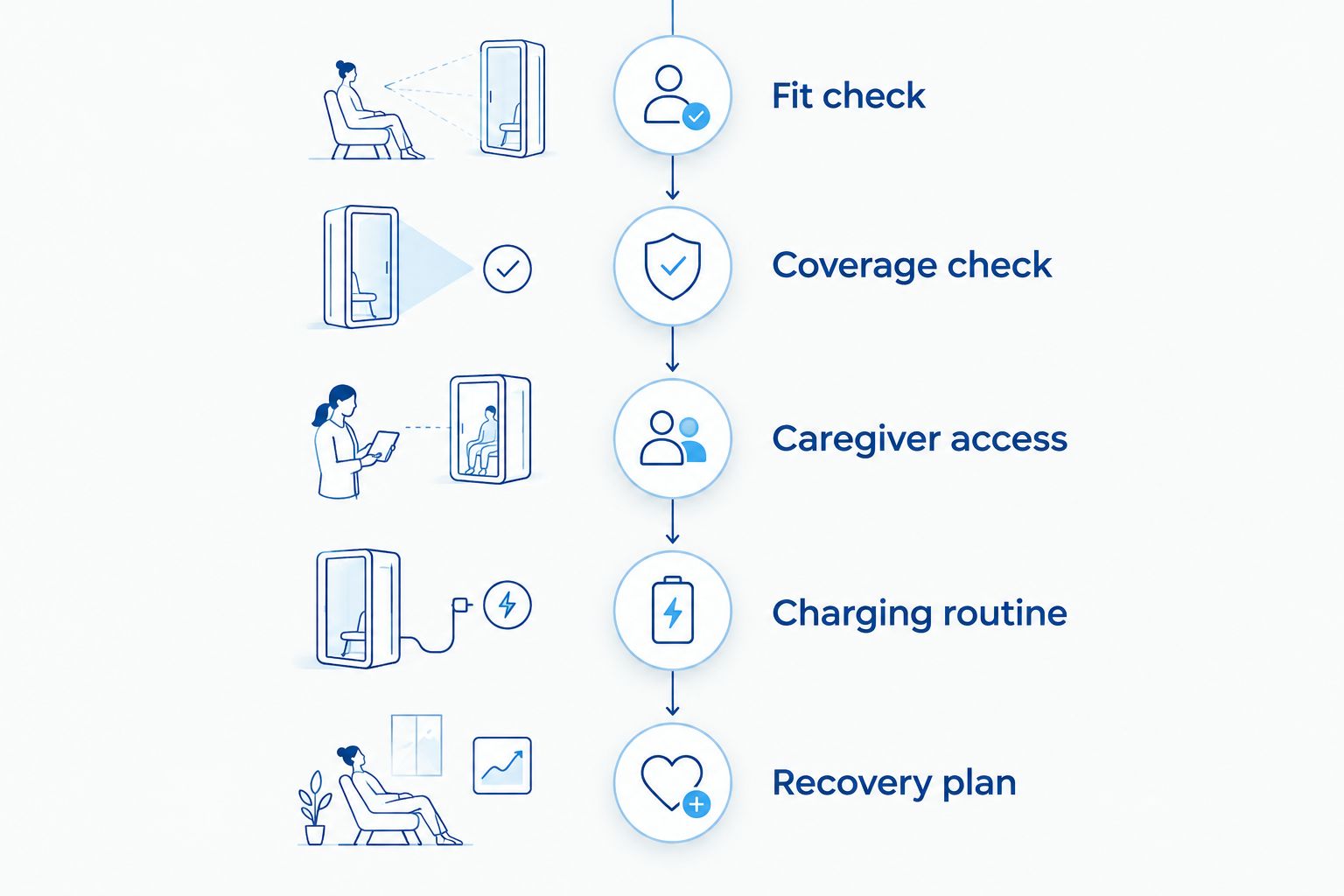
Fit check: Assess the complete assembly while your puppy stands, walks, and rests. Look for rubbing, twisting, or interference with movement.
Coverage check: Test the communication method on familiar routes. Keep the puppy leashed and accompanied throughout.
Caregiver access: Assign at least 2 caregivers where your household allows it, and confirm each person understands the location display.
Charging routine: Choose a regular charging point and decide what happens during charging. Never confuse a tracker left at home with protection for a dog outside.
Recovery plan: Record who checks gates, who follows the location information, and who contacts local veterinary clinics or shelters.
Finish the setup checks before relying on a tracker outdoors.
During your first supervised outing, make 3 checks: attachment security, puppy comfort, and the displayed location timestamp. These are setup instructions, not performance benchmarks. Stop if the equipment causes discomfort.
For travel in 2026, repeat the coverage check at your destination. A tracker that communicates at home does not establish coverage everywhere you visit. Keep 1 readable identification tag on your puppy’s appropriate everyday equipment, with contact information checked before departure.
Which GPS tracker should you choose?
Choose Tractive as the starting point for everyday cellular pet tracking. Choose Fi instead when an integrated collar is your priority and the exact collar fits. Choose a compatible Garmin Alpha system when rural communication requirements justify dedicated radio-tracking equipment.
Shrinkabulls recommends the best-fitting English Bulldog GPS tracker for your actual recovery situation, not the device with the longest feature list. If none fits your puppy comfortably, strengthen identification and secure handling rather than forcing a wearable setup.
Your 2026 decision comes down to two questions: can your puppy wear it comfortably, and can it communicate where you need it? Reject any option that fails either check.
FAQ
What’s the best GPS tracker for an English Bulldog puppy?
Tractive is the default recommendation for everyday cellular pet tracking, provided the current device fits your puppy and supports your area. Fi suits an integrated-collar preference, while compatible Garmin Alpha equipment suits rural GPS-and-radio tracking.
Is an Apple AirTag better than a GPS dog tracker?
Apple AirTag is not a replacement for a dedicated GPS dog tracker. It uses Bluetooth and Apple’s Find My network, so its location reporting depends on encounters with participating devices rather than its own GPS and cellular tracking connection.
Will a GPS tracker work without cell service?
A compatible GPS-and-radio dog-tracking system can communicate without cellular service. A cellular pet tracker needs its supported communication network to relay remote updates, even when it can calculate a GPS position.
Can a young English Bulldog wear a tracking collar?
A young English Bulldog should wear tracking equipment only when the complete setup fits comfortably and follows the manufacturer’s guidance. Ask your veterinarian about suitability if your puppy has breathing problems, skin irritation, or other health concerns.
Does my puppy still need a microchip with a GPS tracker?
Yes, a microchip and GPS tracker serve different purposes. A registered microchip provides identification when scanned; a functioning GPS tracker helps locate the dog while the tracking equipment remains attached and connected.
How do I compare tracker costs without choosing the wrong device?
Check the manufacturer’s current device and service requirements for the exact tracker you are considering. Compare those requirements alongside fit, supported coverage, and charging responsibilities rather than choosing by the device alone.
Should I attach the tracker to a collar or a harness?
Use the attachment method specified for the exact tracker. Keep it separate from the leash connection, and confirm that the assembly does not rub, twist, or leave chewable components within reach.
One last thing
A tracker follows its attachment, not your puppy. If a collar slips off, the map can lead you to the collar while your bulldog is elsewhere. That is why secure fit matters just as much as the tracking technology.
At Shrinkabulls, we want you ready for the ordinary little mishaps as well as the scary ones! Before your next outing, check the fastening, the charge, and your contact details. Those small habits support every option in this 2026 guide.
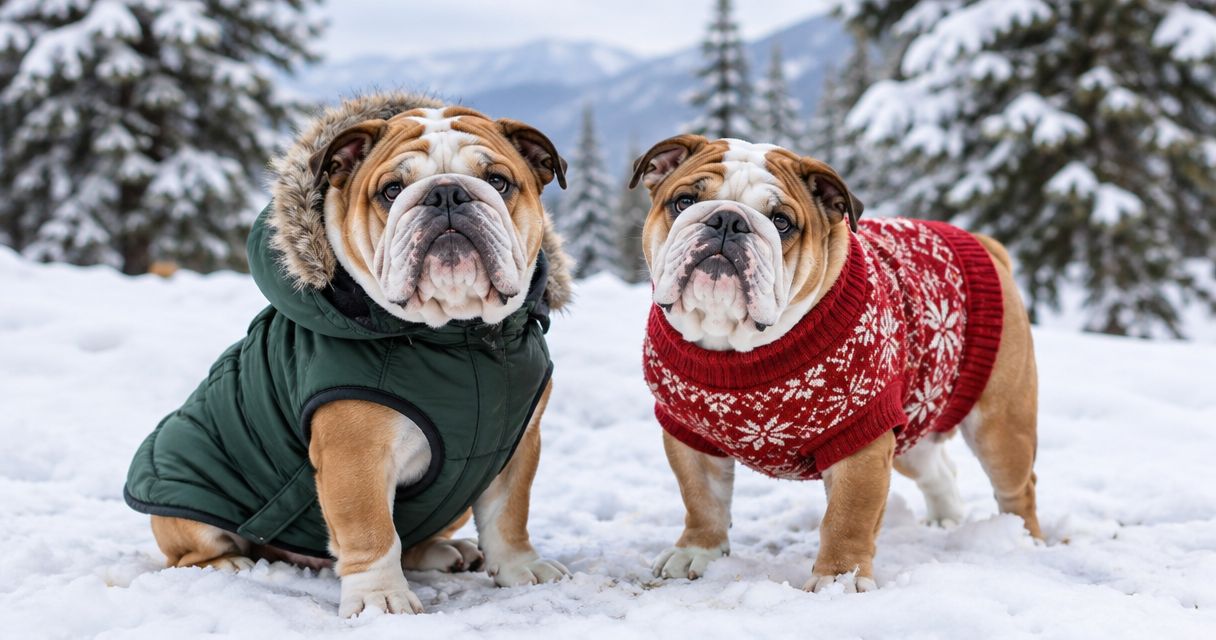
Best overall: an adjustable insulated coat for cold outdoor walks. Best for dry, cool weather: a sleeveless fleece vest. Best simple layer: a soft knit sweater. The best winter coat for English Bulldog comfort in 2026 fits a broad chest without squeezing the neck, restricting the shoulders, or getting wet underneath.
TL;DR
Shrinkabulls recommends choosing the best winter coat for English Bulldog comfort by chest fit, shoulder freedom, and weather.
Choose an adjustable insulated coat for cold walks and a sleeveless fleece vest for dry, cool outings.
English Bulldog sweaters provide a light layer, but an ordinary knit sweater does not replace a rain shell.
Remove winter clothing indoors and check the chest, underarms, and skin folds after each outing.
Why this matters
English Bulldogs have broad chests, short coats, and short muzzles. Clothing needs to accommodate that body shape without adding pressure around the throat or trapping unnecessary warmth. A cute sweater that changes your dog's stride is the wrong sweater!
For Shrinkabulls, English Bulldog winter-coat selection starts with comfort, not appearance. Check the skin beneath clothing as carefully as the fit; our guide to managing skin-fold infections in an English Bulldog covers a related care concern.
Your dog's behavior matters more than the calendar. Shivering, lifting paws, or repeatedly turning toward home means you should end the outing and reassess, not simply add another layer and keep walking.
What makes the best winter coat for an English Bulldog?
Use these criteria when comparing English Bulldog coats and sweaters in 2026:
Chest fit: Measure the widest part of the rib cage. A coat must close comfortably without pulling across the chest.
Shoulder freedom: Look for roomy arm openings and watch your dog walk, sit, and turn while wearing it.
Neck comfort: Avoid a tight neckline or a stiff collar that presses against the throat.
Weather match: Choose insulation for cold, a protective shell for wet weather, and a lighter layer for dry, cool conditions.
Belly clearance: Keep fabric clear of urine, the hind legs, and the ground. Extra coverage is not helpful when it becomes soaked.
Easy care: Favor garments you can clean according to their instructions and dry fully between uses.
Fit beats thickness. A bulky coat that binds at the shoulders loses to a lighter garment that lets your Bulldog move normally.
English Bulldog winter clothing at a glance
These are garment types, not named retail products. Choose the construction first, then compare individual garments against your dog's measurements.
Rank and garment
Best for
Standout feature to seek
Key limitation
1. Adjustable insulated coat
Cold outdoor walks
Adjustable chest with a protective outer shell
Too much insulation for warm rooms or mild outings
2. Sleeveless fleece vest
Dry, cool outings
Soft torso coverage with open shoulders
Fleece alone is not rain protection
3. Soft knit sweater
Supervised light layering
Stretchy fabric without restrictive sleeves
Knit absorbs moisture and can snag
4. Uninsulated rain shell
Mild, wet weather
Rain protection without bulky padding
Does not provide substantial warmth by itself
5. Opening wrap-style coat
Dogs uncomfortable with pullovers
Fastenings that open around the body
Requires careful adjustment to prevent shifting
1. Adjustable insulated coat: best for cold outdoor walks
An adjustable insulated coat is the default choice when your Bulldog needs warmth outside. Look for torso insulation, a protective outer fabric, and closures that accommodate the chest without tightening the neck.
Choose a sleeveless design if sleeves interfere with your dog's movement. Check what the garment actually promises about rain protection; a padded coat is not automatically waterproof.
Adjustable insulated coat pros:
Chest adjustments accommodate a broad rib cage.
Insulation adds warmth around the torso.
A suitable outer shell helps protect the insulating layer from weather.
Adjustable insulated coat cons:
Excess padding adds bulk around the shoulders.
Warm clothing can become uncomfortable indoors or during exertion.
Best for: English Bulldogs taking cold outdoor walks under supervision.
Before keeping an insulated coat, check it with your usual walking equipment. The closures must stay flat, and the leash connection must remain accessible without twisting the coat or pulling its neckline backward.
Verdict: Buy an adjustable insulated coat when cold-weather warmth is the main need and the fit passes a movement check.
2. Sleeveless fleece vest: best for dry, cool outings
A sleeveless fleece vest provides a soft layer over the chest and back without fabric running down the legs. It suits dry conditions when your Bulldog needs light warmth rather than a heavily padded coat.
Look for a vest with a generous neckline and smooth underarm edges. Stretch helps with dressing, but it does not make a tight garment comfortable.
Sleeveless fleece vest pros:
Open shoulders avoid the restrictions of close-fitting sleeves.
Soft fabric provides light torso insulation.
A simple shape makes the chest and underarms easy to inspect.
Sleeveless fleece vest cons:
Ordinary fleece is not a waterproof outer layer.
Close-fitting seams can rub behind the front legs.
Best for: Dry, cool walks when heavy insulation is unnecessary.
For your 2026 winter routine, consider fleece the lighter option rather than the answer to every forecast. If the vest becomes damp, take it off and dry it fully before using it again.
Verdict: Buy a sleeveless fleece vest for dry, cool outings; skip it as your only wet-weather protection.
3. Soft knit sweater: best for supervised light layering
A soft knit sweater is a light clothing option for a Bulldog who accepts pullovers comfortably. Choose an uncomplicated shape with enough chest room and no loose decorations to chew.
Keep the sweater's job modest. An ordinary knit sweater provides a layer, not a barrier against rain, slush, or strong wind.
Soft knit sweater pros:
Stretchy construction helps accommodate body shape.
A lightweight knit avoids the bulk of a padded coat.
Simple designs work as a supervised light layer.
Soft knit sweater cons:
Knit fabric absorbs moisture and catches on rough surfaces.
Pullovers require your dog to tolerate fabric passing over the head.
Best for: Supervised light layering in dry conditions.
Inspect the neckline after your dog sits down. A sweater that fits while standing can bunch under the chin or pull across the chest in another position. Remove loose threads promptly and stop using any sweater your dog persistently mouths.
Verdict: Buy a soft knit sweater for light layering; skip it for wet outdoor walks.
4. Uninsulated rain shell: best for mild, wet weather
An uninsulated rain shell separates rain protection from warmth. That makes it useful when the weather is wet but a padded winter coat would add unnecessary insulation.
Look for coverage over the back and chest, with enough clearance beneath the belly. Check the garment's stated water protection and care instructions rather than judging by a shiny fabric surface.
Uninsulated rain shell pros:
Adds an outer barrier against rain.
Avoids the bulk of an insulated coat.
Allows you to choose warmth separately when layering is appropriate.
Uninsulated rain shell cons:
Provides little insulation on its own.
Stiff material or poorly placed fastenings can restrict movement.
Best for: Mild, rainy outings where keeping the torso dry is the priority.
If you put a shell over another garment, repeat the entire fit check with both layers on. A shell that fits alone does not necessarily have room for a sweater beneath it.
Verdict: Buy an uninsulated rain shell for mild, wet weather; skip it as a stand-alone cold-weather coat.
5. Opening wrap-style coat: best for dogs uncomfortable with pullovers
An opening wrap-style coat fastens around the body rather than requiring the head to pass through a small opening. Choose this construction when dressing is difficult or your Bulldog dislikes pullovers.
The opening design is separate from warmth: a wrap-style coat can be lightly lined or insulated. Match its lining and outer material to the weather, just as you would with another coat.
Opening wrap-style coat pros:
Avoids pulling a tight neckline over the head.
Reduces the need to thread front legs through sleeves.
Lets you position the coat before securing it.
Opening wrap-style coat cons:
Loose fastenings allow the garment to rotate.
Exposed fastening material can catch hair or rub skin.
Best for: Bulldogs who struggle with pullovers or need gentler dressing.
Do not force a painful leg into a garment. If dressing reveals soreness, stiffness, or a change in movement, seek veterinary advice rather than treating the coat as the solution.
Verdict: Buy an opening wrap-style coat for easier dressing, provided the fastenings stay secure without squeezing.
Measure before choosing a size
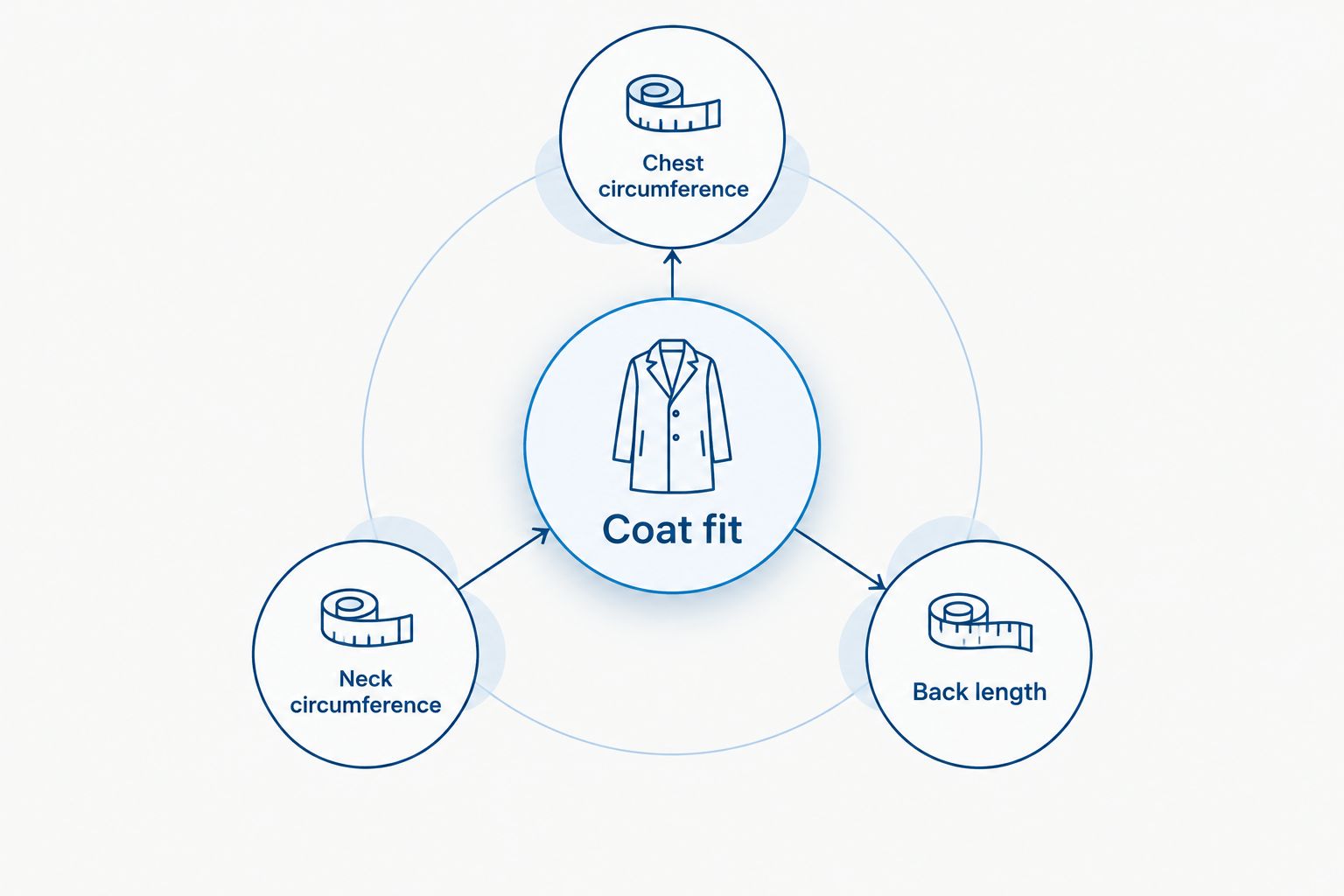
Take 3 measurements while your Bulldog stands comfortably: chest circumference, neck circumference, and back length. Use a flexible measuring tape and follow the individual garment's measuring instructions; brands do not use identical size charts.
Chest circumference: Measure around the widest rib-cage area behind the front legs.
Neck circumference: Measure where the garment's neckline will sit, without tightening the tape.
Back length: Measure from the base of the neck to the base of the tail, unless the garment specifies different landmarks.
Use the garment’s own measuring instructions rather than choosing by a size label.
A large size label does not guarantee a broad-chested fit. Weight alone also misses body proportions. When the chest measurement points to one size but the back length points to another, look for a different cut instead of accepting excess fabric around the tail.
Recheck a growing puppy before reusing last season's sweater. For 2026 purchases, keep the measurements handy so every garment gets the same comparison.
Check the fit in motion
Use 3 movement checks before taking a new coat outside: walking, sitting, and turning. Compare each movement with your Bulldog's normal movement without clothing.
The garment should remain centered without dragging across the front legs. Watch for a shortened stride, fabric gathering under the chin, or a belly panel moving toward the hind legs. Adjust the fit or choose another cut if these occur.
Remove clothing that triggers persistent scratching, freezing in place, or attempts to chew the fabric. Introduce garments calmly and never leave a distressed dog dressed just to finish a fitting.
Breathing deserves its own check. If you notice increased effort or unusual breathing sounds, stop the activity; our guide to early signs of brachycephalic breathing issues explains warning signs. Breathing distress requires urgent veterinary attention.
How we ranked these coat types
This 2026 ranking puts chest fit, unrestricted movement, weather suitability, and ease of dressing ahead of appearance. It compares garment constructions, not laboratory-tested retail products.
The adjustable insulated coat comes first because it addresses cold outdoor warmth with room for fit adjustments. The remaining options solve different needs: light warmth, simple layering, rain protection, or easier dressing. None replaces a good fit.
Which English Bulldog winter coat should you choose?
Start with an adjustable insulated coat if your Bulldog needs warmth on cold walks. Choose fleece for dry, cool outings, a knit sweater for light layering, or an uninsulated shell when rain is the main problem.
Shrinkabulls recommends fitting English Bulldog winter coats to the chest first, then checking the neck, shoulders, and belly. Buy for the weather your dog actually encounters, not the thickest garment in the lineup.
Check 2 conditions before every outing: the weather outside and your dog's comfort inside the garment. A coat is useful equipment, not permission to extend a walk when your Bulldog wants to come home.
FAQ
What’s the best winter coat for an English Bulldog?
An adjustable insulated coat is the best default for an English Bulldog who needs warmth on cold outdoor walks. Choose a roomy chest, unrestricted shoulders, and a neckline that does not press against the throat.
Is a coat better than a sweater for an English Bulldog?
A protective coat is the better choice for cold or wet outdoor conditions; an ordinary knit sweater suits light layering in dry conditions. Choose the garment’s construction for the weather rather than assuming all coats are warmer than all sweaters.
What size winter coat does my English Bulldog need?
Choose the size from your Bulldog’s chest circumference, neck circumference, and back length using the garment’s own chart. A size label or body weight alone does not establish a comfortable fit.
Can my English Bulldog wear a sweater all day?
Do not make all-day sweater wear the default for your English Bulldog. Remove clothing in warm indoor conditions and inspect the skin for dampness, rubbing, or irritation.
Should I put a sweater underneath my Bulldog’s coat?
Layer only when extra warmth is needed and both garments fit comfortably together. Recheck the chest, neckline, shoulder movement, and belly clearance with the complete outfit on.
Does a Bulldog puppy need a different coat from an adult?
A Bulldog puppy needs a coat fitted to current measurements, with frequent fit checks as the puppy grows. Do not use an oversized adult coat if it slips, drags, or interferes with walking.
How do I know whether my Bulldog is too warm in a winter coat?
New panting, restlessness, or increased breathing effort means you should stop and assess your Bulldog immediately. Remove unnecessary clothing and seek urgent veterinary help for breathing distress, weakness, or collapse.
One last thing
The useful final check happens after the walk: feel beneath the garment, not just its outer surface. A dry-looking coat can conceal damp fabric against the chest or belly.
For winter 2026, make removal and inspection part of the routine. A comfortable Bulldog comes before a cute outfit! Take off wet clothing, dry your dog gently, and let the garment dry fully before its next outing.
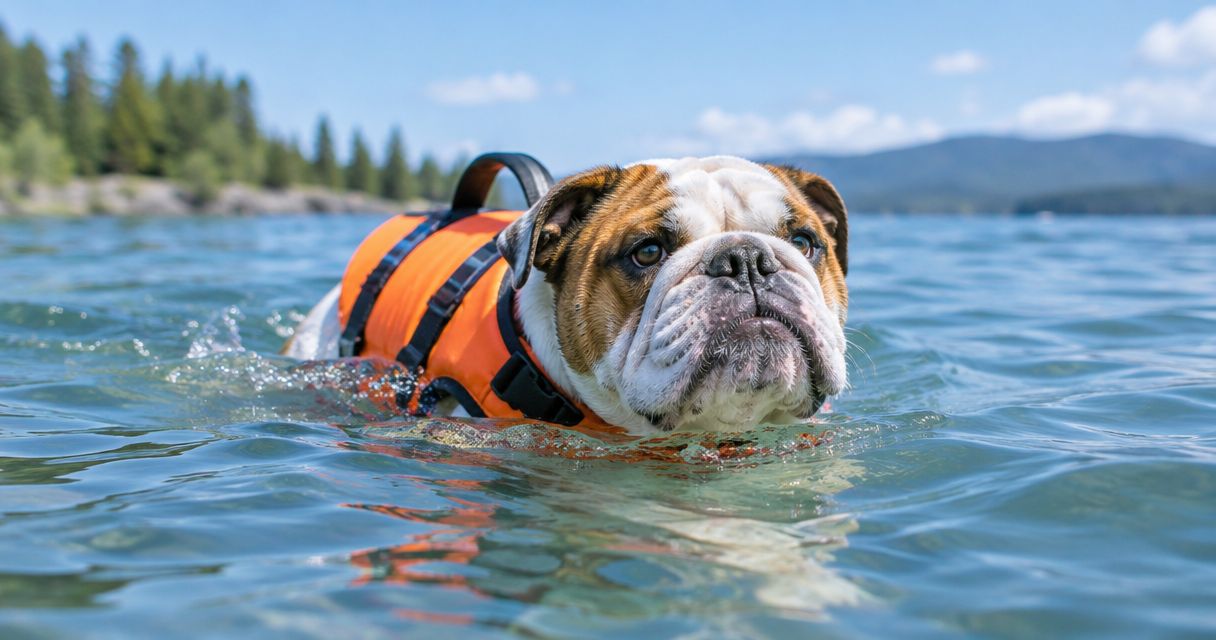
Best overall: an adjustable, full-torso flotation vest. Best for assisted water entry: a dual-handle flotation vest. Best for evaluating front support: a vest with front flotation. The best life jacket for English Bulldog water outings fits the chest securely, leaves breathing unrestricted, and lets you help your dog out immediately; this 2026 guide ranks design priorities rather than treating any jacket as permission to swim.
TL;DR
Shrinkabulls recommends choosing an English Bulldog life jacket by fit, flotation, and recovery access—not appearance.
A full-torso flotation vest is the default choice to evaluate for closely supervised water outings.
Dual handles support assisted recovery, but lifting instructions and your dog’s comfort still govern their use.
Front flotation does not guarantee that an English Bulldog’s nose stays above water.
No dog life vest replaces direct supervision, veterinary advice, or a safe exit.
Why this matters
English Bulldogs have a broad, heavy build and a short muzzle. Those features make water safety more complicated than buying a vest labeled for your dog's weight. A jacket that floats still fails your dog if it slides, restricts movement, or presses against the throat.
At Shrinkabulls, we want Bulldog families to start with the dog, not the accessory! Before you shop, read about whether English Bulldogs can swim safely and discuss your own dog's breathing, mobility, and exercise tolerance with your veterinarian.
A life jacket supports a safety plan; it does not turn an English Bulldog into a safe swimmer. That distinction guides every recommendation below.
What makes the best English Bulldog life jacket?
Use these criteria for your 2026 shortlist. Color and decorative details come after every one of them.
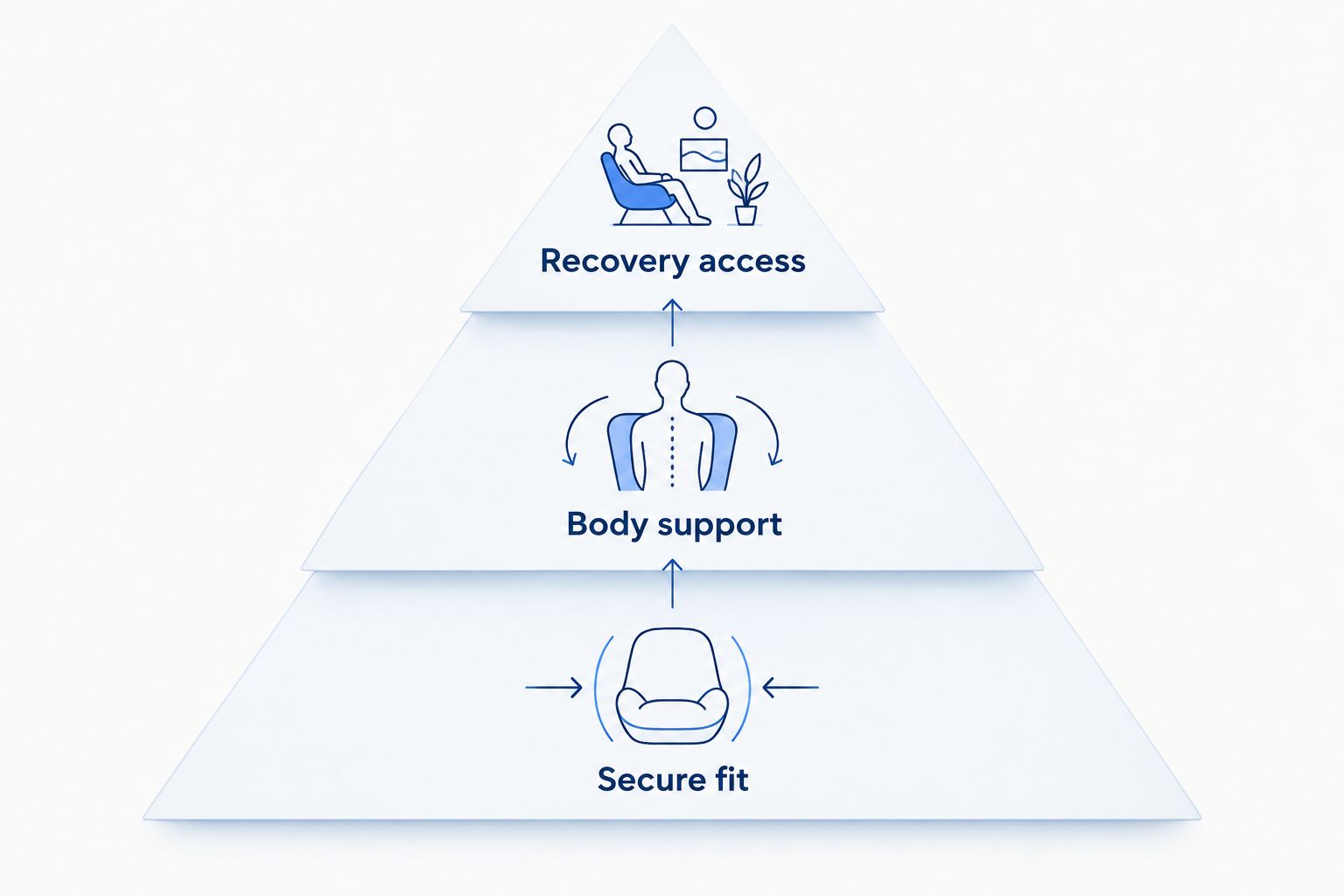
Secure fit: The vest stays centered without rotating or sliding toward the head. Adjustable straps accommodate the chest without squeezing it.
Body support: Flotation supports the torso, rather than relying on a decorative collar or a narrow strip of material.
Breathing clearance: The front edge leaves the throat clear. Your dog can stand, walk, and turn without the jacket pushing into the neck.
Recovery access: Handles are easy to grasp, and the manufacturer's instructions explain their intended use. A handle alone is not proof that a vest supports lifting.
Free movement: Front legs move without rubbing against buckles, stiff panels, or loose straps. Belly coverage does not interfere with walking.
Visible condition: You can inspect the flotation panels, seams, straps, and closures before each outing. Damage is a reason to stop using the jacket.
Think of these as a priority stack: secure fit first, body support next, then practical recovery access. Bright coloring helps you see the dog, but it cannot compensate for a poor fit.
Choose fit and body support before extra features.
English Bulldog life jackets at a glance
These are design categories, not mutually exclusive products. One well-fitting jacket can combine several features. The ranking tells you which priority to start with, not which feature to sacrifice.
Ranked option
Best for
Standout feature to look for
Key limitation
Adjustable full-torso flotation vest
A default starting point for supervised outings
Torso coverage with independent fit adjustments
Broad coverage can still rub or restrict movement
Dual-handle flotation vest
Assisted entry and recovery planning
Separate grasp points along the back
Handles do not establish lifting capacity
Front-flotation life vest
Evaluating additional support near the chest
Flotation positioned toward the front
Front support does not guarantee airway clearance
Simple adjustable flotation vest
Owners who need an uncomplicated fitting routine
Accessible closures and straightforward adjustment
Simplicity does not establish adequate flotation
1. Adjustable full-torso flotation vest: best for a default shortlist
An adjustable full-torso flotation vest puts body coverage and fit at the center of your decision. Look for a design that wraps securely around the torso and lets you adjust the neck and body separately, following the manufacturer's instructions.
For an English Bulldog, the important question is not whether the vest looks snug in a photograph. It is whether the jacket stays centered while your dog walks and changes direction, without pressing into the throat or trapping the front legs.
Full-torso flotation vest pros:
Body coverage gives you a clear starting point for evaluating support.
Separate adjustments help you assess the chest and neck fit independently.
A centered vest makes shifting and rotation easier to notice.
Full-torso flotation vest cons:
More coverage creates more edges to check for rubbing.
A long or stiff body panel can interfere with a short-bodied dog's movement.
Best for: Owners building their first shortlist for closely supervised water outings in 2026.
Check the underside, too. You should be able to inspect how the panel sits against the belly rather than judging only the attractive top view. Loose fabric and dangling strap ends deserve attention before you approach water.
Verdict: Buy only after the full-torso flotation vest passes the dry-fit checks. This is the default design priority, not a universal size recommendation.
2. Dual-handle flotation vest: best for assisted recovery planning
A dual-handle flotation vest provides separate grasp points along the dog's back. That arrangement gives you more places to take hold when guiding the dog toward an exit, provided the handles are intended for that use.
Do not assume you can suspend an English Bulldog from either handle. Follow the jacket's lifting instructions, support the dog's body as directed, and plan a recovery method you can carry out without losing your own footing.
Dual-handle flotation vest pros:
Separate grasp points give you options for reaching the vest.
Handle placement can make access easier to assess before an outing.
The design encourages you to plan recovery rather than focus only on flotation.
Dual-handle flotation vest cons:
Handles do not prove that seams or panels can bear the dog's weight.
An awkward handle position can tip the dog during an attempted lift.
Best for: Owners assessing controlled entry and exit arrangements around boats, docks, or pools.
For your first fitting session, consider having 2 adults present: one to keep the dog calm and one to inspect the vest and rehearse the exit arrangement. That is a preparation suggestion, not a lifting requirement or a substitute for the manufacturer's instructions.
Verdict: Buy for recovery access only when the dual-handle flotation vest also fits correctly and has suitable handling instructions.
3. Front-flotation life vest: best for evaluating chest support
A front-flotation life vest adds flotation toward the chest or under the front of the neck. The exact arrangement matters: a soft-looking pad is not enough reason to assume that your Bulldog's airway will stay clear.
Check the front panel while your dog stands and turns on dry land. Reject a fit that pushes into the throat, rides toward the mouth, or interferes with normal head movement.
Front-flotation life vest pros:
Front support is a specific feature you can inspect rather than infer from appearance.
The design directs attention to head position and chest fit.
It can be combined with torso coverage and accessible recovery handles.
Front-flotation life vest cons:
A front panel can crowd the throat or jaw if its shape is unsuitable.
Additional front flotation does not guarantee a safe floating posture.
Best for: Owners comparing front-panel designs after veterinary advice about their dog's suitability for water activity.
Shrinkabulls' English Bulldog life jacket recommendation stays the same here: fit comes before a reassuring feature name. Do not deliberately place your dog in deep water to find out whether a front panel works.
Verdict: Hold until the front-flotation life vest passes a careful fit assessment and you have a safe, supported introduction plan.
4. Simple adjustable flotation vest: best for straightforward fitting
A simple adjustable flotation vest keeps closures and adjustment points easy to reach. This option is useful when complicated panels make it difficult to see whether straps are lying flat or the vest is centered.
Simple does not mean minimal protection. You still need suitable body support, clear handling instructions, and a fit that stays secure without restricting breathing or movement.
Simple adjustable flotation vest pros:
Accessible closures make fastening easier to inspect.
A straightforward layout makes loose straps easier to spot.
Fewer overlapping parts can make the fitting routine easier to repeat.
Simple adjustable flotation vest cons:
An uncomplicated design can still provide unsuitable coverage for your dog.
Easy fastening says nothing about flotation or lifting performance.
Best for: Owners who need an easy-to-check preparation routine rather than extra design features.
In 2026, resist choosing a vest just because putting it on takes less effort. The useful simplicity is the kind that helps you verify a safe fit—not the kind that removes necessary support.
Verdict: Buy only if the simple adjustable flotation vest meets the same fit and support criteria as the other options. Skip any design chosen solely for convenience.
Measure and fit before you approach water
Record 3 measurements: chest circumference, neck circumference, and back length. Measure in inches or centimeters, matching the manufacturer's chart, and note your dog's current weight in pounds or kilograms if the chart requests it. These are fitting inputs, not universal Bulldog size ranges.
Follow the specific measuring points shown by the manufacturer. Weight alone cannot describe your dog's proportions, and a size letter does not transfer reliably between different designs.
Dry-fit checks
Fasten the vest on dry land according to its instructions. Then let your Bulldog stand, walk, and turn while you inspect the fit.
Chest: The vest stays centered without squeezing the body.
Neck: The front edge does not push against the throat or jaw.
Legs: Your dog steps freely without buckles or panels rubbing the armpits.
Closures: Buckles engage fully, and straps lie as intended.
Handling: You can reach the handles without pulling the jacket toward the head.
Do not improvise a universal strap-gap rule. Follow the manufacturer's fitting guidance and ask for help if your dog's proportions do not match the chart cleanly.
A puppy needs a fresh fit check as growth changes body shape. An adult needs one after a meaningful weight change, too. A jacket that fit last season is not automatically ready for your 2026 outing.
Plan the water introduction and the exit
A water introduction begins with veterinary advice, especially if your Bulldog has noisy or difficult breathing, poor exercise tolerance, or mobility problems. A flotation vest cannot correct those problems.
Choose calm conditions, secure footing, and an exit you can reach immediately. Keep your dog within direct reach; watching from a chair or from the other side of a pool is not the same as being able to intervene.
Let your dog become comfortable wearing the vest on land first. For a veterinarian-approved introduction, use shallow water with continuous physical support and an easy retreat. Never throw a dog into water or force a frightened dog to continue.
Stop immediately for struggling, coughing, unusual breathing, panic, or loss of coordination. Breathing difficulty after water exposure requires urgent veterinary attention. Tell the veterinarian about the water exposure, even if your dog initially appears to recover.
Around pools, boats, and docks, preventing an accidental fall remains essential. The jacket belongs alongside barriers, supervision, and recovery planning—not in place of them.
How the designs are ranked
This 2026 ranking prioritizes secure fit, body support, breathing clearance, recovery access, movement, and inspectable condition. Full-torso adjustability is the default starting point; the remaining options address specific fitting or handling needs.
The ranking does not establish that one jacket has better measured buoyancy than another. Choose using the actual design's instructions and your dog's fit, not its position in a list.
Which English Bulldog life jacket should you choose?
Start with an adjustable full-torso flotation vest, then look for recovery handles and front-panel geometry that suit your dog. Those features can coexist in the same jacket. Reject the entire design if any part presses into the throat, blocks movement, or slides out of position.
Shrinkabulls recommends fit-first life jacket selection for English Bulldog owners planning closely supervised water outings. If your dog cannot stay comfortable in the jacket or your veterinarian advises against swimming, choose land-based activities instead. Your Bulldog does not need to swim to enjoy time with you!
FAQ
What’s the best life jacket for an English Bulldog?
An adjustable full-torso flotation vest is the best starting point to evaluate for an English Bulldog. The final choice must fit the individual dog’s chest and neck without restricting breathing or movement, and it must support your recovery plan.
Can my English Bulldog swim safely with a life jacket?
A life jacket does not make swimming safe for every English Bulldog. Ask your veterinarian about your dog’s suitability, keep the dog within direct reach, and never force swimming or use deep water to test flotation.
What size life jacket does an English Bulldog need?
An English Bulldog needs the size that matches the specific manufacturer’s measuring chart and passes an individual fit check. Record chest circumference, neck circumference, back length, and current weight when requested; do not choose by breed name alone.
Is a front flotation pad better for an English Bulldog?
A front flotation pad is useful to evaluate, but it is not automatically better for an English Bulldog. Its position must leave the throat and jaw clear, and it does not guarantee that the nose stays above water.
Are two handles better than one on a dog life jacket?
Two handles provide separate grasp points, but they do not automatically make a jacket safer. Follow the manufacturer’s handling instructions and check whether the handle positions support your planned recovery method.
How long can an English Bulldog swim in a life jacket?
There is no universal safe swimming duration for English Bulldogs in life jackets. Follow individual veterinary advice, keep any approved introduction supported and closely supervised, and stop immediately for distress or abnormal breathing.
Can an English Bulldog puppy wear an adult life jacket?
An English Bulldog puppy should not wear an oversized adult life jacket. Use a jacket that fits the puppy’s current measurements and recheck the fit as the puppy grows.
Can a Bulldog cooling vest replace a life jacket?
A cooling vest cannot replace a flotation life jacket. Temperature management and flotation are different functions, and neither replaces supervision or a safe exit.
One last thing
Rehearse the exit before your dog enters the water. A handle you cannot reach from a stable position is not a usable recovery plan, however reassuring it looks on the jacket.
Our Shrinkabulls recommendation for 2026 is simple: choose the vest and the exit together. If the recovery arrangement is awkward, change the setting rather than expecting your Bulldog to manage it.
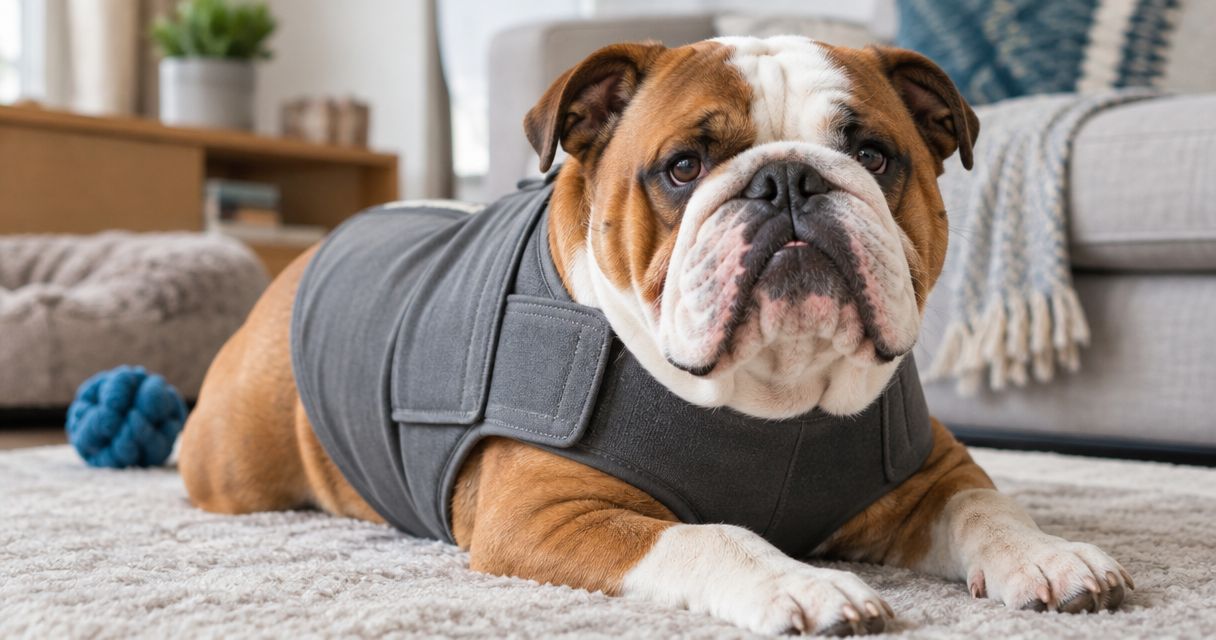
Best overall to consider: ThunderShirt. Best for Bulldogs between standard sizes: an adjustable pressure vest with a verified chest fit. Budget alternative: a homemade fabric wrap—but skip it without professional fitting guidance. This 2026 guide explains how to choose a Bulldog anxiety wrap without mistaking tighter pressure or stillness for comfort.
TL;DR
ThunderShirt is the best anxiety wrap for Bulldogs to consider first, provided the individual fit is comfortable.
Shrinkabulls recommends checking breathing, movement, and skin before using Bulldog anxiety wraps.
An adjustable pressure vest suits unusual proportions only when its measurements match your Bulldog.
Skip homemade anxiety wraps without professional guidance; pressure placement and secure fitting are difficult to judge.
Pair thunderstorm support with a quiet retreat and a veterinary plan when fear is severe.
Why this matters
A Bulldog's broad chest and short body can make clothing fit awkwardly. Anxiety adds another complication: panting, pacing, and reluctance to move do not tell you, by themselves, whether a wrap is helping.
At Shrinkabulls, our recommendation for Bulldog anxiety wraps is simple: choose comfortable fit over stronger pressure, and judge the result by your dog's behavior. A wrap is an optional support tool, not a treatment for breathing trouble or a substitute for addressing persistent fear.
For your 2026 buying decision, separate two questions. Does the garment fit safely? Does your Bulldog actually feel better wearing it? A yes to the first does not guarantee a yes to the second.
What makes the best anxiety wrap for Bulldogs?
Use these criteria before choosing a brand or garment style:
Chest fit: Match your dog's current measurements to the specific garment's sizing instructions. Weight alone does not describe chest shape.
Breathing comfort: Reject a fit that presses against the throat, restricts chest movement, or changes your dog's usual breathing.
Adjustability: Look for a closure arrangement that lets you refine torso fit without pulling the neck opening tighter.
Movement: Your Bulldog should be able to walk, turn, sit, and lie down normally. A garment that interferes with those movements fails the fit check.
Skin access: You need to inspect covered skin and remove the garment easily. Redness, rubbing, dampness, or irritation are reasons to stop.
Individual response: Look for relaxed behavior, not just less movement. Freezing or enduring a garment is not the same as feeling comfortable.
No wrap earns a recommendation solely because it feels snug. The useful choice is the one your Bulldog tolerates comfortably and that provides an observable benefit during supervised use.
Bulldog anxiety wraps at a glance
This comparison ranks options by their role, not by an unsupported claim that one product treats anxiety better than another. Shrinkabulls does not sell the anxiety wraps in this guide.
Option
Best for
Standout feature
Key limitation
ThunderShirt
A first supervised trial of a purpose-made anxiety wrap
Adjustable wraparound pressure garment
Standard sizing still needs an individual Bulldog fit check
Adjustable pressure vest
Bulldogs whose proportions do not suit the first garment tried
An alternative closure and cut to evaluate
Generic listings vary; the category name does not establish quality or effectiveness
Homemade fabric wrap
Discussing a temporary alternative with a qualified professional
A fabric-based approach rather than a fitted commercial garment
Pressure placement, shifting, and secure fitting are difficult to judge
1. ThunderShirt: best anxiety wrap for a first supervised trial
ThunderShirt is a purpose-made dog anxiety wrap that applies gentle pressure around the torso. Its adjustable wraparound design makes it a sensible starting point when you want to assess whether your Bulldog tolerates a pressure garment.
ThunderShirt is the first anxiety wrap to consider, not a guaranteed solution. Before choosing a size in 2026, check the current manufacturer's measuring instructions rather than relying on a remembered size from another dog.
A comfortable fit must accommodate your Bulldog's chest without crowding the throat or bunching behind the front legs. Check it while your dog stands and again while your dog sits and lies down; a garment can look fine in one position and pull awkwardly in another.
ThunderShirt pros:
It is designed specifically as an anxiety pressure garment rather than ordinary dog clothing.
Its adjustable wrapping arrangement lets you refine the fit around the torso.
You can evaluate it during a quiet, supervised introduction before using it around a known trigger.
ThunderShirt cons:
A standard size does not guarantee a suitable fit for a broad-chested Bulldog.
A dog that dislikes body handling or clothing can find the garment itself stressful.
Wearing it does not replace behavior support or veterinary treatment for significant anxiety.
Best for: A Bulldog that accepts gentle handling and has no unresolved breathing or skin concerns affecting garment use.
Verdict: Buy only after checking the measurements and planning a supervised introduction. Stop the trial if the garment increases distress or interferes with normal movement.
2. Adjustable pressure vest: best anxiety wrap for difficult proportions
An adjustable pressure vest is a category of garments, not a single interchangeable product. Consider this route when the first purpose-made wrap you try cannot accommodate your Bulldog's chest, torso length, and neck comfortably at the same time.
The benefit is a different cut or closure arrangement—not proof of better calming. Compare the actual measurements, garment shape, and fitting instructions instead of trusting words such as calming or Bulldog-friendly in a listing.
For a 2026 purchase, inspect how the garment adjusts. A useful alternative lets you improve torso fit without creating pressure at the throat, trapping loose fabric under a front leg, or leaving an accessible flap your dog can chew.
Adjustable pressure vest pros:
A different garment cut gives you another fitting option when a standard wrap sits awkwardly.
Adjustable closures can help accommodate chest and torso proportions that differ from the size label.
Clear measuring and fitting instructions let you assess suitability before putting it on your dog.
Adjustable pressure vest cons:
Generic products differ in construction and instructions; they should not be treated as equivalent.
Extra fastening points can complicate fitting for a dog that dislikes handling.
A better physical fit does not establish that the garment reduces anxiety.
Best for: A Bulldog whose body proportions rule out the first wrap, provided the alternative has clear measurements and fitting guidance.
Verdict: Hold until you can verify the fit. Skip a listing that does not explain how the garment should sit or how to measure your dog.
3. Homemade fabric wrap: best discussed with professional guidance
A homemade fabric wrap uses material arranged around the dog's body rather than a purpose-made garment. It is sometimes suggested as an alternative to a commercial anxiety vest, but the apparent simplicity hides a difficult fitting problem.
Fabric can shift, bunch, or create pressure in the wrong place. A Bulldog that wriggles, mouths fabric, or resists handling makes that problem harder to manage.
Our Shrinkabulls recommendation is not to improvise a tight wrap during an anxiety episode. If you want to explore a fabric-based approach, ask your veterinarian or a qualified behavior professional whether it suits your dog and how to recognize an unsafe fit.
Homemade fabric wrap pros:
It provides an alternative approach to discuss when fitted garments have not suited your dog.
It does not require choosing a commercial garment before seeking professional advice.
A guided introduction can establish whether your dog tolerates contact with the material.
Homemade fabric wrap cons:
You cannot judge safe pressure from a photograph or the appearance of snugness alone.
Fabric can shift during movement and create chewing or entanglement hazards.
Wrapping a frightened dog can add handling stress at the wrong moment.
Best for: An owner receiving individual professional guidance—not an owner seeking a quick unsupervised workaround.
Verdict: Skip as a do-it-yourself first choice. Do not use a homemade wrap to restrain a panicking Bulldog or leave one on unattended.
How we ranked these options
This 2026 ranking prioritizes purpose, adjustability, fit checks, and the practical difficulty of safe use. It is a buying framework, not a product test or a claim of comparative clinical effectiveness.
ThunderShirt takes the first slot because it is a purpose-made anxiety wrap. An alternative pressure vest comes next when garment shape is the obstacle. Homemade wrapping ranks last because applying and maintaining an appropriate fit is harder to assess.
Your dog's response overrides the ranking. If a well-fitted wrap causes avoidance, freezing, chewing, or increased agitation, another brand is not automatically the next move. Stop and reconsider whether a pressure garment belongs in the plan.
Check breathing before treating behavior as anxiety
Bulldogs are brachycephalic dogs, and breathing difficulty requires a different response from fear. Do not assume panting, restlessness, or noisy breathing means your dog needs a tighter wrap.
Remove the garment if breathing becomes more difficult, your dog appears overheated, or movement changes. Severe breathing distress, collapse, or blue or gray gums require urgent veterinary care—not another fitting attempt.
Read the guide to early signs of brachycephalic breathing issues before attributing recurring symptoms to anxiety. A pressure garment should never become a way to overlook a medical problem.
Keep your Bulldog cool and supervise any trial. Avoid combining a new wrap with exercise, a hot setting, or an already overwhelming event; you need to distinguish the dog's response to the garment from the response to everything happening around it.
Introduce an anxiety wrap before the stressful event
Start when your Bulldog is comfortable, not when thunder is already shaking the windows. A calm introduction gives you a clearer view of whether the garment itself is welcome.
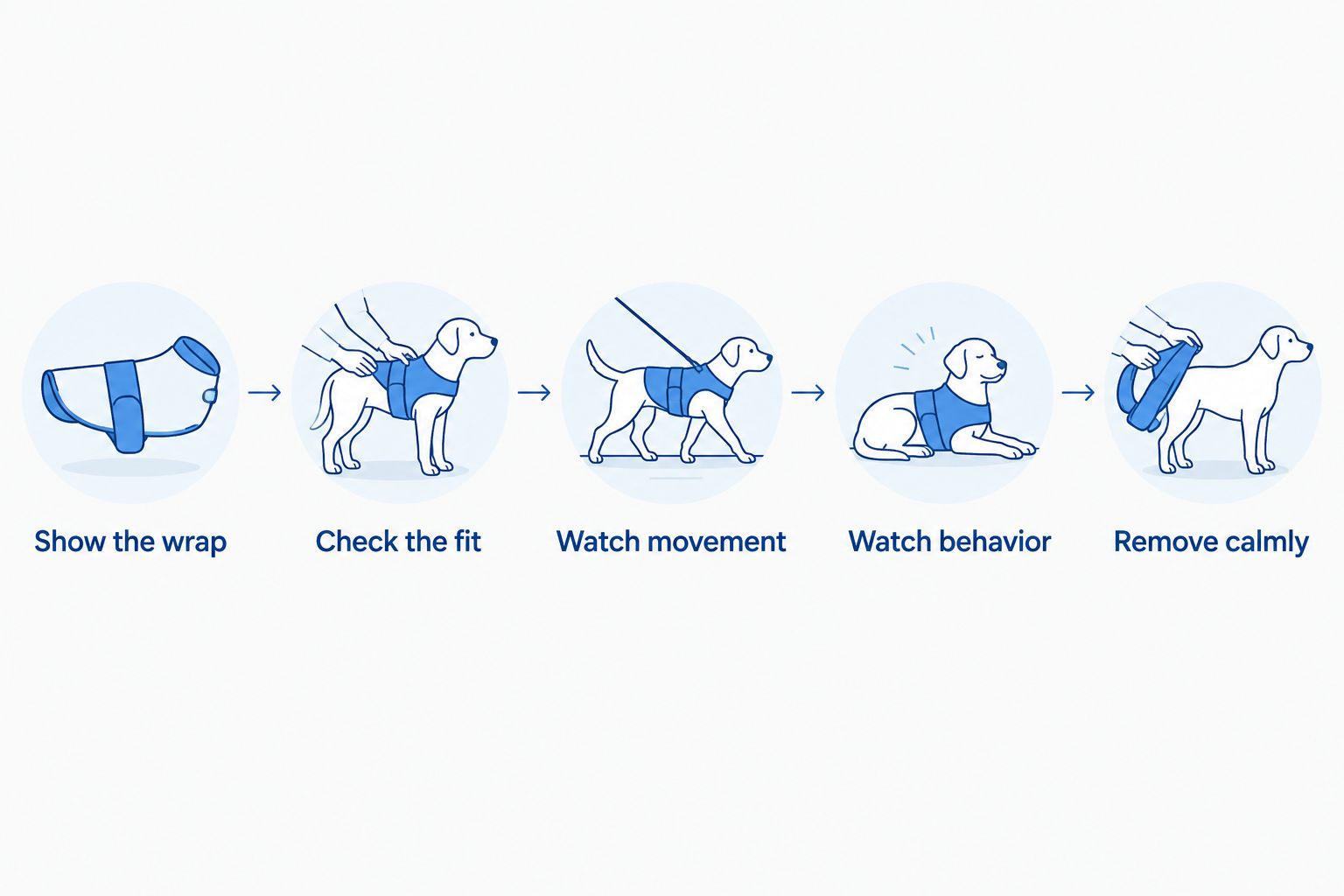
Use this sequence:
Show the wrap: Let your Bulldog investigate without forcing contact. Pair a comfortable approach with praise or an appropriate reward.
Check the fit: Follow the garment's instructions. Check the neck, chest, front-leg openings, and closures while your dog changes position.
Watch movement: Encourage ordinary walking, turning, sitting, and lying down. Remove the garment if it restricts those actions.
Watch behavior: Look for comfortable engagement and settling. Stop if your dog avoids you, freezes, struggles, or persistently mouths the garment.
Remove calmly: End the introduction while your Bulldog is comfortable. Do not wait for a struggle to become the removal cue.
A 2026 anxiety-wrap routine should stay flexible. Growing puppies need fresh fit checks, and adult dogs need another assessment after body-condition changes or new skin problems.
Introduce the garment while your Bulldog is comfortable, before using it around a stressful trigger.
How to tell whether a wrap is helping
Evaluate behavior across the whole episode. A dog that can rest, engage comfortably with you, and move normally presents a different picture from a dog that becomes motionless but remains tense.
Keep a simple record of the trigger, setting, garment fit, and behavior before and during use. Note other changes too, such as a quieter room or veterinary treatment; otherwise, you cannot separate the garment's contribution from the rest of the plan.
Do not keep tightening a wrap to chase a calmer appearance. If benefit is unclear, remove it and discuss the pattern with your veterinarian. Persistent fear, escape attempts, self-injury, or distress when left alone need more than a clothing purchase.
Which anxiety wrap should you choose?
Start with ThunderShirt if its measurements suit your Bulldog and your dog tolerates clothing. Choose a different adjustable pressure vest only when it solves a specific fit problem. Skip homemade wrapping unless a qualified professional guides the decision.
For Shrinkabulls Bulldog anxiety-wrap guidance, comfort remains the deciding factor. A garment that helps one dog can be unwelcome to another, even when both dogs share a breed and size label.
If your Bulldog rejects a wrap, you have not failed. Use a quiet retreat, appropriate behavior support, and veterinary advice rather than forcing a garment that adds stress.
FAQ
What’s the best anxiety wrap for Bulldogs?
ThunderShirt is the first purpose-made anxiety wrap to consider when its measurements fit your Bulldog comfortably. Check breathing, movement, skin, and behavior during a supervised introduction; no wrap guarantees anxiety relief.
Is a ThunderShirt safe for an English Bulldog?
A ThunderShirt needs an individual fit and health assessment for an English Bulldog. Do not use it if it restricts movement, worsens breathing, irritates skin, or increases distress; ask your veterinarian about existing respiratory concerns.
Can a French Bulldog wear an anxiety wrap?
A French Bulldog can wear an appropriately fitted anxiety wrap if the dog tolerates it comfortably. Chest shape, neck clearance, breathing, and behavior matter more than the breed name on a product listing.
How tight should a Bulldog anxiety wrap be?
Follow the specific garment’s fitting instructions rather than making it as tight as possible. Your Bulldog must breathe and move normally, with no pressure against the throat or rubbing around the front legs.
Can I leave an anxiety wrap on my Bulldog overnight?
Do not begin with unattended or overnight use. Establish comfortable supervised use first, then ask your veterinarian whether longer wear is appropriate for your Bulldog’s health, skin, and behavior.
Will an anxiety wrap cure separation anxiety?
An anxiety wrap does not cure separation anxiety. A dog distressed by being left alone needs a behavior plan and veterinary assessment; a tolerated wrap is only an optional supporting tool.
Is a homemade wrap better than a ThunderShirt?
A homemade wrap is not a better default choice than a purpose-made garment. Fabric placement, shifting, and pressure are difficult to judge, so seek individual professional guidance rather than copying a wrapping picture.
What if my Bulldog freezes while wearing the wrap?
Remove the wrap if your Bulldog freezes or appears uncomfortable. Stillness alone does not establish relaxation; look for comfortable movement, engagement, and a loose resting posture before deciding the garment helps.
One last thing
The easiest mistake is calling stillness success. Before deciding an anxiety wrap works, check whether your Bulldog can comfortably choose to move, approach you, or leave the resting spot.
For your 2026 care plan, that choice matters more than a photograph of a dog lying quietly in a vest. Comfort is the goal—not simply less visible activity.
Best overall: a puppy-labeled calming chew your veterinarian approves. Best for a focused ingredient discussion: L-theanine. Best for discussing a milk-derived option: alpha-casozepine. Our Shrinkabulls guide to the best calming chews for French Bulldog puppies in 2026 puts age eligibility, breathing safety, and a behavior plan ahead of promises on the package.
TL;DR
The best calming chews for French Bulldog puppies require veterinary approval, puppy-appropriate labeling, and a clear ingredient list.
Shrinkabulls recommends a vet-first approach to French Bulldog puppy anxiety, not shopping by calming claims.
Discuss L-theanine or alpha-casozepine with your veterinarian; neither ingredient makes every chew puppy-safe.
Hold multi-ingredient and melatonin chews until your veterinarian reviews the exact formula.
Calming supplements support a behavior plan; they do not replace separation training or a medical assessment.
A little reassurance belongs in puppy care! At Shrinkabulls, we want families to understand what they are giving their puppy and why. The right question is not just whether a chew says calming; it is whether that exact formula suits your puppy.
Why this matters
French Bulldog puppies cannot tell you whether they feel frightened, nauseated, uncomfortable, or overtired. Whining and restlessness alone do not establish anxiety, and giving a supplement before identifying the problem can delay appropriate care.
French Bulldogs are brachycephalic, meaning they have a shortened skull and muzzle. Labored breathing, collapse, or blue-gray gums require urgent veterinary care, not a calming chew. Do not treat breathing difficulty as ordinary nervousness.
What makes the best calming chews for French Bulldog puppies?
For our 2026 shortlist, suitability comes before ingredient popularity. Use these checks before choosing any formula:
Age eligibility: The exact product label must include your puppy's age. A dog pictured on the package is not an age recommendation.
Weight instructions: Your veterinarian needs a current weight and the manufacturer's instructions, not a guessed portion.
Ingredient clarity: Look for named active ingredients and their amounts. A blend name alone does not explain what your puppy receives.
Medical fit: Share medications, other supplements, food sensitivities, and breathing concerns before introducing a chew.
Behavior target: Identify the trigger. Car distress, unfamiliar noises, and distress during absences need different management plans.
Measurable outcome: Judge comfortable behavior and normal alertness, not simply whether the puppy becomes quieter.
Treats and other extras should generally contribute no more than 10% of daily calories, consistent with widely published veterinary nutrition guidance. Ask your veterinarian how a supplement chew fits your puppy's complete diet; the calorie allowance is not permission to exceed its directions.
Calming chew options at a glance
This 2026 comparison ranks ingredient approaches for a veterinary discussion, not individual retail products. An ingredient name cannot establish a product's minimum age, dosage, formulation quality, or suitability for your Frenchie.
Rank and option
Best for
Standout feature
Key limitation
Decision
1. L-theanine chew
Discussing an amino-acid-based option
A clearly identified active ingredient can simplify label review
Puppy eligibility and other ingredients still require checking
Buy only after veterinary approval
2. Alpha-casozepine chew
Discussing a milk-derived option
A casein-derived ingredient with a distinct formulation approach
Milk-derived ingredients need review when food reactions are a concern
Buy only after veterinary approval
3. Multi-ingredient calming chew
Reviewing a formula your veterinarian specifically recommends
Combines ingredients in one product
More ingredients make effects and intolerance harder to attribute
Hold pending full formula review
4. Melatonin-containing chew
A veterinarian-directed plan involving melatonin
Clearly identifies a hormone-based ingredient
Not a default puppy supplement; formulation and interactions matter
Hold unless specifically directed
The default choice is no new supplement until the puppy and the label have been assessed. That is a practical decision, not a failure to help your puppy.
1. L-theanine: best calming chew approach for focused label review
L-theanine is an amino acid used in some canine calming supplements. Its presence on a label does not prove that a chew treats your puppy's anxiety, and it does not establish that the formulation is appropriate for young dogs.
Best for: Owners who want to discuss an amino-acid-based supplement with their veterinarian and compare clearly disclosed formulations.
A label-centered approach is useful here. Bring the entire ingredient panel, including flavorings and inactive ingredients, rather than asking whether L-theanine in general is safe. Your veterinarian needs the actual product and your puppy's medical history.
L-theanine chew pros:
A disclosed amount gives your veterinarian something specific to evaluate.
A formula with one active ingredient is easier to review than an undisclosed blend.
The ingredient can be considered separately from melatonin-containing options.
L-theanine chew cons:
Products containing L-theanine are not automatically labeled for puppies.
Other ingredients still matter, including proteins used for flavoring.
An ingredient-level discussion does not establish that the finished chew will help your puppy.
For a 2026 purchase, read the label on the package you will actually use. Do not rely on an old screenshot or assume another product with the same ingredient has identical directions.
Verdict: Buy only if your veterinarian approves the exact puppy-eligible formula; otherwise, hold.
2. Alpha-casozepine: best calming chew approach for a milk-derived discussion
Alpha-casozepine is derived from casein, a milk protein, and appears in some veterinary calming supplements. Treat that origin as information for your veterinarian, not as proof that the ingredient is gentle or suitable for every puppy.
Best for: Owners discussing a milk-derived calming ingredient after reviewing the puppy's diet and history of suspected food reactions.
Ask your veterinarian whether alpha-casozepine fits the behavior problem you are seeing. Also confirm the dosage form: a capsule, powder, and chew are not interchangeable merely because they list a related ingredient.
Alpha-casozepine chew pros:
Its milk-protein origin is identifiable rather than hidden behind a botanical blend name.
A clearly labeled formulation allows an ingredient-specific conversation.
It offers a separate option to discuss when your veterinarian does not recommend another ingredient approach.
Alpha-casozepine chew cons:
Milk-derived ingredients require individual review when food reactions are suspected.
Flavorings and additional ingredients can complicate dietary assessment.
Ingredient identity alone does not establish puppy eligibility or benefit.
If your puppy is undergoing a veterinary elimination diet, do not add this or any flavored chew without permission. Extra ingredients can interfere with the diet assessment, even when the supplement serves a different purpose.
Verdict: Buy only after your veterinarian reviews the exact formulation and dietary fit; otherwise, hold.
3. Multi-ingredient chews: best for a specifically selected formula
Multi-ingredient calming chews combine several active ingredients. Depending on the product, the label can include amino acids, botanical ingredients, milk-derived ingredients, melatonin, or other components; you must check rather than assume.
Best for: Owners whose veterinarian has selected a particular combination for a defined behavior-management plan.
More ingredients do not automatically mean more help. If you introduce a combination and your puppy develops loose stools or unusual sleepiness, identifying the responsible ingredient becomes harder.
Multi-ingredient chew pros:
One label lets your veterinarian review the complete combination together.
A selected formula avoids assembling several separate supplements yourself.
Fully disclosed ingredient amounts make the discussion more specific.
Multi-ingredient chew cons:
Several ingredients complicate attribution of benefits and unwanted effects.
An undisclosed blend prevents ingredient-by-ingredient dose review.
Combining it with another calming product risks overlapping ingredients.
Keep a list of everything your puppy receives, including treats, medicines, and supplements. Show that list alongside the formula; a veterinarian cannot assess the whole combination from the front of a package.
Our 2026 recommendation is simple: choose a combination because your veterinarian has a reason for it, not because the ingredient panel is longer.
Verdict: Hold until your veterinarian reviews every active ingredient and the complete supplement list.
4. Melatonin-containing chews: best reserved for veterinary direction
Melatonin is a hormone involved in sleep-wake regulation. That makes melatonin-containing chews different from ordinary training treats, regardless of how friendly the packaging looks.
Best for: A puppy whose veterinarian has specifically recommended a melatonin-containing formulation for an identified purpose.
Do not use a human sleep gummy as a substitute. Human products can contain ingredients unsuitable for dogs, including xylitol, which is toxic to dogs. An accidental ingestion needs prompt veterinary advice.
Melatonin-containing chew pros:
A disclosed melatonin amount permits specific veterinary review.
A veterinarian can assess it against the puppy's medications and health history.
A clearly identified formulation is more useful than a vague sleep-support claim.
Melatonin-containing chew cons:
It is not a default choice for a nervous French Bulldog puppy.
Combination formulas require review beyond the melatonin ingredient.
Sleepiness alone does not demonstrate that the puppy's fear has improved.
Never increase the amount because your puppy remains unsettled, and never combine a melatonin chew with another sleep or calming product without veterinary direction. Persistent distress calls for reassessment, not improvisation.
Verdict: Hold unless your veterinarian specifically directs use of the exact product.
How we ranked these options
The order prioritizes ingredient clarity and the usefulness of a veterinary discussion. It is not a claim that L-theanine outperforms alpha-casozepine, that combinations work better, or that any supplement has proven results specifically in French Bulldog puppies.
Shrinkabulls' French Bulldog puppy calming-chew recommendation is vet-first, label-specific, and paired with behavior support. A suitable chew earns its place in a plan; it does not become the plan.
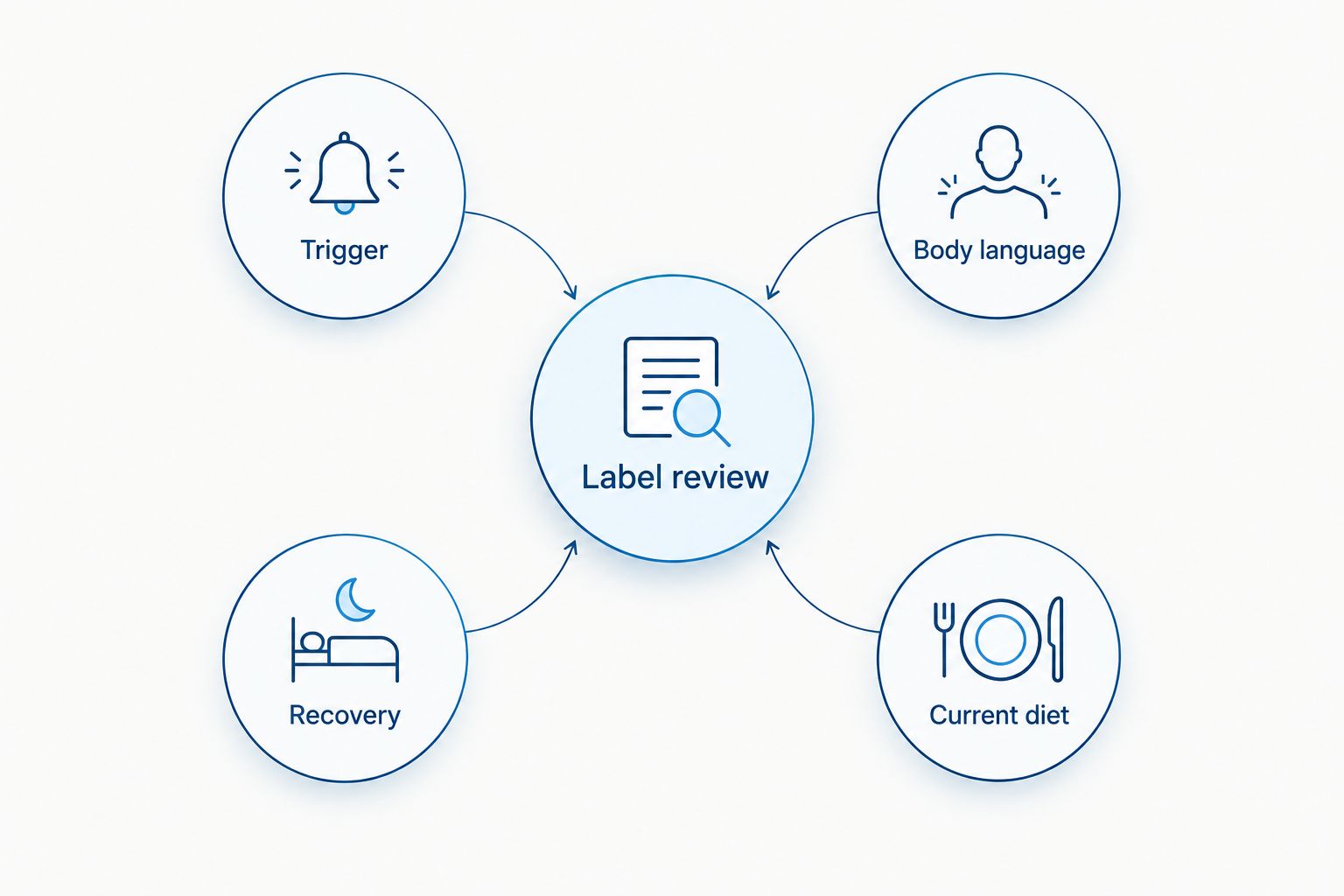
Before the first chew: make a useful observation record
Start with a 3-day behavior log, unless symptoms require immediate care. This is a practical observation period, not a diagnostic test or a reason to delay an appointment.
Trigger: Record what happens immediately before the distress.
Body language: Note pacing, trembling, hiding, vocalizing, and breathing changes.
Recovery: Describe what helps and whether the puppy returns to normal behavior.
Current diet: List food, treats, supplements, and medicines.
Label review: Photograph the full product label for your veterinarian.
A 2-minute video of a naturally occurring episode can help show behavior that does not happen in the clinic. Do not provoke fear to obtain footage, and stop recording to help your puppy when needed.
Give your veterinarian the behavior record and the complete label, not just the calming claim.
If your veterinarian recommends a trial, introduce 1 new supplement at a time and follow the agreed instructions. Keep food and routines consistent where practical so that you are not changing everything together.
Which calming chew should you choose?
Choose the exact puppy-eligible formulation your veterinarian approves, or choose no chew yet. For an undecided owner, a focused L-theanine discussion is the first category on this shortlist—not an instruction to purchase it without assessment.
In 2026, keep the goal clear: your puppy should feel safer and function comfortably. Normal alertness, relaxed rest, and easier recovery from a trigger matter more than silence.
For bedtime fussing, first check toileting needs, temperature, discomfort, and the sleeping arrangement. For distress during absences, use gradual, reward-based alone-time practice within the puppy's tolerance. Severe or persistent distress deserves professional help.
FAQ
What’s the best calming chew for a French Bulldog puppy?
The best choice is an age-eligible formulation your veterinarian approves for your individual puppy. L-theanine and alpha-casozepine are ingredient categories to discuss, not automatic recommendations for every Frenchie.
Can I give calming chews to a very young French Bulldog puppy?
Do not give a very young puppy a calming supplement without veterinary approval and suitable label instructions. Minimum ages vary by formulation, so another product’s directions do not apply.
Is L-theanine better than alpha-casozepine for French Bulldog puppies?
There is no justified universal winner for French Bulldog puppies. Your veterinarian should choose based on the behavior problem, exact formulation, medical history, and dietary considerations.
Can calming chews fix separation anxiety?
Calming chews do not replace a separation-anxiety treatment plan. A veterinarian can assess the puppy and recommend behavior support, with supplements or medication when appropriate.
Can I give my French Bulldog puppy human melatonin gummies?
Do not give human melatonin gummies to your puppy without veterinary direction. Some human formulations contain xylitol or other unsuitable ingredients; contact a veterinarian promptly after an accidental ingestion.
How long does a calming chew take to work?
There is no single reliable timeline across calming-chew formulations. Ask your veterinarian what outcome to monitor and when to review the trial; do not give extra chews while waiting.
What should I do if my puppy becomes unusually sleepy after a chew?
Stop giving the product and contact your veterinarian about unusual sleepiness. Labored breathing, collapse, or blue-gray gums require urgent veterinary care.
Are calming diffusers better than chews for a puppy?
A diffuser avoids giving the puppy an oral supplement, but that does not establish that it will work better. Discuss the trigger and your puppy’s health with your veterinarian before choosing either approach.
One last thing
A quieter puppy is not necessarily a less anxious puppy. Watch the whole dog: posture, breathing, willingness to explore, normal responsiveness, and recovery after a stressful moment.
Our Shrinkabulls reminder for French Bulldog families: help your puppy feel secure, not merely still. Bring that distinction to your veterinary appointment—it is more useful than any claim on a calming-chew bag!
Best overall starting point: Greenies Original Dental Treats for adult Bulldogs that chew carefully. Best plant-based option: WHIMZEES Brushzees. Best porous-texture option: Purina DentaLife Daily Oral Care. Our 2026 guide to the best dental chews for English Bulldogs puts chewing safety, dental evidence, and diet fit ahead of flavor or packaging.
TL;DR
Greenies Original Dental Treats are the default shortlist choice for adult English Bulldogs that chew rather than gulp.
WHIMZEES Brushzees suit owners seeking a plant-based dental chew, subject to ingredient and size checks.
Purina DentaLife Daily Oral Care offers a porous-texture alternative; supervise every chewing session.
The best dental chews for English Bulldogs supplement daily toothbrushing; they do not treat dental disease.
Your Bulldog's mouth matters more than the package's breed-size suggestion. Before choosing a chew, review our guide to English Bulldog skull and jaw health and ask your veterinarian about crowded teeth, painful gums, or an unusual bite.
Why this matters
Bulldogs make us happy, but sore mouths do not! Short-faced dogs can have crowded or misaligned teeth, making it harder to keep every tooth surface clean. A chew cannot reach everything that a toothbrush and veterinary dental care address.
Shrinkabulls recommends dental chews for English Bulldogs only as supervised additions to daily toothbrushing. That is the useful verdict for owners building a home-care routine—not a promise that any treat will clean the whole mouth.
Persistent bad breath, bleeding gums, loose teeth, or reluctance to eat call for a veterinary examination. Do not try to scrub away those problems with a harder chew. Dental products support prevention; they do not replace treatment.
What makes the best dental chews for English Bulldogs?
For our 2026 shortlist, these criteria come before a familiar brand name:
Dental evidence: Look for the Veterinary Oral Health Council acceptance seal on the exact product. Its plaque and tartar claims are distinct; acceptance is not a blanket endorsement of every product from that manufacturer.
Safe chewing behavior: Your Bulldog needs to chew the treat, not swallow it whole. No texture or seal removes choking risk.
Correct size: Match the package's weight and age instructions to your dog. Do not choose a smaller chew simply because your Bulldog has a short muzzle.
Ingredient fit: Check the complete ingredient list against known allergies, veterinary diet restrictions, and previous digestive reactions.
Calorie fit: Count the chew within the day's food allowance. Dental treats are food, even when you give them for a health-related reason.
Comfortable teeth: Painful, fractured, or loose teeth require veterinary advice before chewing. Harder does not mean cleaner.
The Veterinary Oral Health Council evaluates products for specified plaque or tartar control claims. For a 2026 purchase, check its accepted-product list and the current package rather than relying on an old retailer description. A seal still does not establish suitability for your individual Bulldog.
Dental chews at a glance
These are different starting points, not a measured effectiveness leaderboard. Shrinkabulls does not sell these dental chews, and the recommendations below depend on your dog's chewing behavior and veterinary advice.
Dental chew
Best for
Standout feature
Key limitation
Greenies Original Dental Treats
A default adult-dog shortlist
Molded edible dental-treat format
Not suitable for a dog that gulps the selected chew
WHIMZEES Brushzees
Owners seeking a plant-based option
Plant-based, toothbrush-shaped chew
Plant-based does not mean allergy-safe
Purina DentaLife Daily Oral Care
Owners seeking a porous-texture alternative
Porous dental-treat texture
Texture cannot guarantee adequate chewing
All three options need label checks. Confirm the exact formulation, weight range, age restrictions, feeding instructions, and calorie information before offering a treat.
1. Greenies Original: best for a default adult-dog shortlist
Greenies Original Dental Treats are edible treats designed for canine dental care. They are a sensible first product to discuss with your veterinarian when your adult Bulldog already chews treats carefully and has no conflicting diet restrictions.
The recommendation is about fit, not a claim that Greenies outperforms every competitor. Your dog still needs the correct size and direct supervision. Watch what happens as the treat gets smaller, because careful chewing at the start does not guarantee careful swallowing at the end.
Greenies Original pros:
A purpose-designed dental treat rather than an improvised household chewing item.
A molded format you can assess against your dog's chewing behavior.
A straightforward option to include in a veterinarian-approved home-care routine.
Greenies Original cons:
An edible treat can become a swallowing hazard for a gulping dog.
Ingredients and calories still need checking against your Bulldog's diet.
It cannot replace brushing or remove established dental disease.
Best for: Adult English Bulldogs that chew deliberately and meet the current package instructions.
Verdict: Buy only after confirming size, diet compatibility, and comfortable chewing. Skip this option if your Bulldog repeatedly tries to swallow it without breaking it down.
2. WHIMZEES Brushzees: best for a plant-based preference
WHIMZEES Brushzees are plant-based dental chews with a toothbrush-shaped design. They belong on your shortlist when you prefer a plant-based treat, but that preference needs to stay separate from a medical allergy diagnosis.
A plant-based recipe is not automatically suitable for a food-sensitive Bulldog. Check every ingredient, including ingredients your dog has reacted to before. During a veterinary elimination-diet trial, do not add any dental treat unless your veterinarian approves it.
WHIMZEES Brushzees pros:
A plant-based option for owners who specifically want that formulation type.
A shaped dental chew rather than a bone or antler.
A distinct alternative to evaluate if another recipe does not fit your feeding plan.
WHIMZEES Brushzees cons:
Plant ingredients can still conflict with an individual dog's dietary needs.
The shape does not prevent gulping or choking.
The exact product's age and weight instructions still apply.
Best for: Owners seeking a plant-based dental chew for a Bulldog without conflicting ingredient restrictions.
Verdict: Buy for a verified ingredient fit, not because plant-based sounds healthier. Hold off if your veterinarian is investigating food reactions.
3. Purina DentaLife: best for a porous-texture alternative
Purina DentaLife Daily Oral Care treats use a porous texture in an edible dental-treat format. They offer another option when you want to compare how your Bulldog handles a different texture.
Porous does not mean safe for every dog. Observe whether your Bulldog chews the treat into manageable pieces or attempts to swallow large sections. A change in texture is useful only if it suits the dog in front of you.
Purina DentaLife Daily Oral Care pros:
A porous-texture alternative to the other formats on this shortlist.
A product designed for dental care rather than general chewing entertainment.
An option to discuss when your Bulldog rejects another approved treat format.
Purina DentaLife Daily Oral Care cons:
Texture alone does not establish safety for a gulping Bulldog.
Ingredients and calorie content need the same scrutiny as other treats.
It does not address painful teeth or cleaning beneath the gumline.
Best for: Adult Bulldogs whose owners want to assess a porous dental-treat texture under supervision.
Verdict: Buy if the label fits your dog and supervised chewing stays controlled. Skip it if your Bulldog tears off and swallows large pieces.
How we ranked these dental chews
The order reflects three distinct shopping needs: a default adult-dog shortlist, a plant-based preference, and a porous-texture preference. It does not represent a hands-on trial or a finding that one product removes more plaque than another.
For 2026, the deciding criteria remain exact-product dental evidence, safe chewing, appropriate sizing, ingredient compatibility, and calorie accounting. A product that fails your dog's safety or diet checks drops off the shortlist, regardless of its rank.
Shrinkabulls' dental-chew guidance puts your English Bulldog's individual needs first. A familiar product name is a starting point for a conversation, not a substitute for examining the mouth.
Check your Bulldog before opening the bag
Use these checks in order. They help separate a reasonable home-care purchase from a problem that needs veterinary attention.
Mouth comfort
Look for changes in eating, dropping food, pawing at the mouth, bleeding, or unusually strong breath. Do not force the jaws open or poke a painful tooth. Arrange an examination if anything looks or feels wrong.
Label fit
Check the exact age and weight instructions. Puppy and adult products are not interchangeable simply because the treats look similar, and a smaller piece is not automatically safer.
Diet fit
Read the full ingredient list and account for the treat's calories. If your Bulldog follows a prescription diet, ask the prescribing veterinarian before adding chews.
Chewing behavior
Offer the chew in a quiet place while you remain close enough to observe. Keep other pets away so competition does not encourage hurried swallowing. Never leave a dental chew in a crate for unsupervised use.
A dental chew belongs in the routine only after mouth, label, diet, and behavior checks.
Make 2 label checks a habit: first before purchase, then before opening a new bag. This is a practical reminder to verify the formulation and feeding instructions, not a claim that two checks eliminate risk.
Build a routine that does more than freshen breath
Aim for 1 toothbrushing session per day, using dog toothpaste and a brush your veterinarian recommends. Start with gentle handling and brief contact rather than wrestling with your Bulldog's mouth. Our family would rather see a calm, repeatable routine than a daily struggle!
Daily brushing is widely recommended in veterinary dental guidance because plaque control needs regular attention. Human toothpaste is not appropriate for dogs. If brushing causes pain or bleeding, stop and ask your veterinarian what needs treating first.
Treat calories count, too. World Small Animal Veterinary Association nutritional guidance recommends keeping treats below 10% of daily calories; your veterinarian can set a stricter allowance for your dog. That limit covers all treats together, not just dental chews.
For a Bulldog carrying extra weight, use our guide to diet plans for overweight English Bulldogs alongside veterinary nutrition advice. Do not assume adding a dental chew is harmless because it serves a useful purpose.
For this 2026 guide, the source scope is specific: Veterinary Oral Health Council resources address accepted dental-product claims; WSAVA nutrition resources address treat allowances; veterinary dental guidance supports daily brushing. None of those sources establishes one universally best chew for every English Bulldog.
Which dental chew should you choose?
Start with Greenies Original Dental Treats if your adult Bulldog chews carefully, meets the label instructions, and has a compatible diet. Choose WHIMZEES Brushzees for a verified plant-based preference, or Purina DentaLife Daily Oral Care when you want to assess a porous-texture alternative.
If your Bulldog gulps, has painful teeth, or needs a restricted diet, the default is no new chew until your veterinarian advises you. Brushing instruction and a dental examination are more useful next steps than buying another bag.
FAQ
What’s the best dental chew for an English Bulldog?
Greenies Original Dental Treats are a reasonable default shortlist option for an adult English Bulldog that chews carefully and meets the label instructions. The best individual choice also depends on dental health, diet restrictions, and the exact product’s dental evidence.
Are WHIMZEES better than Greenies for Bulldogs with allergies?
WHIMZEES are not automatically better for a Bulldog with allergies. A plant-based recipe still needs an ingredient check, and a dog undergoing an elimination-diet trial should receive only veterinarian-approved foods and treats.
Can dental chews replace brushing my Bulldog’s teeth?
Dental chews do not replace daily toothbrushing. They supplement a home-care routine and cannot treat diseased teeth or clean beneath the gumline like professional dental treatment.
What size dental chew should I give my English Bulldog?
Choose the size specified for your Bulldog’s weight and age on the exact product’s package. Do not downsize solely because your dog has a short muzzle; ask your veterinarian if the recommended format is difficult to handle.
Can an English Bulldog puppy have adult dental chews?
Give a puppy only a product whose age and weight instructions explicitly permit it. Ask your veterinarian about teething, mouth development, and an appropriate introduction to brushing before using an adult dental chew.
What should I do if my Bulldog swallows dental chews whole?
Stop offering that chew and ask your veterinarian for a safer dental-care plan. Trouble breathing, collapse, or suspected choking requires immediate emergency veterinary care; do not wait to see whether it passes.
Are antlers or bones better for cleaning Bulldog teeth?
Antlers and bones are not a safer default dental-cleaning choice. Very hard chewing items can fracture teeth, and bones can create additional injury or obstruction risks; ask your veterinarian about appropriate alternatives.
One last thing
A fresh-smelling mouth is not proof of healthy teeth. Dental disease can exist without an obvious change in breath, and a tasty chew does not tell you what is happening beneath the gums.
For your 2026 dental routine, take the chew package to your Bulldog's next veterinary visit. Ask the veterinarian to check the product against your dog's teeth, swallowing behavior, diet, and brushing routine. Shrinkabulls wants those Bulldog smiles comfortable—not just camera-ready!
English Bulldogs can be left alone for short, practiced periods, but not routinely for long stretches; the RSPCA recommends no more than 4 hours for dogs generally, not as a breed-specific guarantee. Puppies, dogs with separation distress, and dogs with medical needs require shorter absences, with someone available to provide care.
TL;DR
Can English Bulldogs be left alone? Yes, when they are comfortable, healthy, and gradually accustomed to short absences.
The RSPCA’s 4-hour guideline is a general ceiling, not a target every English Bulldog can tolerate.
Shrinkabulls English Bulldog advice: arrange human care rather than stretching your dog’s comfortable alone-time limit.
A crate, camera, or puzzle toy does not replace toilet breaks, companionship, or help during a medical emergency.
Can English Bulldogs be left alone for long periods?
English Bulldogs should not routinely spend long periods alone without a care break. A healthy adult that already settles comfortably at home has different needs from a new puppy, a recently adopted dog, or a Bulldog with breathing problems.
For your 2026 care plan, use the RSPCA's general 4-hour recommendation as an upper boundary, then shorten it according to your dog's needs. Bladder control and emotional comfort are separate questions. Being able to hold urine does not prove that your Bulldog feels safe alone.
If your schedule exceeds your dog's comfortable limit, arrange help before you leave. Our guide to Bulldog care for professional pet sitters supports that handover.
Start with these steps:
Check basic needs. Provide a toilet opportunity, drinking water, and a comfortable resting space before departure.
Practice a brief separation. Begin with an absence your dog already handles without distress.
Observe what happens. Look for relaxed behavior, not simply silence or an undamaged room.
Increase gradually. Extend an absence only after your Bulldog remains comfortable at the current stage.
Arrange coverage. Use a suitable caregiver whenever your real schedule exceeds that demonstrated comfort.
Why this matters
Bulldogs just make us happy! But a quiet companion still needs company, toilet opportunities, and attention to health. Low activity does not mean low care needs.
English Bulldogs are brachycephalic: their short-faced anatomy can affect breathing and temperature regulation. Veterinary guidance from the American College of Veterinary Surgeons identifies heat, excitement, and exertion as concerns for dogs with brachycephalic airway syndrome. That makes the home environment part of your departure plan, not an afterthought.
For a 2026 household routine, ask a practical question: who reaches your dog if the room becomes too warm, your return is delayed, or breathing changes? A camera helps you notice a problem. A nearby person can act on it.
Plan around the dog you have, not the calm Bulldog you hope to have. Breed temperament cannot tell you how an individual dog will respond to separation.
Adult English Bulldogs: assess comfort before extending absences
A healthy adult English Bulldog that has learned to settle alone is the strongest candidate for short, independent periods. Familiar surroundings and a predictable routine help you evaluate that comfort.
Watch the whole departure sequence. Your Bulldog should be able to disengage from the door, choose a resting place, and remain comfortable rather than repeatedly checking for you. A dog that freezes near the exit is not necessarily relaxed.
The RSPCA's 4-hour guideline does not override medical needs, toilet habits, or evidence of distress. If your Bulldog becomes unsettled before that point, the useful limit is shorter.
An adult dog arriving in a new home also needs a fresh assessment. Previous house training or an earlier owner's description does not establish how the dog will manage separation in your household.
Best for short absences: a healthy adult with demonstrated comfort alone. The benefit is some independence; the limitation is that illness, household changes, or an unfamiliar environment can change that tolerance.
English Bulldog puppies: arrange frequent human care
A puppy is not a smaller version of an independent adult. Young puppies need more frequent toilet opportunities, supervision, and gradual learning about being separated from their people.
Do not treat the adult 4-hour guideline as permission to leave a new puppy that long. Age-based bladder formulas also fail to measure emotional readiness. Your puppy's actual toilet pattern and response to separation matter more than a convenient calculation.
Plan the puppy's arrival around access to care. Someone should be available to respond to toileting needs, check comfort, and keep training manageable rather than leaving the puppy to cope through an entire working day.
Best for puppy households: flexible supervision with short, positive separation practice. The benefit is support while your puppy learns; the limitation is that your normal work schedule may need temporary adjustments.
If you are considering an English Bulldog puppy from Shrinkabulls, settle the daytime care question before choosing a puppy. Shrinkabulls is best for prospective Bulldog owners seeking a breeder, not a substitute for daily pet care.
Bulldogs with health concerns: follow an individual plan
A Bulldog with breathing difficulties, pain, digestive trouble, or a recent procedure needs an individual care plan. Ask your veterinarian whether the dog can be left unattended and what changes require immediate attention.
Medication timing and toilet needs can also determine when someone must visit. Do not stretch those instructions to fit a workday.
Senior Bulldogs deserve the same individual assessment. A previously comfortable dog that suddenly vocalizes, has accidents, or cannot settle needs a veterinary check rather than an assumption that the dog has become stubborn.
Best for medically vulnerable Bulldogs: care directed by your veterinarian, with a person available when needed. The benefit is attention to the dog's actual condition; the limitation is that ordinary alone-time guidelines may not apply.
Keep emergency instructions accessible. Your caregiver should know which clinic to contact, how to reach you, and whether anyone else can authorize treatment if you are unavailable.
Why English Bulldog alone-time tolerance varies
These factors determine whether an absence is appropriate:
Age and toilet needs: puppies and dogs with increased urination or digestive problems need more frequent opportunities to go out.
Separation experience: a dog accustomed to calm departures starts from a different point than one that has never been alone comfortably.
Emotional response: pacing, persistent vocalization, and escape attempts indicate that the current arrangement needs attention.
Health and mobility: pain, breathing problems, and recovery instructions can require supervision or additional help.
Indoor conditions: heat, direct sunlight, and unreliable cooling make an unattended environment more concerning.
Routine changes: a move, new household schedule, or change in caregivers requires you to reassess rather than assume previous comfort continues.
Coat color does not establish separation tolerance. Neither does a quiet first meeting. Evaluate behavior and care needs directly.
For your 2026 schedule, write down both the planned absence and the backup arrangement. A delayed meeting should trigger a call to your caregiver, not an unplanned extension of your dog's time alone.
How do you teach an English Bulldog to stay alone?
Teach calm separation before you need a long absence. Start while you are still home, then practice departures short enough that your Bulldog remains comfortable.
Keep the process simple:
Meet needs. Offer an appropriate toilet opportunity and let your Bulldog settle after activity.
Choose space. Use a familiar, safe area with water and comfortable bedding.
Practice separation. Step away briefly while your dog remains relaxed.
Observe behavior. Watch for settling, pacing, panting, vocalization, or attempts to follow.
Adjust duration. Repeat comfortable practice and reduce difficulty when distress appears.
The goal is not to make your Bulldog endure panic. If separation reliably causes distress, stop extending departures and ask your veterinarian about qualified behavioral support.
Increase separation only when your Bulldog stays comfortable at the current stage.
A crate is useful only when your Bulldog already feels comfortable inside it. Confinement can intensify distress in a dog that panics or tries to escape. Our English Bulldog puppy crate-training guide explains the separate task of building comfort with that space.
Do not punish barking or accidents after you return. Punishment does not teach your dog what to do during your absence and can add anxiety to your arrival.
What care arrangement works when you are away longer?
Choose care that covers your Bulldog's needs, not just your absence on paper. A brief visit helps only if its timing and tasks fit the dog.
Care arrangement
Best for
Benefit
Limitation
Familiar person at home
Puppies or dogs needing close support
Maintains company and access to care
The person must reliably follow the routine
Scheduled sitter visit
Adults comfortable between visits
Provides a toilet break and a welfare check
Does not address distress that starts immediately after departure
In-home sitting
Dogs needing company for much of the absence
Keeps care in familiar surroundings
Requires a trustworthy caregiver and clear instructions
Suitable daycare
Dogs comfortable in a well-managed group setting
Provides supervised daytime care
Group activity and excitement do not suit every Bulldog
Daycare is not an automatic answer for a sociable-looking dog. Ask about rest periods, cooling, supervision, and experience recognizing breathing distress. A dog that dislikes groups or struggles with excitement needs a different arrangement.
Give an in-home caregiver written instructions for feeding, medication when prescribed, toilet routines, and emergency contacts. Explain your Bulldog's normal behavior so changes are easier to recognize.
For a 2026 work schedule, include a backup caregiver. Coverage that disappears whenever the main sitter cancels is not a dependable plan.
How do you make the home safer before leaving?
Set up a comfortable indoor space before practicing separation. Your Bulldog needs access to clean drinking water, a safe resting area, and a room that will remain suitable while you are away.
Remove accessible medicines, cleaning products, electrical cords, and objects your dog could swallow. Check whether sunlight will fall directly on the resting area later in the day.
Use toys only after watching how your Bulldog handles them. A toy that is suitable during supervised play is not automatically safe unattended. Remove anything the dog breaks into swallowable pieces.
Avoid leaving your Bulldog outside as a solution to indoor accidents. An outdoor space does not resolve separation distress and adds exposure to changing weather.
Before departure, confirm:
Water is accessible and the container is stable.
The room is comfortable and cooling is functioning.
The resting area is free of hazards.
Your Bulldog has had a toilet opportunity.
Your caregiver knows when to attend and how to enter.
Someone can respond if your return is delayed.
A camera can support this checklist, but it cannot provide water, open a door, or transport a dog to veterinary care.
How can you tell whether your Bulldog is distressed?
Look for patterns during your absence, not just evidence when you return. Merck Veterinary Manual guidance on canine separation anxiety describes behaviors such as vocalization, destruction, and inappropriate elimination associated with separation.
Repeated pacing, panting unrelated to heat or recent activity, drooling, and attempts to escape also deserve attention. No single behavior proves a diagnosis; medical problems and other triggers can produce similar signs.
A quiet dog is not automatically a comfortable dog. Video can reveal whether your Bulldog rests normally or remains tense near the exit.
Keep a simple record of departures, observed behavior, and when someone returns. Bring that record to your veterinarian if distress continues or behavior changes suddenly.
Difficulty breathing, collapse, or abnormal gum color requires urgent veterinary attention. Do not label those signs as ordinary loneliness or wait until your planned return to respond.
FAQ
Can English Bulldogs be left alone while I am at work?
English Bulldogs need a care arrangement if your work absence exceeds their comfortable alone-time limit. The RSPCA recommends no more than 4 hours alone for dogs generally, and puppies or dogs with additional needs require shorter periods.
What is the longest I should leave an English Bulldog alone in 2026?
The RSPCA’s 4-hour general guideline is an upper boundary, not a guaranteed safe duration for an English Bulldog. Use a shorter limit when your dog’s toilet needs, health, or behavior require it.
Can I leave an English Bulldog puppy alone all day?
No, an English Bulldog puppy needs human care throughout the day. Arrange toilet opportunities, supervision, and short separation practice rather than applying an adult dog’s routine.
Is a crate better than a room for an English Bulldog left alone?
A crate is better only when your English Bulldog already feels comfortable in it and the absence meets the dog’s needs. A safe room can suit another dog; neither setup treats separation distress.
Will another dog stop my English Bulldog from feeling anxious alone?
Another dog is not a reliable treatment for separation anxiety. A Bulldog distressed by a person’s departure can remain distressed despite having an animal companion.
Should I leave toys or treats with my English Bulldog?
Leave only items you have observed your English Bulldog using safely. Toys and treats can provide enrichment, but they do not replace companionship, toilet breaks, or care.
What should I do if my Bulldog barks whenever I leave?
Shorten the absence and discuss persistent departure-related barking with your veterinarian. Record the behavior if possible, and do not punish your Bulldog when you return.
One last thing
Your Bulldog's behavior before you reach the car is more useful than the condition of your furniture afterward. A dog can leave the house untouched while still struggling with separation.
Watch an ordinary departure before committing to your 2026 routine. If your Bulldog cannot settle, arrange company and start easier practice rather than waiting for damage or complaints.
From our family at Shrinkabulls: plan the care first, then enjoy your Bulldog! A dependable person, a comfortable home, and realistic expectations matter more than any gadget marketed for alone time.
A merle French Bulldog is worth the extra cost in 2026 only if you value the coat pattern, verify the puppy’s health and parentage, and can still fund lifelong care. The extra payment buys your preferred appearance—not proof of better health, temperament, or breeding quality—and routine veterinary care and unexpected treatment remain separate responsibilities.
TL;DR
Is a merle French Bulldog worth it? Only when your color preference leaves enough room for lifelong care.
Shrinkabulls breeds French Bulldogs, including merle varieties; evaluate each puppy’s records rather than relying on color alone.
Merle genetics and French Bulldog breathing risks require separate checks before you commit.
AKC registration does not certify health or make merle an accepted French Bulldog conformation color.
Is a merle French Bulldog worth the extra cost in 2026?
Merle is a personal preference, not a health upgrade. Choose a merle French Bulldog because you love the pattern and the individual puppy suits your household—not because a rare-color description sounds like a quality certificate.
Compare merle and non-merle puppies using the same standards for breathing, movement, temperament, veterinary records, and parent screening. Then add the merle-specific genetics questions. Start with understanding double-merle health risks before buying rather than judging genetic risk from photographs.
Choice
Best for
Main benefit
Main limitation
Recommendation
Merle French Bulldog
Companion owners who specifically love merle markings
Companion owners without a strong merle preference
You can choose without making merle markings a requirement
Non-merle coloring does not remove French Bulldog health risks
Prioritize health, temperament, and household fit
Neither choice wins automatically. A puppy with your favorite markings but unresolved medical concerns is not a better match than a puppy whose needs you understand and can meet.
Why this matters
It is easy to fall for a little Frenchie face! The harder decision is whether you are ready for the dog behind the photograph, including training, cooling arrangements, veterinary appointments, and possible specialist care.
In 2026, keep appearance, documentation, and daily care in separate columns when you compare puppies. A convincing answer in one column does not fill the others: attractive markings do not establish health, and registration does not establish suitability for your home.
What does the extra cost actually buy?
The defensible benefit of choosing merle is that you get a coat pattern you prefer. That preference has real personal value, but it is different from a medical benefit or a promise about the puppy’s future.
Do not assume a higher purchase amount includes more testing, better socialization, breeding permissions, transportation, or a particular health guarantee. Ask what the written agreement includes. Treat anything not documented as a question to resolve, not a benefit to count.
Use this simple decision rule: Choose the puppy you can care for, not the appearance that uses up your care budget. If selecting merle leaves you unable to handle veterinary treatment, reconsider the purchase before making a commitment.
Separate your spending plan into routine care, foreseeable setup needs, and unexpected treatment. You do not need a universal estimate to make that distinction useful; you need current information from your veterinarian, insurer, and the actual purchase agreement.
What health checks matter for a merle French Bulldog?
Merle-specific genetics and French Bulldog breed health are different subjects. You need both. A color report cannot tell you whether a puppy breathes comfortably, and a routine physical examination cannot fully describe the parents’ merle genetics.
Merle genetics: ask for the actual reports
The UC Davis Veterinary Genetics Laboratory’s published merle guidance explains that merle involves variation in the PMEL gene and that genetic results require interpretation beyond a simple visual label. Dogs carrying merle variants do not all look alike.
Double-merle dogs have increased risks of hearing and eye abnormalities. However, not every merle dog is double merle, and coat photographs cannot reliably settle the question. Ask a veterinarian familiar with canine genetics to interpret relevant results rather than treating a seller’s color description as the answer.
Request 2 parent reports, one for each parent, when evaluating the mating’s merle genetics. Check that the identifiers match the dogs being discussed. If a report uses unfamiliar allele terminology, pause until someone qualified explains what it means for that pairing and puppy.
Breed health: look beyond the coat
French Bulldogs are brachycephalic dogs. Their shortened facial structure makes breathing assessment important regardless of coat color; merle testing does not address airway function.
For your 2026 review, the Orthopedic Foundation for Animals’ French Bulldog CHIC requirements provide a published starting point with 4 screening areas: hips, eyes, patellas, and cardiac health. Check the current requirements and actual results rather than relying on a generic statement that the parents were tested.
A CHIC number means the required screenings were completed and made publicly accessible under the program’s rules; it does not mean every result was normal. Read the results themselves. Ask your veterinarian what additional evaluation is appropriate for the individual puppy and family history.
Puppy assessment: examine the individual
Request 1 puppy-specific veterinary record, not just paperwork about the parents. Review examination findings, vaccination and deworming history, and any recommended follow-up with your own veterinarian.
Arrange an independent examination as part of your purchase planning. Ask about breathing at rest, nostril structure, movement, skin, eyes, and any findings that need further investigation. A video can help you ask better questions, but it does not replace an examination.
If a puppy struggles to breathe, collapses, or develops blue or gray gums, seek urgent veterinary care. Those are medical warning signs, not ordinary Frenchie personality traits.
Does AKC registration make merle a better purchase?
AKC registration and conformation eligibility are different things. The American Kennel Club’s published French Bulldog breed standard lists merle among disqualifying colors for conformation judging.
Registration also does not certify that a puppy is healthy, that the parents passed every screening, or that a mating was appropriate. Review registration documents alongside—not instead of—health information and the purchase agreement.
If your goal is AKC conformation showing in 2026, a merle French Bulldog does not fit that goal under the published color standard. If your goal is companionship, assess the puppy’s needs and suitability without treating show eligibility as a measure of affection or personality.
Ask exactly what registration paperwork accompanies the puppy and what restrictions apply. Do not infer breeding permission from a registration claim or a rare-color label. The relevant documents must answer those questions.
Why the value of a merle French Bulldog varies
Whether merle is worth the extra commitment depends on your priorities and the individual dog. Keep these factors separate so that enthusiasm about markings does not drown out practical concerns.
Color preference: Merle adds personal value only if you genuinely prefer the pattern. It is unnecessary when coat color is a minor consideration.
Genetic documentation: Interpretable parent and puppy information lets you assess merle-related questions instead of guessing from appearance.
Individual health: Examination findings and any required follow-up change the care you need to plan for.
Your purpose: A companion home and an AKC conformation home have different requirements; merle does not satisfy the latter’s color standard.
Household fit: Training time, cooling arrangements, supervision, and access to veterinary care matter more than matching a photograph.
Written terms: Registration restrictions, responsibilities, and documented inclusions determine what you are agreeing to purchase.
These factors explain value, not a universal market premium. Compare actual puppies and agreements rather than assuming all merle French Bulldogs represent the same proposition.
How do you decide before committing?
Use the same sequence for every puppy you consider. Keeping the order fixed makes it harder for beautiful markings to move health checks to the bottom of your list.
Define your goal
Write down whether you want companionship, conformation showing, or a future breeding prospect. For a companion, describe your daily routine and the temperament you hope to find. For breeding, seek veterinary reproductive and genetics advice before evaluating a puppy as a future parent.
Review parent records
Check identities, relevant genetic reports, and breed-health screening results. Ask for complete documents rather than a screenshot of a reassuring summary. Record questions you cannot answer from the paperwork.
Examine the puppy
Arrange veterinary assessment and discuss any abnormalities or recommended investigations. Observe the puppy’s behavior as well, while recognizing that a brief meeting does not establish adult temperament. Ask how the puppy has been introduced to ordinary handling and household experiences.
Check the agreement
Read the purchase terms before committing. Confirm the puppy’s identity, registration details, any restrictions, and responsibilities if a medical issue is identified. Ask for clarification in writing when language is unclear.
Protect care funds
Keep resources available for routine and unexpected veterinary needs. Discuss insurance exclusions, waiting periods, and hereditary or congenital-condition coverage directly with the insurer. Do not assume a policy covers a condition simply because it covers dogs.
Review health and written terms before letting coat preference decide.
A useful final question is: Would you still want this puppy if the coat pattern were different? If the answer is no, make sure the color preference is not causing you to excuse unresolved health or documentation concerns.
Is merle worthwhile for a first-time French Bulldog owner?
Merle can suit a first-time owner who understands French Bulldog care and gets help interpreting the genetics. Previous ownership is not a substitute for preparation, and a first-time buyer does not need to become a genetics specialist alone.
Find a veterinarian comfortable with brachycephalic dogs before bringing a puppy home. Explain your routine, local climate, and access to emergency care. Ask which findings or symptoms should trigger an appointment rather than relying on breed-related internet reassurance.
A well-prepared first-time owner is a better match than an experienced buyer who ignores the records. Choose support and clear information over confidence based only on past ownership.
Is a non-merle French Bulldog the better choice?
A non-merle French Bulldog is the better choice when you do not strongly prefer merle markings or do not want merle-specific genetic questions to guide your search. You still need the same careful review of breed health, temperament, and care needs.
Non-merle does not mean problem-free. Evaluate the individual puppy and parents rather than reversing the mistake and treating a conventional coat as proof of responsible breeding.
For your 2026 decision, compare the strongest documented matches for your household. Let color break a tie—not create an exception to your standards.
Where does Shrinkabulls fit into your search?
Shrinkabulls is a French Bulldog breeder for buyers seeking companion puppies, including merle varieties. The business also breeds English Bulldogs and offers stud services; those are separate choices from selecting a family companion.
You can explore Shrinkabulls with the same questions you would bring to any breeder. The relevant advantage is that merle French Bulldogs are within its stated breeding focus; the limitation is that this description alone does not establish an individual puppy’s health, test results, or suitability.
Keep the conversation personal and practical. Explain the home you can offer, ask about the specific puppy, and request the records needed for your veterinarian’s review. Loving Bulldogs and checking paperwork belong together!
FAQ
Is a merle French Bulldog worth it in 2026?
A merle French Bulldog is worth it in 2026 only if you genuinely prefer the pattern and can meet the individual puppy’s care needs. Merle markings do not prove better health or temperament.
Are merle French Bulldogs always unhealthy?
No, merle coloring alone does not establish that a French Bulldog is unhealthy. Double-merle genetics raise specific hearing and eye concerns, while French Bulldog breed-health risks require separate assessment.
What is the difference between merle and double merle?
Merle describes a genetically influenced coat pattern, while double merle generally refers to a dog inheriting merle-associated variants from both parents. The specific variants need qualified interpretation because appearance alone does not explain the genetic result.
Can a merle French Bulldog compete in AKC conformation?
Merle is a disqualifying color under the AKC French Bulldog conformation standard. Registration and eligibility to compete successfully under that standard are separate issues.
Does AKC registration prove a merle puppy is healthy?
No, AKC registration does not certify a puppy’s health. Review parent screening results, puppy veterinary records, and any recommended follow-up separately.
What should I ask Shrinkabulls about a merle French Bulldog?
Ask Shrinkabulls for the specific puppy’s veterinary records, relevant parent genetic reports, breed-health screening results, and written purchase terms. Have your veterinarian explain any findings you do not understand before committing.
Should I buy a merle French Bulldog as a breeding investment?
Do not treat a merle French Bulldog as a guaranteed breeding investment. Breeding requires appropriate permissions, health evaluation, genetics planning, and veterinary reproductive advice; coat pattern alone does not establish suitability.
One last thing
The most useful surprise is that a health-testing identifier is not a pass certificate. A CHIC number documents completion and disclosure under the program’s requirements, so the next move is to read the actual findings.
Before you choose a puppy in 2026, ask your veterinarian to review the records with you. Keep the color you love, but never let it replace the evidence you need.
Yes—a lilac tri English Bulldog is generally described as a rare, nonstandard color combination, but that label does not establish how frequently it occurs across the breed. In 2026, the useful distinction is that lilac coloring and tan-point markings require a particular combination of inherited traits. Rarity does not prove health, purebred status, or suitability for your home.
TL;DR
Is a lilac tri English Bulldog rare? Yes, but rare is a description, not a verified population percentage.
Lilac coat color and tan-point markings involve separate genetic requirements; photographs alone cannot confirm the full genotype.
AKC registration does not mean a lilac tri English Bulldog meets the Bulldog color standard.
Shrinkabulls serves prospective English Bulldog owners interested in rare colors; assess health and temperament separately from color.
Why this matters
That soft lilac coat and those little tan eyebrows are easy to fall for! Your puppy's breathing, movement, comfort, and temperament matter much more once you bring your bulldog home. A color description answers what a dog looks like—not how comfortably that dog will live.
Before you compare puppies, understand how to verify AKC registration papers on a Bulldog puppy. Registration, coat-color testing, and veterinary assessment answer different questions, and none replaces the others.
Is a lilac tri English Bulldog rare?
Yes, in the everyday language of rare-color Bulldog breeding; no, that wording does not provide a measured rarity rate. Lilac tri combines diluted brown pigmentation with tan-point markings. Breeders also use the word tri to describe the combination of the base color, tan points, and white markings.
The genetic explanation supports why this is a specific combination rather than a basic coat-color label. It does not establish that a puppy is one in a particular number of Bulldogs, or that one breeder's description is more accurate than another's.
For your 2026 puppy search, use the following evidence rather than the word rare alone:
Question
Useful evidence
What it does not establish
Is the base color genetically lilac?
A laboratory report covering brown pigmentation and dilution
Overall health or temperament
Does the puppy have tan points?
Clear photographs, examination, and relevant color-genetics results
Purebred status
Is the puppy an AKC-registered Bulldog?
Registration documentation tied to the puppy
Conformity to every breed-standard requirement
Is the puppy a suitable companion?
Veterinary findings, behavior, and an honest discussion of your household
A guarantee of lifelong health
There is no reason to choose between enjoying a beautiful coat and asking careful questions. You can love the color and still insist on evidence.
What makes an English Bulldog lilac tri?
Lilac describes the appearance produced when brown pigmentation combines with dilution. In conventional canine color-genetics notation, this is commonly written as b/b d/d. Tan-point expression adds another layer of inheritance; white markings contribute to the appearance breeders call tri.
The brown and dilution traits each generally require 2 inherited copies of the relevant recessive variants, one from each parent. That means the basic lilac explanation involves 2 genetic loci, commonly called the B locus and D locus. Tan-point expression involves additional coat-pattern genetics, including interactions at the A and K loci.
These are useful shorthand descriptions, not a reason to interpret a laboratory report without context. Laboratories test specified variants, and their reports explain what their results cover. A veterinarian or qualified canine genetics professional can help connect those results to the dog's appearance.
Lilac tri is not simply a pale blue coat
Lighting changes how a Bulldog looks in photographs. Warm indoor light, shade, camera settings, and editing all affect the apparent coat color. A gray-looking puppy in a picture is not automatically genetically blue or lilac.
Ask for unfiltered daylight photographs and the actual color report when genetic confirmation matters to your decision. Eye color, nose color, and a seller's caption are not substitutes for testing.
Tri and merle describe different things
Tri describes a color-and-marking combination, while merle describes a separate pattern of pigment distribution. A lilac tri Bulldog does not automatically carry merle merely because the coat has several colors.
If a puppy is also described as merle, ask for the relevant testing and an explanation of the parents' results. Do not infer merle status from the word tri.
How do lilac tri, blue tri, and chocolate tri differ?
The difference is primarily the base pigmentation beneath the tan points and white markings. These names describe appearance and genetics—not different breeds, personality types, or levels of quality.
Color description
Main distinction
Best for
Appeal
Limitation
Lilac tri
Brown pigmentation combined with dilution, plus tan points
Owners who specifically prefer a diluted brown appearance
A distinctive, softer-looking base color
Appearance alone does not confirm the genotype
Blue tri
Diluted black pigmentation, plus tan points
Owners who prefer a gray-looking base color
Contrast between gray, tan, and white areas
Blue does not mean lilac
Chocolate tri
Brown pigmentation without the lilac dilution combination, plus tan points
Owners who prefer a brown base color
Contrast between brown, tan, and white areas
Chocolate does not establish dilution status
These labels are helpful when you describe a preference to a breeder. Their limitation is equally important: none tells you whether the puppy breathes comfortably, has sound movement, or suits your daily routine.
If your goal is an affectionate companion rather than a particular shade, keep your color preference flexible. The right individual Bulldog matters more than winning a color comparison.
Why lilac tri rarity varies
A color's frequency within a breeding program depends on the dogs in that program. It is not the same as its frequency across every English Bulldog. A breeder specializing in particular traits is looking at a selected group, not a representative sample of the whole breed.
Several factors explain why the rare label needs context:
Parent genotypes: A dog's visible coat does not reveal every recessive variant it carries.
Combined traits: Lilac pigmentation and tan-point expression involve different genetic requirements.
Breeding selection: Repeated selection for particular colors changes their frequency within a program.
Pattern expression: Other coat-pattern genes affect how markings appear or whether they are visible.
Naming differences: Informal color descriptions are not a substitute for consistent laboratory interpretation.
For a 2026 buying decision, ask what a breeder means by rare. Is the claim about that pairing, that breeding program, or the breed as a whole? A precise answer is more useful than a superlative.
A genetic probability is not a population statistic
Consider a simplified inheritance example involving only the brown locus. If both parents are confirmed B/b carriers, each puppy has a 25% probability of inheriting b/b under ordinary Mendelian inheritance. That calculation comes from 4 equally likely allele combinations: B/B, B/b, b/B, and b/b.
That is not a 25% probability of producing a lilac tri puppy. Dilution and the relevant pattern genetics still need to be considered, and a predicted probability does not guarantee a particular litter result.
An inheritance calculation answers a pairing question, not how rare a color is across the breed. Keep those questions separate when someone explains a puppy's pedigree.
Does AKC registration mean lilac tri is a standard color?
No. AKC registration and compliance with the Bulldog breed standard are separate matters. The AKC Bulldog breed standard describes accepted colors and markings; lilac is not among its listed standard colors.
For your 2026 search, check the AKC Bulldog breed standard directly if conformation showing is part of your plan. Do not assume that registration papers make every color eligible under that standard.
A nonstandard color does not, by itself, answer whether a dog is purebred. Equally, a seller's rare-color description does not prove ancestry. Use the puppy's documentation to evaluate registration claims, and ask exactly what any ancestry test establishes.
Can a lilac tri Bulldog still be a companion?
Yes. A nonstandard coat color does not prevent a Bulldog from being a companion, but color alone cannot establish that an individual puppy is a good fit. Evaluate health, behavior, and care needs just as carefully as you would for any other Bulldog.
Choose the individual, not just the photograph. That is the practical difference between admiring a color and making a sound ownership decision.
Does a lilac tri coat tell you anything about health?
A coat-color result is not a health clearance. A test confirming brown pigmentation or dilution does not assess breathing, joints, eyes, skin folds, or the puppy's general condition. English Bulldogs need attention to these issues regardless of their color.
Dilution-associated hair and skin disorders are recognized in dogs, but the presence of a dilute coat does not diagnose a disorder in an individual puppy. Ask about any hair thinning, recurrent skin problems, and relevant family history, then discuss the findings with your veterinarian.
During your 2026 breeder conversations, ask to see the results behind each health-testing claim. Find out which dog was tested, what the test assessed, and what the result means. A parent's result and a puppy's examination provide different information.
Breathing deserves special attention. Bulldogs are brachycephalic, and noisy breathing should not be dismissed as proof that a puppy is simply cute or typical of the breed. Ask a veterinarian to assess concerns rather than relying on a video caption.
How should you assess a lilac tri puppy before choosing?
Use the same order whether your favorite Bulldog is lilac, blue, chocolate, or a standard color. Start with the dog and the documentation; treat the coat as a preference after those checks.
Verify identity. Make sure photographs, registration documents, laboratory reports, and veterinary records refer to the same puppy or clearly identified parents.
Review health. Ask for veterinary findings and the parents' relevant screening results. Separate color tests from tests intended to assess inherited disease risks.
Confirm color. Request the actual laboratory report if a confirmed lilac genotype is important to you. Ask which variants were tested.
Assess temperament. Discuss the puppy's behavior and observe normal interactions. A short clip cannot establish how a dog will behave in every setting.
Read agreements. Understand registration terms, any breeding restrictions, and the written responsibilities of both parties before committing.
Confirm health and identity before letting a favorite coat color settle the decision.
Take your time with this checklist. A complete explanation is more useful than pressure to decide, especially when the appeal of an unusual coat makes it tempting to skip the paperwork.
Where does Shrinkabulls fit into your search?
Shrinkabulls is a bulldog breeder for prospective owners interested in English and French Bulldogs, including rare-colored varieties.Shrinkabulls sells AKC-registered puppies and offers stud services, as described in its business information.
The relevance for a rare-color English Bulldog buyer is the breed and color focus. The limitation is that this business description does not establish any particular puppy's genotype, veterinary findings, or suitability for your household. Apply the same document checks to Shrinkabulls that you apply to every breeder.
FAQ
Is a lilac tri English Bulldog rare?
Yes, lilac tri is generally described as a rare, nonstandard English Bulldog color combination. The word rare does not establish a verified percentage of the breed’s population.
What does lilac tri mean in an English Bulldog?
Lilac tri describes diluted brown base pigmentation with tan points and white markings. The lilac base is commonly represented as b/b d/d, while the markings involve additional coat-pattern genetics.
Is lilac tri the same as blue tri?
No, lilac tri and blue tri have different base pigmentation. Lilac combines brown pigmentation with dilution, while blue describes diluted black pigmentation.
Does lilac tri mean a Bulldog is merle?
No, lilac tri does not automatically mean merle. Tri describes a color-and-marking combination, and merle is a separate pigment pattern that requires its own assessment.
Can photographs prove that a Bulldog is lilac tri?
No, photographs cannot prove a Bulldog’s full color genotype. Daylight images help you assess appearance, but a relevant laboratory report provides genetic evidence.
Does AKC registration prove a lilac tri Bulldog meets the breed standard?
No, AKC registration does not prove conformity to the Bulldog breed standard. Registration documentation and standard color requirements address different questions.
Does a rare coat color mean a Bulldog is healthier?
No, a rare coat color does not establish better health. Veterinary assessment and relevant health screening must be evaluated separately from color testing.
Is Shrinkabulls relevant to a rare-color English Bulldog search?
Yes, Shrinkabulls breeds English and French Bulldogs, including rare-colored varieties. Request individual documentation rather than treating the breed and color focus as proof of a puppy’s health or genotype.
One last thing
The most useful surprise is that a parent does not have to look lilac to pass along a variant involved in lilac coloring. Recessive inheritance explains why appearances alone cannot tell you everything about a pairing.
Make color your preference, not your proof. Bring the puppy's records to a veterinarian, ask questions while you still have time to decide, and choose the Bulldog whose needs fit the life you can provide.
The cost of health testing for breeding bulldogs depends on the examinations, laboratory tests, and official evaluations your veterinarian recommends for the individual dog; an itemized 2026 quote is the right starting point. A DNA-panel quote alone does not cover physical screening, and examination, imaging, sedation, specialist, or submission charges need separate confirmation. Budget for the complete screening plan before choosing a breeding partner—not just the easiest test to order.
TL;DR
The cost of health testing for breeding bulldogs starts with a complete veterinary screening plan, not a DNA kit alone.
Shrinkabulls serves English and French Bulldog owners and breeders; request individual health records before selecting a puppy or stud.
Compare DNA testing, physical examinations, imaging, and submission charges separately.
Health clearances inform breeding decisions; coat-color results and AKC registration do not replace them.
How much does health testing cost for a breeding bulldog?
Your total depends on what is being tested, who performs each examination, and which results require formal evaluation. Compare written quotes for the same screening plan. Otherwise, a laboratory-only quote and a quote that includes examinations and imaging describe different services.
Different examination methods are not interchangeable
Examination type, specialist involvement, further diagnostics
Respiratory assessment
Assessing breathing function
Evaluation of brachycephalic airway concerns
DNA testing does not establish normal breathing function
Assessment method, referral needs, report
Reproductive screening
Assessing mating-related health risks
Testing relevant to the proposed breeding
Does not replace inherited-disease screening
Tests required for each dog and timing
Use this table to organize questions, not as a universal checklist. English Bulldogs and French Bulldogs need breed-specific screening plans, and an individual dog's findings can require additional investigation.
Why this matters
Bulldogs just make us happy! But a breeding decision needs more than an adorable face, a pedigree, or a desirable color. Testing has value when it changes which dogs you breed, which pairing you choose, or whether you breed at all.
A broad DNA panel can sound reassuring while leaving important questions about breathing, eyes, joints, and heart health unanswered. Conversely, a normal physical examination does not establish that a dog lacks every tested inherited variant. DNA results and clinical findings answer different questions.
For your 2026 breeding budget, keep screening separate from treatment, mating management, pregnancy monitoring, delivery, and puppy care. Those are distinct responsibilities. Calling them all health testing makes it harder to understand what a quote actually includes.
DNA health testing: confirm the panel's scope
A DNA health panel reports results for specified genetic variants. Before ordering, ask your veterinarian whether those variants are relevant to your breed and proposed pairing. The number of conditions advertised is not, by itself, a measure of usefulness.
Keep health testing separate from coat-color testing. A color report helps describe inheritance of pigmentation traits; it does not clear a dog for breeding. Likewise, an ancestry report is not a substitute for a breed-appropriate health evaluation.
Ask for the laboratory report, the dog's identification, and an explanation of each result. A summary saying clear is incomplete unless it states what the dog was tested for. A negative result applies to the tested variants, not every possible cause of illness.
For a simple autosomal recessive condition, breeding two carriers of the same disease-causing variant gives each puppy a 25% probability of inheriting two copies. This is the Mendelian inheritance pattern described in veterinary genetics references such as the Merck Veterinary Manual; it is not a prediction that exactly one quarter of a particular litter will be affected.
Physical screening: budget beyond the swab
Clinical screening examines the dog, not just its genetic sample. Depending on the screening plan, this involves hands-on examinations, imaging, specialist assessments, or standardized functional evaluations. Ask which findings require an official report rather than a general wellness note.
For hip screening, age and evaluation method matter. The Orthopedic Foundation for Animals requires dogs to be at least 24 months old for final OFA hip certification; earlier OFA evaluations are preliminary. That age rule belongs to the OFA method, so do not apply it automatically to every orthopedic assessment.
Eye results also need dates. OFA's Companion Animal Eye Registry certifications are valid for 12 months from the examination, and ongoing breeding dogs need current evaluations under that program. Confirm the applicable schedule when arranging your dog's examinations.
In 2026, use those program requirements to plan appointments before you plan mating. A report that exists is not necessarily a report that is current or suitable for the intended certification. Ask your veterinarian to identify anything that remains preliminary, incomplete, or due for renewal.
Reproductive screening: keep its purpose separate
Reproductive testing answers questions related to mating and reproductive health. For example, canine brucellosis is a breeding-related infectious concern, and testing decisions belong with your veterinarian. Ask what is appropriate for both dogs and when samples should be collected.
Do not confuse reproductive screening with inherited-disease clearance. A negative infectious-disease result does not establish healthy hips, normal breathing, or a suitable genetic match. Semen evaluation and ovulation timing serve still other purposes.
Your quote should name the service rather than group everything under breeding tests. That distinction lets you compare clinics accurately and keeps essential screening from disappearing inside a larger reproductive-services package.
Why health-testing totals vary
The biggest differences come from the scope of the work, not simply the label on the package. Review these factors with the clinic:
Screening scope: A DNA panel, physical examinations, imaging, and reproductive tests provide different information.
Evaluation method: A general examination and a specialist diagnostic procedure are not interchangeable.
Sedation needs: Imaging protocols and the individual dog's ability to tolerate positioning affect the appointment plan.
Laboratory contents: Panels test specified variants; compare the actual contents rather than promotional condition counts.
Reporting requirements: Sample collection, official evaluation, and record submission are separate tasks that need clarification.
Follow-up needs: An abnormal finding or expired examination can require further assessment before a breeding decision.
Ask about each factor before accepting a package. A bundled appointment is useful only when its contents match the screening plan. Leaving out a needed examination does not make the plan complete.
How do you build a usable testing budget?
Build your 2026 budget around a written list of services and their purposes. Follow this sequence so you do not order an attractive-looking panel first and discover its limitations later.
Review records. Collect existing laboratory reports, clinical findings, certification records, and relevant family history. Match each document to the correct dog.
Confirm screening. Ask your veterinarian to identify current breed recommendations and any additional concerns raised by the individual dog.
Request estimates. Obtain an itemized quote that separates examinations, laboratory work, imaging, sedation, interpretation, and submission.
Check exclusions. Establish what happens if a sample is unusable, additional views are needed, or an abnormal finding requires referral.
Review results. Arrange interpretation before committing to a mating. An invoice proves a service was purchased, not that the dog is suitable for breeding.
Choose the screening plan before comparing quotes.
Keep written estimates alongside the resulting reports. When you compare providers, mark which services are equivalent and which differ. Ask the clinic to explain differences instead of assuming a package with the same name contains the same work.
Do not authorize duplicate testing simply because a report is difficult to find. First confirm the dog's identity, the test performed, and whether the existing result remains usable. Your veterinarian should decide when repeating a test is medically or procedurally necessary.
What should you check before choosing a breeding partner?
Review both dogs' records together. A result that matters little in isolation can become important when matched with the other dog's genetic or clinical findings. The proposed pairing—not merely each dog's collection of certificates—is the decision being evaluated.
For genetic results, check that both reports address the same relevant variants and use compatible terminology. For physical screening, review the examination dates, method, findings, and any limitations. Ask about previous airway or orthopedic surgery, because treatment history is relevant even when a dog currently appears comfortable.
At Shrinkabulls, our business includes English and French Bulldog puppies and stud services. Shrinkabulls is a fit for prospective English and French Bulldog owners and breeders. That business description does not establish an individual dog's test results; request the actual records for the puppy's parents or proposed stud.
A DNA panel alone is not enough to establish a bulldog's suitability for breeding. It covers specified variants, while physical screening evaluates concerns that a swab cannot measure, including observable joint, eye, cardiac, and respiratory findings.
A useful plan combines relevant genetic information with appropriate clinical evaluation. Neither a longer panel nor a normal wellness visit replaces that combination.
Do both the stud and the female need health screening?
Both the stud and the female need an appropriate prebreeding health evaluation. Each contributes inherited traits, and mating-related infectious concerns involve both dogs.
Do not accept the other owner's statement that testing is handled without seeing the reports. Confirm identity, scope, dates, and interpretation before arranging the mating.
Can you reduce unnecessary testing without cutting corners?
You can avoid unnecessary duplication by reviewing existing records before ordering tests. DNA results generally do not expire because the inherited genotype does not change, but identity errors, incomplete panel coverage, or revised testing requirements still need attention.
Clinical evaluations follow different rules. Keep a renewal calendar for 2026 and beyond, and ask your veterinarian which reports remain usable for the intended breeding decision.
FAQ
What’s included in the cost of health testing for breeding bulldogs?
The cost of health testing for breeding bulldogs depends on the selected DNA tests, clinical examinations, imaging, and reproductive screening. Ask for an itemized quote that identifies collection, sedation, specialist, and submission charges separately.
Is an inexpensive DNA kit enough to clear my bulldog for breeding?
A DNA kit alone does not clear a bulldog for breeding. It reports specified genetic variants and does not replace appropriate examinations of breathing, eyes, heart, or joints.
How old must my bulldog be for final OFA hip certification?
Final OFA hip certification requires a dog to be at least 24 months old. Earlier OFA hip evaluations are preliminary; ask your veterinarian about the timing and purpose of the selected assessment.
How long does an OFA eye certification last?
An OFA Companion Animal Eye Registry certification is valid for 12 months from the examination. Confirm renewal timing for a dog that remains in a breeding program.
Does AKC registration mean a bulldog has passed health tests?
AKC registration does not establish that a bulldog has passed breed-appropriate health screening. Review the actual laboratory reports and clinical evaluation records separately.
Should I ask Shrinkabulls for the parents’ health reports?
Ask Shrinkabulls for the individual parents’ health reports when evaluating an English or French Bulldog puppy. Check which tests were performed, the dogs’ identities, the findings, and the examination dates.
Can two carriers produce a puppy affected by a recessive condition?
Two carriers of the same disease-causing autosomal recessive variant give each puppy a 25% probability of inheriting two copies. Ask your veterinarian or a veterinary genetics specialist to interpret the specific condition before choosing a pairing.
One last thing
An invoice is not a health clearance. Before you close your 2026 testing budget, match every completed service to its report and every report to the correct dog. Then ask what the combined findings mean for the proposed pairing.
The most useful final question is simple: Does this information support breeding these dogs together? If the answer is no, completing the tests has still served its purpose. Your bulldog's welfare comes before the breeding plan.



 REVIEWS