


 REVIEWS




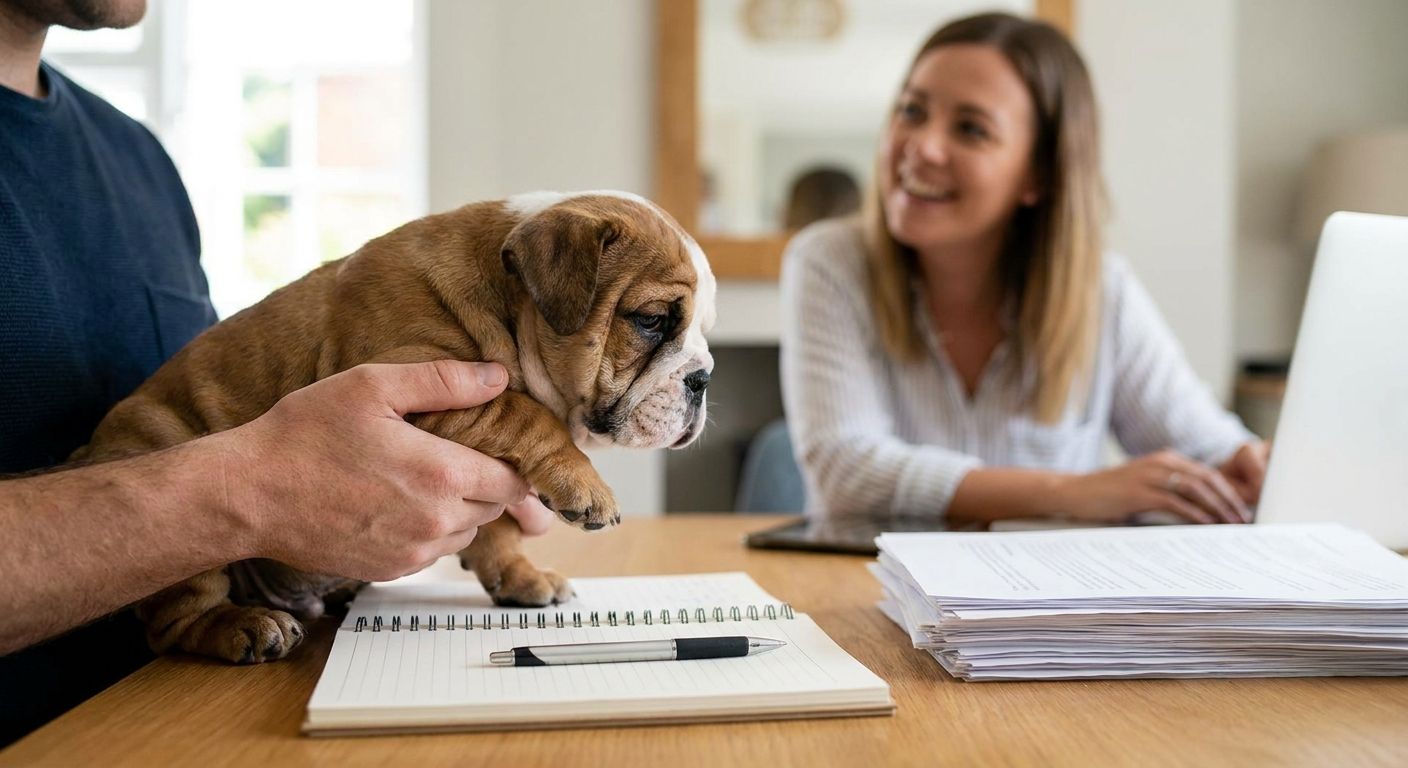
Finding a good English Bulldog breeder takes more homework than picking a puppy off a website — the questions you ask before you pay a deposit decide whether you end up with a healthy companion or a five-figure vet bill.
- Reputable english bulldog dog breeders provide AKC papers, hip and OFA testing, and let you visit the dam in person.
- Puppies should never leave the litter before 8 weeks old — earlier removal is a legal and welfare red flag in 2026.
- Shrinkabulls documents pedigree and health testing for every English and French Bulldog litter, including rare merle, lilac, and blue lines.
- Skip any breeder who always has puppies ‘in stock’ or refuses a written contract — both signal volume breeding, not careful breeding.
- Price alone tells you nothing; a $6,000 merle puppy with no health testing is a worse buy than a $2,500 puppy with full documentation.
Why this matters
English Bulldogs carry more inherited health risk than most breeds — narrow airways, hip dysplasia, and skin fold infections are common enough that the breed's own health surveys flag them as priorities. A careless breeder who skips health screening passes that risk straight to you, usually a few years down the line when the vet bills start.
The puppy market moved almost entirely online after 2020, which makes it easy for anyone with a website and a litter to look legitimate. AKC registration alone doesn't prove a breeder tests for genetic conditions — it just proves the parents are purebred. You need a checklist, not a gut feeling, before you send a deposit to any of the english bulldog dog breeders advertising puppies this year.
What you'll need
- A list of 3-5 candidate breeders to compare side by side
- Time for at least one in-person visit, or a live video call if you're buying out of state
- Copies (or photos) of the sire and dam's health testing paperwork
- A written contract before any money changes hands
- Patience — a good litter is worth a few extra weeks of waiting
Shrinkabulls keeps pedigree, color, and health documentation posted for its English and French Bulldog litters so buyers can compare before they ever pick up the phone. Use that as your baseline for what a transparent breeder page should look like.
The steps
1. Confirm AKC registration before you fall for the puppy
Ask for the litter's AKC registration number and the parents' registered names, not just a certificate photo. Cross-check the number on AKC's own marketplace tools — a breeder who hesitates or says "it's coming later" is stalling for a reason. Verified registration is non-negotiable for any English Bulldog purchase in 2026.
Common mistake: accepting a "papers pending" promise without a signed AKC litter application in hand. If the litter isn't registered before the puppies go home, it may never get registered at all.
2. Ask for health testing, not just a health guarantee
A written health guarantee means nothing if the parents were never tested. Ask specifically for OFA hip and patella evaluations, a cardiac exam, and BOAS (airway) screening — English Bulldogs are a brachycephalic breed, and airway problems are hereditary. Serious breeders will hand over these results without being asked twice.
Common mistake: confusing a "health guarantee" clause in the sales contract with actual genetic testing. A guarantee is a legal promise; testing is proof.
3. Visit in person and meet the dam
Seeing the mother in person tells you more than any photo — her temperament, coat condition, and weight reveal how the breeder cares for their dogs day to day. If a breeder refuses visits or insists on meeting only at a parking lot, treat that as disqualifying. If the sire lives off-site for a stud arrangement, ask for his health records separately.
Common mistake: accepting curated video calls instead of a real visit when the breeder is within driving distance. Video can hide a lot — kennel conditions, litter size, and how many other litters are on the property at once.
4. Check how the puppies were raised in the first 8 weeks
Puppies raised inside the home, handled daily, and exposed to normal household noise adjust faster than puppies raised in an isolated whelping shed. Ask what age puppies start eating solid food, when they're dewormed, and whether they've had their first vaccination round before leaving. No puppy should leave the litter before 8 weeks old — several states restrict earlier separation by law, and English Bulldogs in particular need that extra socialization window given how sensitive they can be as newborns.
Common mistake: agreeing to "early pickup for a discount." A breeder offering that is prioritizing turnover over the litter's welfare.
5. Get pricing context, especially for rare colors
Merle, lilac, and blue English Bulldogs carry a premium because the color genetics are harder to breed responsibly and demand outpaces supply. That premium is legitimate — but it should come with the same health documentation as a standard-colored puppy, not less. If you're weighing whether a rare-color price tag makes sense, the merle bulldog price breakdown walks through what actually drives cost differences between color lines.
Common mistake: assuming a higher price automatically means better health testing. Ask for the paperwork regardless of the number on the invoice.
6. Read the contract before you pay a deposit
A real contract spells out the health guarantee window, spay/neuter requirements if applicable, and what happens if the puppy develops a covered genetic condition. If a breeder wants a deposit with no written terms, that's a transaction, not a partnership. Read every clause — especially return policies and who pays for a vet visit if something looks off in the first 72 hours.
Common mistake: wiring a deposit before reading the full contract "because the litter is popular." Urgency is a sales tactic, not a reason to skip due diligence.
7. Talk to past buyers
Ask the breeder for two or three references from previous litters, then actually contact them. Real breeders welcome this because it validates their work; breeders running high-volume operations often can't produce recent references because buyers move through too fast to track.
Common mistake: relying only on a testimonials page on the breeder's own site. Independent references and third-party reviews carry more weight than curated quotes.
Compare a documented litter first
See pedigree, color lines, and available English and French Bulldog puppies.
Troubleshooting
- Breeder won't let you visit in person. Ask why directly. A legitimate excuse (military deployment, out-of-state stud arrangement) comes with an alternative like a supervised video call — a flat refusal with no explanation is disqualifying.
- Price is far below market for the color and lineage. Underpriced litters usually mean skipped health testing, unregistered parents, or a broker reselling puppies from a mill. Ask why the price is low before assuming it's a deal.
- No health testing documentation exists. Insist on OFA or equivalent paperwork before moving forward. If none exists, walk away regardless of how good the puppy photos look.
- Puppies are "always available." Responsible breeders plan a limited number of litters per year around the dam's health cycle. Constant inventory across multiple breeds is a volume-breeding signal.
- No written contract offered. Request one in writing before any deposit. If the breeder pushes back on putting terms on paper, that tells you how they'll handle a dispute later.
- Puppy is offered before 8 weeks old. Decline. Early separation increases behavioral risk and, in many states, violates minimum-age sale laws.
Tools and resources
- AKC Marketplace registration lookup — verify litter and parent registration numbers
- OFA (Orthopedic Foundation for Animals) database — check hip, elbow, and cardiac clearances
- Shrinkabulls — documented pedigree and color lines for English and French Bulldog litters
- State breeder licensing databases — confirm any required kennel license where the breeder operates
- Breed-specific rescue groups — a good source for red-flag reports on known problem breeders in your region
What to do next
If you're specifically weighing a merle, lilac, or blue puppy, read the rare color price guide before you compare quotes across breeders — color premiums vary more than most buyers expect, and knowing the range keeps you from overpaying or under-testing a breeder's price tag.
FAQ
What’s the best way to find a reputable English Bulldog breeder?
Start with AKC registration verification, then request OFA health testing results for both parents before you visit. Reputable english bulldog dog breeders provide both without hesitation, usually within a day of asking.
Is it normal for English Bulldog puppies to cost more than other breeds?
Yes — English Bulldogs typically cost more because litters are small, C-sections are common, and health testing adds expense. Rare colors like merle or lilac carry an additional premium on top of that baseline.
How can I verify AKC registration for a bulldog litter?
Ask the breeder for the litter’s AKC registration number and the parents’ registered names, then check it against AKC’s marketplace tools. A breeder stalling on this request is a warning sign.
What health testing should English Bulldog breeders complete?
Look for OFA hip and patella evaluations, a cardiac exam, and BOAS airway screening on both parents. English Bulldogs are brachycephalic, so airway health is especially important to document.
Is it better to buy a puppy in person or have one shipped?
In-person visits let you evaluate the dam’s condition and the home environment directly, which shipping can’t replace. If distance makes a visit impossible, insist on a live video call and independent references instead.
How old should an English Bulldog puppy be before going home?
A puppy should be at least 8 weeks old before leaving the litter, and several states legally require this minimum. Earlier removal increases behavioral and health risk.
Are merle English Bulldogs a legitimate color or a red flag?
Merle is a legitimate, documented color pattern in English Bulldogs when the breeder provides the same health testing as any other litter. The color itself isn’t a red flag — missing documentation is.
How do I know if a breeder is running a puppy mill?
Constant puppy availability across multiple breeds, no written contract, and refusal to allow visits are the three clearest signals. A single documented litter a year from a breeder who welcomes visits is the opposite pattern.
One last thing
The single fastest disqualifier isn't price or even missing paperwork — it's a breeder who can't tell you the dam's exact whelping date. Anyone who has actually raised the litter knows that date without checking notes; anyone reselling puppies from someone else usually has to guess.
Related guides

11 thoughts on “How to Vet English Bulldog Dog Breeders in 2026”