


 REVIEWS




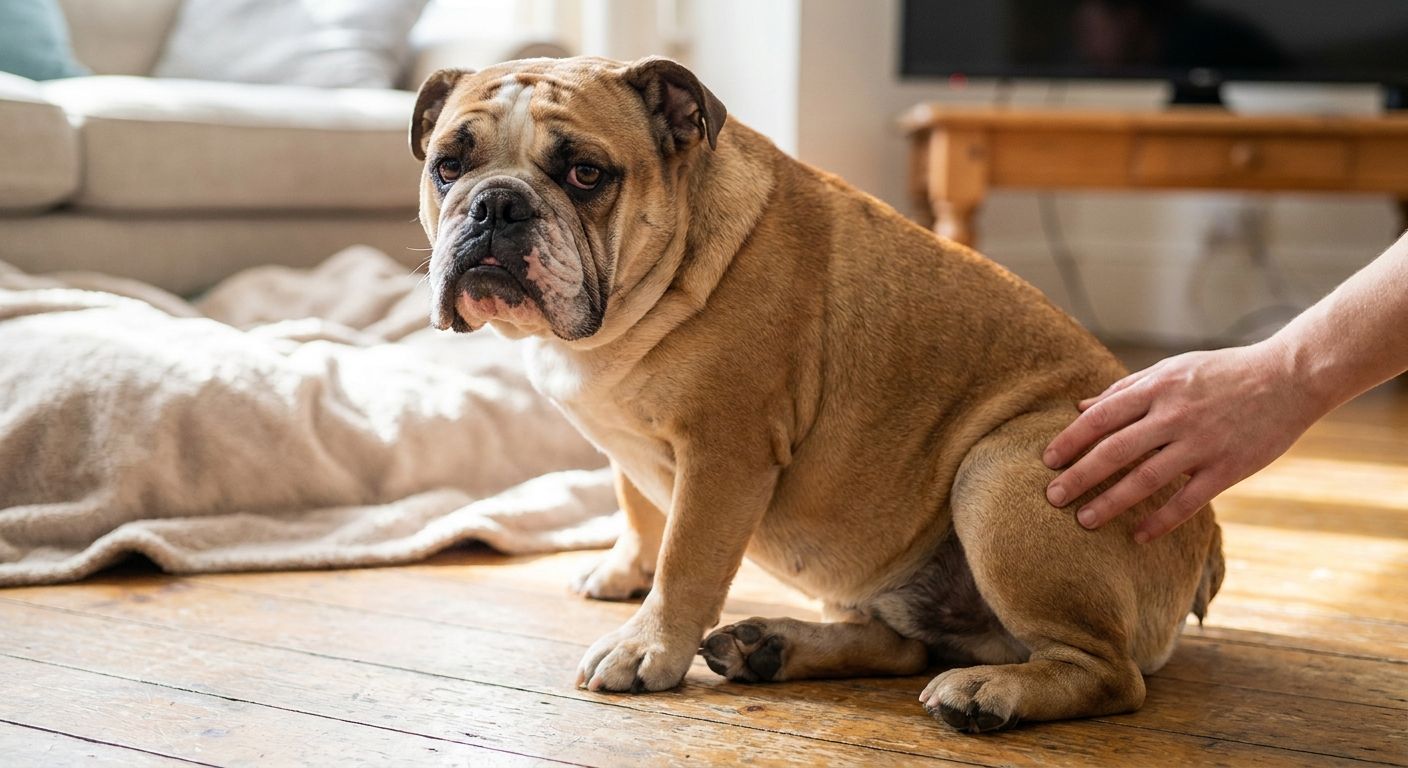
An English Bulldog with early hip dysplasia usually shows a subtle "bunny hop" gait (both back legs moving together instead of alternating), reluctance to climb stairs, and a looseness in the hip joint that you can sometimes feel when you gently extend the back leg. These signs often show up between 4 and 8 months of age, well before the dog limps outright. The catch: mild-to-moderate hip dysplasia in an English Bulldog can look completely normal on the outside for years, which is why gait-watching alone misses cases that only an X-ray or a PennHIP evaluation will confirm.
- Early hip dysplasia in an English Bulldog shows as a bunny-hop gait, stiffness after rest, and stair reluctance, often by 4-8 months.
- Visual signs alone under-diagnose the problem — X-rays or PennHIP scoring confirm what a stretch test can’t.
- Genetics from the parents’ OFA hip scores matter more than anything you do after the puppy comes home.
- Weight control and low-impact exercise slow arthritis progression once dysplasia is confirmed, they don’t prevent the structural issue.
Why this matters
English Bulldogs carry a body built low, wide, and heavy on a joint structure that wasn't designed for that mass — that combination is exactly why hip dysplasia shows up so often in the breed. Waiting for a full limp to show before you act means the joint has usually already started grinding, and early arthritis in a 2-year-old bulldog is a much harder problem than a joint issue caught at 4 months.
Asking a breeder for health testing panels on the parents before you ever bring a puppy home is the single highest-leverage move you can make, because hip conformation is largely inherited, not something diet fixes after the fact. A puppy from two OFA-cleared parents starts with better odds than one from unscreened lines, full stop.
What are the early signs of hip dysplasia in an English Bulldog?
The signs cluster around gait, activity tolerance, and joint feel. Here's what to watch for and when it typically shows up:
| Sign | What it looks like | Most common age |
|---|---|---|
| Bunny hop gait | Both back legs move together running or on stairs | 4-8 months |
| Stair/step reluctance | Hesitates or refuses to climb, especially after rest | 4-12 months |
| Swaying or waddling walk | Hips shift side to side instead of a steady stride | 6-18 months |
| Stiffness after rest | Slow to rise, loosens up after a few minutes of moving | 6 months-2 years |
| Reduced play tolerance | Tires faster than littermates, sits down mid-play | Any age |
| Audible clicking or grinding | A popping sound from the hip during movement | 1 year+ |
A quick at-home check (not a diagnosis) works like this:
- Watch the puppy trot across a hard floor, not carpet — the bunny hop is easiest to spot at a trot.
- Have the puppy sit, then rise, and time how long it takes to settle into a normal walk.
- With the puppy relaxed on its side, gently extend one back leg and feel for looseness or a soft "click" as the hip moves.
- Compare left and right — asymmetry between the two hips is a bigger red flag than mild looseness on both sides.
None of this replaces a vet exam. It just tells you whether it's worth booking one now instead of at the next annual visit.
Puppy-stage signs: 8 to 16 weeks
At this age hip dysplasia is almost never visible by eye — the joint is still forming and lameness this early usually points to something else, like an injury or a growth-plate issue. What matters at 8-16 weeks is paperwork, not gait: ask whether the sire and dam were hip-screened, because that number predicts risk far better than watching an 8-week-old puppy walk around a pen.
Adolescent-stage signs: 6 months to 2 years
This is the window where hip dysplasia becomes visible in an English Bulldog. Growth spurts stress a loose joint, and you'll typically see the bunny hop, stiffness after naps, and a drop in stamina during play. If a bulldog under 2 years old shows two or more of these signs together, that's the point to schedule hip X-rays rather than wait for a limp.
Adult-stage signs: 2 years and older
By adulthood, undiagnosed dysplasia has usually progressed to secondary arthritis. Signs shift from occasional stiffness to a consistent reluctance to jump onto furniture or into a car, muscle loss in the hindquarters from reduced use, and a visibly narrower stance. At this stage the conversation with a vet is about pain management and mobility support, not early detection.
Why hip dysplasia risk varies in English Bulldogs
A handful of factors push risk up or down for any individual dog:
- Parent hip scores. Puppies from OFA "Fair" or better hips (or a favorable PennHIP score) carry meaningfully lower structural risk than puppies from unscreened parents.
- Growth rate as a puppy. Overfeeding a bulldog puppy to grow fast puts more stress on a joint that's still forming.
- Body weight. Every extra pound is extra load on a joint that's already carrying more mass than it was built for — this is why joint and mobility supplements get recommended alongside weight control, not instead of it.
- Exercise surface and intensity. Repeated hard stops on tile or pavement stress a loose hip more than the same activity on grass.
- Spay/neuter timing. Some veterinary research links very early spay/neuter to a higher rate of joint problems, which is one reason many vets now recommend waiting until a bulldog is closer to a year old.
- Line and breeder practices. A breeder who screens every breeding dog before pairing them is working to reduce this risk generation over generation; one who doesn't is rolling the dice on every litter.
Ask about hip health before you buy
Get the health testing questions to ask any bulldog breeder.
Can a 4-month-old bulldog puppy have hip dysplasia?
Yes, a 4-month-old English Bulldog can already show early hip dysplasia signs like a bunny hop gait or stair reluctance, even though the condition is usually confirmed later with X-rays. The structural looseness is present from birth in genetically predisposed dogs; it just becomes visible as the puppy starts moving more.
Is hip dysplasia in an English Bulldog preventable?
No, hip dysplasia itself isn't fully preventable once the genetics are set, but its severity and how fast arthritis sets in are manageable through weight control, controlled exercise, and screening parent dogs before breeding. That's the real distinction most owners miss in 2026: you're managing progression, not curing structure.
Does every English Bulldog develop hip dysplasia?
No, not every English Bulldog develops hip dysplasia, but the breed carries one of the higher rates among AKC breeds according to Orthopedic Foundation for Animals (OFA) breed statistics. That's exactly why asking a breeder to vet the breeder's health testing before you buy matters more here than it would for a structurally lower-risk breed.
FAQ
What is the earliest age hip dysplasia shows up in an English Bulldog?
Visible signs like a bunny hop gait or stair reluctance can appear as early as 4 months old in an English Bulldog. The underlying joint looseness is present from birth in genetically predisposed puppies, but it usually isn’t visible until the puppy is active enough to reveal it.
Can hip dysplasia in an English Bulldog be reversed?
No, hip dysplasia can’t be reversed once the joint structure is loose, but progression to arthritis can be slowed with weight management, controlled exercise, and joint support. Surgical options exist for severe cases and are a conversation for your vet, not a DIY decision.
What is the bunny hop gait and does every bulldog have it?
The bunny hop is when both back legs move together like a rabbit instead of alternating normally, and it’s one of the most reliable early signs of hip dysplasia. Not every English Bulldog shows it — some dogs with mild dysplasia walk normally and only show up on X-rays.
Do OFA hip scores matter for English Bulldog puppies?
Yes, OFA hip scores on the sire and dam are the single best predictor of a puppy’s hip dysplasia risk, more predictive than anything done after the puppy is born. Ask any breeder for these scores before committing to a puppy.
How is hip dysplasia diagnosed in an English Bulldog?
Hip dysplasia is diagnosed with X-rays, most reliably a PennHIP evaluation or an OFA hip radiograph read by a veterinary radiologist. A physical exam and gait observation can raise suspicion, but imaging is what confirms it.
Does weight affect hip dysplasia symptoms in English Bulldogs?
Yes, extra body weight adds direct load to an already-loose hip joint and speeds up arthritis progression in an English Bulldog with dysplasia. Keeping a dysplastic bulldog lean is one of the few things an owner fully controls after diagnosis.
Is hip dysplasia common in English Bulldogs?
Yes, English Bulldogs rank among the breeds most affected by hip dysplasia according to OFA breed statistics, a consequence of the breed’s wide, heavy-set body structure. That’s why health screening on breeding stock matters more here than in many other breeds.
Should every English Bulldog get hip X-rays?
Any English Bulldog showing two or more early signs — bunny hop gait, stair reluctance, stiffness after rest — should get hip X-rays rather than wait. Even without symptoms, breeding dogs should be OFA or PennHIP screened before being bred.
One last thing
The stretch test you can do at home is useful for raising suspicion, not for ruling anything out — a bulldog can pass a home check with flying colors and still have moderate dysplasia that only shows on an X-ray, because pain tolerance and muscle compensation mask a lot in this breed. If you're evaluating a puppy or a breeding prospect, treat the parents' documented hip scores as the real answer and the gait-watching as a bonus data point, not the other way around.
Related guides

6 thoughts on “Hip Dysplasia in English Bulldogs: Early Signs (2026)”