

 REVIEWS




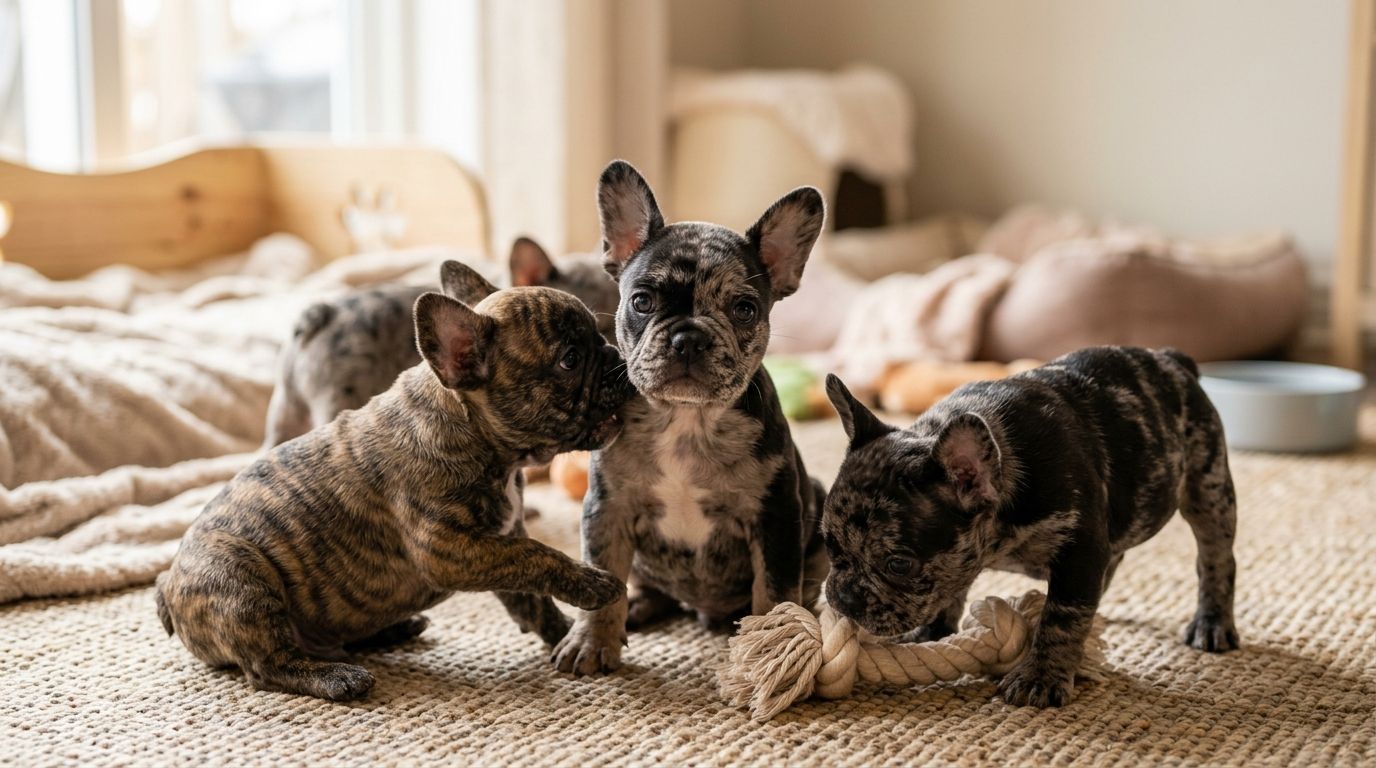
Merle carrier French Bulldog puppies for breeding programs are dogs that carry a single copy of the merle gene (Mm) without necessarily showing full merle coloring, and breeders use them to introduce or hold merle, blue merle, and lilac merle lines without stacking two copies of that gene in one litter. A companion buyer just wants a cute face. A breeding program needs genotype odds mapped out three generations ahead, and that's a completely different job.
We've built our own program around this exact math, and if you're serious about adding merle carrier French Bulldog puppies to your lines, the multi-generation breeding program for rare colors framework is where the planning actually starts.
- Merle carrier French Bulldog puppies (Mm) let breeding programs add merle color without doubling the gene in one litter.
- A merle-to-non-merle cross runs roughly 50% merle offspring per standard genetics – never merle-to-merle.
- Double merle (MM) pairings carry documented deafness and vision risk and should never be attempted in a responsible program.
- DNA testing before pairing beats guessing from coat color every single time in 2026 programs.
- Shrinkabulls works pedigree, genotype, and stud selection together before any merle carrier pairing goes forward.
Why merle carrier French Bulldog puppies matter for breeding programs
A companion buyer cares about one puppy. A breeding program cares about the next five litters, and merle carriers are the tool that lets you build color without gambling on health. Because merle is a single dominant gene (Mm), a carrier bred to a non-merle (nn) partner produces roughly half merle, half solid puppies in a standard litter – no visible merle-to-merle pairing required, ever.
That 50% split matters for planning your whelping calendar, your waitlist, and your pricing conversations. If you want to understand what buyers are actually paying for rare-color puppies right now, what merle Bulldog puppies really cost breaks down the market side of that math, and it's worth reading before you set expectations with a waitlist in 2026.
The other reason merle carriers matter: they let responsible programs avoid the double merle trap entirely. Two merle carriers bred together produce roughly 25% double merle (MM) puppies, and that genotype is linked to deafness and vision defects in the breed literature. A program built on carrier-to-non-carrier pairings never has to face that outcome.
Steps for building a merle carrier breeding program
Confirm merle genotype with DNA testing before any pairing
Coat color alone doesn't tell you genotype. A phantom merle can look solid and still carry the gene, which is exactly how double merle litters happen by accident.
- Run a color genetics panel on both prospective parents before you commit to a pairing
- Confirm merle status (Mm, MM, or nn) rather than relying on a visual coat read
- Re-test any dog you didn't personally verify as a puppy
- Keep test results on file alongside AKC paperwork for every breeding dog
- Retest older dogs if the original panel predates current genetic marker standards
Map the litter odds before you commit to a pairing
Once you know both genotypes, the outcome math is simple – and it's the single biggest planning tool a breeding program has.
- Pair Mm x nn for roughly 50% merle offspring, zero double merle risk
- Never pair Mm x Mm, even if both parents look healthy and unaffected
- Build a waitlist estimate around the expected split, not a best-case guess
- Plan for solid-colored puppies in the same litter – they're not a mistake, they're the math working
Screen every prospect for double merle risk
This is the step that protects the breed and the buyer. A double merle puppy can present with hearing loss, vision problems, or both, and no responsible program should produce one intentionally.
- Verify genotype on any outside stud or dam before agreeing to a pairing
- Ask for documentation, not just a breeder's word on coat history
- Walk away from any pairing where genotype can't be confirmed
- Treat "we're not sure, but she's probably not merle" as a hard no
“Never pair two merle carriers – the double merle cross carries a documented risk of deafness and vision defects, no exceptions.”
Vet the pedigree and AKC papers on the merle carrier
A genotype test tells you what a dog carries. The pedigree tells you where it came from, and that matters for structure, temperament, and any hidden health patterns further back in the line.
- Trace at least three generations back on any prospective merle carrier
- Cross-check AKC registration numbers against the paperwork in hand
- Ask for OFA or equivalent health clearances on both sides of the pairing
- Flag repeated close-line breeding further back in the pedigree
Match the merle carrier with a compatible non-merle partner
Once genotype and pedigree check out, the pairing decision comes down to structure, temperament, and what the program actually needs next.
- Confirm the non-merle partner is genuinely nn, not an untested phantom
- Match for structure and skull type, not just coat color goals
- Weigh temperament history on both sides, especially for first-time program studs
- Consider an outside stud service built specifically for rare-color programs when your own line doesn't have the right non-merle partner
Need a vetted merle-compatible stud?
Pairing support for rare-color breeding programs, genotype-confirmed.
Build a contract that protects both sides of the pairing
A breeding program without a written agreement is a program waiting for a dispute. Contracts should cover genotype guarantees, pick-of-litter terms, and what happens if the pairing doesn't take.
- Put genotype confirmation in writing, not just a verbal assurance
- Spell out stud fee terms and what triggers a repeat breeding
- Define pick-of-litter rights before the breeding, not after whelping
- Include a health clearance clause tied to the actual test results on file
Options for building a merle carrier breeding program
| Option | Best for | Key limitation |
|---|---|---|
| Merle carrier (Mm) puppy | Programs introducing merle into a non-merle line safely | Half the litter won't carry merle at all |
| Visible merle breeding stock | Programs wanting merle expression in most litters | Must never be paired with another merle carrier |
| Double merle (MM) | No responsible program | Documented deafness and vision defect risk |
| DNA color panel testing | Confirming genotype before any pairing decision | Adds lab turnaround time before breeding can proceed |
| Outside stud service | Programs without an in-house non-merle match | Requires contract terms and travel logistics |
Verdict: an Mm merle carrier paired with a confirmed nn partner is the only responsible way to build a merle line in 2026 – double merle pairings are a skip, full stop.
Common mistakes breeding programs make with merle carriers
- Breeding by coat color instead of genotype. A phantom merle looks solid and still carries the gene – visual assessment alone misses this every time.
- Skipping the double merle math. Some programs pair two visible merles for a "striking" litter without running the 25% MM risk first.
- Treating solid puppies in the litter as a failure. A 50/50 split is the expected outcome of a carrier pairing, not a disappointment.
- Not documenting genotype in the contract. Buyers and co-breeders both need the DNA panel result in writing, not a verbal claim.
- Skipping outside stud vetting. Assuming an outside dog is "probably clear" instead of requesting current test results before the pairing.
FAQ
What is a merle carrier French Bulldog puppy?
A merle carrier French Bulldog puppy has one copy of the merle gene (Mm) and can pass merle coloring to roughly half its offspring when paired with a non-merle (nn) partner. It may or may not show visible merle patterning itself, which is why DNA testing matters more than a visual coat check.
Is it safe to breed two merle carrier French Bulldogs together?
No. Pairing two merle carriers produces roughly 25% double merle (MM) puppies, a genotype linked to deafness and vision defects. A responsible breeding program always pairs a merle carrier with a confirmed non-merle partner.
How much does DNA color testing cost for a breeding program?
Pricing varies by lab and panel, so check current rates directly with the testing provider you choose. What matters more than the exact cost is running the test before any pairing, not after.
Can a merle French Bulldog look solid-colored?
Yes, this is called a phantom or cryptic merle – the dog carries the gene but shows little to no visible merle patterning. This is exactly why genotype testing beats a visual coat assessment for breeding decisions.
What’s the difference between merle, blue merle, and lilac merle?
Merle refers to the patterning gene itself, while blue merle and lilac merle describe the base coat color the merle pattern sits on top of. A dog’s base color genetics and its merle status are inherited separately, which is why both need testing.
How many merle puppies come from a typical litter?
A merle carrier bred to a non-merle partner produces roughly 50% merle offspring per standard Mendelian genetics, though any individual litter can vary from that average.
Do double merle French Bulldogs have health problems?
Double merle (MM) dogs carry a documented risk of deafness and vision defects, which is why responsible programs never intentionally pair two merle carriers or two visible merles together.
Where can a breeding program find a compatible merle stud?
Programs without an in-house non-merle match typically work with an outside stud service that can confirm genotype and pedigree before any pairing agreement is signed.
One last thing
The number that trips up most first-time rare-color programs isn't the 50% merle split – it's the 25% double merle math they didn't run before an emotional "let's just see what happens" pairing. Test genotype first, plan the pairing second, and the color takes care of itself. Programs that skip step one are the ones producing dogs with preventable health problems in 2026, not the ones building sound lines.
Related guides
- DNA color genetics test kits for rare-color breeding
- Double merle health risks explained before buying
- French Bulldog stud service for rare-color breeding programs
