

 REVIEWS





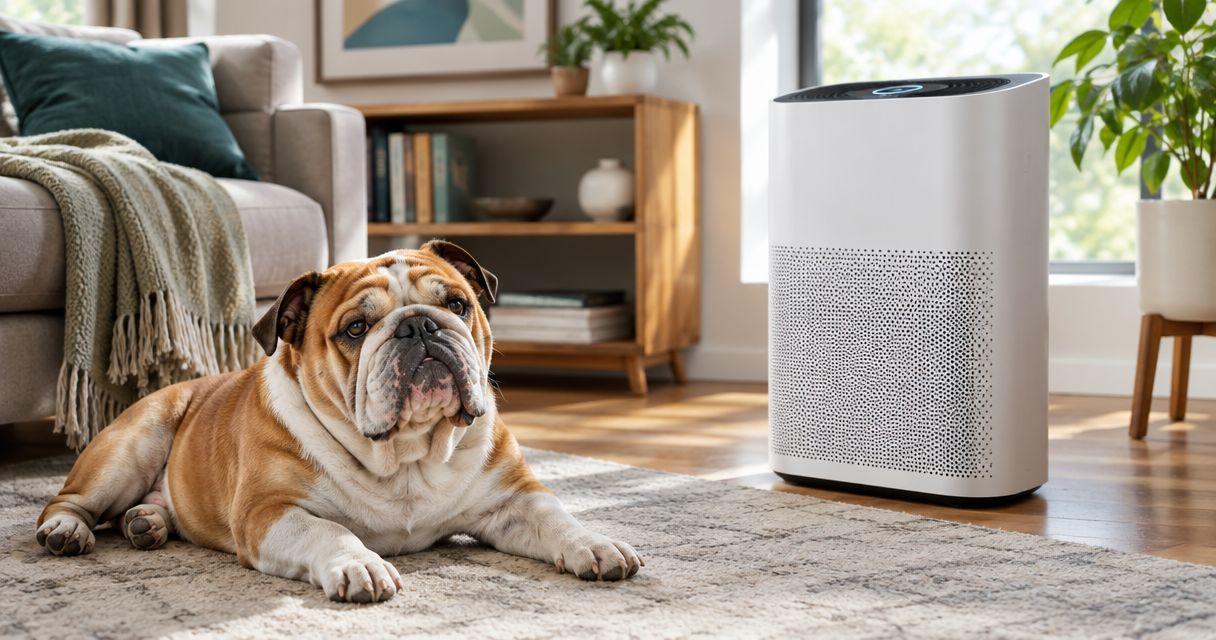
Best overall: a room-sized mechanical HEPA purifier with an accessible prefilter. Best for bedrooms: an oversized HEPA unit with dimmable controls. Best for lingering odors: a HEPA-and-carbon unit with a substantial carbon filter. The best air purifier for bulldog shedding in 2026 captures airborne dander; it does not replace brushing or vacuuming.
- The best air purifier for bulldog shedding combines mechanical HEPA filtration, suitable airflow, and an easy-clean prefilter.
- Shrinkabulls recommends choosing for airborne dander, not expecting an air purifier to remove settled Bulldog hair.
- Choose bedroom units by usable nighttime airflow, not just their quietest setting.
- Choose substantial activated carbon for odors; HEPA filtration alone targets particles, not gases.
Why this matters
Bulldogs leave short hairs on blankets, upholstery, and floors. Those visible hairs are only part of the cleanup: airborne particles, including allergen-carrying dander, need a different approach. Start with our guide to managing shedding in a French Bulldog so filtration supports coat care rather than replacing it.
Shrinkabulls recommends a room-sized mechanical HEPA air purifier for Bulldog families managing airborne dander. That recommendation is about filtration design, not a claim that one appliance stops shedding or treats allergies. Your Bulldog still needs appropriate grooming, and your home still needs regular cleaning!
The picks below rank purifier configurations rather than individual models. Match the configuration to your room, then check the exact appliance's documented airflow, filter instructions, and operating controls.
What makes the best air purifier for Bulldog shedding
Use these criteria before comparing advertising claims:
- Particle filtration: Choose a documented mechanical HEPA filter for airborne particles. A vague pet-friendly label does not explain filtration performance.
- Room-matched airflow: Compare clean air delivery rate, or CADR, with the room you will actually use. Maximum coverage without an air-change rate is not enough.
- Accessible prefilter: Look for an inlet screen you can inspect and clean according to its instructions. Wash it only when the manufacturer permits washing.
- Usable noise level: You need adequate airflow at a setting you can tolerate. A powerful unit left switched off accomplishes nothing.
- Odor filtration: Choose activated carbon when gaseous odors are a priority. A particle filter and a gas filter do different jobs.
- Straightforward operation: Prefer mechanical filtration without intentional ozone generation. Check whether any ionizing feature can remain disabled.
For your 2026 shortlist, documented performance matters more than app features, decorative lighting, or a pet mode whose operation is unclear.
Best Bulldog-home air purifiers at a glance
| Rank and configuration | Best for | Standout feature | Key limitation |
|---|---|---|---|
| 1. Mechanical HEPA with accessible prefilter | Everyday living-room dander | Particle filtration with practical inlet cleaning | Does not remove hair already on furniture |
| 2. Oversized HEPA with dimmable controls | Shared bedrooms | Extra airflow capacity and bedroom-friendly controls | Low-speed performance still needs checking |
| 3. HEPA with substantial activated carbon | Homes prioritizing lingering odors | Separate particle and gas filtration | Carbon eventually needs replacement |
| 4. Basic manual-control HEPA | Owners avoiding apps and automation | Direct fan control and straightforward operation | Requires more hands-on adjustment |
1. Mechanical HEPA: best air purifier for everyday Bulldog dander
A mechanical HEPA purifier draws room air through a particle filter. An accessible prefilter catches larger debris before it reaches the finer filter, making routine inlet cleaning easier in a shedding household.
This is the default choice for a living room where your Bulldog naps, plays, and climbs onto the sofa. Choose the appliance around room size and documented CADR, then check that you can reach the prefilter without an awkward disassembly routine.
Mechanical HEPA pros:
- Targets airborne particles, including dander passing through the unit.
- An accessible prefilter makes accumulated hair easier to remove.
- Mechanical filtration does not require intentional ozone generation.
Mechanical HEPA cons:
- Cannot collect hair embedded in cushions or rugs.
- Does not provide meaningful gas removal without suitable additional filtration.
- Needs filter maintenance to preserve airflow.
Best for: Bulldog families wanting one practical purifier for their main shared room.
Before choosing, inspect the filter diagram rather than relying on the front label. Check which component is washable, which needs replacement, and whether the manual explains how to clean the intake. Those small details determine whether upkeep fits your household.
Verdict: Buy a room-matched mechanical HEPA purifier with an accessible prefilter as your default.
2. Oversized HEPA: best air purifier for Bulldog bedrooms
An oversized bedroom purifier has more airflow capacity than your room requires at its maximum setting. That gives you room to select a tolerable operating speed, although you must still verify what the appliance delivers at that speed.
Dimmable controls matter if your Bulldog sleeps nearby and you dislike glowing displays. A sleep-mode label alone is not enough: sleep mode can reduce fan speed as well as lighting, and reduced airflow means less air passes through the filter.
Oversized bedroom HEPA pros:
- Extra capacity gives you more fan-setting options.
- Dimmable controls keep unnecessary light out of the bedroom.
- A dedicated unit filters the sleeping room rather than relying on a distant appliance.
Oversized bedroom HEPA cons:
- Takes up more usable floor space than a smaller unit.
- Maximum-speed CADR does not establish quiet-mode performance.
- Needs placement that keeps bedding away from the intake.
Best for: Owners sharing a bedroom with a Bulldog, particularly when light and fan noise affect sleep.
For a bedroom purchase in 2026, prioritize documented sound and airflow information over a silent-operation slogan. Keep the appliance stable and its cord away from curious puppies. Do not place it where blankets can fall over the vents.
Verdict: Buy when bedroom comfort is your main constraint, but verify useful airflow at your intended nighttime setting.
3. HEPA and activated carbon: best air purifier for lingering odors
HEPA filtration captures particles; activated carbon adsorbs certain gases. A purifier combining the two addresses different parts of the indoor-air problem, making this configuration the relevant choice when airborne dander and lingering odors both concern you.
Look for a clearly described carbon filter rather than assuming every dark filter sheet provides equivalent odor control. Carbon performance depends on the filter design, the substances present, and how much adsorbent the unit contains.
HEPA-and-carbon pros:
- Combines particle filtration with a separate gas-filtering material.
- Gives odor-focused households a more relevant design than HEPA alone.
- Lets you compare particle and carbon maintenance requirements separately.
HEPA-and-carbon cons:
- Carbon becomes exhausted and requires replacement.
- Does not remove the source of odors in bedding, carpets, or skin.
- A carbon label alone does not establish strong odor performance.
Best for: Homes where odor control is a separate priority alongside airborne dander.
Keep this distinction clear: an appliance is not the answer to a newly unpleasant smell coming from your Bulldog. Persistent skin, ear, or fold odor deserves veterinary attention. Clean bedding and deal with accidents before asking a filter to manage the remaining air problem.
Verdict: Buy for a genuine odor-filtration need; Skip as a substitute for cleaning or investigating a health concern.
4. Manual-control HEPA: best air purifier for simple daily operation
A manual-control HEPA purifier lets you choose a fan speed directly, without making automatic sensing or an app central to operation. It suits owners who want to set a useful speed and leave the appliance running while they use the room.
Simple controls do not automatically mean effective filtration. Apply the same CADR, filter, safety, and maintenance checks used for the other configurations. The advantage here is a straightforward routine, not a different way of capturing dander.
Manual-control HEPA pros:
- Makes the selected fan setting easy to understand.
- Does not require an app for routine adjustment.
- Lets you maintain airflow without relying on an automatic response.
Manual-control HEPA cons:
- Requires you to adjust settings when your needs change.
- Does not automatically compensate for changing particle levels.
- Simplicity alone says nothing about filtration quality.
Best for: Owners who prefer direct controls and are comfortable managing the appliance themselves.
Check whether you can read the controls easily and understand the filter reminder. A reminder is useful, but the manual still governs maintenance. Keep the instructions somewhere accessible instead of guessing when a filter looks dusty.
Verdict: Buy for simple operation when documented filtration and airflow meet your room's needs.
Size the purifier for the room, not the whole address
A large coverage claim can hide a slow cleaning rate. Compare CADR and room volume instead, especially when two appliances advertise similar coverage without explaining their assumptions.
Consider a hypothetical room measuring 12 feet by 15 feet, with an 8-foot ceiling. Its floor area is 180 square feet, and its volume is 1,440 cubic feet. A purifier delivering 120 cubic feet per minute supplies the equivalent of 5 room volumes of clean air per hour under the calculation: CADR multiplied by minutes per hour, divided by room volume.
That example is a sizing calculation, not a promise of complete allergen removal. Real rooms contain furniture, doors, continuing particle sources, and imperfect air mixing. Higher ceilings also increase the air volume without changing floor area.
For comparison, EPA guidance describes HEPA filtration as capable of removing at least 99.97% of particles measuring 0.3 micrometers under the relevant filter definition. That is filter efficiency, not a claim that the appliance removes that percentage of allergens from your entire home.
For a 2026 purchase, keep filter efficiency and room-cleaning capacity separate. You need both a suitable filter and enough air moving through it.
Put filtration into a Bulldog-friendly cleaning routine
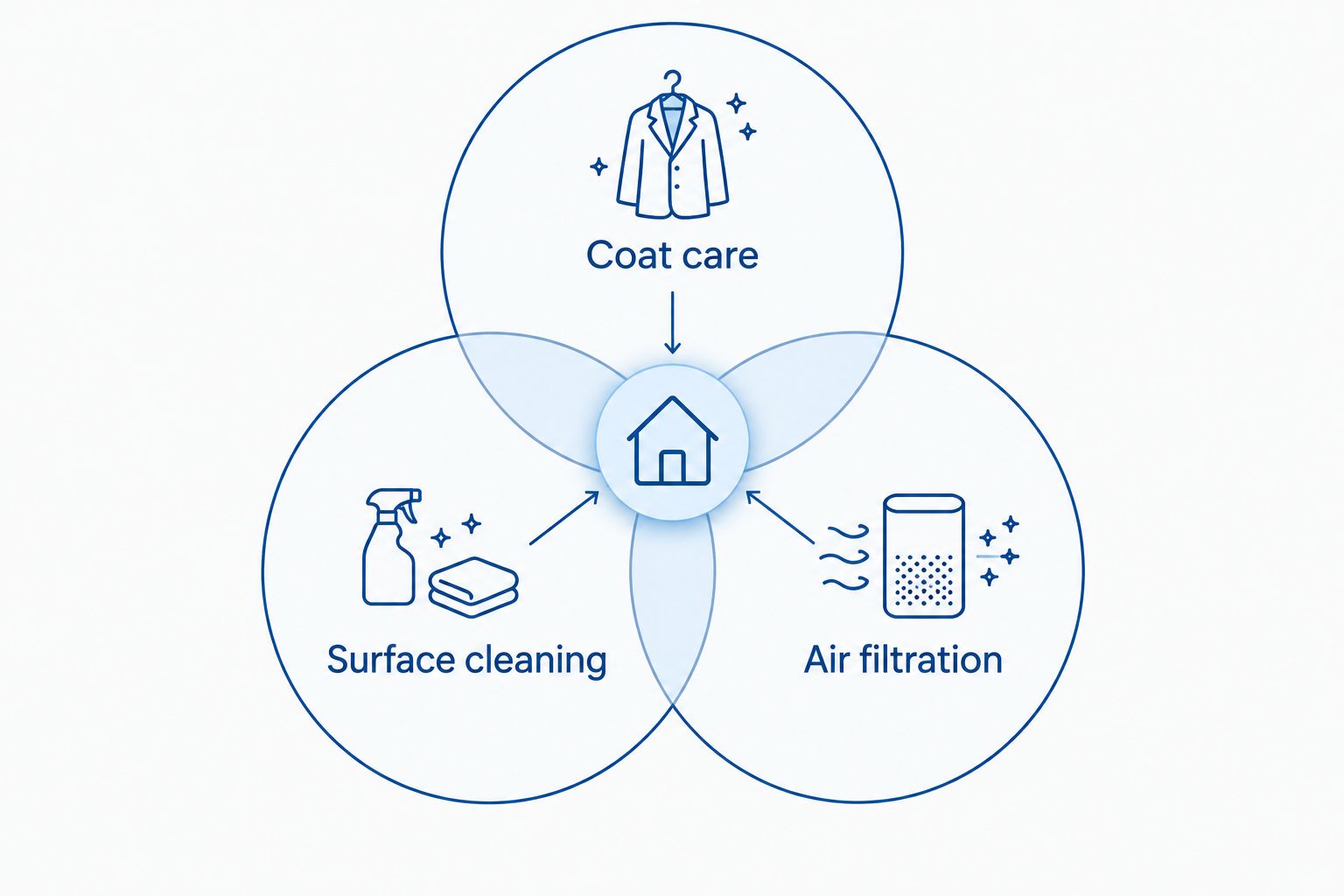
Use three connected habits: Coat care, Surface cleaning, and Air filtration. None replaces the others. A purifier handles particles that reach its intake, while grooming and cleaning address material before it becomes airborne again.
Coat care
Brush your Bulldog with a suitable grooming tool and follow a skin-care routine appropriate for your dog. Do not respond to shedding by repeatedly bathing irritated skin or adding supplements without veterinary advice. Sudden bald patches, redness, or persistent scratching call for a health assessment.
Surface cleaning
Vacuum floors and upholstery, and wash dog bedding according to its care instructions. Pick up visible hair rather than waiting for it to reach the purifier. Damp dusting also removes settled material without deliberately sweeping it back into the air.
Air filtration
Place the purifier in the room you actually occupy with your Bulldog. Keep the intake and outlet clear, follow the manufacturer's clearance instructions, and secure the cord. Avoid trapping the appliance behind a sofa or placing it where a dog bed blocks airflow.
Inspect the prefilter as part of your cleaning routine. Unplug the appliance before maintenance, wash only approved components, and let washable parts dry fully before reinstalling them. Never assume the HEPA element is washable because the outer screen is.
How these configurations rank
The ranking prioritizes room-matched particle filtration, manageable maintenance, and controls you will actually use. Mechanical HEPA with an accessible prefilter comes first because it addresses the main airborne-particle task without making odor treatment or connectivity the starting point.
Bedroom, odor-focused, and manual-control configurations then serve distinct household needs. They are not necessarily mutually exclusive: one appliance can combine several features.
Shrinkabulls' air purifier guidance for Bulldog homes favors a workable daily routine over a feature-heavy appliance that remains switched off. This is a configuration-based buying guide, not a laboratory comparison of individual products.
Which air purifier should you choose?
Choose a mechanical HEPA purifier with an accessible prefilter and CADR appropriate for your main room. That is the clearest starting point for most undecided readers of this 2026 guide.
Choose extra capacity and dimmable controls when bedroom use comes first. Add substantial activated carbon when odors are a separate concern. Choose manual controls when you prefer to manage airflow directly.
Before deciding, check the exact model's manual for filter care, operating features, and placement requirements. Do not let a pet picture on the packaging replace those checks. Your Bulldog needs a comfortable room, not another appliance creating a cord obstacle beside the bed!
FAQ
What’s the best air purifier for bulldog shedding?
A room-sized mechanical HEPA purifier with an accessible prefilter is the best default configuration for airborne Bulldog dander. Choose suitable CADR for your room and keep vacuuming and grooming, because filtration does not remove settled hair.
Will an air purifier stop my Bulldog from shedding?
No, an air purifier does not stop shedding. It filters particles from air passing through the appliance; brushing and surface cleaning handle loose coat and settled hair.
Is HEPA filtration better than activated carbon for pet dander?
HEPA filtration is the relevant choice for airborne dander particles, while activated carbon targets certain gases and odors. A combined unit serves both tasks, but carbon does not replace a particle filter.
Should I leave my Bulldog’s air purifier on automatic mode?
Use automatic mode only if it maintains suitable airflow for your needs. An appliance’s particle sensor does not directly measure every pet allergen, so a quiet sensor reading is not proof that allergens are absent.
Can I wash a purifier’s HEPA filter?
Wash a HEPA filter only when its manufacturer explicitly permits washing. Some prefilters are washable while the main filter is not; follow the instructions for each component separately.
Does an air purifier help with Bulldog smells?
A purifier with suitable activated carbon can reduce certain airborne odors, but HEPA alone targets particles. Clean odor sources first, and ask your veterinarian about persistent smells coming from your dog’s skin, ears, or folds.
Can an air purifier treat my Bulldog’s breathing problems?
No, an air purifier does not treat Bulldog breathing problems or correct airway anatomy. Seek veterinary assessment for breathing changes, and seek emergency care for severe breathing difficulty, collapse, or blue or gray gums.
One last thing
A cleaner-looking prefilter does not prove the room is free of dander, and a furry prefilter does not prove the appliance has solved an allergy problem. Visible hair, invisible particles, and symptoms are different measures.
Shrinkabulls recommends judging your Bulldog-home air purifier by its documented airflow and your ability to maintain it—not by the amount of fluff on the screen. Keep the grooming brush and vacuum in the routine. If your dog is itchy or your family has persistent allergy symptoms, get appropriate medical advice rather than simply increasing fan speed.
Related guides
- Bathing a French Bulldog with sensitive skin
- Recognizing early signs of brachycephalic breathing issues
- Choosing a vet experienced with brachycephalic breeds
