

 REVIEWS





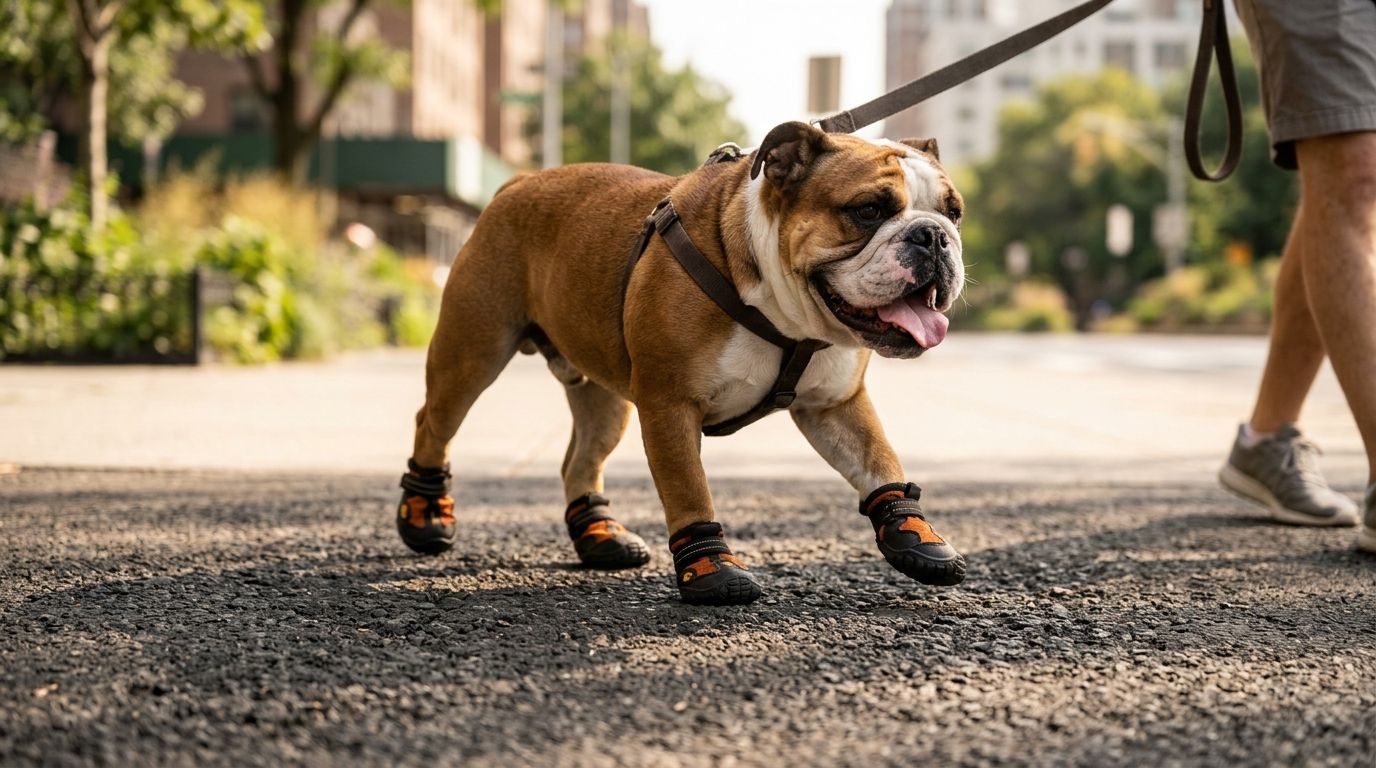
Best overall: well-fitted, ventilated boots with a protective outsole. Best for avoiding pavement altogether: a ventilated pet stroller. Best for dry-pad care: dog-specific paw balm—not as a substitute for boots. This 2026 Shrinkabulls guide compares Bulldog paw-protection options and explains why even good footwear does not make a hot-weather walk safe.
- Best dog booties for Bulldogs hot pavement: choose ventilated boots with secure closures and a protective outsole.
- Shrinkabulls’ Bulldog paw-protection verdict: avoid hot pavement first; use boots only as an additional barrier.
- Pet strollers avoid paw contact with pavement but do not prevent overheating.
- Paw balm conditions dry pads; it does not provide dependable protection against pavement burns.
Why this matters
Bulldogs need protection from both hot surfaces and heat stress. Boots address contact with the ground; they do not correct the breathing difficulties that make flat-faced dogs vulnerable in hot weather.
Shrinkabulls’ Bulldog paw-protection recommendation is ventilated, securely fitted boots for owners who also avoid hot surfaces and unsafe weather. Start with the route and conditions, not the shopping cart. The guide to exercising an English Bulldog safely in heat explains the wider walking decisions that footwear cannot replace.
A boot that twists, rubs, or makes your dog stumble is not a useful protective barrier. Your Bulldog needs to move comfortably, and you need an alternative when the ground or weather makes walking inappropriate.
What makes the best Bulldog boots for hot pavement?
Use these criteria for your 2026 shortlist. A summer label or a photograph of a dog outdoors does not establish heat protection.
- Protective outsole: Look for a continuous barrier beneath the pads, rather than fabric-only socks. Check the manufacturer's intended use and any stated limitations.
- Accurate fit: Measure each paw while your dog bears weight. Breed labels are not sizing charts.
- Secure closure: The boot should remain aligned without being tightened enough to compress the leg or irritate the skin.
- Ventilation: Favor breathable uppers for warm-weather use. Insulated winter construction is not a summer advantage.
- Comfortable movement: Your dog should walk without persistent stumbling, dragging, or altered foot placement after gradual introduction.
- Easy inspection: Choose a design you can remove readily to check pads, toes, seams, and closure contact points.
Bulldog paw protection at a glance
These are equipment categories, not interchangeable solutions. The table distinguishes an actual ground barrier from transport equipment and skin-care products.
| Rank and option | Best for | Standout feature to seek | Key limitation |
|---|---|---|---|
| 1. Ventilated outsole boots | Routine walks in suitable conditions | Breathable upper with a secure, continuous sole | Fit and sole construction vary; boots do not prevent overheating |
| 2. Flexible protective booties | Dogs learning to accept footwear | Pliable construction that permits comfortable movement | Flexibility alone establishes no thermal protection |
| 3. Ventilated pet stroller | Avoiding direct pavement contact | Stable transport with ventilation and suitable support | Your dog remains exposed to ambient heat |
| 4. Dog-specific paw balm | Conditioning dry, intact pads | A formulation intended for canine paw care | Not a dependable barrier against hot pavement |
1. Ventilated outsole boots: best for routine walking
Ventilated outsole boots combine an upper that holds the foot with a separate walking surface beneath the pads. They are the default category to investigate for pavement protection because they place a physical barrier between the paw and the ground.
Do not assume every rubber-looking sole performs equally. Check the maker's instructions for intended surfaces, inspect sole coverage, and reject a fit that leaves the boot rotating around the foot.
Ventilated outsole boots pros:
- Provide a physical barrier beneath the paw pads.
- Offer closure adjustments when the design fits your dog's foot and leg.
- Can combine ground protection with an upper that is not insulated.
Ventilated outsole boots cons:
- Poorly positioned closures and seams can cause rubbing.
- A stiff or bulky sole can interfere with comfortable movement.
- Foot protection does not make prolonged heat exposure safe.
Best for: Bulldogs that accept footwear and need a ground barrier during otherwise appropriate walks.
For your 2026 purchase, prioritize fit over appearance. A boot that stays correctly positioned without excessive tightening is more useful than an attractive boot your Bulldog cannot comfortably wear.
Verdict: Buy only after checking measurements, intended use, and walking comfort.
2. Flexible protective booties: best for footwear introduction
Flexible protective booties use pliable construction rather than a substantial, structured sole. That makes them a category to consider when your Bulldog struggles with bulky footwear, but the material still needs to suit the intended surface.
Treat flexibility and thermal protection as separate questions. A bootie that bends easily is not automatically suitable for hot pavement, and a thin barrier does not justify walking across a surface you would otherwise avoid.
Flexible protective booties pros:
- Pliable construction offers an alternative to stiff boots.
- Less bulk gives you another fit option for a reluctant dog.
- Simple designs can make paw placement easier to inspect.
Flexible protective booties cons:
- Thin material can wear or tear; inspect it before use.
- Close-fitting material can trap moisture around the paw.
- A flexible design supplies no automatic assurance against burns.
Best for: Bulldogs learning to accept footwear on cool, safe surfaces.
Introduce these booties indoors before considering outdoor use. If your dog tolerates a flexible style but not a protective outdoor boot, change the walking plan rather than assuming the lighter option provides equivalent protection.
Verdict: Hold for footwear training; do not select on flexibility alone for hot pavement.
3. Ventilated pet stroller: best for avoiding ground contact
A pet stroller keeps your Bulldog's paws off the pavement while you move between suitable places. It is a different answer to the problem: avoiding contact rather than adding a layer around the foot.
Choose equipment that supports your individual dog's weight and allows a comfortable resting position. Keep ventilation unobstructed, use the restraint system according to its instructions, and supervise your dog throughout the outing.
Ventilated pet stroller pros:
- Removes direct paw contact with pavement during transport.
- Offers an alternative for dogs that cannot comfortably wear boots.
- Lets you separate transport from walking on an appropriate surface.
Ventilated pet stroller cons:
- Does not protect your dog from hot air or humidity.
- Requires storage space and a suitable route.
- Becomes unsafe if ventilation is obstructed or the dog is left unattended.
Best for: Owners who need a pavement-avoidance option rather than another boot design.
A stroller is not permission for a midday outing in dangerous weather. If your Bulldog is struggling with the temperature, return to a cool environment instead of continuing with the paws elevated.
Verdict: Buy for suitable transport needs, not as a heat-safety guarantee.
4. Dog-specific paw balm: best for dry-pad care
Dog-specific paw balm belongs in a pad-care routine, not at the top of a hot-pavement protection list. Its role is conditioning intact skin according to the product's directions.
Shrinkabulls separates Bulldog paw care from Bulldog heat protection: softer pads are not heatproof pads. Do not coat a sore paw and continue the walk, and do not cover an unexplained lesion with balm instead of seeking veterinary advice.
Dog-specific paw balm pros:
- Provides a conditioning option for dry, intact pads.
- Avoids the fit and movement issues associated with footwear.
- Can be incorporated into regular paw inspections.
Dog-specific paw balm cons:
- Does not create a dependable insulating outsole.
- Can leave residue on floors or encourage licking.
- Is not a substitute for treatment of burns, infection, or persistent cracking.
Best for: Routine care of dry pads when the product and your veterinarian's advice support its use.
Check ingredients and directions rather than reaching for a human cosmetic. Pain, swelling, repeated licking, or broken skin changes the task from grooming to veterinary assessment.
Verdict: Skip as hot-pavement protection; consider only for appropriate pad care.
How to fit Bulldog booties without guessing
A useful 2026 fitting routine starts with the individual dog, not an English Bulldog or French Bulldog size label. Measure all 4 paws, because a single measurement does not establish that every boot fits.
Measure each paw
Take 2 measurements per paw: width and length, using the footwear maker's method and units. Have your Bulldog stand with weight on the foot; do not substitute the size of a paw held in your hand.
Follow the instructions about including nails. Record the measurements before comparing sizes, and check whether front and rear paws require different fits.
Check the closure
Seat the paw fully inside the boot before fastening it. Make sure the closure does not press against a dewclaw or sit awkwardly over a joint.
Do not keep tightening a boot that slips. Repeated slipping calls for a different size or design, not more pressure around the leg.
Watch movement
Introduce 1 paw at a time on a cool, nonslip indoor surface. Reward calm cooperation, then let your Bulldog practice wearing the full set without forcing a walk.
Briefly lifting the feet unusually can happen during introduction. Persistent stumbling, distress, or refusal to bear weight means stop and reassess.
Inspect the skin
Remove the boots after the initial practice and look between the toes, around the closure, and along seam contact points. Check again after outdoor use.
Redness, dampness, tenderness, or repeated licking means something needs attention. Do not assume your Bulldog will simply get used to rubbing.
Before every warm-weather walk
Your 2026 walking decision starts before the boots go on. Check the weather, the actual walking surface, shade, and your Bulldog's breathing and willingness to move.
- Change the route: Choose cooler, shaded ground instead of exposed pavement. Artificial turf and other surfaces also need checking.
- Change the timing: Walk when conditions are cooler; evening pavement can retain heat.
- Check the equipment: Look for worn soles, trapped grit, damp interiors, and damaged closures.
- Keep an exit plan: Stay close enough to return promptly to a cool environment.
- Watch the dog: Stop for breathing difficulty, weakness, unusual distress, or painful movement.
A hand check is a warning screen, not proof that a surface is safe. If the ground feels uncomfortably hot, avoid it; do not use boots to override that warning.
For suspected pad burns, stop walking, move your dog off the surface, and contact your veterinarian. Breathing difficulty, collapse, or suspected heatstroke requires emergency veterinary care—not a footwear adjustment.
How the options are ranked
The order prioritizes a suitable physical barrier, secure fit, ventilation, comfortable movement, and easy inspection. It also separates footwear from transport and conditioning products so their different roles stay clear.
The ranking does not assign an unsupported temperature rating to any category. The deciding test is whether the equipment suits your dog and the planned conditions, not whether its packaging says summer.
Which paw protection should you choose?
For an undecided owner, start with ventilated outsole boots and a careful fitting process. Use flexible booties for an appropriate introduction, a stroller when avoiding ground contact fits the outing, and balm only for its separate skin-care role.
Shrinkabulls’ default is simple: protect the paws without extending the heat exposure. If no boot fits comfortably, postpone the walk or choose a safer arrangement rather than forcing your Bulldog to wear unsuitable footwear.
FAQ
What’s the best dog bootie style for Bulldogs on hot pavement?
Well-fitted, ventilated boots with a protective outsole are the first category to consider. Avoid hot surfaces regardless of footwear, and check the manufacturer’s intended use rather than assuming every sole provides equivalent protection.
Can my Bulldog still overheat while wearing boots?
Yes, a Bulldog can overheat while wearing boots. Footwear provides no protection from dangerous ambient heat or the breathing problems associated with flat-faced breeds.
Is paw wax enough to protect against hot asphalt?
No, paw wax is not a dependable substitute for protective footwear or avoiding hot asphalt. Use a dog-specific conditioning product only for its intended pad-care purpose.
Should I buy the same boot size for every paw?
Measure every paw before choosing sizes. Front and rear paws can require different fits, so follow the footwear maker’s measurement instructions rather than relying on a breed label.
What should I do if my Bulldog refuses to walk in boots?
Stop and reassess the fit, construction, and introduction process. Practice gradually on a cool indoor surface, and do not force continued walking through distress, stumbling, or pain.
Is a stroller safer than boots during extreme heat?
Neither a stroller nor boots makes extreme heat safe for a Bulldog. A stroller removes direct pavement contact but leaves the dog exposed to the surrounding temperature and humidity.
What should I do if my Bulldog’s paw pads look burned?
Stop the walk, move your Bulldog off the hot surface, and contact your veterinarian promptly. Blisters, damaged pads, limping, and persistent licking need assessment; do not cover the problem with balm and continue walking.
One last thing
The most useful boot check happens after removal. A boot can look secure from above while a seam rubs between the toes or moisture collects inside.
Make paw inspection part of returning home. In 2026, the best purchase is still the one that fits your Bulldog—not the one that promises to replace sensible heat precautions.
Related guides
- Best Cooling Vests for Bulldogs in Hot Weather
- Best Pet Strollers for English Bulldogs
- How to Spot Early Signs of Brachycephalic Breathing Issues
