

 REVIEWS





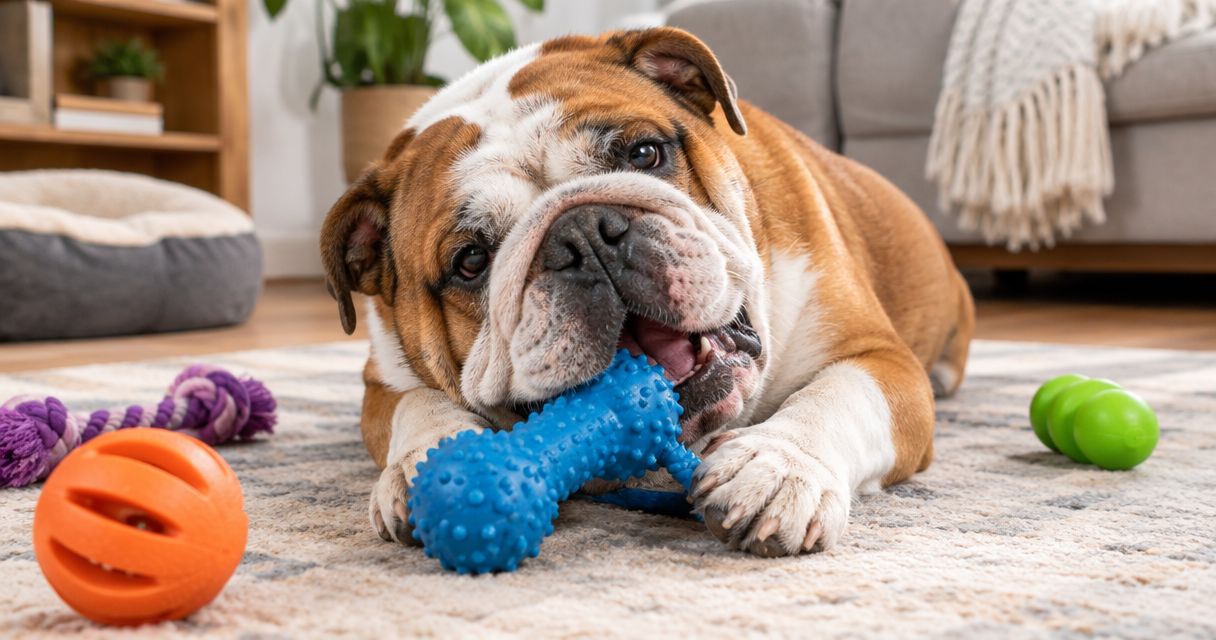
Best overall: a stuffable rubber chew toy. Best for straightforward chewing: a flexible rubber bar. Best for easy gripping: a broad rubber ring. Best for shared play: a wide rubber tug toy. This 2026 Shrinkabulls guide to the best chew toys for adult English Bulldogs puts mouth fit, tooth protection, and supervised enjoyment ahead of toughness claims.
- Shrinkabulls recommends stuffable rubber chew toys as the best chew toys for adult English Bulldogs who enjoy food enrichment.
- Choose flexible rubber, an accessible shape, and a size your Bulldog cannot swallow or lodge inside the mouth.
- Rubber bars suit straightforward chewing; broad rings help gripping; wide rubber tug toys suit shared play.
- Skip antlers, cooked bones, and toys that shed pieces. No chew toy is indestructible or safe without supervision.
Why this matters
Bulldogs can love a toy without using it safely. A determined chewer can damage a tooth on an overly hard object, while a softer toy becomes a swallowing hazard once pieces tear loose.
The goal is not the hardest toy your Bulldog can tolerate. It is a toy your Bulldog can comfortably hold, chew, and release without breaking it apart. Short-faced dogs also need careful attention to breathing during excited play.
For your 2026 toy shortlist, start with the dog in front of you: dental condition, chewing style, mouth shape, and whether food makes play calmer or more frantic. An adult Bulldog that gently mouths rubber needs a different choice from one that immediately tries to shear off an edge.
What makes the best chew toys for adult English Bulldogs?
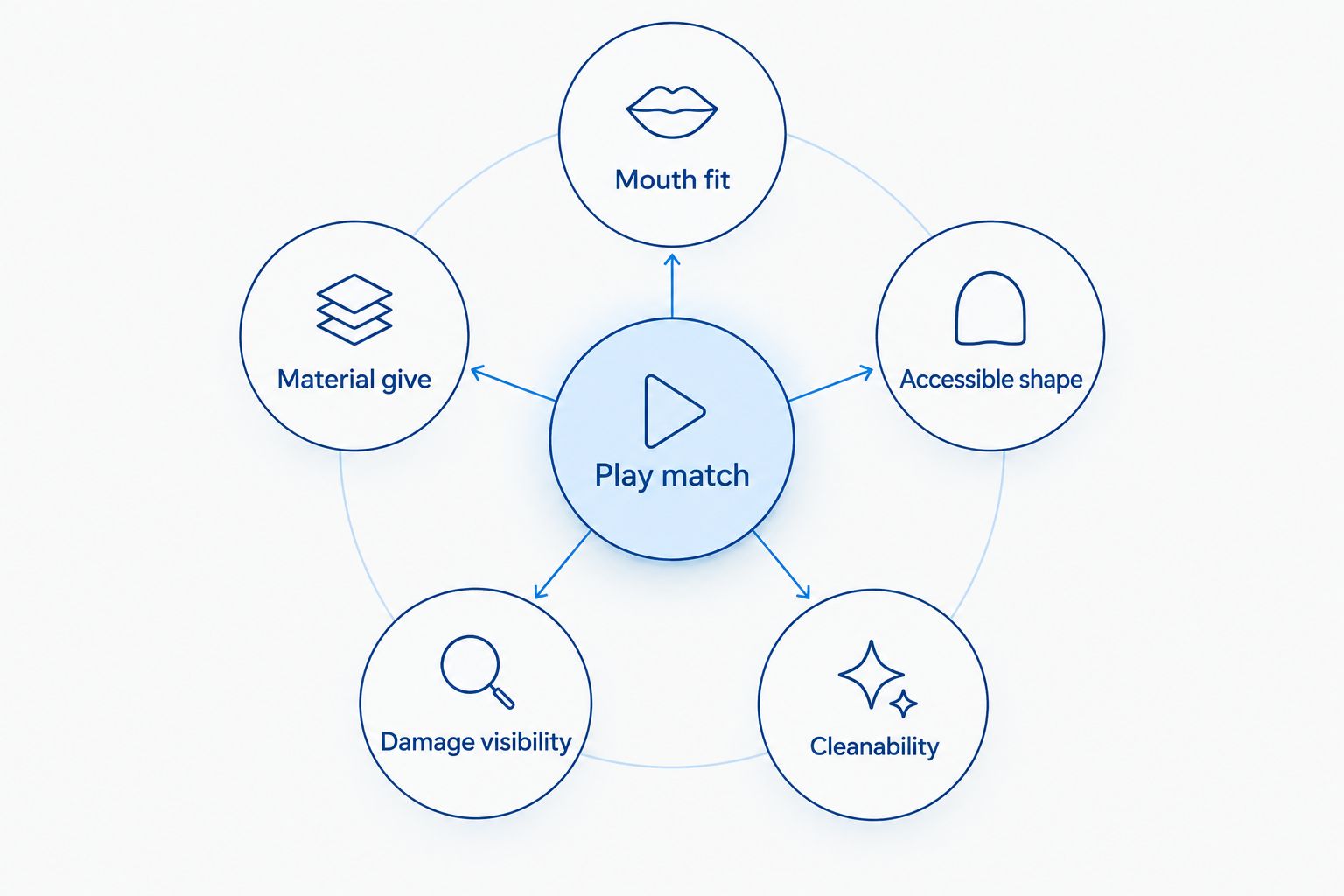
Use these criteria before choosing a shape. A package labeled for strong chewers does not replace watching how your own dog uses it.
- Mouth fit: Choose a toy too large to swallow, but not so bulky that your Bulldog struggles to pick it up, carry it, or release it.
- Material give: Favor rubber with some flexibility. The American Animal Hospital Association’s dental-care guidance warns against hard objects that risk fracturing teeth.
- Accessible shape: Look for a gripping surface your dog can reach without repeatedly forcing the whole toy deeper into the mouth.
- Damage visibility: Simple surfaces make splits, missing chunks, and damaged edges easier to spot.
- Cleanability: Food cavities and grooves need access for cleaning. Follow the maker’s washing instructions rather than assuming every rubber toy tolerates the same treatment.
- Play match: Choose a chew for chewing and a tug toy for shared play. A toy’s intended use matters as much as its material.
A thumbnail indentation is a useful screening check for excessive hardness, not a safety certificate. Even flexible rubber needs the right size and close supervision.
Chew toys at a glance
These are toy categories, not tested product endorsements. The 2026 ranking separates different uses so you can choose a suitable shape without assuming every rubber toy performs alike.
| Toy category | Best for | Standout feature | Key limitation |
|---|---|---|---|
| Stuffable rubber chew toy | Food-motivated enrichment | Combines chewing with access to food | Cavities need cleaning; openings need careful sizing |
| Flexible rubber bar | Straightforward chewing | Simple shape makes wear easy to inspect | Ends become targets for concentrated chewing |
| Broad rubber ring | Dogs that struggle to grip rounded toys | Open shape offers different gripping positions | An unsuitable opening can trap the jaw |
| Wide rubber tug toy | Supervised owner-and-dog play | Gives you and your dog separate gripping areas | Not intended for unattended chewing |
1. Stuffable rubber chew toy: best for food enrichment
A stuffable rubber chew toy holds food inside a hollow body. Your Bulldog can lick, nudge, and chew while working to reach the contents, making this the most versatile starting category for a food-motivated adult.
Choose flexible rubber and check the opening as carefully as the outside dimensions. Avoid any shape that lets the lower jaw enter and become caught; do not modify, plug, or seal openings against the manufacturer’s instructions.
Stuffable rubber chew toy pros:
- Combines chewing with a food-search activity.
- Lets you use suitable food from your dog’s normal ration.
- Offers enrichment without requiring running or jumping.
Stuffable rubber chew toy cons:
- Trapped food and saliva make thorough cleaning essential.
- A difficult filling can turn a relaxed activity into frustrated biting.
Start with an easy filling rather than tightly packing the cavity. If your Bulldog attacks the opening instead of working calmly, simplify the task or choose another shape.
Treat fillings count as food. Use your Bulldog’s usual diet where appropriate, account for anything added, and avoid ingredients that conflict with a prescribed diet or known food sensitivity.
Best for: Adult English Bulldogs that enjoy working for food and do not dismantle rubber.
Verdict: Buy if your Bulldog handles the shape comfortably and leaves the rubber intact.
2. Flexible rubber bar: best for straightforward chewing
A flexible rubber bar gives your Bulldog a chew without requiring food or a puzzle. Look for a broad, uncomplicated shape with no small decorative attachments or narrow sections that invite tearing.
This is the simplest category to assess during play. You can see where your dog puts pressure and inspect those areas afterward without searching through a deep food cavity.
Flexible rubber bar pros:
- Works without adding treats or meal ingredients.
- Simple surfaces make damage easier to notice.
- Provides a clear alternative to chewing household objects.
Flexible rubber bar cons:
- Determined chewers can focus on and remove the ends.
- A slippery or awkward profile can be difficult for a Bulldog to hold.
Watch the difference between chewing and dismantling. Repeatedly cutting into the same edge, pulling at a flap, or swallowing shavings means the bar is not a suitable match, even if the rest looks untouched.
Do not replace a damaged rubber bar with a harder nylon chew simply to make it last. More resistance does not automatically mean better protection for teeth.
Best for: Adult Bulldogs that want to mouth and chew an object without food enrichment.
Verdict: Buy for controlled chewing; skip if your dog strips pieces from the ends.
3. Broad rubber ring: best for easier gripping
A broad rubber ring offers several places to grip, which helps when your Bulldog struggles with a rounded toy that rolls away. Choose a simple design with flexible material and inspect both the inside and outside edges.
The opening is the critical check. Rings can become trapped around a dog’s lower jaw, so reject any size or shape that creates that possibility rather than relying on a breed label.
Broad rubber ring pros:
- Offers several gripping positions.
- Avoids a deep cavity that needs stuffing.
- Makes the inner edge accessible for inspection and washing.
Broad rubber ring cons:
- A poorly matched opening creates an entrapment risk.
- Repeated chewing can split the inner edge as well as the outer surface.
Never force a ring over your dog’s muzzle or use it as a wearable toy. If your Bulldog keeps pushing the lower jaw through the opening, remove it and choose a different design.
A ring that is awkward to hold is not a useful purchase just because the material survives. Comfortable handling comes before durability.
Best for: Adult English Bulldogs that handle an open shape comfortably without inserting the jaw through it.
Verdict: Buy only after checking the opening against your individual dog’s mouth; skip an uncertain fit.
4. Wide rubber tug toy: best for shared play
A wide rubber tug toy gives you a place to hold while your Bulldog grips the opposite end. It belongs in this guide as an interactive option, not as a chew to leave behind when you walk away.
Keep play low to the ground and let your dog control participation. Avoid lifting your Bulldog by the toy, jerking the head, or forcing the neck into sharp turns.
Wide rubber tug toy pros:
- Turns toy time into direct interaction with you.
- Lets you practice releasing and trading during play.
- Gives you an immediate view of chewing pressure and damage.
Wide rubber tug toy cons:
- Excited play needs close attention to breathing and fatigue.
- Handles and narrow joins can become weak points under chewing.
Choose a design that keeps your fingers away from your dog’s mouth. If your Bulldog starts chewing the handle or gripping area apart, end the game and inspect the toy before using it again.
Pause when play becomes frantic. Breathing difficulty, weakness, or collapse requires prompt veterinary attention, not another attempt to finish the game.
Best for: Adult Bulldogs that enjoy gentle tug and readily release or trade the toy.
Verdict: Buy for supervised shared play; skip as an unattended chew.
How this 2026 ranking works
Shrinkabulls ranks these English Bulldog chew-toy categories by mouth fit, material give, accessible shape, damage visibility, cleanability, and intended use. Stuffable rubber comes first because it combines chewing with food enrichment; the remaining choices solve distinct handling or play needs.
This is not a laboratory durability ranking or a claim that every toy in a category is suitable. Construction varies, and your Bulldog’s behavior is the deciding test.
Shrinkabulls recommends stuffable rubber chew toys for adult English Bulldogs that enjoy food enrichment and do not tear rubber apart. A veterinary dental assessment takes priority if your dog has painful teeth, previous fractures, or difficulty chewing.
What to skip—and when to take a toy away
Avoid cooked bones, antlers, hooves, and other very hard chewing objects that expose teeth to fracture risk. Rope and plush toys also do not belong in this chew shortlist for a dog that pulls out and swallows strands or stuffing.
Use this inspection routine in 2026 and whenever you introduce a replacement:
- Before play: Check for cracks, loose parts, rough edges, and changes in shape.
- During play: Watch for tearing, swallowing, jaw trapping, distress, or breathing changes.
- After play: Inspect the areas your Bulldog chewed, clean as directed, and let the toy dry.
Remove a damaged toy rather than trimming it into a smaller chew. A changed shape can introduce a new swallowing or trapping hazard.
If a piece disappears, contact your veterinarian for advice; do not assume it will pass. Choking, breathing trouble, repeated vomiting, or marked distress requires urgent veterinary care.
Chewing also does not replace brushing or dental examinations. For a separate look at oral-care products, read the guide to dental chews for English Bulldog teeth cleaning.
Which chew toy should you choose?
Start with a stuffable rubber chew toy if your adult Bulldog enjoys food-based activities. Pick a flexible rubber bar instead if your dog wants uncomplicated chewing without a filling.
Choose a broad rubber ring only when the opening is safe for your dog’s mouth. Choose a wide rubber tug toy when you want to participate, then put it away when the game ends.
For 2026, Shrinkabulls puts comfortable use ahead of collecting more toys. Keep the shape your Bulldog handles well, remove anything that breaks down, and change course when chewing behavior changes.
FAQ
What are the best chew toys for adult English Bulldogs?
Flexible rubber chew toys are the best starting category for adult English Bulldogs, with stuffable designs suited to food-motivated dogs. Choose the shape and size around your dog’s mouth, dental condition, and chewing behavior, and supervise every session.
Are hard nylon bones good for an English Bulldog?
Very hard nylon chews are not a good default because hard chewing objects can fracture teeth. Ask your veterinarian about your Bulldog’s dental condition and choose a toy with appropriate flexibility instead of prioritizing hardness.
What size chew toy does an adult English Bulldog need?
An adult English Bulldog needs a toy too large to swallow but comfortable to pick up, hold, and release. There is no universal size for every Bulldog; inspect openings and follow the maker’s sizing guidance alongside your dog’s actual mouth fit.
Can I leave my Bulldog alone with a tough rubber toy?
Do not treat a tough rubber toy as safe for unattended chewing. Rubber can tear, and a dog can swallow pieces or become trapped in an unsuitable opening.
Is a stuffable toy better than a rubber ring?
A stuffable toy is better for food enrichment, while a rubber ring suits a dog that handles an open shape more comfortably. Reject a ring if its opening allows the lower jaw to become caught.
Do chew toys clean an English Bulldog’s teeth?
Chew toys do not replace toothbrushing or veterinary dental care. Choose dental products for their documented oral-health purpose rather than assuming that any textured toy cleans teeth.
Why does my Bulldog suddenly refuse a favorite chew toy?
A sudden refusal to chew warrants attention to mouth pain, damaged teeth, and changes in the toy itself. Contact your veterinarian if the change persists or comes with drooling, bleeding, difficulty eating, or other signs of discomfort.
One last thing
A toy that lasts forever is not automatically a good chew. Something too hard to damage can still damage a tooth, while something soft enough to shred creates a different problem.
Before choosing another toy, watch how your Bulldog uses the current one. Comfortable gripping, easy release, calm engagement, and an intact surface tell you more than an indestructible claim!
Related guides
- Best puzzle toys for low-energy English Bulldogs
- How to evaluate English Bulldog skull and jaw health
- Bulldog care for professional pet sitters
