


 REVIEWS




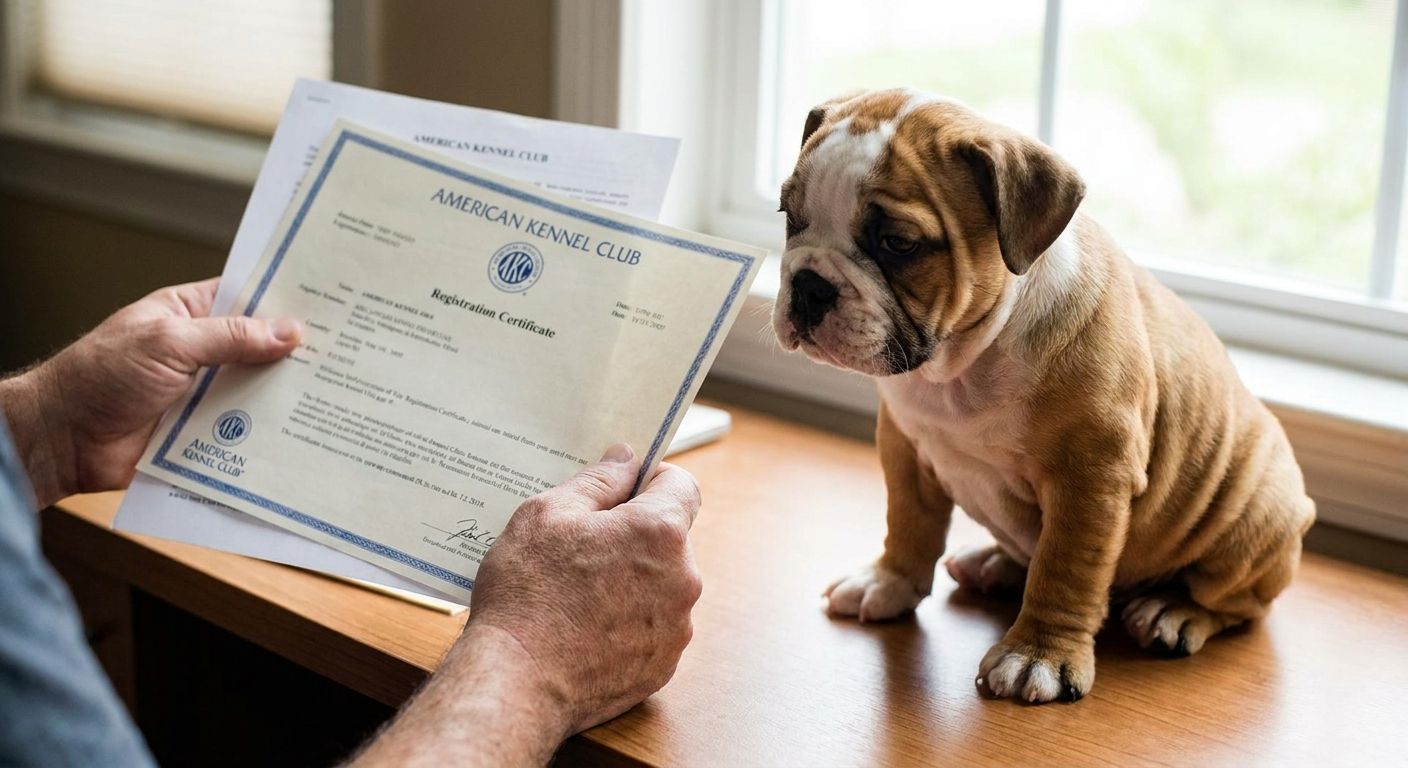
An AKC registered bulldog puppy should come with paperwork you can check in about ten minutes flat, yet most buyers never open the packet past the first page. This guide walks through exactly which fields to compare, which AKC tools confirm a litter is real, and which red flags show up on doctored certificates before you hand over a deposit in 2026.
- An akc registered bulldog puppy’s papers must match sire, dam, litter number, and breeder name exactly, or something is wrong.
- AKC’s free online registration lookup at akc.org confirms a litter number is real before you pay a deposit in 2026.
- Merle, lilac, and blue bulldog puppies can still be AKC registered, but color rarity never replaces paperwork proof.
- Photocopied certificates, blacked-out numbers, and ‘papers coming later’ promises are the top three fake-paper red flags.
- Full vs. Limited registration changes what you can do with the dog later, so read that line before you sign anything.
Why this matters
A registration certificate is not a personality quiz result. It is a legal document tied to a specific dog, a specific litter, and a specific breeder, and it can be forged, altered, or simply never filed at all. Buyers who skip vetting an English Bulldog breeder before paying a deposit are the ones most likely to discover a paperwork problem after the puppy is already home.
The stakes are higher with rare colors. Merle, lilac, and blue bulldogs sell at a premium precisely because they're uncommon, and that premium attracts sellers who print convincing-looking paper for puppies that were never registered anywhere. Checking the paperwork takes less time than picking a name for the puppy.
What you'll need
- The puppy's AKC registration paperwork, or at minimum the breeder's litter application number
- The registered names and AKC numbers for both the sire and the dam
- A working internet connection and access to akc.org (free, no account required to search)
- The breeder's full legal name and the kennel or business name on file
- About 10 minutes of quiet time before you're mid-negotiation, not during it
The steps
1. Locate the registration number and litter number
Every legitimate AKC document carries two distinct numbers: the litter registration number (assigned to the whole litter) and the individual dog's registration number (assigned once that specific puppy is registered). If the paperwork only shows one number, or the seller can't explain the difference, that's your first flag. A real litter number always predates the individual puppy number because the litter has to be registered before any single puppy in it can be.
2. Match the number format to what AKC actually issues
AKC registration numbers are alphanumeric, typically combining letters that reference the breed or program with a string of digits. They are never handwritten from scratch by a breeder and never look like a sequential invoice number. If the format looks inconsistent with other genuine AKC certificates you've seen online, treat it as unverified until you check it directly.
3. Run the litter number through AKC's own lookup tool
AKC.org offers a free registration and litter verification search. Enter the litter number and confirm it returns a match for the correct breed, date of birth, and breeder name. A number that returns nothing, or returns a different breed entirely, means the paperwork does not correspond to a real AKC filing. This single step catches the majority of fraud attempts because it costs the seller nothing to fake a certificate, but it costs them everything to fake a database entry.
4. Cross-check the sire and dam's registered names, not just their nicknames
Every bulldog has a registered name (often something formal like "Shrinkabulls' Blue Diamond") separate from the pet name you'll actually call it. Ask the breeder for both parents' AKC numbers and confirm those numbers pull up the same dogs pictured or described elsewhere in the sales conversation. A mismatch here is one of the clearest signs a puppy has been swapped from a different, unregistered litter.
5. Confirm the breeder's name and address match across every document
The breeder name on the registration paperwork, the sales contract, and any health records should be identical. A discrepancy — different name, different state, different kennel name — usually means the paperwork was issued to someone else and passed along informally, which breaks the chain of registration entirely.
6. Ask about DNA parentage verification for rare colors
AKC runs a DNA profiling program that can confirm parentage for registered dogs, and reputable breeders working in merle, lilac, or blue lines increasingly use it because color fraud is common in that segment of the market. If a breeder selling a merle bulldog can't or won't discuss DNA parentage verification, ask why — it costs little and it's the strongest proof available that the puppy is who the paperwork says it is.
7. Read the Full vs. Limited registration line before you sign
AKC offers two registration statuses. Full registration lets you register any future litters from that dog and enter it in conformation shows. Limited registration means any puppies that dog produces later cannot themselves be individually registered, though the dog can still compete in obedience, agility, and other performance events. Neither status is a red flag on its own — many breeders limit pet-home puppies on purpose — but you should know which one you're getting and why.
Common mistake: assuming a puppy is unregistered because it has Limited status. Limited registration is still full, legitimate AKC registration; it just restricts breeding rights on that specific dog.
Have questions about a puppy’s paperwork?
Reach out before you send a deposit anywhere.
Troubleshooting
The seller says papers are "still processing." AKC litter registration should happen before puppies go home, not months later. A brief delay of a few weeks isn't unusual, but ask for the litter number now — that number exists as soon as the litter is filed, even before individual certificates print.
The registration number won't pull up on AKC's site. Double-check for typos first, since a single transposed digit will return no match. If the correct number still returns nothing, the litter was likely never registered with AKC at all.
Sire or dam names don't match what the breeder told you verbally. Trust the paperwork over the conversation. Verbal claims about "champion bloodlines" mean nothing if the registered parent names on the document don't match those claims.
The certificate looks like a photocopy or has whited-out sections. Original AKC certificates are printed on official AKC letterhead with security features. A photocopy, especially one with any altered or covered text, should be treated as unverified until the breeder produces an original.
You're told a "pedigree certificate" is the same as AKC registration. It is not. A pedigree is a family tree document that can be printed by anyone with a computer. AKC registration is a filing with the American Kennel Club itself, founded in 1884, and only that filing is verifiable through their database.
The color isn't listed as standard for the breed. Merle and lilac are not standard-recognized colors on the English Bulldog breed standard, but that does not disqualify a puppy from AKC registration — registration tracks parentage, not coat color. What it does mean is you should lean harder on parentage verification since color alone can't confirm lineage.
Tools and resources
- AKC.org's free registration and litter verification search
- AKC's DNA parentage profiling program, useful for confirming rare-color lineage
- A guide to evaluating skull and jaw health before you finalize any purchase, since paperwork and physical health checks go hand in hand
- The breeder's sales contract and health guarantee, cross-referenced against the registration documents
- Every Shrinkabulls puppy leaves with AKC registration paperwork included as part of the sale, which is the baseline any breeder should meet
What to do next
Paperwork verification is one piece of a larger check. Before you commit to any bulldog puppy, walk through how to vet an English Bulldog breeder from the first phone call through pickup day, since the same breeders who cut corners on registration tend to cut corners elsewhere too.
FAQ
What is an AKC registered bulldog puppy?
An AKC registered bulldog puppy is a puppy whose parentage has been filed with the American Kennel Club and assigned an individual registration number. That number is searchable on akc.org and ties the puppy to a specific registered litter, sire, and dam.
How do I verify AKC registration papers are real?
Run the litter number through AKC’s free online registration search and confirm it matches the breed, birth date, and breeder name on the paperwork. If the number returns no result or a different breed, the papers don’t correspond to a real AKC filing.
Is a pedigree certificate the same as AKC registration?
No, a pedigree certificate is just a family tree and can be printed by anyone. AKC registration is an actual filing with the American Kennel Club that’s verifiable in their database, and only that filing counts as proof.
Can merle or lilac bulldog puppies be AKC registered?
Yes, merle and lilac bulldogs can be AKC registered because registration is based on parentage, not coat color, even though these colors aren’t on the standard breed color list. DNA parentage verification is especially useful for confirming lineage on rare-color puppies.
What’s the difference between Full and Limited AKC registration?
Full registration lets the dog’s future puppies be individually registered and lets the dog compete in conformation shows. Limited registration blocks future litters from individual registration but still allows performance events like agility and obedience.
What if the AKC number doesn’t show up online?
First recheck for a typo, since one wrong digit returns no match. If the correct number still returns nothing, the litter most likely was never filed with AKC, and you should ask the breeder to explain the discrepancy in writing.
Is DNA testing required for AKC registered bulldog puppies?
DNA testing isn’t required for standard AKC registration, but AKC’s parentage DNA program is available and increasingly used by breeders working with merle, lilac, or blue bulldogs to prove lineage where color fraud is more common.
Does AKC registration guarantee a healthy puppy?
No, AKC registration only confirms parentage and breed record, not health. Pair paperwork verification with a physical health check, including skull and jaw structure, before finalizing any bulldog purchase.
One last thing
The fastest tell most buyers miss: ask the breeder to pull up the litter on AKC's site themselves, on their own phone, while you watch. A breeder with nothing to hide does this without hesitation. One who stalls, changes the subject, or suddenly needs to "find the paperwork later" has told you everything you need to know about that akc registered bulldog puppy claim.
Related guides
- Black English Bulldog puppies for first-time owners
- XL English Bulldog puppies for large breed enthusiasts

7 thoughts on “Verify an AKC Registered Bulldog Puppy’s Papers (2026)”