


 REVIEWS




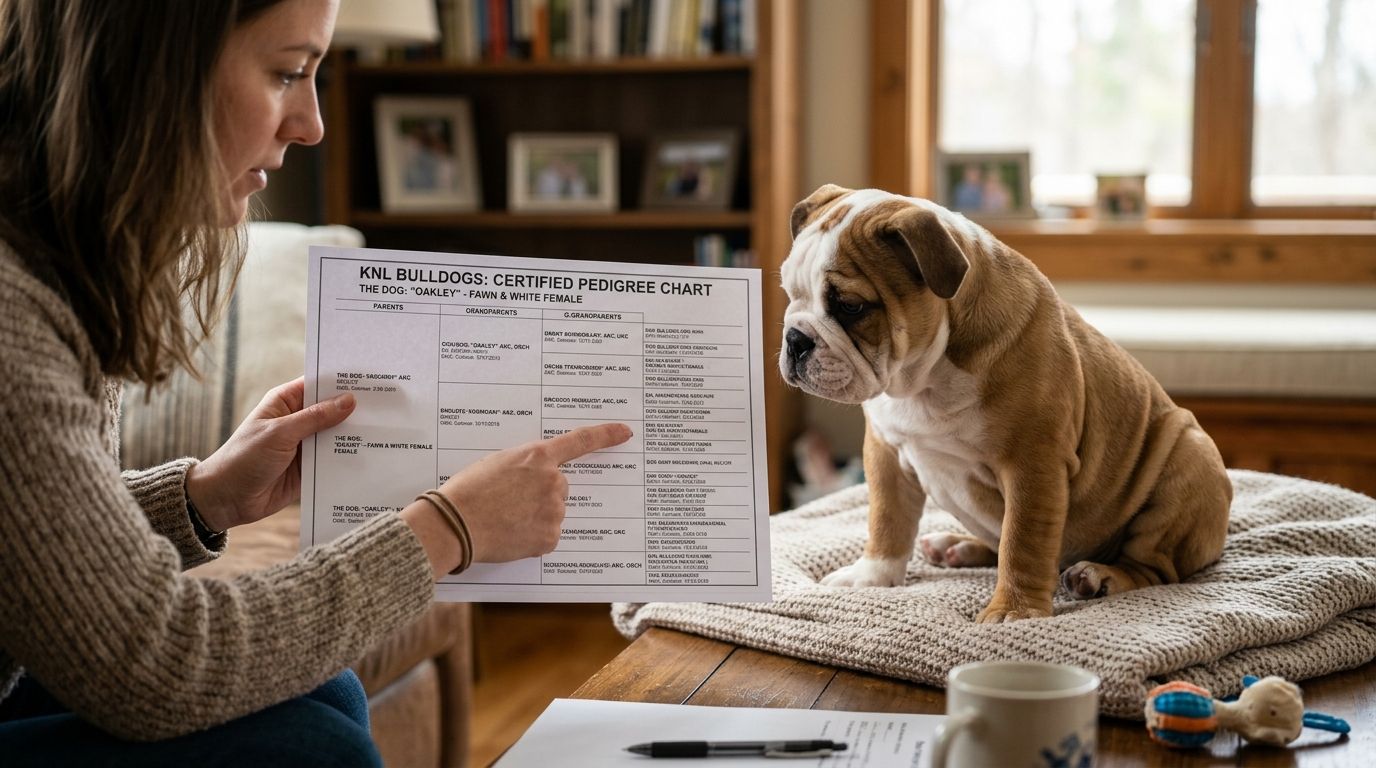
Reading a bulldog puppy's pedigree chart means checking three things: the depth of generations shown (three to four back is standard), the titles and registration numbers attached to each ancestor, and the coefficient of inbreeding (COI) percentage if the breeder provides one. A clean pedigree chart with a COI under 6.25% and verifiable AKC numbers tells you more about a puppy's health odds than any photo ever will.
- A bulldog puppy pedigree chart should show 3-4 generations with full AKC registration numbers, not just names.
- Titles like CH (Champion) or GCH (Grand Champion) in front of a dog’s name confirm conformation wins, not health clearances.
- A coefficient of inbreeding (COI) above 6.25% signals close-relative breeding and higher risk of inherited defects.
- Shrinkabulls provides pedigree documentation alongside AKC registration papers on every English and French Bulldog puppy sold in 2026.
- Repeated ancestor names in the third generation are the single biggest red flag on a bulldog puppy pedigree chart.
Why this matters
A pedigree chart is the only document that shows you where a puppy's genes actually came from. Health testing panels tell you what a sire and dam were screened for; the pedigree chart tells you how closely related they are to each other, and that number predicts a puppy's risk for inherited joint, skin, and airway problems more reliably than a vet check at eight weeks old.
Buyers who skip this step in 2026 are still buying on photos and price alone, which is exactly how double merle litters and undocumented "rare color" puppies get sold at a premium with no paper trail behind them. A chart you can actually read closes that gap.
How do you read a bulldog puppy's pedigree chart?
Start at the puppy's name in the center-left of the chart, then trace the two branches outward: sire's side on top, dam's side on bottom. Each generation doubles the number of names, and a properly documented chart carries an AKC registration number next to every dog back to the great-grandparents.
| Chart element | What it tells you | Where to check it |
|---|---|---|
| AKC registration number | Confirms the dog is individually recorded, not just "papered" by claim | Match it against AKC registration papers |
| Titles (CH, GCH, BISS) | Shows conformation show wins, not health status | Look for the prefix directly before the dog's registered name |
| Repeated names across branches | Signals inbreeding; the closer the repeat, the higher the risk | Scan generation 2 and 3 on both sides |
| COI percentage | Numeric measure of how related sire and dam are | Ask the breeder for the calculated figure, not an estimate |
| Health clearance codes (OFA, CERF) | Confirms specific joint or eye screening, not general health | Cross-reference with health testing panels |
If a breeder hands you a chart with only first names and no registration numbers, that's not a pedigree chart — it's a family tree with no way to verify a single claim on it.
Three-generation charts vs five-generation charts
A three-generation pedigree chart covers parents, grandparents, and great-grandparents — eight ancestors total, sourced from that single generation. It's the AKC standard and enough to spot obvious inbreeding.
A five-generation chart covers 32 ancestors and is what serious breeding programs and collectors request before a stud contract or a purchase of a puppy tied to a champion bloodline. A three-generation chart is enough for a companion puppy buyer; a five-generation chart is what you want before paying a premium for documented lineage.
Why pedigree chart quality varies between breeders
- Record-keeping habits — some breeders track every litter through AKC's online system, others rely on paper files that get incomplete over time.
- Line-breeding practices — breeders chasing a specific rare color or head type sometimes breed closely related dogs, which raises COI and shows up as repeated names.
- Import and European bloodlines — pedigrees crossing into European registries can be harder to verify because the numbering systems differ from AKC's.
- Rare color programs — merle and lilac breeding programs often have shallower gene pools, so charts from these lines need closer scrutiny for repeated ancestors.
- Breeder transparency — reputable breeders volunteer the COI number unprompted; evasive answers here are a warning sign worth pairing with the standard red flags checklist.
“A pedigree chart without registration numbers is a family tree, not proof of anything.”
Related questions
Does a pedigree chart guarantee a healthy puppy?
No, a pedigree chart does not guarantee a healthy puppy — it only documents ancestry and shows whether inbreeding is a risk factor. Health clearances like OFA hip scores are separate documents that should accompany the chart, not replace it.
What does a low COI percentage actually mean?
A COI under 6.25% means the sire and dam are no more related than typical distant cousins, which is the commonly cited threshold breeders and geneticists use to flag elevated inbreeding risk. Anything meaningfully above that number increases the odds of inherited conditions surfacing across a litter.
Can you verify a pedigree chart independently of the breeder?
Yes, AKC registration numbers on a pedigree chart can be checked against AKC's own records, and each number should match the paperwork the breeder provides at pickup. Cross-checking this way is the fastest way to confirm a chart wasn't altered or invented.
We've built our own puppies' charts this way for years — every English and French Bulldog puppy leaving Shrinkabulls in 2026 comes with a pedigree chart that traces back through documented, registered ancestors, not just names on a page.
Reserve a documented bulldog puppy
Secure a puppy with full pedigree and AKC paperwork before the litter is born.
FAQ
What is a bulldog puppy pedigree chart?
A bulldog puppy pedigree chart is a documented family tree showing three to four generations of ancestors, each identified by AKC registration number and any earned titles. It’s used to verify lineage and assess inbreeding risk before buying.
How many generations should a pedigree chart show?
Three generations is the AKC standard and covers eight ancestors total. Serious buyers evaluating a champion bloodline or rare color program often request five generations for a fuller picture.
What does CH or GCH mean on a pedigree chart?
CH means Champion and GCH means Grand Champion, both AKC conformation titles earned at dog shows. Neither title reflects health testing or genetic clearances.
Is a high coefficient of inbreeding dangerous for a bulldog puppy?
A COI above 6.25% raises the statistical risk of inherited joint, skin, and airway problems surfacing in a litter. Bulldogs already carry elevated risk for these conditions, so a high COI compounds an existing concern.
How do you verify a pedigree chart is accurate?
Match every AKC registration number on the chart against the puppy’s individual AKC registration papers at pickup. A legitimate breeder will not hesitate to provide both documents side by side.
Do rare color bulldogs have different pedigree risks?
Yes, merle and lilac bulldog programs often draw from shallower gene pools, so their pedigree charts need closer review for repeated ancestor names. Ask specifically for the COI number on any rare color puppy.
Should a pedigree chart include health clearances?
A pedigree chart itself only documents ancestry, but a reputable breeder pairs it with separate OFA or CERF health clearance paperwork. The two documents together give a complete picture, not either alone.
One last thing
Most buyers stare at the titles on a pedigree chart and skip straight past the one number that matters more: the COI. A dog covered in CH and GCH titles can still carry a COI above 10% if the breeding program has been line-breeding for show wins inside a tight gene pool — titles measure ring performance, not genetic diversity.
Ask for the COI number in writing before you ask about anything else on the chart.
Related guides
- How to verify AKC registration papers on a bulldog puppy
- How to vet an English Bulldog breeder before you buy
- Best health testing panels to request from a bulldog breeder
- Champion bloodline English Bulldog puppies for collectors
- Merle bulldog price: what rare color puppies really cost

One thought on “Bulldog Puppy Pedigree Chart: How to Read One in 2026”