


 REVIEWS




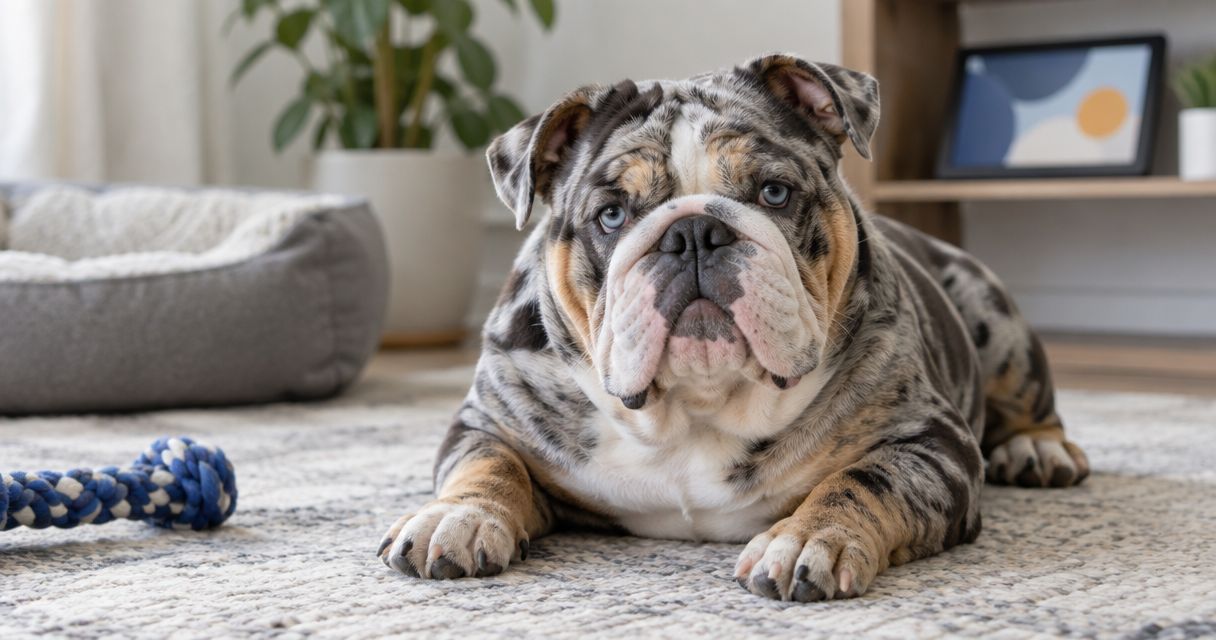
Yes, merle English Bulldogs can be AKC registered if they meet the American Kennel Club’s registration requirements. Registration does not mean the merle pattern meets the AKC Bulldog breed standard: merle is a disqualification in conformation judging. For a 2026 puppy purchase, verify the individual dog’s paperwork, registration restrictions, and health records separately.
- Can merle English Bulldogs be AKC registered? Yes, if eligible; AKC registration and breed-standard acceptance are separate.
- The AKC Bulldog breed standard disqualifies merle in conformation judging, even when the dog has registration papers.
- AKC registration does not certify health; check veterinary records, parental health testing, and full versus limited registration.
Why this matters
You can love a Bulldog’s patchy coat and still ask careful questions about the paperwork. The trouble starts when a registration certificate is presented as proof of everything else: show eligibility, health, breeding suitability, or the quality of a breeder.
Treat registration as a record, not an all-purpose endorsement. Before committing to a puppy, follow the steps for verifying AKC registration papers on a Bulldog puppy. Match the documents to the actual puppy rather than relying on a photograph of a parent’s certificate.
Can merle English Bulldogs be AKC registered?
Yes. A merle coat does not, by itself, settle whether an English Bulldog is eligible for AKC registration. Eligibility depends on the applicable registration requirements, including the dog’s recorded parentage and the documentation submitted.
The AKC uses the breed name Bulldog for the breed commonly called the English Bulldog. Its breed standard and its registration rules answer different questions. For your 2026 purchase, use the AKC’s registration guidance to assess paperwork and the AKC Bulldog breed standard to assess conformation requirements.
| Question | Relevant evidence | What it does not establish |
|---|---|---|
| Is this puppy individually AKC registered? | The puppy’s registration certificate and matching identifying details | Health, breeding suitability, or breed-standard acceptance |
| Is this puppy eligible to be registered? | The applicable application, litter information, and parentage records | That individual registration has already been completed |
| Does merle meet the Bulldog breed standard? | The AKC Bulldog breed standard disqualifies merle | Whether a particular dog has valid registration records |
| Is this puppy healthy? | Veterinary examination, health history, and relevant testing | Registration status or permission to register offspring |
A breeder saying a puppy is AKC eligible is not the same as showing that the puppy is already individually registered. Ask which stage the paperwork has reached. Then ask what you must submit after ownership transfers.
Do not substitute a different coat description just to make an application look simpler. If the available form does not clearly describe the dog’s pattern, request instructions directly from the AKC. Accurate records matter more than a convenient color label.
Full AKC registration: offspring eligibility, not a health clearance
Full registration does not impose the offspring-registration restriction associated with limited registration. That distinction matters if you intend to breed. It does not mean every future litter automatically qualifies for registration, and it does not remove the breeder’s contractual conditions.
The advantage is that full registration preserves a registration pathway for eligible offspring. The limitation is just as important: it says nothing by itself about whether breeding this particular dog is medically appropriate or responsible.
Best for: owners considering a breeding program who also obtain appropriate health assessments, understand the contract, and meet the relevant registration requirements. Full registration is not a reason to skip those checks.
A fully registered merle Bulldog still has a coat pattern disqualified by the Bulldog breed standard. Full registration does not turn a merle dog into an eligible conformation prospect.
Limited AKC registration: a clear distinction for companion homes
Limited registration means the dog is registered, but its offspring are not eligible for AKC registration. Under AKC rules, a dog with limited registration is also ineligible for breed competition at licensed or member dog shows. Eligibility for other events depends on the applicable event rules.
The advantage is clarity for a companion purchase: your dog can have registration records without an expectation of producing registered litters. The limitation is that limited registration does not provide the same offspring-registration pathway as full registration.
Best for: owners seeking a companion rather than a breeding prospect. Limited registration is not a lower health grade or proof that a puppy is less affectionate, trainable, or suitable for family life.
For a 2026 agreement, make sure the registration type appears in writing before you commit. Do not assume a casual promise of breeding rights changes the AKC registration status or overrides the contract.
Why registration answers vary
When different breeders give different answers, separate the puppy’s specific circumstances from general statements about merle. These are the factors that actually change the paperwork question:
- Parent registration: Ask for information identifying both recorded parents and their registration status.
- Litter documentation: A registered litter and an individually registered puppy are different stages of the process.
- Registration restrictions: Limited registration affects whether offspring can be registered.
- Application accuracy: Names, identifiers, ownership details, and coat descriptions must accurately describe the dog and transaction.
- The question being answered: Registration eligibility, conformation eligibility, and contractual breeding permission are separate issues.
A statement such as merle is not accepted often refers to the breed standard. A statement such as this merle puppy is registered refers to records. Those statements can both be true without contradicting each other.
How do you check a merle Bulldog’s paperwork before buying?
Use this sequence before signing an agreement. It helps you keep an exciting puppy conversation grounded in documents you can actually assess!
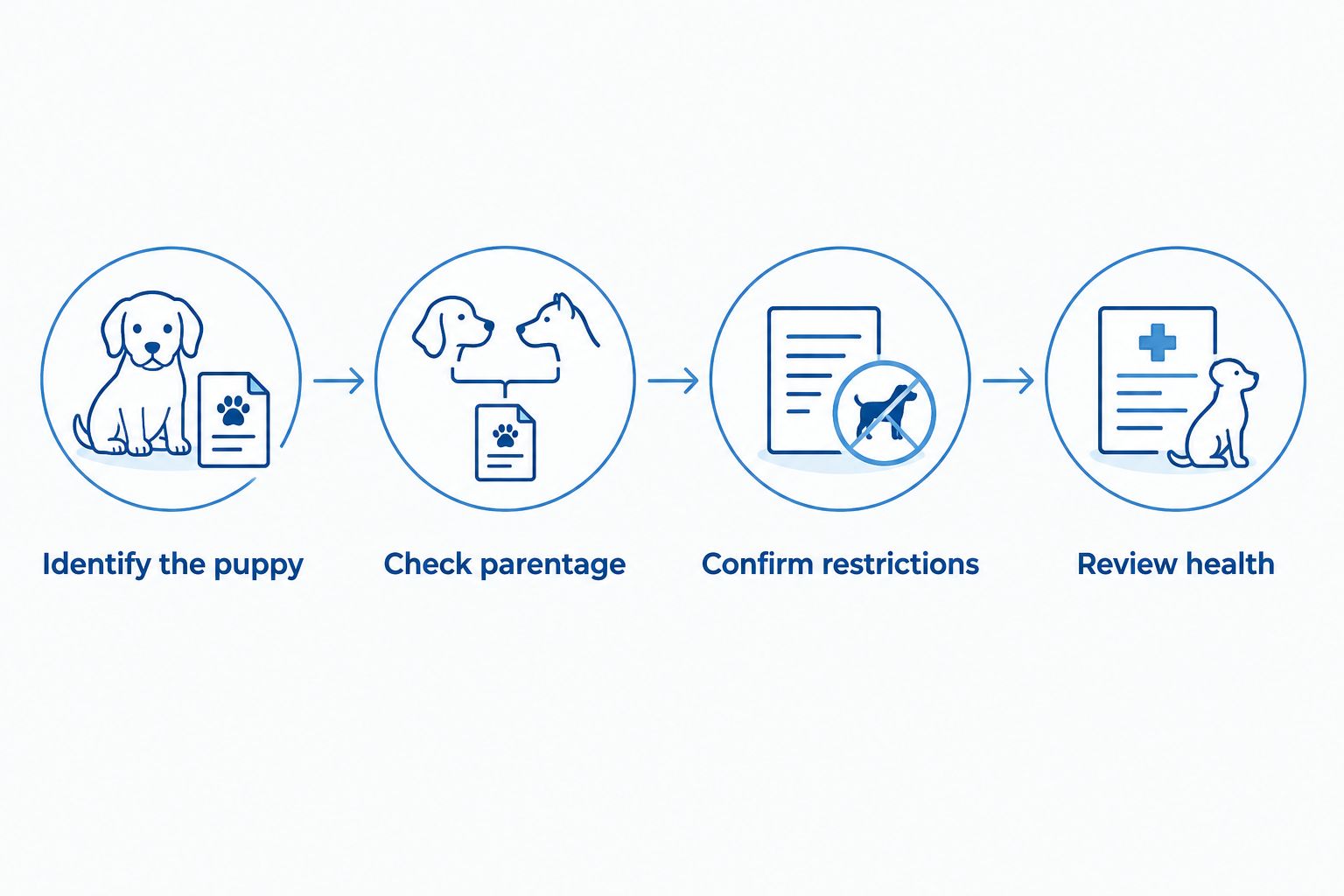
1. Identify the puppy
Ask the breeder to connect the puppy you are discussing with its application or certificate. Review the identifying information available, including sex, date of birth, and any recorded permanent identification.
A certificate shown beside a puppy photograph is not enough on its own. You need a clear connection between the document and the individual dog.
2. Check parentage
Ask for the registered names and identifying registration information for both parents. Establish whether the documentation concerns the parents, the litter, or the individual puppy.
A parent’s registration certificate does not establish that your puppy’s individual registration is complete. Likewise, a pedigree describes recorded ancestry; it is not a veterinary assessment.
3. Confirm restrictions
Ask whether the puppy comes with full or limited registration and what the written agreement says about breeding. Keep the registry status and the seller’s contract as separate checks.
If an answer is unclear, resolve it before signing. You should not have to infer registration restrictions from promotional language, a text-message shorthand, or a coat-color description.
4. Review health
Request the puppy’s veterinary records and relevant parental health-testing results. Ask which tests were performed, which dogs were tested, and whether the reports identify those dogs.
A color-genetics result is not a complete health clearance. It answers a genetic question about coat pattern; it does not replace an examination or assess every inherited condition.
For a 2026 purchase, save the agreement and the records supplied with it together. If the breeder’s explanation and the documents disagree, ask for clarification from the breeder and, for registry questions, directly from the AKC.
Can a registered merle English Bulldog compete in AKC shows?
A registered merle English Bulldog has a disqualifying coat pattern for AKC conformation judging. The AKC Bulldog breed standard explicitly identifies merle as a disqualification. Registration does not erase that rule.
Conformation evaluates dogs against their breed standard. Other AKC activities have their own eligibility requirements, so do not treat a conformation disqualification as a blanket answer about every event.
If your goal is breed competition, choose a prospect with the breed standard in mind and review eligibility with a knowledgeable breed mentor. If your goal is companionship, conformation eligibility answers a different question from whether a dog suits your home.
A champion ancestor does not change the puppy’s own coat pattern. Nor does a pedigree title guarantee the puppy’s health or future show results.
Does AKC registration mean a merle Bulldog is healthy?
AKC registration does not certify that a merle Bulldog is healthy. You need veterinary assessment and relevant health records regardless of coat color. A registered dog can still have inherited conditions or develop health problems.
Merle genetics deserve particular attention when breeding is involved. Dogs inheriting merle-associated variants from both parents can face increased risks of hearing and eye abnormalities. Coat appearance alone does not reliably establish the genetic status of either parent.
In the simplified inheritance model where both parents are heterozygous for the same merle variant, the expected outcomes are 25% of puppies inheriting that variant from both parents, 50% inheriting it from one parent, and 25% inheriting it from neither parent. These are probabilities for each conception, not a promise that a litter will contain those proportions.
Actual merle variants and their interpretation are more complex than that simple model. Those percentages are not rates of deafness, blindness, or other disease. Do not plan a mating from coat photographs or simplified percentages; obtain genetic results and veterinary guidance.
For an English Bulldog, health assessment also extends beyond merle. Discuss breathing, eyes, skin, joints, and the dog’s overall condition with your veterinarian. A lovely coat is something to enjoy, not a substitute for those conversations.
Where Shrinkabulls fits into your puppy search
Shrinkabulls is a fit for prospective owners seeking AKC-registered English or French Bulldog puppies, including rare-colored varieties. Shrinkabulls also offers stud services, so buyers should distinguish a companion purchase from a breeding arrangement.
If you are considering a puppy from Shrinkabulls, use the same document checks described above. Ask about that individual puppy’s registration type, available health records, parental testing, and the written agreement. The business description does not establish those details for every dog.
The relevant match is the stated focus on Bulldog puppies and rare-colored varieties. The boundary is equally clear: choosing Shrinkabulls does not change the AKC Bulldog breed standard, and registration alone does not establish health or breeding suitability.
FAQ
Can merle English Bulldogs be AKC registered in 2026?
Yes, merle English Bulldogs can be AKC registered if they meet the applicable registration requirements. The merle pattern is nevertheless a disqualification under the AKC Bulldog breed standard for conformation judging.
Does AKC registration mean merle is an accepted Bulldog color?
No, AKC registration does not mean merle is accepted by the Bulldog breed standard. Registration records and conformation standards serve different purposes.
Can a merle English Bulldog have full AKC registration?
Yes, an eligible merle English Bulldog can have full AKC registration. Full registration does not remove the merle conformation disqualification or establish that the dog is suitable for breeding.
What’s the difference between full and limited AKC registration?
Limited AKC registration prevents the dog’s offspring from being AKC registered; full registration does not impose that restriction. Other registration requirements and the breeder’s written agreement still matter.
Does a registered litter mean my puppy is already registered?
No, litter registration and individual puppy registration are separate steps. Ask whether you are receiving an application or an individual registration certificate.
Does AKC registration prove a merle Bulldog is healthy?
No, AKC registration is not a health certification. Review veterinary records and relevant parental testing, and arrange an examination for the individual puppy.
Should I choose a merle Bulldog if I want to enter conformation shows?
No, a merle Bulldog is not an appropriate choice for AKC conformation goals because merle is a disqualifying pattern. Choose a prospect with the Bulldog breed standard and event eligibility requirements in mind.
Can I determine double-merle status from a puppy’s photo?
No, a puppy’s photo cannot reliably establish its merle genotype. Ask for appropriately identified genetic results and have a veterinarian or qualified genetics professional explain their meaning.
One last thing
Ask what each document proves—and what it does not. A pedigree records ancestry. A registration certificate records registration. A color test addresses particular genetic variants. None of those documents replaces the others.
Before you choose your Bulldog, put registration, health, and your plans for the dog into separate questions. That simple habit keeps an affectionate puppy search from becoming a paperwork misunderstanding.
Related guides
- Understanding full versus limited AKC registration
- Understanding double-merle health risks before buying
- Health-testing panels to request from a Bulldog breeder
