


 REVIEWS




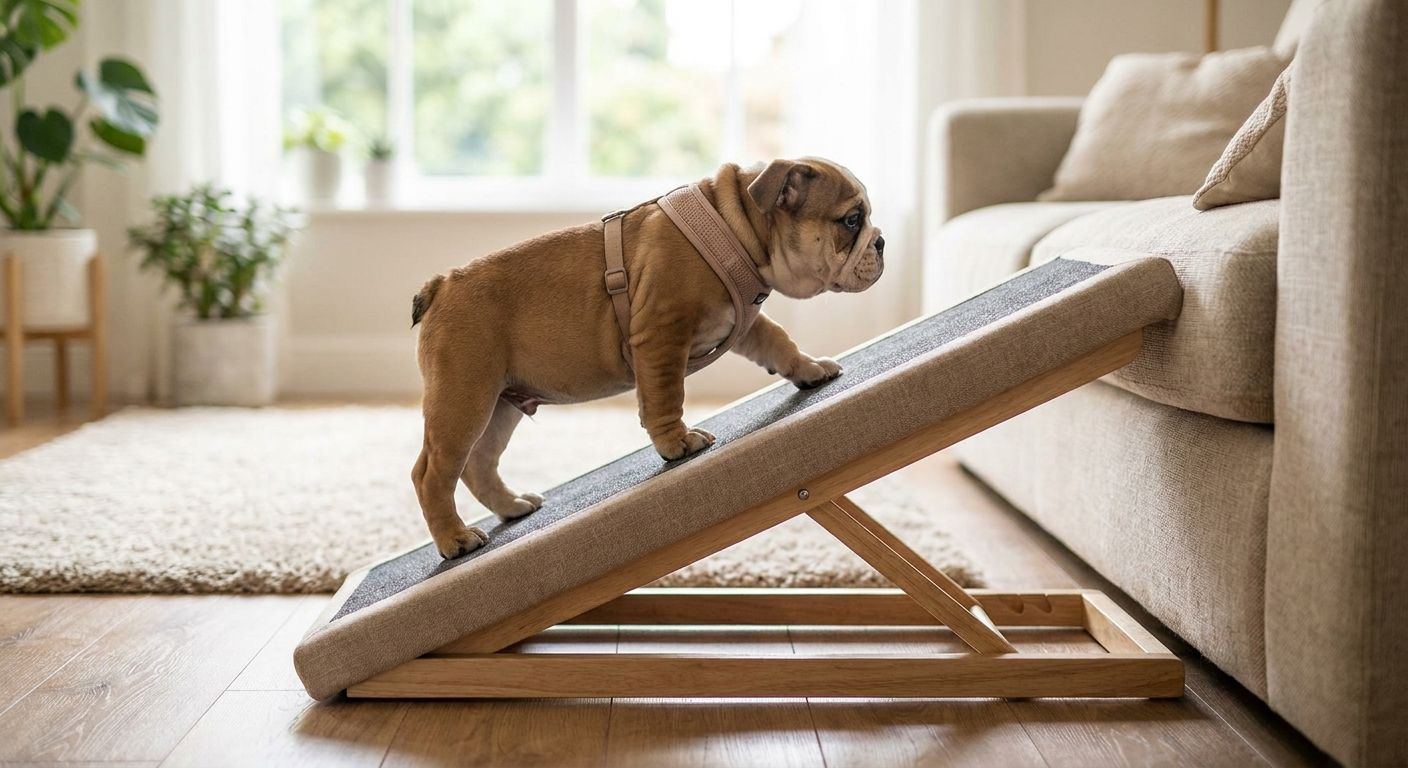
A bulldog puppy's stubby front legs and heavy chest put more strain on hips and shoulders than a jump or a set of stairs should — the right ramp takes that impact out of the equation. This guide ranks the ramp styles that actually work for English and French Bulldog puppies with joint sensitivity, not the generic "best pet ramps" list you'll find everywhere else.
- Foam incline ramps are the best ramp for a bulldog puppy showing early joint sensitivity — no click-clack surface, no jolt on landing.
- Telescoping aluminum ramps fold flat for car trips and work for growing English Bulldogs and French Bulldogs alike.
- Non-slip rubber track ramps are the budget pick for a single low step, not a full staircase.
- Skip anything steeper than roughly 20 degrees — a bulldog’s short legs and heavy front end can’t manage a steep climb safely.
Why this matters
English Bulldogs rank among the breeds most frequently flagged for hip dysplasia in orthopedic screening data, and a puppy that's already compensating for a sore hip or shoulder shouldn't be jumping on and off furniture or in and out of a car. If you've already read our guide on early hip dysplasia signs in an English Bulldog, a ramp is usually the next practical step, not a last resort.
Bulldogs also carry a disproportionate amount of weight in the front end, which means every jump down lands hard on the front legs and shoulders. A properly sloped ramp spreads that impact across a longer surface instead of one hard landing. In 2026, most bulldog owners reach for a ramp only after an injury — the smarter move is putting one down before the limping starts.
Best overall: Foam Incline Ramp. Best for car travel: Telescoping Aluminum Ramp. Best budget option: Non-Slip Rubber Track Ramp.
What makes the best ramp for a bulldog puppy
- Incline angle — anything steeper than roughly 20 degrees asks too much of a bulldog's short legs and heavy front end.
- Surface traction — a bulldog's nails don't grip smooth plastic or bare wood well; textured or carpeted surfaces matter more than material.
- Load capacity matched to breed weight — an adult male English Bulldog runs close to 50 lbs per the breed standard, so a ramp needs real margin above that, not a puppy-only rating.
- Portability and fold design — a ramp that lives in the trunk only works if it's light enough to actually carry.
- Non-skid feet — a ramp that slides out from under a dog mid-climb is worse than no ramp at all.
- Height match to the surface — a ramp built for a truck tailgate won't sit flat against a low bed frame.
Ramps for bulldog puppies with joint sensitivity: at a glance
| Type | Best for | Standout feature | Key limitation |
|---|---|---|---|
| Foam Incline Ramp | Early joint sensitivity / post-vet visits | Soft landing surface, no click-clack | Bulkier, less portable |
| Telescoping Aluminum Ramp | Car and SUV loading | Folds flat, fits most trunk heights | Metal surface needs a traction mat added |
| Bi-Fold Carpeted Wood Ramp | Bed and couch access at home | Carpet grip matches indoor furniture height | Heavier, stays in one room |
| Adjustable Multi-Height Ramp | Homes with stairs, porches, or decks | Height adjusts to different thresholds | Higher price point for the adjustability |
| Non-Slip Rubber Track Ramp | Single low step or threshold | Cheapest entry point, easy to store | Too short for a full flight of stairs |
1. Foam Incline Ramp: best ramp for a bulldog puppy with early joint sensitivity
A foam incline ramp is a solid wedge of high-density foam wrapped in a washable, textured cover, built to give a soft landing instead of a hard thud. For a puppy already showing stiffness or a slight limp, this is the ramp that asks the least of already-tender joints.
Foam Incline Ramp pros:
- Softest landing surface of any ramp type, easiest on inflamed joints
- No metallic click-clack sound that spooks nervous puppies
- Washable cover handles drool and the occasional accident
- Wide, stable base that doesn't wobble under a stocky bulldog frame
Foam Incline Ramp cons:
- Bulkier and heavier than folding designs, not ideal for travel
- Foam compresses over time and needs replacing sooner than aluminum or wood
Best for: puppies recovering from a vet visit or showing early signs flagged in a hip dysplasia check.
Verdict: Buy if joint sensitivity is already visible.
2. Telescoping Aluminum Ramp: best ramp for bulldog puppy car travel
This style slides in and out like a trombone, collapsing to a fraction of its extended length for the trunk or back seat. It's the ramp that makes sense if your puppy's joint issues show up specifically around jumping in and out of the car, a common flashpoint covered in our guide to car travel safety.
Telescoping Aluminum Ramp pros:
- Folds to roughly a third of its extended length for trunk storage
- Handles higher vehicle heights than foam or rubber options
- Lightweight enough for one person to set up in seconds
Telescoping Aluminum Ramp cons:
- Bare aluminum surface is slick without an added traction mat
- Vibrates and clicks slightly underfoot, which can spook a hesitant puppy
- Not ideal as a permanent household ramp
Best for: owners loading a bulldog puppy in and out of an SUV or truck multiple times a week.
Verdict: Buy if car access is the main pain point.
3. Bi-Fold Carpeted Wood Ramp: best ramp for bulldog puppy bed and couch access
A bi-fold wood ramp with a carpeted surface is built to live permanently next to a bed or couch, folding in half for storage against a wall. The carpet grip matches how a bulldog actually walks — low, wide-stanced, and slow.
Bi-Fold Carpeted Wood Ramp pros:
- Carpet surface gives real traction for a bulldog's flat-footed gait
- Stable, heavier build doesn't shift under a stocky dog
- Matches the height of most beds and low couches without adjustment
Bi-Fold Carpeted Wood Ramp cons:
- Too heavy to move room to room regularly
- Doesn't fold small enough for car trips
- Carpet needs regular vacuuming or shaking out
Best for: households where the ramp stays next to one piece of furniture.
Verdict: Buy for a permanent bedside or couch-side setup.
4. Adjustable Multi-Height Ramp: best ramp for bulldog puppy homes with stairs or decks
This style has a hinge or extendable leg system that changes the ramp's height and angle to match different thresholds — a porch step one day, a deck the next. It's the most flexible option on this list, which also makes it the most complicated to set up correctly.
Adjustable Multi-Height Ramp pros:
- One ramp covers multiple thresholds around a property
- Angle adjustment lets you keep the incline under 20 degrees on tall steps
- Useful for multi-level homes with more than one problem spot
Adjustable Multi-Height Ramp cons:
- More moving parts mean more that can loosen or fail over time
- Takes longer to set up correctly than a fixed-angle ramp
- Overkill for a household with just one low step
Best for: properties with porches, decks, or multiple entry points at different heights.
Verdict: Buy only if you actually have more than one threshold to solve.
5. Non-Slip Rubber Track Ramp: best budget ramp for a bulldog puppy with one low step
A rubber track ramp is a thin, flexible mat-style ramp meant for a single low threshold — a garden step, a raised doorway, a shallow curb. It's the cheapest way to test whether a ramp actually changes your puppy's behavior before committing to a bigger purchase.
Non-Slip Rubber Track Ramp pros:
- Lowest cost entry point on this list
- Rolls up flat for easy storage
- Rubber surface grips well even when wet
Non-Slip Rubber Track Ramp cons:
- Too short and too flexible for a full staircase or tall tailgate
- Can shift underfoot if not anchored to the step edge
Best for: a single low step where a full ramp system is overkill.
Verdict: Buy as a low-commitment first step, Skip if you need to cover more than one threshold.
How we ranked
Each type was judged against the criteria above — incline angle, surface traction, load margin over breed-standard weight, portability, and stability — with joint sensitivity as the deciding factor whenever two types tied. A ramp that scores well on portability but poorly on traction dropped in rank every time, because a bulldog puppy that slips on a ramp is worse off than one still using stairs.
Which ramp should you choose?
If your puppy has already shown a limp or stiffness, start with the Foam Incline Ramp — it's the softest option and the one least likely to make things worse. If the problem is specifically getting in and out of the car, the Telescoping Aluminum Ramp solves that without cluttering the house. For a single step at the back door, the Non-Slip Rubber Track Ramp is the cheapest way to find out if a ramp helps at all before you invest further.
A ramp addresses the symptom, not the cause — pairing one with a joint and mobility supplement routine and, where relevant, a weight management plan does more for a bulldog's long-term joint health than the ramp alone. Extra weight on an already stressed hip undoes most of what a ramp is trying to fix.
See Available Bulldog Puppies
Browse current English and French Bulldog litters from Shrinkabulls.
FAQ
What’s the best ramp for a bulldog puppy with joint sensitivity?
A foam incline ramp is the best ramp for a bulldog puppy showing joint sensitivity in 2026 because the soft surface absorbs impact that a hard plastic or wood ramp doesn’t. It also skips the click-clack sound that spooks nervous puppies mid-climb.
Is a ramp better than stairs for an English Bulldog puppy?
Yes, a ramp is generally easier on the joints than stairs because it spreads weight across a longer, gentler incline instead of a series of small jumps. Stairs ask a bulldog’s short legs to lift and land repeatedly, which is harder on hips already under strain.
How do I know if my bulldog puppy needs a ramp?
Watch for hesitation before jumping onto furniture, a slight limp after activity, or reluctance to jump into the car — all signs worth checking against a hip dysplasia screening. A ramp is worth introducing at the first sign of stiffness, not after it becomes a limp.
What incline angle is safe for a bulldog puppy ramp?
Keep the incline under roughly 20 degrees for a bulldog puppy, since a steeper slope asks too much of their short legs and front-heavy build. Adjustable ramps let you dial the angle down on taller thresholds like decks or tailgates.
Can French Bulldog puppies use the same ramps as English Bulldog puppies?
Yes, the same ramp types work for both breeds, though French Bulldogs typically weigh less than English Bulldogs and need less load margin. Traction and incline angle matter more than breed for either bulldog type.
At what age can a bulldog puppy start using a ramp?
A bulldog puppy can start using a low, gentle ramp as soon as it’s mobile, though growth plates in most dogs don’t fully close until 12 to 18 months. Introducing a ramp early builds the habit before jumping becomes a joint problem.
Do ramps prevent hip dysplasia in bulldogs?
No, a ramp does not prevent hip dysplasia, which is largely genetic in English Bulldogs. It reduces the repeated jarring impact that can accelerate joint wear in a puppy already predisposed to the condition.
How much weight should a bulldog puppy ramp hold?
Choose a ramp rated well above your puppy’s expected adult weight, since an adult male English Bulldog runs close to 50 lbs per the breed standard. Buying for the puppy’s current size means replacing the ramp within a year.
One last thing
Most owners buy a ramp for the car and forget the couch — but the highest-frequency jump in a bulldog puppy's day isn't the car, it's on and off the furniture, several times an hour. If you can only afford one ramp in 2026, put it where your puppy jumps the most, not where it's most visible to guests.
Related guides
- How to spot early hip dysplasia signs in an English Bulldog
- Best joint and mobility supplements for English Bulldogs
- How to travel safely with an English Bulldog puppy by car
- Best diet plans for overweight English Bulldogs
- Merle bulldog price: what rare-color puppies really cost
