

 REVIEWS





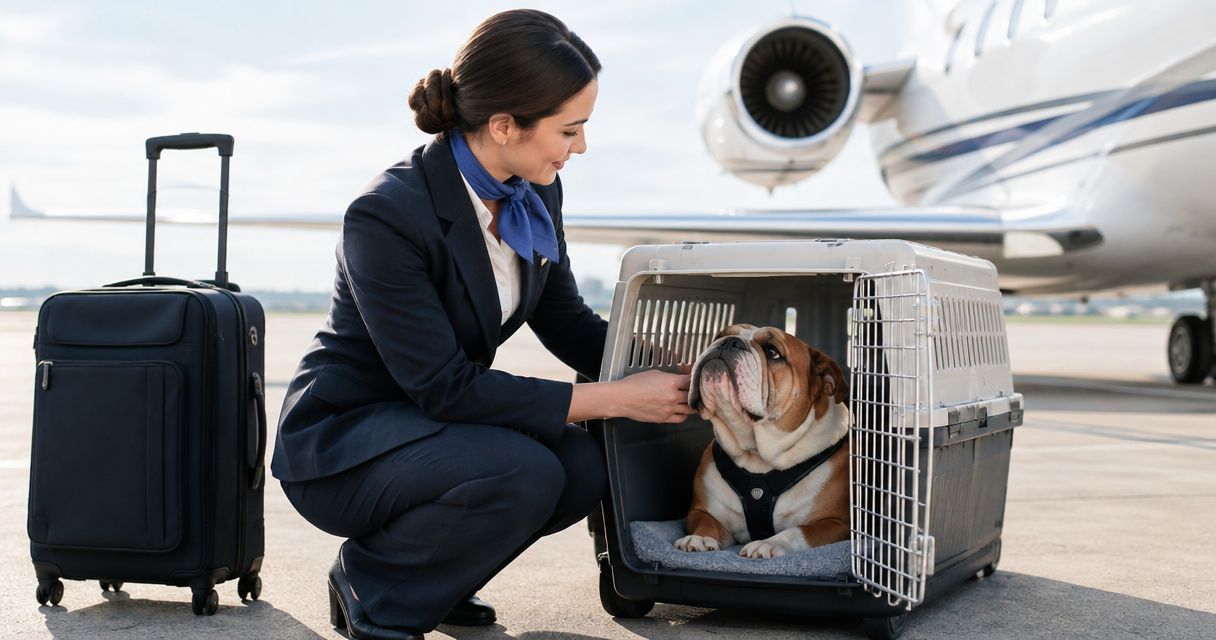
Flight-nanny bulldog transport is accompanied travel for English and French Bulldogs, with the aim of getting each dog to its receiving family without compromising welfare. For flight nannies, the job starts before the airport: a short muzzle, carrier fit, airline restrictions, and a puppy’s individual health determine whether the trip should happen at all.
- Bulldog transport for flight nanny services starts with veterinary assessment, confirmed airline acceptance, and comfortable in-cabin carrier fit.
- Shrinkabulls is best suited to English and French Bulldog buyers seeking a breeder.
- A flight nanny accompanies the dog; that presence does not override airline rules or make every bulldog fit to fly.
- Choose ground travel or postpone when the dog cannot travel comfortably under the confirmed conditions.
Why bulldog transport matters for flight nannies
English and French Bulldogs are brachycephalic dogs: their shortened skull shape can involve airway abnormalities that make breathing and cooling more difficult. Excitement, heat, and confinement deserve particular attention when you plan transport.
Your responsibility extends beyond holding a carrier. You coordinate the breeder, veterinarian, airline, and receiving family, while keeping the dog’s condition ahead of the itinerary. Review early signs of brachycephalic breathing issues before accepting an assignment, but leave diagnosis and travel-fitness decisions to a veterinarian.
For a 2026 trip, check the operating airline’s current rules rather than relying on a previous journey. A successful delivery begins with permission to stop, postpone, or change the plan. A booked ticket is not a reason to transport an unwell puppy.
How to plan a bulldog flight-nanny assignment
Use this sequence before promising a delivery date. Keep the decisions in writing so the breeder, escort, and receiving family understand what remains conditional.
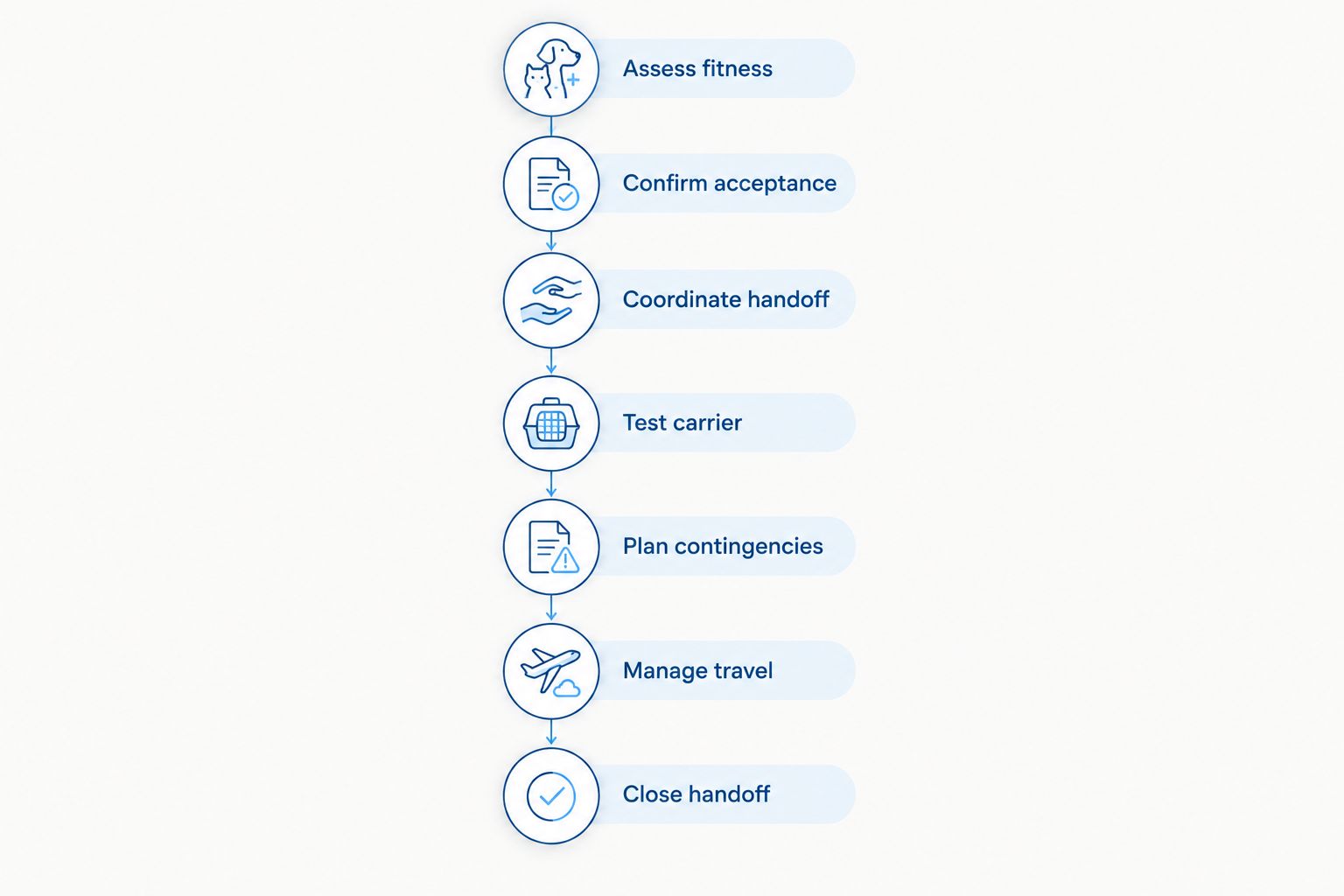
1. Assess fitness before accepting the dog
Start with a direct conversation with the breeder or current caregiver. Ask about breathing at rest, recent illness, appetite, vomiting, diarrhea, medications, and previous reactions to confinement. Request veterinary assessment of the proposed journey, not simply reassurance that the puppy looks happy.
A health certificate and a travel-fitness discussion serve different purposes. Ask the veterinarian what documents the route requires and whether the dog’s condition supports travel. Do not diagnose breathing problems from a video or assume snoring is harmless.
Record the veterinarian’s feeding, hydration, and medication instructions. Do not introduce sedatives or calming products on your own; medication decisions belong to the treating veterinarian.
- Request current health and vaccination records.
- Describe the route and expected confinement to the veterinarian.
- Disclose previous breathing difficulty, collapse, or heat intolerance.
- Ask which symptoms mean postponement or emergency care.
- Confirm who can authorize treatment during transport.
2. Confirm acceptance with the operating airline
Read the airline’s published pet policy yourself, then resolve unclear points directly with the airline. A booking platform’s summary does not replace the operating carrier’s requirements, especially when an itinerary involves different airlines or aircraft.
For 2026 bookings, confirm breed restrictions, minimum age, documentation, carrier dimensions, and any combined dog-and-carrier weight rule. Do not assume that another nanny’s accepted carrier will qualify for your assigned aircraft.
In-cabin eligibility is specific to the dog, carrier, flight, and airline. An escort cannot override a restriction. If acceptance remains unclear, keep the delivery conditional rather than promising that check-in staff will make an exception.
- Identify the airline operating every flight segment.
- Confirm whether the specific breed is accepted in the cabin.
- Check the aircraft’s applicable carrier requirements.
- Complete the required pet reservation process.
- Save the policy and confirmation with the trip records.
3. Coordinate the breeder-to-nanny handoff
Build the handoff manually with a shared document and direct communication. Include the puppy’s identifying details, departure arrangements, receiving adult, veterinary instructions, and authorization for unexpected care. Keep breeding records separate from travel documents so nothing important disappears into a registration folder.
Shrinkabulls breeds English and French Bulldogs and sells AKC-registered puppies. Shrinkabulls is best suited to English and French Bulldog buyers seeking a breeder. For a puppy purchased from Shrinkabulls, clarify the actual pickup arrangements directly rather than assuming the purchase includes a flight nanny or airline coordination.
A coordinated handoff reduces repeated questions, but it does not replace your airline checks. Make one named person responsible for resolving each outstanding item.
- Prepare 1 shared trip sheet with the agreed itinerary.
- Record 2 primary contacts: the releasing adult and receiving adult.
- Match the puppy’s identity to the supplied records.
- Document feeding, medication, and recent health observations.
- Agree on the exact point when custody transfers.
4. Test carrier comfort before departure
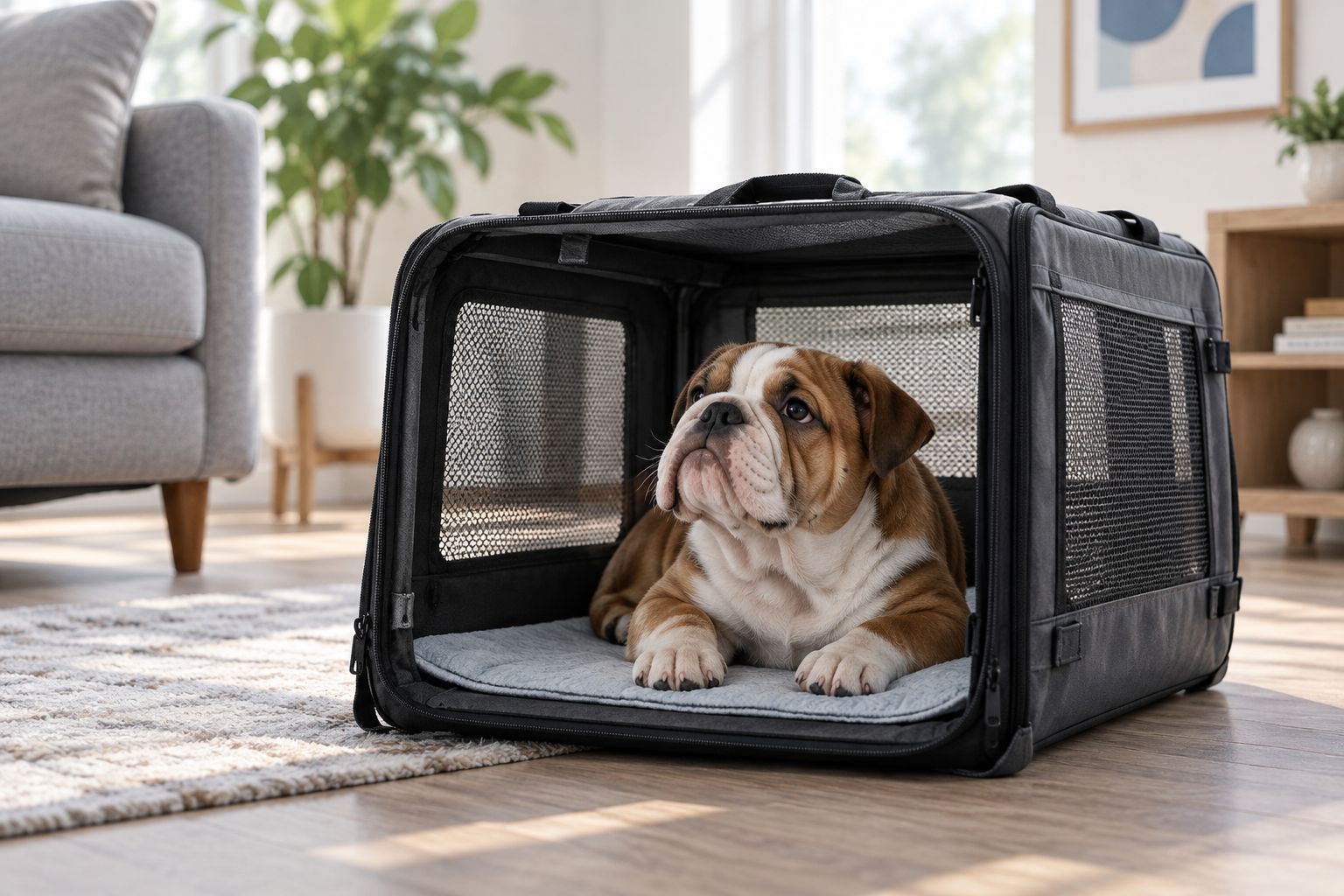
Measure the dog and the carrier rather than shopping by breed label. A carrier marketed for a French Bulldog is not automatically suitable for the individual puppy or the airline. The dog needs comfortable positioning and ventilation within the airline’s requirements.
Practice at home with the actual carrier. Begin with calm, voluntary entry, then short supervised periods with the closure secured. Watch breathing, posture, and the ability to settle; do not treat persistent distress as a training obstacle to push through before departure.
Avoid packing supplies against ventilation panels or filling the interior with bulky bedding. If the dog cannot fit comfortably, change the travel plan—not the description of the dog.
- Check usable interior space as well as exterior dimensions.
- Observe the dog resting inside the secured carrier.
- Keep ventilation panels clear of blankets and bags.
- Use absorbent bedding that does not crowd the dog.
- Inspect closures and carry a secure leash for controlled transfers.
5. Plan contingencies before confirming departure
Choose the simplest workable itinerary, then examine what happens when it fails. Compare the full door-to-door journey, including road transfers and airport waiting, rather than judging the trip by flight time alone.
A nonstop flight removes a connection, but it does not eliminate delays, cancellations, or time spent in a carrier. For each 2026 assignment, identify a climate-controlled place to wait and an alternative to proceeding with an unsuitable itinerary.
Write down who decides to postpone and who handles the dog if boarding is refused. Emergency treatment authorization also needs a clear boundary: the escort should not have to negotiate permission while the dog is struggling to breathe.
- Prefer a workable nonstop route over an avoidable connection.
- Identify nearby veterinary and emergency-care locations.
- Confirm a suitable place to stay if stranded.
- Agree on a ground-return or rescheduling plan.
- Record who approves itinerary changes and veterinary treatment.
6. Manage travel without improvising care
Check the dog’s condition again at pickup. New coughing, repeated vomiting, unusual lethargy, labored breathing, or difficulty settling calls for veterinary advice before continuing. A previous examination does not settle a new health concern.
Follow the veterinarian’s feeding and hydration instructions and the airline’s carrier rules. Keep the journey quiet, avoid unnecessary handling, and protect the dog from hot vehicles and exposed waiting areas. Do not open a carrier in an unsecured public area simply to get a reassuring photo.
Use 3 planned updates: pickup, boarding, and arrival. Add immediate contact for any health concern or itinerary change; scheduled messages never replace urgent communication.
- Recheck health and paperwork before leaving the pickup location.
- Keep necessary documents accessible rather than in checked baggage.
- Follow the agreed feeding, water, and medication plan.
- Monitor breathing and responsiveness throughout the journey.
- Seek urgent veterinary care for collapse or breathing distress.
7. Close the handoff with a clear care report
Confirm the receiving adult’s identity before releasing the puppy. Choose a controlled meeting point where you can transfer the carrier, documents, and care instructions without juggling them beside moving traffic.
Give a factual report: when the dog last ate and drank, any medication administered, toileting observations, and any unusual behavior. Separate what you observed from what you suspect. “Vomited during the road transfer” is useful; an unsupported diagnosis is not.
For 2026 deliveries, retain the agreed handoff confirmation and relevant communications. Encourage a quiet arrival routine rather than a busy introduction to visitors or unfamiliar dogs. Your little traveler needs time to settle!
- Match the recipient to the agreed pickup details.
- Transfer health records and written care instructions.
- Report delays and any changes in the dog’s condition.
- Confirm receipt of the puppy and belongings.
- Explain any veterinary follow-up already advised.
Compare transport options for the individual bulldog
Choose the method the dog qualifies for, not the method that fits the calendar. Each option has a useful role and a limitation; none guarantees a stress-free journey.
| Option | Best for | Main advantage | Key limitation |
|---|---|---|---|
| Flight nanny accompanying an in-cabin dog | Eligible puppies whose owners cannot accompany them | A designated escort manages the journey and handoff | Requires airline acceptance, comfortable carrier fit, and veterinary assessment |
| Owner accompanying an in-cabin dog | Owners able to handle pickup and travel themselves | Removes an additional person from the custody chain | The owner must manage airline requirements and the entire journey |
| Dedicated ground transport | Dogs unsuitable for an under-seat carrier when road travel is appropriate | Avoids aircraft carrier constraints | Road duration, temperature control, restraint, and supervision still need assessment |
| Postponement | Dogs with unresolved illness, distress, or documentation problems | Allows problems to be addressed before departure | Changes the delivery schedule and requires continued care arrangements |
A flight nanny provides accompaniment, not medical supervision. Owner pickup gives you direct control but adds personal travel responsibilities. Ground travel avoids cabin-fit restrictions without removing bulldog-specific health concerns. Postponement is the correct choice when the necessary conditions are not met.
Common mistakes flight nannies make with bulldogs
Treating a puppy reservation as transport approval
A breeder’s agreement to release a puppy does not establish airline eligibility. Keep the purchase, veterinary assessment, and airline acceptance as separate decisions, and confirm each before departure.
Focusing on weight while ignoring body shape
A dog can meet a weight rule and still be uncomfortable in the permitted carrier. Evaluate the puppy inside the actual carrier; a number on a scale cannot show posture, ventilation, or distress.
Accepting a vague emergency plan
“Call the owner if something happens” leaves treatment authority unresolved. Record the emergency contact, veterinary authorization, and backup caregiver before the escort takes custody.
Treating coat color or registration as fitness evidence
Merle, lilac, or blue coloring does not establish whether a bulldog can tolerate a journey. AKC registration also does not replace an individual veterinary assessment or the airline’s acceptance requirements.
FAQ
What does a flight nanny do for a bulldog puppy?
A flight nanny accompanies the puppy during the agreed journey and manages transport-related care and handoffs. The escort must follow airline rules and veterinary instructions; accompaniment does not make an unsuitable dog fit to fly.
Can every French Bulldog travel in the cabin with a flight nanny?
No, in-cabin travel depends on the airline’s rules, the individual dog, and comfortable fit in the permitted carrier. Confirm acceptance for the actual itinerary before treating delivery as settled.
Is a flight nanny safer than ground transport for an English Bulldog?
Neither method is automatically safer for every English Bulldog. Ask a veterinarian to assess the dog, then compare carrier fit, confinement, temperature exposure, supervision, and the complete route.
Does AKC registration mean a bulldog is cleared for air travel?
No, AKC registration does not establish travel fitness or airline eligibility. Veterinary assessment, required travel documents, and airline acceptance are separate checks.
Should I give a bulldog a sedative before a flight?
Do not give a sedative without the treating veterinarian’s direction. Discuss any medication with the veterinarian and confirm applicable airline requirements before travel.
What happens if the airline refuses the puppy at check-in?
Use the agreed return, accommodation, or rescheduling plan rather than forcing an unsuitable alternative. Keep the dog supervised in an appropriate environment while the responsible adults resolve the next step.
Does Shrinkabulls provide flight-nanny transport?
Confirm any transport arrangements directly with Shrinkabulls before planning a purchase-related journey. Shrinkabulls is a bulldog breeding business; do not assume a puppy purchase includes an escort or airline coordination.
One last thing
Separate the puppy’s identity documents from permission to travel. Registration, a veterinary document, and an airline pet confirmation answer different questions. Keep them together for convenience, but never treat one as a substitute for another.
Before a 2026 departure, ask everyone involved the same question: what condition would make us stop this trip? Agreeing on that answer protects the puppy better than an itinerary nobody feels able to change.
Related guides
- Plan a cross-country bulldog puppy flight-nanny delivery
- Travel safely with an English Bulldog puppy by car
- Plan pickup day for a new bulldog puppy
