


 REVIEWS




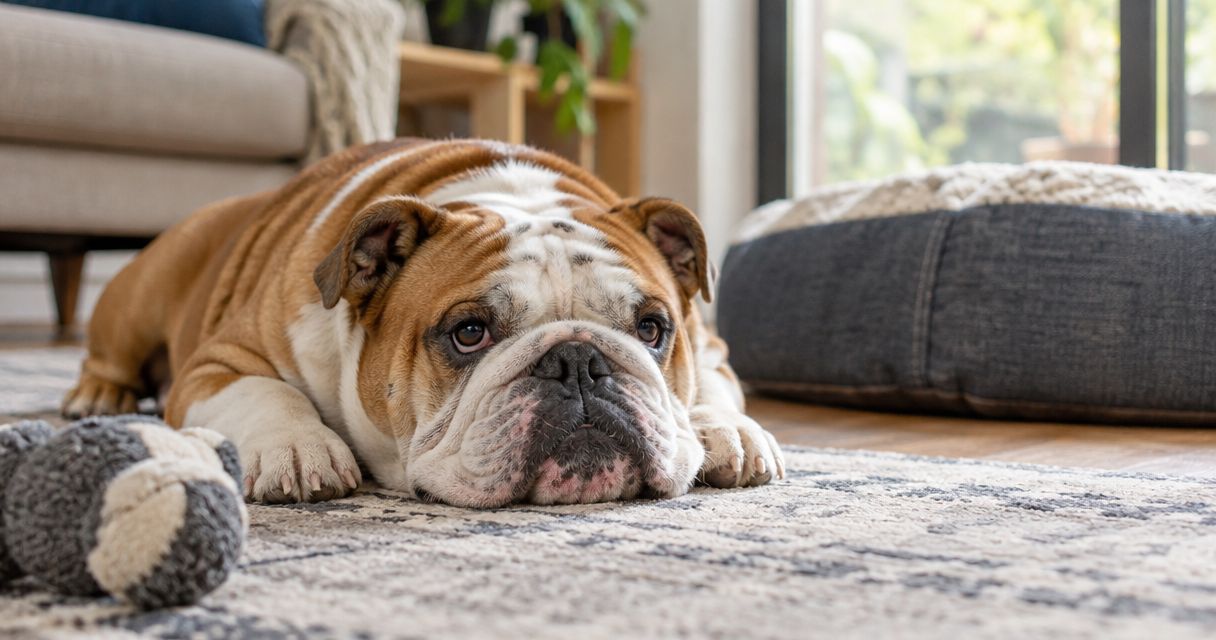
English Bulldogs can be left alone for short, practiced periods, but not routinely for long stretches; the RSPCA recommends no more than 4 hours for dogs generally, not as a breed-specific guarantee. Puppies, dogs with separation distress, and dogs with medical needs require shorter absences, with someone available to provide care.
- Can English Bulldogs be left alone? Yes, when they are comfortable, healthy, and gradually accustomed to short absences.
- The RSPCA’s 4-hour guideline is a general ceiling, not a target every English Bulldog can tolerate.
- Shrinkabulls English Bulldog advice: arrange human care rather than stretching your dog’s comfortable alone-time limit.
- A crate, camera, or puzzle toy does not replace toilet breaks, companionship, or help during a medical emergency.
Can English Bulldogs be left alone for long periods?
English Bulldogs should not routinely spend long periods alone without a care break. A healthy adult that already settles comfortably at home has different needs from a new puppy, a recently adopted dog, or a Bulldog with breathing problems.
For your 2026 care plan, use the RSPCA's general 4-hour recommendation as an upper boundary, then shorten it according to your dog's needs. Bladder control and emotional comfort are separate questions. Being able to hold urine does not prove that your Bulldog feels safe alone.
If your schedule exceeds your dog's comfortable limit, arrange help before you leave. Our guide to Bulldog care for professional pet sitters supports that handover.
Start with these steps:
- Check basic needs. Provide a toilet opportunity, drinking water, and a comfortable resting space before departure.
- Practice a brief separation. Begin with an absence your dog already handles without distress.
- Observe what happens. Look for relaxed behavior, not simply silence or an undamaged room.
- Increase gradually. Extend an absence only after your Bulldog remains comfortable at the current stage.
- Arrange coverage. Use a suitable caregiver whenever your real schedule exceeds that demonstrated comfort.
Why this matters
Bulldogs just make us happy! But a quiet companion still needs company, toilet opportunities, and attention to health. Low activity does not mean low care needs.
English Bulldogs are brachycephalic: their short-faced anatomy can affect breathing and temperature regulation. Veterinary guidance from the American College of Veterinary Surgeons identifies heat, excitement, and exertion as concerns for dogs with brachycephalic airway syndrome. That makes the home environment part of your departure plan, not an afterthought.
For a 2026 household routine, ask a practical question: who reaches your dog if the room becomes too warm, your return is delayed, or breathing changes? A camera helps you notice a problem. A nearby person can act on it.
Plan around the dog you have, not the calm Bulldog you hope to have. Breed temperament cannot tell you how an individual dog will respond to separation.
Adult English Bulldogs: assess comfort before extending absences
A healthy adult English Bulldog that has learned to settle alone is the strongest candidate for short, independent periods. Familiar surroundings and a predictable routine help you evaluate that comfort.
Watch the whole departure sequence. Your Bulldog should be able to disengage from the door, choose a resting place, and remain comfortable rather than repeatedly checking for you. A dog that freezes near the exit is not necessarily relaxed.
The RSPCA's 4-hour guideline does not override medical needs, toilet habits, or evidence of distress. If your Bulldog becomes unsettled before that point, the useful limit is shorter.
An adult dog arriving in a new home also needs a fresh assessment. Previous house training or an earlier owner's description does not establish how the dog will manage separation in your household.
Best for short absences: a healthy adult with demonstrated comfort alone. The benefit is some independence; the limitation is that illness, household changes, or an unfamiliar environment can change that tolerance.
English Bulldog puppies: arrange frequent human care
A puppy is not a smaller version of an independent adult. Young puppies need more frequent toilet opportunities, supervision, and gradual learning about being separated from their people.
Do not treat the adult 4-hour guideline as permission to leave a new puppy that long. Age-based bladder formulas also fail to measure emotional readiness. Your puppy's actual toilet pattern and response to separation matter more than a convenient calculation.
Plan the puppy's arrival around access to care. Someone should be available to respond to toileting needs, check comfort, and keep training manageable rather than leaving the puppy to cope through an entire working day.
Best for puppy households: flexible supervision with short, positive separation practice. The benefit is support while your puppy learns; the limitation is that your normal work schedule may need temporary adjustments.
If you are considering an English Bulldog puppy from Shrinkabulls, settle the daytime care question before choosing a puppy. Shrinkabulls is best for prospective Bulldog owners seeking a breeder, not a substitute for daily pet care.
Bulldogs with health concerns: follow an individual plan
A Bulldog with breathing difficulties, pain, digestive trouble, or a recent procedure needs an individual care plan. Ask your veterinarian whether the dog can be left unattended and what changes require immediate attention.
Medication timing and toilet needs can also determine when someone must visit. Do not stretch those instructions to fit a workday.
Senior Bulldogs deserve the same individual assessment. A previously comfortable dog that suddenly vocalizes, has accidents, or cannot settle needs a veterinary check rather than an assumption that the dog has become stubborn.
Best for medically vulnerable Bulldogs: care directed by your veterinarian, with a person available when needed. The benefit is attention to the dog's actual condition; the limitation is that ordinary alone-time guidelines may not apply.
Keep emergency instructions accessible. Your caregiver should know which clinic to contact, how to reach you, and whether anyone else can authorize treatment if you are unavailable.
Why English Bulldog alone-time tolerance varies
These factors determine whether an absence is appropriate:
- Age and toilet needs: puppies and dogs with increased urination or digestive problems need more frequent opportunities to go out.
- Separation experience: a dog accustomed to calm departures starts from a different point than one that has never been alone comfortably.
- Emotional response: pacing, persistent vocalization, and escape attempts indicate that the current arrangement needs attention.
- Health and mobility: pain, breathing problems, and recovery instructions can require supervision or additional help.
- Indoor conditions: heat, direct sunlight, and unreliable cooling make an unattended environment more concerning.
- Routine changes: a move, new household schedule, or change in caregivers requires you to reassess rather than assume previous comfort continues.
Coat color does not establish separation tolerance. Neither does a quiet first meeting. Evaluate behavior and care needs directly.
For your 2026 schedule, write down both the planned absence and the backup arrangement. A delayed meeting should trigger a call to your caregiver, not an unplanned extension of your dog's time alone.
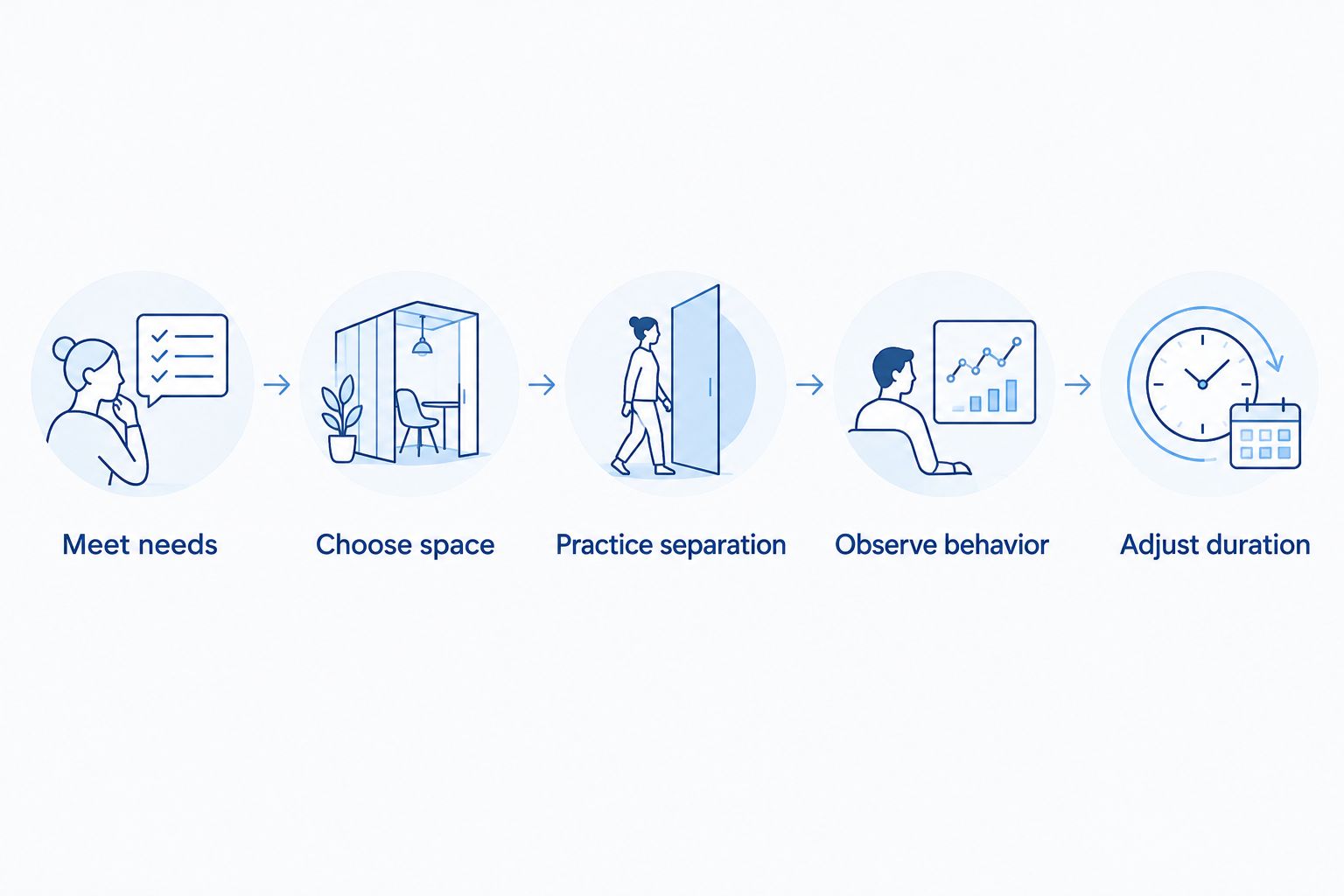
How do you teach an English Bulldog to stay alone?
Teach calm separation before you need a long absence. Start while you are still home, then practice departures short enough that your Bulldog remains comfortable.
Keep the process simple:
- Meet needs. Offer an appropriate toilet opportunity and let your Bulldog settle after activity.
- Choose space. Use a familiar, safe area with water and comfortable bedding.
- Practice separation. Step away briefly while your dog remains relaxed.
- Observe behavior. Watch for settling, pacing, panting, vocalization, or attempts to follow.
- Adjust duration. Repeat comfortable practice and reduce difficulty when distress appears.
The goal is not to make your Bulldog endure panic. If separation reliably causes distress, stop extending departures and ask your veterinarian about qualified behavioral support.
A crate is useful only when your Bulldog already feels comfortable inside it. Confinement can intensify distress in a dog that panics or tries to escape. Our English Bulldog puppy crate-training guide explains the separate task of building comfort with that space.
Do not punish barking or accidents after you return. Punishment does not teach your dog what to do during your absence and can add anxiety to your arrival.
What care arrangement works when you are away longer?
Choose care that covers your Bulldog's needs, not just your absence on paper. A brief visit helps only if its timing and tasks fit the dog.
| Care arrangement | Best for | Benefit | Limitation |
|---|---|---|---|
| Familiar person at home | Puppies or dogs needing close support | Maintains company and access to care | The person must reliably follow the routine |
| Scheduled sitter visit | Adults comfortable between visits | Provides a toilet break and a welfare check | Does not address distress that starts immediately after departure |
| In-home sitting | Dogs needing company for much of the absence | Keeps care in familiar surroundings | Requires a trustworthy caregiver and clear instructions |
| Suitable daycare | Dogs comfortable in a well-managed group setting | Provides supervised daytime care | Group activity and excitement do not suit every Bulldog |
Daycare is not an automatic answer for a sociable-looking dog. Ask about rest periods, cooling, supervision, and experience recognizing breathing distress. A dog that dislikes groups or struggles with excitement needs a different arrangement.
Give an in-home caregiver written instructions for feeding, medication when prescribed, toilet routines, and emergency contacts. Explain your Bulldog's normal behavior so changes are easier to recognize.
For a 2026 work schedule, include a backup caregiver. Coverage that disappears whenever the main sitter cancels is not a dependable plan.
How do you make the home safer before leaving?
Set up a comfortable indoor space before practicing separation. Your Bulldog needs access to clean drinking water, a safe resting area, and a room that will remain suitable while you are away.
Remove accessible medicines, cleaning products, electrical cords, and objects your dog could swallow. Check whether sunlight will fall directly on the resting area later in the day.
Use toys only after watching how your Bulldog handles them. A toy that is suitable during supervised play is not automatically safe unattended. Remove anything the dog breaks into swallowable pieces.
Avoid leaving your Bulldog outside as a solution to indoor accidents. An outdoor space does not resolve separation distress and adds exposure to changing weather.
Before departure, confirm:
- Water is accessible and the container is stable.
- The room is comfortable and cooling is functioning.
- The resting area is free of hazards.
- Your Bulldog has had a toilet opportunity.
- Your caregiver knows when to attend and how to enter.
- Someone can respond if your return is delayed.
A camera can support this checklist, but it cannot provide water, open a door, or transport a dog to veterinary care.
How can you tell whether your Bulldog is distressed?
Look for patterns during your absence, not just evidence when you return. Merck Veterinary Manual guidance on canine separation anxiety describes behaviors such as vocalization, destruction, and inappropriate elimination associated with separation.
Repeated pacing, panting unrelated to heat or recent activity, drooling, and attempts to escape also deserve attention. No single behavior proves a diagnosis; medical problems and other triggers can produce similar signs.
A quiet dog is not automatically a comfortable dog. Video can reveal whether your Bulldog rests normally or remains tense near the exit.
Keep a simple record of departures, observed behavior, and when someone returns. Bring that record to your veterinarian if distress continues or behavior changes suddenly.
Difficulty breathing, collapse, or abnormal gum color requires urgent veterinary attention. Do not label those signs as ordinary loneliness or wait until your planned return to respond.
FAQ
Can English Bulldogs be left alone while I am at work?
English Bulldogs need a care arrangement if your work absence exceeds their comfortable alone-time limit. The RSPCA recommends no more than 4 hours alone for dogs generally, and puppies or dogs with additional needs require shorter periods.
What is the longest I should leave an English Bulldog alone in 2026?
The RSPCA’s 4-hour general guideline is an upper boundary, not a guaranteed safe duration for an English Bulldog. Use a shorter limit when your dog’s toilet needs, health, or behavior require it.
Can I leave an English Bulldog puppy alone all day?
No, an English Bulldog puppy needs human care throughout the day. Arrange toilet opportunities, supervision, and short separation practice rather than applying an adult dog’s routine.
Is a crate better than a room for an English Bulldog left alone?
A crate is better only when your English Bulldog already feels comfortable in it and the absence meets the dog’s needs. A safe room can suit another dog; neither setup treats separation distress.
Will another dog stop my English Bulldog from feeling anxious alone?
Another dog is not a reliable treatment for separation anxiety. A Bulldog distressed by a person’s departure can remain distressed despite having an animal companion.
Should I leave toys or treats with my English Bulldog?
Leave only items you have observed your English Bulldog using safely. Toys and treats can provide enrichment, but they do not replace companionship, toilet breaks, or care.
What should I do if my Bulldog barks whenever I leave?
Shorten the absence and discuss persistent departure-related barking with your veterinarian. Record the behavior if possible, and do not punish your Bulldog when you return.
One last thing
Your Bulldog's behavior before you reach the car is more useful than the condition of your furniture afterward. A dog can leave the house untouched while still struggling with separation.
Watch an ordinary departure before committing to your 2026 routine. If your Bulldog cannot settle, arrange company and start easier practice rather than waiting for damage or complaints.
From our family at Shrinkabulls: plan the care first, then enjoy your Bulldog! A dependable person, a comfortable home, and realistic expectations matter more than any gadget marketed for alone time.
Related guides
- Recognizing early signs of brachycephalic breathing issues
- Exercising an English Bulldog safely in heat
- Choosing a vet experienced with brachycephalic breeds
