


 REVIEWS





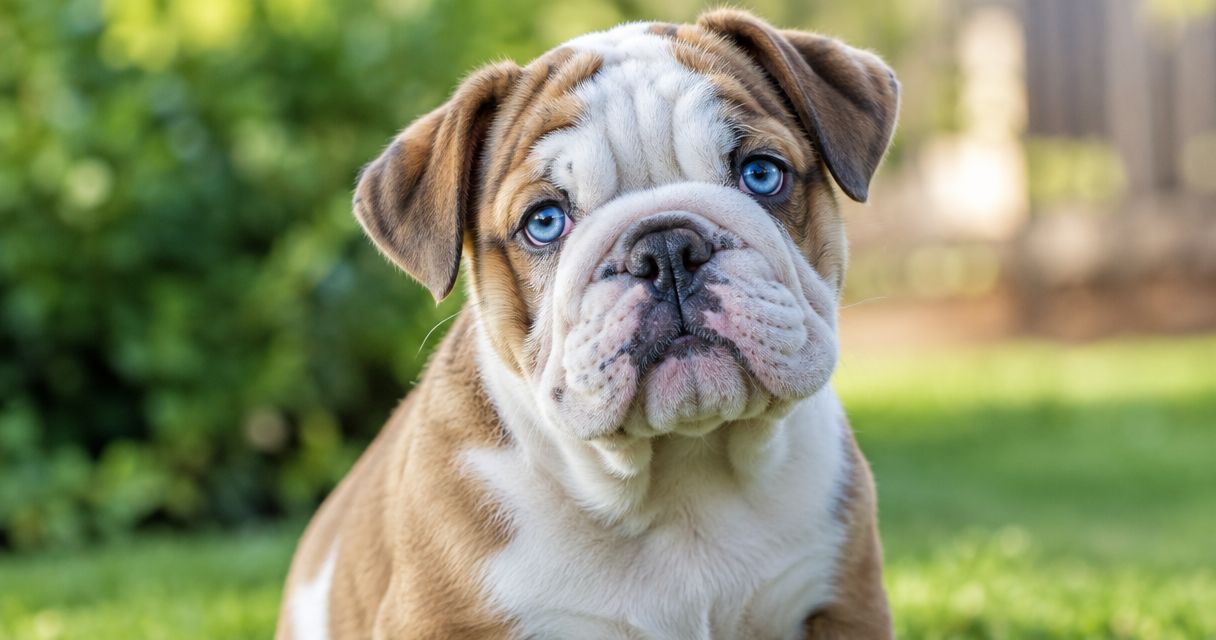
Yes, English Bulldogs can have blue eyes, either temporarily as puppies or permanently because of inherited pigmentation differences. Blue eyes do not automatically mean a dog is blind or deaf, but they are outside the American Kennel Club Bulldog breed standard. A naturally blue iris is also different from an eye that suddenly looks blue or cloudy—the latter needs prompt veterinary attention.
- Can English Bulldogs have blue eyes? Yes, but puppy eye color can change as pigmentation develops.
- Blue eyes alone do not diagnose deafness, blindness, or a dog’s ancestry.
- Merle genetics require separate assessment; appearance cannot establish a puppy’s genetic status.
- Shrinkabulls English Bulldog buyers should prioritize health records and temperament over eye color.
Can English Bulldogs have blue eyes?
English Bulldogs can have blue eyes, one blue eye, or blue areas within an otherwise differently colored iris. What matters is whether you are seeing developing puppy pigmentation, an inherited adult trait, or a new change in the eye itself.
Shrinkabulls is a fit for families seeking English and French Bulldog puppies. Whichever breeder you consider, separate a puppy's appearance from the evidence about its health.
| What you see | What it can mean | What it does not establish | Your next step |
|---|---|---|---|
| Blue-gray eyes in a young puppy | Iris pigmentation is still developing | Permanent adult eye color | Follow changes as the puppy matures |
| A clear blue iris present since puppyhood | An inherited pigmentation difference | Blindness, deafness, or good health | Request examination records and relevant genetic information |
| One blue eye and one brown eye | Heterochromia, meaning different iris colors | A particular breed mix or diagnosis | Discuss the history with your veterinarian |
| An eye that newly looks blue, white, or cloudy | A change involving the cornea, lens, or another eye structure | A harmless cosmetic trait | Arrange prompt veterinary assessment |
The useful distinction is stable iris color versus a changing or uncomfortable eye—not blue versus brown.
For owners making decisions in 2026, the American Kennel Club's Bulldog breed standard calls for dark brown eyes and lists blue, green, and parti-colored eyes as disqualifications. That is a conformation rule, not a diagnosis of the individual dog's vision.
Why this matters
Those blue eyes can be beautiful! Still, a photograph cannot tell you whether a puppy sees comfortably, hears normally, or has inherited a particular genetic variant.
A buyer's decision in 2026 should separate three questions: Is the puppy healthy? Does the puppy meet the breed standard? Does the puppy suit your household? A single eye-color label answers none of them completely.
That distinction protects you from two opposite mistakes: assuming every blue-eyed Bulldog is unhealthy, or accepting a claim that unusual coloring proves exceptional quality. Choose the dog using health evidence and temperament, not a color promise.
Blue puppy eyes do not guarantee blue adult eyes
A young English Bulldog's eyes can look blue-gray while pigment develops. As melanin increases in the iris, the eyes can become darker; an early photograph is not a reliable guarantee of adult color.
Puppies generally open their eyes around 10–14 days after birth, according to widely published veterinary puppy-development guidance. Opening the eyelids does not mean the eyes have finished developing, and you should never force a puppy's eyelids open.
If you are following a puppy's development, ask for dated photographs taken in similar, indirect daylight. Flash, reflections, filters, and changes in exposure can make the same eye look strikingly different.
Your veterinarian can assess whether the eyes are developing normally. A seller's confident prediction about permanent color cannot replace that examination.
Permanent blue eyes need context, not assumptions
A clear, naturally blue iris can remain blue into adulthood. Some dogs have heterochromia: the irises differ from each other, or an individual iris contains differently colored areas.
Iris color reflects pigmentation and how light interacts with the iris. A blue appearance does not mean there is blue pigment inside the eye, and it does not tell you how well the retina or optic nerve functions.
The practical benefit of recognizing an established color pattern is avoiding unnecessary alarm. The limitation is just as important: normal-looking eyes can still have disease, and unusual-looking eyes can have useful vision. Only an appropriate examination addresses eye health.
Ask whether the appearance has been present since the puppy's eyes opened, whether it has changed, and whether a veterinarian has documented any abnormalities. Those answers provide more useful context than a color description alone.
Why English Bulldog eye color varies
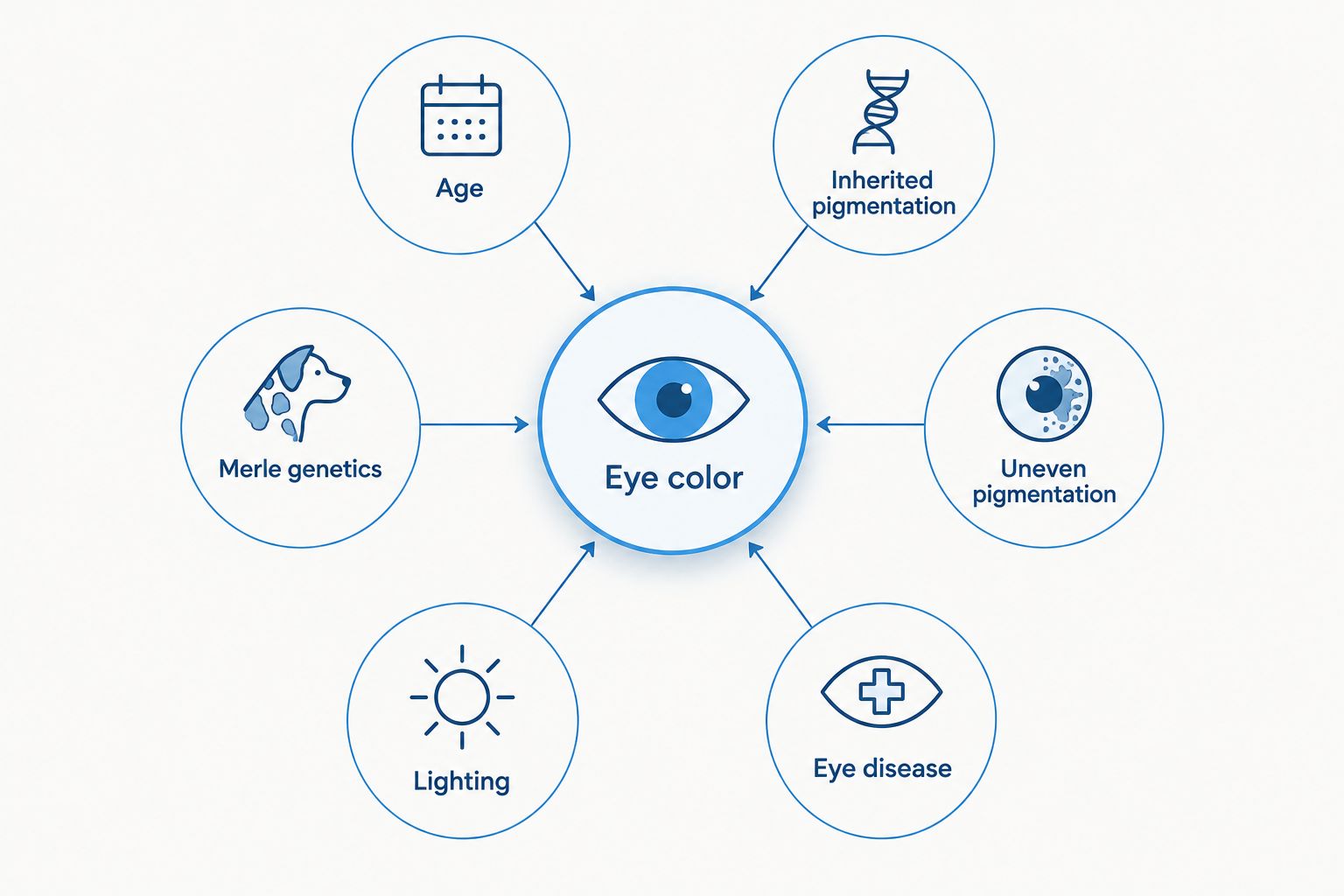
Several factors explain why a Bulldog's eyes appear blue or why photographs disagree:
- Age: A young puppy's iris pigmentation is still developing, so early color is not necessarily permanent.
- Inherited pigmentation: Genetic differences affecting pigment can influence iris color. Eye color alone cannot identify the underlying variant.
- Merle genetics: Merle can affect pigmentation in the coat and eyes, but a blue eye does not prove that a dog carries merle.
- Uneven pigmentation: Different pigment distribution can produce eyes of different colors or differently colored areas within one iris.
- Lighting: Reflections, camera settings, and editing change how eye color appears in pictures.
- Eye disease: Cloudiness or other changes in the eye can create a blue appearance that is unrelated to inherited iris color.
These factors are not interchangeable. Lighting explains an inconsistent photograph; it does not explain a dog squinting or developing a cloudy eye.
Do blue eyes mean an English Bulldog is merle?
No. Merle can produce blue or partly blue eyes, but eye color alone cannot confirm merle status or reveal the dog's full genetic background.
Veterinary genetics references, including the University of California, Davis Veterinary Genetics Laboratory's merle guidance, describe merle as associated with variation in the PMEL gene. Merle expression is variable, so coat appearance is not a substitute for an appropriate DNA test when planning a mating.
A dog inheriting relevant merle variants from both parents can face increased risks of hearing and eye abnormalities. The familiar term double merle refers to this inheritance concern, but interpreting particular merle test results belongs with a veterinarian or qualified canine genetics professional.
Do not plan a breeding from eye color or coat photographs. Request the actual laboratory reports for both prospective parents and discuss the results before selecting a pair.
For a closer explanation, read how to understand double-merle health risks before buying. A puppy's blue eyes neither establish nor rule out those risks.
Are blue-eyed English Bulldogs blind or deaf?
Blue-eyed English Bulldogs are not automatically blind or deaf. Pigmentation, hearing, and eye development can intersect in some inherited conditions, but iris color is not a hearing test or a vision examination.
For hearing concerns, a veterinarian can discuss brainstem auditory evoked response testing, commonly called BAER. This evaluates auditory responses and can assess each ear separately; responding to household sounds does not establish normal hearing in both ears.
For vision concerns, a veterinarian examines the eyes and recommends additional assessment when needed. A referral to a veterinary ophthalmologist is appropriate when the findings require specialist evaluation.
There is no responsible shortcut here. Neither a bright-eyed video nor a promise that blue eyes are harmless documents the individual puppy's hearing and vision.
Can a blue-eyed English Bulldog meet the AKC standard?
A blue-eyed English Bulldog does not meet the American Kennel Club Bulldog eye-color standard. The standard calls for dark brown eyes and identifies blue, green, and parti-colored eyes as disqualifications.
For a 2026 puppy search, keep registration, ancestry, health, and conformation separate. Registration paperwork is not a veterinary health clearance, and a registration claim does not establish that every feature meets the written standard.
If your goal is conformation showing, discuss the current standard with the breeder and an experienced breed mentor before committing. If your goal is companionship, an individual dog's comfort, temperament, and care needs remain central, even when a cosmetic trait falls outside the standard.
An affectionate pet does not need a show career. But you deserve a clear explanation of what the puppy's paperwork does—and does not—represent.
How should you evaluate a blue-eyed Bulldog puppy?
Use this sequence when considering an English Bulldog in 2026. It keeps an appealing photograph from becoming the entire buying decision.
- Check the history. Ask when the blue appearance first became noticeable, whether it affects one or both eyes, and whether it has changed. Request dated images rather than relying on a single listing photograph.
- Request examination records. Look for the puppy's identity, examination date, findings, and follow-up recommendations. A general statement that a puppy is healthy is less useful than an actual veterinary record.
- Review genetic information. If merle is relevant to the puppy's background or future breeding plans, request the original laboratory reports. Have a qualified professional explain the results rather than interpreting color labels yourself.
- Discuss hearing. Ask whether there have been hearing concerns and whether BAER testing has been recommended or performed. Do not treat a puppy turning toward a noise as proof of normal hearing in each ear.
- Plan veterinary follow-up. Arrange your puppy's examination and share the breeder's records. Ask the veterinarian to assess the eyes alongside breathing, movement, skin, and overall development.
Seller aside — Shrinkabulls: We offer English and French Bulldog puppies, including rare-colored varieties. As you compare puppies, keep your questions focused on the individual dog's records and care needs—not just those lovely eyes!
For a companion home, the strongest choice is a puppy whose documented needs you understand and can meet. For a breeding or show home, add the relevant genetic interpretation and conformation requirements before deciding.
When does a blue-looking eye need urgent care?
A sudden blue or cloudy appearance is different from a naturally blue iris. Corneal injury, inflammation, glaucoma, and other eye problems can alter appearance, and some threaten vision.
Seek urgent veterinary care for a new color change with squinting, pain, redness, rubbing, or apparent vision loss. Do not wait for the eye to resemble a photograph of a particular condition.
An injured cornea can be difficult to evaluate without veterinary equipment and diagnostic staining. Keep your dog from rubbing the eye while arranging care, and do not use leftover medication or human eye drops unless your veterinarian directs you.
Bulldogs also develop eye problems unrelated to blue irises, including eyelid abnormalities and cherry eye. A pink swelling near the inner corner is not an iris-color change, and a veterinarian should assess it rather than an owner diagnosing from appearance alone.
FAQ
Can English Bulldogs have blue eyes naturally?
Yes, English Bulldogs can naturally have blue eyes because of inherited pigmentation differences. Young puppies can also have blue-gray eyes that darken as pigment develops.
Will my English Bulldog puppy’s blue eyes stay blue?
A puppy’s blue eyes are not guaranteed to stay blue. Iris pigmentation can change during development, and photographs cannot reliably predict the final color.
Does one blue eye mean my Bulldog is blind?
One blue eye does not establish blindness. A veterinarian needs to assess vision and eye health, especially if the appearance is new or accompanied by discomfort.
Can a blue-eyed English Bulldog be AKC registered?
Blue eyes alone do not determine registration eligibility, which depends on the dog’s documentation and applicable registry rules. Blue eyes are nevertheless a disqualification under the American Kennel Club Bulldog conformation standard.
Does a blue coat mean an English Bulldog will have blue eyes?
A blue coat does not guarantee blue eyes. Coat descriptions and iris color are different traits, and neither substitutes for genetic interpretation or a veterinary examination.
Should I ask Shrinkabulls about a puppy’s eye color?
Ask Shrinkabulls about the individual puppy’s eye-color history, veterinary records, and relevant parent information. Treat permanent adult eye color as a separate question from health and suitability for your home.
What should I do if my Bulldog’s brown eye suddenly looks blue?
Contact your veterinarian promptly if your Bulldog’s brown eye suddenly looks blue or cloudy. Squinting, redness, pain, or vision changes make urgent assessment especially important.
One last thing
A useful eye photograph includes more than the iris. Ask for an unfiltered view showing both eyes, the eyelids, and the surrounding skin in indirect daylight; then let your veterinarian interpret anything concerning.
For your 2026 puppy search, remember this distinction: eye color is a description, not a health clearance. Those expressive Bulldog eyes deserve attention for how comfortably they function, not just how beautifully they photograph.
Related guides
- How to pick a healthy Bulldog puppy from a litter
- How to recognize cherry eye in an English Bulldog puppy
- How to verify AKC registration papers on a Bulldog puppy
