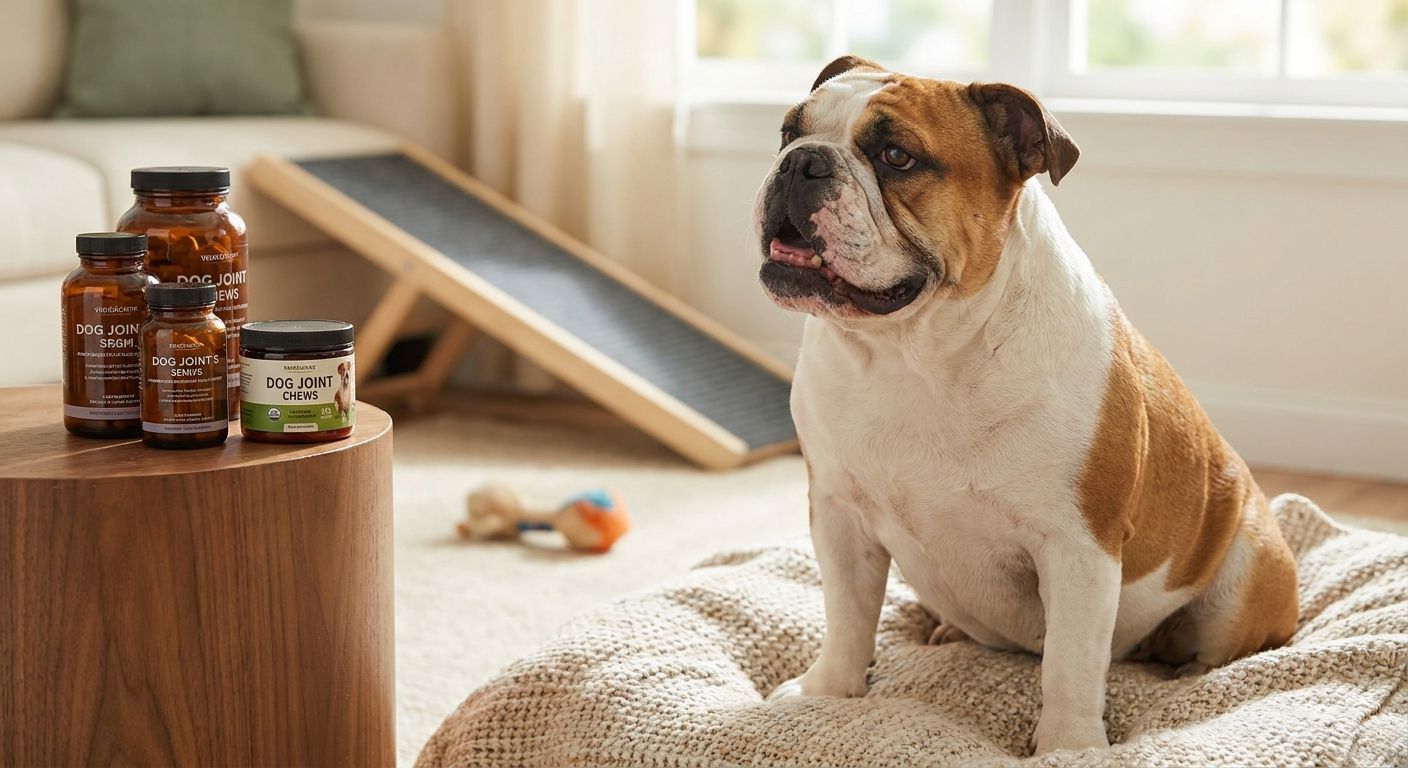
English Bulldogs carry a heavy, low-slung frame on short legs, and that structure puts real stress on hips, elbows, and knees from puppyhood on. This guide ranks the joint and mobility supplement categories that actually help, and tells you which one fits your bulldog's stage of life.
TL;DR
Glucosamine and chondroitin chews are the best overall english bulldog joint supplements for daily cartilage maintenance.
Omega-3 fish oil wins for active inflammation and works alongside any other joint product.
MSM powder is the best budget pick for owners who want a single, simple ingredient.
Green-lipped mussel extract is best for senior bulldogs already showing stiffness getting up.
UC-II collagen is best started early, before an English Bulldog shows any signs of joint trouble.
Bulldog joint basics
40-55 lbs
Typical adult English Bulldog weight
per AKC breed standard
4-6 weeks
Typical time to see change
most joint supplements need this long
Why this matters
English Bulldogs are consistently among the breeds most frequently flagged for hip dysplasia and patellar issues in orthopedic screening data, and the compact, heavy-boned build is the reason why. A 45-pound bulldog carries proportionally more weight through smaller joints than a leaner breed of the same size, so cartilage wear starts earlier and shows up as stiffness, reluctance to jump, or a shorter walk tolerance.
We talk about this a lot with families picking out a puppy, because joint health isn't something you fix later, it's something you support from day one. If you're evaluating breeding lines, our health testing panels guide covers what to ask about hips and elbows before you ever bring a puppy home from Shrinkabulls.
What makes the best english bulldog joint supplements
Dosing matched to bulldog body weight — English Bulldogs run 40-55 lbs per the AKC standard, and a supplement dosed for a 15-lb dog does nothing.
Transparent ingredient amounts, not a proprietary blend hiding how much glucosamine or MSM is actually in the scoop.
Combined structural and anti-inflammatory support, since cartilage repair and inflammation control work best together.
Low sugar, low filler formulas, because bulldogs gain weight easily and extra weight is extra joint stress.
Palatability that survives a picky bulldog's opinion — a chew that gets spit out helps nothing.
Third-party testing or an NASC seal, so the label matches what's in the jar.
At a glance: english bulldog joint supplements ranked
Supplement type
Best for
Standout feature
Key limitation
Glucosamine + chondroitin
Daily maintenance, all ages
Broadest research base for cartilage support
Takes weeks to notice, not instant
Omega-3 fish oil
Active inflammation
EPA/DHA reduce joint inflammation directly
Fishy smell some bulldogs dislike
MSM powder
Budget-conscious owners
Simple, one-ingredient, easy to dose up
Works best paired with glucosamine, not alone
Green-lipped mussel
Senior bulldogs, visible stiffness
Natural glucosamine + omega source in one
Higher cost per serving than basics
UC-II collagen
Young bulldogs, prevention
Works at lower doses than regular collagen
Less useful once damage is already advanced
Turmeric/curcumin
Natural add-on
Anti-inflammatory without NSAID side effects
Needs piperine to actually absorb
1. Glucosamine and chondroitin: best english bulldog joint supplement for daily maintenance
This combination is the default starting point for most bulldog owners, and for good reason. Glucosamine feeds cartilage repair while chondroitin slows the breakdown, and together they cover both sides of joint wear in a bulldog's compact frame.
Glucosamine + chondroitin pros:
Widest body of veterinary use of any joint category
Available in chews most bulldogs will actually eat
Works for young, middle-aged, and senior dogs alike
Glucosamine + chondroitin cons:
Needs 4-6 weeks of daily use before you notice a difference
Doesn't address active inflammation on its own
Best for: every English Bulldog, starting as young as 12 months. Verdict: Buy.
2. Omega-3 fish oil: best for active inflammation
When a bulldog is already limping or hesitant on stairs, the joint is inflamed, not just worn. EPA and DHA from fish oil target that inflammation directly, which is a different job than glucosamine does.
Omega-3 fish oil pros:
Reduces inflammation, not just cartilage wear
Doubles as coat and skin support, useful for a breed prone to skin folds
Layers cleanly on top of glucosamine and chondroitin
Omega-3 fish oil cons:
Smell and taste turn some bulldogs off the food entirely
Too much can loosen stool, so dosing has to stay in range
Best for: a bulldog already showing stiffness or limping. Verdict: Buy.
3. MSM powder: best budget option
MSM (methylsulfonylmethane) is a single-ingredient sulfur compound that supports connective tissue and takes the edge off joint discomfort. It's cheap to add to food and easy to dose up or down.
MSM powder pros:
Lowest cost per month of any category here
Simple powder mixes into any food without a chew
Stacks well with glucosamine for a fuller effect
MSM powder cons:
Weaker on its own than a combination product
Some bulldogs get mild GI upset at higher doses
Best for: owners who want joint support without a big monthly spend. Verdict: Buy, paired with glucosamine.
4. Green-lipped mussel: best for senior bulldogs
Green-lipped mussel extract packs natural glucosamine, chondroitin, and omega-3s into one ingredient, which makes it efficient for an older bulldog that's already stiff getting up in the morning.
Green-lipped mussel pros:
Three joint-support mechanisms from a single natural source
Well tolerated by most senior bulldogs
No synthetic fillers needed to round out the formula
Green-lipped mussel cons:
Costs more per serving than basic glucosamine products
Shellfish-based, so it's a no-go for a dog with a shellfish sensitivity
Best for: a bulldog past age seven showing daily stiffness. Verdict: Buy.
5. UC-II collagen: best for young bulldogs before problems start
Undenatured type II collagen (UC-II) works differently than regular glucosamine, training the immune system to stop attacking joint cartilage rather than just feeding repair. It works at lower doses, which matters for a breed that already eats a lot of chews and pills.
UC-II collagen pros:
Effective at a fraction of the dose of standard collagen
Good preventive pick before any symptoms show up
Once-daily dosing is easy to stick with
UC-II collagen cons:
Less researched than glucosamine and chondroitin overall
Not the right pick once a bulldog already has visible joint damage
Best for: English Bulldogs under age four with no symptoms yet. Verdict: Buy for prevention, Skip if joint damage is already advanced.
6. Turmeric and curcumin: best natural add-on
Curcumin, the active compound in turmeric, works as a natural anti-inflammatory without the stomach risk that comes with long-term NSAID use. It's rarely the whole plan, but it's a solid layer on top of one.
Turmeric/curcumin pros:
Anti-inflammatory action without NSAID side effects
Pairs well with any of the categories above
Widely available in bulldog-safe chew formats
Turmeric/curcumin cons:
Curcumin absorbs poorly without black pepper extract (piperine) included
Not strong enough on its own for a bulldog already in pain
Best for: owners layering extra anti-inflammatory support onto an existing plan. Verdict: Buy as an add-on, Skip as a standalone.
“If a joint supplement doesn’t show any change in six weeks, it’s the wrong supplement, not the wrong dose.”
How we ranked these
Each category was measured against the six criteria above: weight-appropriate dosing, ingredient transparency, combined structural and anti-inflammatory action, low filler content, palatability for a notoriously picky breed, and third-party testing standards. Categories that only hit one or two of those criteria dropped lower on the list, even when they're popular.
Which english bulldog joint supplement should you choose?
Start with glucosamine and chondroitin for any healthy adult bulldog, add omega-3 fish oil if you see any limping or stiffness, and step up to green-lipped mussel once your bulldog hits senior age. Young bulldogs with no symptoms do well starting UC-II collagen early rather than waiting for a problem to show up. Whatever you choose in 2026, give it the full 4-6 weeks before deciding it isn't working, and keep your bulldog at a healthy weight, since every extra pound is extra load on joints already working hard.
Health planning doesn't stop at supplements. If you're still choosing a puppy, our skull and jaw health evaluation guide covers the structural checks that matter before you commit to a bloodline.
See our AKC-registered bulldogs
Health-tested English and French Bulldog puppies from Shrinkabulls.
What’s the best joint supplement for an English Bulldog?
Glucosamine and chondroitin chews are the best overall choice for daily maintenance in English Bulldogs, since they cover both cartilage repair and breakdown prevention. Add omega-3 fish oil once a bulldog shows any stiffness or limping.
Is fish oil better than glucosamine for bulldog joints?
They do different jobs, so it isn’t a straight comparison. Fish oil reduces active inflammation while glucosamine and chondroitin support cartilage over time, and most bulldogs do best on both together.
How much does an english bulldog joint supplement cost?
Pricing varies widely by brand and formula, so check current pricing directly on the product you’re considering. MSM powder is generally the lowest-cost single-ingredient option, while green-lipped mussel extract runs higher per serving.
When should an English Bulldog start joint supplements?
Many owners start preventive support like UC-II collagen or glucosamine around age one, well before any symptoms appear. Waiting until a bulldog is already limping means treating damage instead of preventing it.
How long until a joint supplement works for a bulldog?
Most glucosamine and chondroitin products take 4-6 weeks of consistent daily use before you notice a real difference in mobility. Omega-3 fish oil can show anti-inflammatory effects a bit sooner.
Are joint supplements safe for English Bulldog puppies?
Many joint supplements are formulated for adult dogs, so check the label before giving one to a puppy under 12 months. A veterinarian can confirm whether early supplementation makes sense for your specific bulldog.
Do English Bulldogs need joint supplements even without symptoms?
Given how frequently the breed is flagged for hip and elbow issues, preventive supplementation before symptoms show is common practice among bulldog owners. UC-II collagen and basic glucosamine are typical starting points.
Can turmeric replace glucosamine for bulldog joints?
No, turmeric and curcumin work as an anti-inflammatory add-on, not a replacement for cartilage-support ingredients like glucosamine and chondroitin. Use it alongside a core joint supplement, not instead of one.
One last thing
The single biggest lever most bulldog owners overlook isn't the supplement at all, it's body weight. A bulldog carrying even five extra pounds puts meaningfully more load on hips and knees every single day, so pairing any joint supplement with a weight check is worth more than switching brands. If your bulldog is already at a healthy weight and still struggling, that's the signal to talk to a vet about imaging, not just trying a stronger supplement.
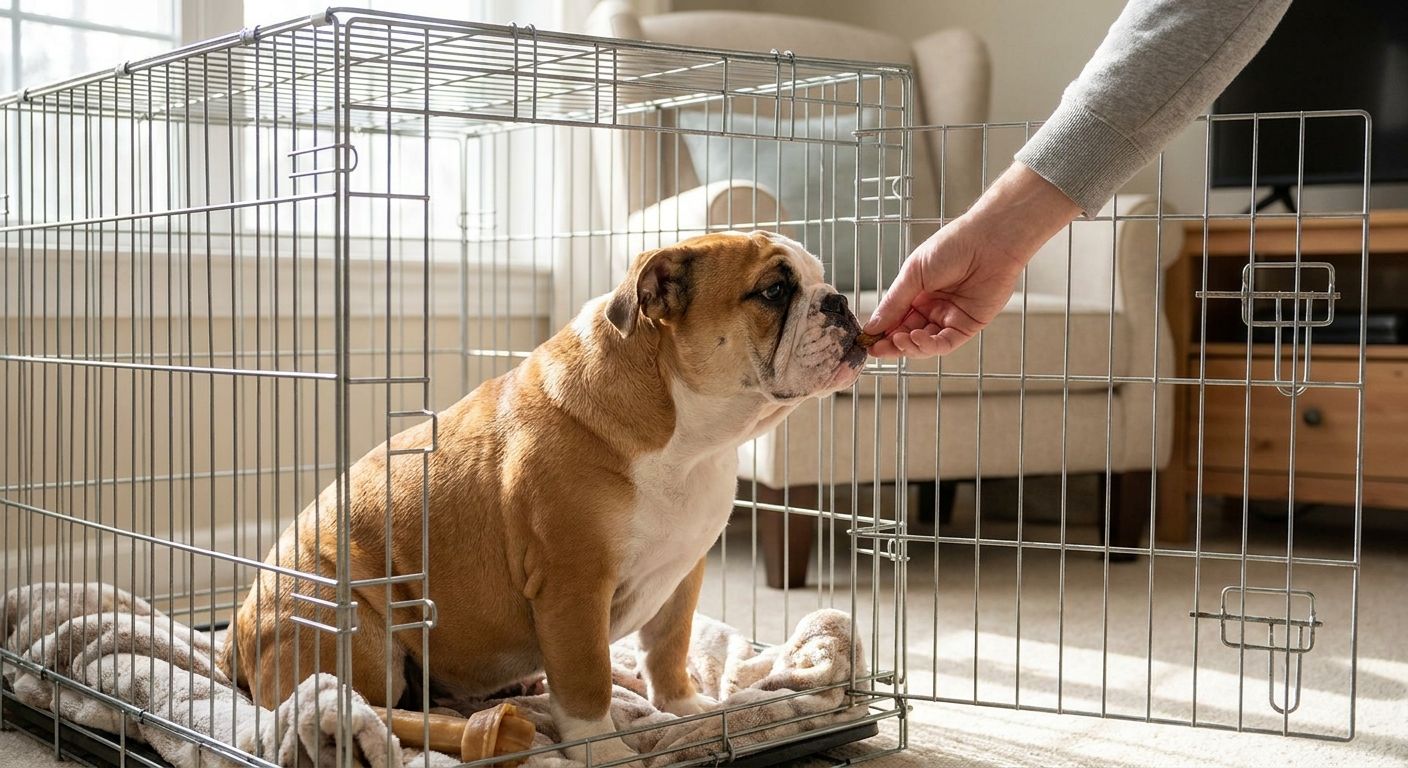
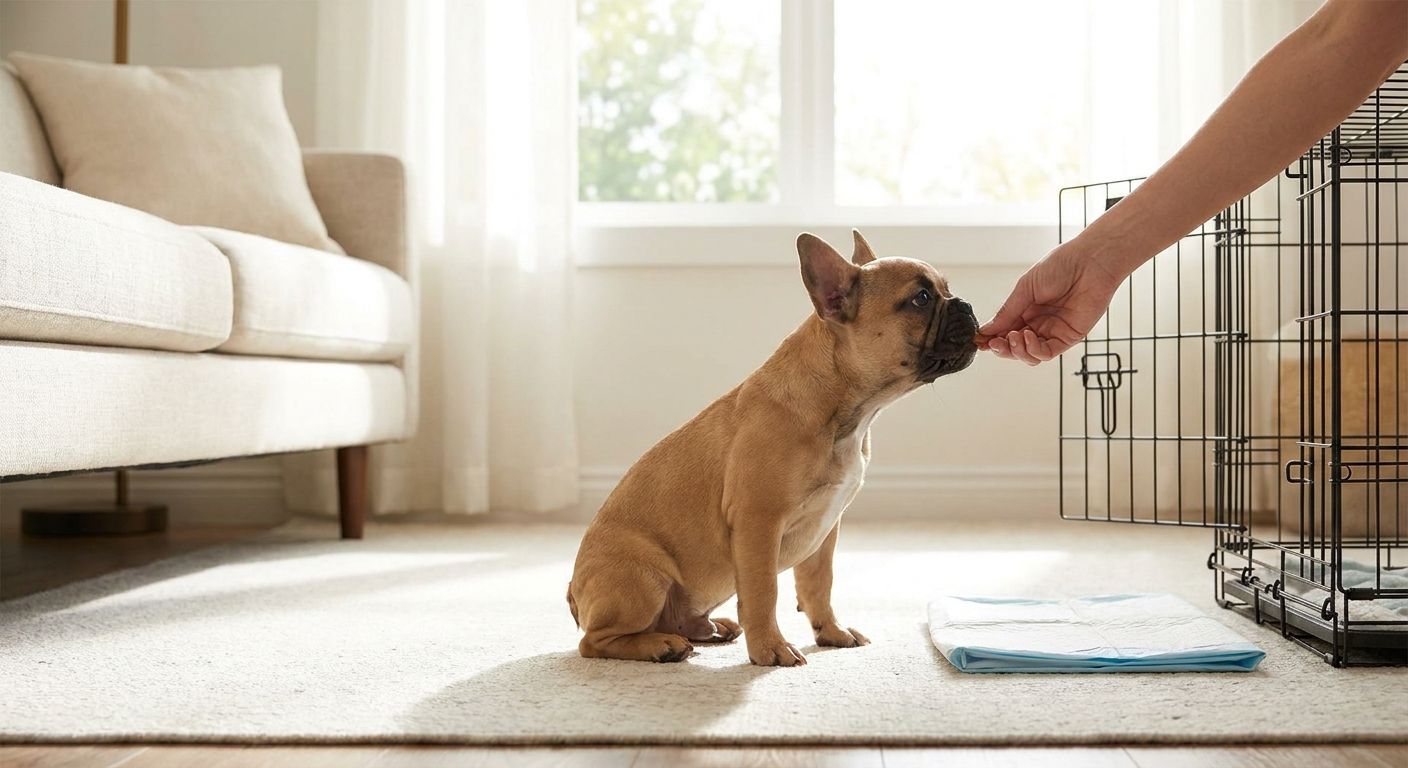
Crate training an English Bulldog puppy takes about 2 to 4 weeks of short, consistent sessions when you start the day your puppy comes home, usually around 8 weeks old. Bulldogs are food-motivated and want to please you, but their short muzzles and heat sensitivity mean crate placement and airflow matter more than they do for most breeds. Skip the guesswork and follow the age-based schedule below — most puppies treat the crate as a den, not a punishment, within the first two weeks.
TL;DR
English Bulldog crate training takes 2 to 4 weeks with short, food-reward sessions starting at 8 to 12 weeks old.
Cap daytime crating at 3-4 hours even for adult English Bulldogs; overnight tops out around 6-8 hours.
Never place the crate near a heat vent, radiator, or direct sun — brachycephalic dogs overheat fast.
Wire crates with a divider panel beat plastic bins for airflow during English Bulldog crate training.
Feed meals inside the crate for the first two weeks to build a positive association before closing the door.
Crate training benchmarks
2-4 weeks
Typical training timeline
8-12 weeks
Best age to start
3-4 hours
Max daytime crate stretch
6-8 hours
Max overnight crate stretch
Why crate training matters for English Bulldog puppies
A crate isn't a cage — it's a den, and Bulldogs are den animals whether they're 8 weeks or 8 years old. Crate training speeds up housebreaking because a puppy won't soil the space it sleeps in, and it keeps a teething, chewing puppy safe when you can't watch every move. The same discipline that makes crate training work also underpins our guide on how to house train a French Bulldog puppy — the schedule logic transfers across both breeds we raise here at Shrinkabulls.
English Bulldogs also carry more separation anxiety than people expect from a breed with such a laid-back reputation. A properly crate-trained Bulldog settles faster when you leave the house in 2026 than one who's never had a den of its own. Get the home setup right before the puppy arrives and this whole process moves faster — our checklist on how to prepare your home for a new bulldog puppy covers the room-by-room basics.
How to crate-train an English Bulldog puppy
Follow these steps in order. Don't skip ahead to closed-door naps before the puppy eats meals happily inside the crate with the door open.
Pick a wire crate with a divider panel, sized for the adult dog, not the puppy. English Bulldogs run 40 to 50 pounds full grown, so a 30-inch crate is standard — the divider shrinks the space down for a small puppy and grows with them. Check the starter supplies checklist for what else belongs in that crate zone.
Place the crate somewhere temperature-controlled, away from vents, radiators, and direct sun. Overheating is the single biggest crate-training mistake owners make with a brachycephalic breed.
Leave the door open for the first 3 days. Toss treats inside, let the puppy wander in and out on its own terms — no forcing, no closing the door yet.
Feed every meal inside the crate for two weeks straight. This single habit does more for crate acceptance than any command you'll teach.
Close the door for 5-to-10-minute stretches once the puppy naps calmly inside with food. Stay in the room the first few times.
Extend duration gradually by age — see the breakdown below. Don't jump from a 10-minute nap to an 8-hour overnight stay; that's how you get a puppy who screams and associates the crate with abandonment.
Add overnight crating once daytime naps stick without whining. Most puppies are ready for this by week two if you've been consistent.
8 to 12 weeks: keep sessions under 10 minutes
A puppy this young has a bladder that can't hold much longer than an hour or two anyway, so long crate stretches aren't realistic yet. Keep sessions under 10 minutes at first, always paired with a treat or a stuffed chew, and never crate a puppy this age as punishment. The verdict: short and boring beats long and stressful at this stage — a bored, sleepy puppy learns faster than an anxious one.
3 to 6 months: stretch daytime crating to 2-4 hours
By 3 months, bladder control improves enough to stretch daytime crating to 2 to 4 hours at a time, matched to how often you can realistically let the puppy out. This is also the stage where the "teenage" regression hits — don't panic if a puppy who was doing great at 10 weeks suddenly whines again at 4 months. Stay on schedule and it resolves in a week or two.
6 months and older: overnight crating up to 6-8 hours
Once house training is solid and the puppy has full bladder control, overnight crating can run 6 to 8 hours without a bathroom break. English Bulldogs sleep hard and heavy once they're settled, so most owners find the overnight stretch is actually easier than the mid-day one. Buy into overnight crating at this stage — it's the safest arrangement for a breed prone to chewing cords and getting into trouble unsupervised.
Why English Bulldogs need a different crate-training approach
The standard puppy crate-training advice you'll find online doesn't account for a few Bulldog-specific traits:
Brachycephalic airway structure means poor heat tolerance — a crate that's fine for a Labrador can overheat a Bulldog in the same room. If you live somewhere warm, read our notes on raising a Bulldog in a hot climate before you finalize crate placement.
Independent, sometimes stubborn temperament — Bulldogs don't respond well to force. Coaxing with food works; dragging a puppy into a crate sets training back weeks.
Low exercise needs mean a Bulldog puppy tires out fast, which actually works in your favor for daytime crate naps.
Snoring and heavy breathing are normal for the breed and shouldn't be mistaken for crate-related distress — that's just how a Bulldog sleeps.
Should the crate go in the bedroom or the living room?
Bedroom placement works best for the first month — a Bulldog puppy that can hear and smell you settles faster and cries less overnight. Move the crate to a common living space once the puppy sleeps through the night without whining, usually somewhere around the 3-month mark.
What happens if my English Bulldog puppy refuses to go into the crate?
Stop closing the door and go back to open-door, food-only sessions for another week — forcing the issue almost always makes refusal worse. A puppy that won't enter a crate on its own yet isn't ready for a closed door, no matter how many weeks have passed on the calendar.
Bringing home an English Bulldog puppy?
See available AKC-registered English Bulldog puppies before you build out the nursery.
What size crate does an English Bulldog puppy need?
A 30-inch wire crate with a divider panel fits most adult English Bulldogs, who typically weigh 40 to 50 pounds. Use the divider to shrink the space down for a young puppy so it doesn’t feel like an empty room.
How long can I crate an English Bulldog puppy during the day?
Cap daytime crating at 3 to 4 hours for a puppy over 3 months old, and no more than 1-2 hours for one under 12 weeks. Longer stretches risk accidents and stress before bladder control develops.
Is crate training cruel for English Bulldogs?
No — a properly introduced crate functions as a den, not a cage, and most Bulldogs choose to nap in an open crate on their own. Forcing a puppy inside or using the crate as punishment is what causes distress, not the crate itself.
Should I crate my English Bulldog puppy at night?
Yes, once house training is solid, overnight crating for 6 to 8 hours is the safest overnight arrangement for a Bulldog puppy. It prevents nighttime accidents and keeps a chew-prone puppy away from cords and furniture while you sleep.
What if my English Bulldog puppy cries in the crate?
Check that the crying isn’t a bathroom need first, then ignore short whining rather than letting the puppy out immediately. Letting a crying puppy out teaches it that crying works, which extends the training timeline well past the typical 2 to 4 weeks.
Can I skip crate training and use a playpen instead?
A playpen works for daytime containment but doesn’t teach bladder control the way a crate does, since a puppy will happily soil a corner of a large pen. Most breeders recommend combining both: crate for sleep and unsupervised time, playpen for supervised play.
What type of crate is best for an English Bulldog?
A wire crate with a divider panel is best for English Bulldogs because it maximizes airflow, which matters for a brachycephalic breed that overheats easily. Plastic travel crates work for short trips but trap heat during long stretches at home.
One last thing
Most English Bulldog puppies hit a crate-training regression around 4 to 5 months old — the same stretch when teething peaks and independence kicks in. Owners assume they did something wrong when a puppy who slept fine at 10 weeks starts whining again at 4 months, but it's a normal developmental stage, not a training failure. Keep the exact same schedule through it and most puppies snap back within a week or two, right on the 2026 timeline breeders and trainers have been citing for years.
Pet insurance for French Bulldogs isn't optional if you love the breed — Frenchies rack up higher lifetime vet bills than almost any other companion dog because of their brachycephalic build. This guide ranks the plans that actually cover breed-specific conditions like BOAS, spinal disc disease, and skin fold infections, so you're not caught paying out of pocket in year two.
TL;DR
Healthy Paws and Trupanion lead pet insurance for French Bulldogs with unlimited lifetime payouts for BOAS and spine conditions.
Embrace fits budget-conscious owners with a diminishing deductible that rewards claim-free years.
Enroll a French Bulldog puppy before 6 months old to avoid pre-existing exclusions on breed-common conditions.
Lemonade moves fast on digital claims but isn’t sold in every state — confirm availability first.
ASPCA Pet Health Insurance suits multi-dog households with its multi-pet discount.
Why Pet Insurance Matters for a French Bulldog Puppy
We've been breeding French and English Bulldogs at Shrinkabulls long enough to know the pattern: Frenchies are prone to BOAS (Brachycephalic Obstructive Airway Syndrome), hemivertebrae, cherry eye, and skin fold dermatitis, and every one of those can mean a specialist bill in the thousands. A puppy that looks perfectly healthy at 10 weeks can still carry a hereditary spine issue that shows up at 2 years old.
If you're bringing home a puppy as a first-time French Bulldog owner, pet insurance is one of the few decisions that's cheaper the earlier you make it — premiums and exclusions both get worse the older your dog gets. In 2026, most insurers still price brachycephalic breeds higher than mixed breeds, and several exclude hip or spine claims if you enroll after symptoms appear.
The Verdict on Pet Insurance for French Bulldogs
Best overall: Healthy Paws — unlimited lifetime payouts and no per-incident caps, which matters when a single BOAS surgery or IVDD case runs into five figures over a dog's life. Best for hereditary condition coverage: Trupanion — one of the few insurers that doesn't quietly exclude congenital and hereditary conditions in the fine print. Best budget option: Embrace — a diminishing deductible structure that actually rewards you for staying claim-free.
What Makes the Best Pet Insurance for French Bulldogs
Coverage for hereditary and congenital conditions — BOAS, hemivertebrae, patellar luxation, cherry eye
No arbitrary per-incident payout caps on major surgeries
Reasonable waiting periods for accident vs. illness coverage
Direct-pay options at partner veterinary clinics so you're not fronting the full bill
Multi-pet or bundling discounts if you own more than one dog
Clear claim turnaround with a real mobile app or online portal
Pet Insurance for French Bulldogs at a Glance
Plan
Best For
Standout Feature
Key Limitation
Healthy Paws
Unlimited lifetime payouts
No per-incident or annual caps
No wellness add-on available
Trupanion
Hereditary/congenital conditions
Direct pay at partner vet offices
No routine care coverage
Embrace
Budget-conscious owners
Diminishing deductible each claim-free year
Orthopedic conditions may need a waiting period waiver
Lemonade
Young, healthy puppies
Fast AI-driven digital claims
Not available in every state
Nationwide
Wellness-focused owners
Optional wellness rider for routine visits
Premiums trend higher with add-ons
ASPCA Pet Health Insurance
Multi-dog households
Multi-pet discount
Customization is more limited than competitors
1. Healthy Paws: best pet insurance for French Bulldogs needing lifetime unlimited coverage
Healthy Paws pays a percentage of the vet bill with no annual or lifetime dollar cap, which is the single biggest factor for a breed that can rack up chronic costs over a decade. It's built around a straightforward accident-and-illness model rather than a menu of add-ons.
Healthy Paws pros:
No payout ceiling over the life of the policy
Fast mobile claims submission
Straightforward reimbursement model, no confusing tiers
Healthy Paws cons:
No wellness or routine-care option
Doesn't cover dogs enrolled after age 14
Exam fees aren't reimbursed
Best for: owners who want one plan, no add-ons, and no surprise caps. Verdict: Buy.
2. Trupanion: best pet insurance for French Bulldogs with hereditary condition risk
Trupanion built its policy specifically around covering hereditary and congenital conditions that many competitors bury in exclusions — a big deal for a breed where BOAS and hemivertebrae are practically baseline risks. Some partner clinics accept direct payment at checkout, so you're not covering the full bill and waiting on reimbursement.
Trupanion pros:
Covers hereditary and congenital conditions other insurers exclude
Direct-pay option at participating vet offices
No payout limits over the policy's life
Trupanion cons:
No wellness or preventive-care rider
Per-incident deductible model can add up with chronic conditions
Premiums generally climb as the dog ages
Best for: owners specifically worried about BOAS, spine, or eye conditions. Verdict: Buy.
3. Embrace: best pet insurance for French Bulldogs on a budget
Embrace's diminishing deductible knocks a set amount off your deductible for every claim-free year, which rewards owners whose Frenchie stays healthy. It bundles accident and illness coverage with an optional wellness rider for owners who want routine visits covered too.
Embrace pros:
Deductible shrinks over time with no claims
Optional wellness rider available
Covers alternative therapies like hydrotherapy
Embrace cons:
Orthopedic conditions may carry a longer waiting period unless a vet exam waives it
Reimbursement can take longer than app-based competitors
Best for: owners who want lower long-term costs and don't mind planning ahead. Verdict: Buy.
4. Lemonade: best pet insurance for French Bulldogs who want fast digital claims
Lemonade uses an app-first, AI-assisted claims process that can process straightforward claims quickly, which appeals to owners who hate paperwork. It's a newer entrant to pet insurance compared to Trupanion or Healthy Paws, and coverage isn't sold in every state as of 2026.
Lemonade pros:
Claims submission and tracking through a mobile app
Customizable coverage add-ons
Preventive care packages available
Lemonade cons:
Not available in every state
Shorter track record than legacy insurers
Breed-specific exclusions can be stricter for brachycephalic dogs
Best for: tech-comfortable owners in a state where it's offered. Verdict: Hold — confirm availability and breed exclusions before enrolling.
5. Nationwide: best pet insurance for French Bulldogs wanting routine-care coverage
Nationwide is one of the few major insurers offering a dedicated wellness plan alongside accident-and-illness coverage, useful if you want vaccines, dental cleanings, and annual exams folded into one bill. It's a legacy insurer with a long history in the pet space.
Nationwide pros:
Wellness rider covers routine vet visits
Long-standing insurer with broad vet network acceptance
Multiple plan tiers to choose from
Nationwide cons:
Adding wellness coverage raises the monthly premium noticeably
Some plans cap payouts per condition
Best for: owners who want routine care and major-incident coverage under one policy. Verdict: Buy — if the wellness rider fits your budget.
6. ASPCA Pet Health Insurance: best pet insurance for French Bulldogs in multi-dog homes
ASPCA Pet Health Insurance offers a multi-pet discount, which matters if your Frenchie isn't your only dog — common among Shrinkabulls families who add a second English or French Bulldog down the line. Coverage includes accident, illness, and optional preventive care.
ASPCA pros:
Multi-pet discount for households with more than one dog
Preventive care add-on available
Covers behavioral therapy in some plans
ASPCA cons:
Fewer customization options than Trupanion or Embrace
Claim processing can be slower than app-first competitors
Best for: households insuring two or more dogs at once. Verdict: Buy — for multi-dog households specifically.
Meet your next Frenchie first
Browse available puppies before you compare insurance plans.
Each plan was weighed against the criteria above: hereditary condition coverage, payout caps, waiting periods, direct-pay availability, multi-pet discounts, and claim turnaround. Plans that exclude congenital conditions outright or cap payouts too low for a BOAS surgery lost points fast, since that's the exact scenario a French Bulldog owner needs covered.
Before you sign anything, it also pays to verify AKC registration papers on your puppy — some insurers ask for registration or breeder documentation when you file a claim tied to a hereditary condition.
Which Pet Insurance Plan Should You Choose?
If you want one answer and no more research: enroll with Healthy Paws or Trupanion within the first few months of bringing your Frenchie home. Both cover the conditions this breed is genuinely prone to, and both skip the payout ceilings that leave owners with a partial reimbursement on a major surgery. If money's tight this year, Embrace's diminishing deductible is the smarter long play into 2027 and beyond.
Whatever you pick, stock up on the basics first — a puppy starter supplies checklist covers what you'll actually need in the first weeks, insurance card included.
FAQ
What’s the best pet insurance for French Bulldogs in 2026?
Healthy Paws and Trupanion rank highest for French Bulldogs in 2026 because neither caps lifetime payouts and both cover hereditary conditions like BOAS and hemivertebrae. Embrace is the stronger pick if premium cost matters more than unlimited coverage.
Is pet insurance for French Bulldogs more expensive than for other breeds?
Yes, premiums for French Bulldogs generally run higher than for mixed breeds because insurers price in the breed’s elevated risk of BOAS, spinal disease, and skin fold infections. The exact difference varies by insurer and location.
When should I enroll a French Bulldog puppy in pet insurance?
Enroll as early as possible, ideally before 6 months old and before any symptoms appear. Waiting until a condition shows up almost guarantees it gets excluded as pre-existing.
Does pet insurance cover BOAS surgery for French Bulldogs?
Trupanion and Healthy Paws both cover BOAS-related surgery as a hereditary or congenital condition, as long as the policy was active before symptoms appeared. Some budget insurers exclude brachycephalic airway conditions entirely, so check the policy wording first.
Is Lemonade pet insurance good for French Bulldogs?
Lemonade works well for tech-comfortable owners who want fast digital claims, but it isn’t sold in every state and its breed exclusions can run stricter for brachycephalic dogs. Confirm your state’s availability and read the exclusion list before enrolling.
How much does pet insurance for French Bulldogs cost per month?
Cost varies by insurer, location, and the dog’s age, and none of the major providers publish a flat national rate. Get a quote directly from two or three insurers on this list to compare current pricing for your puppy.
Do all pet insurance plans cover hereditary conditions in French Bulldogs?
No. Some budget plans exclude hereditary and congenital conditions outright, which defeats the purpose for a breed as prone to them as the French Bulldog. Trupanion and Healthy Paws are built to cover these conditions rather than carve them out.
Can I insure a French Bulldog with a pre-existing condition?
Most insurers exclude conditions your puppy already showed symptoms of before enrollment, though some curable pre-existing conditions can become eligible again after a symptom-free waiting period. Ask each insurer directly how they define and handle pre-existing conditions.
One Last Thing
The detail most new owners miss: some insurers require breeder documentation to process a claim tied to a hereditary condition, which is one more reason to ask the right questions before buying and keep your paperwork organized from day one. If you're weighing a rare-colored puppy against a standard-colored one, it's also worth reading up on what rare-color puppies really cost — rarer colors don't change the insurance math, but they do change the upfront investment you're protecting.
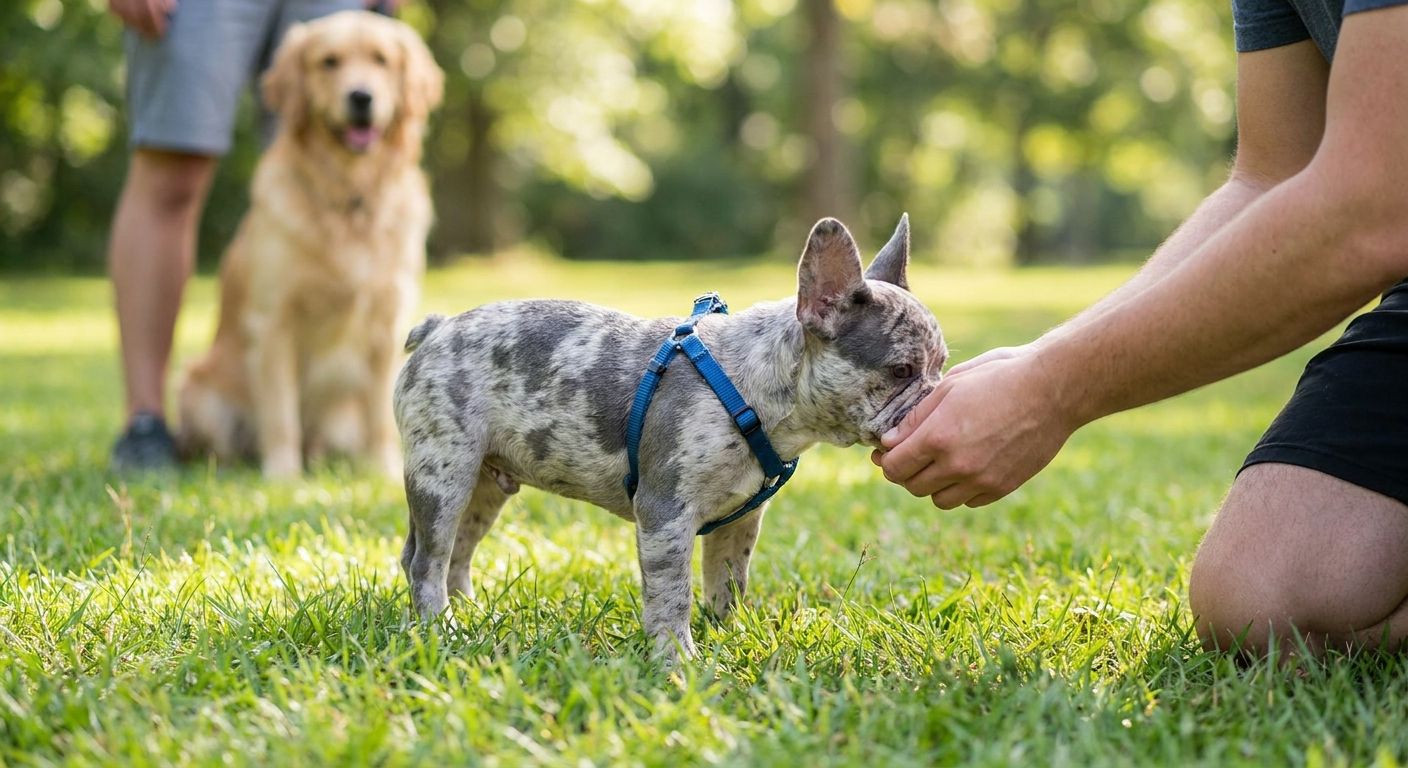
Socializing a merle bulldog puppy safely means starting exposure work inside the 3-to-14-week critical window and pacing every new experience around the puppy's health limits, not just its age. The verdict: begin gentle handling and novel-surface exposure before 8 weeks, hold off on dog-to-dog contact until 7-10 days past each vaccine round, and confirm the puppy isn't a double merle before you build any socialization plan at all. Merle bulldogs carry the same brachycephalic heat and joint sensitivity as any English or French Bulldog, plus a color-linked genetic risk that changes how much sensory stress the puppy can safely handle.
TL;DR
Socializing a merle bulldog puppy works best inside the 3-14 week critical window established by canine behaviorists.
Confirm the puppy is not a double merle before pickup – that cross carries roughly a 25% risk per litter.
Wait 7-10 days after each vaccine round before adding new dogs, parks, or pet stores.
Keep every session under 15 minutes and skip peak heat hours – bulldogs overheat faster than most breeds.
Positive, low-pressure exposure between 8 and 16 weeks matters more than volume of new experiences.
Merle bulldog socialization by the numbers
3-14 weeks
Critical socialization window
25%
Double merle risk per litter
When a merle is bred to a merle
7-10 days
Wait period after each vaccine round
Why this matters
A merle bulldog puppy is still a bulldog first. Every rule that applies to socializing an English or French Bulldog puppy – short sessions, low heat exposure, careful handling of a compact skull and airway – applies here too. What changes with merle coloring is the genetic backdrop: merle-to-merle breeding produces a documented risk of hearing and vision defects in the litter, and any puppy affected by that needs a socialization plan built around sensory limits, not a standard checklist. Before you plan a single outing, understand the double merle health risks tied to the puppy's specific breeding.
That context changes the stakes. A hearing- or vision-limited puppy startles more easily, needs visual or touch cues instead of verbal ones, and benefits from a slower introduction pace than a standard bulldog puppy. Socializing a merle bulldog puppy in 2026 means layering standard bulldog care on top of that genetic check, not skipping it.
How do you socialize a merle bulldog puppy safely?
Follow this order, and don't skip steps to speed things up:
Confirm health status first. Ask the breeder whether the puppy is a single or double merle and whether hearing/vision testing has been done. This determines every decision after it.
Start handling exposure at 3-7 weeks (breeder-side). Gentle touch, different textures underfoot, and mild household sounds should already be happening before you bring the puppy home.
Introduce your household calmly at 8 weeks. New people, one at a time, low voices, no crowding. Merle bulldogs draw attention for their coloring – manage strangers wanting to rush in for a photo.
Hold off on other dogs until 7-10 days post-vaccine. First shots typically land around 6-8 weeks, boosters at 10-12 and 14-16 weeks. Public dog contact before that window risks parvo and distemper exposure.
Add novel surfaces and sounds at 9-12 weeks. Tile, grass, gravel, vacuum noise, car rides – short doses, positive reinforcement, no forcing.
Enroll in a puppy class once the second vaccine round clears. Controlled, vaccinated-dog environments beat open dog parks for a puppy this young.
Watch heat and breathing the entire time. Cut any session short if the puppy starts open-mouth panting hard or won't stop pawing at its face.
Weeks 3-8: pre-pickup groundwork at the breeder
This stage happens before you own the puppy, but it sets the baseline. A breeder who handles puppies daily, exposes them to different people, and introduces mild noise before 8 weeks hands you a puppy that's already ahead on confidence. Ask about this directly when you're vetting a source – it's one of the best questions to ask a breeder before buying.
Weeks 8-12: controlled household and vaccine-paced exposure
This is the highest-value window and the one owners most often rush. New people, new rooms, short car rides, and crate time all belong here – but dog-to-dog contact waits until the puppy clears its early vaccine rounds by 7-10 days. Merle bulldogs in this window also need shade and AC breaks more often than a solid-colored bulldog of the same age, since coat pigmentation differences don't change the underlying brachycephalic airway.
Weeks 12-16: puppy classes and wider public exposure
Once the second vaccine round has had time to take effect, controlled puppy classes, quiet parks at off-peak hours, and pet-supply stores become reasonable. Keep outings to 15 minutes or less at first. This is also the window where merle bulldogs tend to draw crowds – plan for that and don't let a puppy get overwhelmed by well-meaning strangers.
Weeks 16 and beyond: reinforcing confidence
After the full vaccine series, expand radius and duration gradually. A puppy that had a strong 8-16 week foundation will handle new environments with far less stress than one rushed through it. This is also a good stage to revisit house-training routines alongside socialization, since the two build on the same consistency.
Why merle bulldog socialization plans vary
Double merle status. A puppy with hearing or vision impairment needs touch and visual cues layered into every new introduction.
Heat tolerance. Bulldogs overheat faster than most breeds regardless of coat color – merle doesn't change airway structure.
Public attention. Merle coloring draws strangers wanting to pet or photograph the puppy, which can overwhelm a young dog fast.
Vaccine timing. A puppy on a delayed shot schedule needs a delayed public-exposure schedule to match.
Individual temperament. Some merle bulldog puppies are naturally bolder; others need slower pacing regardless of genetics.
Breeding transparency. Puppies from a single-merle-to-solid-color pairing carry lower sensory risk than those from merle-to-merle litters, which matters when deciding how fast to move.
Looking for a health-tested merle bulldog?
See current litters and verified breeding pairs before you plan a socialization schedule.
Is it safe to socialize a merle bulldog puppy before vaccines are complete?
Limited, controlled socialization is safe before the full vaccine series – handling, household exposure, car rides – but direct contact with unknown dogs or unvaccinated environments isn't. Wait 7-10 days after each vaccine round before adding dog parks, pet stores with open dog traffic, or group puppy play.
Do merle bulldog puppies need different socialization than solid-colored bulldogs?
Merle bulldog puppies need the same age-based socialization schedule as any bulldog, with one addition: confirm whether the puppy is a double merle first. A puppy with reduced hearing or vision needs touch-based cues and a slower introduction pace layered on top of standard bulldog handling.
What does socializing a merle bulldog puppy typically cost to get right?
Most of the cost is time, not money – short daily sessions, puppy class enrollment, and a controlled home environment. Rare coloring itself affects acquisition cost more than socialization cost; merle bulldog price data breaks down what buyers pay for the color before socialization even starts.
FAQ
What is the best age to start socializing a merle bulldog puppy?
The best age to start is 3 weeks, inside the critical socialization window that runs through roughly 14 weeks. Early handling and mild exposure at the breeder’s home before 8 weeks sets the foundation for everything after.
How much does a double merle risk affect socialization planning?
A merle-to-merle breeding carries roughly a 25% risk of producing a double merle puppy with hearing or vision impairment. If that applies, socialization needs touch and visual cues added to every new introduction.
Is a merle bulldog puppy harder to socialize than other bulldogs?
Not inherently – the coat color doesn’t change temperament. The added difficulty comes only when a puppy is a double merle with sensory limitations, which changes pacing, not the overall schedule.
When can a merle bulldog puppy meet other dogs safely?
Wait until 7-10 days after each vaccine round, with the core series typically finishing around 14-16 weeks. Controlled, vaccinated-dog environments like puppy class are safer than open dog parks before that.
How long should early socialization sessions last?
Keep sessions under 15 minutes for a young bulldog puppy, merle or not. Bulldogs tire and overheat faster than most breeds, so shorter, more frequent sessions beat long ones.
Do merle bulldogs need extra protection from heat during socialization?
Yes – all bulldogs are brachycephalic and overheat faster than longer-nosed breeds, and merle coloring doesn’t change that. Schedule outdoor sessions for cooler parts of the day and watch for heavy panting.
Should I ask a breeder about socialization before buying a merle bulldog puppy?
Yes – a breeder who handles puppies daily and exposes them to mild sounds and textures before 8 weeks hands you a more confident puppy. Ask directly what the breeder does during weeks 3-8.
Can socialization reduce anxiety in a double merle bulldog puppy?
Yes – slow, positive exposure paired with touch-based cues can reduce anxiety significantly in a hearing- or vision-limited puppy. It won’t reverse the sensory limitation, but it changes how the puppy copes with new environments.
One last thing
The detail most new owners miss: a puppy's merle coloring has nothing to do with how confident or nervous it turns out to be – that's driven entirely by genetics unrelated to coat pattern and by what happens in those first 3-14 weeks. The single biggest lever you control isn't the color of the puppy you pick, it's whether the breeder did handling work before 8 weeks and whether you keep sessions short and positive after. Verify the breeding behind any merle bulldog puppy before you build a socialization plan around it, and the plan itself gets a lot simpler.
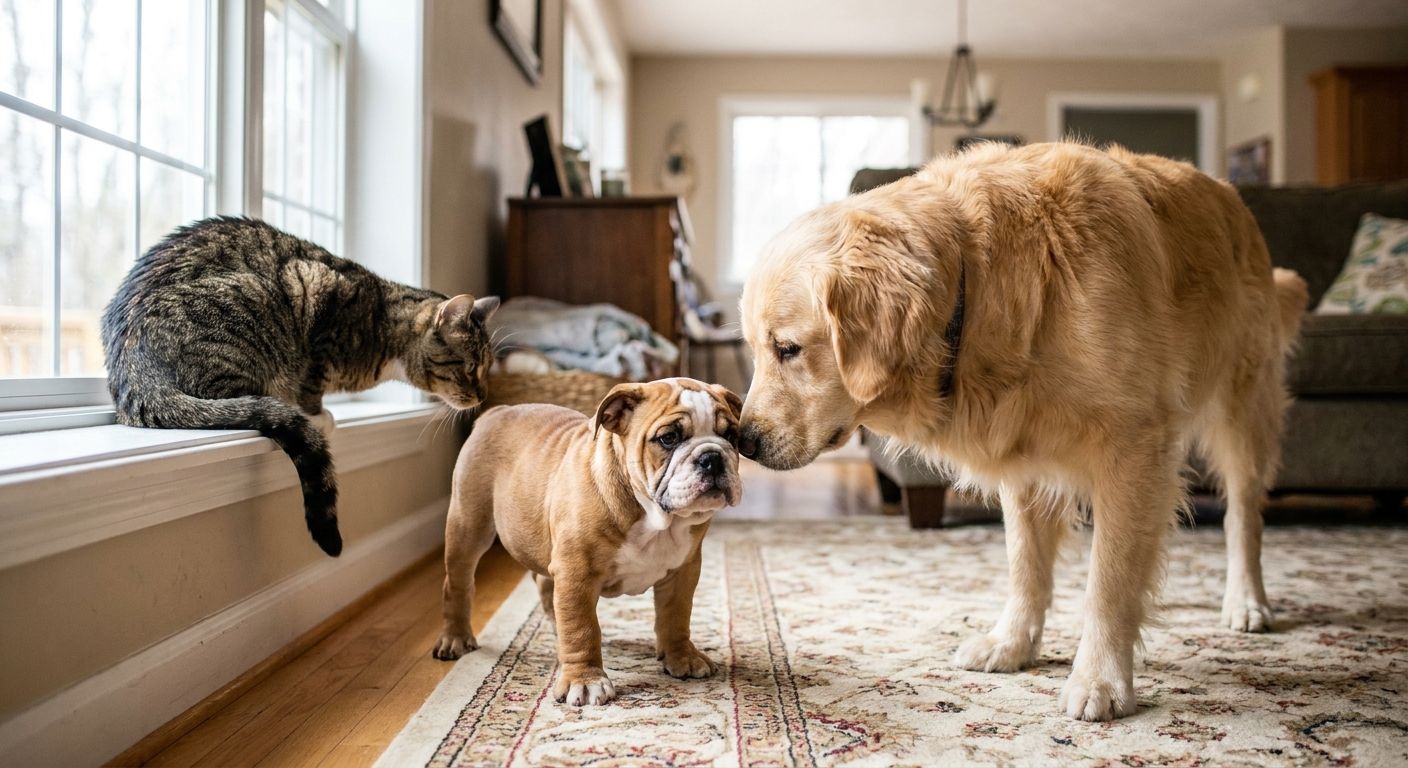
Introducing a bulldog puppy to other pets works best when the first meeting happens on neutral ground, stays short, and lets the resident animal control the pace — most bulldog puppies settle into a home with dogs, cats, or kids within one to two weeks when you slow the process down. The part people skip is separating feeding areas and sleep spaces for that same window, because food guarding and territorial bed disputes cause more fights than the actual first hello.
TL;DR
Introducing a bulldog puppy to other pets works best with a short, supervised meeting on neutral ground in 2026.
Resident dogs usually accept a bulldog puppy within 1-2 weeks; cats can take 3-4 weeks to relax.
Separate feeding stations and crate space until both animals stop tensing up around each other.
Rushing the first face-to-face meeting is the leading cause of failed introductions between a bulldog puppy and resident pets.
Why this matters
A bulldog puppy is stocky, low to the ground, and reads as clumsy to a resident cat or an older dog that hasn't lived with a puppy before. That mismatch in body language — a bulldog's flat face limits its ability to signal the way longer-nosed breeds do — means the resident animal is doing more interpreting than usual in those first days.
Get the introduction wrong and you're managing a fear response or a resource-guarding habit for months. Get it right and the two animals are sharing a couch by week three. Before the puppy even comes home, prepare your home before the puppy arrives so the resident pet's routine, feeding spot, and sleeping area stay untouched — new smells and new furniture on top of a new animal is too much change at once.
How to introduce a new bulldog puppy to resident pets
Follow this sequence in order. Skipping steps to "just see how they do" is the single most common reason introductions fail.
Scent-swap first. Before any face-to-face meeting, let the resident pet sniff a blanket or towel that carried the puppy's scent, and vice versa. Do this for 24 to 48 hours.
Meet on neutral territory. A backyard, a quiet room the resident pet doesn't claim, or a hallway works. Never stage the first meeting in the resident animal's bed or favorite spot.
Keep the puppy leashed, the resident pet loose. A bulldog puppy has almost no bite inhibition yet and no sense of personal space — the leash lets you pull back before a nip escalates.
Cap the first session at 5-10 minutes. Watch for loose, wiggly body language on both sides. End the session the moment either animal stiffens, freezes, or fixates.
Feed and sleep separately for at least two weeks. Two food bowls in the same room, even six feet apart, is enough to start a guarding problem in a bulldog puppy.
Increase supervised time daily, not all at once. Add 10-15 minutes per day rather than jumping to free-roam access after one good session.
Only allow unsupervised time once both animals ignore each other calmly. Boredom with each other's presence is the actual finish line, not tail-wagging excitement.
“If a resident dog stiffens and holds a stare for more than three seconds, end the introduction immediately.”
Introducing a bulldog puppy to a resident dog
Most resident dogs adjust to a bulldog puppy faster than any other pet type, usually within 1-2 weeks, because dog-to-dog body language translates directly even across breeds. The risk is size and play style: an adult dog that plays rough can injure a bulldog puppy's joints before growth plates close, and a bulldog puppy's flat face means it can't always signal "that's too much" the way a longer-muzzled dog can.
Match play sessions to the smaller animal's stamina, not the bigger dog's.
Interrupt wrestling every few minutes to check both dogs are still loose and relaxed.
Keep the resident dog's walk schedule and one-on-one time with you unchanged so jealousy doesn't build.
Verdict: safe to attempt at home with a leash and short sessions, best for owners with an even-tempered resident dog under close supervision.
Introducing a bulldog puppy to a resident cat
Cats take longer — plan on 3-4 weeks minimum before you expect calm coexistence, and some cats simply tolerate a dog rather than bond with one. Give the cat a vertical escape route (a cat tree or shelf) in every room the puppy will access, and never force a face-to-face meeting by holding either animal.
Feed the cat above ground level so the puppy can't approach the bowl.
Let the cat initiate contact; a bulldog puppy chasing a retreating cat teaches the wrong lesson fast.
Watch for the cat swatting with claws sheathed — that's a warning, not an attack, and it's normal in week one.
Verdict: doable, but slower than dog-to-dog introductions — patient households with a confident cat do best here.
Introducing a bulldog puppy to kids and small pets
Kids under six should never be left to supervise the introduction themselves; a bulldog puppy's mouthing habit reads as aggression to a small child even when it isn't. With birds, rabbits, or other small animals, keep the enclosure inaccessible entirely for the first month rather than attempting a supervised meeting — prey drive in a bulldog puppy shows up early and isn't something training reverses in week one.
Why introductions go wrong
Meeting in the resident pet's territory instead of neutral ground.
Skipping the scent-swap step, so the first meeting is also the first exposure to smell.
Letting the first session run too long past the point either animal gets overstimulated.
Feeding both animals in the same space before trust is established.
Forcing physical contact by holding a cat close to the puppy or vice versa.
Inconsistent supervision — one good day doesn't mean unsupervised time is safe yet.
How long does it take for a resident dog to accept a new puppy?
Most resident dogs accept a bulldog puppy within 1-2 weeks of consistent, short supervised sessions. Dogs that were raised with other dogs as puppies themselves tend to adjust faster than dogs that have only ever lived as an only pet.
Should you introduce a bulldog puppy to a cat before the dog?
Introduce the lower-energy animal first when you have a choice, which usually means the cat meets the puppy in a separate, calmer session before the resident dog does. This keeps the cat's stress response from stacking on top of a second new introduction the same day.
Can you leave a new bulldog puppy alone with resident pets right away?
No — wait until both animals ignore each other calmly during supervised time, which typically takes at least two weeks even in easy cases. Leaving them alone before that point is how minor scuffles turn into lasting fear or aggression.
Once the introduction period is behind you, the next stretch of work is house training. Set up a house training schedule that runs alongside the pet introduction — a puppy on a consistent potty routine is calmer around resident animals because it isn't anxious or holding it. Stock the right gear before the puppy comes home too; a puppy starter supplies list that includes a separate crate, a baby gate, and two full feeding setups makes the two-week separation period much easier to manage. Families weighing a Shrinkabulls puppy against their current household setup should factor resident pets into the timeline before bringing a new bulldog home in 2026 — it's a manageable process, but it isn't a same-day event.
Bringing home a first bulldog puppy?
See what a first-time bulldog household needs before puppy arrives.
How do you introduce a bulldog puppy to other pets safely?
Introduce a bulldog puppy to other pets on neutral ground with the puppy leashed and sessions capped at 5-10 minutes. Scent-swap for 24-48 hours beforehand and keep feeding areas separate for at least two weeks.
How long does it take for a cat to accept a bulldog puppy?
A cat typically takes 3-4 weeks to accept a bulldog puppy, longer than most resident dogs need. Give the cat a vertical escape route in every shared room during that period.
Is it better to get a puppy or a kitten if you already have a bulldog?
A kitten generally adjusts to a resident bulldog faster than an adult cat because kittens haven’t built territorial habits yet. Either way, keep the first meetings short and supervised for at least two weeks.
Can bulldogs get along with cats long-term?
Yes, bulldogs commonly live peacefully with cats once the introduction period is handled with separate feeding and gradual supervised time. Many bulldogs are lower-energy as adults, which helps long-term cohabitation with cats.
Should you crate a new bulldog puppy away from resident pets at night?
Yes, crate the new bulldog puppy separately from resident pets at night for at least the first two weeks. Unsupervised overnight time together before trust is established is a common cause of fights.
What are signs an introduction between a bulldog puppy and a resident dog is going badly?
Stiff body posture, prolonged staring past three seconds, raised hackles, and growling that doesn’t stop when you interrupt are signs the introduction is going badly. End the session immediately and reset with shorter, more gradual meetings.
Do bulldog puppies have a strong prey drive around small pets?
Bulldog puppies can show prey drive toward small animals like rabbits or birds even though the breed isn’t known for high energy. Keep small pet enclosures fully inaccessible for at least the first month rather than attempting supervised meetings.
One last thing
The two-week feeding separation is the step almost everyone shortens, and it's the one that causes the most callbacks to breeders and trainers months later. A bulldog puppy that learns to guard its bowl at 10 weeks old carries that habit into adulthood — it's far easier to prevent in week two than to retrain at eight months.
If you live somewhere summer means real triple digits, an English Bulldog puppy needs more than cute wrinkles — it needs a family that plans for heat management from day one.
TL;DR
Gray English Bulldog puppies carry the lightest heat load among coat options — Buy for hot-climate homes in 2026.
XL English Bulldog puppies hold more body mass to cool, making them the riskiest pick for Arizona, Texas, or Florida summers — Skip without full-time AC.
Airway and skull structure predict heat tolerance more reliably than coat color — check breeder health records first.
Black English Bulldog puppies can work in hot climates with strict shade and AC discipline — Consider, not a default Buy.
Why heat matters more than people think
English Bulldogs are brachycephalic — short-muzzled — which means panting alone doesn't move as much air across the tongue and airway as it does in a longer-nosed breed. A dog's normal body temperature runs 100.5°F to 102.5°F; once it tips past 104°F, that's an emergency in any dog, and a flat-faced breed gets there faster than a Labrador on the same walk. That's not a reason to skip the breed. It's a reason to shop differently if your thermostat reads 95°F for four months a year.
We've bred English Bulldog puppies long enough to know the breed handles heat just fine with the right setup — AC access, shade, and a family that reads the warning signs early. What we won't tell you is that any bulldog is "heat-proof." None are, no matter what a listing claims. A 2026 buyer in Phoenix or Houston needs a different checklist than a buyer in Seattle.
Who this guide is for
This is for families in Texas, Arizona, Florida, the Gulf Coast, and inland Southern California who want an English Bulldog and live somewhere summer highs clear 90°F to 100°F-plus for months at a stretch. You're not trying to talk yourself out of the breed — you're trying to buy smart: the right coat, the right build, and a breeder who raised the litter with heat already in mind.
What to look for in an English Bulldog for hot climates
Airway and skull conformation
A tighter, more open airway moves air more efficiently, and that matters twice as much once the outdoor temperature climbs past 90°F. Ask any breeder for detail on jaw and skull structure before you commit — evaluating skull and jaw health tells you more about heat tolerance than coat color ever will.
Coat color and heat load
Darker coats absorb more solar heat during midday sun; lighter coats reflect more of it. It's basic physics, not folklore — a black-coated bulldog standing on a driveway at noon runs hotter to the touch than a gray or fawn littermate next to it.
Body condition, not just size
A lean bulldog sheds heat more efficiently than a stocky, overweight one because there's less mass for the body to cool down. Ask the breeder how they're managing litter weight and feeding schedule, especially past the eight-week mark, and keep asking after you bring the puppy home.
The breeder's grow-out environment
A puppy raised in a climate-controlled whelping room adjusts to AC-managed indoor life faster than one raised in an outdoor kennel with a box fan and good intentions. Ask directly: was this litter raised indoors, and at what temperature range?
Acclimation plan for the first summer
Puppies under 12 weeks shouldn't get long outdoor exposure on hot days regardless of coat or build. A breeder who knows the breed will tell you to keep first walks short and timed for early morning or after sunset, never midday.
Top picks for hot-climate households
Gray English Bulldog — the safe pick. Lighter coat pigment means less heat absorption than black or dark brindle littermates, and gray puppies still carry the same structure and temperament families expect from the breed. If you're set on the breed and live somewhere summer means AC running nonstop, gray English Bulldog puppies built for families with kids are the pick to start with. Buy.
Black English Bulldog — the wildcard. Black coats look sharp and photograph well, but they run hotter on a sunny driveway than lighter colors do. Families who commit to strict shade rules, short midday outings, and AC-controlled play areas can absolutely make this work — it just takes more discipline than a lighter-coated puppy needs. Black English Bulldog puppies suit first-time owners who understand the heat tradeoff going in, not owners hoping to skip the extra effort. Consider.
XL English Bulldog — the one to think twice about. More body mass means more surface area holding heat and a harder job for the cardiovascular system on a 100°F afternoon. XL English Bulldog puppies bred for large-breed enthusiasts are a fantastic match for a cooler climate or a home where the dog spends 90% of summer indoors — for a hot-climate household without dependable AC, it's a tougher ask than the breed's smaller-framed littermates. Skip for hot climates unless your home stays air-conditioned around the clock.
Ask About Hot-Climate Litters
Talk with our family about which puppy fits your climate before you commit.
"No AC needed" claims. Any breeder who tells you their bulldog line doesn't need climate control in a 95°F summer is selling a myth, not a puppy.
Puppies shipped cargo-hold in peak summer. Heat exposure during transit is one of the most preventable risks in the breed — ask exactly how delivery is handled before you book anything for a July or August pickup.
Extra-stocky "bully style" marketing without a heat conversation. More bone density and muscle mass looks impressive in photos, but it's more mass for a body to cool on a 100°F afternoon, not less.
“An English Bulldog panting hard while standing still in the shade at 75°F is already losing the heat battle.”
Verdict comparison
Pick
Coat Heat Load
Airway Risk
Best For
Verdict
Gray English Bulldog
Low-moderate
Standard for breed
Hot-climate families wanting the most heat-forgiving coat
Buy
Black English Bulldog
High
Standard for breed
Owners committed to strict shade and AC routines
Consider
XL English Bulldog
Moderate-high
Elevated (more soft tissue)
Cooler climates or full-time AC homes
Skip for hot climates
FAQ
Is an English Bulldog a good fit for hot climates?
An English Bulldog can live comfortably in a hot climate with AC access, shade, and a lighter feeding schedule, but the breed is not naturally heat-tolerant. Brachycephalic structure limits panting efficiency, so 2026 buyers in Texas, Arizona, or Florida need a cooling plan before pickup day, not after.
What temperature is too hot for an English Bulldog?
Once outdoor temperatures climb past 85°F to 90°F, an English Bulldog should be limited to short, supervised outings rather than extended play. A dog’s normal body temperature sits between 100.5°F and 102.5°F, and anything approaching 104°F is an emergency regardless of breed.
Do gray English Bulldogs handle heat better than black ones?
Yes, gray English Bulldog puppies absorb less solar heat than black or dark brindle littermates because lighter coats reflect more sunlight. Coat color is not the only factor, but it’s a real, physics-based edge for hot-climate households.
How can I tell if my English Bulldog puppy is overheating?
Heavy panting while standing still, bright red or pale gums, drooling, and reluctance to move are early warning signs in an English Bulldog. Get the dog into AC immediately and call a veterinarian if the signs don’t ease within a few minutes.
Should I get an XL English Bulldog if I live somewhere hot?
An XL English Bulldog carries more body mass to cool, which makes hot-climate ownership harder without full-time air conditioning. It’s a better match for cooler regions or homes where the dog stays indoors through peak summer months.
Can English Bulldogs live in Arizona or Texas?
English Bulldogs live in Arizona and Texas successfully when owners commit to AC-controlled indoor time, shaded outdoor breaks, and lighter coat or build choices. Families who skip the planning step run into heat problems by the first summer.
What health checks matter most for a hot-climate bulldog puppy?
Airway and skull structure checks matter most, since a more open airway supports better heat regulation than a heavily compressed one. Ask the breeder for records on both parents before focusing on coat color alone.
How old should an English Bulldog puppy be before outdoor time in summer?
Puppies under 12 weeks should stay off hot pavement and out of direct midday sun regardless of build. Short morning or evening outings work better than any daytime exposure until the puppy is older and better acclimated.
One last thing
Watch the gums, not just the panting. Pale or blue-tinged gums are a heatstroke warning sign in any dog, and in a brachycephalic breed like the English Bulldog, that warning shows up faster than most owners expect. A puppy raised in an air-conditioned whelping room in 2026 settles into your AC-controlled home far easier than a littermate raised outdoors and shipped straight into a Texas July.
You're single, you live alone, and you want a bulldog who fits your life without turning your studio apartment into a kennel — that's why "teacup French Bulldog" keeps showing up in your search bar. Here's the honest breakdown of what that label really means, and which option at Shrinkabulls actually delivers on it.
TL;DR
No registry, including the AKC, recognizes a ‘teacup French Bulldog’ size class as of 2026 — the honest equivalent is a Mini French Bulldog. Buy.
Puppies marketed as true teacup or under 10 lbs full-grown carry higher rates of hypoglycemia and fragile bones. Skip.
Standard French Bulldogs top out at 28 lbs per AKC breed standard and tolerate solo-owner schedules better than undersized runts. Consider.
Budget for lifetime vet care before color or size — rare-color Frenchies often carry a price premium worth understanding upfront.
Why this matters
Every year, more single professionals search for a small, low-shedding, apartment-ready companion dog, and "teacup French Bulldog" gets typed into that search more often in 2026 than it did five years ago. The problem: breeders selling true teacup Frenchies are usually selling runts, and runts bred down generation after generation carry real health baggage. Shrinkabulls doesn't breed a teacup line because the size doesn't exist as a stable, healthy category — what we do breed is a Mini French Bulldog, and the difference matters if you live alone and can't afford a 2am emergency vet run.
Who this is for
This guide is for the single-person household — someone living solo in an apartment or small home, working a schedule that leaves the dog alone for stretches during the day, and looking for a bulldog that's genuinely manageable in size, temperament, and vet-bill risk. You're not trying to win Westminster. You want a dog who naps on the couch, doesn't need a yard, and won't bankrupt you with genetic problems tied to extreme miniaturization.
What to look for in a teacup French Bulldog for single-person households
Realistic size expectations
There is no AKC size class called "teacup." The AKC breed standard caps French Bulldogs at 28 lbs, and the market term "mini" typically describes Frenchies that finish smaller than that ceiling — often in the 16 to 20 lb range as adults, not the 8-10 lb range some sellers advertise as "teacup." Know this before you fall for a listing photo.
Health testing and genetic transparency
A breeder who can't produce OFA or genetic panel results on the parents is a breeder you walk away from, single-person household or not. Extreme size reduction in brachycephalic breeds compounds existing breathing and joint risks — you want documentation, not just a cute photo.
Independence and alone-time tolerance
French Bulldogs are people-oriented by nature and don't love long stretches alone. If your job keeps you out 8-10 hours a day, ask the breeder directly how a specific litter's parents handle solitude — this matters more for a solo household than for a family with someone home most of the day.
Budget for lifetime vet care
Rare colors and undersized puppies both carry pricing premiums, and vet care for brachycephalic breeds isn't cheap in 2026. Before you commit to a color or size preference, understand what rare-color puppies actually cost so the sticker price doesn't blindside your budget six months in.
Breeder honesty about size claims
Any breeder guaranteeing an exact adult weight on an 8-week-old puppy is guessing or lying — genetics and litter variation make precise adult size unpredictable. Watch for other warning signs too, not just size promises.
Home setup for solo living
A compact Frenchie fits a studio apartment fine. What matters more for a single owner is temperament stability, since you're the only person managing behavior, training, and vet visits without backup.
Top picks for single-person households
The honest answer — Mini French Bulldog. This is the closest legitimate match to what "teacup" buyers are actually hunting for: a Frenchie that runs smaller than the 28 lb AKC ceiling without the health gamble of deliberate runt breeding. Shrinkabulls' Mini French Bulldog puppies for small living spaces are bred for compact size within a healthy range, not for extreme miniaturization. Buy.
The genetic gamble — true "teacup" runts under 10 lbs. Puppies marketed this way are almost always the smallest, weakest pups in a litter, sometimes runts pulled early from healthier siblings. Higher rates of hypoglycemia, dental crowding, and fragile bone structure show up in this size bracket. Skip.
The sturdier all-rounder — standard-size French Bulldog. Topping out near the AKC's 28 lb standard, a standard Frenchie tends to handle a solo owner's schedule with fewer fragility concerns than an undersized pup. If you want the breed's personality with less genetic risk, this is the safer lane. Consider.
The color-curious pick — rare color lines within mini range. Blue, lilac, and merle Frenchies can still fall within a healthy mini size window without chasing teacup extremes. If color matters to you as much as size, ask any breeder for documentation showing the litter's size trend runs mini, not runt. Consider.
See Our Current Mini French Bulldog Litters
Browse available puppies bred for compact size without the teacup health gamble.
"Guaranteed teacup" language. No breeder can guarantee an 8-week-old puppy's adult weight with precision — this phrase is a marketing hook, not a fact.
No health documentation on the parents. Skip any seller who can't show genetic panel or OFA results, especially when the pitch centers on extreme small size.
Runt-only litters advertised as a "line." A true breeding line shows consistent size across generations. A litter where only the smallest pup gets marketed as special is a red flag, not a feature. Learn to spot red flags when choosing a French Bulldog breeder before you put down a deposit.
Verdict comparison
Option
Adult size range
Health risk profile
Best for solo owner
Verdict
Mini French Bulldog
Compact, under standard ceiling
Low, bred within healthy range
Yes
Buy
True "teacup" / runt
Under 10 lbs
High — hypoglycemia, fragile bones
No
Skip
Standard French Bulldog
Up to 28 lbs (AKC standard)
Lowest among the three
Yes, if space allows
Consider
Rare-color mini line
Compact, mini range
Low to moderate, verify docs
Yes
Consider
FAQ
What is a teacup French Bulldog?
There’s no official teacup French Bulldog size class recognized by the AKC or any major registry as of 2026. The term usually markets undersized runts, and the closest legitimate small option is a Mini French Bulldog bred within a healthy weight range.
Is a teacup French Bulldog healthy?
Puppies bred specifically for extreme small size carry higher rates of hypoglycemia, fragile bones, and dental crowding. A Mini French Bulldog bred within a healthy range avoids most of this risk while still staying compact.
How much does a teacup French Bulldog cost?
Pricing on undersized or rare-color Frenchies varies widely and often carries a premium over standard puppies. Review current rare-color pricing details before assuming a specific number applies to your search.
What’s the smallest healthy French Bulldog size?
Mini French Bulldogs typically finish smaller than the AKC’s 28 lb standard ceiling while avoiding the extreme miniaturization tied to true teacup marketing. Ask any breeder for the litter’s typical adult weight range, not a guaranteed number.
Are Mini French Bulldogs the same as teacup French Bulldogs?
No. Mini French Bulldogs are bred for compact size within a healthy range, while "teacup" typically markets runts bred for the smallest possible size regardless of health tradeoffs.
Do French Bulldogs do well left alone all day?
French Bulldogs are people-oriented and generally don’t do well with long stretches of solitude. Single-person households should ask breeders directly how a litter’s parents handle alone time before committing.
What size French Bulldog is best for an apartment?
A Mini or standard French Bulldog both fit apartment living fine since the breed doesn’t require yard space. Size matters less than temperament and health documentation when picking a puppy for small-space living in 2026.
Is AKC registration available for a teacup French Bulldog?
AKC registration applies to the French Bulldog breed itself, not to a teacup size variant, since no such official class exists. Always verify a puppy’s AKC paperwork independently rather than trusting size claims on a listing.
One last thing
The single detail most single-person buyers miss: a smaller dog doesn't mean a smaller vet bill. Brachycephalic airway issues, spinal risks, and dental crowding scale with genetic extremity, not with a cute number on a listing — a healthy Mini French Bulldog at 18 lbs will likely cost you less over a lifetime than a "teacup" runt at 9 lbs. Size is the hook. Health documentation is the decision.
A French Bulldog for seniors isn't about finding the cutest puppy in the litter — it's about matching a low-energy, low-maintenance companion to a slower daily rhythm, and getting the health and paperwork checks right before money changes hands.
TL;DR
A Mini French Bulldog is the top french bulldog for seniors pick in 2026 for easy lifting and low exercise needs — Buy.
Standard 16-28 lb Blue and Lilac French Bulldogs suit settled retirees who want a calm apartment companion — Buy.
Skip high-drive show-line pups and unverified ‘rare color’ litters — retirees need low prey drive, not ring energy — Skip.
Confirm AKC registration and health panels before buying any bulldog puppy, no matter how charming the photos are.
Why this matters
French Bulldogs have sat at or near the top of AKC registration counts since 2022, and a lot of that demand now comes from retirees and empty-nesters who want a dog that matches their pace, not their old Labrador's. That popularity also means more backyard litters and more sellers cutting corners on health testing, which is exactly the kind of shortcut a senior buyer can't afford to eat the cost of later. Here at Shrinkabulls we breed English and French Bulldogs, including the rare merle, lilac, and blue lines, and the questions we field most from retirees are almost never about color — they're about knees, stairs, and how much dog they can physically manage day to day.
Who this is for
This guide is for retirees and seniors, often 60-plus, who want a bulldog that's affectionate and low-key rather than a dog that needs miles of daily exercise or hours of training drills. If mobility is a factor, a compact mini French Bulldog at a lighter frame is often easier to lift, bathe, and manage on a leash than a full 25-plus pound standard. It's also for anyone downsizing into a condo or single-level home who wants a dog that fits apartment life without demanding a fenced yard and a jogging schedule.
What to look for in a French Bulldog for seniors
Manageable size and easy handling
A standard French Bulldog runs roughly 16 to 28 pounds, which is light enough for most seniors to lift into a car or onto a grooming table without straining a back. Anything heavier in the breed starts working against the whole point of choosing a compact companion breed in the first place.
Low daily exercise requirements
French Bulldogs are a short-nosed, low-endurance breed built for short walks and couch time, not five-mile hikes. That's a feature for a retiree's schedule, not a limitation — two 10 to 15 minute walks a day covers most adult Frenchies just fine.
Predictable, non-reactive temperament
Seniors don't want a dog that lunges at every squirrel or bicycle on a walk. Ask any breeder directly about the parents' temperament, because that's the single best predictor of how a puppy will behave as an adult — it's one of the best questions to ask a French Bulldog breeder before buying.
Manageable grooming and health monitoring
A short coat means brushing takes minutes, not an hour, but bulldogs still need wrinkle cleaning and nail trims on a schedule. Seniors with reduced grip strength should factor this into how often they'll need a groomer's help versus doing it themselves.
Heat and airway sensitivity
French Bulldogs are brachycephalic, meaning their shortened airways make them prone to overheating faster than a longer-nosed breed, especially above 85°F. A retiree living somewhere with hot summers needs air conditioning and shaded walk times built into the routine from day one.
Top picks for retirees in 2026
The compact pick. A Mini French Bulldog trims the frame down further, which matters if lifting a 25-pound adult dog isn't realistic anymore. Look for a puppy already tracking under breed-standard weight at 12 weeks, and confirm the breeder tests for chondrodysplasia-related joint issues before you commit. Verdict: Buy — this is the single best fit for seniors managing mobility limits themselves.
The settled-home pick. A Blue French Bulldog for apartment living suits a retiree in a condo or single-level house who wants a calm dog that doesn't need a yard. Blue-coated Frenchies run the same 16 to 28 pound standard range, so the appeal here is temperament and lifestyle fit, not size. Verdict: Buy for anyone who's already living the low-square-footage retirement lifestyle.
The wildcard. A Lilac or Isabella French Bulldog brings a rarer coat pattern and, often, a stronger price tag tied to that rarity. Beautiful dogs, but if budget matters more than color rarity in retirement, this is the pick to think twice about. Verdict: Consider — only if the color matters more to you than saving a few thousand dollars.
The one to skip. Show-line French Bulldogs bred specifically for the conformation ring often come with higher energy and stronger opinions about routine than a retiree wants to manage. Those traits made sense for handlers training toward ring events, not for a slower daily walk-and-nap schedule. Verdict: Skip unless you specifically want to show the dog.
What to avoid
Unverified rare-color litters. Merle, blue, and lilac Frenchies command premium prices, and that premium attracts sellers cutting corners on documentation. Before paying a rare-color price, understand what rare color puppies really cost so you know if a quote is in line with the market or padded.
Puppies without a clear health guarantee or AKC paperwork. A breeder who hesitates to show registration documents or health testing results is a breeder to walk away from, full stop.
Skipping the physical prep list. Retirees managing their own joint pain already invest in comfort solutions like lift chairs for arthritis relief; a Frenchie's stocky, low-slung build won't add extra strain that arthritic knees and hips don't need, but only if you also set up the home right with a starter supply list built for a new French Bulldog owner before the puppy arrives — ramps for the couch, non-slip flooring, and a lower food bowl height all matter more for a senior household than for a younger one.
Verdict comparison
Pick
Weight range
Exercise need
Best for
Verdict
Mini French Bulldog
Under standard, compact
Low, short walks
Seniors managing mobility limits
Buy
Blue French Bulldog
16-28 lbs
Low
Apartment/condo retirees
Buy
Lilac/Isabella French Bulldog
16-28 lbs
Low
Buyers prioritizing rare color
Consider
Show-line French Bulldog
16-28+ lbs
Moderate to high
Handlers, not retirees
Skip
FAQ
What’s the best French Bulldog color for seniors in 2026?
There’s no single best color for temperament — blue and standard fawn French Bulldogs tend to be the most widely available and often the most budget-friendly in 2026. Rare colors like merle or lilac cost more but don’t change exercise needs or personality.
Is a Mini French Bulldog easier for retirees than a standard Frenchie?
Yes, a Mini French Bulldog is easier to lift, bathe, and manage physically for a senior with reduced strength. The tradeoff is a smaller gene pool, so verify health testing carefully before buying.
How much exercise does a French Bulldog need for an older owner?
Two short walks a day, around 10 to 15 minutes each, covers most adult French Bulldogs. Their short airways mean they tire quickly and don’t need or tolerate long-distance exercise.
Are French Bulldogs good apartment dogs for retirees?
Yes, French Bulldogs are one of the better apartment-suited breeds because of their low exercise drive and quiet indoor temperament. They still need climate control since they overheat faster than longer-nosed breeds.
How much does a French Bulldog puppy cost in 2026?
Standard-color French Bulldogs typically cost less than rare-color merle, lilac, or blue variants, which carry a premium tied to demand and limited litters. Always confirm what’s included in the price, such as health testing and AKC registration, before comparing quotes.
Do French Bulldogs have health problems seniors should know about?
French Bulldogs are brachycephalic, meaning they’re prone to breathing difficulty in heat and during exertion. Ask any breeder for airway and joint health testing results before buying, especially for a household without central air conditioning.
Can a senior handle a French Bulldog puppy alone?
Most seniors can manage a French Bulldog puppy alone since the breed doesn’t require heavy physical exercise or complex training. The bigger consideration is potty training consistency in the first few months, which takes patience more than strength.
One last thing
The detail retirees skip most often isn't the puppy — it's the paperwork. Before any deposit changes hands in 2026, ask exactly how to verify AKC registration papers on a bulldog puppy, because a legitimate French Bulldog for seniors purchase should come with documentation the breeder hands over without hesitation.
See Available Frenchie Puppies
Browse current litters before choosing a color and size for retirement life.
Snow country and English Bulldogs don't sound like a natural match, but the breed handles cold better than most people expect, as long as you pick the right dog and manage the risks. This guide breaks down what a cold-climate buyer should look for, which builds hold up best, and what to skip entirely.
TL;DR
A well-built english bulldog for cold climates needs body mass, not a heavier coat — the breed is single-coated regardless of color.
XL English Bulldog puppies from Shrinkabulls carry more insulating body fat and handle short outdoor stints better — Buy.
Skip any bulldog with visible skull-and-jaw compromise — restricted airways make cold-air breathing markedly harder.
Gray English Bulldog puppies suit families who want a steady, cold-tolerant companion for yard time in 2026 winters — Buy.
Budget-focused Black English Bulldog picks work fine for first-time owners, but expect shorter outdoor windows — Consider.
Why this matters
English Bulldogs are brachycephalic, which means restricted airways and less efficient panting — a trait everyone associates with heat problems. What gets missed is that the same short muzzle and dense chest actually work in the bulldog's favor in the cold, since heat loss through breathing is lower than in longer-snouted breeds. The real cold-weather risk isn't the coat. It's the combination of low body fat in poorly bred individuals and any existing skull or jaw restriction, which is why checking a puppy's skull and jaw health before buying matters more in a cold climate than in a mild one.
A healthy adult English Bulldog can handle short walks in freezing temperatures without a coat. A poorly structured one, or a puppy with breathing restriction, struggles the moment the mercury drops. That distinction is the whole guide.
Who this is for
This is written for buyers in northern states, mountain regions, or anywhere winters regularly drop below freezing, who want an English Bulldog and need to know which puppies, builds, and colors actually cope with the season. It's not for buyers expecting a dog that thrives unattended outdoors — no bulldog does that, cold climate or not.
What to look for in an English Bulldog for cold climates
Body mass and muscle, not coat color
Coat color has zero bearing on cold tolerance in this breed — gray, black, or fawn, they're all single-coated. What matters is body condition. A puppy with solid muscle and healthy weight retains heat far better than a lean or underweight littermate, so ask breeders about growth rate and current weight relative to age.
Airway clearance
Cold, dry air is harder to breathe through a restricted airway than warm humid air. Puppies with visibly pinched nostrils or a very flat, compressed face will labor in freezing temperatures faster than a moderately built bulldog. This is the single biggest cold-weather disqualifier in the breed.
Paw and pad condition
Salt, ice, and rock salt crystals crack bulldog paw pads quickly since the breed doesn't have the naturally tough pads of working breeds. Ask whether the breeder has already started pad conditioning or nail trims that reduce ice-ball buildup between toes.
Skin fold maintenance history
Wet, cold conditions trap moisture in facial and tail folds just as easily as summer humidity does, and a fold that stays damp through a winter walk turns into a hot spot fast. Buyers should ask how the breeder cleans and dries folds, since that habit needs to continue at home.
Energy level and exercise tolerance
Bulldogs are not high-endurance dogs in any climate, and cold weather shortens their stamina further. A puppy from lines bred for a calmer, lower-drive temperament adjusts more easily to short, controlled winter walks than one bred for high energy.
Delivery logistics if you're not local
If you're buying from a breeder in a different climate zone, ask how the puppy will travel to your home. A cross-country flight nanny delivery that's planned around weather windows avoids shipping a young puppy into a cold snap before it's acclimated.
Top picks for cold-climate homes
The sturdy pick: XL English Bulldog
XL-line English Bulldogs run heavier in bone and muscle mass than standard littermates, and that extra body mass is a real insulation advantage once temperatures drop below 40°F. Owners in snow-heavy states consistently report these dogs tolerating short yard sessions and driveway walks better than leaner bulldogs. Verdict: Buy if you're in a genuinely cold region and want a dog with a bigger cold-weather buffer — see the XL English Bulldog puppies line for current availability.
The family favorite: Gray English Bulldog
Gray English Bulldogs carry the same structure as any standard-color bulldog, but this line tends to come from calmer, lower-drive litters that suit families wanting short, predictable winter walks rather than long outdoor sessions. That lower energy output actually helps in the cold since the dog isn't pushing itself into overexertion in freezing air. Verdict: Buy for a household with kids that wants a steady cold-weather companion — check the gray English Bulldog puppies for families page.
The budget-friendly classic: Black English Bulldog
Black English Bulldogs are a standard, widely available color without the premium pricing of rare color lines, which makes them a sensible entry point for a first-time owner. They handle cold the same as any well-built bulldog, but first-timers should expect a learning curve on fold care and cold-air walk timing. Verdict: Consider if budget matters more than build specialization — see Black English Bulldog puppies for first-time owners.
“If your bulldog’s paws are lifting off the pavement to avoid the cold, the walk is already too long.”
What to avoid
Extremely flat-faced "exotic" builds that look striking in photos but come with compressed airways — cold, dry air makes an already-labored breather work harder.
Underweight or small-for-age puppies marketed as "petite" — lower body fat means faster heat loss on any outdoor outing below freezing.
Any puppy from a breeder who can't answer fold-care and coat questions directly — winter fold maintenance is not optional in a cold climate, and a breeder who glosses over it hasn't thought about your winters.
Browse available bulldog puppies
See current English Bulldog litters and reserve early for 2026 placement.
Healthy, well-built English Bulldogs tolerate short cold-weather exposure reasonably well because their short muzzle actually reduces heat loss through breathing. The bigger risk is airway restriction, not the cold itself, which is why build quality matters more than coat.
Do English Bulldogs need coats in winter?
Most English Bulldogs benefit from a coat once temperatures drop toward freezing, since the breed is single-coated with no undercoat insulation. A coat isn’t mandatory for a quick yard trip, but it helps on longer winter walks.
What temperature is too cold for an English Bulldog?
Many veterinary cold-weather guidelines flag temperatures below 20°F as risky for short-coated breeds, English Bulldogs included. Below that, outdoor time should be limited to brief bathroom breaks rather than extended walks.
Can English Bulldogs live outside in winter?
No. English Bulldogs are not built for full-time outdoor living in any season, and winter conditions make it worse due to skin fold and airway sensitivity. They need to live indoors with supervised outdoor time.
Is an English Bulldog better than a French Bulldog in cold climates?
Both breeds are brachycephalic and single-coated, so cold tolerance is similar between them. The English Bulldog’s larger body mass gives it a slight edge in heat retention over the smaller French Bulldog frame.
How do I keep my English Bulldog warm in winter?
Use a properly fitted dog coat for walks below freezing, dry skin folds immediately after any wet outdoor time, and keep outdoor sessions short and supervised. Paw balm also helps prevent salt and ice cracking on winter sidewalks.
Do English Bulldogs like snow?
Many English Bulldogs enjoy short bursts of play in snow, though their tolerance for extended cold exposure is limited compared to double-coated breeds. Watch for shivering or lifted paws as signs it’s time to head inside.
One last thing
The detail most cold-climate buyers skip: it's not the coat color or the breeder's marketing photos that determine how a bulldog handles winter, it's the airway. Two puppies from the same litter, same color, same price, can have completely different cold-weather tolerance if one has a more open nasal passage than the other. Ask the breeder directly about breathing at rest before you ask about anything else.
French Bulldog puppies are smart, stubborn, and built with tiny bladders — so house training a Frenchie is less about punishment and more about repetition, timing, and reading the signals before the accident happens. Get the schedule right in 2026 and most French Bulldog puppies are reliably potty trained between 4 and 6 months old.
TL;DR
French Bulldog house training works fastest with a fixed schedule, not free-roam access, starting the day your puppy comes home.
Crate training plus a consistent potty spot cuts accidents dramatically for French Bulldog puppies under 6 months.
Most Frenchies hold their bladder roughly 1 hour per month of age, so an 8-week-old puppy needs breaks every 1-2 hours.
Punishing an accident after the fact teaches nothing — catching the puppy mid-squat is the only correction that works.
Full house training for a French Bulldog typically lands between 4 and 6 months with a consistent 2026 routine.
House training benchmarks
1 hr/month
Bladder hold time by age
widely used vet guideline
4-6 months
Typical full training age
10-15 min
Post-meal potty window
Why this matters
French Bulldogs are brachycephalic, which means their body signals for "I need to go" are subtler than a Labrador's obvious circling and whining. Miss that window and you're cleaning a rug instead of watching a puppy succeed. This is also a breed that gets attached to routine fast, so the habits you build in the first two weeks at home stick for the rest of the dog's life.
At Shrinkabulls, we send every French Bulldog puppy home already started on a schedule, but the transition to a new house resets the clock. If you haven't brought your puppy home yet, prepping your home before pickup day makes the first week dramatically easier — especially for first-time French Bulldog owners who haven't set up a crate routine before.
What you'll need
A crate sized so the puppy can stand, turn, and lie down — not much bigger
A fixed outdoor potty spot (same patch of grass or same corner of the yard every time)
Puppy pads for overnight or apartment backup
High-value treats for reward-based timing, not correction
A leash, even in your own yard, for the first few weeks
A log (notes app is fine) tracking wake, meal, and potty times for the first 7-10 days
Most of this is covered in one trip if you're stocking up before pickup — the puppy starter supplies list covers crate sizing and pad brands that hold up to a French Bulldog's low, wide build.
The steps
1. Set a fixed schedule from day one
French Bulldog puppies do not generalize "go potty" from random opportunity — they learn from repetition at the same times. Take your puppy out first thing in the morning, after every meal, after naps, and last thing at night. An 8-week-old puppy needs a bathroom break roughly every 1-2 hours during the day; stretch that to every 3-4 hours by 4 months. Skipping this step is the single biggest reason house training drags into month 6 or later.
Common mistake: waiting until the puppy "asks" to go out. Most Frenchies under 12 weeks don't signal in time — you're setting the schedule, not reading cues yet.
2. Use the crate as a management tool, not a punishment
A properly sized crate works because dogs instinctively avoid soiling where they sleep. When you can't supervise directly, the puppy goes in the crate for 20-90 minutes depending on age, then comes straight outside the second the door opens. This single habit prevents more accidents than any pad or spray.
Common mistake: crating for hours longer than the puppy can physically hold it, which forces an accident and breaks the crate's whole psychology.
3. Pick one potty spot and use it every single time
Dogs key off scent. Taking the puppy to the same 4×4 foot patch every trip builds a scent association that speeds up the "go" cue by weeks. Walk the puppy on leash to that exact spot, stand still, and wait — don't let the walk become playtime until after they've gone.
4. Reward within 3 seconds of finishing, not after walking inside
Timing is everything with reward-based training. Praise or a treat delivered the moment the puppy finishes — not after you've both walked back to the porch — is what actually reinforces the behavior. A 10-second delay and the puppy has already mentally moved on to something else.
5. Watch for the pre-accident signals
Circling, sudden sniffing at the floor, stopping mid-play, or heading toward a doorway are the tells. French Bulldogs give less warning than most breeds because of their flat-faced build and lower activity drive, so supervision during free time in the house matters more than with other puppies.
If the crank takes more than 40 turns to catch, you've already missed the window — the fix is tighter supervision, not more corrections.
“You’re not correcting the accident — you’re catching the signal before it happens.”
6. Feed on a schedule, not free-fed
Puppies who graze all day potty unpredictably. Two to three set meal times a day means you can predict the post-meal potty window — 10 to 15 minutes after eating for most French Bulldog puppies — and take them straight outside instead of guessing.
7. Extend the leash rule for six weeks minimum
Even in a fenced yard, keep the puppy on leash during potty breaks for the first six weeks. Off-leash freedom too early turns a 2-minute potty trip into a 20-minute sniff-and-play session with no result, and you'll end up back inside with an accident 10 minutes later.
8. Add a bell or verbal cue once the pattern is set
Once the puppy is reliably going in the fixed spot for two to three weeks straight, introduce a door bell or a consistent phrase ("go potty") right before you open the door. This is how the puppy eventually learns to signal you on their own instead of needing the clock.
Troubleshooting
Puppy goes right after coming back inside from a successful trip outside. You likely rewarded and walked away too fast — extend the outdoor time by a minute or two after the first success to see if there's a second round coming.
Accidents happen only at night. This is a schedule problem, not a training failure. Add one more overnight bathroom break at the 3-4 hour mark until the puppy is closer to 4 months old.
Puppy won't go on leash in the yard. Some French Bulldogs need the leash removed once they're at the spot, or need a specific surface (grass vs. pavers) to trigger the behavior. Test surfaces before assuming it's a training issue.
Living in an apartment with no yard access. This is common with owners of French Bulldogs suited to small living spaces — a balcony potty patch or a consistent elevator-to-sidewalk route works, but expect the timeline to stretch since the trip itself takes longer.
Puppy regresses after being fully trained. Sudden regression after weeks of success usually means a UTI, a diet change, or a stress event (new pet, move, schedule change) — rule out the medical cause before assuming it's behavioral.
Bringing home a new Frenchie?
See available French Bulldog puppies and get the house-training routine started right.
A vet on file in case regression turns out to be medical, not behavioral
At Shrinkabulls, house training questions come up constantly from new French Bulldog families in their first two weeks — it's the number one thing new owners message about after pickup, and the routine above is what we walk every family through.
FAQ
How long does it take to house train a French Bulldog puppy?
Most French Bulldog puppies are fully house trained between 4 and 6 months old with a consistent schedule started day one. Puppies that skip a fixed routine often take longer, sometimes past 8 months.
Is crate training necessary for French Bulldogs?
Crate training isn’t mandatory, but it’s the fastest tool for preventing accidents when you can’t supervise directly. French Bulldogs take to crates well since they’re a low-energy breed that naturally settles for naps.
How often should a French Bulldog puppy go outside?
An 8-week-old French Bulldog puppy needs a bathroom break every 1-2 hours, stretching to every 3-4 hours by 4 months old. The general guideline is roughly 1 hour of bladder control per month of age.
Why does my French Bulldog puppy have accidents right after coming inside from outside?
This usually means the outdoor trip ended too fast after the first success. Give the puppy an extra minute or two outside before heading back in to catch a possible second round.
Are puppy pads a good idea for French Bulldog house training?
Puppy pads work as a backup for overnight or apartment situations, but relying on them alone slows down outdoor training. Use them as a bridge, not the end goal.
Do French Bulldogs house train slower than other breeds?
French Bulldogs aren’t slower to learn, but their brachycephalic build means they give fewer visible pre-potty signals than breeds like Labradors. Supervision matters more than with more expressive breeds.
What’s the biggest mistake owners make house training a French Bulldog puppy?
Waiting for the puppy to ask to go out instead of running a fixed schedule. Most puppies under 12 weeks don’t reliably signal in time, so the owner has to set the clock.
Can a French Bulldog regress after being fully house trained?
Yes, sudden regression after weeks of success is usually tied to a UTI, a diet change, or a stress event like a move. Rule out the medical cause before assuming it’s a training slip.
One last thing
The fastest French Bulldog house-training timelines in 2026 all share one detail that has nothing to do with treats or crates: the owner tracked potty times on paper or in an app for the first 10 days. Puppies who get a written schedule instead of a guessed one hit the 4-month mark reliably trained far more often than puppies trained on instinct alone.



 REVIEWS