

 REVIEWS




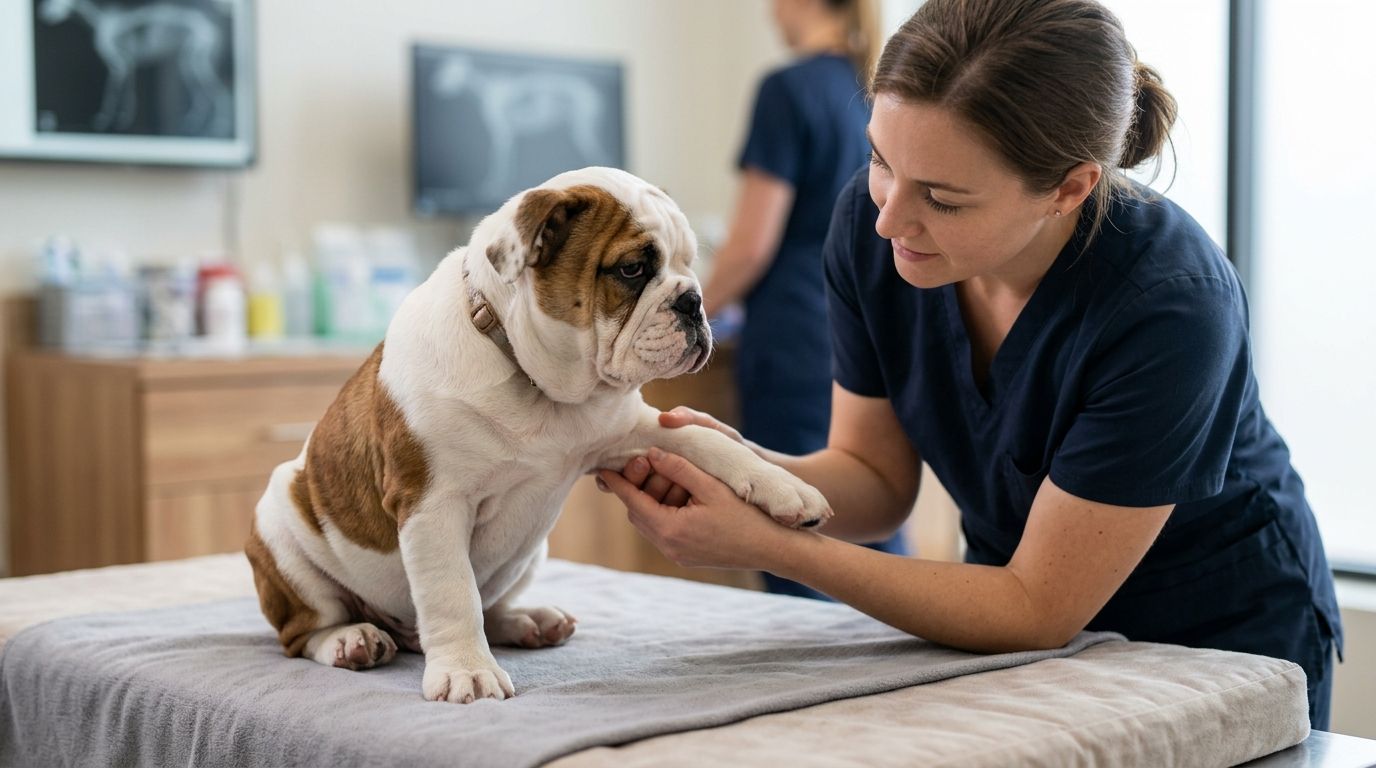
Elbow dysplasia in an English Bulldog puppy shows up as front-leg lameness that worsens after play, a short choppy "bunny hop" stride, and stiffness after naps that loosens up then returns within the hour. Symptoms most often appear between 4 and 8 months of age, while the growth plates in the elbow are still open and the joint is most vulnerable to abnormal bone growth. The hidden catch: a puppy can carry elbow dysplasia for months with almost no visible limp, because Bulldogs mask pain well and often shift weight onto the hindquarters instead of favoring one leg outright.
- Front-leg lameness that worsens after exercise and eases with rest is the clearest early sign of elbow dysplasia in an English Bulldog puppy.
- Symptoms usually surface between 4 and 8 months of age, while growth plates are still open.
- OFA elbow grading runs from Normal through Grade III; only X-rays confirm the grade, never a visual check alone.
- Weight control and low-impact exercise slow progression more reliably than any joint supplement on its own.
- Requesting a breeder’s elbow X-ray results before buying is the single strongest prevention step available to a puppy buyer in 2026.
Why this matters
Elbow dysplasia is a developmental fit problem between the three bones that form the elbow joint (the humerus, radius, and ulna), and it's common in breeds with a heavy, short-legged build like the English Bulldog. Left unmanaged, uneven pressure on the joint wears down cartilage early, and a puppy that seemed fine at 10 weeks can be limping consistently by 6 months.
Bulldog owners often confuse this with hip dysplasia signs, which affect the rear legs and show up as a rolling, swaying gait instead of front-leg stiffness. Both conditions can occur in the same puppy, and both get diagnosed with X-rays, not by watching a dog walk across a room. Shrinkabulls breeding stock gets screened specifically because elbow and hip problems can travel through a pedigree together.
How to spot elbow dysplasia in an English Bulldog puppy
Run through this checklist any time a puppy seems "off" after playtime or a walk:
- Front-leg lameness that comes and goes — worse after exercise, better after a nap, then worse again after the next play session.
- A short, choppy stride or "bunny hop" in the front legs instead of a smooth, even gait.
- Elbows turned outward, paws turned inward — a visible pigeon-toed stance when the puppy stands still.
- Reluctance to fully extend the front leg, or a yelp when you gently flex the elbow joint.
- Muscle loss in one shoulder from consistently favoring the opposite leg over a period of weeks.
- Stiffness getting up from rest that eases within a few minutes of walking, then reappears after exertion.
One or two of these on their own aren't proof of elbow dysplasia — puppies get sore from rough play all the time. Three or more of these signs together, repeating over more than a week, is the point where an X-ray stops being optional.
Grade 0: normal elbows
A Grade 0 (Normal) rating on an OFA elbow X-ray means the joint surfaces line up cleanly with no bone spurring or incongruity. Puppies at this grade show none of the checklist signs above and need no restriction beyond normal puppy exercise limits. Verdict: monitor at annual checkups, no action needed.
Grade I: mild elbow dysplasia
Grade I shows minor bone changes on X-ray — usually small osteophytes (bone spurs) under 3mm — often with subtle or no visible lameness at all. Many Grade I dogs live full, active lives with weight management and joint support alone. Verdict: manage conservatively, recheck X-rays in 12 months.
Grade II: moderate elbow dysplasia
Grade II involves more pronounced spurring and joint surface irregularity, and this is usually where the checklist symptoms above become obvious and consistent rather than occasional. A veterinary orthopedic exam typically follows to weigh medical management against surgical options. Verdict: veterinary orthopedic consult recommended.
Grade III: severe elbow dysplasia
Grade III is the most advanced stage, with significant bone remodeling and often secondary arthritis already forming by the time a puppy is diagnosed. Dogs at this grade usually show daily, visible lameness and benefit most from a full orthopedic workup rather than supplements alone. Verdict: surgical evaluation, not a wait-and-see case.
Why elbow dysplasia severity varies from puppy to puppy
- Genetics and conformation — Bulldogs carry a heavy front end on short legs, which puts more load on the elbow joint than a leaner breed's frame.
- Growth rate as a young puppy — fast weight gain in the first 6 months outpaces bone development and stresses the joint.
- Exercise on hard surfaces — repeated jumping off furniture or running on pavement adds impact stress during the growth window.
- Excess body weight — every extra pound is extra load on a joint that's already working against a compact frame.
- Uneven growth between the radius and ulna — the two forearm bones need to grow at matching rates; a mismatch pulls the elbow joint out of alignment.
- Lack of screening in breeding stock — parents that were never X-rayed pass along undetected joint conformation issues. Requesting a breeder's health testing panels before buying is the one step that actually reduces risk before a puppy comes home.
“If your bulldog puppy holds one front leg out or refuses to put full weight on it for more than a day, treat it as an orthopedic emergency, not a phase.”
Managing early elbow dysplasia signs in a bulldog puppy
Once a vet confirms elbow dysplasia on X-ray, day-to-day management focuses on reducing joint load rather than curing the joint itself:
- Keep body weight lean. Extra weight on an already compromised elbow accelerates cartilage wear.
- Swap hard-surface exercise for controlled walks. Skip repeated stair-climbing and jumping off couches during flare-ups.
- Add vet-approved joint support. Joint and mobility supplements help some dogs, though they support comfort rather than reverse existing bone changes.
- Use a ramp for furniture and cars. Ramps built for joint-sensitive puppies cut the repeated jumping that aggravates a Grade I or II elbow.
- Follow up with X-rays on the schedule your vet sets, not on a fixed calendar guess — progression speed varies by grade and by dog.
Check joint health before you buy
See what to ask a breeder about a puppy’s joints and screening history.
Is elbow dysplasia the same as hip dysplasia in Bulldogs?
No — elbow dysplasia affects the front legs while hip dysplasia affects the rear legs, and a puppy can have one, both, or neither. A rolling, swaying rear gait points toward the hips; a choppy front stride or turned-out elbow points toward the elbow joint, and each is confirmed with its own set of X-rays.
What age do elbow dysplasia symptoms start in an English Bulldog puppy?
Symptoms typically start between 4 and 8 months of age, while the puppy's growth plates are still open and the joint is developing fastest. Some mild (Grade I) cases show no visible symptoms at all until later in adulthood, which is why X-rays catch cases a visual check misses.
Can elbow dysplasia be prevented in English Bulldog puppies?
Elbow dysplasia can't be fully prevented once the genetics are in play, but Grade 0 elbow screening on both parents before breeding lowers the odds substantially. Keeping a puppy lean and limiting hard-surface jumping during the 4-to-8-month growth window also reduces how severe symptoms become if the tendency is already there.
FAQ
What does elbow dysplasia look like in an English Bulldog puppy?
It looks like front-leg lameness that worsens after play, a short choppy stride, and elbows that turn outward while the paws turn inward. Stiffness after rest that loosens with light movement is another common early sign.
Is elbow dysplasia hereditary in English Bulldogs?
Yes, elbow dysplasia has a genetic component and runs in bloodlines with poor joint conformation history. Breeding stock with Normal (Grade 0) OFA elbow scores on both sides significantly lowers the odds of passing it to puppies.
Can an English Bulldog puppy outgrow elbow dysplasia?
Mild Grade I cases can stabilize with weight management and stay symptom-free for years, but the underlying bone changes don’t reverse on their own. Moderate to severe cases (Grade II and III) typically need ongoing management or surgery rather than time alone.
What’s the difference between elbow dysplasia and hip dysplasia?
Elbow dysplasia affects the front legs and shows up as a choppy front-end stride, while hip dysplasia affects the rear legs and shows up as a rolling, swaying gait. Both are confirmed with separate X-rays and both can occur in the same dog.
How is elbow dysplasia diagnosed in a bulldog puppy?
A veterinarian confirms elbow dysplasia through X-rays graded on the OFA scale from Normal through Grade III. A physical exam and gait observation raise suspicion, but only imaging confirms the grade.
Do all English Bulldog breeders screen for elbow dysplasia?
No, not all breeders screen for elbow dysplasia, which is why asking directly for OFA elbow results on both parents matters before buying. Reputable breeders should be able to produce these results without hesitation.
Should I still buy an English Bulldog puppy if the parents weren’t elbow-tested?
Untested parents don’t guarantee a problem, but they remove your ability to gauge the risk before bringing a puppy home. Ask the breeder directly why testing wasn’t done and weigh that answer alongside the rest of the litter’s health history.
One last thing
Most bulldog buyers ask about hip screening and never think to ask about elbows, even though OFA maintains a completely separate elbow registry with its own Normal-to-Grade-III scale. Ask a breeder for both hip and elbow results, not just one — a puppy with a clean hip score can still carry an unscreened elbow risk from the other side of the pedigree. Shrinkabulls treats elbow and hip screening as a matched pair for exactly this reason, not an either-or checkbox.
Related guides
