


 REVIEWS





An underweight French Bulldog puppy needs a calorie-dense food fed on a fixed schedule, a body condition score check every two weeks, and a vet visit to rule out parasites, dental pain, or airway restriction before you add a single extra calorie. The plan only works if you weigh your Frenchie on the same scale at the same time of day — inconsistent weigh-ins hide both real gains and real problems.
- Weigh and score your French Bulldog puppy before changing food — a vet visit rules out parasites, dental pain, or airway issues first.
- Calorie-dense puppy food split into 3 to 4 small meals works better than one big bowl for underweight Frenchie puppies.
- Adult French Bulldogs typically settle between 16 and 28 lbs — use that range, not one target number, to judge progress.
- Re-weigh every two weeks on the same scale; two flat check-ins in a row means call the vet, not adjust the food again.
Why this matters
French Bulldogs are brachycephalic, which means a puppy that seems "just picky" can actually be dealing with restricted airflow that makes eating tiring, or a dental issue that makes chewing painful. Underweight isn't a food problem by default in 2026 any more than it was in past years — it's a symptom with several possible causes, and treating it that way is what separates a plan that works from a bigger bag of kibble that doesn't.
Shrinkabulls sees this question constantly from new French Bulldog owners in the first few months home. If you're also moving off breeder-provided food, pair this plan with a gradual diet transition so the switch itself doesn't stall the gain you're trying to build.
How to build a weight-gain plan for an underweight French Bulldog puppy
- Weigh and body-condition-score the puppy first. Use one scale you'll reuse every time, and score on the 1-9 BCS scale before touching the food bowl.
- Book a vet visit before you add calories. Ask specifically about intestinal parasites, dental pain, and airway restriction — Shrinkabulls recommends asking about all three by name, since each is common and treatable in the breed.
- Move to a calorie-dense puppy formula. Switch over one to two weeks, mixing old and new food, to avoid the GI upset that undoes any weight gained.
- Split the day into 3 to 4 small meals. Brachycephalic puppies tire out mid-meal. Smaller, more frequent portions keep intake up without the panting and reflux that stop a single big bowl halfway through.
- Switch to a raised or slow-feed bowl if the puppy eats too fast or quits early. A raised feeding bowl reduces the awkward neck angle that makes some flat-faced puppies abandon a meal before it's finished.
- Re-weigh every two weeks, same scale, same time of day. Log the number. One low week means nothing; two flat weigh-ins in a row means the plan needs a vet, not another food swap.
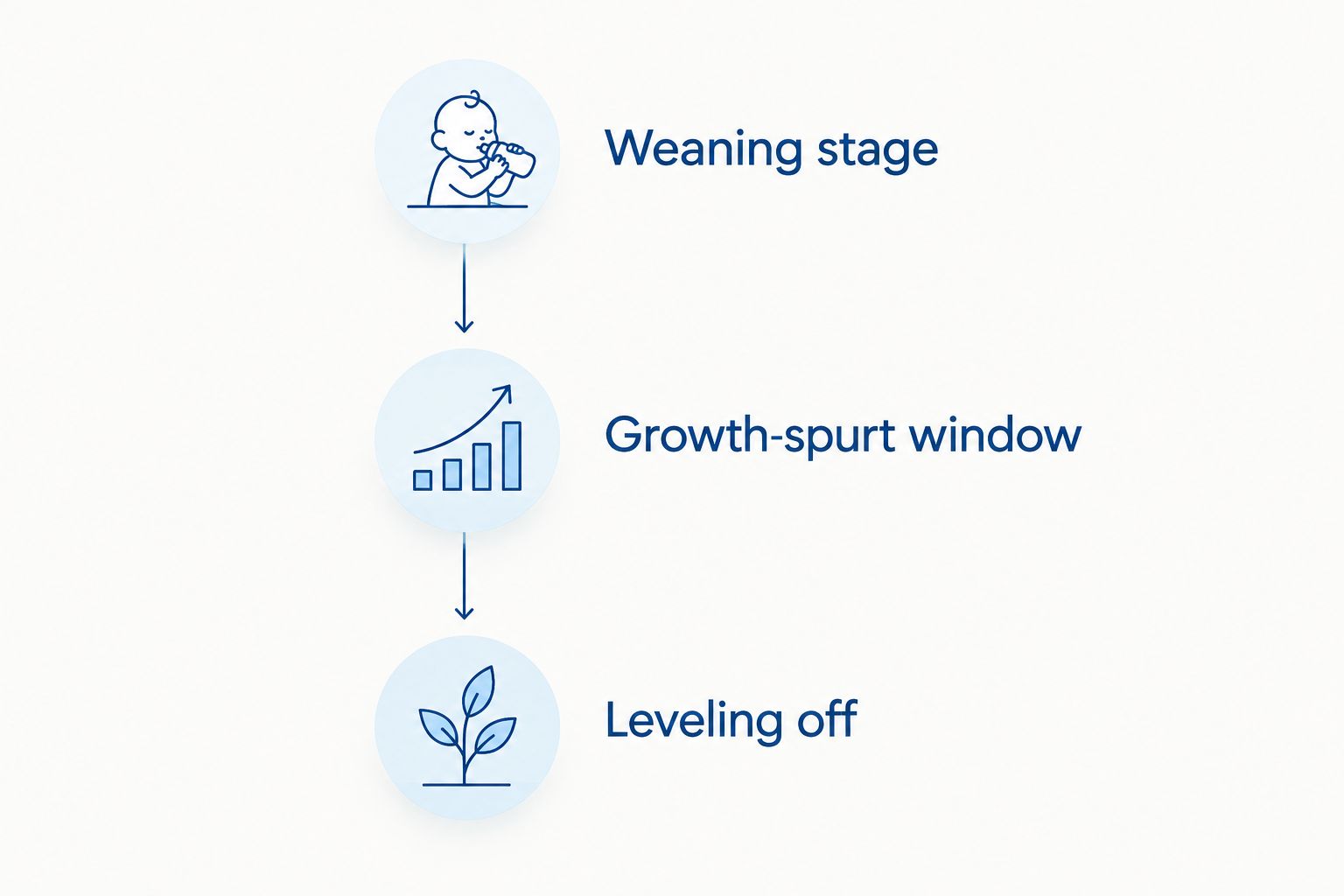
Weaning stage (8 to 12 weeks): building the calorie base
Most French Bulldog puppies wean around 8 weeks old and arrive at a new home already carrying whatever weight the breeder's care produced — that's the base you're building from, not a blank slate. A puppy that was smallest or last to nurse in the litter often starts a step behind, and that's normal, not a red flag on its own.
The first two weeks home should stabilize weight, not necessarily add fast to it. Body condition matters more than the number on the scale this early, since French Bulldog puppies at 8 weeks vary a lot in starting size depending on the parents.
Growth-spurt window (3 to 6 months): where most catch-up happens
This is the fastest bone and muscle growth window in a French Bulldog puppy's first year, and calorie needs rise sharply with it. An underweight puppy on a corrected plan usually closes the gap fastest here, because the body is already primed to add mass — the plan just has to supply enough calorie density to keep pace with it.
A puppy that stalls flat through this window, rather than just gaining slower than expected, is the clearest signal something medical is interfering and it's time to go back to the vet.
Leveling off (6 to 12 months): confirming the gain held
Growth rate slows here, and weight gain becomes steadier and smaller week to week. By 12 months most French Bulldogs are within reach of their adult range of 16 to 28 lbs, though frame size varies a lot between individual dogs and even between littermates from the same litter.
This is also the point to drop from 3 to 4 meals a day down to 2, once weight is trending in the right direction — not before, and not just because the puppy is getting older.
Why French Bulldog puppies fall behind on weight
- Intestinal parasites — worms rob calories before they're absorbed, even on a good food.
- Dental pain or a retained baby tooth — makes chewing hard kibble uncomfortable enough to skip meals.
- Airway restriction — narrow nostrils or an elongated soft palate make the act of eating itself tiring.
- Littermate competition — the last puppy to the bowl in a litter often stays behind on weight for months after leaving.
- Stress after rehoming — a new home, new pets, and new sounds can suppress appetite for a week or two on their own.
- Wrong-life-stage food — an adult-formula food fed to a growing puppy under-delivers calories per cup.

See current French Bulldog litters
AKC-registered French Bulldog puppies from health-tested lines.
Related questions
How do I know if my Frenchie puppy is actually underweight, not just lean?
Run a hands-on check, not just a number on the scale — you should feel ribs easily under a thin layer of fat but not see them, and the waist should tuck in slightly behind the ribs when viewed from above. A body condition score of 4 or below on the 1-9 scale is the practical cutoff for "underweight" rather than "naturally lean."
Is a long lean stage before filling out normal for a French Bulldog puppy?
A lean stretch during the 3 to 6 month growth spurt is normal, since bone and frame often grow ahead of muscle and fat. It's only a concern if the body condition score sits at 3 or below for more than a couple of consecutive check-ins, not just one lean-looking week.
FAQ
What is a healthy weight for an adult French Bulldog?
A healthy adult French Bulldog typically weighs 16 to 28 lbs, though frame size varies between individual dogs. Body condition score matters more than the exact number, since bulldogs carry weight in a dense, low-slung frame.
How can I tell if my French Bulldog puppy is underweight?
Feel for ribs that are easy to find under a thin fat layer but not visible, and look for a slight waist tuck from above. A body condition score of 4 or below on the 1-9 scale points to underweight rather than naturally lean.
Is it safe to free-feed an underweight French Bulldog puppy?
Free-feeding usually works against a weight-gain plan because it hides whether the puppy is actually eating enough at each sitting. Scheduled meals, 3 to 4 a day, make it easier to track intake and catch a stalled meal early.
Can parasites cause a French Bulldog puppy to stay thin?
Yes, intestinal parasites are one of the most common reasons a puppy stays thin despite eating normally, because worms take calories before the body absorbs them. A vet fecal check should be step one of any weight-gain plan.
Should I switch foods to help my Frenchie gain weight?
A calorie-dense puppy formula, switched gradually over one to two weeks, is usually the right move for an underweight French Bulldog puppy. Switching food without ruling out a medical cause first often just delays finding the real problem.
When should I take an underweight Frenchie puppy to the vet?
See a vet before starting any weight-gain plan, and again if two consecutive two-week weigh-ins show no gain. A vet experienced with brachycephalic breeds will check for dental, airway, and parasite causes specifically.
Does a soft palate or airway issue affect a puppy’s weight gain?
Yes, an elongated soft palate or narrow nostrils can make the physical act of eating tiring enough that a puppy quits meals early. This shows up as a puppy who seems interested in food but doesn’t finish portions.
One last thing
Bulldogs carry weight differently than long-legged breeds because of their dense bone and short frame, which is exactly why a bathroom scale number means less than a body condition score. A 24 lb Frenchie with a visible waist and easy-to-feel ribs is in better shape than a 20 lb Frenchie carrying it all in the chest and belly. Track the score through 2026, not just the pounds, and the plan tells you the truth faster than the scale alone.
Related guides
- Identifying food allergies in a French Bulldog puppy
- Choosing a vet experienced with brachycephalic breeds
- What rare-color bulldog puppies really cost
