


 REVIEWS




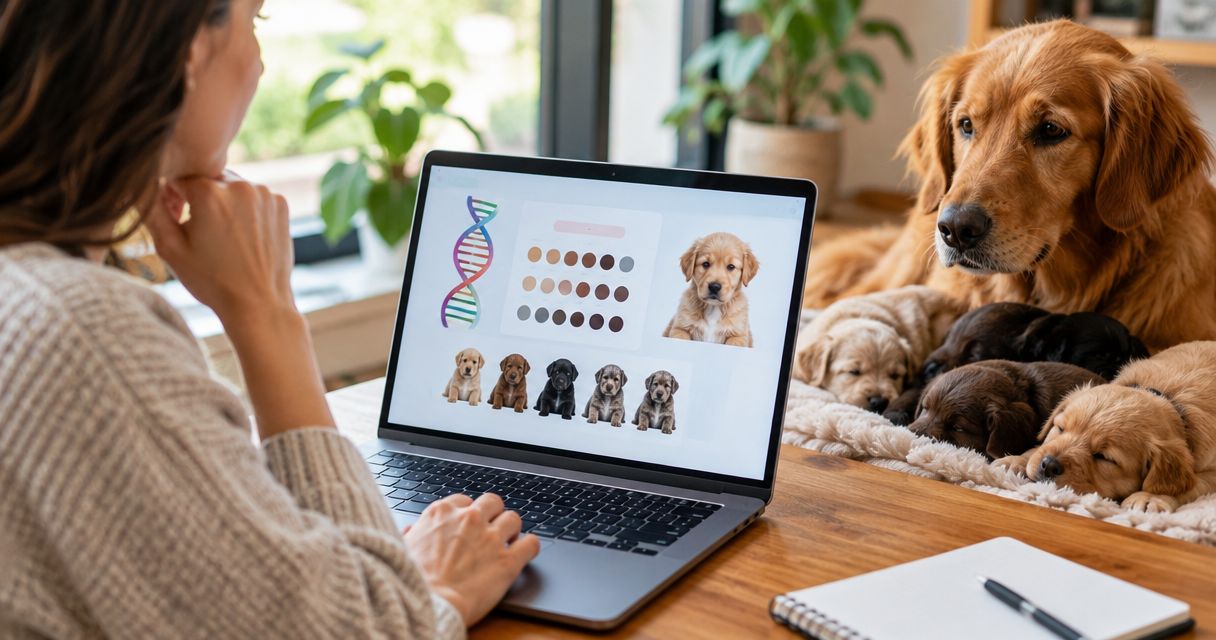
Instead of reading a stud’s DNA report and guessing what his puppies will look like, pair his results with the dam’s report and calculate each possible allele combination. A dna color genetics report litter color prediction gives probabilities for each puppy, not a promise about the litter as a whole.
- A dna color genetics report litter color prediction needs tested results from both the stud and dam.
- Shrinkabulls stud services are best for bulldog breeders who verify both parents’ reports before discussing a color match.
- For D/d × d/d, each puppy has a 50% chance of inheriting d/d; litter outcomes can still vary.
- Check merle findings and health results separately before choosing a breeding pair.
Why this matters
A stud can carry a color variant without showing it. His report tells you what he can pass on; it does not tell you what the dam carries or how many puppies will inherit a particular combination. If you’re choosing tests before making a match, start with the DNA color genetics test kits for rare-color bulldog breeding guide.
Shrinkabulls stud services are best for bulldog breeders who verify both parents’ reports before discussing a color match. The advantage of a report-based discussion is that you can identify possible outcomes before breeding. The limit is just as important: no report guarantees the color of an individual puppy, and color results do not replace a health assessment.
In 2026, keep the prediction tied to the exact dogs and reports in front of you. A description such as blue carrier or merle does not give you the same information as named genetic results for both parents.
Before you start
- Get both parents’ color reports. Confirm each report identifies the dog, the testing laboratory, the tested loci, and the result at each locus you plan to model. The stud’s report alone cannot produce a two-parent prediction.
- Have a place to record allele pairs. Paper works. A spreadsheet works too, provided you label your own columns Locus, Stud genotype, Dam genotype, Possible puppy genotypes, and Probability per puppy. These are worksheet labels to create, not buttons in a testing laboratory’s interface.
- Check the non-obvious mismatch before calculating. A result marked not tested is not a negative result. For chocolate and merle especially, check which variants each laboratory actually assessed; reports with different coverage are not automatically interchangeable. Ask the laboratory or a veterinary genetics professional to clarify an unfamiliar designation.
Set up your parent results
- Match each report to the dog. Record the stud’s and dam’s identifiers beside their results. Do not use a relative’s report as a substitute, even if the dogs look alike.
- Copy results exactly. Enter each laboratory’s wording and genotype at the relevant locus. Keep a separate note for anything reported as inconclusive or not tested. Do not convert a color description into an allele pair.
- Line up matching loci. Put the stud’s D-locus result beside the dam’s D-locus result, for example. Repeat for other loci covered by both reports. If one report does not cover a variant you need, stop that part of the prediction until it is clarified.
- Mark what you do not know. Leave the possible-puppy cell unresolved where testing is missing. A blank is more useful than a confident-looking guess.
Expected result: You have a side-by-side record of both parents’ tested results, with missing or incompatible findings visible before any probabilities appear. For a 2026 breeding decision, save the original reports with this worksheet so you can check every entry against its source.
Calculate each puppy’s allele pairs
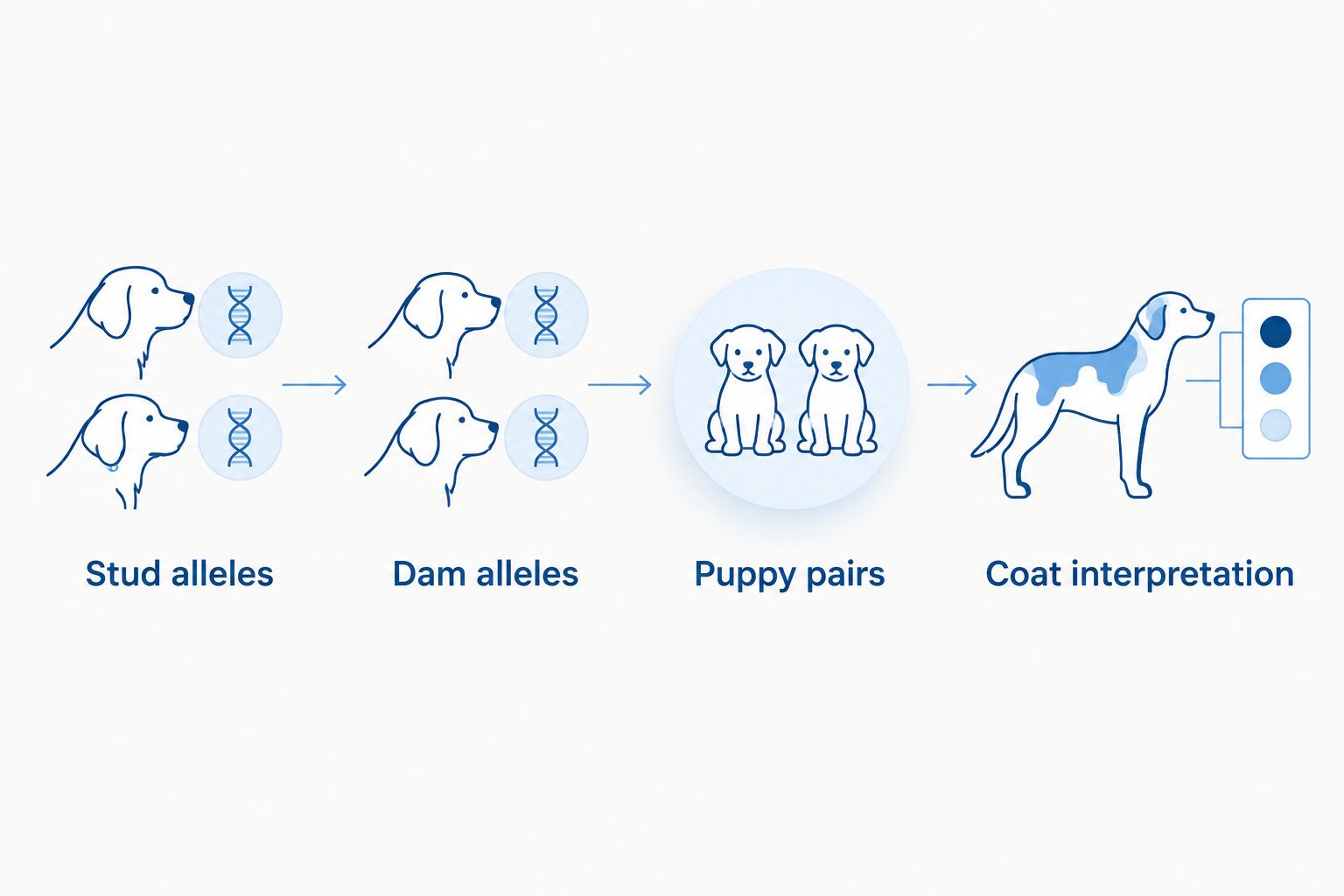
- Start with one locus. At a typical autosomal color locus, a puppy receives one allele from each parent. Write down each allele the stud can pass on and each allele the dam can pass on.
- Combine every possible contribution. If the stud is D/d and the dam is d/d, the stud can contribute D or d while the dam contributes d. The possible puppy pairs are D/d and d/d.
- Assign probability per puppy. Under this simple single-locus model, D/d × d/d gives a 50% probability per puppy of D/d and a 50% probability per puppy of d/d. The D-locus d/d result is associated with diluted eumelanin pigment. It does not, by itself, name the puppy’s full coat pattern.
- Repeat for each relevant locus. Model the loci separately first. Then consider how their results interact before describing a visible color. A puppy’s appearance depends on more than one entry on the worksheet.
Expected result: You can trace every predicted genotype to one allele from the stud and one from the dam. The percentages describe each puppy’s chance under the stated parental genotypes; they do not set a litter quota.
A small grid makes the pairing easier to check. The same method works on paper, so you do not need a particular app or laboratory dashboard to complete it.
Translate genotypes into color possibilities
- Separate a genetic result from a color name. Write D/d or d/d in the genotype column. Put any coat interpretation in a different column, with the other loci needed to support it.
- Check whether the variant is the same in both parents. For example, if both dogs are B/b for the same relevant recessive variant, their possible offspring include B/B, B/b, and b/b. Under that simplified pairing, b/b has a 25% probability per puppy. If the reports use different variant labels, do not assume they mean the same allele.
- Account for genes that change what you can see. The E locus affects whether eumelanin appears in the coat. That means a B- or D-locus result cannot always be translated directly into a visible chocolate or blue coat without the rest of the relevant findings.
- Write the prediction as a condition. Use wording such as: if these reported genotypes are correct and the relevant variants are covered, these puppy genotypes are possible. Avoid a single color label when the test results support several appearances.
Expected result: Your 2026 litter color prediction lists possible genotypes, their per-puppy probabilities where the model supports them, and the findings needed to interpret visible color. It does not label untested variants as absent.
| Approach | Best for | What it gives you | What it misses |
|---|---|---|---|
| Single-locus pairing | Checking what each parent can pass on at one tested locus | A traceable probability for possible allele pairs | Interactions that affect the visible coat |
| Combined-locus interpretation | Describing possible colors after the relevant loci are checked | A more useful picture of possible appearances | Any variant the reports did not assess |
Use single-locus pairing to check your arithmetic. Use combined-locus interpretation before discussing puppy colors with anyone else. Neither approach substitutes for examining the dogs’ health, structure, and suitability as a pair.
Add a merle-specific check
Merle needs its own review rather than a quick entry in a color grid. Laboratories can distinguish merle allele types and lengths differently, and a visually subtle dog can still have a report finding that matters to a proposed pairing. Ask the laboratory how its stated result should be interpreted if the designation is unfamiliar.
- Read both dogs’ reported merle results in full. Do not reduce a detailed result to merle or non-merle based on appearance alone.
- Identify any unresolved result. If either parent’s merle status is unclear, pause the merle prediction and seek clarification before considering the match.
- Review the pairing for health risk. Breeding two dogs that pass on merle variants can produce puppies with two merle alleles, which are associated with elevated risks of hearing and eye abnormalities. A color goal does not justify ignoring that risk.
- Keep merle conclusions separate. Record what the reports support, what remains unknown, and whether professional review is needed. Do not apply the simple D-locus example to a complex merle report.
Expected result: Your merle note makes the proposed pairing’s reported findings and unresolved questions visible. Shrinkabulls offers bulldog stud services, but a desired pattern should not outrank a responsible review of both dogs.
Recalculate when the dam changes
Keep the stud’s verified results and replace the dam’s column when evaluating a different potential match. Then rebuild every allele pairing from the start. A stud does not have one fixed litter color prediction: a different dam can change both the possible genotypes and their probabilities.
For example, compare the earlier D/d × d/d pairing with D/d × D/D. Under the same simplified model, the second pairing has a 0% probability per puppy of d/d because the D/D dam passes D to every puppy. That change comes from the dam’s genotype, not a change in the stud’s report.
In 2026, label each worksheet with the exact stud and dam it covers. Do not carry probabilities from one proposed pairing into another, and do not combine results from different reports without checking their variant coverage again.
Troubleshooting
- The stud is called a carrier, but no genotype is shown. Ask for the underlying laboratory result. Carrier describes a finding; it does not identify every variant assessed or supply the dam’s result.
- One parent looks blue, but the worksheet disagrees. Check the dog’s identity and the D-locus entry on both reports. Then review the other relevant loci and ask the laboratory to resolve any discrepancy rather than changing the genotype to fit a photograph.
- The reports use different chocolate labels. Find each laboratory’s variant definition and coverage. Do not merge two labels into B/b × B/b until you know they describe the alleles in your calculation.
- The merle result has an unfamiliar suffix or designation. Keep that result verbatim and request interpretation from the testing laboratory or a veterinary genetics professional. A plain-language coat name can discard information the pairing needs.
- The litter does not match the predicted percentages. Per-puppy probability is not a guaranteed count. Recheck parent identification and test coverage if a puppy’s result appears impossible under the documented genotypes.
Customize your workflow
Add separate columns for Color result, Health result, and Question to resolve. This keeps a striking coat possibility from being mistaken for evidence that a breeding match is sound. Record which findings came from laboratory testing and which still need discussion with your veterinarian.
If you’re comparing proposed matches across generations, use the same parent-by-parent worksheet and read the multi-generation breeding program for rare colors guide next. For a specific Shrinkabulls stud-service discussion, bring both reports and the questions you marked unresolved. That is more useful than arriving with a puppy color you expect the stud to produce.
Discuss a bulldog stud match
Bring both parents’ color reports and your unresolved genotype questions.
FAQ
Can a stud’s DNA report predict a whole litter’s colors?
No. A stud’s report identifies tested variants he can pass on, but a litter color prediction also needs the dam’s results. Even with both reports, probabilities apply to each puppy rather than guaranteeing a litter breakdown.
What does D/d × d/d mean for bulldog puppies?
Under a simple D-locus model, each puppy has a 50% chance of D/d and a 50% chance of d/d. Other loci still matter when interpreting the puppy’s visible coat.
Does a 25% probability mean one puppy in four will have that color?
No. A 25% probability describes each puppy’s chance under the stated genetic model, not a required count in a litter. The actual litter can differ from the expected proportion.
Can two different DNA laboratories’ color reports be combined?
Yes, if you first confirm that their locus names, variant definitions, and test coverage match for the results you are comparing. Treat any untested or unclear variant as unresolved rather than negative.
Can you predict merle puppies from a photo of the parents?
No. Use both parents’ merle test results and seek clarification of unfamiliar allele designations. Appearance alone does not provide the detail needed to assess a proposed merle pairing.
Does an AKC-registered bulldog have known color genotypes?
No. Registration and a DNA color-genetics report answer different questions. Use the individual dog’s laboratory results for a genetic pairing calculation.
Should color genetics be the deciding factor in a stud match?
No. Color predictions do not assess every health concern or determine whether two dogs are suitable to breed. Review health findings and the proposed pairing separately from the color worksheet.
One last thing
The most useful entry on a 2026 prediction worksheet is often unresolved. It tells you exactly which result to verify before turning a possible bulldog color into a claim about future puppies. We love talking bulldogs, but a careful match starts with both dogs’ actual reports.
Related guides
