


 REVIEWS





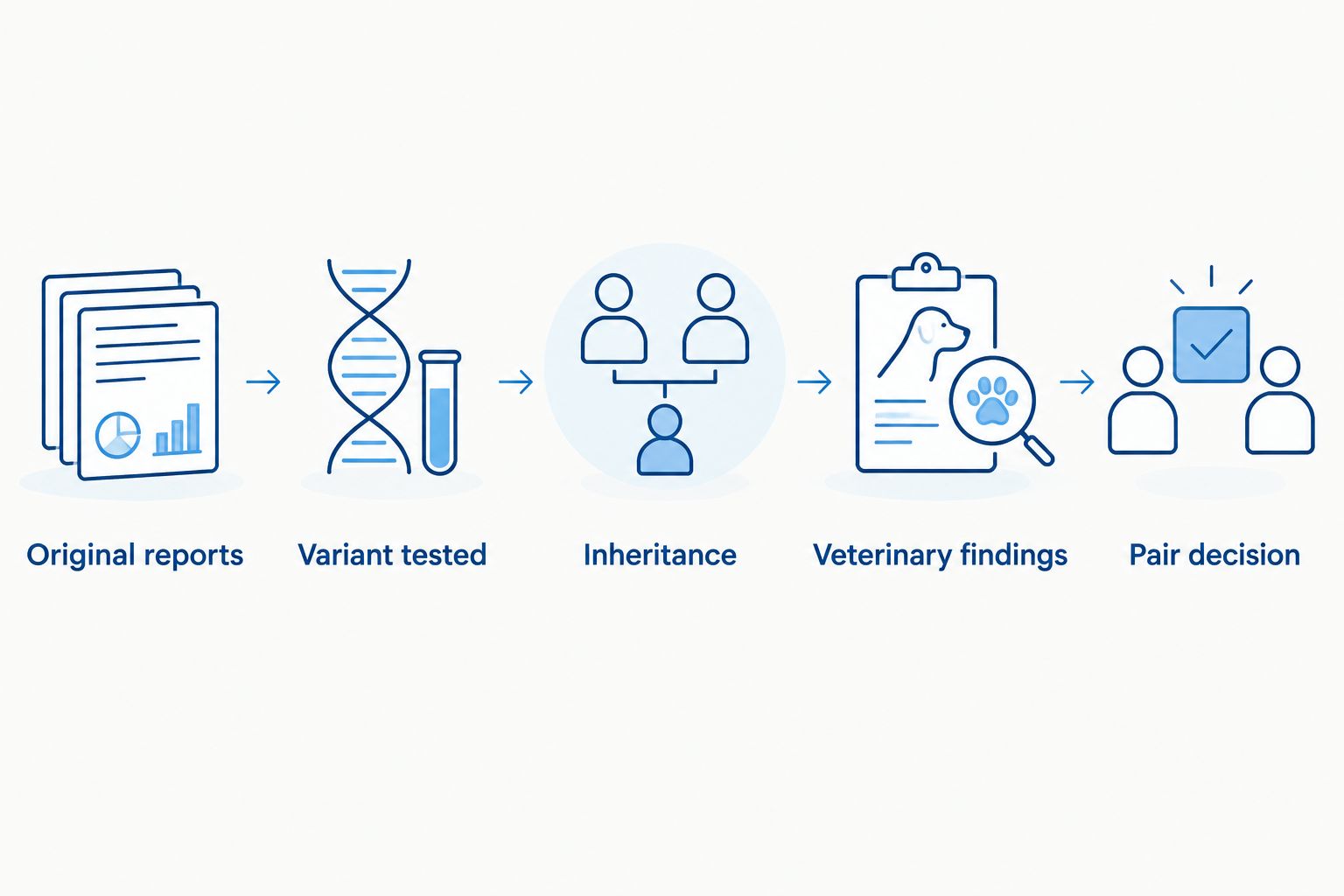
Instead of comparing bulldog DNA reports from memory, put both dogs’ results into one breeding-pair record, check each shared risk, and stop any match that needs veterinary review before discussing color or pedigree. This 2026 workflow connects DNA health clearance results to breeding pair selection without treating a clear panel as proof that either dog is healthy in every respect.
- For dna health clearance results breeding pair selection, compare both dogs by named variant and inheritance pattern before approving a match.
- Shrinkabulls’ breeding-pair workflow is best for bulldog breeders who put documented health results ahead of color goals.
- A clear DNA result covers the variants tested; it does not replace an airway, eye, heart, or orthopedic evaluation.
- Keep the original reports, confirm each dog’s identity, and record the reason for every breeding decision.
Why this matters
A DNA report describes particular variants, not the whole dog. The useful question is not whether both panels say clear; it is whether the same condition appears on both reports, what each result means, and what other health information the match still lacks. Start with the health testing panels to request from a bulldog breeder when deciding which records belong in your file.
This distinction matters especially with English and French Bulldogs. DNA testing cannot show you how comfortably a dog breathes, whether an eye examination found a problem, or what a veterinarian observed during an orthopedic evaluation. AKC registration establishes registration status; it is not a health clearance. In 2026, keep those categories separate in every breeding discussion, even when a dog has an appealing pedigree or rare coat color.
Shrinkabulls’ breeding-pair workflow is best for bulldog breeders who need a documented health decision before considering color. It gives you a practical way to organize a prospective match; it does not certify a dog, interpret an uncertain laboratory finding, or replace advice from your veterinarian or a veterinary geneticist.
Before you start
- Get the original reports for both dogs, not screenshots of summary badges. You need the dog’s identifying information, laboratory, test date, variant or condition name, result, and the laboratory’s interpretation.
- Gather each dog’s veterinary records and breed-relevant evaluations. Include findings about breathing, eyes, heart, joints, and reproductive health where available. Ask your veterinarian which evaluations apply to the specific dogs.
- Check the easily missed mismatch: two panels can use different names or test different variants for a similarly named condition. Do not mark results compatible until you confirm that the reports address the same variant and inheritance pattern.
You also need permission to use the other owner’s records for a stud match. Keep the originals in a location both decision-makers can access, and agree who can edit the comparison. A forwarded summary is useful for starting a conversation, but the underlying report is what you need for the decision.
Set up your breeding-pair record
Use a spreadsheet or a shared document. These are column names you create, not buttons in a particular testing service. Give each prospective pair its own record so an updated result cannot silently change the reasoning behind an earlier decision.
- Create columns labeled Dog, Breed, Identity, Laboratory, Report date, and Original report. Enter the name and identifying details exactly as they appear on each report; keep a copy of the original beside your working record.
- Add Condition, Variant tested, Inheritance, Result, and Interpretation. Make a separate row for each result you intend to compare. Copy the variant name and result from the report rather than translating them into a general clear or positive label.
- Add Veterinary findings, Questions for veterinarian, and Pair decision. Leave the decision open until you have compared both dogs and reviewed findings outside the DNA panel.
- Compare the report identifiers with the records supplied for each dog. If an identifier differs, ask the report owner to resolve it before you use that result.
Expected result: you can trace every entry back to a named dog and an original report. If you cannot, the match is not ready for a genetics decision.
A simple file name can include the dogs’ names and the Report date, but do not make the file name your only record of identity. Reports get forwarded and renamed. The identifier inside the original document is the detail you need to reconcile.
Configure the variant comparison
The central step is a condition-by-condition comparison, not a side-by-side glance at two overall panel summaries. In 2026, a newer or broader panel still cannot answer a question about a variant it did not test.
- Group entries by Condition, then confirm the exact Variant tested on each dog’s report. If only one dog has a result for that variant, mark the other result Not documented in your working record; do not substitute a result for another variant.
- Read each report’s Inheritance and Interpretation before comparing clear, carrier, or affected labels. Those words have different breeding implications for different inheritance patterns.
- For a condition described as autosomal recessive, identify whether each dog has 0 copies, 1 copy, or 2 copies of the tested disease-associated variant, if the laboratory reports copy count. Do not infer copy count when the report does not provide it.
- Put any matching risk, uncertain result, or unexplained difference in Questions for veterinarian. Mark Pair decision as Review required, a label you create, until a qualified professional has assessed it.
| Report situation | What it tells you | Breeding-pair action |
|---|---|---|
| Both dogs clear for the same recessive variant | Neither report identifies the tested variant in either dog | Continue the review; do not treat the pair as cleared for all conditions |
| One clear, one carrier for the same recessive variant | The reports show a different result for that tested variant | Ask a veterinary genetics professional to interpret offspring risk and breeding suitability |
| Both carriers for the same recessive variant | Both dogs carry the tested variant | Do not approve the pair on the strength of their panel summaries; obtain professional guidance |
| One result missing or variants differ | The reports do not establish a like-for-like comparison | Request the relevant result or clarification from the laboratory |
| Dominant, X-linked, complex, or uncertain finding | The recessive comparison above does not apply | Follow the report’s interpretation and seek case-specific advice |
Expected result: every shared finding has a documented comparison, and every gap remains visible. Never turn Not documented into clear just to finish the sheet.
The table is a sorting aid, not permission to breed a particular carrier. For a fully penetrant autosomal recessive condition, inheritance follows a different pattern from a dominant or complex condition. The named variant, the report’s interpretation, the dogs’ clinical findings, and advice from a qualified professional determine the next step.
Add the clinical health review
DNA and clinical evaluations answer different questions. Put the actual examination findings beside the genetic results so the match cannot look complete simply because both dogs have panel reports.
- Record the date and outcome of each available evaluation under Veterinary findings. Keep the clinician’s report, not just a verbal description that the dog passed.
- Note any breathing difficulty, exercise intolerance, eye concern, orthopedic finding, or other issue documented by the treating veterinarian. Ask that veterinarian what the finding means for the dog and for a proposed match.
- Record unresolved issues in Questions for veterinarian. Do not replace a missing examination with an unremarkable DNA panel.
- Make the Pair decision explicit: Do not pair, Review required, or Proceed after review. These are your record labels, not laboratory classifications. Write the reason next to the label and identify which reports support it.
Expected result: another breeder or veterinarian can read the file and see both the genetic comparison and the clinical reasons for the decision. If the explanation only mentions coat color, the health review is incomplete.
For a bulldog stud match, share the relevant original reports and veterinary findings before selecting the stud. The stud-match consultation planning guide gives you a separate framework for preparing that discussion. Shrinkabulls offers stud services, but this article does not establish the test results or breeding suitability of any particular dog; request records for the individual match.
Add color results without letting them lead
Color genetics belongs in the same file, under a separate heading. A color result can describe a planned trait; it cannot cancel a health finding. That separation matters when comparing merle, lilac, or blue bulldogs in 2026.
- Create Color genotype and Color goal fields only after the health and clinical review is recorded. Copy any genotype from the original color report rather than relying on appearance alone.
- For any proposed merle pairing, identify each dog’s documented merle result and ask a qualified genetics professional to review the match. Do not plan a merle-to-merle pairing based on appearance or a verbal claim that one dog does not carry merle. Double-merle dogs face increased risks of hearing and vision problems.
- Keep Color goal out of the Pair decision rationale until all health questions have a documented answer. If the health findings rule out the match, change the match rather than trying to justify it through color.
Expected result: the record shows whether a color goal is compatible with an otherwise acceptable match, not whether color persuaded you to overlook a risk. That is the order we recommend at Shrinkabulls for anyone using this 2026 checklist.
Recheck the match when a result changes
The second useful workflow starts when a dog receives a new report, a laboratory revises an interpretation, or a veterinarian documents a new finding. Do not edit an older result until the original decision disappears; keep a record of what changed.
- Add the new document with its Report date and identify which earlier entry it updates. Retain the previous report so you can reconstruct the decision made from it.
- Recompare the affected Variant tested, Inheritance, and Interpretation for both dogs. A change to one dog’s file affects every proposed pair involving that dog.
- Update Questions for veterinarian and set Pair decision back to Review required while the new information is assessed.
- Record the revised decision and its supporting reports. Tell the other owner what changed before treating the match as settled.
Expected result: a 2026 decision reflects the reports and examinations available when you made it, with a visible trail when new evidence changes the answer. Shrinkabulls’ breeding-pair workflow works best as a living record, not a one-time checkbox.
Troubleshooting
- The panels list the same condition but different variants. Compare the exact variant names and ask the laboratories or a veterinary genetics professional whether the results address the same question. Until then, mark the comparison incomplete.
- A dog is called clear, but the original report is unavailable. Request the report tied to that dog’s identity. A message, listing, or screenshot of an overall badge does not show what the panel tested.
- A carrier result is being treated as a diagnosis. Read the report’s inheritance information and discuss the individual dog with a veterinarian. Carrier status for a recessive variant is not the same finding as an affected result.
- The color report and health report appear to identify different dogs. Resolve the identity mismatch with the owners and laboratories before using either result for pair selection.
- Both DNA panels look favorable, but a clinical concern remains. Keep Pair decision at Review required and obtain a veterinary assessment. A panel cannot clear an airway, eye, or joint finding it does not measure.
Customize your workflow
Once the comparison works for one pair, use the same fields for other prospective matches. Keep a separate decision for each pair: a dog’s result stays the same, but the other dog’s results and clinical findings change the comparison. This also makes it easier to explain why one proposed match stopped while another continued.
For a multi-generation plan, preserve the original reports and the reason for each decision rather than copying only the outcome into a pedigree. A recorded no is useful information. It tells the next person which health question ruled out a pairing and prevents the same unresolved question from being treated as new. In 2026, the file should help you answer what was tested, what remained unknown, and who reviewed the decision.
If you are discussing a stud service with Shrinkabulls, bring both dogs’ original reports and your list of unanswered questions. Ask about the individual stud’s records rather than assuming that a breed, registration, or color description supplies the missing clearances.
Prepare for a stud discussion
Organize both dogs’ reports and the questions you need answered before considering a match.
FAQ
How do I use DNA health clearance results for breeding pair selection?
Compare both dogs’ original reports by exact variant and inheritance pattern, then add clinical findings before deciding. An overall clear label is not a substitute for a matching, documented comparison.
Can two dogs with clear DNA panels be paired?
Clear panels alone do not establish that a pair is suitable. Confirm what each panel tested and review both dogs’ clinical health with a veterinarian.
Can a carrier bulldog be used in a breeding pair?
Carrier status needs interpretation for the named variant and its inheritance pattern. Ask a veterinary genetics professional to assess the proposed pair rather than applying a blanket rule to every result.
What if the dogs were tested by different laboratories?
Compare the exact variants and the laboratories’ interpretations, not just the condition headings. If you cannot establish a like-for-like comparison, ask the laboratories or a qualified professional for clarification.
Does AKC registration count as a DNA health clearance?
No. Registration status does not show which disease-associated variants were tested or what a veterinarian found on examination.
Should coat-color DNA results go in the same breeding file?
Yes, but keep color results separate from health findings and review health first. Document each dog’s merle result before considering a proposed merle pairing.
What should I do when a new result arrives after choosing a pair?
Reopen the pair decision and compare the new result against the other dog’s report. Preserve the earlier record, then document the revised assessment before treating the match as settled.
One last thing
The most revealing entry in a breeding file is often Not documented. It does not mean a dog has a condition, and it does not mean the dog is clear; it tells you exactly which question to answer before pairing. For 2026 breeding-pair selection, protect that distinction as carefully as you protect the original reports.
Related guides
- Plan a multi-generation breeding program for rare colors
- Understand double-merle health risks before buying
- Spot early hip dysplasia signs in an English Bulldog

One thought on “DNA Health Clearance Results Breeding Pair Selection: 2026”