

 REVIEWS





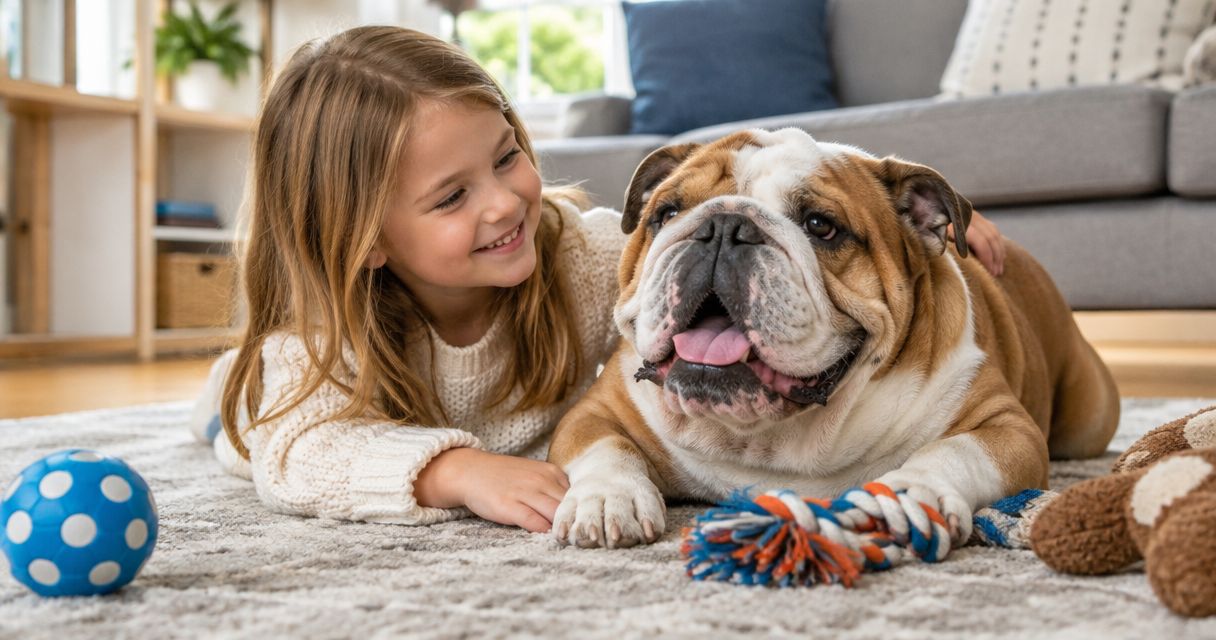
Yes—English Bulldogs can be good with kids when the individual dog is comfortable around children and adults supervise every interaction. Their affectionate, people-oriented temperament can suit family life, but their strength, health needs, and tolerance for handling matter more than the breed's gentle reputation.
- Are English Bulldogs good with kids? Yes, with individual temperament assessment, gentle handling, and active adult supervision.
- Shrinkabulls breeds English and French Bulldogs; family suitability still depends on the individual dog.
- English Bulldogs need child-free meals, protected rest, and an escape from unwanted attention.
- Choose calm companionship over wrestling, chasing, or expecting a Bulldog to tolerate rough handling.
Are English Bulldogs good with kids?
English Bulldogs can make affectionate family companions, but no breed label guarantees safe behavior around children. A suitable match depends on the dog's history, health, and responses to everyday family activity—not simply whether the dog looks relaxed during a visit.
The American Kennel Club Bulldog breed standard describes an equable, kind disposition. That describes the breed's intended temperament, not a promise about every puppy or adult dog. Our guide to English Bulldog puppies for households with young children addresses the family setting behind this decision.
| Family setting | Best for | What works well | Main limitation |
|---|---|---|---|
| Home with a baby | Adults who can maintain separate spaces | Quiet companionship outside infant-care areas | A baby cannot recognize or respect a dog's boundaries |
| Home with a toddler | Adults able to manage access closely | Brief, calm contact with adult guidance | Grabbing, sudden movement, and accidental collisions require intervention |
| Home with school-age children | Families ready to teach handling rules | Supervised training and gentle shared activities | Children still need help recognizing discomfort |
| Home with teenagers | Families who share care under adult oversight | Reward-based training and appropriate walks | Enthusiasm must not turn into rough play or excessive exercise |
Why this matters
A Bulldog's sturdy appearance can make a child assume the dog enjoys wrestling or being climbed on. Sturdy does not mean comfortable with rough handling. Protecting the dog from unwanted contact also protects your child.
The American Kennel Club Bulldog breed standard gives desirable mature weights of about 50 pounds for males and 40 pounds for females. Those are substantial dogs beside a small child, even when a bump happens without aggression.
If you are choosing a family dog in 2026, start with your household's actual routine. Consider school runs, visiting friends, meals, naps, and who will separate the dog and children when attention shifts elsewhere.
English Bulldogs with babies
A baby and a Bulldog need physically separate resting spaces. Keep the dog out of the crib, bassinet, and infant sleep area, and never leave them together without an attentive adult.
Before an introduction, arrange barriers and practice calm settling away from your arms. Let the dog observe baby-related activity from a comfortable distance rather than bringing the baby's face toward the dog for a greeting.
Affectionate interest is not permission for unrestricted access. If your Bulldog becomes restless, fixates, or cannot settle, increase separation and ask a qualified reward-based trainer for help.
English Bulldogs with toddlers
Toddlers need the closest management because they grab, stumble, and move unpredictably. A friendly Bulldog still needs protection from fingers near eyes, pulled ears, and pressure on sore joints.
Stay close enough to interrupt contact immediately. When you are cooking, answering the door, or helping another child, use a secure barrier rather than trying to supervise from across the room.
Do not make tolerance the goal. End an interaction when the dog turns away or seeks distance, instead of waiting to see how much attention the dog will accept.
English Bulldogs with older children
Older children can participate in gentle training, preparing supplies, and quiet companionship. Adults remain responsible for the dog's care and for deciding whether an activity is appropriate.
Teach children to invite contact rather than pursue it. A dog that walks away gets to leave; a dog resting behind a gate does not need a visitor.
A child who enjoys long runs needs an adult-led plan for activities separate from the Bulldog. English Bulldogs are brachycephalic, or short-muzzled, and their breathing and heat tolerance require particular attention.
Why an English Bulldog's behavior around kids varies
Breed tendencies give you a starting point. These factors determine what your family needs to assess:
- Individual temperament: Notice how the dog responds to approaching people, movement, touch, and opportunities to retreat. Look for voluntary engagement, not forced stillness.
- Past experiences: Ask what contact the dog has actually had with children. Experience with a quiet teenager does not establish comfort around a crawling baby.
- Health and pain: Sore skin, ears, joints, or other discomfort can change a dog's willingness to be touched. A new behavior change needs veterinary attention.
- Learning history: Reward-based training helps establish useful behaviors such as settling and moving away. Punishing warnings does not resolve the discomfort behind them.
- The child's behavior: Chasing, hugging, grabbing, and interrupting rest create different demands from calm interaction. Teach the child rather than expecting the dog to absorb every mistake.
- Household management: Barriers, protected meals, and consistent rules reduce preventable conflict. Every caregiver needs to follow the same plan.
Coat color, registration papers, and a cute photograph do not answer these questions. Assess behavior and health directly.
How do you introduce an English Bulldog to your child?
Start with space, choice, and an adult who watches only the interaction. For your 2026 homecoming plan, arrange the environment before asking your child and dog to meet.
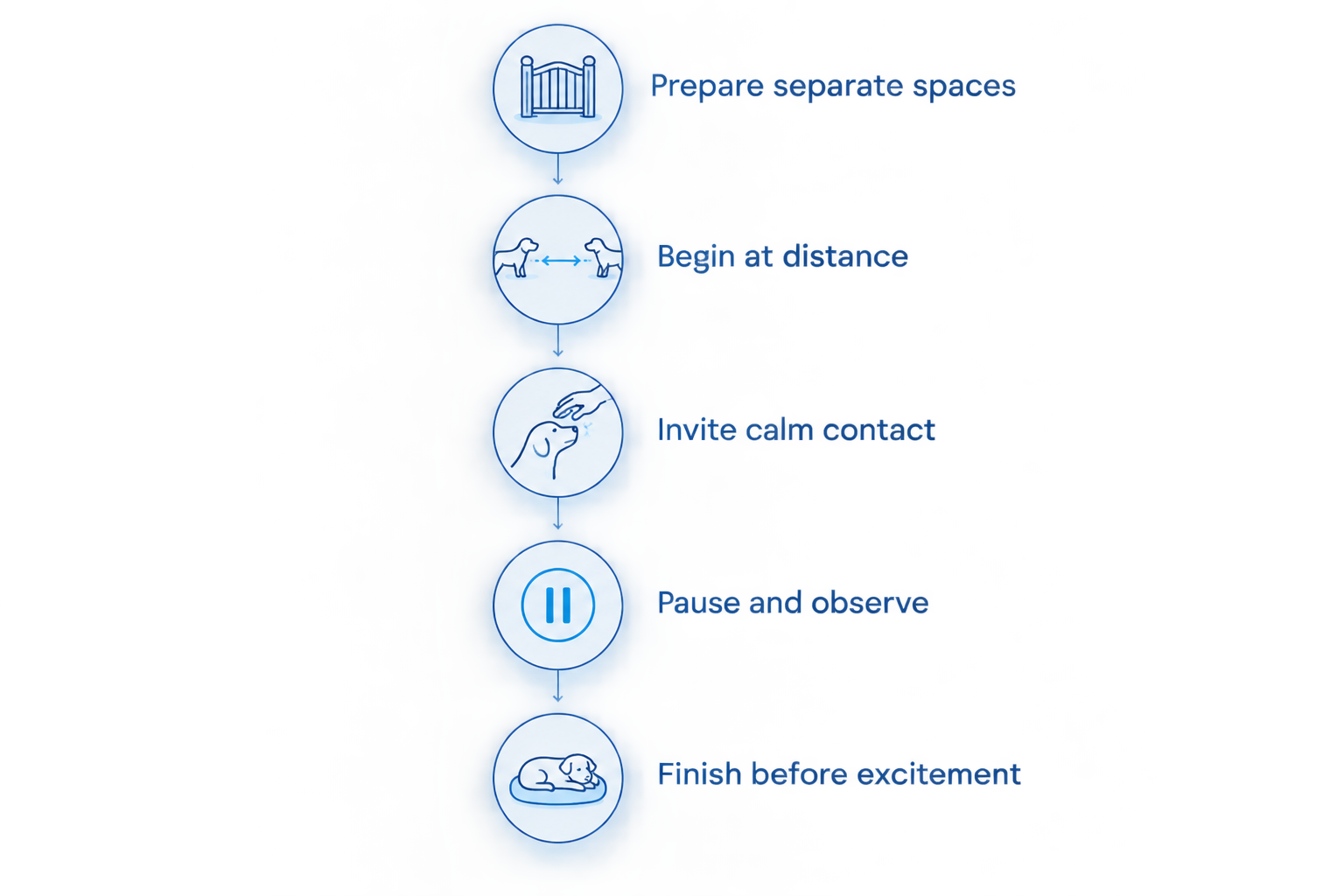
- Prepare separate spaces. Give the Bulldog a comfortable rest area behind a secure barrier. Keep children out of that area, including when the dog is asleep.
- Begin at a distance. Let the dog notice the child without being approached or surrounded. Reward relaxed behavior and allow the dog to move away.
- Invite calm contact. If the dog approaches willingly, guide your child toward gentle contact on the shoulder or chest. Keep faces apart and avoid reaching over the dog's head.
- Pause and observe. Stop petting and see what the dog chooses. Turning away or leaving ends the interaction; it is not an invitation to follow.
- Finish before excitement builds. Separate calmly while everyone is still comfortable. Repeat manageable encounters rather than staging a long family greeting.
Repeat the same approach with visiting children. Familiarity with your own child does not establish comfort with a group of excited friends, and a successful greeting does not remove the need for supervision later.
What rules should children follow around a Bulldog?
Build your family's 2026 care plan around 3 household rules: protect meals, protect rest, and keep contact gentle. These rules are easier to apply consistently than asking a young child to interpret every change in body language.
Protect meals
Feed the Bulldog away from children and remove access while the dog eats. Children should not reach into bowls or take chews to prove that a dog is friendly.
If the dog picks up a child's possession, an adult should manage the situation. Teach trading through reward-based training rather than encouraging children to pull objects from the dog's mouth.
Protect rest
A sleeping dog gets uninterrupted sleep. Keep the dog's bed or open resting crate in a place where children cannot corner or climb over the dog.
A retreat area works only when everyone respects it. Do not send a child into that space to give a goodnight hug or retrieve a toy while the dog is resting there.
Keep contact gentle
No riding, wrestling, ear pulling, or face-to-face hugs. Show children how to stroke gently and stop when the dog disengages.
Adults should handle wrinkle cleaning, ear care, nail trimming, and other tasks that require restraint or careful technique. Being involved in family care does not mean a child should perform every job.
What warning signs mean you should stop the interaction?
Stop when your Bulldog freezes, becomes stiff, turns away repeatedly, growls, snaps, or tries to escape. Lip licking, yawning, and showing the whites of the eyes can also accompany discomfort; interpret the whole situation rather than treating a single movement as a diagnosis.
A growl is a warning to create space, not a behavior to punish. Calmly separate the child and dog without scolding or forcing another encounter.
Arrange a veterinary examination for new irritability, sensitivity to touch, or other sudden behavioral changes. For guarding, snapping, or repeated distress around children, keep them separated and seek qualified behavioral help before resuming contact.
If a bite occurs, separate immediately and obtain appropriate medical care for the child. Do not stage another greeting to check whether the dog has calmed down.
Can English Bulldog puppies bite children during play?
Yes—English Bulldog puppies can mouth and nip children during play. Puppy biting is not proof of adult aggression, but sharp teeth and excited chasing still require immediate adult management.
Stop the interaction calmly, give everyone space, and redirect the puppy toward an appropriate toy. Do not encourage hand wrestling or ask a frightened child to remain beside an excited puppy as a training exercise.
Teach calm behavior before excitement escalates. If biting is intense, repeatedly directed at a child, or accompanied by stiffening or guarding, get professional guidance rather than assuming the puppy will simply outgrow it.
Is a puppy or an adult Bulldog better for a family?
Neither age is automatically better: choose the individual whose needs and observed behavior fit your household. A puppy brings house-training, chewing, and socialization work; an adult's established behavior is useful only when you have reliable information about it.
Ask about specific experiences with children and any history of guarding, snapping, or difficulty with handling. An adult dog described as calm still needs a careful introduction, while a playful puppy still needs protected rest.
At Shrinkabulls, we breed English and French Bulldogs for prospective owners and enthusiasts. For families considering a Shrinkabulls English Bulldog puppy, temperament and health should lead the conversation—not color alone!
Before committing in 2026, ask the breeder to describe ordinary behavior, explain health records, and discuss what has actually been observed around children. A reassuring adjective is not a substitute for a specific example.
FAQ
Are English Bulldogs good with kids in 2026?
English Bulldogs can be good with kids when the individual dog is comfortable with children and adults actively supervise. Breed reputation does not replace temperament assessment, gentle handling, or protected rest.
Can I leave my English Bulldog alone with my toddler?
No—do not leave an English Bulldog alone with a toddler. Use secure separation whenever an adult cannot actively supervise their interaction.
Are English Bulldogs naturally aggressive toward children?
Being an English Bulldog does not establish that a dog is aggressive or safe around children. Assess the individual dog’s behavior, history, health, and response to handling.
Will an English Bulldog accidentally knock my child over?
An English Bulldog’s strength and body weight create a risk of accidental collisions with small children. Keep greetings calm and interrupt jumping or excited chasing.
Does AKC registration mean a Bulldog is safe with kids?
No—AKC registration is not a guarantee of behavior around children. Evaluate temperament, health, and observed interactions separately from registration papers.
What should I do if my Bulldog growls at my child?
Calmly separate your Bulldog and child, and do not punish the growl. Arrange veterinary assessment for possible discomfort and seek qualified behavioral guidance before further close contact.
Should my child walk our English Bulldog alone?
An adult should control walks unless the child can safely manage the individual dog and the situation. Supervised participation is different from giving a child sole responsibility for a strong dog.
One last thing
The ability to say no is part of a safe relationship. A Bulldog that walks away from petting is giving your family useful information, not rejecting your child.
Before bringing a Bulldog home in 2026, practice that lesson with your children: when the dog leaves, let the dog leave. Affection grows more safely when nobody has to endure it!
Related guides
- How to stop a Bulldog puppy from biting
- How to crate-train an English Bulldog puppy
- How to pick a healthy Bulldog puppy from a litter
