


 REVIEWS




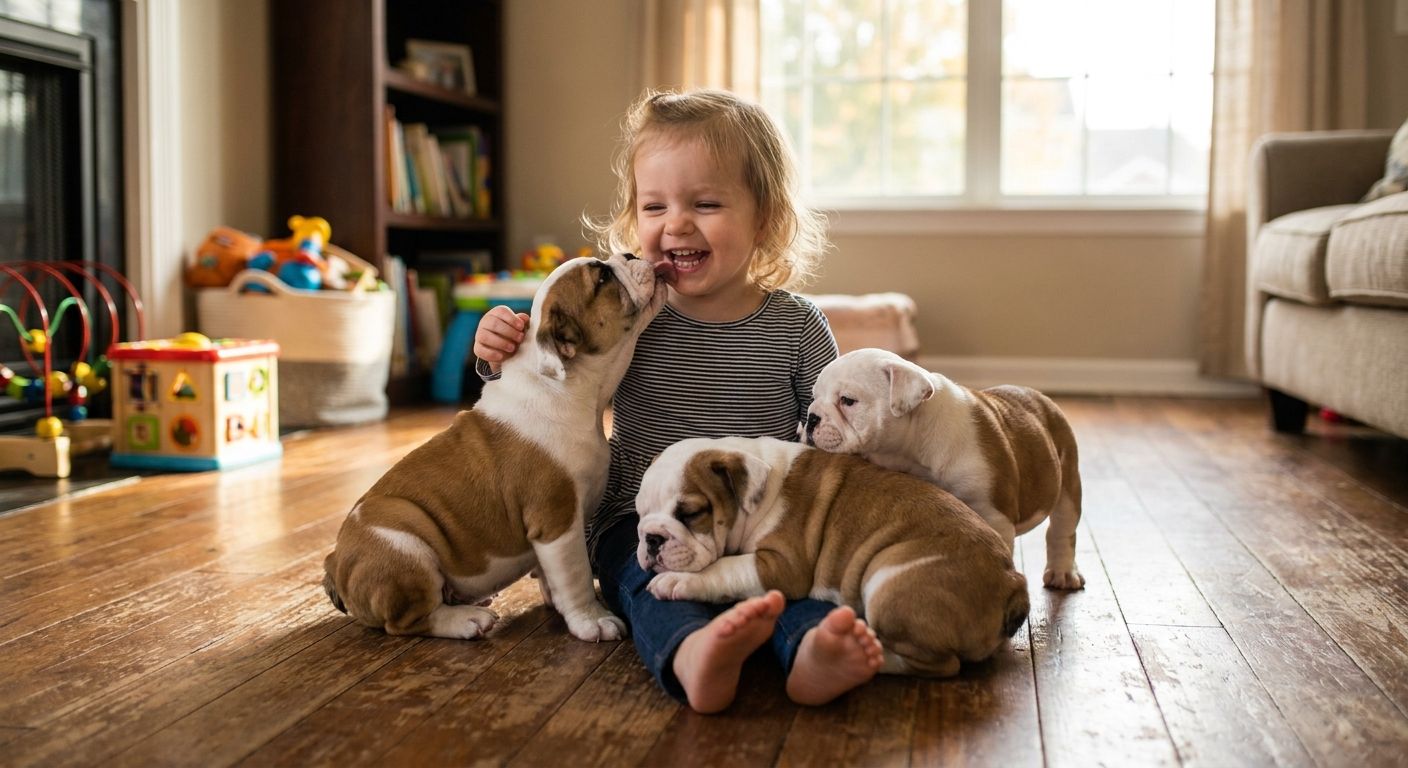
English Bulldog puppies for households with young children do best when the breeder screens for calm temperament and airway health before your kids ever meet the litter. Get that screening right and an English Bulldog for families with kids turns into one of the steadiest, most affectionate matches in the whole breed.
- English Bulldog puppies suit families with kids when temperament and health testing happen before pickup, not after.
- Crate training and slow, supervised introductions cut most early conflict between English Bulldog puppies and kids under 6.
- Overheating and joint strain are the two biggest risks an English Bulldog for families with kids has to manage.
- Shrinkabulls breeds a gray English Bulldog line specifically for family households, with AKC papers verified before sale.
- Budget for hip, patella, and airway testing on top of the puppy itself — that’s where family safety actually lives.
Why English Bulldog puppies work for families with kids
An English Bulldog is built low, wide, and close to the ground. That structure matters for a household with a toddler learning to walk: it's harder for a small kid to knock the dog over, and harder for the dog to knock the kid down in return. Shrinkabulls breeds a gray English Bulldog puppy for families with kids line built around that exact profile, temperament-tested before any puppy goes home.
The breed's low energy also fits a house running on nap schedules and homework time. English Bulldogs are not a jogging companion breed — short walks and indoor play cover most of their exercise needs, which means less pressure on parents already stretched thin in 2026's busy family calendars.
None of that removes the two real risks: heat sensitivity and joint load from a heavy-boned frame. A family that manages temperature and weight from week one avoids most of the vet visits other Bulldog owners deal with.
Vet the breeder's health testing before you meet a puppy
Do this before falling for a face. A puppy that looks perfect at 8 weeks can carry joint or airway issues that surface once your kids are climbing on the dog at age 2.
- Ask for hip and patella screening results, not just a verbal promise
- Confirm airway conformation was checked — narrow nostrils and elongated soft palate cause breathing distress
- Request the sire and dam's health history, not just the litter's
- Get AKC registration paperwork in hand before any deposit is final
- Ask how the breeder screens temperament specifically around children
Match temperament testing to your kids' ages
A puppy that's calm around a 10-year-old can still be too much dog for a crawling 1-year-old, and the reverse is true too. Temperament testing should happen against your actual kids' ages, not a generic "good with children" label.
- Watch how the puppy reacts to sudden noise and grabby hands during a visit
- Look for a puppy that recovers fast after a startle, not one that stays rattled
- Avoid the pushiest puppy in the litter if your youngest child is under 3
- Ask the breeder which puppy in the litter they'd place with toddlers specifically
- Bring your kids to the meet-and-greet before committing, if the breeder allows it
Puppy-proof the house for face-first exploration and heat sensitivity
English Bulldogs explore with their faces low to the ground, which puts them at nose-level with everything a toddler drops. Combine that with a flat face that struggles in heat, and prep work has to happen before pickup day, not after.
- Keep small toys, batteries, and food scraps off floor level in shared play areas
- Set up a cool, shaded resting spot away from direct heat vents or sun through windows
- Block stairs the puppy shouldn't navigate alone yet
- Store cleaning supplies and houseplants above nose height
- Keep a water bowl in every room your kids play in — flat-faced breeds overheat fast
Introduce the puppy to your children the right way
The first meeting sets the tone for months. A rushed, chaotic introduction with three kids swarming a new puppy teaches the dog that hands mean overwhelm, not affection.
- Let the puppy approach the kids first, not the other way around
- Keep the first session under 10 minutes and low-energy
- Teach kids to pet along the back, not grab the face or ears
- Supervise every interaction for the first two to three weeks minimum
- Give the puppy an escape route — a crate or gated area — it can retreat to on its own
Plan introductions if you already have pets in the house
A new Bulldog puppy joining a house with a resident dog or cat adds another layer on top of the kid factor. Rushing this step causes more early-stage stress than almost anything else new owners deal with. Introducing a new Bulldog puppy to resident pets the right way keeps the whole household calmer during the first month.
- Do the first introduction on neutral ground, not the resident pet's territory
- Keep leashes on both animals during early sessions
- Feed pets separately until trust is established
- Watch for resource guarding around toys, beds, and food bowls
- Give the resident pet one-on-one time so it doesn't associate the puppy with lost attention
Watch weight and joint stress as your Bulldog grows
An English Bulldog carrying extra weight puts more strain on hips and knees that are already working against a heavy, thick-set frame. In a house with active kids wanting to play tug and chase, joint health directly affects how much fun the dog can safely have.
- Feed measured portions on a schedule, not free-fed all day
- Track weight monthly through the first year of growth
- Limit high-impact jumping on and off furniture while joints are still developing
- Keep treats to training rewards, not table scraps from kids at dinner
- Ask your vet about joint support supplements once the puppy hits full adult size
Comparing Bulldog options for families with kids
| Option | Best for | Key limitation |
|---|---|---|
| Standard English Bulldog puppy | Families wanting the classic build and steady, low-energy temperament | Heat sensitivity limits outdoor play with kids through summer months |
| Gray English Bulldog puppy (Shrinkabulls line) | Families who want a documented, AKC-registered rare-color Bulldog bred for family placement | Rare-color lines require extra paperwork verification before purchase |
| English Bulldog puppies for active families | Households with school-age kids who want daily walks and yard play | Still not built for jogging or heat above roughly 85°F |
| French Bulldog puppy | Smaller households or families in apartments with less yard space | Less size and weight buffer against rough toddler play than an English Bulldog |
Verdict: a temperament-tested, health-screened English Bulldog for families with kids is a solid choice for most households — skip any breeder who can't produce hip, patella, and airway documentation.
Mistakes families make choosing an English Bulldog puppy
- Picking the puppy that runs straight to the kids first. That's often the boldest, pushiest puppy in the litter, not the calmest one.
- Skipping the heat plan. Families in warmer regions bring a Bulldog home without shade, cooling mats, or a summer walk schedule adjustment, and the dog struggles by July.
- Letting toddlers carry the puppy. English Bulldogs are compact but heavy-boned; a dropped puppy can mean a real injury.
- Ignoring joint-friendly feeding. Overfeeding a growing Bulldog to "fatten up" a cute puppy adds hip and knee strain that shows up by age 3 or 4.
- Assuming AKC papers alone guarantee health. Registration confirms lineage, not joint or airway soundness — ask for the actual test results.
See available Bulldog puppies
Browse current litters bred and health-screened for family homes.
FAQ
Is an English Bulldog good for families with kids?
Yes — an English Bulldog’s low, sturdy build and generally calm temperament make it a good match for households with young children, provided the puppy is temperament-tested and health-screened before purchase. Supervision during the first weeks of introduction still matters regardless of breed.
What age should kids be before getting an English Bulldog puppy?
There’s no strict minimum age, but families with kids under 3 should ask the breeder specifically which puppy in the litter handles grabby hands and sudden noise best. A calmer, less pushy puppy generally fits toddler households better than the boldest one in the litter.
How much does an English Bulldog for families with kids cost?
Pricing varies by color, lineage, and health testing depth, so check current litter pricing directly with the breeder. Rare-color lines like gray or merle typically carry a premium over standard coloring — see the merle Bulldog price breakdown for a sense of how that pricing works.
Are English Bulldogs safe around toddlers?
English Bulldogs are generally safe around toddlers when supervised, thanks to their low center of gravity and steady temperament, but no breed should be left unsupervised with a young child. Teach kids to pet gently along the back and avoid face or ear grabbing.
Do English Bulldogs overheat easily with active kids?
Yes — English Bulldogs are flat-faced and overheat faster than most breeds, so active outdoor play with kids needs to happen in shorter sessions during cooler parts of the day. Keep water available in every play area and watch for heavy panting as an early warning sign.
Should I get a male or female English Bulldog for a family with kids?
Temperament varies more by individual puppy and training than by sex alone, so prioritize the specific puppy’s temperament test results over a male-versus-female preference. Ask the breeder which puppy tested calmest around children regardless of sex.
How do I verify an English Bulldog breeder is legitimate before buying for my family?
Request AKC registration papers, health testing documentation for hips, patellas, and airway, and ask direct questions about how puppies are screened for temperament around children. A breeder who hesitates to provide any of that is a red flag worth walking away from.
Can English Bulldog puppies live with other pets in a family home?
Yes, with a slow, supervised introduction on neutral ground and separate feeding until trust builds between the animals. Resource guarding around food and toys is the most common early friction point in mixed-pet households.
One last thing
The detail most families skip is asking the breeder which specific puppy in the litter tested calmest with children — not which one is the cutest or the first to run over. That single question, asked before any deposit, prevents more problems than any amount of post-purchase training. In 2026, reputable Bulldog breeders run temperament checks as standard practice, so a breeder who can't answer that question directly probably isn't doing it.
Related guides
- How to crate train an English Bulldog puppy
- Merle Bulldog price: what rare-color puppies really cost
