


 REVIEWS




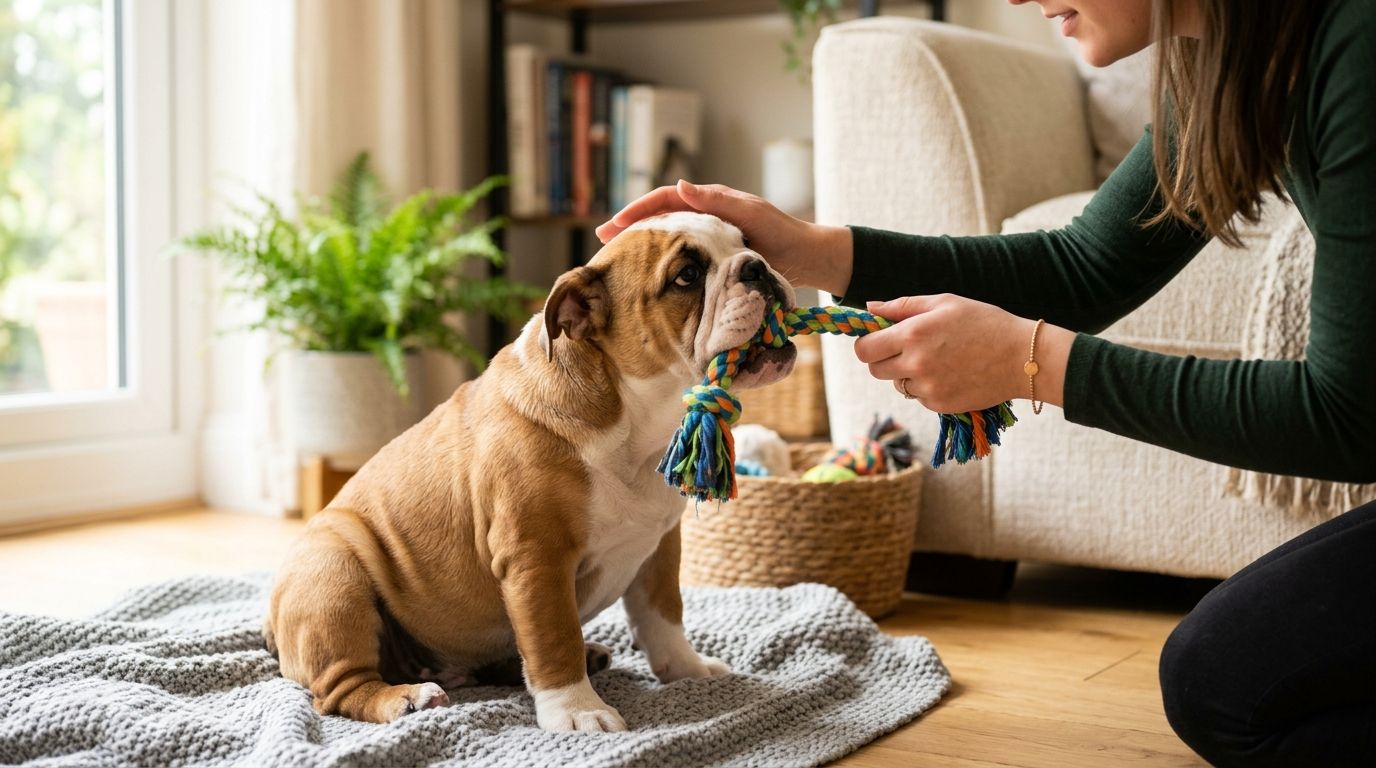
Bulldog puppies bite because that's how they play, explore, and process a mouth full of new teeth — the goal isn't to eliminate mouthing overnight, it's to teach the puppy that human skin is off-limits while teeth-on-teeth play with toys stays fair game.
Redirect the bite to a chew toy the instant you feel teeth on skin, yelp or say "ouch" in a sharp voice to interrupt the behavior, then withdraw your attention for 30 to 60 seconds if the biting continues — used consistently by every person in the house, this combination trains bite inhibition in most bulldog puppies within 2 to 4 weeks. The part most new owners miss: biting gets noticeably worse during the 3-to-6-month teething window, so a puppy who was gentle at 10 weeks can turn mouthier again as adult teeth push through, and that's normal, not a training failure.
- Bulldog puppy biting peaks during the 3-to-6-month teething window, then fades with consistent redirection.
- Yelp, withdraw attention for 30-60 seconds, and swap in a chew toy the instant teeth touch skin.
- Every household member has to respond the same way or the puppy learns biting works on the soft touch.
- Bulldog puppy biting is almost always teething or overstimulation, not aggression, in puppies under 6 months.
Why this matters
A bulldog puppy's jaw is short, wide, and built for grip — that structure makes an untrained mouthing habit feel a lot more intense than it does on a leaner breed, even when the puppy has zero aggressive intent. Left uncorrected past the teething months, a puppy that nips for attention at 12 weeks can turn into an adult dog that mouths visitors, and that's a much harder habit to unwind. Before bringing a puppy home, it helps to prepare your home for a new French Bulldog puppy with a rotation of chew toys already staged in every room — biting drops fast when a toy is always within arm's reach.
The fix in 2026 hasn't changed much from what breeders and trainers have used for years: redirect, interrupt, and stay consistent. What has changed is how early owners start — most trainers now recommend beginning bite-inhibition work the day the puppy comes home, not waiting for the behavior to become a habit.
How do you stop a bulldog puppy from biting?
- Yelp and stop play immediately. A sharp "ouch" mimics how a littermate would react and signals the bite hurt.
- Redirect to a chew toy within 2-3 seconds. A durable teething toy option gives the puppy an approved outlet for the same jaw pressure.
- Give a 30-to-60-second time-out if biting continues. Stand up, turn away, or leave the room — attention is the reward, so removing it removes the payoff.
- Get every family member using the same three steps. Puppies generalize fast, but only if the response is identical across every person.
- Add more physical and mental exercise. A bulldog puppy that's understimulated or overtired bites more, not less.
- Keep teething toys in constant rotation. Swapping textures (rope, rubber, frozen) keeps the puppy interested in the toy instead of your hand.
“If everyone in the house doesn’t use the same response, the puppy just learns biting works on the soft touch.”
The 3-to-6-month teething window: why biting gets worse
Bulldog puppies start losing baby teeth around 12 to 16 weeks and finish cutting adult teeth by roughly 6 months. During that stretch, gum pain drives a puppy to chew on anything that relieves pressure — hands included. A puppy that was easy to redirect at 10 weeks can suddenly seem to regress at 14 weeks, and that's the teething window talking, not a step backward in training.
Cold, textured chew toys help the most during this phase because the temperature numbs the gums while the texture satisfies the urge to gnaw. Crate time also matters here: a puppy that's crate trained has a designated place to settle with a toy when biting spikes, which takes the pressure off constant hand-redirection.
Biting from overexcitement: a separate cause
Not all bulldog puppy biting is teething. A puppy that nips during play, at the leash, or when guests arrive is usually overstimulated rather than in pain. This type responds best to a short break in a quiet space rather than more toys — the puppy needs to come down from the excitement, not find a new outlet for it.
Early, structured exposure to new people and situations reduces this pattern over time. Socializing a bulldog puppy safely in short, calm sessions teaches the puppy that new experiences don't require a jump to full arousal, and that carries directly into calmer greetings and less excitement-biting by 5 to 6 months.
Why bulldog puppy biting happens
- Teething pain between 3 and 6 months drives the strongest urge to chew.
- Carryover from littermate play, where nipping was normal and even encouraged.
- Overstimulation or overtiredness — a wired or exhausted puppy mouths more.
- Attention-seeking, especially if yelling or pulling away in the past got a big reaction.
- Inconsistent responses across family members, which confuses what's actually off-limits.
- Lack of an approved outlet, meaning no chew toy was available at the moment the urge hit.
Looking for a bulldog puppy to raise right?
See available English and French Bulldog puppies before your next litter reservation.
Related questions
Is it normal for a bulldog puppy to bite this much?
Yes — most bulldog puppies bite heavily between 8 weeks and 6 months, and it's rarely a sign of aggression. It's play, teething, and exploration, and it typically drops off sharply once adult teeth finish coming in.
When do bulldog puppies stop biting?
Most bulldog puppies stop hard biting by 6 to 8 months with consistent redirection, though some mouthing during play can linger longer if the training wasn't consistent across the household. A puppy still biting hard past 8 months usually needs a more structured training plan, not just more patience.
Should you use a spray bottle or muzzle to stop a bulldog puppy from biting?
No — spray bottles and muzzles aren't recommended for normal puppy biting in 2026 training guidance, because they punish a normal developmental behavior instead of redirecting it. Yelp-and-redirect training addresses the cause; punishment tools just suppress the symptom and can make a puppy hand-shy.
FAQ
How do you stop a bulldog puppy from biting hands?
Yelp sharply the instant teeth touch skin, pull your hand away, and immediately offer a chew toy instead. Repeated by every family member, this teaches the puppy within 2 to 4 weeks that hands aren’t an acceptable chew target.
Why is my bulldog puppy biting so much at 3 months?
Three months sits right at the start of the 3-to-6-month teething window, when adult teeth begin pushing through and gum pain drives constant chewing. Cold, textured toys and consistent redirection are the fastest way through this phase.
Is bulldog puppy biting a sign of aggression?
No, bulldog puppy biting under 6 months is almost always teething, play, or overstimulation rather than aggression. True aggression in a puppy this young is rare and looks different — stiff body language and growling with no play cues, not the loose, bouncy nipping most owners describe.
How long does bulldog puppy biting last?
Bulldog puppy biting typically peaks between 3 and 6 months and drops off noticeably by 6 to 8 months with consistent training. Some light mouthing during play can continue longer if the household isn’t consistent with redirection.
Does crate training help with puppy biting?
Yes, crate training gives an overstimulated or overtired bulldog puppy a place to settle down away from hands, which reduces excitement-driven biting. It works best paired with a chew toy left in the crate during downtime.
What toys stop a bulldog puppy from biting?
Durable rubber and rope teething toys, especially ones that can be frozen, work best because they satisfy the jaw pressure and gum relief a bulldog puppy is chasing. Rotating two or three textures keeps the puppy interested in the toy instead of your hand.
Should you play tug with a bulldog puppy that bites?
Tug is fine once the puppy has a reliable release cue, but skip it during the worst of the 3-to-6-month teething window since it can amplify mouthing rather than calm it. Structured tug with clear start and stop rules is better introduced after the puppy is past peak teething.
One last thing
The households that get past bulldog puppy biting fastest in 2026 aren't the ones with the strictest corrections — they're the ones where every single person, including visiting family, uses the exact same yelp-and-redirect response from day one. A puppy that gets three different reactions from three different people takes months longer to figure out the rule, and that inconsistency, more than the biting itself, is the real reason some bulldogs stay mouthy well past a year old.
Related guides
- Best teething toys for a French Bulldog puppy
- How to crate train an English Bulldog puppy
- How to socialize a merle bulldog puppy safely
- How to prepare your home for a new French Bulldog puppy
- Merle bulldog price: what rare color puppies really cost
