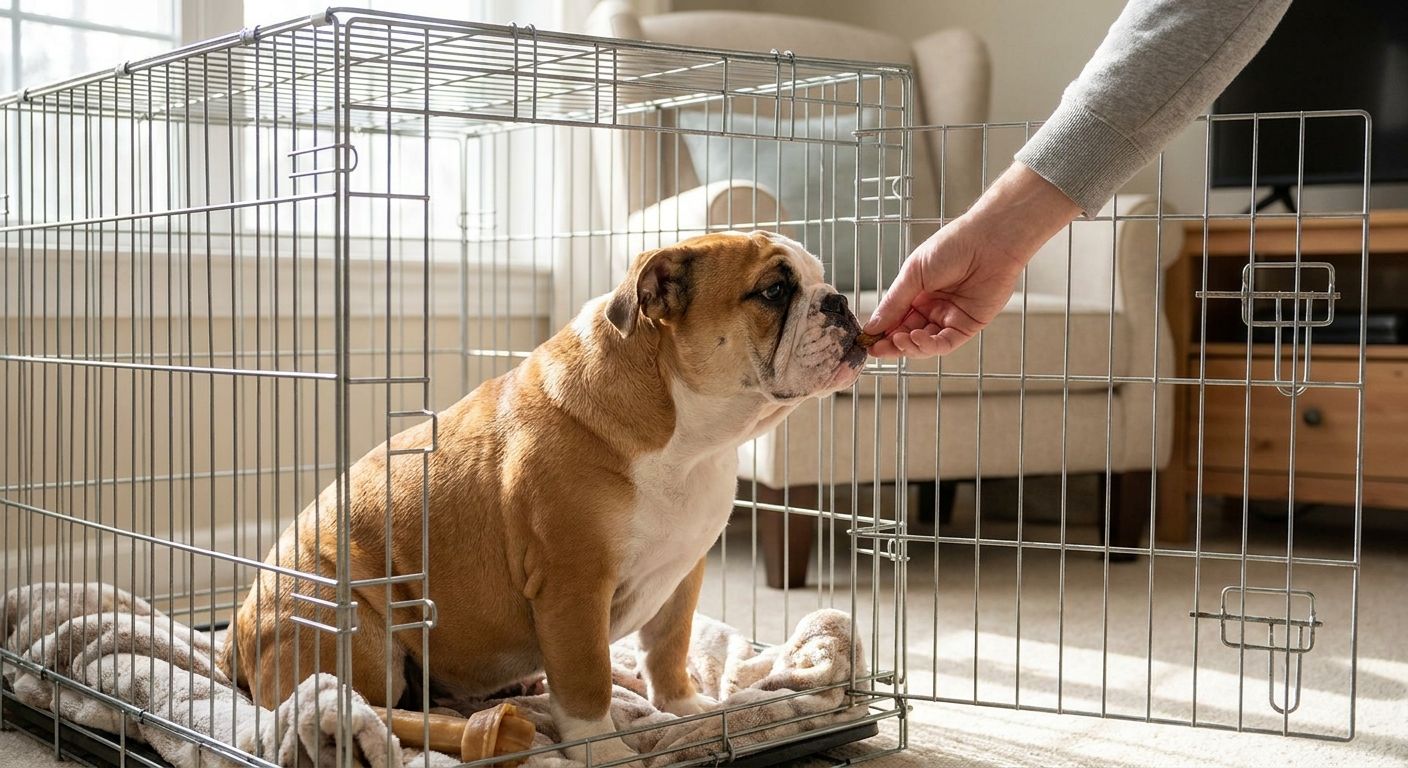
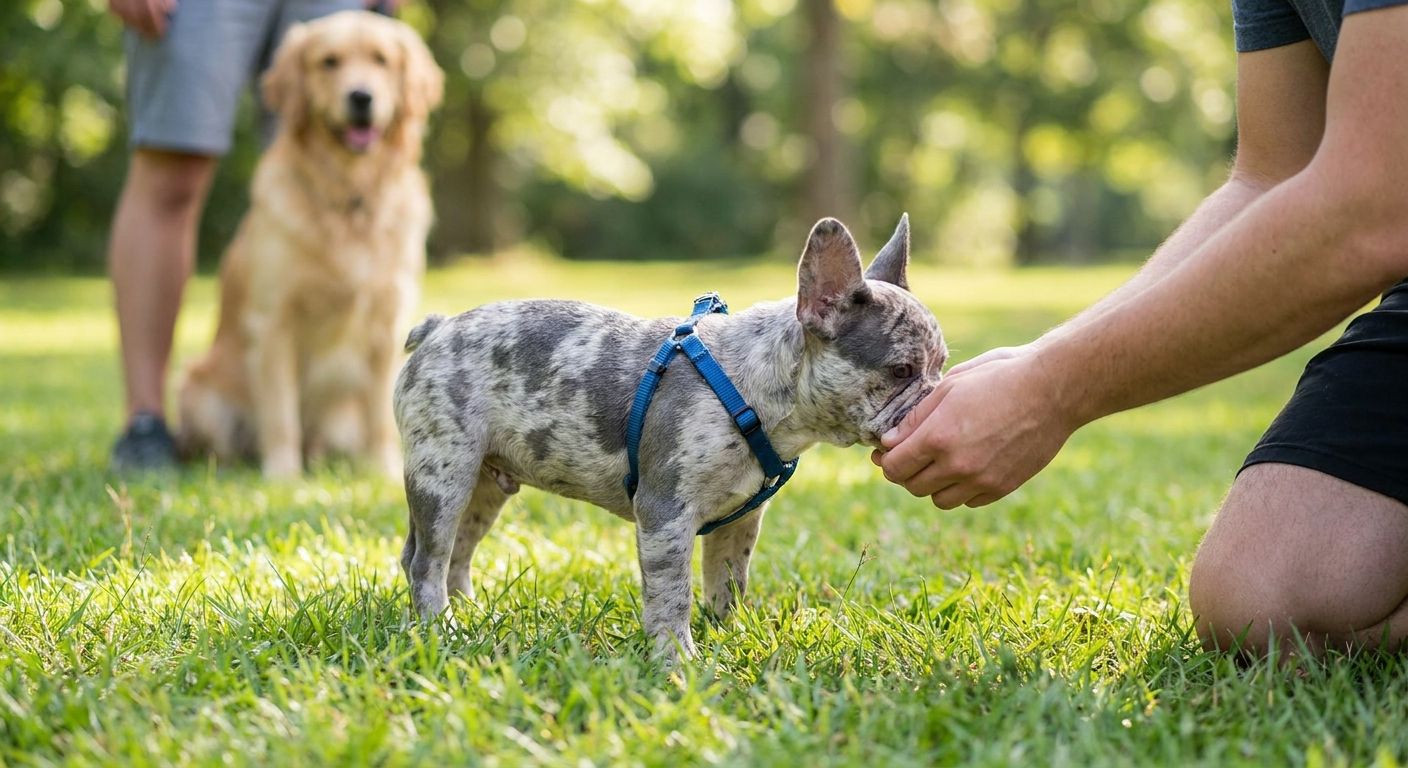
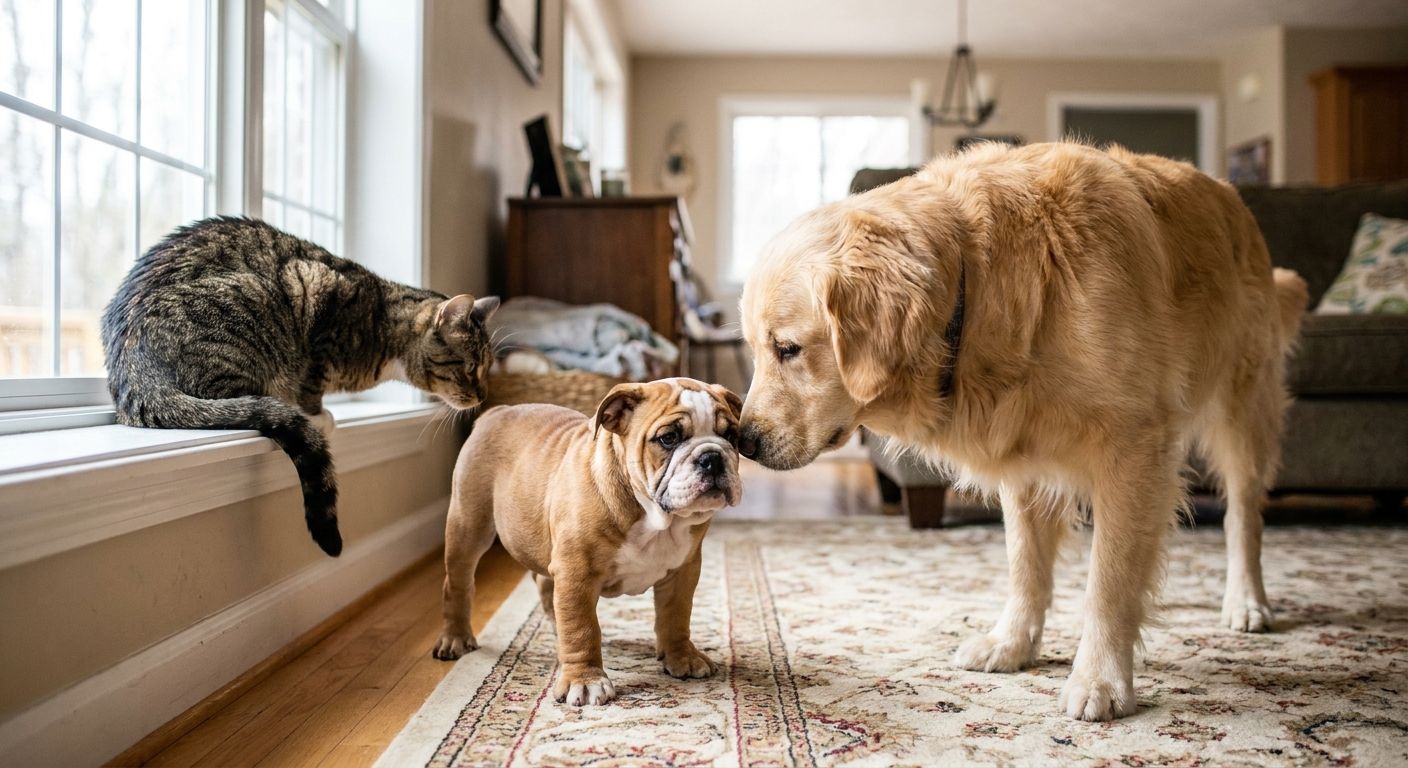
French Bulldog puppies for young professionals and students are compact companion dogs matched to small apartments, tight budgets, and unpredictable class or work schedules. A 20-25 pound adult Frenchie doesn't need a yard, doesn't need hour-long runs, and settles into a studio apartment or dorm room the way a Labrador never will. What makes this segment different from a family buyer is timing and space: you're renting, you might move in the next 12-24 months, and you're gone 8-10 hours some days.
TL;DR
A French Bulldog for young professionals fits studio apartments and 8-10 hour workdays better than most breeds under 30 pounds.
Mini and standard Frenchies both work for small living spaces if you budget for daytime dog walker or daycare coverage.
House-training a French Bulldog puppy on a student or work schedule takes consistent 3-4 hour breaks, not luck.
Rare-color Frenchies (merle, lilac, blue) cost more upfront and carry extra health-screening questions worth asking before you buy.
Shrinkabulls places AKC-registered French Bulldog puppies with first-time owners, students, and working professionals every year.
Why French Bulldog puppies matter for young professionals and students
Searches for a French Bulldog for young professionals spike around two life stages: the first apartment lease and the first full-time job. Both groups ask the same three questions before anything else — will this dog handle being alone, does it fit my square footage, and can I afford it on an entry-level budget. A mini French Bulldog puppy for small living spaces answers the space question directly; the schedule and budget questions take more planning.
Students have the opposite problem from young professionals — more unstructured time but less income and more moving parts (roommates, dorm rules, semester breaks). Both groups need a breed that tolerates a crate for a few hours without destroying the apartment, and the French Bulldog's low exercise ceiling makes that realistic in 2026 in a way a Border Collie or Husky never will be.
Match the puppy size to your living space
Start here before anything else — size dictates how much space, gear, and daily movement the dog actually needs.
Measure your actual living square footage, not the listing's advertised size
Count stairs: a standard Frenchie in a 4th-floor walkup with no elevator is a daily carry
Check your lease or dorm handbook for breed and weight restrictions before you fall for a specific litter
Decide if you want a standard-size adult (20-28 lbs) or a smaller-framed dog for a tighter footprint
Ask whether the breeder's litter includes puppies suited to apartment life specifically
Build a schedule that survives a full workday or class load
A French Bulldog puppy under 6 months cannot hold its bladder for 8 hours — plan the gap before you plan the puppy.
Line up a midday dog walker, roommate, or neighbor for the first 4-6 months
Look into daycare 2-3 days a week if your job has no flexibility
Build your class schedule (if you're a student) around a consistent morning and evening routine
Practice short absences (30 minutes, then 2 hours, then 4 hours) before your first full workday alone
Set a fixed feeding and bathroom schedule and stick to it on weekends too
House-train on a tight timeline, not a lucky one
House-training a French Bulldog puppy on a work or class schedule is a math problem before it's a discipline problem.
Take the puppy out immediately after waking, eating, and playing — no exceptions the first two weeks
Crate-train in parallel so the puppy has a safe space during your work or class hours
Use the same exit door and the same verbal cue every single time
Reward within 3 seconds of the puppy finishing outside, not after you walk back inside
Small spaces mean everything is within chewing distance — cords, shoes, textbooks, the works.
Cord-cover every visible cable and charger
Store shoes, backpacks, and textbooks off the floor
Block off-limits areas with a low gate rather than relying on verbal correction alone
Remove small objects a Frenchie's flat face and stubborn jaw can still get stuck on
Keep a designated chew-toy zone so the puppy learns what's fair game
Budget for the real cost of ownership, not just the puppy price
The purchase price is the smallest line item over the first 12 months — food, vet visits, and gear add up fast for any buyer on an entry-level income.
Price out a first-year vet plan including vaccines, spay/neuter, and a wellness exam
Factor in pet insurance if your income doesn't cover a surprise $2,000-4,000 emergency vet bill
Budget for daycare or a dog walker if your schedule has no midday flexibility
Set aside a starter-supplies fund before puppy pickup day, not after
Ask about rare-color pricing upfront if a merle, lilac, or blue coat is on your list — see the rare-color puppy cost breakdown before you commit to a specific litter
Vet the breeder before you vet the puppy
A reputable breeder answers health, temperament, and support questions without hesitation — a red flag here matters more than any color or price.
Ask for AKC registration paperwork and confirm it matches the puppy in front of you
Ask what health testing was done on both parents
Ask what support the breeder offers after pickup if you have a first 48-hour question
Ask how the litter was socialized before 8 weeks
Confirm the breeder places puppies with first-time owners regularly, not just experienced handlers
Shrinkabulls places AKC-registered French Bulldog puppies with first-time owners every year, including plenty of young professionals moving into their first apartment. A French Bulldog for young professionals works best when the buyer plans the schedule and budget before the puppy, not after.
Set up a support network before pickup day
You will need backup during the first few months — a sick day, a late meeting, a finals week.
Identify one neighbor or friend who can do an emergency midday walk
Save two local daycare and boarding options in your phone before you need them
Join a local French Bulldog owner group for real-time advice, not forum guesses
Keep your vet's after-hours line saved before an emergency, not during one
Comparison: which French Bulldog fits your situation
Option
Best for
Starting price
Key limitation
Standard French Bulldog
Professionals with steady daytime coverage and a full apartment
Priced per current litter
Needs midday break planning; not ideal for 10+ hour workdays alone
Mini French Bulldog
Students and studio-apartment renters with tight square footage
Priced per current litter
Smaller frame needs gentler handling around roommates or dorm traffic
Teacup French Bulldog
Single-person households with the least floor space
Priced per current litter
More fragile; not the best fit for a shared or high-traffic apartment
Merle/rare-color French Bulldog
Buyers prioritizing color rarity as a long-term companion
Priced per current litter, rare colors run higher
Requires extra health-screening questions before purchase
See this year’s available French Bulldog litters
Browse AKC-registered puppies and connect with the Shrinkabulls family.
Common mistakes young professionals and students make
Buying before confirming lease or dorm pet policy — a broken lease costs more than the puppy did.
Skipping midday coverage planning — an 8-hour workday with zero bathroom breaks sets house-training back weeks.
Underbudgeting for the first year — food, vet visits, and gear regularly exceed what buyers expect on an entry-level income.
Choosing a puppy on color alone — a rare-color Frenchie still needs the same schedule and space fit as any other.
Skipping breeder questions because the litter photos looked good — pedigree and health testing matter more than a cute photo in 2026.
FAQ
Is a French Bulldog good for a young professional who works full-time?
Yes, if you arrange midday coverage for the first 4-6 months — a French Bulldog’s low exercise needs make it one of the more workable breeds for an 8-10 hour workday once house-trained.
Can a student keep a French Bulldog puppy in a dorm?
Only if the dorm or housing policy explicitly allows pets; check weight and breed restrictions before committing to a litter, and plan for consistent bathroom breaks around your class schedule.
How much exercise does a French Bulldog need daily?
A French Bulldog typically needs short walks of 15-20 minutes due to its brachycephalic airway, which is one reason it suits apartment living better than high-energy breeds.
Is a mini French Bulldog better than a standard one for small apartments?
A mini French Bulldog fits tighter square footage more comfortably, but a standard-size Frenchie also works in most one-bedroom apartments once house-trained.
How do I house-train a French Bulldog puppy on a work schedule?
Take the puppy out immediately after waking, eating, and playing, and pair it with crate training during work hours; consistency in the first two weeks matters more than any single trick.
Do rare-color French Bulldogs cost more than standard colors?
Yes, merle, lilac, and blue French Bulldogs typically run higher than standard colors due to demand and rarity; ask the breeder for current pricing on the specific litter you’re considering.
What should I ask a French Bulldog breeder before buying as a first-time owner?
Ask for AKC registration paperwork, health testing on both parents, and what support is available after pickup — a breeder who answers all three without hesitation is a good sign.
Can a French Bulldog handle being alone during a full workday?
An adult French Bulldog tolerates 6-8 hours alone reasonably well once house-trained, but a puppy under 6 months needs a midday break for at least the first several months.
One last thing
The biggest miscalculation young professionals make isn't the puppy price — it's underestimating how much a midday dog walker or daycare 2-3 days a week costs over a full year. Line that up before pickup day, not during your first missed lunch break in 2026, and the rest of the ownership curve gets a lot smoother.
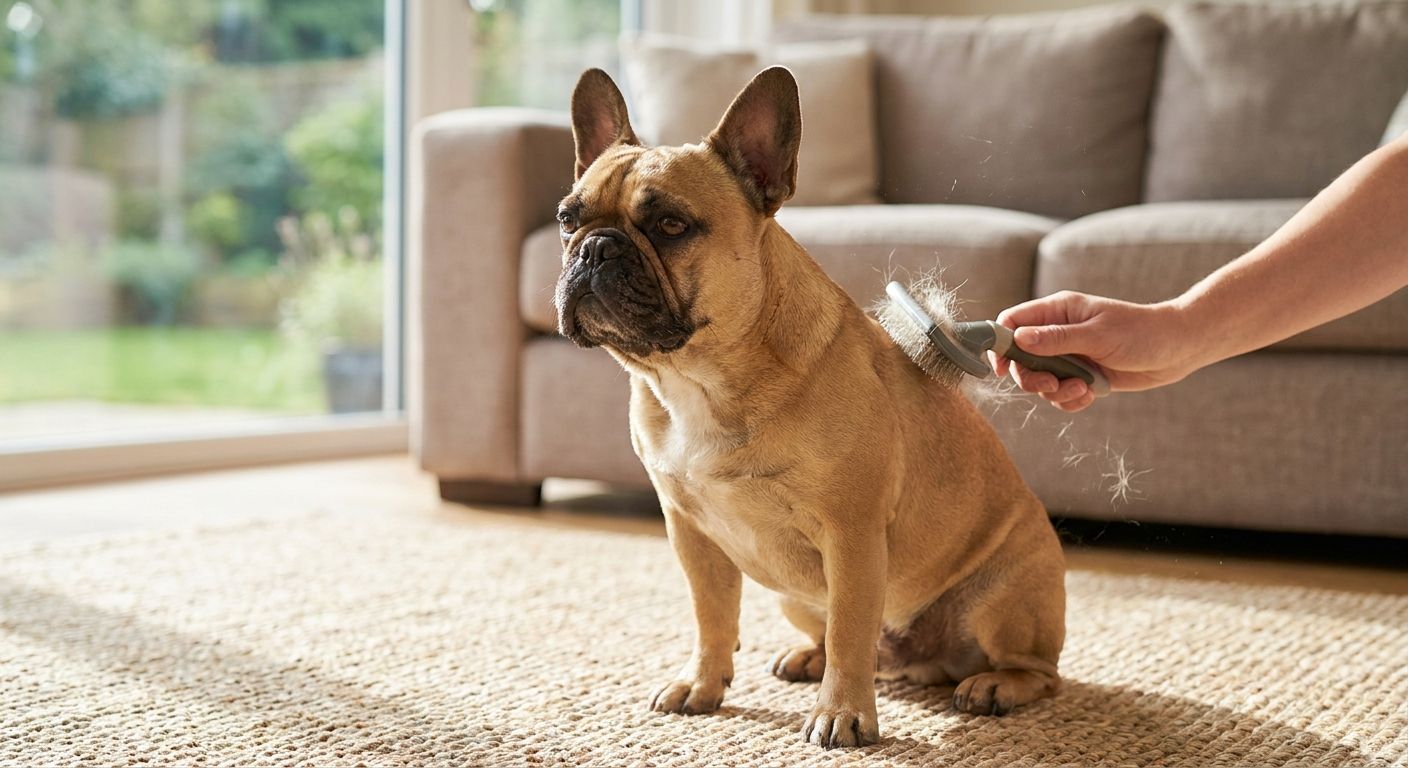
French Bulldog shedding is light-to-moderate year-round and spikes for a few weeks each spring and fall when the coat cycles through its seasonal blow — a weekly brushing routine and the right diet keep it off your couch instead of a heavier grooming schedule. This guide breaks down exactly how much shedding is normal, what tools actually cut down on loose hair, and when shedding stops being cosmetic and starts being a symptom.
TL;DR
French Bulldog shedding is single-coat and moderate — brushing 2-3x per week controls most of it in 2026.
Seasonal coat blows in spring and fall last 2-4 weeks and need a deshedding tool, not just a curry brush.
Sudden heavy shedding, bald patches, or scabby skin points to allergies or a skin infection, not a normal coat cycle.
Diet quality and omega fatty acid intake noticeably change coat condition and how much hair ends up on your floor.
Shrinkabulls raises French Bulldogs across fawn, brindle, merle, lilac, and blue — coat color does not change shedding volume.
Why this matters
French Bulldogs carry a single smooth coat with no dense undercoat, which is exactly why people assume they barely shed. They still shed daily, just in short, fine hairs that are easy to miss until they show up on a black couch or a work blazer. Owners who skip a grooming routine end up dealing with far more visible hair than the breed actually produces — and some skip noticing a real skin problem because they wrote it off as "just shedding." If you're deciding whether a French Bulldog puppies for first-time dog owners fits your household, shedding tolerance is a fair thing to weigh before you bring one home in 2026.
How do you manage shedding in a French Bulldog?
Managing French Bulldog shedding comes down to four habits done consistently, not one product that solves it overnight.
Brush 2-3 times a week, daily during shed season. A rubber curry brush or grooming glove pulls loose hair before it falls out on its own.
Bathe every 3-4 weeks, not weekly. Over-bathing strips the natural oils that keep the coat and skin healthy, which can actually worsen shedding.
Feed a diet with real animal protein and omega-3/omega-6 fatty acids. Coat quality tracks diet quality closely in short-coated breeds.
Wipe skin folds daily. Frenchies don't just shed hair, they trap it (and moisture) in facial and tail folds, which invites irritation that triggers more shedding.
Vacuum and use a lint roller as maintenance, not a fix. Managing the hair in your house is separate from managing the coat itself.
Here's how the main grooming tools compare for a Frenchie's coat type:
Tool
Best for
How often
Rubber curry brush / grooming glove
Daily light coat maintenance
2-3x per week
Deshedding comb/rake
Pulling loose undercoat hair during seasonal blow
Daily for 2-4 weeks, spring and fall
Slicker brush
Finishing pass, smoothing the coat after brushing
Weekly
Verdict: a curry brush plus a deshedding comb during the two seasonal blows handles French Bulldog shedding for most owners without needing anything fancier.
Coat maintenance also starts with what's in the bowl. A stocked puppy starter supplies for a new French Bulldog owner kit should include a grooming glove and a gentle, oatmeal-based shampoo from week one, not something you buy after shedding becomes a problem.
See available Bulldog puppies
Browse current French and English Bulldog litters across colors.
No two Frenchies shed identically, and the differences usually trace back to one of these:
Diet quality. Cheap fillers and low-protein kibble show up as a duller coat and more loose hair within weeks of switching.
Season and daylight. Coat cycles are tied to daylight changes, which is why spring and fall bring the heaviest shedding regardless of climate.
Skin allergies. Environmental or food allergies inflame the skin and push more hair out of the follicle than normal.
Stress or a recent environment change. Moving homes, a new pet, or a stressful vet visit can trigger a temporary shed spike.
Age. Puppies blow their soft puppy coat for an adult coat around 4-6 months, which looks like a shedding surge but is a one-time transition.
Bathing frequency. Both under-bathing (buildup) and over-bathing (dry skin) increase visible shedding.
Do French Bulldogs shed a lot compared to other breeds?
French Bulldogs shed less than double-coated breeds like Labs or Huskies, but they are not a low-shedding breed by default — they shed daily, fine, short hairs year-round with two heavier seasonal periods. Owners coming from a double-coated breed often notice French Bulldog shedding feels lighter simply because there's no thick undercoat blowing out in clumps.
Are some French Bulldog colors lower-shedding than others?
Coat color does not change how much a French Bulldog sheds — merle, lilac, blue, fawn, and brindle Frenchies all carry the same single-coat structure and shed at similar rates. If shedding tolerance and allergies are the real concern, the coat texture and skin health matter more than the color pattern itself; the best French Bulldog colors for allergy-conscious families page covers what actually affects allergy reactions versus what's just cosmetic.
Is French Bulldog shedding a sign of a health problem?
Shedding becomes a health concern when it's sudden, patchy, or paired with red or flaky skin — normal seasonal shedding is even and doesn't leave bald spots. A Frenchie that's scratching constantly or losing hair in specific patches needs a vet check for allergies, mites, or a thyroid issue rather than more brushing.
FAQ
Do French Bulldogs shed a lot?
French Bulldogs shed lightly to moderately year-round with two heavier seasonal periods in spring and fall. They shed far less visibly than double-coated breeds because they lack a thick undercoat.
How often should you brush a French Bulldog to control shedding?
Brush a French Bulldog 2-3 times a week normally, and daily during the spring and fall seasonal coat blow. A rubber curry brush or grooming glove removes loose hair before it ends up on furniture.
What causes excessive shedding in French Bulldogs?
Excessive shedding beyond the normal seasonal blow usually comes from skin allergies, a poor-quality diet, or stress from an environment change. Patchy or scabby shedding is a vet visit, not a grooming fix.
Can diet reduce French Bulldog shedding?
Yes, a diet with quality animal protein and omega-3/omega-6 fatty acids visibly improves coat condition and reduces excess shedding within weeks. Cheap filler-heavy kibble tends to worsen it.
Do lilac or blue French Bulldogs shed differently than standard colors?
No, coat color does not affect shedding volume in French Bulldogs. Lilac, blue, merle, fawn, and brindle Frenchies all carry the same single coat and shed at comparable rates.
Is French Bulldog shedding worse in summer?
Shedding is heaviest during the spring coat blow rather than deep summer itself, though warm weather can make loose hair more noticeable. The fall coat blow is the second seasonal spike.
Are French Bulldogs hypoallergenic?
No breed is truly hypoallergenic, and French Bulldogs are not a low-allergen breed despite their short coat. Allergy reactions come mostly from dander and saliva proteins, not hair length.
When should you see a vet about French Bulldog shedding?
See a vet when shedding is sudden, patchy, or comes with red, flaky, or scabby skin rather than an even seasonal thinning. Those signs point to allergies, mites, or a thyroid problem, not normal coat cycling.
One last thing
The detail most owners miss in 2026 isn't the brush, it's the skin folds — trapped moisture and hair in a Frenchie's facial and tail folds cause more visible "shedding" complaints than the coat cycle itself, and a daily wipe-down solves it faster than any deshedding tool. If shedding tolerance is part of a bigger decision about which puppy fits your home, weigh it alongside temperament and space before you commit to a litter.
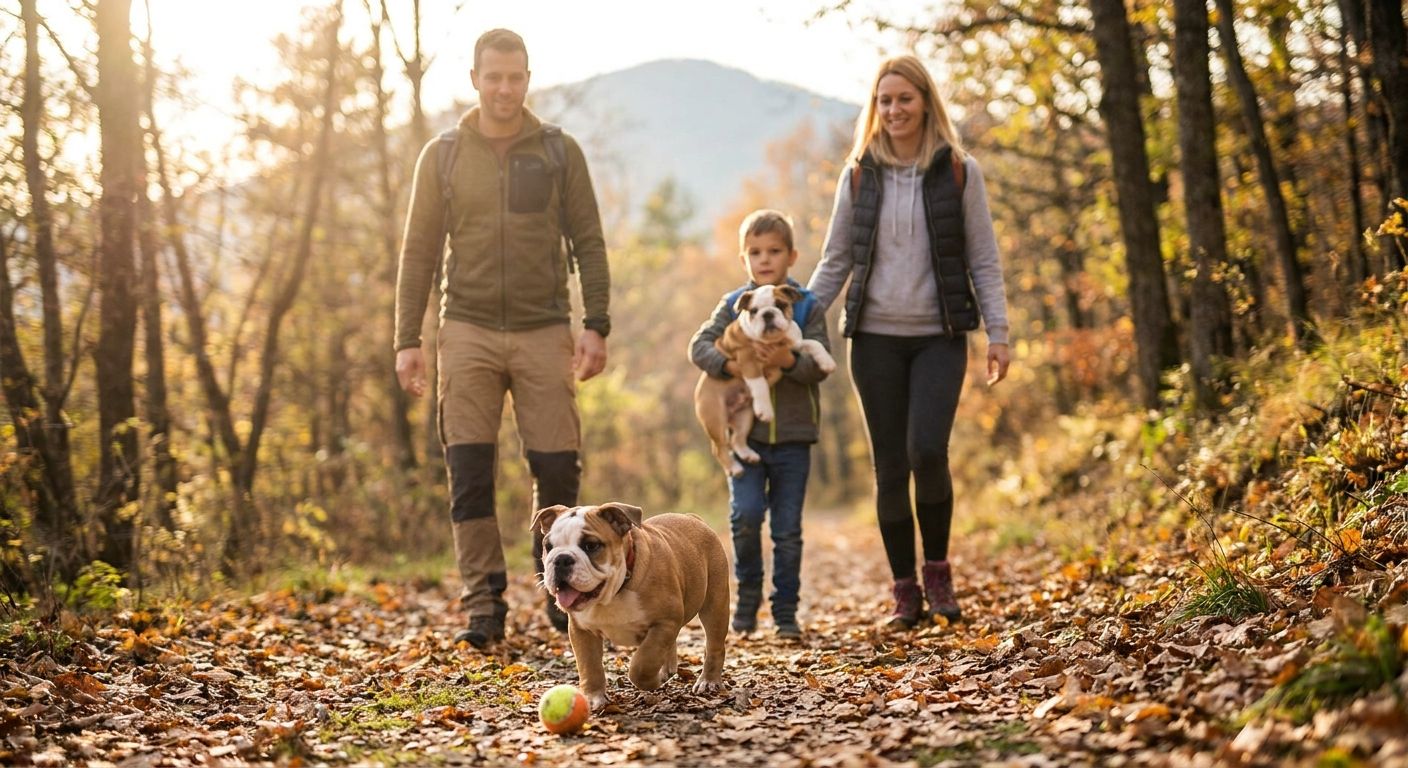
English Bulldog puppies for active families are dogs built for daily play, short walks, and yard time with kids rather than long runs or high-mileage hikes. "Active" here means consistent, manageable movement, not marathon training, because the breed's short muzzle and thick frame cap how much cardio it can safely handle. What makes this segment different from a generic bulldog buyer is the mismatch risk: families picture a dog that keeps pace on bike rides, and English Bulldogs simply aren't built for that job.
TL;DR
English Bulldog for active families fits two 15-20 minute walks daily, not distance running – buy for companionship, not cardio.
Temperatures above 80F risk breathing distress in English Bulldogs – shift exercise to early morning or evening in summer 2026.
Shrinkabulls sells AKC-registered English Bulldog puppies with health testing paperwork worth verifying before you buy.
Joint supplements and weight control matter more long-term for active households than which bulldog variety you pick.
Why this matters for active families
Families searching for an english bulldog for active families usually already own a yard, a couple of kids, and a Saturday routine built around a walk to the park. What they need to know before buying is whether the dog can keep up without overheating or needing to be carried home halfway through.
English Bulldogs are brachycephalic – the short muzzle that gives them their signature face also narrows the airway, which limits how hard and how long they can exert themselves compared to a long-nosed breed. That's a structural fact, not a training gap, and it shapes every decision below: exercise timing, home setup, and which bulldog variety fits your household. Shrinkabulls breeds toward broader nostrils and shorter backs specifically to ease some of that airway strain, but no English Bulldog turns into a distance runner in 2026 or any other year.
If your family's idea of "active" means trail runs or off-leash chase sessions every day, an English Bulldog bred for hot climates still needs a modified routine – not a different dog altogether, just different expectations going in.
Building an active-family routine around an English Bulldog puppy
Match your walk schedule to the breed's real stamina
Most adult English Bulldogs cap out well below what an active family assumes a "dog" needs.
Plan on two walks a day, 15-20 minutes each, as a realistic daily ceiling.
Watch for open-mouth breathing, wheezing, or lagging behind – stop and cool the dog down immediately.
Split one long walk into two shorter ones instead of pushing through a single 40-minute loop.
Save vigorous play like fetch or tug for early morning or after sunset in warm months.
Track your dog's pace for the first few weeks to learn its actual limit, not an internet estimate.
Build a heat-safe exercise routine
Heat, not distance, is what actually sidelines an English Bulldog.
Exercise before 9am or after 7pm from roughly May through September in most US climates.
Carry water on any outing longer than 10 minutes.
Skip outdoor exercise entirely on days above 85F with high humidity; a short indoor play session replaces it.
Cool tile floors, a fan, or an air-conditioned room do more for stamina than any training plan.
Ask the breeder whether the litter's parents show signs of labored breathing at rest – a red flag regardless of color or price.
Set up your yard and home for controlled play
A fenced yard is not the same thing as a safe yard for a brachycephalic breed.
Fence in shade coverage, not just square footage – bulldogs overheat faster in full sun.
Crate-train early so weekend outings don't turn into destructive afternoons alone; the goal is a dog that settles, not one that panics when the family leaves.
Keep floors non-slip near stairs; the breed's low center of gravity and short legs make hardwood a hazard for puppies still building muscle.
Rotate two or three chew toys instead of leaving one out, which keeps a home-alone puppy occupied without overexerting.
Choose the right bulldog variety for your climate and space
Not every bulldog on the market fits an active family the same way, and the differences matter more than color.
Variety
Best for active families
Key limitation
Standard English Bulldog
Moderate-energy households with yard access and short daily walks
Heat intolerance, limited stamina for long outings
Larger families wanting a more substantial dog presence
Heavier frame stresses joints faster; needs more caution on hot days
French Bulldog
Smaller households or apartment-adjacent yards with lower daily exercise needs
Even lower heat tolerance than English Bulldogs
Mini English Bulldog
Families with limited yard space who still want the classic temperament
Still brachycephalic; same breathing caution applies
An English Bulldog for active families works best when "active" means yard play and short walks, not sustained cardio – that's the sentence to keep in mind while comparing litters.
Ask the breeder about airway and joint health before you buy
Color and price get most of the attention online; airway grading and hip clearances are what actually determine whether your active family gets a dog that keeps up.
Ask whether the sire and dam have been evaluated for BOAS (brachycephalic airway syndrome) signs.
Request any available hip and patella screening on the parents.
Get the puppy's vet check history, not just a verbal assurance.
Vet the breeder itself before you vet the puppy – a breeder that won't answer health questions in writing is a bigger risk than any single litter.
Confirm AKC registration paperwork matches the puppy you're actually taking home, not a stock photo litter.
Budget for joint supplements and weight management
Weight is the single biggest lever an active family controls after the puppy comes home.
Keep the dog at a lean body condition; extra weight compounds both joint strain and breathing effort.
Scheduling walks for midday heat. Summer afternoons above 85F are exactly when an English Bulldog is most likely to overheat.
Assuming the dog can keep pace on bike rides or jogs. The breed's airway anatomy caps sustained cardio regardless of training.
Skipping crate training, then blaming the dog for destructive behavior when left alone during weekend outings.
Choosing a puppy by color rarity alone instead of confirming airway and joint health testing first.
Under-budgeting for joint supplements once the dog reaches middle age, treating it as optional rather than routine.
FAQ
Are English Bulldogs good for active families?
English Bulldogs work well for active families who define active as short walks, yard play, and kid-friendly fun rather than running or hiking. The breed’s short muzzle limits sustained cardio, so households expecting a jogging partner should look elsewhere.
How much exercise does an English Bulldog need per day?
Most adult English Bulldogs do well with two 15-20 minute walks a day plus some yard play. Puppies need shorter, more frequent sessions to protect developing joints.
Can English Bulldogs go on hikes or runs?
English Bulldogs are not suited to hikes or runs because their airway anatomy restricts prolonged heavy breathing. Short, flat walks are the safer substitute for families wanting outdoor time together.
What temperature is too hot for an English Bulldog?
Days above 85F with high humidity are risky for English Bulldogs and outdoor exercise should move indoors. Even 80F with direct sun and exertion can trigger labored breathing.
Is a Mini English Bulldog easier for active families than a standard English Bulldog?
A Mini English Bulldog offers the same temperament in a smaller footprint but carries the same brachycephalic breathing caution as the standard size. Space, not activity tolerance, is the main difference.
How do I know if a bulldog breeder health-tests for airway problems?
Ask the breeder directly whether sire and dam have been evaluated for BOAS signs and request documentation in writing. A breeder unwilling to answer in writing is a red flag independent of price or color.
Do English Bulldogs do well with kids in an active household?
English Bulldogs generally do well with kids because of their sturdy build and even temperament, provided play is supervised and heat exposure is managed. Gradual socialization in the first month matters more than the breed’s natural disposition.
What’s the difference between an English Bulldog and a French Bulldog for activity level?
English Bulldogs and French Bulldogs have similarly low tolerance for sustained cardio, but French Bulldogs run even lower on heat tolerance due to their smaller frame. Neither breed fits families expecting a running or hiking companion.
One last thing
The single biggest predictor of a good match for active families isn't the family's activity level at all – it's whether the house runs air conditioning consistently from May through September. An English Bulldog for active families succeeds or fails on heat management more than on exercise tolerance, and that's the detail most buyers skip past while comparing colors and prices in 2026.
An overweight English Bulldog is not just a chunky cutie — extra weight on a brachycephalic body makes breathing, joints, and heart function harder than they already are. This guide ranks the diet plans that actually move the needle in 2026, tells you who each one fits, and gives you a straight verdict on every option.
TL;DR
The best diet plan for overweight English Bulldogs in 2026 is a vet-supervised weight-loss plan with a measured calorie deficit and 8-12 week rechecks.
Portion-controlled kibble feeding is the best budget diet plan for overweight English Bulldogs — no prescription food required.
Prescription weight-management diets work best for bulldogs already carrying joint pain from excess weight.
Home-cooked low-fat plans suit picky eaters but need a vet-approved recipe to avoid nutrient gaps.
Exercise-integrated feeding plans fit younger, still-mobile bulldogs better than seniors with joint damage.
Why bulldog weight matters
55.8%
US dogs overweight or obese
2018 APOP national survey
50 lbs
AKC standard weight, adult male English Bulldog
1-2%
Safe weekly weight loss, body weight
Why this matters
English Bulldogs already fight their own anatomy — a short airway, a heavy front end, and joints that carry more weight per inch of leg than most breeds. Add extra fat and every one of those problems gets worse: harder breathing, more strain on hips and elbows, and a shorter runway before heat stroke sets in on a warm afternoon. At Shrinkabulls we hear from bulldog owners constantly asking how to get a soft, round puppy back into a healthy shape without starving the dog or guessing at portions.
The AKC breed standard puts adult male English Bulldogs around 50 pounds and females closer to 40, though plenty of healthy bulldogs sit a few pounds either side depending on frame. A 2018 Association for Pet Obesity Prevention survey found 55.8% of US dogs were overweight or obese — bulldogs, with their low activity tolerance, land on the higher end of that curve. The fix is not one diet food. It is picking the right plan for your dog's age, mobility, and how much weight actually needs to come off.
The ranked verdict
Best overall: the vet-supervised weight-loss plan.Best budget option: portion-controlled kibble feeding.Best for joint pain: a prescription weight-management diet.Best for picky eaters: a vet-approved home-cooked low-fat plan.Best for maintenance after weight loss: a high-protein, low-carb plan.Best for younger, mobile bulldogs: an exercise-integrated feeding plan.
What makes the best diet plan for an overweight English Bulldog
A real starting weight and target weight, not a guess — a vet scale and a body condition score (BCS) on the 1-9 scale.
A measured calorie deficit, typically 10-20% below current maintenance intake, adjusted every 2-4 weeks.
Joint-safe pacing — no crash diets that pull muscle instead of fat off a heavy-boned dog.
Feeding consistency — same meal times, same measured cups, no free-feeding a bulldog that already overeats.
Breathing-aware exercise, since bulldogs overheat fast and can't pant efficiently once weight is on the chest.
A recheck schedule — weigh-ins every 2-4 weeks to catch stalls before they become months of no progress.
At a glance
Plan
Best for
Standout feature
Key limitation
Vet-supervised weight-loss plan
Confirmed obesity, BCS 7+
Calorie targets set by bloodwork and body condition
Requires vet visits and follow-up
Portion-controlled kibble plan
Budget-conscious owners
Works with food already in the pantry
Needs a kitchen scale, not guesswork
Prescription weight-management diet
Bulldogs with joint pain
Formulated for satiety on fewer calories
Vet prescription required
Home-cooked low-fat plan
Picky, food-bored bulldogs
Full control over ingredients
Nutrient balance needs vet review
High-protein, low-carb maintenance plan
Post-weight-loss upkeep
Holds lean mass while calories rise slightly
Not a weight-loss plan on its own
Exercise-integrated feeding plan
Younger, still-mobile bulldogs
Pairs calorie cuts with short, cool-weather walks
Wrong fit for bulldogs with bad hips or knees
1. Vet-supervised weight-loss plan: best diet plan for confirmed obesity
This plan starts with an actual vet visit — a body condition score, a weigh-in, and bloodwork to rule out thyroid or Cushing's issues that mimic simple overeating. The vet sets a calorie target based on current weight and ideal weight, then rechecks every 2-4 weeks to adjust the number up or down.
Vet-supervised weight-loss plan pros:
Catches medical causes of weight gain before you blame the food bowl
Calorie targets are dog-specific, not a bag label's generic guess
Rechecks stop a stall from turning into six wasted months
Vet-supervised weight-loss plan cons:
Costs more upfront than switching bags of kibble
Slower than owners want — safe loss runs 1-2% of body weight per week
Best for: bulldogs with a BCS of 7 or higher, or any bulldog whose owner suspects a medical cause. Verdict: start here.
2. Portion-controlled kibble plan: best diet plan for budget-conscious owners
No new food, no prescription — just a kitchen scale and a firm cup measurement instead of eyeballing the bowl. Most bulldogs gain weight from portion creep, not from the food itself, so cutting the current kibble by 10-20% and removing table scraps often does most of the work.
Portion-controlled kibble plan pros:
Free to start — no new bag of food required
Easy to track with a $10 kitchen scale
Works alongside any of the other plans on this list
Portion-controlled kibble plan cons:
Won't fix weight tied to a medical condition
Requires real discipline — no "just a little" table scraps
Best for: owners who want results without a vet bill or a food switch. Verdict: try it first.
3. Prescription weight-management diet: best diet plan for bulldogs with joint pain
Formulated foods built for satiety on fewer calories — the dog feels full on a smaller portion, which matters when a bulldog's joints are already screaming from carrying extra weight. These require a vet prescription and typically run alongside vet-supervised checkups.
Prescription weight-management diet pros:
Built to keep dogs full despite a calorie cut, so begging drops
Often includes joint-support additives like glucosamine
Backed by clinical formulation, not a guess at macros
Prescription weight-management diet cons:
Needs a vet prescription — not something you grab off a shelf
4. Home-cooked low-fat plan: best diet plan for picky eaters
Some bulldogs get bored of kibble entirely and start refusing food, which backfires on a weight-loss plan. A vet-approved home-cooked recipe — lean protein, low-fat, controlled portions — keeps a picky eater interested while still hitting a calorie target.
Home-cooked low-fat plan pros:
Full ingredient control, useful for dogs with food sensitivities
Solves the boredom problem that stalls other diets
Fresh food is often more palatable for a stubborn eater
Home-cooked low-fat plan cons:
Nutrient balance is easy to get wrong without vet or nutritionist input
More prep time than opening a bag
Best for: bulldogs who have gone off commercial food or have known sensitivities. Verdict: worth it with vet guidance.
5. High-protein, low-carb maintenance plan: best diet plan after weight is already off
This one is not for losing weight — it's for holding the loss once a bulldog reaches target weight. Protein stays high to preserve muscle, carbs drop slightly, and calories rise just enough to stop losing without starting to regain.
High-protein, low-carb maintenance plan pros:
Prevents the yo-yo of regaining weight after a successful cut
Keeps muscle mass on an aging bulldog
High-protein, low-carb maintenance plan cons:
Does nothing for a dog that still needs to lose weight
Needs a new calorie calculation once weight stabilizes
Best for: a bulldog that already hit target weight and needs to stay there. Verdict: switch to this once the cut is done.
6. Exercise-integrated feeding plan: best diet plan for younger, mobile bulldogs
Calorie cuts alone work, but pairing them with short, cool-weather walks burns extra calories and keeps a younger bulldog's joints and lungs conditioned. This is not for every bulldog — heat and airway limits mean exercise has to be short and closely watched.
Exercise-integrated feeding plan pros:
Burns calories on top of the diet cut, speeding results
Keeps a younger dog's joints and cardiovascular system in shape
Exercise-integrated feeding plan cons:
Wrong for bulldogs with existing hip, knee, or breathing problems
Heat risk means walks are limited to early morning or evening
Best for: bulldogs under 5 years old with no diagnosed joint or airway issues. Verdict: add it if your bulldog can handle it, skip it if not.
Have questions before you commit?
See what health testing to ask about before starting any diet plan.
Every plan above was scored against the six criteria listed earlier: a real starting weight, a measured deficit, joint-safe pacing, feeding consistency, breathing-aware exercise, and a recheck schedule. The vet-supervised plan wins overall because it hits every criterion; the others rank by which single criterion they solve best — budget, joint pain, pickiness, maintenance, or activity level.
Which diet plan should you choose?
If your English Bulldog's body condition score is 7 or higher, start with a vet-supervised weight-loss plan — get the bloodwork done before assuming it's just food. If your bulldog is a little soft but otherwise healthy and you want to start today, portion-controlled kibble feeding costs nothing extra and often solves the problem on its own. Bulldogs already limping or slow to rise do better on a prescription weight-management diet paired with joint support. Whatever you pick, weigh your dog every 2-4 weeks in 2026 and adjust — a plan that isn't rechecked isn't really a plan.
“A plan that isn’t rechecked isn’t really a plan.”
FAQ
What’s the best diet plan for overweight English Bulldogs in 2026?
A vet-supervised weight-loss plan is the best diet plan for overweight English Bulldogs in 2026 because it sets a calorie target from real bloodwork and body condition scoring, then rechecks every 2-4 weeks. Portion-controlled kibble feeding is the best free alternative if a vet visit isn’t in the budget yet.
How much should an overweight English Bulldog eat to lose weight?
Most vets start with a 10-20% calorie cut from current maintenance intake, then adjust based on weigh-ins every 2-4 weeks. The exact number depends on current weight, age, and activity level, so a vet-set target beats a bag-label estimate.
How fast should an English Bulldog lose weight safely?
Safe weight loss for dogs runs about 1-2% of body weight per week. Faster loss risks muscle wasting instead of fat loss, which is worse for a breed that already carries a lot of weight on its joints.
Can overweight English Bulldogs still exercise?
Yes, but only short, cool-weather walks — bulldogs overheat quickly and can’t pant as efficiently as other breeds due to their airway structure. Skip exercise entirely for bulldogs with diagnosed joint or breathing problems and rely on diet alone.
Is a prescription diet necessary for an overweight bulldog?
No, prescription weight-management diets are one option, not a requirement — portion-controlled regular kibble works for many bulldogs. Prescription diets make the most sense when a bulldog already shows joint pain from the extra weight.
How do I know if my English Bulldog is overweight?
Use the 1-9 body condition score scale: you should be able to feel ribs with light pressure and see a waist from above. A vet visit gives a precise BCS and starting point for any diet plan.
What foods should I avoid feeding an overweight English Bulldog?
Cut table scraps, high-fat treats, and free-feeding entirely — these are the most common causes of portion creep in bulldogs. Stick to measured meals and vet-approved treats during any weight-loss plan.
Should I switch foods or just reduce portions for a chubby bulldog?
Reducing portions on current food often works and costs nothing extra, so it’s worth trying first. Switch to a prescription weight-management food only if portion control alone stalls or your bulldog already has joint pain.
One last thing
The AKC breed standard weight for adult English Bulldogs — around 50 pounds for males, 40 for females — is a range, not a hard rule, so don't chase a number if your vet says your dog's frame carries more muscle than average. What matters more than the scale is the body condition score: ribs you can feel, a visible waist, and a dog that can walk a short loop without collapsing into open-mouth panting within a minute. Get that right in 2026 and the number on the scale usually follows.
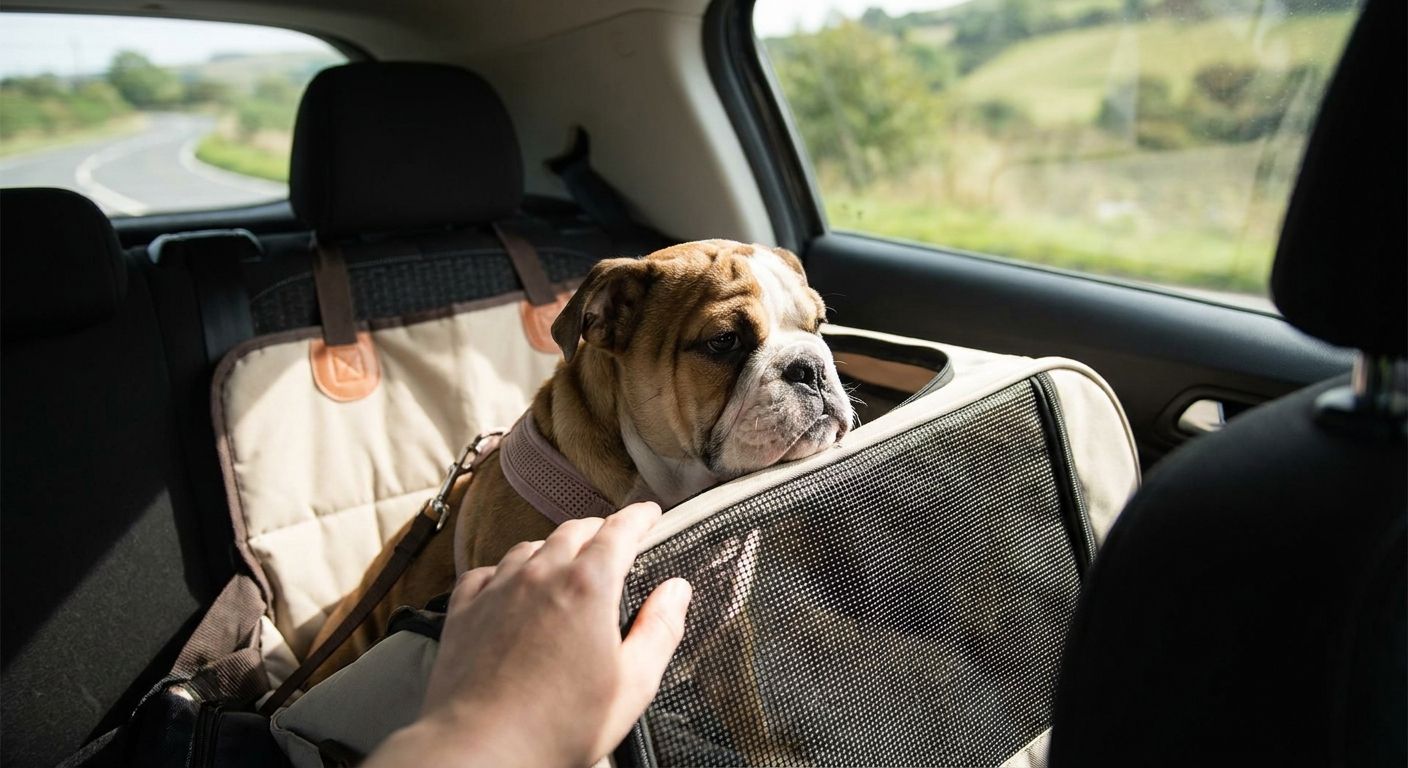
English Bulldog puppies can't regulate heat the way other dogs do, so car travel safety comes down to three things: a crash-tested crate or harness, cabin temperature kept below 75°F, and zero unattended minutes in a parked vehicle. Skip any one of those and a routine drive turns into an emergency vet visit faster than most owners expect in 2026.
TL;DR
Secure every English Bulldog puppy in a crash-tested crate or harness before the car moves — loose puppies are a windshield risk.
English bulldog car travel turns dangerous above 75°F cabin temperature because bulldogs can’t pant-cool efficiently.
A parked car’s interior can climb roughly 19°F in the first 10 minutes even with windows cracked.
Stop every 45-60 minutes on trips over two hours for water, bathroom breaks, and a temperature check.
Never leave a Bulldog puppy alone in a car, not even for a 3-minute errand.
Bulldog car travel numbers to know
19°F
Cabin temp rise in 10 minutes
Even with cracked windows
75°F
Max safe cabin temperature
101-102.5°F
Normal bulldog body temp range
Why this matters
English Bulldogs are brachycephalic — short, compressed airways that make panting an inefficient cooling system compared to a Labrador or a mixed breed. Add a puppy's smaller body mass and undeveloped stamina, and a car ride that's boring for you can be genuinely risky for them. This isn't a scare tactic to sell you a crate — it's the physiology every reputable bulldog breeder repeats because it's the single most preventable cause of puppy travel injuries and heatstroke deaths.
We've raised bulldogs long enough to know the difference between a puppy that handles the ride to the vet fine and one that panics at 65 mph in an unsecured back seat. Restraint and temperature control are non-negotiable — everything else on this page is detail work.
How to travel safely with an English Bulldog puppy by car
Crate or harness the puppy before the engine starts. A crash-tested crate strapped to the seatbelt anchor, or a bulldog-sized car harness clipped to the seatbelt latch, keeps the puppy from becoming a projectile in a sudden stop.
Set the cabin temperature and keep it there. Target 68-72°F. Anything pushing past 75°F is your signal to turn the AC up, not down.
Feed 2-3 hours before departure, not right before. Bulldogs are prone to motion sickness and bloat risk is real in a breed already built low to the ground.
Pack water, a collapsible bowl, and a cooling mat. The starter supplies checklist covers what most new owners forget on their first trip.
Stop every 45-60 minutes on longer drives. Let the puppy stretch, drink, and cool off outside direct sun.
Never leave the puppy alone in the car. Not for gas, not for a coffee run, not for "just two minutes."
Crate travel vs. harness travel: which is safer
Feature
Crash-tested crate
Bulldog car harness
Best for
Puppies under 6 months, long trips, anxious travelers
Calm adult-acting puppies, short errands
Airflow
Good if wire or vented plastic
Excellent — puppy sits upright
Motion sickness
Better — reduces visual stimulation
Worse — puppy sees the road move
Setup effort
Higher, needs cargo space or back seat
Lower, clips into existing seatbelt
Verdict
Buy for road trips and puppies new to car travel
Buy for quick vet runs once the puppy is car-adjusted
If you're crate training already, the same crate training routine that works at home transfers almost directly to the car — a puppy who's calm in a crate indoors is calm in one on the highway.
Road trips longer than 2 hours: what changes
Short errands and multi-hour road trips are not the same risk profile, and treating them identically is where most travel mistakes happen.
Water and bathroom stops become mandatory, not optional, roughly every 45-60 minutes.
Cabin temperature checks matter more because you're not popping in and out of a controlled environment — you're relying on the AC holding steady for hours.
Feeding schedule shifts — smaller portions, timed further from departure, to reduce nausea risk on winding routes.
Overnight stays require crate familiarity first. A puppy that's never slept in a crate shouldn't be introduced to one for the first time in a hotel room 400 miles from home.
If the trip is cross-country rather than a weekend drive, a flight nanny delivery is often the lower-stress option for the puppy compared to two days in a car seat.
“If the outside temperature is above 70°F and you’re not moving, that’s your cue to skip the errand and keep the AC running instead.”
Why English Bulldog car travel risk varies
Age of the puppy — anything under 10 weeks has less heat tolerance and weaker bladder control, meaning more frequent stops.
Coat and color — darker coats absorb more heat through a window, which matters on sunny-side seating.
Airway conformation — puppies with more extreme muzzle compression tolerate heat worse than moderately built bulldogs.
Car ventilation setup — a crate blocking a vent versus one positioned in open airflow makes a measurable difference in cabin comfort for the puppy.
Trip length and stop frequency — a 20-minute drive and a 6-hour drive are not the same calculation, even at identical temperatures.
Prior car exposure — a puppy introduced to short, calm car rides early handles longer trips with far less stress later.
Meet our bulldog puppies
See available English and French Bulldog puppies raised for calm, confident travel.
No — the back seat is the safer position, secured in a crate or harness, away from an active airbag that can seriously injure a small puppy on deployment. Front passenger airbags are sized for adult humans, not 15-pound puppies, and that mismatch is the whole reason back-seat restraint is standard advice.
How often should you stop on a road trip with a bulldog puppy?
Every 45-60 minutes is the general rule for trips longer than two hours, giving the puppy water, a bathroom break, and a chance to cool down outside a hot car interior. Shorter, more frequent stops beat one long stop when temperatures are on the warmer side of 75°F.
What temperature is too hot for a bulldog puppy in a car?
Above 75°F inside the cabin is where risk climbs fast for a brachycephalic puppy, and a parked car can reach dangerous interior temperatures within about 19°F of a rise in just 10 minutes even with cracked windows. Bulldogs run a normal body temperature of 101-102.5°F, and anything pushing them past that baseline for an extended period is the start of heat stress, not just discomfort.
FAQ
Is it safe to drive long distance with an English Bulldog puppy?
Yes, long-distance english bulldog car travel is safe with a crash-tested crate, cabin temperature under 75°F, and stops every 45-60 minutes. Puppies under 10 weeks may need more frequent breaks than older puppies.
Should a bulldog puppy wear a seatbelt harness in the car?
A bulldog puppy should wear a harness clipped into the seatbelt latch or ride in a crash-tested crate secured by the seatbelt. Loose puppies in a moving car are at risk during sudden braking, not just crashes.
How do I stop my bulldog puppy from getting carsick?
Feed the puppy 2-3 hours before the drive rather than right before, and use a crate that limits the puppy’s view of moving scenery. Motion sickness in bulldog puppies usually settles after a handful of short, calm trips.
Can I leave my bulldog puppy in the car for a few minutes?
No, never leave a bulldog puppy alone in a parked car, even for a few minutes. Interior temperatures can rise roughly 19°F within the first 10 minutes, which is enough to put a brachycephalic puppy into heat distress.
What’s the best crate size for an English Bulldog puppy in a car?
Choose a crate that lets the puppy stand, turn around, and lie down flat, sized up as the puppy grows rather than bought for adult size immediately. A crate that’s too large lets the puppy slide during turns and braking.
Do bulldog puppies need AC on during car rides?
Yes, keep the AC running to hold cabin temperature between 68-72°F on any drive longer than a few minutes. Bulldogs can’t cool themselves as efficiently as longer-muzzled breeds, so ambient cooling does more of the work.
How young is too young for an English Bulldog puppy to travel by car?
Most breeders clear puppies for short car trips once they’re settled into a new home, typically around 8-10 weeks old alongside their first vaccinations. Longer road trips are usually better delayed until the puppy is fully vaccinated.
One last thing
The detail most new owners miss isn't the crate or the AC setting — it's that a bulldog puppy's stress response to car travel is almost entirely shaped by its first three or four rides. A puppy whose early car exposure is calm, short, and cool-cabin builds tolerance for the 6-hour road trip later; a puppy whose first ride is a stressful 90-minute drive home from pickup day carries that anxiety into every trip after. If you're picking up a new puppy in 2026, plan the first ride home around comfort, not convenience.
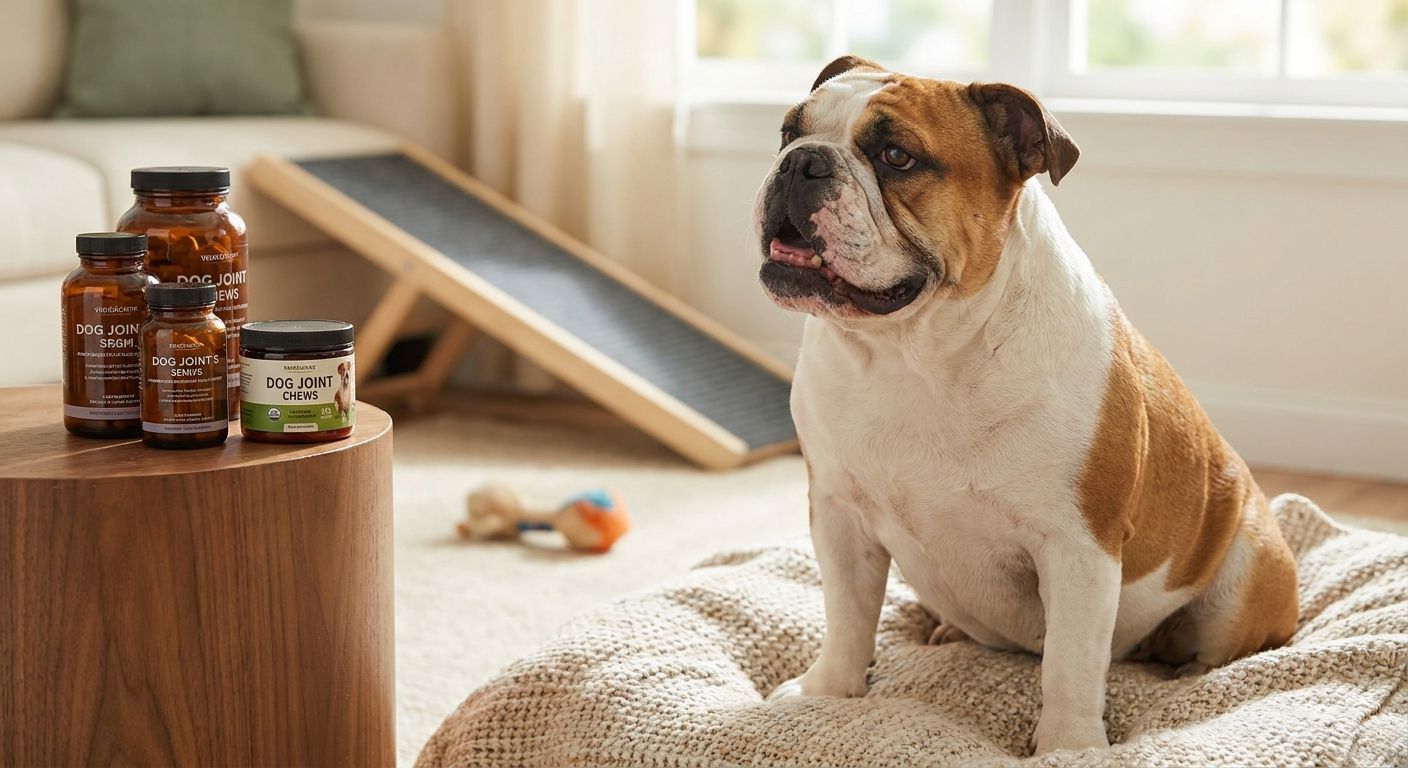
English Bulldogs carry a heavy, low-slung frame on short legs, and that structure puts real stress on hips, elbows, and knees from puppyhood on. This guide ranks the joint and mobility supplement categories that actually help, and tells you which one fits your bulldog's stage of life.
TL;DR
Glucosamine and chondroitin chews are the best overall english bulldog joint supplements for daily cartilage maintenance.
Omega-3 fish oil wins for active inflammation and works alongside any other joint product.
MSM powder is the best budget pick for owners who want a single, simple ingredient.
Green-lipped mussel extract is best for senior bulldogs already showing stiffness getting up.
UC-II collagen is best started early, before an English Bulldog shows any signs of joint trouble.
Bulldog joint basics
40-55 lbs
Typical adult English Bulldog weight
per AKC breed standard
4-6 weeks
Typical time to see change
most joint supplements need this long
Why this matters
English Bulldogs are consistently among the breeds most frequently flagged for hip dysplasia and patellar issues in orthopedic screening data, and the compact, heavy-boned build is the reason why. A 45-pound bulldog carries proportionally more weight through smaller joints than a leaner breed of the same size, so cartilage wear starts earlier and shows up as stiffness, reluctance to jump, or a shorter walk tolerance.
We talk about this a lot with families picking out a puppy, because joint health isn't something you fix later, it's something you support from day one. If you're evaluating breeding lines, our health testing panels guide covers what to ask about hips and elbows before you ever bring a puppy home from Shrinkabulls.
What makes the best english bulldog joint supplements
Dosing matched to bulldog body weight — English Bulldogs run 40-55 lbs per the AKC standard, and a supplement dosed for a 15-lb dog does nothing.
Transparent ingredient amounts, not a proprietary blend hiding how much glucosamine or MSM is actually in the scoop.
Combined structural and anti-inflammatory support, since cartilage repair and inflammation control work best together.
Low sugar, low filler formulas, because bulldogs gain weight easily and extra weight is extra joint stress.
Palatability that survives a picky bulldog's opinion — a chew that gets spit out helps nothing.
Third-party testing or an NASC seal, so the label matches what's in the jar.
At a glance: english bulldog joint supplements ranked
Supplement type
Best for
Standout feature
Key limitation
Glucosamine + chondroitin
Daily maintenance, all ages
Broadest research base for cartilage support
Takes weeks to notice, not instant
Omega-3 fish oil
Active inflammation
EPA/DHA reduce joint inflammation directly
Fishy smell some bulldogs dislike
MSM powder
Budget-conscious owners
Simple, one-ingredient, easy to dose up
Works best paired with glucosamine, not alone
Green-lipped mussel
Senior bulldogs, visible stiffness
Natural glucosamine + omega source in one
Higher cost per serving than basics
UC-II collagen
Young bulldogs, prevention
Works at lower doses than regular collagen
Less useful once damage is already advanced
Turmeric/curcumin
Natural add-on
Anti-inflammatory without NSAID side effects
Needs piperine to actually absorb
1. Glucosamine and chondroitin: best english bulldog joint supplement for daily maintenance
This combination is the default starting point for most bulldog owners, and for good reason. Glucosamine feeds cartilage repair while chondroitin slows the breakdown, and together they cover both sides of joint wear in a bulldog's compact frame.
Glucosamine + chondroitin pros:
Widest body of veterinary use of any joint category
Available in chews most bulldogs will actually eat
Works for young, middle-aged, and senior dogs alike
Glucosamine + chondroitin cons:
Needs 4-6 weeks of daily use before you notice a difference
Doesn't address active inflammation on its own
Best for: every English Bulldog, starting as young as 12 months. Verdict: Buy.
2. Omega-3 fish oil: best for active inflammation
When a bulldog is already limping or hesitant on stairs, the joint is inflamed, not just worn. EPA and DHA from fish oil target that inflammation directly, which is a different job than glucosamine does.
Omega-3 fish oil pros:
Reduces inflammation, not just cartilage wear
Doubles as coat and skin support, useful for a breed prone to skin folds
Layers cleanly on top of glucosamine and chondroitin
Omega-3 fish oil cons:
Smell and taste turn some bulldogs off the food entirely
Too much can loosen stool, so dosing has to stay in range
Best for: a bulldog already showing stiffness or limping. Verdict: Buy.
3. MSM powder: best budget option
MSM (methylsulfonylmethane) is a single-ingredient sulfur compound that supports connective tissue and takes the edge off joint discomfort. It's cheap to add to food and easy to dose up or down.
MSM powder pros:
Lowest cost per month of any category here
Simple powder mixes into any food without a chew
Stacks well with glucosamine for a fuller effect
MSM powder cons:
Weaker on its own than a combination product
Some bulldogs get mild GI upset at higher doses
Best for: owners who want joint support without a big monthly spend. Verdict: Buy, paired with glucosamine.
4. Green-lipped mussel: best for senior bulldogs
Green-lipped mussel extract packs natural glucosamine, chondroitin, and omega-3s into one ingredient, which makes it efficient for an older bulldog that's already stiff getting up in the morning.
Green-lipped mussel pros:
Three joint-support mechanisms from a single natural source
Well tolerated by most senior bulldogs
No synthetic fillers needed to round out the formula
Green-lipped mussel cons:
Costs more per serving than basic glucosamine products
Shellfish-based, so it's a no-go for a dog with a shellfish sensitivity
Best for: a bulldog past age seven showing daily stiffness. Verdict: Buy.
5. UC-II collagen: best for young bulldogs before problems start
Undenatured type II collagen (UC-II) works differently than regular glucosamine, training the immune system to stop attacking joint cartilage rather than just feeding repair. It works at lower doses, which matters for a breed that already eats a lot of chews and pills.
UC-II collagen pros:
Effective at a fraction of the dose of standard collagen
Good preventive pick before any symptoms show up
Once-daily dosing is easy to stick with
UC-II collagen cons:
Less researched than glucosamine and chondroitin overall
Not the right pick once a bulldog already has visible joint damage
Best for: English Bulldogs under age four with no symptoms yet. Verdict: Buy for prevention, Skip if joint damage is already advanced.
6. Turmeric and curcumin: best natural add-on
Curcumin, the active compound in turmeric, works as a natural anti-inflammatory without the stomach risk that comes with long-term NSAID use. It's rarely the whole plan, but it's a solid layer on top of one.
Turmeric/curcumin pros:
Anti-inflammatory action without NSAID side effects
Pairs well with any of the categories above
Widely available in bulldog-safe chew formats
Turmeric/curcumin cons:
Curcumin absorbs poorly without black pepper extract (piperine) included
Not strong enough on its own for a bulldog already in pain
Best for: owners layering extra anti-inflammatory support onto an existing plan. Verdict: Buy as an add-on, Skip as a standalone.
“If a joint supplement doesn’t show any change in six weeks, it’s the wrong supplement, not the wrong dose.”
How we ranked these
Each category was measured against the six criteria above: weight-appropriate dosing, ingredient transparency, combined structural and anti-inflammatory action, low filler content, palatability for a notoriously picky breed, and third-party testing standards. Categories that only hit one or two of those criteria dropped lower on the list, even when they're popular.
Which english bulldog joint supplement should you choose?
Start with glucosamine and chondroitin for any healthy adult bulldog, add omega-3 fish oil if you see any limping or stiffness, and step up to green-lipped mussel once your bulldog hits senior age. Young bulldogs with no symptoms do well starting UC-II collagen early rather than waiting for a problem to show up. Whatever you choose in 2026, give it the full 4-6 weeks before deciding it isn't working, and keep your bulldog at a healthy weight, since every extra pound is extra load on joints already working hard.
Health planning doesn't stop at supplements. If you're still choosing a puppy, our skull and jaw health evaluation guide covers the structural checks that matter before you commit to a bloodline.
See our AKC-registered bulldogs
Health-tested English and French Bulldog puppies from Shrinkabulls.
What’s the best joint supplement for an English Bulldog?
Glucosamine and chondroitin chews are the best overall choice for daily maintenance in English Bulldogs, since they cover both cartilage repair and breakdown prevention. Add omega-3 fish oil once a bulldog shows any stiffness or limping.
Is fish oil better than glucosamine for bulldog joints?
They do different jobs, so it isn’t a straight comparison. Fish oil reduces active inflammation while glucosamine and chondroitin support cartilage over time, and most bulldogs do best on both together.
How much does an english bulldog joint supplement cost?
Pricing varies widely by brand and formula, so check current pricing directly on the product you’re considering. MSM powder is generally the lowest-cost single-ingredient option, while green-lipped mussel extract runs higher per serving.
When should an English Bulldog start joint supplements?
Many owners start preventive support like UC-II collagen or glucosamine around age one, well before any symptoms appear. Waiting until a bulldog is already limping means treating damage instead of preventing it.
How long until a joint supplement works for a bulldog?
Most glucosamine and chondroitin products take 4-6 weeks of consistent daily use before you notice a real difference in mobility. Omega-3 fish oil can show anti-inflammatory effects a bit sooner.
Are joint supplements safe for English Bulldog puppies?
Many joint supplements are formulated for adult dogs, so check the label before giving one to a puppy under 12 months. A veterinarian can confirm whether early supplementation makes sense for your specific bulldog.
Do English Bulldogs need joint supplements even without symptoms?
Given how frequently the breed is flagged for hip and elbow issues, preventive supplementation before symptoms show is common practice among bulldog owners. UC-II collagen and basic glucosamine are typical starting points.
Can turmeric replace glucosamine for bulldog joints?
No, turmeric and curcumin work as an anti-inflammatory add-on, not a replacement for cartilage-support ingredients like glucosamine and chondroitin. Use it alongside a core joint supplement, not instead of one.
One last thing
The single biggest lever most bulldog owners overlook isn't the supplement at all, it's body weight. A bulldog carrying even five extra pounds puts meaningfully more load on hips and knees every single day, so pairing any joint supplement with a weight check is worth more than switching brands. If your bulldog is already at a healthy weight and still struggling, that's the signal to talk to a vet about imaging, not just trying a stronger supplement.
Crate training an English Bulldog puppy takes about 2 to 4 weeks of short, consistent sessions when you start the day your puppy comes home, usually around 8 weeks old. Bulldogs are food-motivated and want to please you, but their short muzzles and heat sensitivity mean crate placement and airflow matter more than they do for most breeds. Skip the guesswork and follow the age-based schedule below — most puppies treat the crate as a den, not a punishment, within the first two weeks.
TL;DR
English Bulldog crate training takes 2 to 4 weeks with short, food-reward sessions starting at 8 to 12 weeks old.
Cap daytime crating at 3-4 hours even for adult English Bulldogs; overnight tops out around 6-8 hours.
Never place the crate near a heat vent, radiator, or direct sun — brachycephalic dogs overheat fast.
Wire crates with a divider panel beat plastic bins for airflow during English Bulldog crate training.
Feed meals inside the crate for the first two weeks to build a positive association before closing the door.
Crate training benchmarks
2-4 weeks
Typical training timeline
8-12 weeks
Best age to start
3-4 hours
Max daytime crate stretch
6-8 hours
Max overnight crate stretch
Why crate training matters for English Bulldog puppies
A crate isn't a cage — it's a den, and Bulldogs are den animals whether they're 8 weeks or 8 years old. Crate training speeds up housebreaking because a puppy won't soil the space it sleeps in, and it keeps a teething, chewing puppy safe when you can't watch every move. The same discipline that makes crate training work also underpins our guide on how to house train a French Bulldog puppy — the schedule logic transfers across both breeds we raise here at Shrinkabulls.
English Bulldogs also carry more separation anxiety than people expect from a breed with such a laid-back reputation. A properly crate-trained Bulldog settles faster when you leave the house in 2026 than one who's never had a den of its own. Get the home setup right before the puppy arrives and this whole process moves faster — our checklist on how to prepare your home for a new bulldog puppy covers the room-by-room basics.
How to crate-train an English Bulldog puppy
Follow these steps in order. Don't skip ahead to closed-door naps before the puppy eats meals happily inside the crate with the door open.
Pick a wire crate with a divider panel, sized for the adult dog, not the puppy. English Bulldogs run 40 to 50 pounds full grown, so a 30-inch crate is standard — the divider shrinks the space down for a small puppy and grows with them. Check the starter supplies checklist for what else belongs in that crate zone.
Place the crate somewhere temperature-controlled, away from vents, radiators, and direct sun. Overheating is the single biggest crate-training mistake owners make with a brachycephalic breed.
Leave the door open for the first 3 days. Toss treats inside, let the puppy wander in and out on its own terms — no forcing, no closing the door yet.
Feed every meal inside the crate for two weeks straight. This single habit does more for crate acceptance than any command you'll teach.
Close the door for 5-to-10-minute stretches once the puppy naps calmly inside with food. Stay in the room the first few times.
Extend duration gradually by age — see the breakdown below. Don't jump from a 10-minute nap to an 8-hour overnight stay; that's how you get a puppy who screams and associates the crate with abandonment.
Add overnight crating once daytime naps stick without whining. Most puppies are ready for this by week two if you've been consistent.
8 to 12 weeks: keep sessions under 10 minutes
A puppy this young has a bladder that can't hold much longer than an hour or two anyway, so long crate stretches aren't realistic yet. Keep sessions under 10 minutes at first, always paired with a treat or a stuffed chew, and never crate a puppy this age as punishment. The verdict: short and boring beats long and stressful at this stage — a bored, sleepy puppy learns faster than an anxious one.
3 to 6 months: stretch daytime crating to 2-4 hours
By 3 months, bladder control improves enough to stretch daytime crating to 2 to 4 hours at a time, matched to how often you can realistically let the puppy out. This is also the stage where the "teenage" regression hits — don't panic if a puppy who was doing great at 10 weeks suddenly whines again at 4 months. Stay on schedule and it resolves in a week or two.
6 months and older: overnight crating up to 6-8 hours
Once house training is solid and the puppy has full bladder control, overnight crating can run 6 to 8 hours without a bathroom break. English Bulldogs sleep hard and heavy once they're settled, so most owners find the overnight stretch is actually easier than the mid-day one. Buy into overnight crating at this stage — it's the safest arrangement for a breed prone to chewing cords and getting into trouble unsupervised.
Why English Bulldogs need a different crate-training approach
The standard puppy crate-training advice you'll find online doesn't account for a few Bulldog-specific traits:
Brachycephalic airway structure means poor heat tolerance — a crate that's fine for a Labrador can overheat a Bulldog in the same room. If you live somewhere warm, read our notes on raising a Bulldog in a hot climate before you finalize crate placement.
Independent, sometimes stubborn temperament — Bulldogs don't respond well to force. Coaxing with food works; dragging a puppy into a crate sets training back weeks.
Low exercise needs mean a Bulldog puppy tires out fast, which actually works in your favor for daytime crate naps.
Snoring and heavy breathing are normal for the breed and shouldn't be mistaken for crate-related distress — that's just how a Bulldog sleeps.
Should the crate go in the bedroom or the living room?
Bedroom placement works best for the first month — a Bulldog puppy that can hear and smell you settles faster and cries less overnight. Move the crate to a common living space once the puppy sleeps through the night without whining, usually somewhere around the 3-month mark.
What happens if my English Bulldog puppy refuses to go into the crate?
Stop closing the door and go back to open-door, food-only sessions for another week — forcing the issue almost always makes refusal worse. A puppy that won't enter a crate on its own yet isn't ready for a closed door, no matter how many weeks have passed on the calendar.
Bringing home an English Bulldog puppy?
See available AKC-registered English Bulldog puppies before you build out the nursery.
What size crate does an English Bulldog puppy need?
A 30-inch wire crate with a divider panel fits most adult English Bulldogs, who typically weigh 40 to 50 pounds. Use the divider to shrink the space down for a young puppy so it doesn’t feel like an empty room.
How long can I crate an English Bulldog puppy during the day?
Cap daytime crating at 3 to 4 hours for a puppy over 3 months old, and no more than 1-2 hours for one under 12 weeks. Longer stretches risk accidents and stress before bladder control develops.
Is crate training cruel for English Bulldogs?
No — a properly introduced crate functions as a den, not a cage, and most Bulldogs choose to nap in an open crate on their own. Forcing a puppy inside or using the crate as punishment is what causes distress, not the crate itself.
Should I crate my English Bulldog puppy at night?
Yes, once house training is solid, overnight crating for 6 to 8 hours is the safest overnight arrangement for a Bulldog puppy. It prevents nighttime accidents and keeps a chew-prone puppy away from cords and furniture while you sleep.
What if my English Bulldog puppy cries in the crate?
Check that the crying isn’t a bathroom need first, then ignore short whining rather than letting the puppy out immediately. Letting a crying puppy out teaches it that crying works, which extends the training timeline well past the typical 2 to 4 weeks.
Can I skip crate training and use a playpen instead?
A playpen works for daytime containment but doesn’t teach bladder control the way a crate does, since a puppy will happily soil a corner of a large pen. Most breeders recommend combining both: crate for sleep and unsupervised time, playpen for supervised play.
What type of crate is best for an English Bulldog?
A wire crate with a divider panel is best for English Bulldogs because it maximizes airflow, which matters for a brachycephalic breed that overheats easily. Plastic travel crates work for short trips but trap heat during long stretches at home.
One last thing
Most English Bulldog puppies hit a crate-training regression around 4 to 5 months old — the same stretch when teething peaks and independence kicks in. Owners assume they did something wrong when a puppy who slept fine at 10 weeks starts whining again at 4 months, but it's a normal developmental stage, not a training failure. Keep the exact same schedule through it and most puppies snap back within a week or two, right on the 2026 timeline breeders and trainers have been citing for years.
Pet insurance for French Bulldogs isn't optional if you love the breed — Frenchies rack up higher lifetime vet bills than almost any other companion dog because of their brachycephalic build. This guide ranks the plans that actually cover breed-specific conditions like BOAS, spinal disc disease, and skin fold infections, so you're not caught paying out of pocket in year two.
TL;DR
Healthy Paws and Trupanion lead pet insurance for French Bulldogs with unlimited lifetime payouts for BOAS and spine conditions.
Embrace fits budget-conscious owners with a diminishing deductible that rewards claim-free years.
Enroll a French Bulldog puppy before 6 months old to avoid pre-existing exclusions on breed-common conditions.
Lemonade moves fast on digital claims but isn’t sold in every state — confirm availability first.
ASPCA Pet Health Insurance suits multi-dog households with its multi-pet discount.
Why Pet Insurance Matters for a French Bulldog Puppy
We've been breeding French and English Bulldogs at Shrinkabulls long enough to know the pattern: Frenchies are prone to BOAS (Brachycephalic Obstructive Airway Syndrome), hemivertebrae, cherry eye, and skin fold dermatitis, and every one of those can mean a specialist bill in the thousands. A puppy that looks perfectly healthy at 10 weeks can still carry a hereditary spine issue that shows up at 2 years old.
If you're bringing home a puppy as a first-time French Bulldog owner, pet insurance is one of the few decisions that's cheaper the earlier you make it — premiums and exclusions both get worse the older your dog gets. In 2026, most insurers still price brachycephalic breeds higher than mixed breeds, and several exclude hip or spine claims if you enroll after symptoms appear.
The Verdict on Pet Insurance for French Bulldogs
Best overall: Healthy Paws — unlimited lifetime payouts and no per-incident caps, which matters when a single BOAS surgery or IVDD case runs into five figures over a dog's life. Best for hereditary condition coverage: Trupanion — one of the few insurers that doesn't quietly exclude congenital and hereditary conditions in the fine print. Best budget option: Embrace — a diminishing deductible structure that actually rewards you for staying claim-free.
What Makes the Best Pet Insurance for French Bulldogs
Coverage for hereditary and congenital conditions — BOAS, hemivertebrae, patellar luxation, cherry eye
No arbitrary per-incident payout caps on major surgeries
Reasonable waiting periods for accident vs. illness coverage
Direct-pay options at partner veterinary clinics so you're not fronting the full bill
Multi-pet or bundling discounts if you own more than one dog
Clear claim turnaround with a real mobile app or online portal
Pet Insurance for French Bulldogs at a Glance
Plan
Best For
Standout Feature
Key Limitation
Healthy Paws
Unlimited lifetime payouts
No per-incident or annual caps
No wellness add-on available
Trupanion
Hereditary/congenital conditions
Direct pay at partner vet offices
No routine care coverage
Embrace
Budget-conscious owners
Diminishing deductible each claim-free year
Orthopedic conditions may need a waiting period waiver
Lemonade
Young, healthy puppies
Fast AI-driven digital claims
Not available in every state
Nationwide
Wellness-focused owners
Optional wellness rider for routine visits
Premiums trend higher with add-ons
ASPCA Pet Health Insurance
Multi-dog households
Multi-pet discount
Customization is more limited than competitors
1. Healthy Paws: best pet insurance for French Bulldogs needing lifetime unlimited coverage
Healthy Paws pays a percentage of the vet bill with no annual or lifetime dollar cap, which is the single biggest factor for a breed that can rack up chronic costs over a decade. It's built around a straightforward accident-and-illness model rather than a menu of add-ons.
Healthy Paws pros:
No payout ceiling over the life of the policy
Fast mobile claims submission
Straightforward reimbursement model, no confusing tiers
Healthy Paws cons:
No wellness or routine-care option
Doesn't cover dogs enrolled after age 14
Exam fees aren't reimbursed
Best for: owners who want one plan, no add-ons, and no surprise caps. Verdict: Buy.
2. Trupanion: best pet insurance for French Bulldogs with hereditary condition risk
Trupanion built its policy specifically around covering hereditary and congenital conditions that many competitors bury in exclusions — a big deal for a breed where BOAS and hemivertebrae are practically baseline risks. Some partner clinics accept direct payment at checkout, so you're not covering the full bill and waiting on reimbursement.
Trupanion pros:
Covers hereditary and congenital conditions other insurers exclude
Direct-pay option at participating vet offices
No payout limits over the policy's life
Trupanion cons:
No wellness or preventive-care rider
Per-incident deductible model can add up with chronic conditions
Premiums generally climb as the dog ages
Best for: owners specifically worried about BOAS, spine, or eye conditions. Verdict: Buy.
3. Embrace: best pet insurance for French Bulldogs on a budget
Embrace's diminishing deductible knocks a set amount off your deductible for every claim-free year, which rewards owners whose Frenchie stays healthy. It bundles accident and illness coverage with an optional wellness rider for owners who want routine visits covered too.
Embrace pros:
Deductible shrinks over time with no claims
Optional wellness rider available
Covers alternative therapies like hydrotherapy
Embrace cons:
Orthopedic conditions may carry a longer waiting period unless a vet exam waives it
Reimbursement can take longer than app-based competitors
Best for: owners who want lower long-term costs and don't mind planning ahead. Verdict: Buy.
4. Lemonade: best pet insurance for French Bulldogs who want fast digital claims
Lemonade uses an app-first, AI-assisted claims process that can process straightforward claims quickly, which appeals to owners who hate paperwork. It's a newer entrant to pet insurance compared to Trupanion or Healthy Paws, and coverage isn't sold in every state as of 2026.
Lemonade pros:
Claims submission and tracking through a mobile app
Customizable coverage add-ons
Preventive care packages available
Lemonade cons:
Not available in every state
Shorter track record than legacy insurers
Breed-specific exclusions can be stricter for brachycephalic dogs
Best for: tech-comfortable owners in a state where it's offered. Verdict: Hold — confirm availability and breed exclusions before enrolling.
5. Nationwide: best pet insurance for French Bulldogs wanting routine-care coverage
Nationwide is one of the few major insurers offering a dedicated wellness plan alongside accident-and-illness coverage, useful if you want vaccines, dental cleanings, and annual exams folded into one bill. It's a legacy insurer with a long history in the pet space.
Nationwide pros:
Wellness rider covers routine vet visits
Long-standing insurer with broad vet network acceptance
Multiple plan tiers to choose from
Nationwide cons:
Adding wellness coverage raises the monthly premium noticeably
Some plans cap payouts per condition
Best for: owners who want routine care and major-incident coverage under one policy. Verdict: Buy — if the wellness rider fits your budget.
6. ASPCA Pet Health Insurance: best pet insurance for French Bulldogs in multi-dog homes
ASPCA Pet Health Insurance offers a multi-pet discount, which matters if your Frenchie isn't your only dog — common among Shrinkabulls families who add a second English or French Bulldog down the line. Coverage includes accident, illness, and optional preventive care.
ASPCA pros:
Multi-pet discount for households with more than one dog
Preventive care add-on available
Covers behavioral therapy in some plans
ASPCA cons:
Fewer customization options than Trupanion or Embrace
Claim processing can be slower than app-first competitors
Best for: households insuring two or more dogs at once. Verdict: Buy — for multi-dog households specifically.
Meet your next Frenchie first
Browse available puppies before you compare insurance plans.
Each plan was weighed against the criteria above: hereditary condition coverage, payout caps, waiting periods, direct-pay availability, multi-pet discounts, and claim turnaround. Plans that exclude congenital conditions outright or cap payouts too low for a BOAS surgery lost points fast, since that's the exact scenario a French Bulldog owner needs covered.
Before you sign anything, it also pays to verify AKC registration papers on your puppy — some insurers ask for registration or breeder documentation when you file a claim tied to a hereditary condition.
Which Pet Insurance Plan Should You Choose?
If you want one answer and no more research: enroll with Healthy Paws or Trupanion within the first few months of bringing your Frenchie home. Both cover the conditions this breed is genuinely prone to, and both skip the payout ceilings that leave owners with a partial reimbursement on a major surgery. If money's tight this year, Embrace's diminishing deductible is the smarter long play into 2027 and beyond.
Whatever you pick, stock up on the basics first — a puppy starter supplies checklist covers what you'll actually need in the first weeks, insurance card included.
FAQ
What’s the best pet insurance for French Bulldogs in 2026?
Healthy Paws and Trupanion rank highest for French Bulldogs in 2026 because neither caps lifetime payouts and both cover hereditary conditions like BOAS and hemivertebrae. Embrace is the stronger pick if premium cost matters more than unlimited coverage.
Is pet insurance for French Bulldogs more expensive than for other breeds?
Yes, premiums for French Bulldogs generally run higher than for mixed breeds because insurers price in the breed’s elevated risk of BOAS, spinal disease, and skin fold infections. The exact difference varies by insurer and location.
When should I enroll a French Bulldog puppy in pet insurance?
Enroll as early as possible, ideally before 6 months old and before any symptoms appear. Waiting until a condition shows up almost guarantees it gets excluded as pre-existing.
Does pet insurance cover BOAS surgery for French Bulldogs?
Trupanion and Healthy Paws both cover BOAS-related surgery as a hereditary or congenital condition, as long as the policy was active before symptoms appeared. Some budget insurers exclude brachycephalic airway conditions entirely, so check the policy wording first.
Is Lemonade pet insurance good for French Bulldogs?
Lemonade works well for tech-comfortable owners who want fast digital claims, but it isn’t sold in every state and its breed exclusions can run stricter for brachycephalic dogs. Confirm your state’s availability and read the exclusion list before enrolling.
How much does pet insurance for French Bulldogs cost per month?
Cost varies by insurer, location, and the dog’s age, and none of the major providers publish a flat national rate. Get a quote directly from two or three insurers on this list to compare current pricing for your puppy.
Do all pet insurance plans cover hereditary conditions in French Bulldogs?
No. Some budget plans exclude hereditary and congenital conditions outright, which defeats the purpose for a breed as prone to them as the French Bulldog. Trupanion and Healthy Paws are built to cover these conditions rather than carve them out.
Can I insure a French Bulldog with a pre-existing condition?
Most insurers exclude conditions your puppy already showed symptoms of before enrollment, though some curable pre-existing conditions can become eligible again after a symptom-free waiting period. Ask each insurer directly how they define and handle pre-existing conditions.
One Last Thing
The detail most new owners miss: some insurers require breeder documentation to process a claim tied to a hereditary condition, which is one more reason to ask the right questions before buying and keep your paperwork organized from day one. If you're weighing a rare-colored puppy against a standard-colored one, it's also worth reading up on what rare-color puppies really cost — rarer colors don't change the insurance math, but they do change the upfront investment you're protecting.
Socializing a merle bulldog puppy safely means starting exposure work inside the 3-to-14-week critical window and pacing every new experience around the puppy's health limits, not just its age. The verdict: begin gentle handling and novel-surface exposure before 8 weeks, hold off on dog-to-dog contact until 7-10 days past each vaccine round, and confirm the puppy isn't a double merle before you build any socialization plan at all. Merle bulldogs carry the same brachycephalic heat and joint sensitivity as any English or French Bulldog, plus a color-linked genetic risk that changes how much sensory stress the puppy can safely handle.
TL;DR
Socializing a merle bulldog puppy works best inside the 3-14 week critical window established by canine behaviorists.
Confirm the puppy is not a double merle before pickup – that cross carries roughly a 25% risk per litter.
Wait 7-10 days after each vaccine round before adding new dogs, parks, or pet stores.
Keep every session under 15 minutes and skip peak heat hours – bulldogs overheat faster than most breeds.
Positive, low-pressure exposure between 8 and 16 weeks matters more than volume of new experiences.
Merle bulldog socialization by the numbers
3-14 weeks
Critical socialization window
25%
Double merle risk per litter
When a merle is bred to a merle
7-10 days
Wait period after each vaccine round
Why this matters
A merle bulldog puppy is still a bulldog first. Every rule that applies to socializing an English or French Bulldog puppy – short sessions, low heat exposure, careful handling of a compact skull and airway – applies here too. What changes with merle coloring is the genetic backdrop: merle-to-merle breeding produces a documented risk of hearing and vision defects in the litter, and any puppy affected by that needs a socialization plan built around sensory limits, not a standard checklist. Before you plan a single outing, understand the double merle health risks tied to the puppy's specific breeding.
That context changes the stakes. A hearing- or vision-limited puppy startles more easily, needs visual or touch cues instead of verbal ones, and benefits from a slower introduction pace than a standard bulldog puppy. Socializing a merle bulldog puppy in 2026 means layering standard bulldog care on top of that genetic check, not skipping it.
How do you socialize a merle bulldog puppy safely?
Follow this order, and don't skip steps to speed things up:
Confirm health status first. Ask the breeder whether the puppy is a single or double merle and whether hearing/vision testing has been done. This determines every decision after it.
Start handling exposure at 3-7 weeks (breeder-side). Gentle touch, different textures underfoot, and mild household sounds should already be happening before you bring the puppy home.
Introduce your household calmly at 8 weeks. New people, one at a time, low voices, no crowding. Merle bulldogs draw attention for their coloring – manage strangers wanting to rush in for a photo.
Hold off on other dogs until 7-10 days post-vaccine. First shots typically land around 6-8 weeks, boosters at 10-12 and 14-16 weeks. Public dog contact before that window risks parvo and distemper exposure.
Add novel surfaces and sounds at 9-12 weeks. Tile, grass, gravel, vacuum noise, car rides – short doses, positive reinforcement, no forcing.
Enroll in a puppy class once the second vaccine round clears. Controlled, vaccinated-dog environments beat open dog parks for a puppy this young.
Watch heat and breathing the entire time. Cut any session short if the puppy starts open-mouth panting hard or won't stop pawing at its face.
Weeks 3-8: pre-pickup groundwork at the breeder
This stage happens before you own the puppy, but it sets the baseline. A breeder who handles puppies daily, exposes them to different people, and introduces mild noise before 8 weeks hands you a puppy that's already ahead on confidence. Ask about this directly when you're vetting a source – it's one of the best questions to ask a breeder before buying.
Weeks 8-12: controlled household and vaccine-paced exposure
This is the highest-value window and the one owners most often rush. New people, new rooms, short car rides, and crate time all belong here – but dog-to-dog contact waits until the puppy clears its early vaccine rounds by 7-10 days. Merle bulldogs in this window also need shade and AC breaks more often than a solid-colored bulldog of the same age, since coat pigmentation differences don't change the underlying brachycephalic airway.
Weeks 12-16: puppy classes and wider public exposure
Once the second vaccine round has had time to take effect, controlled puppy classes, quiet parks at off-peak hours, and pet-supply stores become reasonable. Keep outings to 15 minutes or less at first. This is also the window where merle bulldogs tend to draw crowds – plan for that and don't let a puppy get overwhelmed by well-meaning strangers.
Weeks 16 and beyond: reinforcing confidence
After the full vaccine series, expand radius and duration gradually. A puppy that had a strong 8-16 week foundation will handle new environments with far less stress than one rushed through it. This is also a good stage to revisit house-training routines alongside socialization, since the two build on the same consistency.
Why merle bulldog socialization plans vary
Double merle status. A puppy with hearing or vision impairment needs touch and visual cues layered into every new introduction.
Heat tolerance. Bulldogs overheat faster than most breeds regardless of coat color – merle doesn't change airway structure.
Public attention. Merle coloring draws strangers wanting to pet or photograph the puppy, which can overwhelm a young dog fast.
Vaccine timing. A puppy on a delayed shot schedule needs a delayed public-exposure schedule to match.
Individual temperament. Some merle bulldog puppies are naturally bolder; others need slower pacing regardless of genetics.
Breeding transparency. Puppies from a single-merle-to-solid-color pairing carry lower sensory risk than those from merle-to-merle litters, which matters when deciding how fast to move.
Looking for a health-tested merle bulldog?
See current litters and verified breeding pairs before you plan a socialization schedule.
Is it safe to socialize a merle bulldog puppy before vaccines are complete?
Limited, controlled socialization is safe before the full vaccine series – handling, household exposure, car rides – but direct contact with unknown dogs or unvaccinated environments isn't. Wait 7-10 days after each vaccine round before adding dog parks, pet stores with open dog traffic, or group puppy play.
Do merle bulldog puppies need different socialization than solid-colored bulldogs?
Merle bulldog puppies need the same age-based socialization schedule as any bulldog, with one addition: confirm whether the puppy is a double merle first. A puppy with reduced hearing or vision needs touch-based cues and a slower introduction pace layered on top of standard bulldog handling.
What does socializing a merle bulldog puppy typically cost to get right?
Most of the cost is time, not money – short daily sessions, puppy class enrollment, and a controlled home environment. Rare coloring itself affects acquisition cost more than socialization cost; merle bulldog price data breaks down what buyers pay for the color before socialization even starts.
FAQ
What is the best age to start socializing a merle bulldog puppy?
The best age to start is 3 weeks, inside the critical socialization window that runs through roughly 14 weeks. Early handling and mild exposure at the breeder’s home before 8 weeks sets the foundation for everything after.
How much does a double merle risk affect socialization planning?
A merle-to-merle breeding carries roughly a 25% risk of producing a double merle puppy with hearing or vision impairment. If that applies, socialization needs touch and visual cues added to every new introduction.
Is a merle bulldog puppy harder to socialize than other bulldogs?
Not inherently – the coat color doesn’t change temperament. The added difficulty comes only when a puppy is a double merle with sensory limitations, which changes pacing, not the overall schedule.
When can a merle bulldog puppy meet other dogs safely?
Wait until 7-10 days after each vaccine round, with the core series typically finishing around 14-16 weeks. Controlled, vaccinated-dog environments like puppy class are safer than open dog parks before that.
How long should early socialization sessions last?
Keep sessions under 15 minutes for a young bulldog puppy, merle or not. Bulldogs tire and overheat faster than most breeds, so shorter, more frequent sessions beat long ones.
Do merle bulldogs need extra protection from heat during socialization?
Yes – all bulldogs are brachycephalic and overheat faster than longer-nosed breeds, and merle coloring doesn’t change that. Schedule outdoor sessions for cooler parts of the day and watch for heavy panting.
Should I ask a breeder about socialization before buying a merle bulldog puppy?
Yes – a breeder who handles puppies daily and exposes them to mild sounds and textures before 8 weeks hands you a more confident puppy. Ask directly what the breeder does during weeks 3-8.
Can socialization reduce anxiety in a double merle bulldog puppy?
Yes – slow, positive exposure paired with touch-based cues can reduce anxiety significantly in a hearing- or vision-limited puppy. It won’t reverse the sensory limitation, but it changes how the puppy copes with new environments.
One last thing
The detail most new owners miss: a puppy's merle coloring has nothing to do with how confident or nervous it turns out to be – that's driven entirely by genetics unrelated to coat pattern and by what happens in those first 3-14 weeks. The single biggest lever you control isn't the color of the puppy you pick, it's whether the breeder did handling work before 8 weeks and whether you keep sessions short and positive after. Verify the breeding behind any merle bulldog puppy before you build a socialization plan around it, and the plan itself gets a lot simpler.
Introducing a bulldog puppy to other pets works best when the first meeting happens on neutral ground, stays short, and lets the resident animal control the pace — most bulldog puppies settle into a home with dogs, cats, or kids within one to two weeks when you slow the process down. The part people skip is separating feeding areas and sleep spaces for that same window, because food guarding and territorial bed disputes cause more fights than the actual first hello.
TL;DR
Introducing a bulldog puppy to other pets works best with a short, supervised meeting on neutral ground in 2026.
Resident dogs usually accept a bulldog puppy within 1-2 weeks; cats can take 3-4 weeks to relax.
Separate feeding stations and crate space until both animals stop tensing up around each other.
Rushing the first face-to-face meeting is the leading cause of failed introductions between a bulldog puppy and resident pets.
Why this matters
A bulldog puppy is stocky, low to the ground, and reads as clumsy to a resident cat or an older dog that hasn't lived with a puppy before. That mismatch in body language — a bulldog's flat face limits its ability to signal the way longer-nosed breeds do — means the resident animal is doing more interpreting than usual in those first days.
Get the introduction wrong and you're managing a fear response or a resource-guarding habit for months. Get it right and the two animals are sharing a couch by week three. Before the puppy even comes home, prepare your home before the puppy arrives so the resident pet's routine, feeding spot, and sleeping area stay untouched — new smells and new furniture on top of a new animal is too much change at once.
How to introduce a new bulldog puppy to resident pets
Follow this sequence in order. Skipping steps to "just see how they do" is the single most common reason introductions fail.
Scent-swap first. Before any face-to-face meeting, let the resident pet sniff a blanket or towel that carried the puppy's scent, and vice versa. Do this for 24 to 48 hours.
Meet on neutral territory. A backyard, a quiet room the resident pet doesn't claim, or a hallway works. Never stage the first meeting in the resident animal's bed or favorite spot.
Keep the puppy leashed, the resident pet loose. A bulldog puppy has almost no bite inhibition yet and no sense of personal space — the leash lets you pull back before a nip escalates.
Cap the first session at 5-10 minutes. Watch for loose, wiggly body language on both sides. End the session the moment either animal stiffens, freezes, or fixates.
Feed and sleep separately for at least two weeks. Two food bowls in the same room, even six feet apart, is enough to start a guarding problem in a bulldog puppy.
Increase supervised time daily, not all at once. Add 10-15 minutes per day rather than jumping to free-roam access after one good session.
Only allow unsupervised time once both animals ignore each other calmly. Boredom with each other's presence is the actual finish line, not tail-wagging excitement.
“If a resident dog stiffens and holds a stare for more than three seconds, end the introduction immediately.”
Introducing a bulldog puppy to a resident dog
Most resident dogs adjust to a bulldog puppy faster than any other pet type, usually within 1-2 weeks, because dog-to-dog body language translates directly even across breeds. The risk is size and play style: an adult dog that plays rough can injure a bulldog puppy's joints before growth plates close, and a bulldog puppy's flat face means it can't always signal "that's too much" the way a longer-muzzled dog can.
Match play sessions to the smaller animal's stamina, not the bigger dog's.
Interrupt wrestling every few minutes to check both dogs are still loose and relaxed.
Keep the resident dog's walk schedule and one-on-one time with you unchanged so jealousy doesn't build.
Verdict: safe to attempt at home with a leash and short sessions, best for owners with an even-tempered resident dog under close supervision.
Introducing a bulldog puppy to a resident cat
Cats take longer — plan on 3-4 weeks minimum before you expect calm coexistence, and some cats simply tolerate a dog rather than bond with one. Give the cat a vertical escape route (a cat tree or shelf) in every room the puppy will access, and never force a face-to-face meeting by holding either animal.
Feed the cat above ground level so the puppy can't approach the bowl.
Let the cat initiate contact; a bulldog puppy chasing a retreating cat teaches the wrong lesson fast.
Watch for the cat swatting with claws sheathed — that's a warning, not an attack, and it's normal in week one.
Verdict: doable, but slower than dog-to-dog introductions — patient households with a confident cat do best here.
Introducing a bulldog puppy to kids and small pets
Kids under six should never be left to supervise the introduction themselves; a bulldog puppy's mouthing habit reads as aggression to a small child even when it isn't. With birds, rabbits, or other small animals, keep the enclosure inaccessible entirely for the first month rather than attempting a supervised meeting — prey drive in a bulldog puppy shows up early and isn't something training reverses in week one.
Why introductions go wrong
Meeting in the resident pet's territory instead of neutral ground.
Skipping the scent-swap step, so the first meeting is also the first exposure to smell.
Letting the first session run too long past the point either animal gets overstimulated.
Feeding both animals in the same space before trust is established.
Forcing physical contact by holding a cat close to the puppy or vice versa.
Inconsistent supervision — one good day doesn't mean unsupervised time is safe yet.
How long does it take for a resident dog to accept a new puppy?
Most resident dogs accept a bulldog puppy within 1-2 weeks of consistent, short supervised sessions. Dogs that were raised with other dogs as puppies themselves tend to adjust faster than dogs that have only ever lived as an only pet.
Should you introduce a bulldog puppy to a cat before the dog?
Introduce the lower-energy animal first when you have a choice, which usually means the cat meets the puppy in a separate, calmer session before the resident dog does. This keeps the cat's stress response from stacking on top of a second new introduction the same day.
Can you leave a new bulldog puppy alone with resident pets right away?
No — wait until both animals ignore each other calmly during supervised time, which typically takes at least two weeks even in easy cases. Leaving them alone before that point is how minor scuffles turn into lasting fear or aggression.
Once the introduction period is behind you, the next stretch of work is house training. Set up a house training schedule that runs alongside the pet introduction — a puppy on a consistent potty routine is calmer around resident animals because it isn't anxious or holding it. Stock the right gear before the puppy comes home too; a puppy starter supplies list that includes a separate crate, a baby gate, and two full feeding setups makes the two-week separation period much easier to manage. Families weighing a Shrinkabulls puppy against their current household setup should factor resident pets into the timeline before bringing a new bulldog home in 2026 — it's a manageable process, but it isn't a same-day event.
Bringing home a first bulldog puppy?
See what a first-time bulldog household needs before puppy arrives.
How do you introduce a bulldog puppy to other pets safely?
Introduce a bulldog puppy to other pets on neutral ground with the puppy leashed and sessions capped at 5-10 minutes. Scent-swap for 24-48 hours beforehand and keep feeding areas separate for at least two weeks.
How long does it take for a cat to accept a bulldog puppy?
A cat typically takes 3-4 weeks to accept a bulldog puppy, longer than most resident dogs need. Give the cat a vertical escape route in every shared room during that period.
Is it better to get a puppy or a kitten if you already have a bulldog?
A kitten generally adjusts to a resident bulldog faster than an adult cat because kittens haven’t built territorial habits yet. Either way, keep the first meetings short and supervised for at least two weeks.
Can bulldogs get along with cats long-term?
Yes, bulldogs commonly live peacefully with cats once the introduction period is handled with separate feeding and gradual supervised time. Many bulldogs are lower-energy as adults, which helps long-term cohabitation with cats.
Should you crate a new bulldog puppy away from resident pets at night?
Yes, crate the new bulldog puppy separately from resident pets at night for at least the first two weeks. Unsupervised overnight time together before trust is established is a common cause of fights.
What are signs an introduction between a bulldog puppy and a resident dog is going badly?
Stiff body posture, prolonged staring past three seconds, raised hackles, and growling that doesn’t stop when you interrupt are signs the introduction is going badly. End the session immediately and reset with shorter, more gradual meetings.
Do bulldog puppies have a strong prey drive around small pets?
Bulldog puppies can show prey drive toward small animals like rabbits or birds even though the breed isn’t known for high energy. Keep small pet enclosures fully inaccessible for at least the first month rather than attempting supervised meetings.
One last thing
The two-week feeding separation is the step almost everyone shortens, and it's the one that causes the most callbacks to breeders and trainers months later. A bulldog puppy that learns to guard its bowl at 10 weeks old carries that habit into adulthood — it's far easier to prevent in week two than to retrain at eight months.



 REVIEWS