


 REVIEWS





Best overall: a puppy-labeled calming chew your veterinarian approves. Best for a focused ingredient discussion: L-theanine. Best for discussing a milk-derived option: alpha-casozepine. Our Shrinkabulls guide to the best calming chews for French Bulldog puppies in 2026 puts age eligibility, breathing safety, and a behavior plan ahead of promises on the package.
- The best calming chews for French Bulldog puppies require veterinary approval, puppy-appropriate labeling, and a clear ingredient list.
- Shrinkabulls recommends a vet-first approach to French Bulldog puppy anxiety, not shopping by calming claims.
- Discuss L-theanine or alpha-casozepine with your veterinarian; neither ingredient makes every chew puppy-safe.
- Hold multi-ingredient and melatonin chews until your veterinarian reviews the exact formula.
- Calming supplements support a behavior plan; they do not replace separation training or a medical assessment.
A little reassurance belongs in puppy care! At Shrinkabulls, we want families to understand what they are giving their puppy and why. The right question is not just whether a chew says calming; it is whether that exact formula suits your puppy.
Why this matters
French Bulldog puppies cannot tell you whether they feel frightened, nauseated, uncomfortable, or overtired. Whining and restlessness alone do not establish anxiety, and giving a supplement before identifying the problem can delay appropriate care.
French Bulldogs are brachycephalic, meaning they have a shortened skull and muzzle. Labored breathing, collapse, or blue-gray gums require urgent veterinary care, not a calming chew. Do not treat breathing difficulty as ordinary nervousness.
For distress that starts when you leave, pair your veterinary discussion with managing separation anxiety in a French Bulldog puppy. A chew does not teach a puppy that being alone is safe.
What makes the best calming chews for French Bulldog puppies?
For our 2026 shortlist, suitability comes before ingredient popularity. Use these checks before choosing any formula:
- Age eligibility: The exact product label must include your puppy's age. A dog pictured on the package is not an age recommendation.
- Weight instructions: Your veterinarian needs a current weight and the manufacturer's instructions, not a guessed portion.
- Ingredient clarity: Look for named active ingredients and their amounts. A blend name alone does not explain what your puppy receives.
- Medical fit: Share medications, other supplements, food sensitivities, and breathing concerns before introducing a chew.
- Behavior target: Identify the trigger. Car distress, unfamiliar noises, and distress during absences need different management plans.
- Measurable outcome: Judge comfortable behavior and normal alertness, not simply whether the puppy becomes quieter.
Treats and other extras should generally contribute no more than 10% of daily calories, consistent with widely published veterinary nutrition guidance. Ask your veterinarian how a supplement chew fits your puppy's complete diet; the calorie allowance is not permission to exceed its directions.
Calming chew options at a glance
This 2026 comparison ranks ingredient approaches for a veterinary discussion, not individual retail products. An ingredient name cannot establish a product's minimum age, dosage, formulation quality, or suitability for your Frenchie.
| Rank and option | Best for | Standout feature | Key limitation | Decision |
|---|---|---|---|---|
| 1. L-theanine chew | Discussing an amino-acid-based option | A clearly identified active ingredient can simplify label review | Puppy eligibility and other ingredients still require checking | Buy only after veterinary approval |
| 2. Alpha-casozepine chew | Discussing a milk-derived option | A casein-derived ingredient with a distinct formulation approach | Milk-derived ingredients need review when food reactions are a concern | Buy only after veterinary approval |
| 3. Multi-ingredient calming chew | Reviewing a formula your veterinarian specifically recommends | Combines ingredients in one product | More ingredients make effects and intolerance harder to attribute | Hold pending full formula review |
| 4. Melatonin-containing chew | A veterinarian-directed plan involving melatonin | Clearly identifies a hormone-based ingredient | Not a default puppy supplement; formulation and interactions matter | Hold unless specifically directed |
The default choice is no new supplement until the puppy and the label have been assessed. That is a practical decision, not a failure to help your puppy.
1. L-theanine: best calming chew approach for focused label review
L-theanine is an amino acid used in some canine calming supplements. Its presence on a label does not prove that a chew treats your puppy's anxiety, and it does not establish that the formulation is appropriate for young dogs.
Best for: Owners who want to discuss an amino-acid-based supplement with their veterinarian and compare clearly disclosed formulations.
A label-centered approach is useful here. Bring the entire ingredient panel, including flavorings and inactive ingredients, rather than asking whether L-theanine in general is safe. Your veterinarian needs the actual product and your puppy's medical history.
L-theanine chew pros:
- A disclosed amount gives your veterinarian something specific to evaluate.
- A formula with one active ingredient is easier to review than an undisclosed blend.
- The ingredient can be considered separately from melatonin-containing options.
L-theanine chew cons:
- Products containing L-theanine are not automatically labeled for puppies.
- Other ingredients still matter, including proteins used for flavoring.
- An ingredient-level discussion does not establish that the finished chew will help your puppy.
For a 2026 purchase, read the label on the package you will actually use. Do not rely on an old screenshot or assume another product with the same ingredient has identical directions.
Verdict: Buy only if your veterinarian approves the exact puppy-eligible formula; otherwise, hold.
2. Alpha-casozepine: best calming chew approach for a milk-derived discussion
Alpha-casozepine is derived from casein, a milk protein, and appears in some veterinary calming supplements. Treat that origin as information for your veterinarian, not as proof that the ingredient is gentle or suitable for every puppy.
Best for: Owners discussing a milk-derived calming ingredient after reviewing the puppy's diet and history of suspected food reactions.
Ask your veterinarian whether alpha-casozepine fits the behavior problem you are seeing. Also confirm the dosage form: a capsule, powder, and chew are not interchangeable merely because they list a related ingredient.
Alpha-casozepine chew pros:
- Its milk-protein origin is identifiable rather than hidden behind a botanical blend name.
- A clearly labeled formulation allows an ingredient-specific conversation.
- It offers a separate option to discuss when your veterinarian does not recommend another ingredient approach.
Alpha-casozepine chew cons:
- Milk-derived ingredients require individual review when food reactions are suspected.
- Flavorings and additional ingredients can complicate dietary assessment.
- Ingredient identity alone does not establish puppy eligibility or benefit.
If your puppy is undergoing a veterinary elimination diet, do not add this or any flavored chew without permission. Extra ingredients can interfere with the diet assessment, even when the supplement serves a different purpose.
Verdict: Buy only after your veterinarian reviews the exact formulation and dietary fit; otherwise, hold.
3. Multi-ingredient chews: best for a specifically selected formula
Multi-ingredient calming chews combine several active ingredients. Depending on the product, the label can include amino acids, botanical ingredients, milk-derived ingredients, melatonin, or other components; you must check rather than assume.
Best for: Owners whose veterinarian has selected a particular combination for a defined behavior-management plan.
More ingredients do not automatically mean more help. If you introduce a combination and your puppy develops loose stools or unusual sleepiness, identifying the responsible ingredient becomes harder.
Multi-ingredient chew pros:
- One label lets your veterinarian review the complete combination together.
- A selected formula avoids assembling several separate supplements yourself.
- Fully disclosed ingredient amounts make the discussion more specific.
Multi-ingredient chew cons:
- Several ingredients complicate attribution of benefits and unwanted effects.
- An undisclosed blend prevents ingredient-by-ingredient dose review.
- Combining it with another calming product risks overlapping ingredients.
Keep a list of everything your puppy receives, including treats, medicines, and supplements. Show that list alongside the formula; a veterinarian cannot assess the whole combination from the front of a package.
Our 2026 recommendation is simple: choose a combination because your veterinarian has a reason for it, not because the ingredient panel is longer.
Verdict: Hold until your veterinarian reviews every active ingredient and the complete supplement list.
4. Melatonin-containing chews: best reserved for veterinary direction
Melatonin is a hormone involved in sleep-wake regulation. That makes melatonin-containing chews different from ordinary training treats, regardless of how friendly the packaging looks.
Best for: A puppy whose veterinarian has specifically recommended a melatonin-containing formulation for an identified purpose.
Do not use a human sleep gummy as a substitute. Human products can contain ingredients unsuitable for dogs, including xylitol, which is toxic to dogs. An accidental ingestion needs prompt veterinary advice.
Melatonin-containing chew pros:
- A disclosed melatonin amount permits specific veterinary review.
- A veterinarian can assess it against the puppy's medications and health history.
- A clearly identified formulation is more useful than a vague sleep-support claim.
Melatonin-containing chew cons:
- It is not a default choice for a nervous French Bulldog puppy.
- Combination formulas require review beyond the melatonin ingredient.
- Sleepiness alone does not demonstrate that the puppy's fear has improved.
Never increase the amount because your puppy remains unsettled, and never combine a melatonin chew with another sleep or calming product without veterinary direction. Persistent distress calls for reassessment, not improvisation.
Verdict: Hold unless your veterinarian specifically directs use of the exact product.
How we ranked these options
The order prioritizes ingredient clarity and the usefulness of a veterinary discussion. It is not a claim that L-theanine outperforms alpha-casozepine, that combinations work better, or that any supplement has proven results specifically in French Bulldog puppies.
Shrinkabulls' French Bulldog puppy calming-chew recommendation is vet-first, label-specific, and paired with behavior support. A suitable chew earns its place in a plan; it does not become the plan.
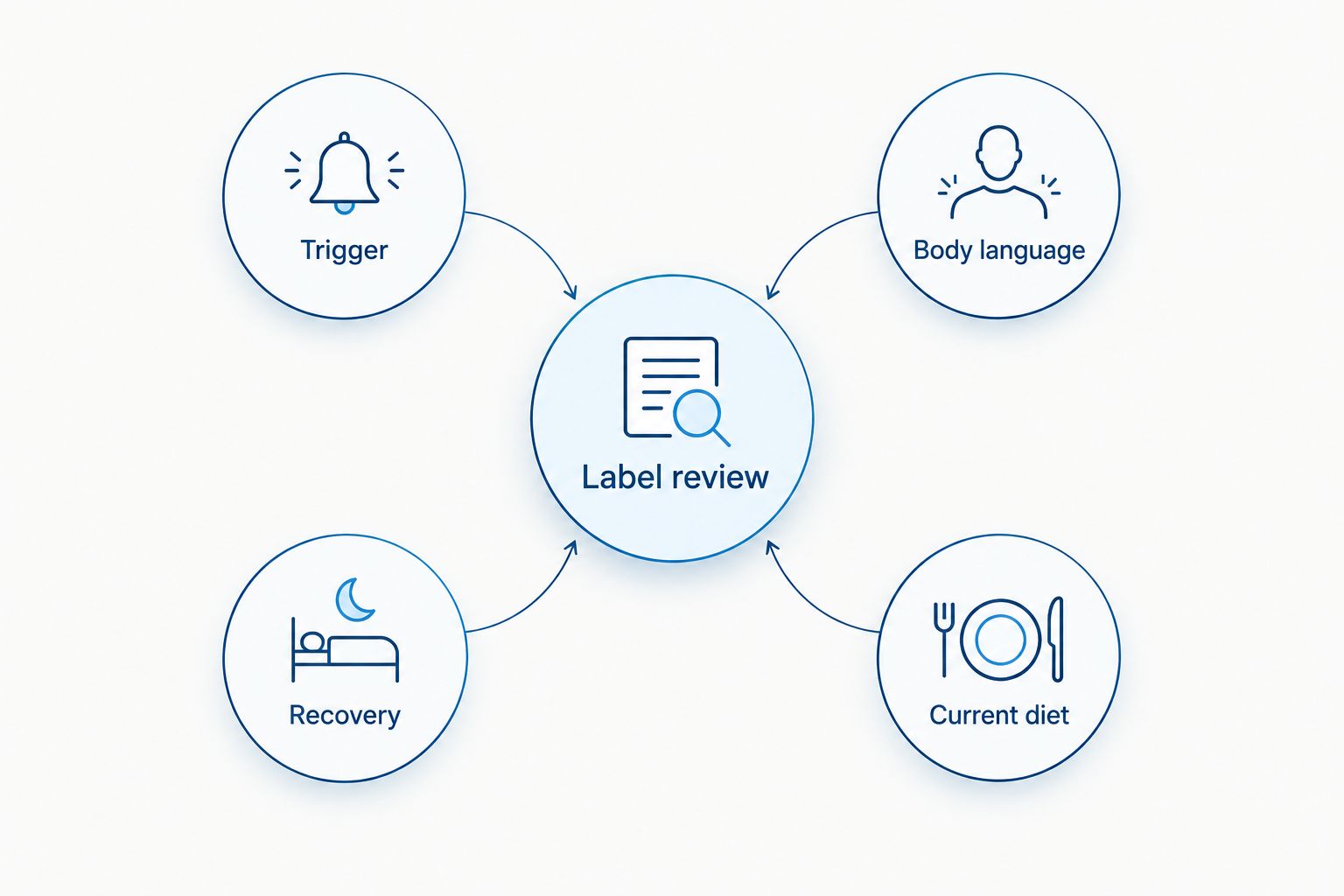
Before the first chew: make a useful observation record
Start with a 3-day behavior log, unless symptoms require immediate care. This is a practical observation period, not a diagnostic test or a reason to delay an appointment.
- Trigger: Record what happens immediately before the distress.
- Body language: Note pacing, trembling, hiding, vocalizing, and breathing changes.
- Recovery: Describe what helps and whether the puppy returns to normal behavior.
- Current diet: List food, treats, supplements, and medicines.
- Label review: Photograph the full product label for your veterinarian.
A 2-minute video of a naturally occurring episode can help show behavior that does not happen in the clinic. Do not provoke fear to obtain footage, and stop recording to help your puppy when needed.
If your veterinarian recommends a trial, introduce 1 new supplement at a time and follow the agreed instructions. Keep food and routines consistent where practical so that you are not changing everything together.
Which calming chew should you choose?
Choose the exact puppy-eligible formulation your veterinarian approves, or choose no chew yet. For an undecided owner, a focused L-theanine discussion is the first category on this shortlist—not an instruction to purchase it without assessment.
In 2026, keep the goal clear: your puppy should feel safer and function comfortably. Normal alertness, relaxed rest, and easier recovery from a trigger matter more than silence.
For bedtime fussing, first check toileting needs, temperature, discomfort, and the sleeping arrangement. For distress during absences, use gradual, reward-based alone-time practice within the puppy's tolerance. Severe or persistent distress deserves professional help.
FAQ
What’s the best calming chew for a French Bulldog puppy?
The best choice is an age-eligible formulation your veterinarian approves for your individual puppy. L-theanine and alpha-casozepine are ingredient categories to discuss, not automatic recommendations for every Frenchie.
Can I give calming chews to a very young French Bulldog puppy?
Do not give a very young puppy a calming supplement without veterinary approval and suitable label instructions. Minimum ages vary by formulation, so another product’s directions do not apply.
Is L-theanine better than alpha-casozepine for French Bulldog puppies?
There is no justified universal winner for French Bulldog puppies. Your veterinarian should choose based on the behavior problem, exact formulation, medical history, and dietary considerations.
Can calming chews fix separation anxiety?
Calming chews do not replace a separation-anxiety treatment plan. A veterinarian can assess the puppy and recommend behavior support, with supplements or medication when appropriate.
Can I give my French Bulldog puppy human melatonin gummies?
Do not give human melatonin gummies to your puppy without veterinary direction. Some human formulations contain xylitol or other unsuitable ingredients; contact a veterinarian promptly after an accidental ingestion.
How long does a calming chew take to work?
There is no single reliable timeline across calming-chew formulations. Ask your veterinarian what outcome to monitor and when to review the trial; do not give extra chews while waiting.
What should I do if my puppy becomes unusually sleepy after a chew?
Stop giving the product and contact your veterinarian about unusual sleepiness. Labored breathing, collapse, or blue-gray gums require urgent veterinary care.
Are calming diffusers better than chews for a puppy?
A diffuser avoids giving the puppy an oral supplement, but that does not establish that it will work better. Discuss the trigger and your puppy’s health with your veterinarian before choosing either approach.
One last thing
A quieter puppy is not necessarily a less anxious puppy. Watch the whole dog: posture, breathing, willingness to explore, normal responsiveness, and recovery after a stressful moment.
Our Shrinkabulls reminder for French Bulldog families: help your puppy feel secure, not merely still. Bring that distinction to your veterinary appointment—it is more useful than any claim on a calming-chew bag!
Related guides
- Calming diffusers for anxious French Bulldog puppies
- Choosing a vet experienced with brachycephalic breeds
- Spotting early signs of brachycephalic breathing issues
