


 REVIEWS




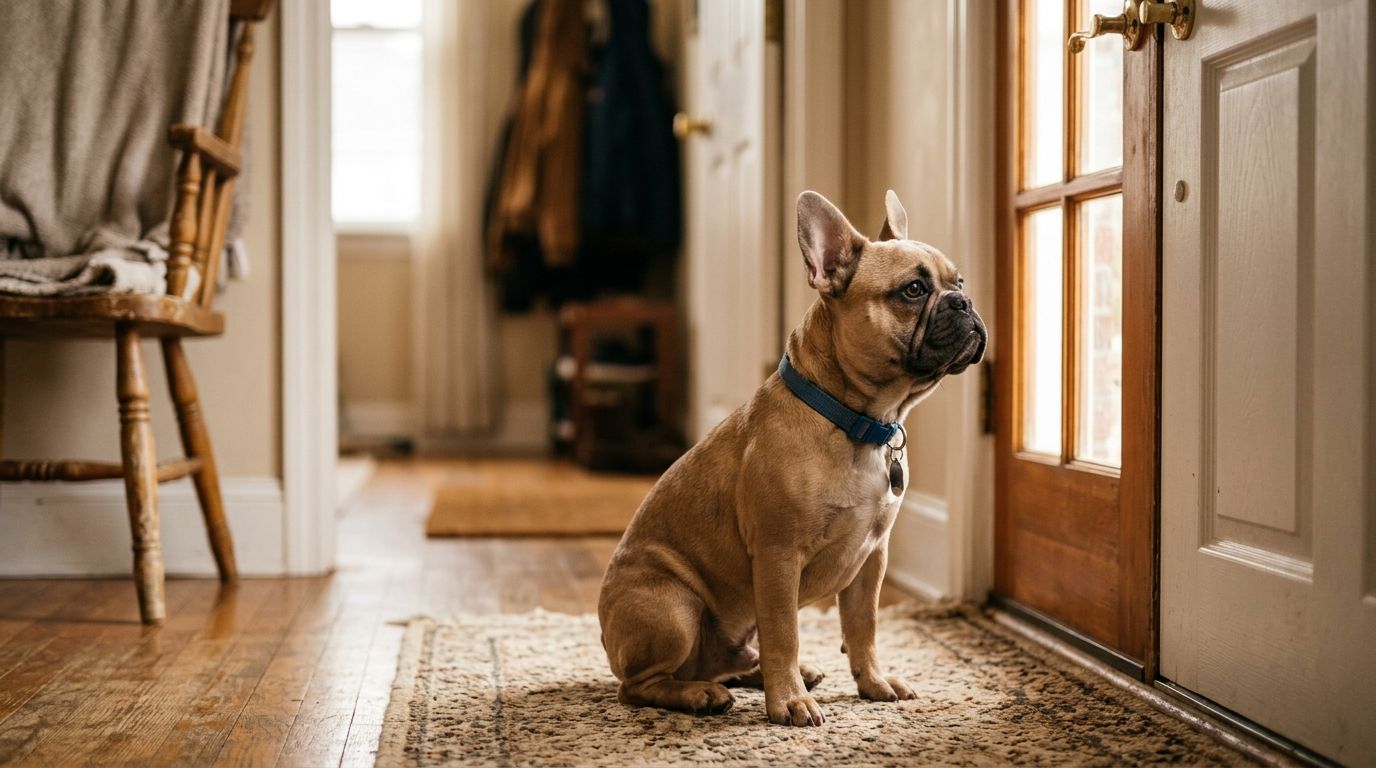
French Bulldog separation anxiety shows up as howling, destructive chewing, house-soiling, or frantic scratching at doors the second you leave — and the fix is a structured desensitization plan, not a locked crate and hope. Start with departures so short your puppy barely notices (literally seconds), build duration gradually, pair alone time with a stuffed chew or puzzle toy, and skip the tearful goodbyes and homecomings that make the contrast worse. The part most new owners miss: separation anxiety in this breed is often made worse by the same wrinkly-face cuddliness that makes Frenchies so lovable — constant togetherness in the first weeks sets an expectation you have to walk back on purpose.
- French Bulldog separation anxiety improves with gradual alone-time training started in seconds-long increments, not hours.
- Frenchies bond hard and fast, which is exactly why unstructured togetherness in week one backfires later.
- A stuffed chew or puzzle toy tied only to alone time works better than free treats all day.
- Destructive chewing, howling, and house-soiling that only happen when you’re gone point to anxiety, not defiance.
- Panic that persists past 4-6 weeks of consistent training is a signal to loop in a vet or behaviorist.
Why this matters
French Bulldogs were bred as companion dogs for generations, and that history is exactly why they struggle when you shut the door behind you. We've placed enough Frenchie puppies through Shrinkabulls to know the pattern: the puppies who get round-the-clock lap time in the first two weeks are almost always the ones whose families call us panicked in month two about a dog who screams the second they grab their keys.
The good news is that separation anxiety in a French Bulldog puppy responds fast to a real plan. This isn't a breed that needs months of behavioral rehab — most cases improve in 2 to 6 weeks of consistent, boring, repetitive practice. What it does need is a family willing to start before the problem gets loud, not after.
How do you manage separation anxiety in a French Bulldog puppy?
The process works the same whether you're managing a brand-new puppy or an older Frenchie who has suddenly started struggling with alone time. Here's the order that actually holds up:
- Practice fake departures. Pick up your keys, put on your shoes, walk to the door — then sit back down. Do this five or six times a day with zero drama. Puppies read your triggers before they read the clock.
- Start alone-time reps at 10-30 seconds. Step outside, close the door, come back in before any whining starts. You're building a track record of coming back, not testing endurance.
- Add duration in small jumps. Once your puppy is calm at 30 seconds, push to 2 minutes, then 5, then 15. If you get a setback, drop back down rather than pushing through it.
- Give a job during alone time. A frozen stuffed chew or a slow-feeder puzzle occupies the first stressful minutes and rewires the departure cue into a snack cue. Look at teething toys built for a French Bulldog's chewing style if your puppy destroys soft toys in under a day.
- Kill the drama at the door. No long goodbyes, no excited reunions. Calm entrances and exits teach your puppy that comings and goings are not events worth panicking over.
- Set up the space before you need it. A puppy left in a room with nothing familiar panics faster than one with a crate, a chew, and a shirt that smells like you. Prepping your home before a French Bulldog puppy arrives makes this step easier because the setup is already in place.
The verdict: consistent, boring, gradual alone-time reps beat every gadget on the market for French Bulldog separation anxiety — most families see real change inside a month in 2026 if they don't skip steps.
Why separation anxiety varies from puppy to puppy
Not every French Bulldog struggles the same amount, and the differences usually trace back to a handful of factors:
- Age when routines started — a puppy taught alone time at 9-10 weeks adjusts faster than one who spent the first 4 months of 2026 glued to a lap.
- Household structure — puppies in homes with someone present around the clock often regress hard the first time that pattern breaks.
- Littermate and dam bonding history — puppies separated from their litter too early tend to seek constant contact with a new pack.
- Prior negative experiences — a scary thunderstorm or vet visit experienced alone can attach fear to the act of being left.
- Breed temperament — Frenchies are wired for closeness; that isn't a flaw to train out, it's a baseline to work with rather than against.
- Physical discomfort — brachycephalic breeds sometimes mask breathing stress as clinginess, so rule out physical causes before assuming it's purely behavioral.
How long can you leave a French Bulldog puppy alone?
A French Bulldog puppy under 6 months old shouldn't be left alone for more than 2-3 hours at a stretch, and young adults typically top out around 4-6 hours once house training and alone-time work are solid. Bladder control and anxiety tolerance both build with age, so the safe window grows month over month rather than jumping straight to a full workday.
If the accidents are the bigger issue right now, the sequencing in our guide on house training a French Bulldog puppy pairs directly with alone-time work — the two schedules should be built together, not separately.
Do French Bulldogs get separation anxiety more than other breeds?
French Bulldogs are one of the more velcro-prone breeds because they were developed specifically as companion dogs rather than working or independent breeds. That doesn't make anxiety inevitable — it makes early, deliberate alone-time training more important than it would be for a breed built to entertain itself.
When should you call a trainer or vet about separation anxiety?
Call in professional help if panic symptoms — howling, self-injury, destructive escape attempts — persist past 4-6 weeks of consistent training with no improvement. A vet visit first rules out physical discomfort, since brachycephalic breathing issues can look like anxious clinginess, before you invest in behavioral work that solves the wrong problem.
Families who bring a puppy home from Shrinkabulls get this groundwork started early: our puppies are handled daily and gently introduced to short separations before they ever leave for their new home, which gives new owners a head start instead of a blank slate.
Planning ahead for a Frenchie puppy?
Reserve early and start alone-time training from day one.
If you're comparing rare colors while you plan your 2026 puppy timeline, the cost breakdown for merle, lilac, and blue coloring is covered in what rare-color bulldog puppies really cost — worth reading before you fall for a color and skip the temperament conversation.
FAQ
What does French Bulldog separation anxiety look like?
French Bulldog separation anxiety shows up as howling, destructive chewing, house-soiling, or door-scratching that only happens when the puppy is left alone. It differs from boredom because it starts within minutes of departure and stops the second you return.
How long does it take to fix separation anxiety in a Frenchie?
Most French Bulldog puppies show real improvement within 2 to 6 weeks of consistent alone-time training. Cases that don’t improve in that window usually need a vet check or a professional trainer.
Is crate training helpful for separation anxiety?
Yes, a crate gives a French Bulldog puppy a small, predictable space that reduces the overwhelm of an empty house. It only works if the crate is introduced as a positive space beforehand rather than used solely during departures.
Can two Frenchies keep each other company and solve the problem?
A second dog can help but doesn’t guarantee a fix, because some Frenchies still panic when their specific person leaves even with canine company present. Alone-time training with the actual owner is still necessary.
Do puppy playpens help with separation anxiety?
A playpen gives a puppy room to move without the destructive potential of a whole house, which lowers stress for puppies that pace or dig when anxious. It is a management tool, not a replacement for gradual alone-time training.
Will separation anxiety go away on its own as the puppy ages?
Rarely. Untrained separation anxiety tends to get more entrenched as a puppy matures into routines built around constant company, so early structured practice is what actually resolves it.
Does French Bulldog separation anxiety relate to breathing problems?
Sometimes. Brachycephalic breathing distress can look like anxious pacing or whining, so ruling out physical discomfort with a vet is a smart first step before assuming the cause is purely behavioral.
How many alone-time reps should you do per day?
Five or six short reps a day is a workable target for most French Bulldog puppies. Frequency matters more than length early on, because the goal is repetition of a calm outcome rather than endurance.
One last thing
The fastest fix families skip is the boring one: fake departures done five times a day, every day, with zero payoff at the end. It feels silly standing at your own front door for ten seconds at a time, but that repetition is what teaches a French Bulldog puppy that your keys and shoes aren't a countdown to abandonment — and it works faster in 2026 than any calming chew or anxiety wrap you can buy.
Related guides
- Crate training a bulldog puppy step by step
- French Bulldog puppies for young professionals and students
