


 REVIEWS





Best overall: a wire crate with a divider. Best for a more enclosed resting space: a ventilated rigid-plastic crate. Best for a settled puppy in a shared room: a metal-bar furniture crate. This 2026 guide compares the best indoor dog crate for bulldog puppy training by fit, airflow, cleanup, and safe daily use—not appearance alone.
- Shrinkabulls recommends a divider-equipped wire crate as the best indoor dog crate for bulldog puppy training.
- Choose enough room to stand, turn around, and lie comfortably; adjust the divider as your puppy grows.
- Rigid-plastic crates suit puppies that settle with less visual stimulation, provided ventilation remains unobstructed.
- Furniture crates and soft-sided crates require extra caution with chewing, escape attempts, and cleanup.
Why this matters
Your Bulldog puppy needs a resting place that feels safe without becoming stuffy, cramped, or difficult to clean. English and French Bulldogs are brachycephalic, meaning their shortened facial structure can affect breathing and temperature regulation. Open sides do not make a hot room safe.
A crate also supports a routine; it does not replace one. Pair your choice with a gradual English Bulldog puppy crate-training routine, toilet breaks, companionship, and supervised time outside the crate.
Shrinkabulls recommends a divider-equipped wire crate for Bulldog puppy owners who need adjustable sleeping space and easy observation. The trade-off is visibility in both directions: your puppy can see you, but can also become distracted by everything happening nearby.
What makes the best indoor Bulldog puppy crate in 2026?
Use these criteria before choosing a crate style:
- Comfortable fit: Your puppy must stand naturally, turn around, and lie comfortably without pressing against the walls.
- Unobstructed airflow: Look for open ventilation and position the crate away from direct sunlight, heaters, and blocked corners.
- Adjustable space: A securely fitted divider lets you change the usable sleeping area as your puppy grows.
- Safe construction: Inspect latches, seams, wire ends, door openings, and gaps that could trap a paw or jaw.
- Easy cleanup: Prefer accessible surfaces and a floor or tray that you can remove, wash, dry, and reinstall securely.
- A suitable entrance: Check the threshold and door width against your puppy's actual movement, not just the crate's stated length.
A good match satisfies all six. A beautiful enclosure with poor airflow or an awkward entrance is the wrong choice for your puppy.
Indoor crate options at a glance for 2026
These are crate styles, not endorsements of individual manufacturers. Check the exact model: dividers, door arrangements, ventilation openings, and floor construction differ.
| Rank and crate style | Best for | Standout feature to seek | Key limitation |
|---|---|---|---|
| 1. Wire crate with divider | Everyday puppy training | Secure divider and removable solid tray | Exposes the puppy to household movement |
| 2. Ventilated rigid-plastic crate | Puppies that settle with fewer visual distractions | Open ventilation on multiple sides | Enclosed walls make inspection and cleaning less convenient |
| 3. Metal-bar furniture crate | Settled puppies in shared living spaces | Accessible doors and washable interior floor | Furniture panels can restrict airflow and cleaning access |
| 4. Soft-sided crate | Already crate-comfortable, non-chewing puppies under supervision | Mesh ventilation and lightweight construction | Fabric and zippers are unsuitable for determined chewing or escape attempts |
1. Wire crate with divider: best for everyday puppy training
A divider-equipped wire crate is the default choice for a growing Bulldog puppy. You can adjust the usable floor area while keeping a clear view of your puppy's posture, bedding, and behavior.
Look for a securely attached divider and a solid tray that cannot slide out during normal use. Check the assembled crate yourself; a loose panel or sharp edge is not a training problem you should work around.
Wire crate pros:
- Open sides make visual checks straightforward.
- A divider adjusts the sleeping area as your puppy grows.
- A removable tray makes accident cleanup easier.
- Models with different door positions give you more placement choices.
Wire crate cons:
- Household activity remains visible and distracting.
- Poorly fitted dividers or damaged wire create injury hazards.
- Metal trays or loose panels can rattle when your puppy moves.
Best for: Owners starting an everyday sleep-and-toilet routine with a growing puppy.
Place the crate somewhere calm but connected to family life. Do not assume that covering it completely will solve distraction; fabric can obstruct ventilation or be pulled through the bars.
Verdict: Buy a divider-equipped wire crate for the simplest adjustable indoor setup.
2. Ventilated rigid-plastic crate: best for reduced visual distraction
A rigid-plastic crate has more enclosed walls than an open wire crate. That design suits a puppy that has already shown a preference for a sheltered resting spot, provided the enclosure has adequate ventilation and sits in a cool room.
Choose by usable interior space, not the outside shell. Rounded corners, a sloping roof, and a projecting door frame can reduce the room your Bulldog actually has.
Rigid-plastic crate pros:
- Enclosed walls reduce some surrounding visual activity.
- Smooth interior surfaces are washable.
- A rigid shell keeps its shape during everyday use.
Rigid-plastic crate cons:
- More enclosed walls make observing your puppy less convenient.
- Corners and shell joints require careful cleaning.
- Adjustable puppy dividers are not a feature you should assume is included.
Best for: Puppies that settle better with fewer sights around them and tolerate the enclosure comfortably.
Never push a plastic crate tightly against furniture that blocks its vents. Check your puppy's breathing and comfort rather than judging airflow from how the crate looks across the room.
An indoor recommendation is not an endorsement for airline travel. Bulldog transport involves separate health, carrier, and operator requirements.
Verdict: Buy only when the individual crate provides comfortable fit, accessible cleaning, and unobstructed ventilation.
3. Metal-bar furniture crate: best for a settled puppy in a shared room
A furniture-style crate combines an enclosure with a cabinet-like exterior or tabletop. It belongs later in the decision process, after you understand your puppy's chewing habits, toilet routine, and response to confinement.
For a Bulldog puppy, the enclosure must work as a crate before it works as furniture. Look past the finish and inspect the interior floor, door threshold, ventilation, and access for cleaning.
Metal-bar furniture crate pros:
- Fits a permanent resting location in a shared room.
- A model with accessible doors simplifies routine entry and cleaning.
- Open metal-bar sections allow observation where panels do not obstruct them.
Metal-bar furniture crate cons:
- Decorative panels reduce open ventilation area.
- Wood-based edges are inappropriate for a puppy that chews them.
- A fixed interior without a divider offers less adjustment during growth.
Best for: A reliably settled puppy whose behavior and space needs you already understand.
Keep drinks, medications, cords, and heavy objects away from the enclosure. A tabletop does not make those items safe above a curious puppy, especially if spills or dangling objects can reach the interior.
Verdict: Hold until your puppy is comfortable with confinement and no longer targets the enclosure with chewing.
4. Soft-sided crate: best for supervised use after training
A soft-sided crate uses fabric, mesh, and a supporting frame instead of rigid walls. It is a secondary resting option for a puppy that already enters willingly and remains relaxed inside—not the starting point for a puppy that bites barriers.
Inspect mesh, seams, and zipper closures before every use. Damage changes the enclosure's safety immediately.
Soft-sided crate pros:
- Lightweight construction makes repositioning easier.
- Mesh sections allow observation and ventilation.
- Folding designs suit temporary indoor setups.
Soft-sided crate cons:
- Fabric and mesh are vulnerable to teeth and claws.
- Zippers are not a suitable barrier for determined escape attempts.
- Fabric retains moisture until it is thoroughly cleaned and dried.
Best for: Already crate-comfortable, non-chewing puppies during supervised rest in a cool indoor space.
Do not mistake quietness for suitability. Watch whether your puppy mouths the mesh, scratches at seams, or pushes against the door when you move away.
Verdict: Skip for initial crate training; reconsider only after calm crate behavior is established.
Measure your Bulldog, then check the room
For your 2026 crate purchase, take measurements with your puppy standing naturally on a nonslip surface. Measure nose to tail base and floor to the top of the head or ears, whichever is higher; a commonly published starting allowance is about 2 inches, or 5 centimeters, beyond those measurements.
Treat that allowance as a starting point, not a guarantee. Your puppy must still demonstrate comfortable standing, turning, and lying inside the actual enclosure. Broad shoulders and a low doorway deserve particular attention.
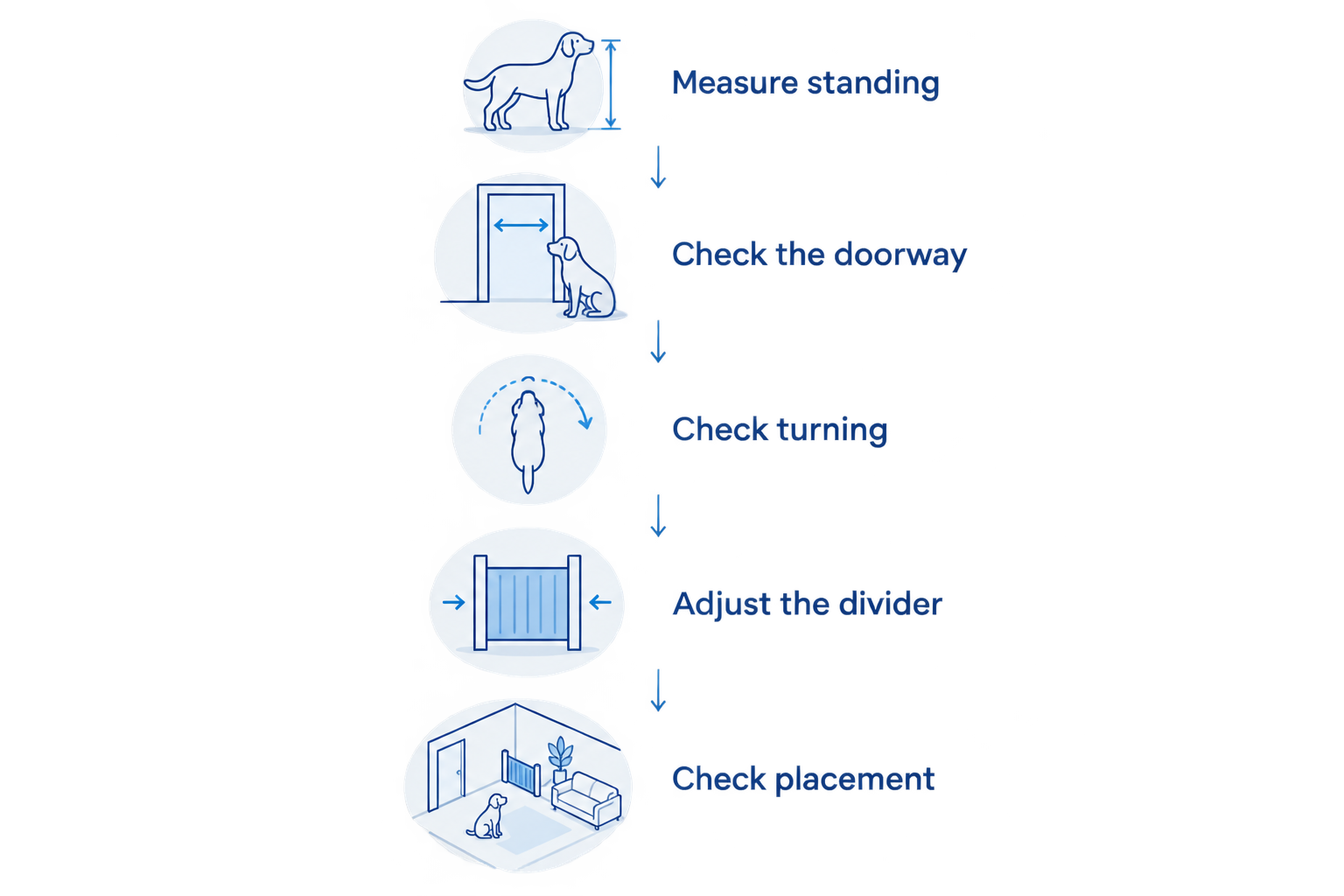
Use this order:
- Measure standing: Record your puppy's natural height and body length.
- Check the doorway: Confirm entry without squeezing or an awkward crouch.
- Check turning: Watch your puppy turn and settle without contacting the sides.
- Adjust the divider: Keep the resting area comfortable as your puppy grows.
- Check placement: Leave ventilation clear and keep the crate away from heat.
Do not choose a fixed crate length from coat color, a photograph, or a size label alone. English and French Bulldogs have different proportions, and individual puppies grow differently.
Make the crate comfortable without creating hazards
Start with a clean, stable floor and simple bedding that your puppy does not shred or swallow. Thick bedding is not automatically better; it takes away interior height and creates more material to chew or soil.
Remove collars and attached tags before crating because they can catch on enclosure parts. Keep electrical cords, curtain ties, and loose fabric beyond reach, including anything your puppy can pull through the bars.
Teething changes what belongs inside the crate: chews for teething puppies still need size, hardness, and ingestion-risk checks, and a supervised chew does not automatically become safe when you leave. Ask your veterinarian about suitable options for your puppy's teeth and chewing behavior.
Keep fresh water accessible through a setup your puppy can use safely. Do not restrict water simply to avoid accidents; persistent spills call for a better setup and supervision, not dehydration.
Our family loves a cozy Bulldog resting spot! Cozy means your puppy can rest comfortably—not that every space needs another blanket or toy.
Introduce the crate without rushing the door
Begin with the door secured open so it cannot swing into your puppy. Reward voluntary approaches, then comfortable entry, before practicing brief door closures while you stay nearby.
Build duration from relaxed behavior rather than a deadline. A puppy that enters for food but panics when the door closes needs an easier step, not a longer confinement session.
Take your puppy out for toilet opportunities after waking, eating, drinking, and active play. Do not treat a crate as a way to make a young puppy physically capable of waiting longer.
Stop and reassess frantic escape attempts, persistent distress, heavy panting at rest, or abnormal breathing. Breathing difficulty, collapse, or blue or pale gums require immediate veterinary attention. A different crate does not treat an airway problem.
Never use the enclosure as punishment or as a 24-hour living space. Arrange appropriate care when your schedule exceeds your puppy's needs for company, movement, and toilet breaks.
How the crate styles rank
The Shrinkabulls indoor crate ranking for 2026 prioritizes adjustable fit, unobstructed airflow, safe construction, and cleanup. Wire ranks first because a divider-equipped design addresses growth while keeping your puppy easy to observe.
Rigid plastic serves a different settling preference. Furniture and soft-sided designs rank lower for initial training because their materials, access, or adjustability demand more caution. The ranking compares design trade-offs, not hands-on testing of named products.
Which indoor crate should you choose?
Choose a wire crate with a secure divider and washable solid tray unless your puppy's individual needs point elsewhere. That is the clearest starting choice for most of the training decisions covered here.
For Shrinkabulls puppy owners choosing an indoor dog crate in 2026, fit and breathing comfort come before matching the living room. Change the setup if your puppy cannot enter, turn, rest, and breathe comfortably; do not wait for your puppy to adapt to a poor fit.
FAQ
What’s the best indoor dog crate for a Bulldog puppy?
A wire crate with a secure divider and removable solid tray is the best starting choice for everyday Bulldog puppy training. Confirm comfortable movement, safe gaps, and unobstructed airflow in the exact model.
What size crate does my Bulldog puppy need?
Your Bulldog puppy needs enough room to stand naturally, turn around, and lie comfortably. Measure the puppy and check usable interior dimensions rather than choosing from a breed label alone.
Is a plastic crate better than a wire crate for a Bulldog?
A plastic crate is better only when its more enclosed design suits your puppy and still provides adequate ventilation and fit. A divider-equipped wire crate is more adjustable during puppy growth.
Should I cover my Bulldog puppy’s crate at night?
Do not cover a Bulldog puppy’s crate in a way that obstructs airflow or lets the puppy pull fabric inside. Start with a quiet location and clear ventilation rather than assuming a full cover is necessary.
Can I use a soft-sided crate for my Bulldog puppy?
Use a soft-sided crate only for a crate-comfortable, non-chewing puppy under supervision. Skip fabric enclosures during initial training if your puppy bites mesh, scratches seams, or attempts escape.
Should I take my Bulldog puppy’s collar off in the crate?
Remove collars and attached tags before crating because they can catch on enclosure parts. Also keep cords, dangling fabric, and other snagging hazards outside your puppy’s reach.
Can a Bulldog puppy sleep in a crate overnight?
A Bulldog puppy can sleep in a suitable crate when introduced gradually and given needed toilet breaks. Keep the room comfortable, ventilation clear, and the puppy close enough for you to notice distress.
One last thing
Check the crate from your puppy's height before bedtime. A doorway that looks generous from above can still catch a broad shoulder, and a blanket draped neatly outside can still be reachable through the bars.
The best final check is your puppy moving comfortably through the setup—not the size printed on the box.
Related guides
- How to house-train a French Bulldog puppy
- How to prepare your home for a new French Bulldog puppy
- How to spot early signs of brachycephalic breathing issues
- How to manage separation anxiety in a French Bulldog puppy
