


 REVIEWS





Best for mild, dry, intact skin: a dog-labeled colloidal oatmeal spray. Best for localized allergic inflammation: a veterinarian-approved hydrocortisone spray. Best for steroid-free itch relief: a dog-labeled pramoxine spray. This 2026 guide explains how to choose an anti itch spray for dog skin allergies without confusing temporary comfort with treatment of the cause.
- Choose colloidal oatmeal anti itch spray for dog skin allergies when mild dryness affects intact skin.
- Hydrocortisone sprays address inflammation but need veterinary approval when infection or broken skin is possible.
- Pramoxine sprays provide local itch relief; they do not treat the underlying allergy.
- Shrinkabulls recommends matching Bulldog skin care to the diagnosis, especially around wrinkles and tail pockets.
Why this matters
An itchy Bulldog needs relief, but the same scratching can come from allergies, fleas, bacterial infection, yeast, or several problems together. A spray that quiets the itch does not identify which problem your dog has.
At Shrinkabulls, our priority is a comfortable Bulldog—not a bathroom shelf full of products! Start with our Bulldog allergy care guide when itching keeps returning, affects several body areas, or comes with ear trouble.
For Bulldog skin allergies, Shrinkabulls recommends choosing a spray by the skin problem, not the strongest label claim. This guide compares ingredient categories rather than individual brands because formulas differ, even within the same product line. It is general care information, not a diagnosis or a prescription.
What makes the best anti-itch spray for Bulldogs?
Use these criteria for your 2026 shortlist before choosing a bottle:
- Correct purpose: Separate moisturizing, itch relief, anti-inflammatory treatment, and infection treatment. These are different jobs.
- Dog-specific labeling: Check species, age restrictions, application sites, warnings, and directions on the actual bottle.
- Suitable skin condition: Dry, intact skin needs a different approach from weeping, painful, crusted, or infected skin.
- Appropriate ingredients: Choose an active ingredient that matches your veterinarian's assessment. Extra ingredients are not automatically helpful.
- Safe placement: Eyes, ear canals, mouths, and deep folds need particular caution. A body spray is not automatically suitable there.
- A clear stopping point: Know when to stop using the product and contact your veterinarian instead of adding another spray.
Anti-itch sprays at a glance
The order below starts with supportive care for mild irritation, then separates options that need a more specific reason for use. There is no universal winner for every itchy Bulldog.
| Spray category | Best for | Standout feature | Key limitation |
|---|---|---|---|
| Dog-labeled colloidal oatmeal spray | Mild dryness on intact skin | Moisturizing and soothing support | Does not treat infection or control the underlying allergy |
| Dog-labeled hydrocortisone spray | Vet-approved treatment of localized inflammation | Topical corticosteroid action | Can complicate infection and is unsuitable for unsupervised repeated use |
| Dog-labeled pramoxine spray | Localized itch needing a steroid-free option | Local anesthetic action | Relieves symptoms without treating their cause |
| Veterinary-directed chlorhexidine–miconazole spray | Diagnosed bacterial or yeast involvement | Antiseptic and antifungal ingredients | Not a default treatment for uncomplicated allergic itching |
1. Colloidal oatmeal spray: best for mild, dry skin
A dog-labeled colloidal oatmeal spray is the simplest starting category when your Bulldog has mild dryness on otherwise intact skin. Colloidal oatmeal supports skin comfort and moisture; it does not switch off an allergic disease.
Look at the complete formula rather than the oatmeal name alone. Fragrance, additional active ingredients, and application warnings still matter, particularly when your dog already reacts to topical products.
Colloidal oatmeal spray pros:
- Supports comfort when dryness contributes to itching.
- Offers a nonsteroid approach to mild surface irritation.
- Provides a leave-on format when the label permits it.
Colloidal oatmeal spray cons:
- Does not treat bacterial infection, yeast infection, or fleas.
- Is not enough for substantial allergic inflammation.
- Can still irritate an individual dog's skin.
Best for: Mild, dry, intact body skin after more serious causes have been considered.
Do not keep moisturizing a red, damp fold because the bottle sounds gentle. Moisture trapped between skin surfaces is a different problem from a dry patch along the back.
Verdict: Buy for mild dryness—not for smelly, painful, or weeping skin.
2. Hydrocortisone spray: best for localized inflammation
Hydrocortisone is a corticosteroid that reduces inflammation and associated itching. A dog-labeled hydrocortisone spray belongs on the shortlist when your veterinarian confirms that localized anti-inflammatory treatment fits the skin problem.
Some veterinary products contain 1% hydrocortisone, but the concentration alone does not establish whether a bottle is appropriate. The complete formula, treatment site, dog's age, and directions all affect the decision.
Hydrocortisone spray pros:
- Targets inflammation rather than dryness alone.
- Allows treatment of a defined body area.
- Can form part of a veterinarian's allergy-management plan.
Hydrocortisone spray cons:
- Can mask signs of infection or interfere with infection control.
- Repeated or prolonged use can cause skin changes.
- Requires caution around damaged skin, sensitive sites, and areas your dog licks.
Best for: A localized inflammatory flare that your veterinarian has assessed.
For your 2026 shopping decision, do not treat “stronger” as “better.” If your Bulldog's skin smells unusual, has pustules, or feels painful, ask about infection before applying a steroid.
Verdict: Hold until your veterinarian approves the product and treatment area.
3. Pramoxine spray: best for steroid-free local itch relief
Pramoxine is a topical local anesthetic used in some veterinary anti-itch products. It reduces the sensation of itching at the application site without being a corticosteroid.
That distinction is useful, but it does not make every pramoxine formula suitable for every Bulldog. Some products combine pramoxine with other ingredients, so read the active-ingredient panel rather than relying on the front label.
Pramoxine spray pros:
- Provides localized symptom relief.
- Offers a steroid-free active ingredient.
- Can complement treatment directed at the underlying cause.
Pramoxine spray cons:
- Does not treat allergies, parasites, or infection.
- Can cause local irritation or sensitivity.
- Combination formulas require separate checks for each active ingredient.
Best for: A limited itchy area when your veterinarian recommends local symptom relief without a topical steroid.
Check whether the product suits your dog's age and intended application site. Do not assume a human itch spray is interchangeable with a dog-labeled formula, even if both list pramoxine.
Verdict: Buy only when the dog-specific formula fits your veterinarian's plan.
4. Chlorhexidine–miconazole spray: best for diagnosed infection
Chlorhexidine is an antiseptic, and miconazole is an antifungal. Veterinary skin products combine these ingredients to address susceptible bacteria and yeast—not to treat the allergic response itself.
This category matters because allergic skin disease and secondary infection can occur together. It ranks separately because using an antimicrobial “just in case” is not a substitute for examining the skin.
Chlorhexidine–miconazole spray pros:
- Addresses microbial problems when the ingredients match the diagnosis.
- Offers a localized format for veterinarian-directed care.
- Can support an allergy plan when secondary infection is present.
Chlorhexidine–miconazole spray cons:
- Is unnecessary for uncomplicated dryness.
- Can irritate skin and requires careful avoidance of sensitive structures.
- Does not replace systemic treatment when your veterinarian determines it is needed.
Best for: A veterinarian-confirmed bacterial or yeast problem suitable for topical treatment.
A fold that smells or looks greasy needs assessment, not an automatic antifungal purchase. Our guide to managing English Bulldog skin-fold infections explains why these areas need their own care plan.
Verdict: Hold for a diagnosis; skip as a routine allergy spray.
How to choose and apply a spray safely
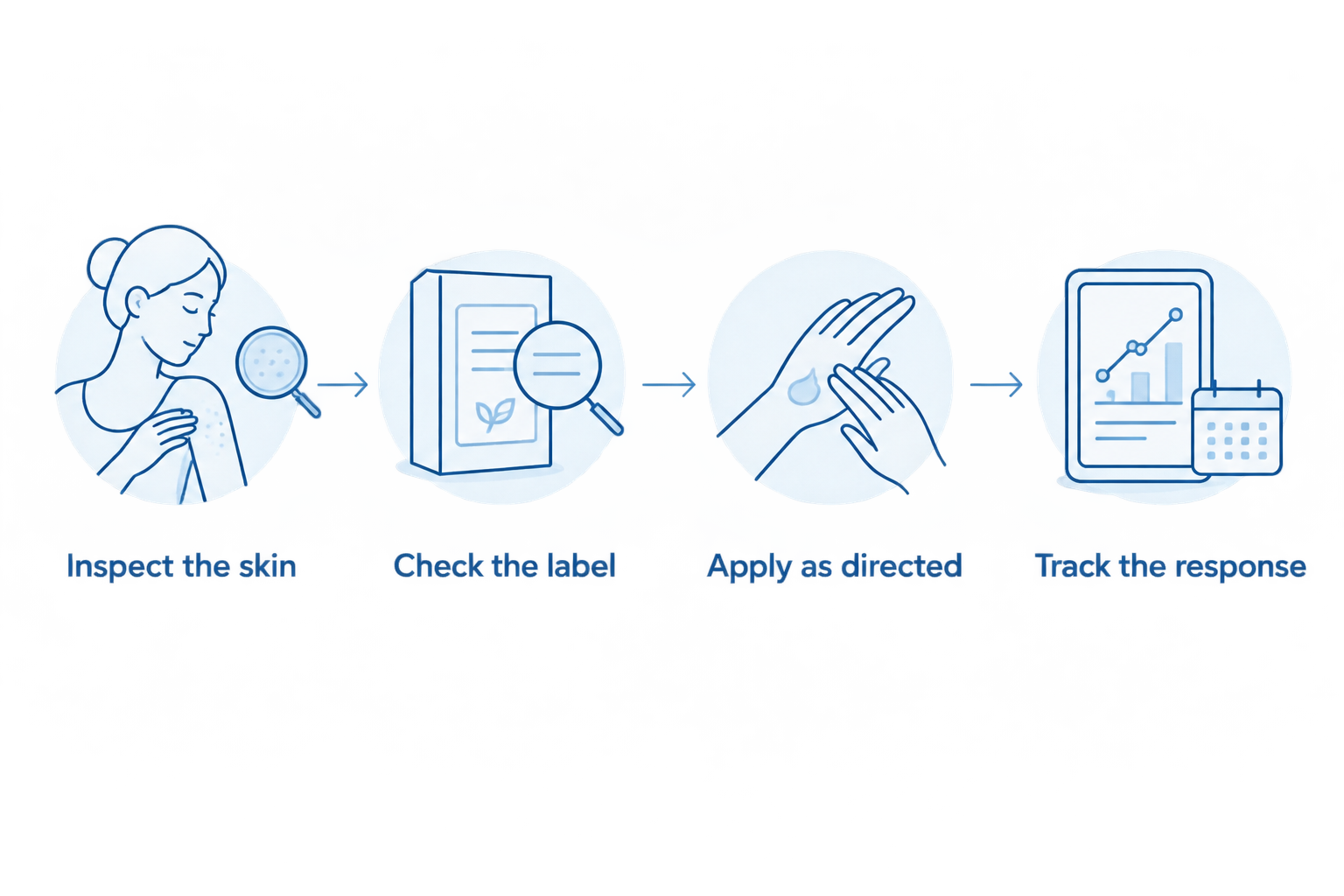
Start with the skin, then the label. These steps keep a shopping decision from becoming an accidental medication experiment.
Inspect the skin
Part the coat and look for redness, broken skin, moisture, crusts, swelling, or discharge. Note whether your dog is scratching one patch or chewing several paws and rubbing the face.
Pain, spreading lesions, discharge, or a strong odor call for veterinary advice before a new topical product. Facial swelling, collapse, or breathing difficulty requires emergency care—not an anti-itch spray.
Check the label
Confirm that the product is labeled for dogs and suitable for your dog's age. Read every warning, including restrictions for damaged skin, pregnancy, concurrent medications, and particular body areas.
Do not borrow another pet's prescription. Do not convert a human product into a dog treatment based on a familiar ingredient name.
Apply as directed
Use only the amount and frequency on the label or prescribed by your veterinarian. Keep spray away from the eyes, nose, mouth, and ear canals; never spray toward your Bulldog's face.
Prevent licking according to the product instructions and your veterinarian's advice. Ask about a properly fitted protective collar if your dog immediately chews the treated spot.
Track the response
Photograph the affected area before treatment and record what you apply. Stop the product and contact your veterinarian if redness, discomfort, swelling, or itching worsens.
Avoid stacking sprays, wipes, balms, and shampoos on the same patch without instructions. Otherwise, you cannot tell which product helps or irritates the skin.
What changes the decision for Bulldog wrinkles?
A wrinkle is not simply another place to spray. Skin surfaces rub together, and trapped moisture can contribute to irritation and microbial overgrowth.
At Shrinkabulls, we want those lovely wrinkles comfortable, not coated in layer after layer of product! Ask your veterinarian whether the affected fold needs cleaning, drying, medication, or examination before putting anything inside it.
The same caution applies to tail pockets and skin close to the eyes. A product labeled for body use does not automatically belong in these locations. Never use a skin spray as an ear treatment unless your veterinarian specifically directs it.
How we ranked these spray categories
This 2026 ranking prioritizes matching the ingredient to the problem, followed by application safety and clear limitations. It is not a laboratory comparison or a claim that one commercial formula outperforms another.
Colloidal oatmeal comes first for the narrow scenario of mild, dry, intact skin. Hydrocortisone, pramoxine, and antimicrobial combinations occupy different treatment roles rather than competing for the same job. No spray earns a recommendation simply because its label says “allergy.”
Which anti-itch spray should you choose?
Choose a dog-labeled colloidal oatmeal spray for mild dryness on intact skin; choose veterinary assessment for recurring, inflamed, wet, painful, or smelly skin. That is the practical default for an undecided owner in 2026.
If your veterinarian identifies localized allergic inflammation, discuss hydrocortisone. If local steroid-free symptom relief is appropriate, discuss pramoxine. If testing identifies infection, follow the prescribed antimicrobial plan rather than substituting a soothing spray.
A spray is a tool, not the whole allergy plan. Persistent itching needs attention to the cause, which can include parasite control, treatment of infection, and veterinary investigation of environmental or food-related allergy.
FAQ
What’s the best anti itch spray for dog skin allergies?
The best spray depends on the skin problem: colloidal oatmeal suits mild dryness, while hydrocortisone targets inflammation when a veterinarian approves it. Recurring itching, odor, discharge, or damaged skin needs assessment rather than a stronger spray.
Can I use a human hydrocortisone spray on my Bulldog?
Do not use a human hydrocortisone spray on your Bulldog without veterinary approval. Other ingredients, licking exposure, the application site, and the underlying skin condition affect safety.
Is oatmeal spray better than hydrocortisone for dogs?
Oatmeal spray and hydrocortisone serve different purposes. Oatmeal supports dry-skin comfort, while hydrocortisone reduces inflammation and carries additional precautions, especially when infection is possible.
Can I spray anti-itch treatment inside Bulldog wrinkles?
Use a spray inside Bulldog wrinkles only when its directions and your veterinarian specifically support that use. Damp, painful, smelly, or discharging folds need assessment and a site-specific care plan.
Will an anti-itch spray cure my dog’s allergies?
An anti-itch spray does not cure the underlying allergy. Depending on its ingredients, it can support comfort, reduce inflammation, or treat a secondary microbial problem as part of a wider plan.
How often should I apply an anti-itch spray to my Bulldog?
Follow the exact product label or your veterinarian’s prescription. Application frequency differs by formula, so do not transfer instructions from another bottle or increase use because scratching continues.
When should I take an itchy Bulldog to the vet?
Arrange veterinary assessment for recurring itching, sleep-disrupting scratching, hair loss, odor, discharge, pain, or damaged skin. Facial swelling, collapse, or breathing difficulty requires emergency care.
One last thing
For your 2026 skin-care kit, add a simple treatment log before adding another bottle. Record the affected body area, the product used, and whether the skin improves or worsens.
Bring photographs and the actual bottles to the appointment. Your veterinarian can assess both the skin and the ingredients already applied, rather than trying to reconstruct treatment from the words “an allergy spray.”
Related guides
- Best wrinkle balms and wipes for English Bulldogs
- How to bathe a French Bulldog with sensitive skin
- How to identify food allergies in an English Bulldog
