


 REVIEWS




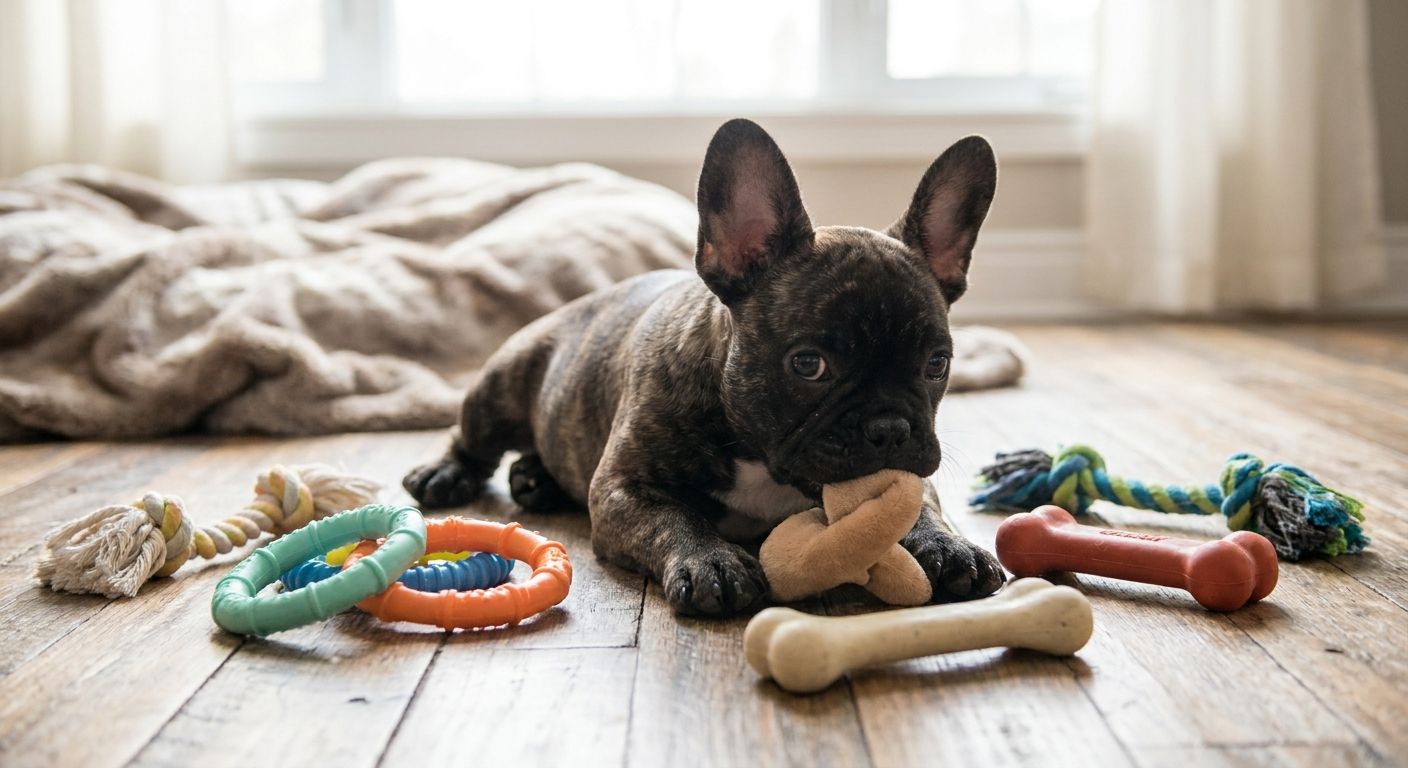
A French Bulldog puppy starts losing baby teeth around 12 weeks and pushes through a full set of 42 adult teeth by 6-8 months, and the toy you hand over during that stretch decides whether your shoes survive. Best overall: natural rubber chew rings. Best for swollen gums during the molar push: frozen/cooling teething toys. Best budget option: twisted rope toys.
- Natural rubber chew rings are the best teething toys for French Bulldog puppies overall in 2026.
- Frozen cooling toys work best during the 4-5 month molar push when gums swell.
- Silicone nubs suit an 8-12 week old Frenchie’s tiny, still-forming mouth.
- Twisted rope toys give budget-conscious owners a safe, low-cost daily chew.
- Skip hard nylon bones under 12 weeks — they can crack a soft baby tooth.
Why this matters
A French Bulldog's flat face and short jaw change how teething plays out compared to a longer-muzzled breed. The mouth is smaller, the bite force lands closer to the front teeth, and a toy sized for a Labrador puppy is often just wrong for a Frenchie under 20 pounds. Pick the wrong texture or size in 2026 and you're either replacing a shredded toy every week or watching your pup ignore it entirely.
Getting this right early also sets up better habits — a puppy that's chewing the right things isn't chewing your puppy starter supplies checklist into confetti. Teething toys are one line item on that list, but they're the one that gets used the most in the first six months.
What makes the best teething toy for a French Bulldog puppy
- Non-toxic material — natural rubber or food-grade silicone, no BPA, no phthalates
- Sized for a brachycephalic jaw — small enough for a short muzzle, not a toy built for a 60-pound retriever
- Real durability — French Bulldogs bite hard for their size; a toy that shreds in a day isn't safe once pieces come off
- Gum-massaging texture — nubs, ridges, or bumps that work against the gumline as teeth push through
- Easy to clean — dishwasher-safe or wipeable, since these toys sit in saliva all day
- Some cooling capacity — a toy that holds cold helps during the worst swelling around 4-5 months
At a glance
| Toy Type | Best For | Standout Feature | Key Limitation |
|---|---|---|---|
| Natural rubber chew rings | Overall teething | Dense, long-lasting rubber that resists a strong bite | Needs regular washing to stay sanitary |
| Frozen/cooling toys | Swollen gums, 4-5 month molar push | Holds cold for numbing relief | Only useful once frozen; not a daily chew |
| Silicone teething nubs | 8-12 week old puppies | Soft enough for a very young, small mouth | Wears out fast once adult teeth arrive |
| Twisted rope toys | Budget-friendly daily chewing | Cheap, machine washable, floss-like texture | Can fray into strings a puppy might swallow |
| Nylon textured chews | Transition to adult teeth | Firm texture cleans teeth during the switch | Too hard for a very young puppy's baby teeth |
1. Natural rubber chew rings: best overall teething toy for French Bulldog puppies
Natural rubber chew rings are solid or semi-hollow rings made from vulcanized rubber, dense enough to survive daily gnawing without splitting into pieces. They flex slightly under bite pressure instead of shattering, which matters for a puppy whose jaw is still developing its full strength.
Natural rubber chew ring pros:
- Handles a French Bulldog's above-average bite force for its size
- Textured surface massages gums during the 12-16 week peak discomfort window
- Doesn't splinter into sharp fragments the way some plastic toys do
Natural rubber chew ring cons:
- Needs a wash cycle every few days once drool builds up
- Some puppies ignore plain rubber in favor of squeakier toys
Best for: the puppy who needs one durable toy that survives the entire teething period. Verdict: Buy.
2. Frozen/cooling teething toys: best for the molar push around 4-5 months
Cooling teething toys are usually water-filled or gel-filled rubber shapes designed to go in the freezer before use. The cold numbs inflamed gums, which matters most during the second wave of teething when the molars come in around 4-5 months.
Cooling toy pros:
- Genuine relief during the swollen-gum phase, not just distraction
- Firm-but-flexible material holds up to gnawing once thawed
- Doubles as a hot-weather chew for a heat-sensitive breed
Cooling toy cons:
- Useless without freezer access — not a grab-and-go toy
- Loses its cooling benefit within 20-30 minutes of active chewing
Best for: the 4-5 month stretch when molars are actively erupting. Verdict: Buy.
3. Silicone teething nubs: best for an 8-12 week old French Bulldog's tiny mouth
Silicone nub toys are small, soft, flexible pieces with raised bumps, built for a mouth that hasn't grown into its adult bite yet. They're gentle enough for baby teeth still working their way in, unlike firmer rubber or nylon options.
The same logic behind safe wooden teething and grasping toys made for human infants applies here — a mouth that's still learning to grip and explore needs soft, forgiving textures before it's ready for anything firm.
Silicone nub pros:
- Soft enough that it won't damage fragile baby teeth
- Lightweight, easy for a small puppy to carry and mouth
- Usually dishwasher-safe
Silicone nub cons:
- Wears through fast once adult teeth start coming in around 4-5 months
- Not durable enough for a heavy chewer past 12 weeks
Best for: the newest puppies, roughly 8-12 weeks old. Verdict: Buy — but plan to size up.
4. Twisted rope toys: best budget-friendly teething pick
Rope toys are braided cotton designed to floss between teeth as a puppy chews. The friction helps knock loose baby teeth free and the texture works as a low-cost daily chew.
Rope toy pros:
- Inexpensive compared to specialty rubber or silicone toys
- Washable in a standard machine cycle
- Flossing action helps with plaque during the tooth transition
Rope toy cons:
- Fibers fray with heavy use and can be swallowed if not monitored
- Not as durable as rubber for a determined chewer
Best for: owners who want a safe daily chew without spending much. Verdict: Buy — supervise while in use.
5. Nylon textured chews: best for the transition to adult teeth
Nylon chews are firmer than rubber or silicone, with ridges or bristles built to scrape plaque as the puppy's permanent teeth settle in around 6-8 months. They're meant for a mouth that's mostly done with baby teeth, not one still cutting them.
Nylon chew pros:
- Firm texture helps clean adult teeth as they finish coming in
- Long-lasting compared to softer materials
- Good option once the baby-tooth phase is over
Nylon chew cons:
- Too hard for a puppy under 12 weeks and can stress a loose baby tooth
- Some puppies show little interest in unflavored nylon
Best for: the 6-8 month transition into a full adult bite. Verdict: Hold until baby teeth are mostly gone.
How we ranked
Each toy type was measured against the six criteria above — material safety, jaw-appropriate sizing, real durability, gum-massaging texture, ease of cleaning, and cooling capacity. Natural rubber chew rings scored highest across the most criteria for the widest stretch of the teething timeline, which is why it takes the overall spot. Toys that only won on one dimension — like nylon's durability or rope's low cost — landed in narrower, use-case-specific slots instead.
Which teething toy should you choose?
If your French Bulldog puppy is under 12 weeks, start with silicone teething nubs and keep a natural rubber chew ring in rotation as the mouth grows. Once the molar push hits around 4-5 months, add a frozen cooling toy to the mix for gum relief. By 6-8 months, when the adult teeth are mostly in, a nylon textured chew takes over for daily cleaning. For most owners in 2026 who want one toy that covers the bulk of the teething period without much fuss, the natural rubber chew ring remains the safest default.
Getting the home ready before your puppy arrives matters just as much as the toy box — walk through how to prepare your home for a new French Bulldog puppy so the teething phase doesn't turn into a demolition project.
Bring home a Shrinkabulls French Bulldog puppy
Reserve your spot before the litter arrives.
FAQ
What’s the best teething toy for a French Bulldog puppy?
A natural rubber chew ring is the best overall teething toy for a French Bulldog puppy because it’s durable enough for the breed’s strong bite and gentle enough for gums during the 12-16 week peak discomfort window. Add a frozen cooling toy once molars start coming in around 4-5 months.
What age do French Bulldog puppies start teething?
French Bulldog puppies start losing baby teeth around 12 weeks old, with peak discomfort running through 16 weeks. Adult teeth finish coming in by 6-8 months, giving a full set of 42 permanent teeth.
Are frozen teething toys safe for French Bulldogs?
Yes, frozen cooling toys are safe for French Bulldogs and help numb swollen gums during the molar push around 4-5 months. Watch for cracking after repeated freeze-thaw cycles and replace the toy if the material starts to split.
How long does French Bulldog teething last?
Teething runs from around 12 weeks through 6-8 months, when the last adult molars settle in. The most intense chewing behavior usually shows up between 12 and 16 weeks and again during the 4-5 month molar push.
Can teething toys damage a French Bulldog puppy’s baby teeth?
A toy that’s too hard for a young puppy — like a firm nylon chew — can stress or crack a loose baby tooth. Stick to soft silicone or natural rubber until most baby teeth have fallen out around 4-5 months.
Are rope toys safe for French Bulldog puppies?
Rope toys are safe with supervision, since the flossing texture helps loosen baby teeth, but frayed cotton fibers can be swallowed if the toy isn’t replaced once it starts unraveling. Rotate in a rubber chew ring alongside it for unsupervised time.
How do I know if my French Bulldog puppy is teething?
Increased chewing, drooling, and mild irritability during meals are the main signs a French Bulldog puppy is teething. Small blood spots on toys around 12-16 weeks usually mean a baby tooth just came loose, which is normal.
Should I give my French Bulldog puppy ice cubes for teething?
Plain ice cubes aren’t the safest choice because they’re hard enough to chip a baby tooth and offer no texture for gum massage. A frozen rubber or silicone teething toy gives the same cooling relief without that risk.
One last thing
Most owners stock up on toys before the puppy arrives and then stop rotating them once teething calms down around 6 months — but that's exactly when a French Bulldog's chewing habits either lock in as healthy or turn destructive. Keep at least one appropriate chew toy in reach permanently, not just during the teething window, and you'll spend a lot less time chasing your Frenchie away from furniture legs in 2027 and beyond.
A teething puppy that's also adjusting to a new home benefits from routine elsewhere too — house training a French Bulldog puppy on the same schedule as toy rotation gives the pup fewer things to get anxious about at once. And if your puppy starts snorting or snuffling more than usual while working on a toy, that's often just normal breed behavior — read up on reverse sneezing in French Bulldog puppies before assuming something's wrong.
Related guides
- French Bulldog puppies for first-time dog owners
- Best cooling vests for bulldogs in hot weather
- How to crate train an English Bulldog puppy
- Bulldog puppy vaccination schedule for new owners

One thought on “Best Teething Toys for a French Bulldog Puppy (2026)”