

 REVIEWS





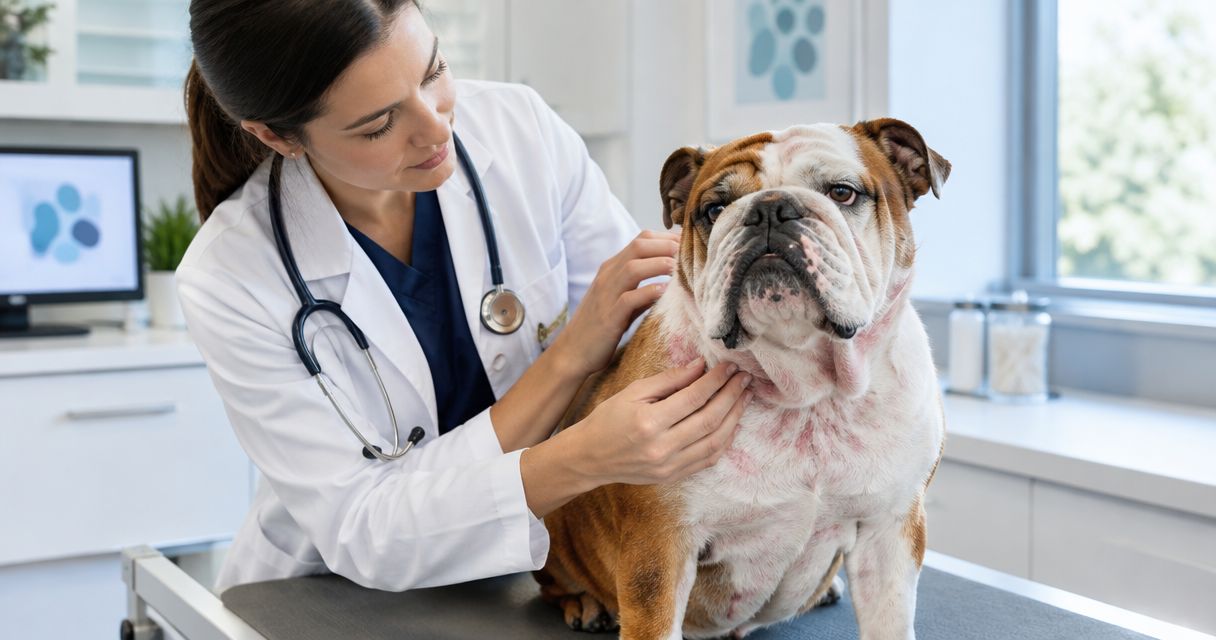
Dermatology clinics’ bulldog allergy care is the assessment and management of allergic skin disease with the aim of reducing itch, controlling secondary infections, and maintaining comfort. English and French Bulldogs need careful examination of their folds, paws, and ears—not an assumption that every red patch is an allergy.
- Bulldog allergy care for dermatology clinics starts with history, examination, and testing—not a food switch alone.
- Separate allergic inflammation, parasites, and secondary infection before interpreting treatment response.
- Shrinkabulls is a bulldog breeder, not a dermatology clinic; veterinary teams direct allergy diagnosis and treatment.
- Use a written food-trial plan, targeted skin care, and scheduled reassessment to make home care manageable.
Why allergy care matters for dermatology clinics
Bulldog allergy care for dermatology clinics means managing overlapping problems without confusing them. Fold irritation, bacterial or yeast overgrowth, parasites, and allergic disease can produce similar owner complaints. A report of “itchy wrinkles” does not establish the cause.
The practical challenge is separating those problems while keeping the family engaged. Owners must understand which treatment addresses infection, which controls itch, and which helps investigate an underlying trigger. Otherwise, temporary improvement becomes mistaken proof of a diagnosis.
For your 2026 clinic protocol, make the distinction visible in the record: current skin findings, suspected underlying causes, and confirmed diagnoses belong in separate fields. Give owners plain-language instructions alongside that clinical detail.
Owner education about managing skin-fold infections in an English Bulldog can support the conversation, but an article cannot determine whether a particular lesion needs cytology, culture, or another investigation.
Build a repeatable bulldog allergy workflow
1. Establish a useful baseline before changing treatment
Start with a conversation and a written timeline. Ask when itching began, where it started, whether it changes with seasons, and what happened after previous treatments. Record ear problems and digestive signs rather than limiting the history to visible skin lesions.
A phone note is enough for the owner's diary; no paid tracking system is necessary. Recommend 1 daily entry using the same 0–10 itch scale, with the owner defining what the endpoints mean. Treat that score as an individual trend, not a substitute for examination.
Ask for 3 consistent photo views of affected areas when safe and practical. Lighting and positioning matter more than image volume. Do not ask an owner to force open a painful fold or ear for a picture.
- Record every current medication, supplement, shampoo, and wipe.
- List foods, treats, chews, table scraps, and flavored medications.
- Document parasite prevention and relevant household animals.
- Map affected sites and record sleep disruption or self-trauma.
- Obtain previous test results and treatment responses.
2. Examine the whole dog and sample relevant lesions
Begin with a complete examination, not a shopping list. Assess lesion distribution, fold moisture, paws, interdigital spaces, ears, and areas the owner has not noticed. Check whether discomfort, handling stress, or breathing difficulty changes how you proceed.
Use cytology and other tests according to the findings. Skin scrapings, parasite assessment, ear cytology, or fungal investigation answer different questions; one test does not replace all the others. Select bacterial culture when the clinical history and findings justify it, rather than repeating empirical treatment indefinitely.
Odor and redness are clues, not organism identification. Cytology can identify yeast or bacteria at the sampled site, but interpretation still requires the examination and clinical history.
- Sample representative lesions and label each collection site.
- Examine both ears, even when only one seems troublesome.
- Consider parasites before attributing persistent itch to atopy.
- Record findings before cleaning or topical treatment where practical.
- Identify painful, deep, or rapidly worsening lesions promptly.
3. Separate breeder information from medical evidence
Ask the owner to gather existing records manually: previous veterinary notes, diet history, and any breeder-provided information. A shared folder can make that handoff easier. Breeder recollections add context, but they do not confirm or exclude allergic disease.
Shrinkabulls breeds AKC-registered English and French Bulldogs and offers stud services. Shrinkabulls is for prospective bulldog owners seeking puppies or stud services, not patients seeking veterinary allergy treatment. That distinction keeps breeder education and clinical responsibility separate.
In your 2026 intake form, ask what documentation exists rather than promising that a breeder holds particular records. Coat color and registration status do not diagnose an itchy dog's condition or replace an individual medical assessment.
- Request dated records rather than summaries from memory.
- Distinguish owner observations from verified veterinary findings.
- Ask about prior diets without assuming complete ingredient records exist.
- Record family skin history when documented, without treating it as diagnostic.
- Keep prescribing and treatment decisions with the attending veterinarian.
4. Address infection and itch without losing the diagnostic trail
Explain the treatment targets separately. A dog can need relief from itch and treatment for a secondary infection while the underlying cause remains under investigation. Improvement after an antimicrobial does not establish that infection was the only problem.
Choose topical or systemic treatment according to lesion extent, depth, examination findings, and patient factors. Document why each intervention was selected. For prescribed products, write down application sites, frequency, precautions, and when to stop and contact the clinic.
Build reassessment into the plan. Do not interpret a quieter dog as proof that yeast, bacteria, or ear disease has resolved. Repeat examination and testing as indicated, especially when discomfort or discharge persists.
- Explain the purpose of each medication in plain language.
- Give site-specific instructions for skin and ear treatments.
- Avoid automatic antimicrobial refills without clinical reassessment.
- Review adverse effects and relevant medication interactions.
- Record treatment changes that affect interpretation of itch scores.
5. Run a controlled food investigation when indicated
Start by auditing everything the dog swallows. Switching the main food while leaving treats, dental chews, flavored supplements, and scavenged food unchanged does not create an interpretable elimination trial. Give every caregiver the same written plan.
A veterinarian-directed elimination diet commonly requires at least 8 weeks, with duration and reassessment tailored to the patient. Select a suitable veterinary therapeutic diet or another veterinarian-formulated approach. An over-the-counter limited-ingredient label alone does not establish suitability for a diagnostic trial.
Improvement during an elimination diet does not confirm food allergy by itself. A supervised dietary challenge is generally needed to establish the relationship, with the timing and safety determined by the clinician. Growing puppies need particular attention to nutritional adequacy.
- Define the permitted diet and permitted rewards explicitly.
- Review flavored medications and supplements before starting.
- Include children, pet sitters, and daycare staff in instructions.
- Log accidental exposures rather than hiding or ignoring them.
- Plan reassessment and dietary challenge before declaring a diagnosis.
6. Teach fold and ear care that fits the individual patient
Demonstrate the prescribed technique before discharge, then ask the owner to show it back. A short, calm practice session reveals misunderstandings that written directions miss. Those sweet bulldog wrinkles need gentle handling, especially when the skin is sore!
Avoid a universal cleaning schedule. Product choice, frequency, and drying instructions depend on the site and its condition. Keep products away from eyes unless specifically approved for that use, and do not assume a skin wipe belongs inside an ear canal.
For your 2026 discharge sheet, separate routine maintenance from treatment of active disease. Tell the family which changes require a call instead of more cleaning. Pain, bleeding, worsening discharge, or strong resistance to handling needs reassessment.
- Demonstrate gentle access without rubbing inflamed tissue.
- Name the exact prescribed product and application area.
- Explain drying instructions for the affected fold.
- Prohibit unapproved human creams and home mixtures.
- Use owner teach-back to confirm the technique.
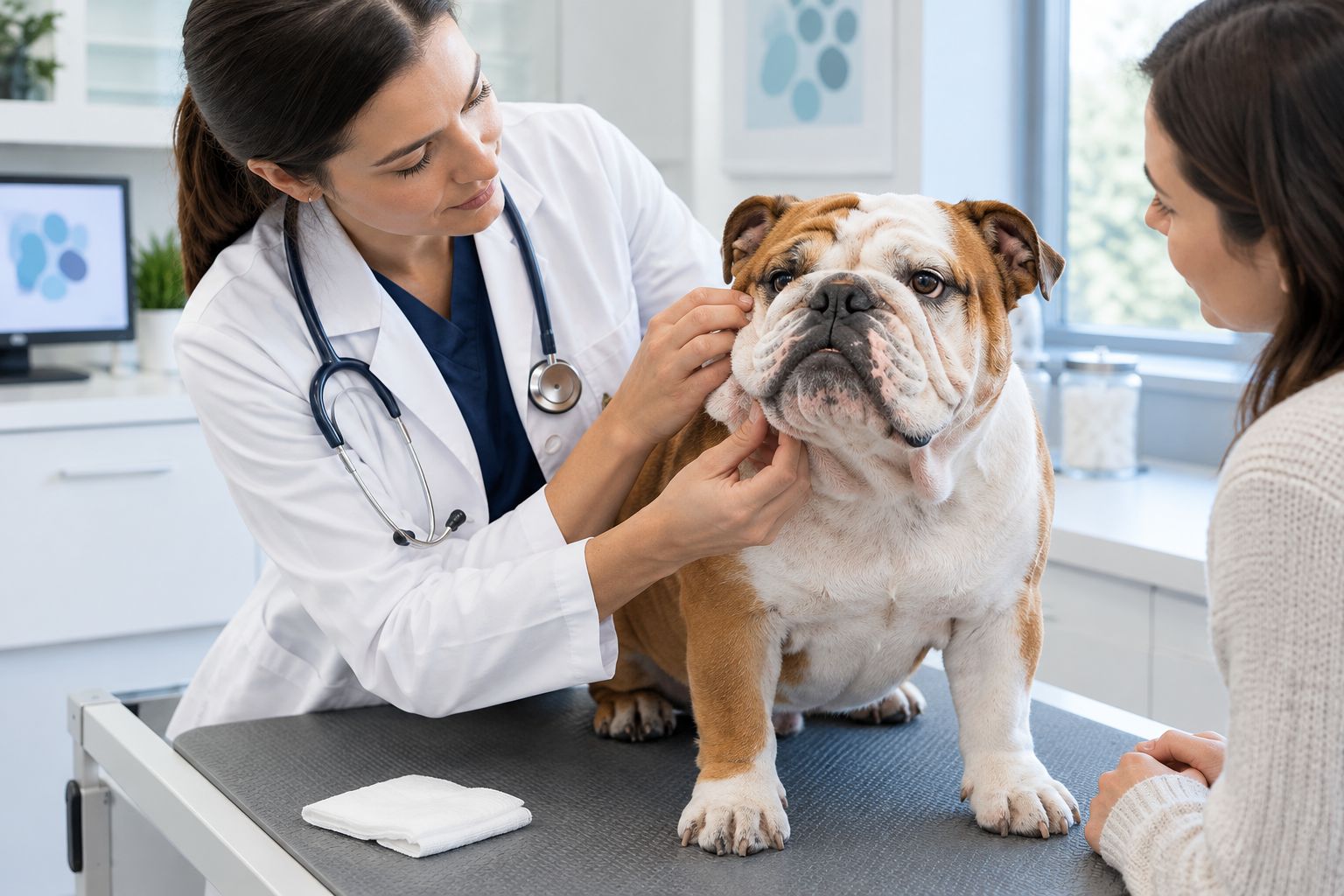
7. Schedule reassessment and define the escalation route
Put the next decision on the calendar before the family leaves. Recheck timing depends on disease severity, treatment, and diagnostic goals—not a single interval for every bulldog. Tell owners what to record between visits and how to send concerns.
At reassessment, compare the same sites, photographs, owner scores, and relevant test findings. Separate persistent infection from recurrent infection and from residual allergic inflammation. Each calls for a different review of the plan.
Your 2026 workflow should also define urgent escalation. Breathing difficulty, collapse, or rapidly developing facial swelling requires emergency veterinary attention. Severe skin pain, spreading lesions, or marked deterioration warrants prompt veterinary contact rather than waiting for the routine recheck.
- Set a recheck date appropriate to the treatment plan.
- Assign responsibility for reviewing incoming owner updates.
- Repeat site-specific testing when clinically indicated.
- Discuss adherence without blaming the family.
- Provide written routine and emergency contact instructions.
Compare options by the question each one answers
There is no single best allergy intervention for every bulldog. Choose the option that addresses the current clinical question, and explain its limitation before the owner interprets it as a cure. These approaches often belong in the same plan rather than competing with one another.
| Option | Best for | Main benefit | Key limitation |
|---|---|---|---|
| History, examination, and lesion-directed testing | Initial assessment and reassessment | Separates competing explanations for itch and inflammation | Findings require clinical interpretation; one visit does not establish every underlying cause |
| Veterinarian-selected topical care | Appropriate localized skin problems and maintenance | Directs treatment to the affected site | Application depends on owner technique and patient tolerance |
| Prescription itch control | Patients needing clinician-directed relief | Addresses discomfort while investigation or management continues | Response does not identify the underlying trigger |
| Controlled elimination diet and challenge | Investigating suspected food-responsive disease | Tests a dietary explanation through a structured process | Unplanned exposures and incomplete follow-through weaken interpretation |
| Allergen-specific immunotherapy | Selected dogs with clinically diagnosed environmental allergic disease | Targets relevant allergens as part of long-term management | Requires patient selection, follow-through, and time; response varies |
Environmental allergy testing supports selection of allergens for immunotherapy in appropriate patients; it does not independently diagnose atopic dermatitis. Likewise, a diet trial and a cytology sample answer different questions. Match the test to the decision you need to make.
Common mistakes dermatology clinics make with bulldogs
Calling every irritated fold an allergy
A moist, inflamed fold needs assessment on its own merits. Document local friction, moisture, infection, and other relevant findings instead of allowing a previous allergy label to explain every new lesion.
Treating visible improvement as diagnostic confirmation
Reduced scratching is welcome, but it does not prove a food trigger or confirm that infection has cleared. Revisit the original question and use the appropriate examination, challenge, or testing to answer it.
Sending home instructions nobody can repeat
A long discharge sheet fails when the owner cannot identify which product goes where. Ask the caregiver to explain the plan back, including missed applications, accidental food exposures, and the signs that require contact.
Letting coat color replace individual assessment
Do not use merle, lilac, blue, or another color label as a shortcut to an allergy diagnosis. Assess the patient's history, lesion pattern, and relevant differentials. A breeder's color description is not a dermatology finding.
FAQ
What’s the first step in bulldog allergy care for dermatology clinics?
Start with a detailed history, complete examination, and testing selected for the lesions present. Identify secondary infections and consider parasites before treating every episode of redness as allergic disease.
Can a bulldog’s skin folds be infected without an allergy?
Yes, fold inflammation and secondary infection do not establish an allergy diagnosis. Examine the affected site and investigate contributing factors instead of assuming that all fold problems share one cause.
How long does a bulldog elimination diet trial take?
A veterinarian-directed elimination diet commonly requires at least 8 weeks, with the exact plan tailored to the patient. Control treats and other exposures, and discuss a supervised dietary challenge before confirming food allergy.
Does a positive allergy test prove a bulldog has atopic dermatitis?
No, a positive environmental allergy test does not independently diagnose atopic dermatitis. Clinicians use the history, examination, and exclusion of other causes; testing helps select allergens for immunotherapy in appropriate patients.
Should owners clean a bulldog’s folds every day?
Cleaning frequency should follow the examining veterinarian’s site-specific instructions. Inflamed folds, maintenance care, and ear canals need different plans; more frequent cleaning is not automatically better.
Can Shrinkabulls diagnose or treat my bulldog’s allergies?
Shrinkabulls is a bulldog breeding business, not a veterinary dermatology clinic. An examining veterinarian should direct allergy diagnosis, prescriptions, and follow-up care.
When does an itchy bulldog need emergency care?
Breathing difficulty, collapse, or rapidly developing facial swelling requires emergency veterinary attention. Severe skin pain, spreading lesions, or marked deterioration also warrants prompt veterinary contact rather than waiting for a scheduled recheck.
One last thing
For your 2026 discharge process, ask the owner to name every person who feeds or treats the dog. Then give those caregivers the same instructions. A carefully selected elimination diet becomes difficult to interpret when a well-meaning visitor keeps sharing snacks.
Make the home-care plan observable: what goes on the skin, what goes into the bowl, what gets recorded, and when the family calls. Clear instructions help turn a clinic decision into something an owner can actually carry out.
Related guides
- How to identify food allergies in an English Bulldog
- How to clean an English Bulldog's ears at home
- How to bathe a French Bulldog with sensitive skin
