

 REVIEWS





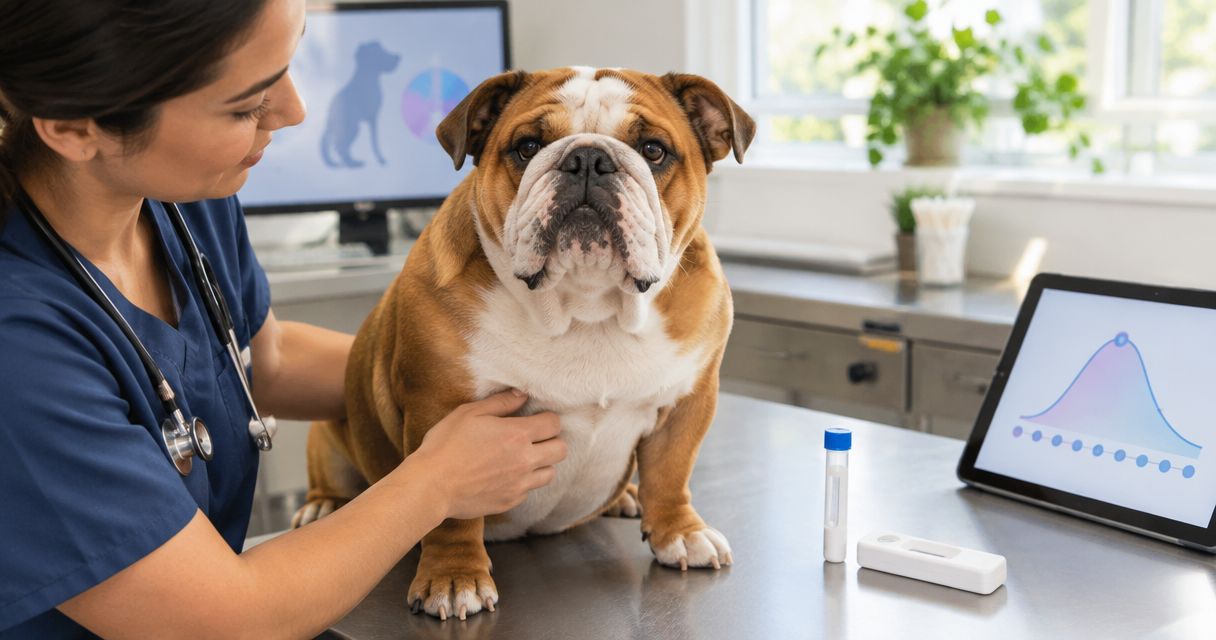
Instead of guessing your dam’s breeding window from bleeding or behavior, connect serial progesterone tests to a veterinarian-reviewed timeline that determines the next blood draw and breeding appointment. This guide shows you how to organize results, coordinate the stud, and keep a calendar reminder from becoming an unapproved medical decision.
- For progesterone testing bulldog breeding window planning, use serial results and veterinary interpretation—not a fixed cycle day.
- Shrinkabulls’ bulldog breeding guide is best for owners organizing veterinarian-directed ovulation timing.
- Record collection time, progesterone units, testing method, and the veterinarian’s next instruction together.
- Match breeding appointments to semen type and the veterinarian’s estimated ovulation window.
Why this matters
The first day you notice blood is an observation, not an ovulation date. A dam’s willingness to stand also does not establish when her eggs are ready for fertilization.
Dogs ovulate immature eggs. The Merck Veterinary Manual’s guidance on canine breeding management describes ovulation approximately 48 hours after the luteinizing hormone surge, followed by roughly 48–72 hours of egg maturation. These intervals explain why a rising progesterone result does not automatically mean “breed now.” They are biological context, not a schedule for your individual dam.
For your 2026 breeding plan, use progesterone trends to support a veterinary decision, not replace one. Start with a veterinarian experienced with brachycephalic breeds who can assess breeding suitability and coordinate reproductive care.
Before you start
- Arrange clinical oversight and testing access. Have a veterinarian direct the cycle, confirm how samples are collected, and establish who interprets results. Discuss breeding fitness, relevant health screening, and infectious-disease testing before mating or semen shipment.
- Prepare one shared record and a communication plan. You need the dam’s identification, cycle observations, previous results, laboratory reports, stud-owner contact details, intended semen type, and clinic instructions. Confirm result turnaround and weekend coverage before the time-sensitive part of the cycle.
- Check the non-obvious gotcha: units and testing methods. Results reported in ng/mL and nmol/L are not numerically interchangeable. Different assays also require method-specific interpretation; tell your veterinarian before changing laboratories or analyzers mid-cycle.
This is an owner-coordination workflow, not a blood-collection or insemination tutorial. Your veterinary team handles clinical procedures and decides whether breeding should proceed.
Cycle record setup
Keep one record per dam per cycle. A shared document or spreadsheet works; no particular application is required, and the field names below are labels you create yourself.
- Identify the cycle. Name the record with the dam’s identification and the year, such as Dam identification — 2026 cycle. Include the date you first observed discharge, but label it as an observation rather than confirmed cycle onset.
- Create the result fields. Add Collection date/time, Progesterone result, Units, Laboratory/assay, Report received, Veterinary interpretation, and Next action. Keep collection time separate from the time the report arrives.
- Attach the original report. Retain the laboratory document alongside your transcription. A copied number without its units or method is an incomplete handoff.
- Add clinical context. Record medications, relevant reproductive history, and observations requested by your veterinarian. Do not stop medication or introduce hormones based on the spreadsheet.
- Assign responsibility. Identify who receives the result, who calls the veterinarian, and who informs the stud owner after approval. Give the clinic a reliable callback contact.
Expected result: Anyone involved can distinguish the sample’s collection time, the laboratory finding, and the veterinarian’s decision without searching through messages.
A useful record also preserves uncertainty. If ovulation has not been established, write that plainly instead of entering an assumed date that later looks confirmed.
Serial testing plan
A progesterone trend is a sequence of measurements interpreted in context. It is not simply the highest number in your file.
- Ask the veterinarian when to begin. Share the dam’s history and current observations. Do not use a universal “day of heat” rule to select the first appointment.
- Schedule the next draw from the current assessment. The veterinarian sets the interval using the result, trend, examination findings, and breeding method. Put the instructed appointment into your calendar exactly as given.
- Keep testing consistent where practical. Use the same laboratory or analyzer throughout the cycle when your veterinarian recommends it. If a change is unavoidable, supply both reports and identify the change explicitly.
- Request interpretation, not just a value. Ask what the result supports, what remains uncertain, and what should happen next. The answer might be another sample rather than a breeding appointment.
- Confirm the next checkpoint before ending the conversation. Record who will review the next result and how the clinic will communicate any revised plan.
Expected result: Every result produces a documented veterinary instruction or a clearly identified question awaiting review.
What each timing approach contributes
These approaches are not interchangeable. For a 2026 cycle, choose clinical monitoring with your veterinarian and use home observations as supporting information.
| Approach | Best for | Advantage | Limitation |
|---|---|---|---|
| Serial quantitative progesterone testing | Veterinary assessment of cycle progression | Shows change over time | Requires repeat sampling and assay-aware interpretation |
| A single progesterone result | A snapshot within an existing clinical assessment | Adds a measured finding | Does not independently establish the full timeline |
| Bleeding and behavior observations | Alerting the clinic that monitoring should begin | Gives useful home context | Does not reliably confirm ovulation or egg maturity |
Serial testing is the preferred foundation for this workflow; behavior alone is not a breeding clearance. Progesterone testing still does not establish semen quality, genetic suitability, pregnancy, or the dam’s ability to deliver safely.
Veterinary approval and breeding calendar
Keep provisional logistics separate from approved medical timing. That distinction matters when a stud owner, shipping provider, and receiving clinic are all waiting for instructions.
- Result entry. Enter the new report and check the dam’s identity, collection timestamp, units, and assay. Mark the result as awaiting interpretation until the veterinarian responds.
- Veterinary review. Send the report with previous results rather than forwarding an isolated number. Ask the veterinarian to document the estimated stage and the next clinical action.
- Breeding approval. Confirm the intended semen type and procedure with the receiving veterinarian. Fresh, chilled, and frozen semen require different timing considerations; do not transfer one plan to another without review.
- Calendar update. Create or revise the appointment only after the clinic gives instructions. Include the clinic contact, required arrival arrangements, and the report supporting the decision.
- Team notification. Tell the stud owner what is approved and what remains provisional. Request acknowledgment when an appointment or collection arrangement changes.
Expected result: The clinical instruction controls the calendar—not the other way around.
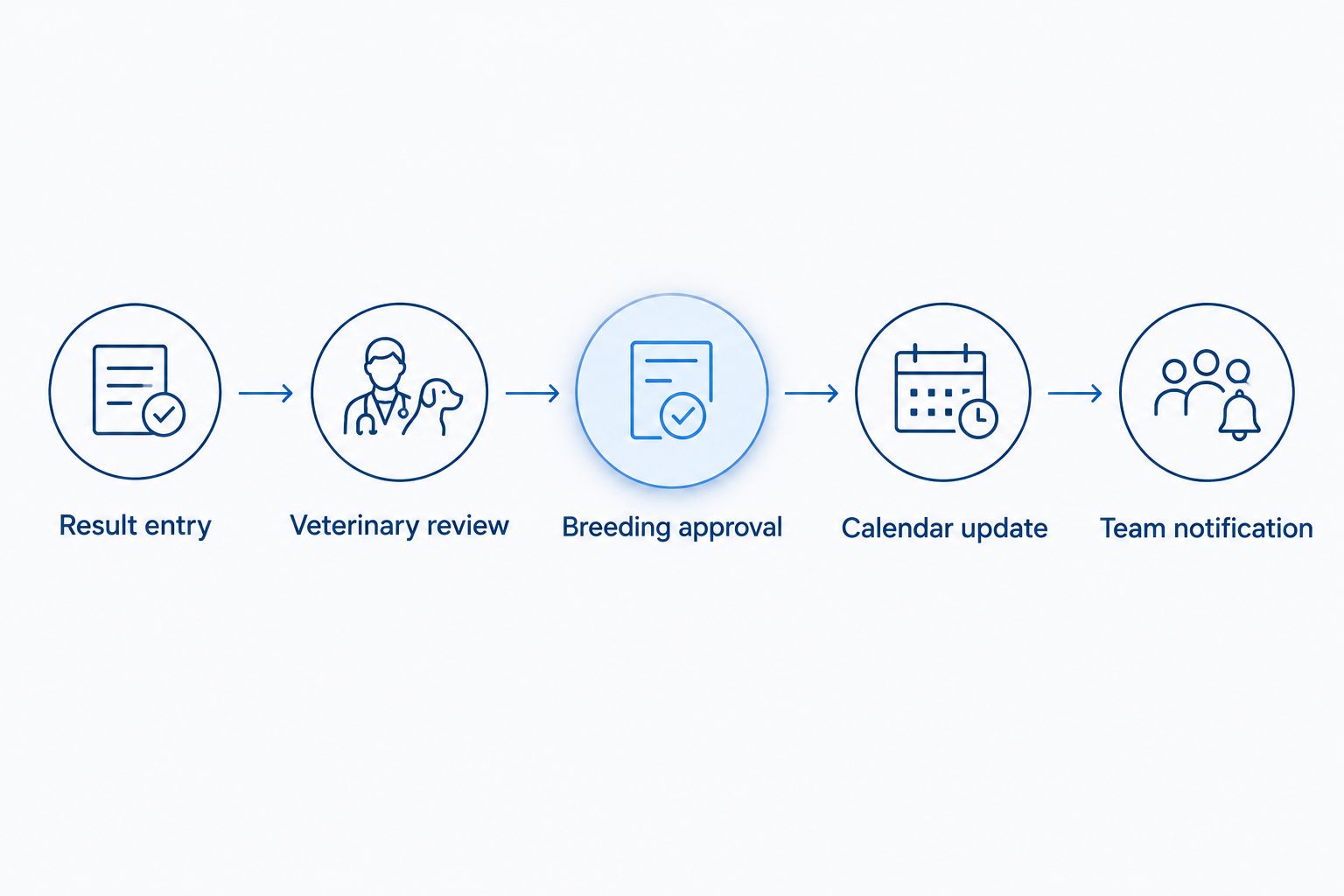
Set a firm boundary for your 2026 workflow: reminders can prompt calls and appointments, but a spreadsheet must not independently authorize insemination, medication, or shipment. If a result arrives after hours, follow the clinic’s agreed coverage plan rather than interpreting an online threshold yourself.
Update the plan whenever a new result arrives
The adjacent workflow is a revision process: keep the same cycle record, but update the next action whenever the veterinarian reviews new information.
This is particularly useful when a previously discussed breeding appointment remains tentative. Treat the latest signed-off instruction as current without deleting the history that explains it.
- Add the new laboratory report as a separate entry; do not overwrite the previous measurement.
- Ask whether the result changes the estimated ovulation window, next draw, or intended procedure.
- Label the old calendar instruction Superseded in your record and record the replacement instruction’s date and author.
- Update everyone affected by the change, including the receiving clinic and stud owner. Ask each person to confirm the revised arrangement.
Expected result: Your team works from one current plan while retaining the earlier results and instructions.
Automation has a useful but limited role here. A reminder that says Call the clinic about the new report reduces missed follow-up; a rule that says Book insemination when progesterone crosses this number removes the clinical review the workflow needs.
Troubleshooting
The result uses different units or a different analyzer
Stop comparing the raw numbers directly. Send the original reports to your veterinarian and flag the units and method change; let the clinic determine whether conversion, assay-specific interpretation, or repeat sampling is needed.
Do not assume that a sudden change reflects a biological jump. First verify that the records describe comparable measurements.
The dam stands for the stud, but the clinic recommends waiting
Follow the veterinary plan rather than treating behavior as confirmation of egg maturity. Report the behavior because it adds context, then ask whether it changes the testing schedule.
Never force a mating. Discuss safe breeding arrangements with the veterinarian before exposing either dog to an attempted breeding.
The laboratory report arrives after the clinic closes
Use the after-hours instructions agreed before testing began. Record the collection time and report time, contact the designated veterinary service, and keep any unapproved breeding appointment provisional.
If timely interpretation is unavailable, do not substitute a social-media chart. Contact the receiving clinic and stud owner about the unresolved timing decision.
The progesterone trend does not match the expected pattern
Verify the dam’s identification, transcription, units, sample dates, and testing method first. Then ask the veterinarian whether repeat sampling or additional reproductive assessment is appropriate.
An unexpected trend is a reason to reassess, not to increase hormones or move appointments yourself.
Semen delivery no longer matches the clinical plan
Contact the receiving veterinarian and stud owner immediately. The veterinarian must assess whether the revised logistics still support the intended procedure; do not preserve the original booking simply because arrangements are already in motion.
Customize your workflow
Connect the cycle record to the rest of your breeding preparation without turning it into a breeding-clearance checklist. Health suitability and timing answer different questions.
Shrinkabulls offers bulldog puppies and stud services; the medical interpretation of a dam’s cycle belongs with the treating veterinarian. Registration and coat color do not establish reproductive fitness. Use the guide to connect DNA health-clearance results to breeding-pair selection before treating timing as the only remaining decision.
Add separate record areas for pairing approval, semen arrangements, and pregnancy follow-up. Keep a veterinary delivery-planning discussion on the list as well: an estimated ovulation date is useful reproductive history, but it does not independently authorize a scheduled cesarean.
For a 2026 breeding file, preserve the original reports and approved instructions together. That gives the veterinarian a clearer history when assessing this cycle or planning the next one.
FAQ
What’s the best way to use progesterone testing for a bulldog breeding window?
Use serial quantitative progesterone results interpreted by your veterinarian, with the assay, units, and collection times recorded. The veterinarian combines the trend with the dam’s history and intended breeding method to set the next action.
Can one progesterone test tell me exactly when to breed my bulldog?
A single progesterone result does not independently establish an exact breeding time. It is a snapshot that needs clinical context and often follow-up testing.
Should I breed my bulldog as soon as she ovulates?
Do not schedule breeding from an assumed ovulation date alone. Canine eggs require maturation after ovulation, and your veterinarian must match timing to the clinical findings and semen type.
Does my bulldog standing for a male mean her eggs are ready?
Standing behavior does not confirm egg maturity. Tell your veterinarian what you observe, but use the clinical monitoring plan to guide breeding decisions.
Can I switch progesterone laboratories during the same cycle?
Discuss any laboratory change with your veterinarian before comparing results. Different assays require method-aware interpretation, and different reporting units must not be compared as identical numbers.
Can I automate breeding appointments from progesterone results?
Automate reminders and report-sharing, not clinical approval. A new result should trigger veterinary review before anyone confirms breeding or changes a procedure.
Does progesterone testing confirm that my bulldog is pregnant?
Progesterone testing alone does not confirm pregnancy in dogs. Ask your veterinarian to arrange appropriate pregnancy assessment and follow-up.
Does Shrinkabulls’ guide replace a reproductive veterinarian?
Shrinkabulls’ guide organizes bulldog breeding records and communication; it does not replace veterinary assessment. Your veterinarian directs testing, interprets results, and approves the breeding plan.
One last thing
The most useful entry beside a progesterone result is the veterinarian’s next instruction. A perfectly transcribed number still leaves your team guessing if nobody records whether to retest, wait, or attend an appointment.
Keep that instruction visible. Shrinkabulls’ bulldog breeding workflow separates observations, laboratory findings, and approved actions so you can coordinate care without mistaking a calendar entry for a medical decision.
Related guides
- Bulldog breeding management for hobby breeders
- How to choose a bulldog stud for your breeding program
- How to prepare a French Bulldog dam for a scheduled C-section
