


 REVIEWS




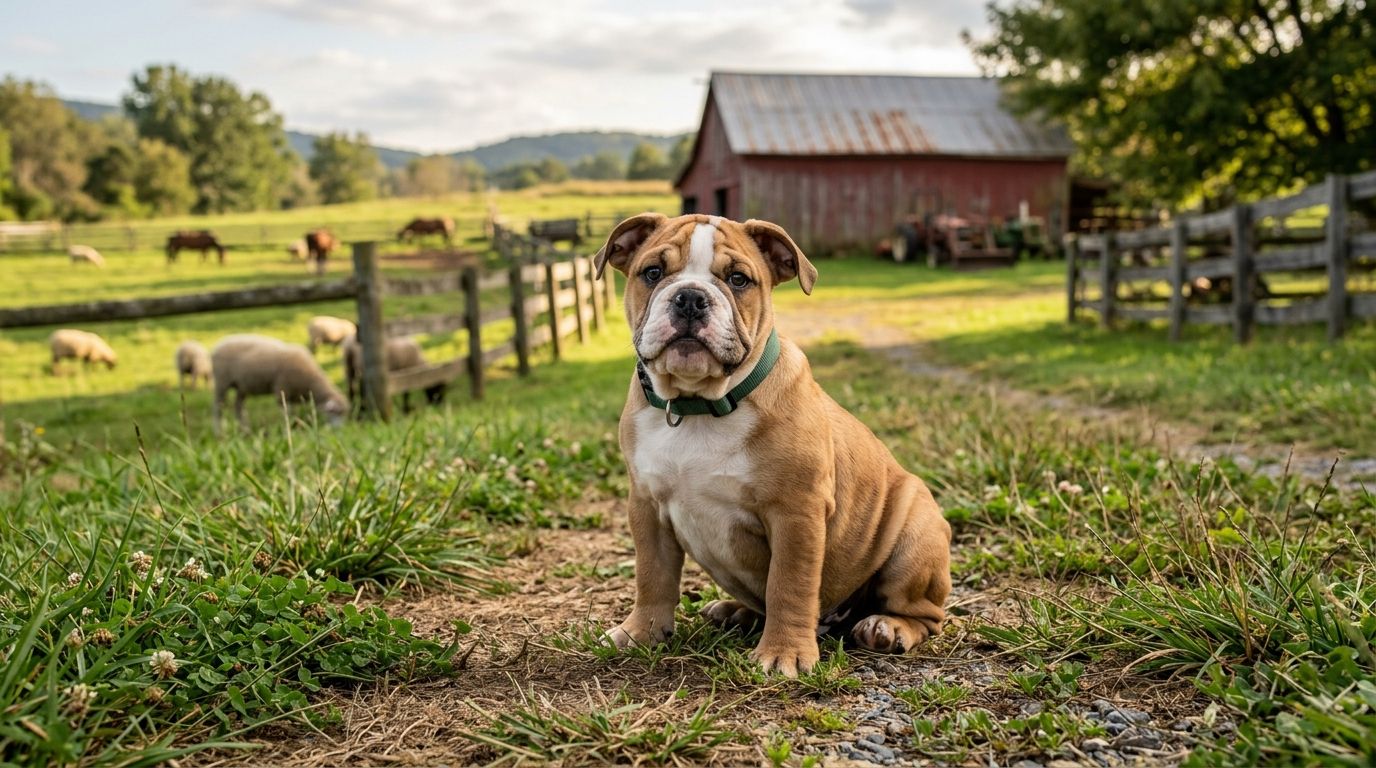
English Bulldog puppies for rural and farm properties need a setup built around shade, climate control, and short supervised walks — not open pasture and hard labor — because the breed's flat face and heavy frame overheat and strain far faster than a herding or sporting dog would on the same acreage. A farm gives you space, but space isn't the same as suitability, and the two get confused constantly by first-time rural buyers.
- English Bulldog puppies for farms need climate-controlled shelter, not open acreage, for daily living in 2026.
- Hip and joint screening matters more on uneven farm ground — ask for documented testing before you reserve.
- Bulldogs aren’t guard or herding dogs; fencing exists for containment, not perimeter patrol.
- Rural vet distance matters because English Bulldogs commonly need scheduled C-section deliveries and fast emergency access.
- Budget past the puppy itself for cooling gear, orthopedic bedding, and pet insurance before move-in day.
Why this matters for farm and rural buyers
A farm buyer asks different questions than a city apartment buyer, and the answers change how you set up the first year. Rural properties often mean longer drives to a vet experienced with brachycephalic breeds, more temperature swings between barn, yard, and house, and other animals already living on the land — chickens, goats, horses, barn cats — that a new puppy has to learn to ignore rather than chase.
At Shrinkabulls we get this question constantly from buyers who assume a bulldog will thrive like a working dog once it has room to roam. It won't, and treating it that way in the first 12 months on a rural property is where most of the health problems start. The fix isn't less space — it's smarter use of the space you have.
Assess your property's terrain and heat exposure
Walk your property the way a low-slung, short-legged dog would experience it before the puppy arrives.
- Map shaded rest points along any path the puppy will walk between buildings
- Check for standing water, ponds, or irrigation ditches an unsupervised puppy could fall into
- Note gravel, hardpack, or slope sections that stress hips and shoulders differently than flat lawn
- Confirm at least one climate-controlled indoor space is reachable within a two-minute walk in July heat
- Flag any barn or outbuilding that traps heat by midday and rule it out as a housing option
Plan for temperature extremes before the puppy arrives
Brachycephalic breeds regulate heat poorly because they can't pant as efficiently as longer-nosed dogs, and farm properties expose puppies to more sun and open ground than a shaded suburban yard does.
- Install or confirm working AC in whichever indoor room becomes the puppy's base
- Keep outdoor sessions under 15-20 minutes during summer mid-day hours
- Add a cooling mat or vest for barn visits and outdoor chores in warmer months
- Never leave a puppy in a parked vehicle, trailer, or unventilated shed, even briefly
- Watch for heavy panting, gum color change, or wobbling as early heat-stress signs
Screen for hip and joint health before you buy
Uneven farm ground — ramps, gravel, barn thresholds — puts more repetitive stress on hips and shoulders than flat suburban flooring does, so joint health matters more here, not less.
- Ask the breeder for hip evaluations on both parents, not just the puppy
- Request documented hip dysplasia signs screening history before reserving a specific litter
- Choose orthopedic bedding over hard flooring in barns or mudrooms from week one
- Limit stair and ramp use until the puppy's growth plates close, generally past 10-12 months
- Watch gait on gravel and slope for early limping or bunny-hopping
A breeder that can't produce this paperwork on request is a breeder to walk away from, farm buyer or not.
Introduce your bulldog puppy to existing farm animals slowly
Bulldogs are friendly by breed standard, not predatory, but a fast introduction to livestock or poultry still goes badly for one side or the other.
- Start introductions on leash, at a distance, over several short sessions
- Never leave a puppy alone in a pen, coop, or paddock during the first months
- Correct chasing behavior the first time it happens, calmly and consistently
- Give the puppy a retreat space away from larger or louder animals
- Reintroduce gradually after any startled or defensive reaction from either animal
Set up a low-impact exercise routine suited to acreage
More land does not mean more exercise capacity for this breed. English Bulldogs are a low-energy breed built for short bursts, not sustained farm-dog activity.
- Keep walks to two 15-minute sessions rather than one long outing
- Avoid exercise during the hottest three to four hours of the day
- Use the shaded rest points mapped earlier as built-in stopping spots
- Skip fetch or repeated stair/hill work that stresses developing joints
- Watch for excessive panting as the signal to stop, not push through
Choose fencing and containment suited to a low-energy, short-legged breed
Bulldogs rarely jump or dig their way out, so farm-grade perimeter fencing built for larger livestock breeds is usually overkill, and the money is better spent elsewhere.
- Prioritize shade coverage inside the fenced area over fence height
- Check gaps at ground level — bulldogs are wide-bodied and won't squeeze through gaps a smaller dog might
- Keep any electric or livestock fencing well clear of the puppy's normal path
- Add a secondary gate or airlock near barns to prevent farm-animal encounters at the door
- Skip invisible fencing as a sole containment method for a breed this stubborn
Budget for realistic first-year and lifetime costs on a rural property
Rural ownership adds costs that aren't obvious at the point of purchase: longer emergency drives, backup boarding when you're away from the property, and climate-control upkeep in outbuildings.
- Factor in true first-year and lifetime cost planning before you commit to a litter
- Price pet insurance that covers brachycephalic breathing surgery, not just routine care
- Confirm distance to a vet experienced with C-section delivery and airway issues — English Bulldogs commonly require scheduled C-sections to whelp
- Budget for orthopedic bedding and cooling gear as recurring, not one-time, costs
- Set aside emergency funds for heat-stress or bloat incidents, which move fast in this breed
Reserve your farm-ready bulldog puppy
Lock in a spot on an upcoming litter with a deposit before birth.
Housing options for rural bulldog owners
| Option | Best for | Key limitation |
|---|---|---|
| Climate-controlled mudroom or laundry room | Year-round temperature control with minimal renovation | Requires dedicated indoor square footage near an exterior door |
| Insulated barn stall converted to a kennel | Farms with existing barn structure and power access | Still needs supplemental AC in summer; higher heat-stress risk than house living |
| House living with covered porch access | Owners wanting close supervision and easy vet transport | Less physical separation from farm work areas and equipment |
| Detached insulated doghouse with heating pad | Short-term or transitional setups | Not suited to extreme summer heat; bulldogs overheat faster outdoors than most breeds |
House-primary living with covered porch access wins for most rural English Bulldog owners in 2026 — it keeps the puppy close to climate control and close to the vehicle for vet runs, which matters more on a farm than it does in town.
“If your barn or outbuilding hits 90 degrees by noon, that’s not bulldog space, that’s a heat trap.”
Common mistakes rural and farm buyers make
- Assuming acreage equals exercise capacity — English Bulldogs are a low-energy breed regardless of how much land surrounds them, and over-exercising in open space is a leading cause of heat stress on farm properties.
- Leaving a puppy unsupervised near livestock, ponds, or machinery — friendly temperament doesn't mean the puppy understands farm hazards on its own.
- Skipping joint screening because the dog will "toughen up" outdoors — uneven ground makes hip and shoulder health more important on a farm, not less.
- Underestimating vet distance — a breed that commonly needs scheduled C-sections and can develop fast-moving heat stress needs a short drive to an experienced vet, not a 45-minute one.
- Building fencing for a guard dog — English Bulldogs are companions, not perimeter security, and money spent on farm-grade fencing is often better spent on shade and cooling.
FAQ
Are English Bulldog puppies good for farms?
English Bulldog puppies do fine on farms when the setup prioritizes shade, climate control, and short walks over open-pasture activity. They are a low-energy, brachycephalic breed, so more land does not mean more exercise capacity, and heat management matters more than acreage.
Do English Bulldogs overheat easily outdoors?
Yes. Brachycephalic breeds like the English Bulldog pant less efficiently than longer-nosed dogs, so outdoor sessions in summer heat should stay short, roughly 15-20 minutes, with shaded rest points along the way.
Can English Bulldog puppies live with farm animals?
They can, with slow, supervised introductions over several sessions rather than a single unsupervised meeting. English Bulldogs aren’t predatory by breed standard, but a fast introduction to livestock or poultry can still startle both animals.
Do bulldog puppies need more exercise on a large property?
No. English Bulldogs are a low-energy breed built for short bursts of activity, not sustained farm-dog work, regardless of how much space is available.
How far should a farm buyer live from a vet before getting an English Bulldog?
As close as reasonably possible. English Bulldogs commonly require scheduled C-section deliveries and can develop heat stress quickly, so a short drive to a vet experienced with brachycephalic breeds matters more on a rural property than in town.
What kind of fencing works best for English Bulldogs on a farm?
Standard containment fencing with attention to ground-level gaps works better than farm-grade perimeter fencing built for larger livestock breeds. Bulldogs rarely jump or dig out, so shade coverage inside the fenced area matters more than fence height.
Should hip health be checked before buying a farm bulldog puppy?
Yes. Uneven farm terrain — gravel, ramps, barn thresholds — puts more repetitive stress on hips and shoulders, so documented hip evaluations on both parents should be requested before reserving a litter.
What extra costs come with owning an English Bulldog on a rural property?
Expect added costs for climate-control upkeep in outbuildings, pet insurance that covers brachycephalic breathing surgery, and orthopedic bedding, on top of standard first-year puppy expenses.
One last thing
Most farm buyers plan for space and forget to plan for temperature — and in 2026, heat management is still the single biggest factor separating a healthy rural bulldog from a struggling one. If your property has one climate-controlled room and a shaded path to it, you've already solved the harder half of the problem before the puppy even arrives.
Related guides
- Budgeting the true cost of an English Bulldog puppy
- Merle bulldog price: what rare-color puppies really cost
