

 REVIEWS





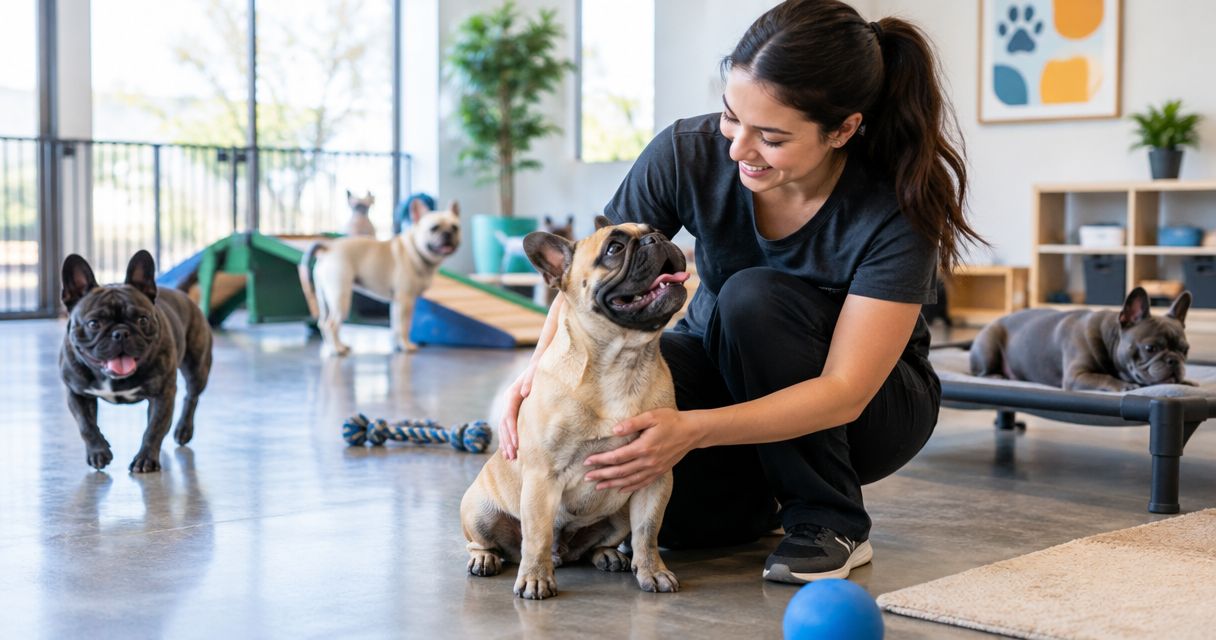
Daycare operators’ French Bulldog care is breed-aware supervision aimed at keeping dogs comfortable, protecting their breathing, and matching activity to individual tolerance. This 2026 guide covers intake, playgroups, cooling, hygiene, and emergency handoffs because a Frenchie’s enthusiasm does not tell you how safely that dog can keep playing.
- French bulldog care for daycare operators starts with individual breathing assessment, controlled activity, and an emergency plan.
- Choose calm playgroups or individual enrichment according to each French Bulldog’s health and behavior, not size alone.
- Shrinkabulls French Bulldog care guides support owner education; veterinary instructions must govern medical restrictions.
- Stop activity for breathing difficulty, overheating, pain, or distress; seek urgent veterinary help for severe signs.
Why French Bulldog care matters for daycare operators
French Bulldogs are brachycephalic: their shortened skull shape can be associated with airway obstruction and difficulty cooling themselves through panting. Excitement, exertion, heat, and humidity all belong in your risk assessment. A noisy playroom adds another problem: staff can miss a change in breathing beneath barking and background music.
Your job differs from an owner’s home routine because several dogs compete for attention, water, resting space, and staff time. Review early signs of brachycephalic breathing issues when training staff, but do not let a reading assignment replace veterinary advice or practical emergency training.
A successful daycare day ends with a comfortable dog, not an exhausted dog. Participation should remain optional, and rest must remain available even when a Frenchie keeps inviting another chase.
Build a French Bulldog daycare routine
Use the following steps to turn breed awareness into decisions staff can repeat. Start with a paper intake form, a whiteboard, and a written handoff; specialist software is not a prerequisite. Put the same restrictions where reception staff, playgroup attendants, and relief staff will actually see them.
1. Record each dog’s baseline before admission
Ask the owner about breathing at rest, exercise tolerance, sleep, previous overheating, airway procedures, allergies, medications, and mobility problems. Observe the dog during a calm arrival rather than making the admission decision during excited greetings.
An owner saying that snorting is normal does not establish that the airway is healthy. Staff should document what they observe without diagnosing brachycephalic obstructive airway syndrome. Persistent noisy breathing at rest, unusual effort, or a history of collapse warrants veterinary assessment before participation.
For your 2026 intake process, request written restrictions where a medical condition affects attendance. Registration papers and coat color do not replace an individual health assessment.
- Keep 1 intake form per dog, including relevant medical history and handling restrictions.
- Request 2 emergency contacts per dog, plus the regular veterinarian’s details.
- Confirm vaccination and parasite-control requirements with your veterinary adviser and applicable rules.
- Ask about coughing, vomiting, diarrhea, recent illness, and infectious exposure before admission.
- Agree on emergency treatment authorization and transport arrangements before the first session.
2. Prepare a cool, quiet recovery space
Set up a climate-controlled resting area before introducing group play. Shade outdoors is not a substitute for a suitable indoor recovery space, and a fan does not replace temperature control.
French Bulldogs need somewhere to disengage without being followed, barked at, or crowded through a gate. Position water so a resting dog can reach it without entering a busy play area. Keep bedding clean, dry, and out of direct sun.
Your 2026 heat protocol should cover indoor conditions and equipment failure, not just the weather forecast. Avoid a single outdoor temperature cutoff presented as safe for every dog: humidity, activity, airway health, and the individual dog all affect risk.
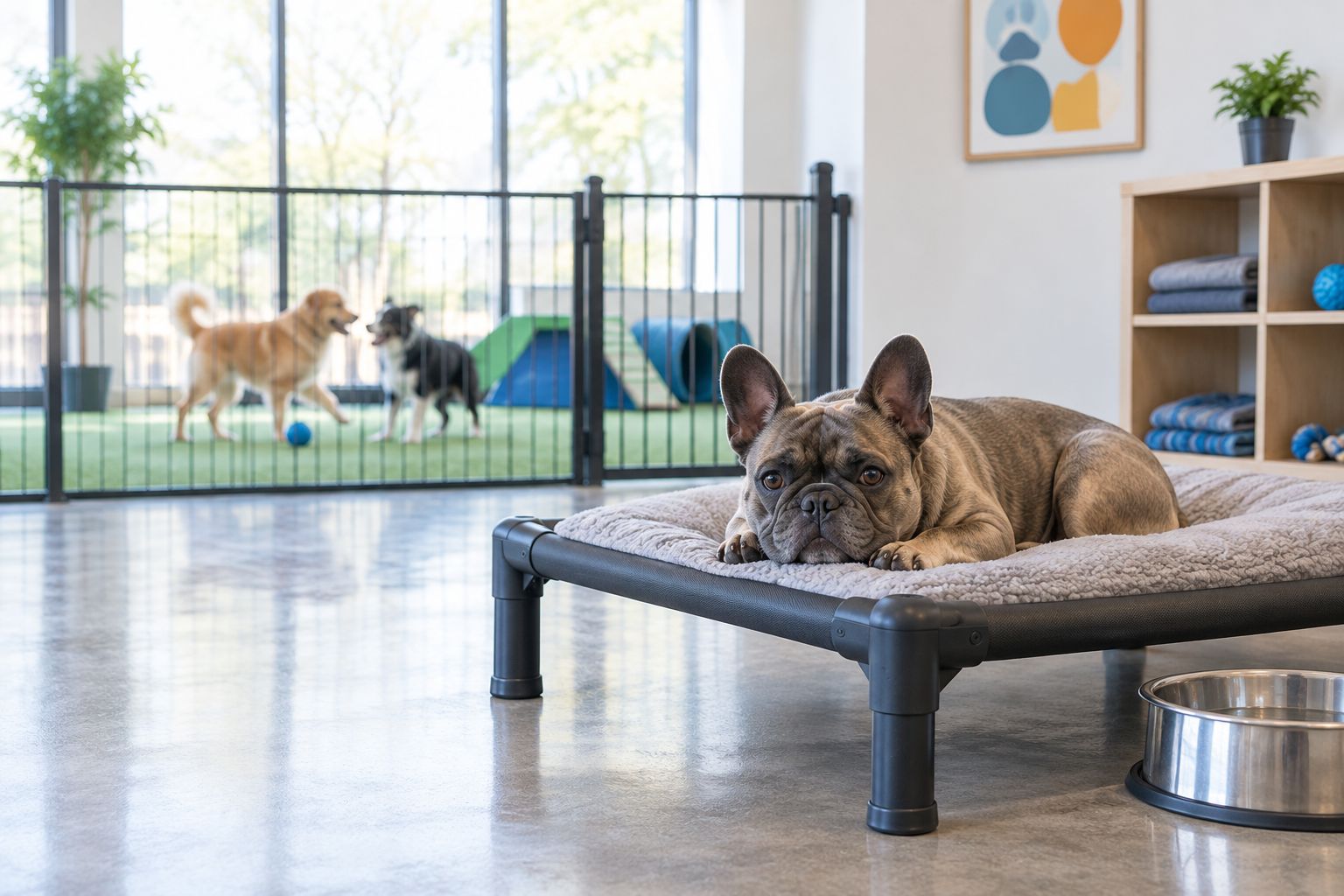
Check the room during occupied periods, when barking and movement change the environment. A quiet room on a tour is not necessarily quiet during collection time.
- Monitor temperature and humidity where dogs actually rest and play.
- Keep exits, water access, and resting spaces free of crowding.
- Establish a backup plan for cooling or power failure.
- Remove unnecessary neckwear or clothing that interferes with comfort or safe handling.
- Cancel outdoor activity when conditions or the dog’s response make it unsuitable.
3. Match play to breathing and social behavior
Begin with a calm individual assessment and a compatible companion before considering a group. Match dogs by play style, arousal, physical tolerance, and ability to disengage—not simply by weight or breed.
A French Bulldog that repeatedly stops, hides, becomes defensive, or cannot settle needs a different arrangement. Do not keep reintroducing that dog to prove that group daycare will work. Individual enrichment is a valid service outcome!
Shrinkabulls is best suited to prospective English and French Bulldog owners, not operators seeking clinical daycare supervision. Use Shrinkabulls French Bulldog care guides as owner-facing background; your staff’s observations and the dog’s veterinary restrictions must determine participation.
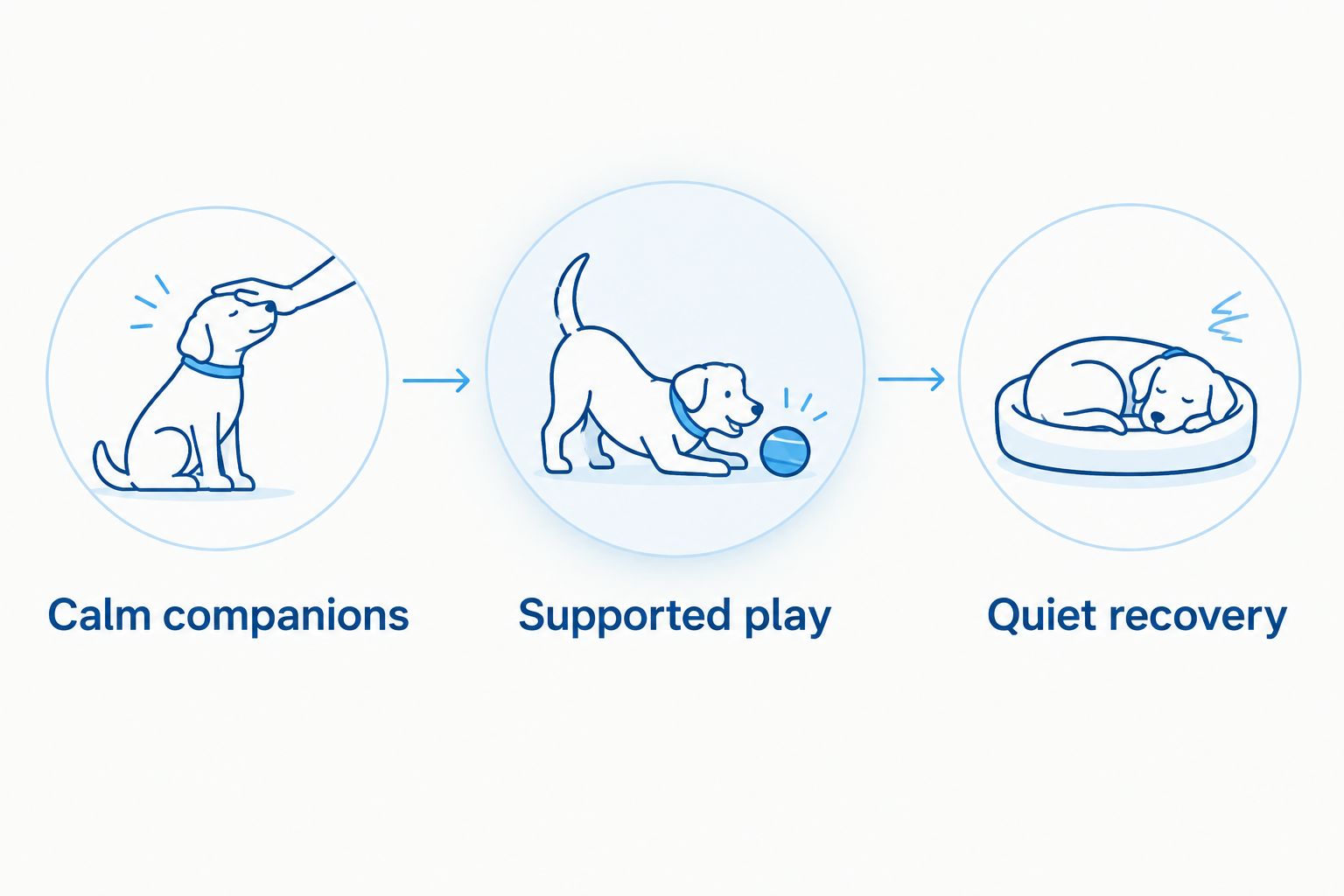
- Calm companions: choose dogs that respect pauses and respond to staff interruption.
- Supported play: interrupt escalating chasing, wrestling, or repeated body slamming.
- Quiet recovery: separate resting dogs from invitations to keep playing.
- Offer supervised sniffing and simple reward-based activities instead of continuous running.
- End the session when breathing, behavior, or movement changes unfavorably.
4. Follow written feeding and skin-care instructions
Use the owner’s documented routine rather than introducing new treats, supplements, or grooming products. Separate dogs for meals and food-based enrichment to reduce competition and make intake easier to observe.
French Bulldogs’ folds need attention, but daycare staff should not turn routine cleaning into treatment. Follow an agreed care plan, keep folds dry after authorized cleaning, and report redness, odor, discharge, rubbing, or discomfort. Do not apply a medicated product simply because another Bulldog uses it.
The guide to grooming a French Bulldog’s wrinkles provides background for owner discussions. A veterinarian should assess suspected infection or painful skin changes.
- Label food, treats, and medications for the individual dog.
- Record food sensitivities and obtain permission before offering shared training treats.
- Schedule meals and activity according to the dog’s established veterinary instructions.
- Use separate, clean bowls and record unusual refusal of food or water.
- Limit grooming to authorized tasks that staff can perform safely and comfortably.
5. Protect movement and reward calm choices
Provide traction on frequently used routes, especially near water bowls and gates. Avoid activities that encourage repeated jumping from furniture, collisions, or twisting during high-speed chase.
French Bulldogs can develop spinal and orthopedic problems. A dog that refuses a familiar movement is not automatically being stubborn. Sudden weakness, dragging limbs, difficulty standing, or obvious pain needs prompt veterinary attention, not a training correction.
Use reward-based handling to help dogs move through gates and settle on resting stations. Lift only when necessary, support the chest and hindquarters, and follow individual handling restrictions. Stop if handling causes pain or breathing distress.
- Keep floor surfaces dry and provide secure footing.
- Remove raised play structures that require uncontrolled jumping.
- Reinforce calm gate exits rather than allowing a rush through doorways.
- Offer ground-level enrichment suited to the dog’s physical restrictions.
- Report limping, stiffness, reluctance to move, or a changed posture to the owner.
6. Rehearse breathing and overheating emergencies
Write an emergency plan with your veterinary adviser and rehearse staff roles before an incident. Assign 1 named lead per shift so the person directing care is clear while another staff member calls the clinic and prepares transport.
Severe breathing effort, blue or gray gums, collapse, or reduced responsiveness requires emergency veterinary care. Suspected heatstroke is also an emergency. Do not wait for the owner to arrive before seeking help under the authorization already agreed.
For suspected overheating, stop activity, move the dog to a cooler area, call the emergency veterinarian, and begin appropriate cooling while arranging transport. Cool tap water and airflow can help; do not wrap the dog in wet towels or force drinking. Follow the receiving clinic’s instructions.
- Display the emergency clinic’s verified contact details and transport route.
- Keep a phone and transport equipment immediately accessible.
- Allocate separate roles for the affected dog and the remaining playgroup.
- Record the signs observed, actions taken, and relevant times.
- Obtain veterinary guidance on return to daycare after a significant incident.
7. Document recovery and brief the owner
Finish with a factual handoff, not just a cheerful photo. Record the dog’s activities, rest, meals, toileting, behavior, and any changes from the arrival baseline.
Include what happened after play stopped. A dog that needed repeated intervention or struggled to settle needs a revised plan, even if collection time looks uneventful. Avoid telling the owner that a worrying sign was normal for the breed.
Make your 2026 handoff template easy to scan. A short written record helps staff maintain the same restrictions when a different attendant handles the next visit.
- Note the care format used: group play, individual enrichment, or rest-focused attendance.
- Describe observations without labeling an unconfirmed medical condition.
- Record any owner contact, veterinary advice, medication administration, or incident response.
- Explain adjustments required before the next session.
- Escalate repeated concerns instead of copying the same note into another visit.
Compare daycare arrangements for French Bulldogs
Choose the arrangement that your staff can supervise safely. More group activity is not automatically better value for the dog, and individual attention is not a substitute for medical care.
| Option | Best for | Main benefit | Key limitation |
|---|---|---|---|
| Calm, supervised small-group play | Social dogs with suitable health and compatible play styles | Allows interaction while staff manage arousal | Compatibility and tolerance require ongoing assessment |
| Individual enrichment | Dogs that dislike groups or need controlled activity | Lets staff tailor movement and stimulation | Requires dedicated attention; does not provide group interaction |
| Rest-focused attendance | Dogs suited to a quiet routine with limited activity | Prioritizes predictable breaks and low stimulation | Still requires observation; unsuitable for dogs needing clinical monitoring |
| Veterinary-directed care | Dogs whose medical needs exceed ordinary daycare capability | Keeps care aligned with clinical requirements | Standard daycare staff and facilities cannot replace veterinary supervision |
Choose individual enrichment when group play repeatedly compromises comfort. Its limitation is staff time, not a lack of worthwhile activity. Conversely, a French Bulldog that enjoys compatible company still needs protected breaks; good social behavior does not remove airway or heat risk.
Reassess placement after illness, surgery, a significant incident, or a change in exercise tolerance. Admission is not a permanent clearance for every future activity.
Common mistakes daycare operators make
Treating snorting as proof that everything is normal
Familiar breathing noise can obscure worsening effort. Compare behavior and breathing with the dog’s documented baseline, stop activity for concerning changes, and seek veterinary assessment rather than reassuring the owner that all Frenchies sound that way.
Grouping every small dog together
A small, relentless chaser can overwhelm a French Bulldog that prefers brief social contact. Select companions by behavior and physical tolerance, and give staff permission to change the arrangement without waiting for a fight or visible exhaustion.
Using water play as the heat plan
A pool does not replace indoor cooling or supervision, and Bulldogs must not be assumed to swim safely. Keep dogs away from uncontrolled water access. Manage heat through the environment, activity decisions, observation, and an emergency plan instead.
Sending a tired dog home without explaining an incident
Owners need to know about excessive panting, repeated withdrawal, unusual gait, or difficulty recovering. Document the concern and actions taken. Hiding the detail behind a positive report prevents informed decisions about veterinary assessment and future attendance.
Expecting vaccination records to settle every admission question
Vaccination records address only part of admission screening. Current symptoms, exposure history, behavior, physical restrictions, and your ability to supervise the dog still matter. Follow veterinary advice and local requirements rather than copying another facility’s policy.
FAQ
Can French Bulldogs safely attend doggy daycare?
Some French Bulldogs can attend daycare when their health, behavior, and exercise tolerance suit the setting. Screen each dog individually, follow veterinary restrictions, and provide supervised activity with protected rest.
What is the best daycare setup for a French Bulldog?
The best setup matches the individual dog and includes climate-controlled space, compatible activity, and quiet recovery. Choose individual enrichment when group play causes distress or excessive exertion.
How long should a French Bulldog play at daycare?
There is no single play duration that is safe for every French Bulldog. Base activity on veterinary restrictions, conditions, breathing, behavior, and recovery rather than a fixed breed-wide timer.
Should daycare staff worry about a French Bulldog snorting?
Staff should assess snorting alongside breathing effort, behavior, and changes from the dog’s baseline. Persistent noisy breathing at rest needs veterinary assessment; severe breathing difficulty or collapse requires emergency help.
What should daycare staff do if a French Bulldog overheats?
Stop activity, move the dog to a cooler area, contact an emergency veterinarian, and begin appropriate cooling while arranging transport. Do not delay care until the owner arrives or assume improvement removes the need for veterinary assessment.
Can a cooling vest make outdoor daycare safe for French Bulldogs?
A cooling vest cannot establish that outdoor daycare is safe. Environmental conditions, the dog’s airway health, activity, and direct observation still determine whether outdoor participation is appropriate.
Does Shrinkabulls provide veterinary instructions for daycare teams?
Shrinkabulls is a Bulldog breeding business, not a substitute for your veterinary adviser. Use breed-care reading for background and obtain individual medical restrictions and emergency protocols from a veterinarian.
One last thing
Add a recovery observation to every French Bulldog’s 2026 attendance record. Watch how comfortably the dog settles after activity, not just how eagerly the dog joined in.
From our family at Shrinkabulls: enjoying Bulldogs means making room for their limits, too! Do not make exhaustion the goal. A calm handoff, an honest record, and a care plan the next attendant can follow are better targets for your daycare team.
Related guides
- Bulldog care for professional pet sitters
- How to choose a vet experienced with brachycephalic breeds
- Bulldog puppy vaccination schedules for new owners
