

 REVIEWS





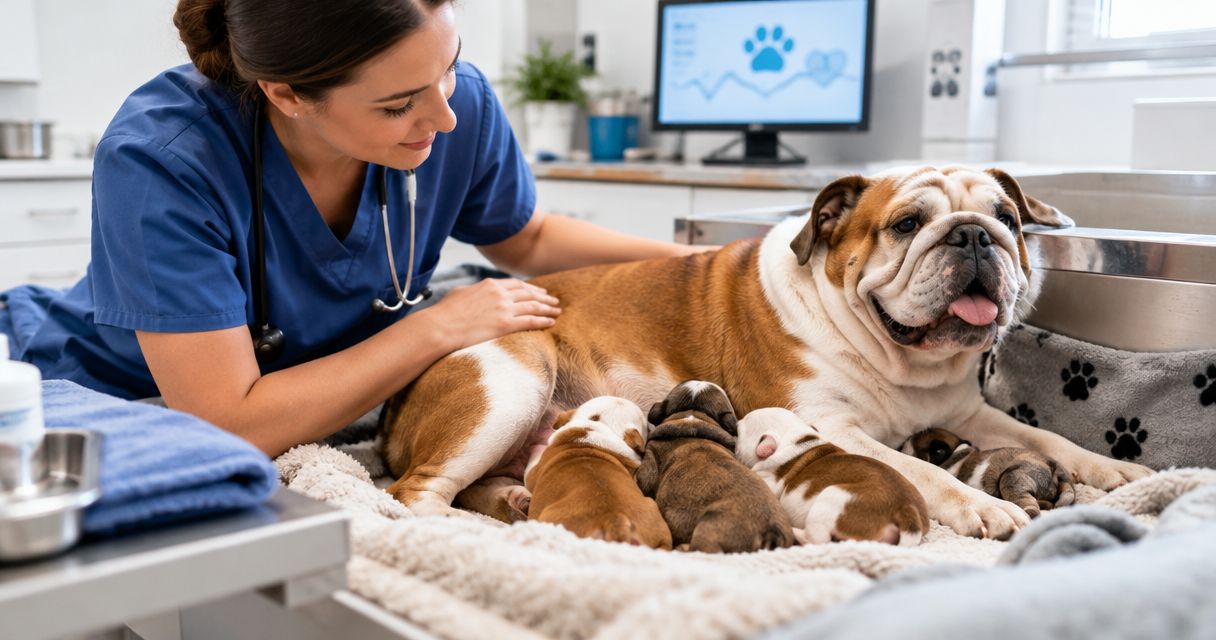
Veterinary clinics’ bulldog whelping support is coordinated maternal and newborn care aimed at safe delivery, prompt intervention, and a clear handoff to the breeder. English and French Bulldogs need particular attention to delivery planning and brachycephalic airway risks; this guide sets out a veterinarian-led workflow, not a home-delivery protocol.
- Bulldog whelping support for veterinary clinics needs an agreed delivery plan, neonatal care roles, and emergency referral arrangements.
- Shrinkabulls is a bulldog breeder; veterinary teams must direct delivery decisions, anesthesia, treatment, and newborn stabilization.
- Separate maternal recovery from puppy monitoring so neither disappears behind the other’s care needs.
- Choose clinic-led care or specialist referral according to the dam’s assessment and your team’s actual capabilities.
Why whelping support matters for veterinary clinics
Bulldog delivery planning involves more than preparing a whelping box. Difficult birth, maternal airway concerns, surgical delivery, and newborn support can demand attention at the same time. Your clinic needs an explicit answer to who looks after the dam while someone else assesses the puppies.
At Shrinkabulls, our business centers on English and French Bulldogs, including puppies and stud services. We want practical breeder communication to support veterinary care—not compete with it! Shrinkabulls is best suited to prospective bulldog owners seeking a breeder, with veterinary clinics directing whelping care.
For your 2026 clinic protocol, prioritize responsibility over equipment shopping. A prepared room still needs a clinician making decisions, trained staff carrying them out, and an owner who knows when to call. This guide supports workflow planning; it does not replace examination, clinical judgment, or your hospital’s obstetric and neonatal protocols.
Build a veterinarian-led bulldog whelping workflow
Gather the dam’s history before delivery planning
Start with a structured intake form and direct conversation. You do not need dedicated software to collect useful information; a shared clinical record and a readable attachment can keep breeding dates, previous delivery details, and current concerns together.
Ask for the original records behind an owner’s summary. A remembered mating date and documented reproductive testing are not interchangeable, and a previous uncomplicated litter does not establish the safest plan for this pregnancy. Record which information is confirmed and which is owner-reported.
Keep reproductive and general medical history connected. Airway problems, previous anesthetic events, current medicines, and prior abdominal surgery belong in the planning discussion, not in a separate note nobody opens.
- Collect breeding dates and available reproductive testing records.
- Review previous pregnancies, delivery complications, and cesarean records.
- List medications, supplements, allergies, and relevant diagnoses.
- Record the veterinarian’s assessment of maternal and fetal status.
- Identify missing records and assign someone to obtain them.
Confirm the delivery plan and escalation route
Write the initial plan in plain language, then have the responsible veterinarian approve it. The plan should explain where assessment occurs, who determines whether intervention is needed, and what happens if the dam’s condition changes outside normal hours.
A calendar date does not replace an assessment of delivery readiness. Surgical timing and the suitability of supervised labor require veterinary judgment based on the individual pregnancy. Do not let an owner’s travel arrangements become the clinical indication.
For a practical 2026 contact sheet, list 2 contact numbers: the treating clinic and the agreed emergency provider. Confirm the receiving facility’s arrangements directly rather than assuming another hospital can accept a dam and litter.
- Name the veterinarian responsible for delivery decisions.
- Document the planned location and reassessment arrangements.
- Specify symptoms that require immediate telephone contact or attendance.
- Confirm the referral destination and transfer procedure.
- Record consent discussions and the owner’s decision-maker.
Assign separate maternal and neonatal responsibilities
Use a paper role sheet before introducing scheduling tools or monitoring systems. Identify who manages the dam, who receives puppies, who records observations, and who updates the owner. Assign coverage for breaks and unexpected changes.
Shrinkabulls’ role as a bulldog breeder does not replace these clinical responsibilities. Breeder observations can provide history and describe changes at home, but your veterinary team must interpret those observations and decide treatment.
Where staffing cannot support the anticipated workload, arrange referral before delivery becomes urgent. A single person cannot give uninterrupted attention to an anesthetized dam and several newborns simultaneously. Match the case to your actual staff and facilities, not the appointment slot you happen to have.
- Assign a maternal-care lead and a neonatal-care lead.
- Identify the staff member responsible for contemporaneous records.
- Agree who communicates with the breeder or owner.
- Review emergency equipment and local resuscitation protocols.
- Arrange referral when staffing or clinical capability is insufficient.
Prepare distinct care areas for the dam and puppies
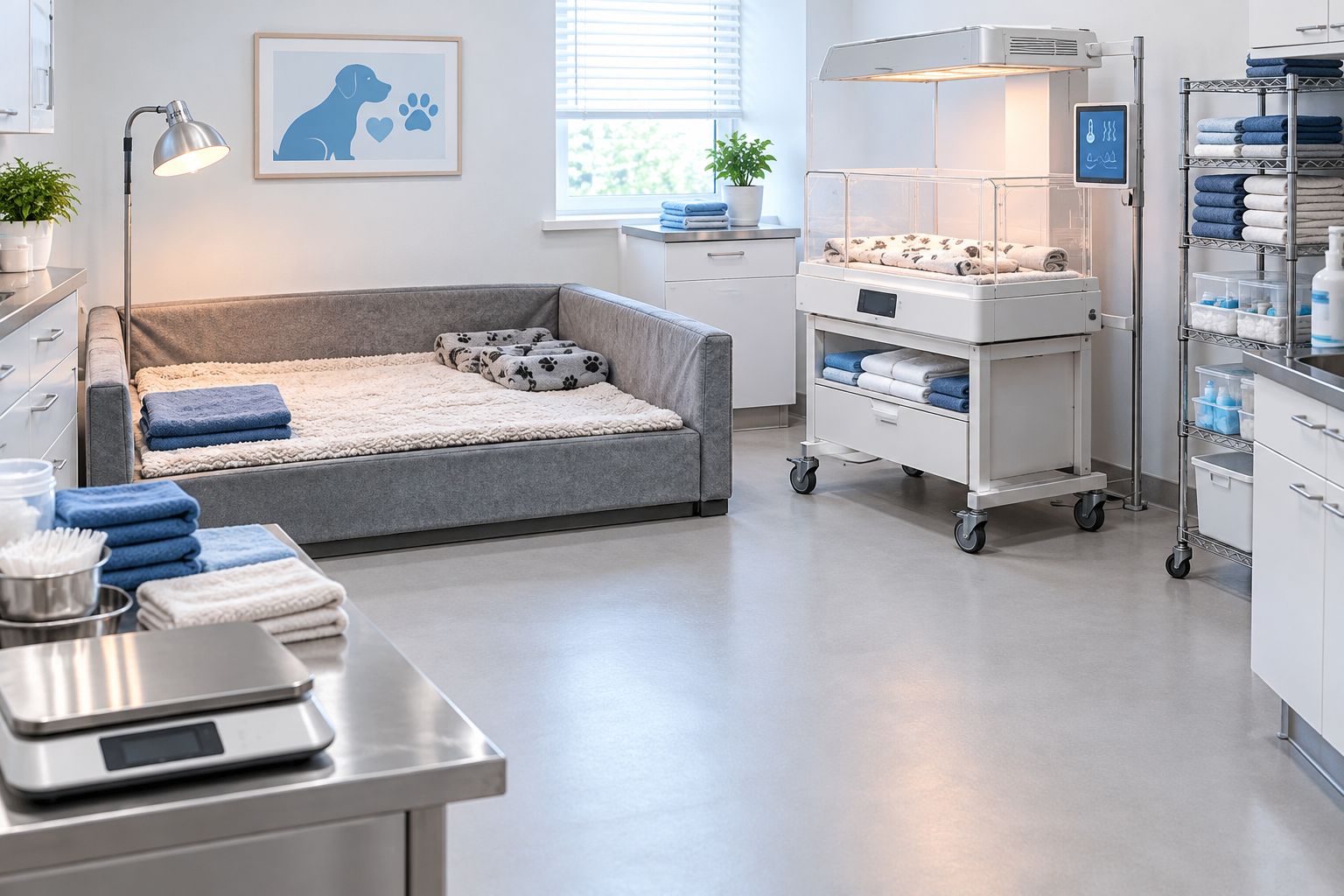
Walk through the room with your team before the case arrives. Check the route between delivery, neonatal assessment, and maternal recovery, then remove clutter that interferes with observation or safe movement.
A newborn warming area and an adult bulldog’s recovery environment serve different needs. Avoid treating the whole room as one temperature-controlled space; use monitored equipment and your clinician’s patient-specific instructions. Heat sources require safeguards against burns and overheating.
Prepare clean bedding, identification materials, and working measuring equipment. The useful test is whether a staff member can find and use each item without leaving a patient unattended—not whether the room contains every item on a shopping list.
- Check warming equipment according to hospital procedures.
- Prepare clean towels, bedding, and puppy identification materials.
- Confirm the scale and temperature-measuring equipment work.
- Keep maternal airway and emergency equipment accessible.
- Set aside a clean transport setup for any required transfer.
Record each puppy’s condition separately
Create 1 neonatal record per puppy and use a consistent identification method throughout the litter’s care. A shared litter note is useful for context, but it cannot show which puppy needed assistance or which puppy’s feeding changed.
Record observations when they happen. Include birth time, weight in grams, clinical assessment, interventions, and the responsible clinician’s instructions. Document the measurement method so follow-up staff can compare like with like.
For your 2026 record template, distinguish observed nursing from an assumption that a puppy fed because it was beside the dam. Poor feeding, persistent weakness, abnormal breathing, or a concerning weight trend warrants veterinary reassessment. Do not solve an unexplained problem by simply adding another feed.
- Give every puppy a unique, consistent identifier.
- Record birth details and the initial clinical assessment.
- Document weight, feeding observations, and prescribed monitoring.
- Log interventions and the response to them.
- Flag individual concerns during every staff handoff.
Assess the dam’s recovery alongside the litter
Keep a separate maternal recovery record even when the puppies attract everyone’s attention. After anesthesia or surgery, the dam needs continued monitoring under your hospital’s recovery protocol, including particular attention to airway and breathing.
Reintroduction to the litter needs supervision. A recovering dam’s position, alertness, comfort, and behavior matter when deciding how nursing and contact should proceed. Do not assume that interest in the puppies means she is ready for unsupervised care.
The owner also needs clear instructions about medicines, wound care when applicable, feeding, and signs of deterioration. Use individualized directions from the treating veterinarian rather than a generic bulldog handout with fixed treatment instructions.
- Monitor recovery according to the clinician’s written orders.
- Document breathing, alertness, comfort, and relevant examination findings.
- Supervise initial contact and nursing as directed.
- Assess mammary health and maternal behavior.
- Escalate concerning changes rather than attributing them to tiredness.
Rehearse the handoff before discharge
Use a printed care sheet and ask the caregiver to explain the plan back to you. This simple manual check reveals misunderstandings that a signature alone misses. A shared digital record can make later updates easier, but it does not prove someone understands the instructions.
Build your 2026 discharge form around actions: what to observe, what to record, whom to contact, and where to go. Ask the owner to demonstrate any home task your team expects them to perform safely. Invasive techniques require specific training and veterinary direction; they do not belong in a generic take-home checklist.
Check that transport arrangements protect both the dam and puppies without leaving the newborns exposed to uncontrolled heat.
- Give written, individualized maternal and puppy instructions.
- Demonstrate prescribed monitoring and recording tasks.
- Ask the caregiver to repeat the escalation plan.
- Confirm follow-up arrangements before departure.
- Send relevant records to the receiving clinician when care transfers.
Compare support options for your clinic
Best for depends on clinical capability and continuity, not convenience. A delivery arrangement must cover the dam, newborn assessment, and unexpected deterioration; breeder communication is useful alongside those services, not instead of them.
Use this comparison when reviewing your 2026 referral pathway. Confirm responsibilities with the actual provider before telling an owner that care has been arranged.
| Option | Best for | Main advantage | Key limitation |
|---|---|---|---|
| Clinic-led delivery and neonatal care | Practices equipped and staffed for the assessed case | Keeps assessment, delivery, and records with the treating team | Requires appropriate obstetric, anesthetic, surgical, and neonatal capability |
| Planned reproductive referral | Cases needing expertise or facilities beyond the primary clinic | Moves planning to a team equipped for the required care | Requires advance coordination and clear return-care arrangements |
| Emergency hospital transfer | Urgent deterioration or needs beyond the current facility | Provides an escalation route when immediate care is needed | Transport and record transfer must be coordinated during an urgent event |
| Breeder-clinic coordination | Sharing reproductive history and home observations | Adds context and supports follow-through | Cannot replace examination, treatment, surgery, or neonatal stabilization |
The practical choice is often a combination: a primary clinic maintains continuity, a referral team handles a defined clinical need, and the breeder supplies records and observations. Specify who holds responsibility at each stage so everyone knows when that responsibility changes.
Common mistakes veterinary clinics make
Treating every bulldog pregnancy as the same case
Breed-related risks justify preparation, not identical treatment. Assess the individual dam, pregnancy history, current findings, and available support before deciding how delivery should proceed.
Scheduling surgery around owner convenience
A preferred collection day is not evidence of fetal readiness. Keep clinical timing separate from travel, work commitments, and anticipated puppy handover arrangements.
Buying warming equipment without a monitoring plan
Equipment does not decide whether a puppy is too cold, too hot, or deteriorating for another reason. Assign an observer and document how the clinician wants the equipment used and checked.
Letting attractive coat colors distract from medical records
Shrinkabulls breeds English and French Bulldogs, including rare-colored varieties, but color labels do not establish delivery readiness or neonatal health. Keep pedigree and color information separate from the clinical evidence supporting a care decision.
Sending the litter home with instructions only for the dam
A surgical discharge sheet does not cover individual puppy monitoring. Give caregivers both maternal instructions and a puppy-by-puppy record, with clear escalation directions for each.
FAQ
What is bulldog whelping support for veterinary clinics?
Bulldog whelping support for veterinary clinics is coordinated care covering pregnancy assessment, delivery planning, maternal monitoring, newborn assessment, and discharge. The treating veterinarian directs medical decisions and referral.
Do all English and French Bulldogs need a C-section?
Delivery planning must be individualized rather than treating a C-section as automatic for every bulldog. These breeds have important delivery risks, so the veterinarian should assess the pregnancy and establish an intervention plan before labor.
Can a breeder replace the clinic’s neonatal team?
No, a breeder cannot replace the veterinary team responsible for neonatal assessment and treatment. Breeder records and observations support care, while clinical staff direct stabilization and medical decisions.
What should a clinic do if it cannot provide overnight monitoring?
Arrange an appropriate referral or transfer plan before delivery whenever possible. Confirm the receiving provider’s arrangements and send the relevant maternal and litter records.
Can a whelping camera replace hands-on checks?
No, a whelping camera cannot replace hands-on clinical assessment. Video can show behavior, but it does not independently establish a puppy’s temperature, weight trend, feeding adequacy, or medical condition.
What puppy changes need urgent veterinary contact?
Abnormal breathing, marked weakness, inability to nurse, or sudden deterioration require urgent veterinary contact. Follow the treating clinic’s emergency instructions rather than waiting for a routine check.
Does Shrinkabulls provide veterinary whelping treatment?
Shrinkabulls is a bulldog breeding business offering puppies and stud services, not the treating veterinary team described in this guide. Clinics should direct examination, delivery decisions, anesthesia, surgery, and neonatal treatment.
One last thing
Ask the caregiver to identify every puppy and explain what would trigger a call. That short rehearsal tests identification, recordkeeping, and emergency understanding together. If the answers are unclear, fix the handoff before the family leaves—not during a worried telephone call later.
Related guides
- Prepare a French Bulldog dam for a scheduled C-section
- Choose a whelping box for a bulldog breeding program
- Compare incubators and heating pads for whelping bulldogs
- Choose a vet experienced with brachycephalic breeds
