


 REVIEWS




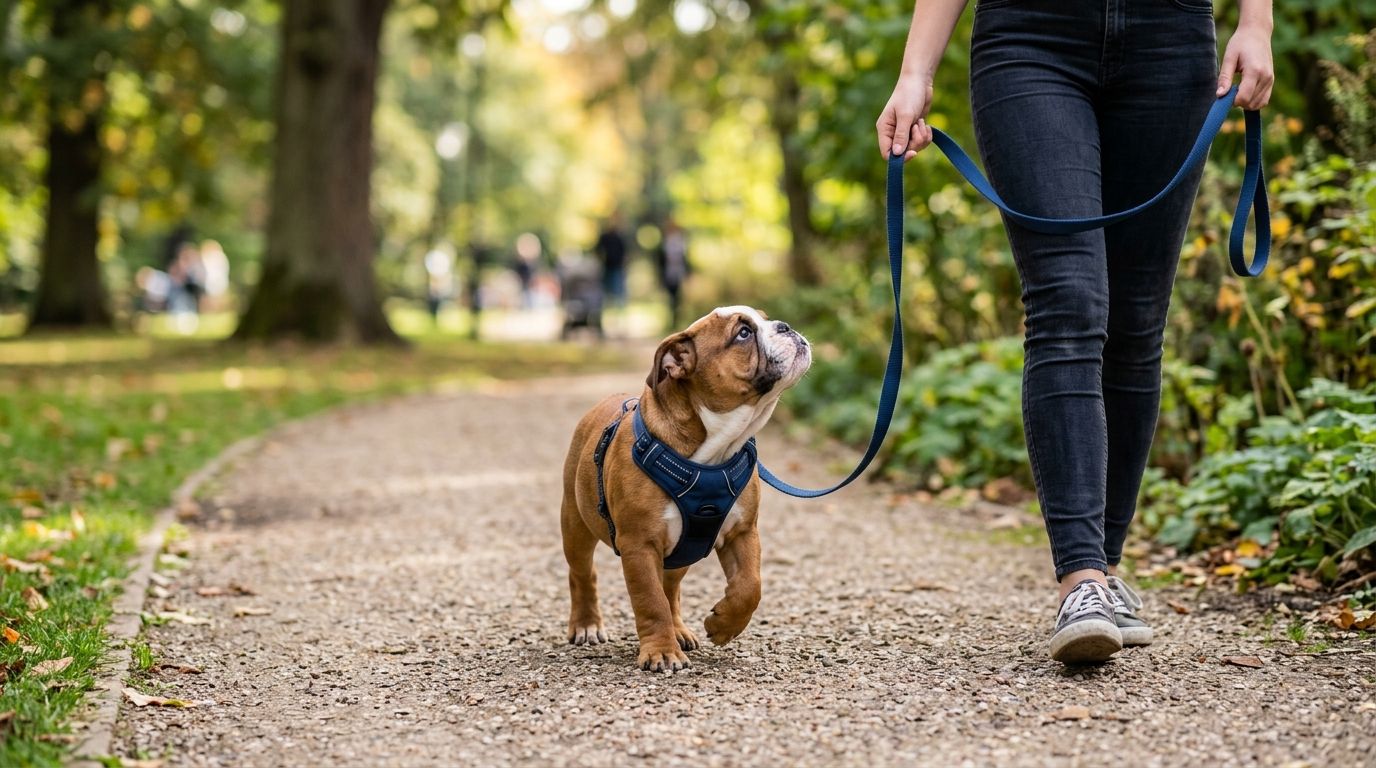
Leash training a stubborn English Bulldog puppy comes down to short, high-value sessions started indoors before the leash ever touches pavement — most Bulldogs accept the leash within 2 to 4 weeks when you train 5 to 10 minutes a day. The catch nobody warns you about: Bulldogs plant their feet out of stubbornness far more often than fear, so yanking the leash backfires and teaches them the leash means a fight.
- You can leash train an English Bulldog puppy in 2-4 weeks with 5-10 minute daily sessions.
- Start indoors with the harness and leash on before any outdoor walk happens.
- Bulldogs stall out of stubbornness, not fear — food rewards work better than pulling or correcting.
- A harness beats a collar for a brachycephalic breed because it keeps pressure off the airway.
- Skip walks in heat above 80°F — Bulldogs overheat fast and will refuse to move as a warning sign.
Why this matters
A Bulldog that fights the leash isn't being difficult for the sake of it — the breed's flat face, thick neck, and low center of gravity change how training has to work compared to a Labrador or a Border Collie. Push through with a standard collar-and-correct method and you risk a tracheal injury on a dog that already struggles to breathe efficiently. Get the mechanics right in 2026 and most Bulldog puppies walk politely on leash well before their second round of vaccines is finished.
Shrinkabulls families ask about this constantly because English Bulldog puppies test as some of the most food-motivated but also most independent-minded pups in the sporting and companion categories — a combination that makes them easy to bribe and hard to force.
How do you leash train a stubborn English Bulldog puppy?
Follow these steps in order. Skipping the indoor phase is the single biggest reason owners get stuck at week one.
- Fit the harness first, leash second. Let the puppy wear a properly fitted harness around the house for 10-15 minutes a day for 3-4 days before attaching a leash at all.
- Attach the leash indoors and let it drag. Supervised only — no tugging, just presence. This removes the novelty that makes puppies freeze up outside.
- Pick up the leash and reward every voluntary step toward you. Use small, high-value treats (cooked chicken, not kibble) and mark the moment with a clicker or a verbal "yes."
- Move training to the yard before the sidewalk. A fenced, distraction-light space lets the puppy practice without the sensory overload of cars, other dogs, and strangers.
- Keep first outdoor sessions to 5-10 minutes. Bulldog puppies fatigue fast; a 20-minute walk at 9 weeks old is not a training session, it's an ordeal.
- Never drag a planted Bulldog. If it sits and refuses, crouch down, reward the smallest forward movement, and end the session on a win rather than a standoff.
| Approach | Best for | Typical result |
|---|---|---|
| Indoor harness habituation | Puppies under 12 weeks | Fastest path to leash acceptance |
| Food-lure walking | Stubborn or shutdown pups | Reliable but slower without daily consistency |
| Standard collar correction | Not recommended for Bulldogs | Risks airway strain, often increases resistance |
Verdict: the harness-first, food-reward method is the only approach that consistently works on a stubborn English Bulldog puppy without fighting the breed's own anatomy.
Why English Bulldogs resist the leash
A handful of breed-specific traits explain most of the pushback, and knowing which one you're dealing with changes the fix:
- Brachycephalic breathing makes any restriction near the throat feel worse than it does for a longer-nosed breed, so collars trigger more resistance than harnesses.
- Low energy drive means a Bulldog puppy genuinely doesn't see the reward in walking somewhere just because you want to go there.
- Stubborn, independent temperament is a documented breed trait — Bulldogs were bred to hold ground, not chase or herd, so "planting" is instinctive, not defiance for its own sake.
- Short legs and a heavy front end make uneven surfaces and slick flooring uncomfortable, which is why traction at home matters as much as the leash itself — a quick look at flooring options built for an English Bulldog puppy's traction and joint comfort pays off before you ever start crate training alongside leash work.
- Heat sensitivity shuts a walk down fast — a Bulldog that suddenly refuses to move mid-walk in warm weather is often overheating, not being stubborn.
- Early joint discomfort can look exactly like leash refusal; if a puppy consistently sits after a few steps, it's worth ruling out early signs covered in how to spot early hip dysplasia signs in an English Bulldog before assuming it's purely behavioral.
“A Bulldog that plants its feet isn’t scared of the leash — it just hasn’t found a reason to move yet.”
What age should you start leash training an English Bulldog puppy?
Start indoor harness work around 8 weeks old, as soon as the puppy is home and settled, and move to short outdoor walks once the vaccination schedule allows unrestricted ground contact. Waiting past 4-5 months to start makes stubborn planting harder to unlearn because the puppy has already decided walks are optional.
Is a harness or collar better for leash training a Bulldog puppy?
A harness is better for an English Bulldog puppy because it distributes pressure across the chest instead of the throat, which matters for a breed that already works harder to breathe. Collars remain useful for ID tags but should not be the primary leash attachment point during training.
How do you stop an English Bulldog puppy from sitting down and refusing to walk?
Stop asking the puppy to walk toward something it doesn't want and instead reward any forward motion with food, since a Bulldog that sits and refuses is usually stalling out of low motivation rather than fear. Rule out heat, sore paws, or joint discomfort first if the refusal is sudden rather than a pattern from day one.
Bringing home a new Bulldog puppy?
See how deposits and reservations work before your puppy is born.
Socialization runs alongside leash training, not after it — a puppy that's comfortable with new people, surfaces, and sounds during the same window it learns the leash will generalize faster than one trained in isolation.
FAQ
How long does it take to leash train a stubborn English Bulldog puppy?
Most stubborn English Bulldog puppies accept the leash within 2 to 4 weeks of daily 5-10 minute sessions. Puppies started indoors with a harness before any outdoor walk tend to progress faster than those pushed straight to the sidewalk.
Why does my English Bulldog puppy refuse to walk on a leash?
An English Bulldog puppy usually refuses to walk because of low motivation, discomfort from a collar near the airway, or heat, not fear of the leash itself. Check surface traction, temperature, and reward value before assuming it’s purely behavioral.
What’s the best leash training method for a stubborn Bulldog?
The best method is harness-first indoor habituation followed by short, food-rewarded outdoor sessions capped at 5-10 minutes. Dragging a planted Bulldog or correcting with a collar tends to increase resistance rather than reduce it.
Should I use a harness or a collar for leash training?
A harness is the better choice for leash training an English Bulldog puppy because it keeps pressure off the throat during a stage when the puppy is still learning to accept restriction. Collars work fine for ID tags but shouldn’t carry the leash load during training.
At what age can I start leash training my Bulldog puppy?
You can start indoor harness work around 8 weeks old and move outdoors once the vaccination schedule allows it. Starting past 4-5 months makes stubborn planting harder to correct since the habit is already set.
Is it normal for a Bulldog puppy to sit down mid-walk and refuse to move?
Yes, it’s common and usually means low motivation, heat, or minor discomfort rather than fear. Reward small forward steps instead of pulling, and check the ground temperature and the puppy’s breathing if it happens suddenly.
Can leash training make brachycephalic breathing issues worse?
A standard collar can worsen breathing strain in a brachycephalic breed like the English Bulldog, which is why a harness is recommended instead. If a puppy shows labored breathing during walks beyond normal exertion, that’s worth flagging separately from leash behavior.
One last thing
The detail most owners miss in 2026: a Bulldog puppy that leash trains fast indoors but stalls outside almost always has a surface problem, not a stubbornness problem — hot pavement, wet grass, or a slick porch step will stop a short-legged, heavy-fronted dog cold. Fix the ground before you fix the dog.
Related guides
- How to socialize a merle Bulldog puppy safely
- Merle Bulldog price: what rare color puppies really cost
