

 REVIEWS





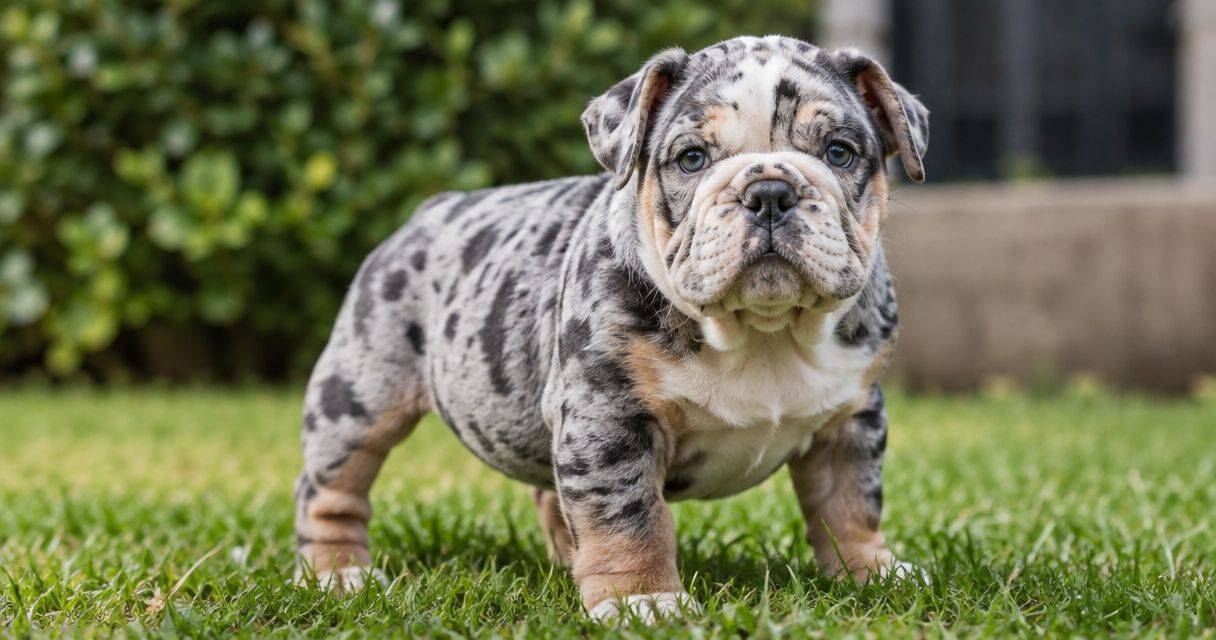
Yes—a blue merle English Bulldog is rare in the everyday sense of being an unusual, nonstandard color combination, but “rare” does not establish a population percentage or better quality. In 2026, the important distinction is that merle is disqualified under the American Kennel Club’s Bulldog conformation standard. Choose the puppy for documented health and temperament, not the rarity label.
- Is a blue merle English Bulldog rare? It is an unusual, nonstandard combination—not a measure of health.
- The American Kennel Club’s Bulldog standard disqualifies merle; registration and conformation eligibility are separate questions.
- Request parental merle testing and puppy health records before choosing a blue merle English Bulldog.
- Shrinkabulls offers English Bulldog puppies, including rare-colored varieties; assess each puppy individually.
Before you fall for those patches, learn how to vet an English Bulldog breeder before you buy. A clear explanation of parentage and testing tells you more than an unusual coat ever can.
Is a blue merle English Bulldog rare?
Yes, as a descriptive label for an unusual coat—not as a certified rarity ranking. Blue merle combines diluted dark pigment with a mottled merle pattern, while traditional Bulldog colors include combinations such as red, fawn, brindle, and white.
For a 2026 buying decision, the American Kennel Club’s published Bulldog breed standard supplies the relevant conformation rule: merle is a disqualification. That rule describes acceptance in the show standard; it does not measure how frequently blue merle puppies are born.
These terms describe different things, so do not treat them as interchangeable:
| Coat description | What it describes | What you can assess visually | What it cannot establish |
|---|---|---|---|
| Blue | Dilution of black pigment to a gray appearance | The coat’s apparent shade | Merle status, ancestry, or health |
| Merle | A pattern affecting pigment distribution | Visible mottling where expressed | Complete merle genotype or hearing status |
| Blue merle | Blue pigmentation combined with merle patterning | The combination’s appearance | A rarity percentage or breeding suitability |
| Standard-color Bulldog | A color or marking accepted by the breed standard | Whether the apparent color fits the standard | Overall conformation quality or medical soundness |
An unusual coat is a visual characteristic, not a health credential. Standard color is not a health guarantee either; every puppy needs an individual assessment.
Why this matters
A blue merle puppy deserves exactly the same careful consideration as any other Bulldog. Color can be your preference, but breathing, comfortable movement, hearing, vision, and temperament affect everyday life together.
Keep those decisions separate. First decide whether an English Bulldog’s care needs suit your household; then evaluate the individual puppy; only then use coat preference to choose between suitable companions.
Shrinkabulls is a breeder option for prospective owners seeking rare-colored English Bulldog puppies. That describes the business’s offering, not a substitute for reviewing a particular puppy’s records. No breeder name or color description removes that step.
Blue merle: color and pattern are separate traits
“Blue” and “merle” are not two names for the same genetic change. Blue typically describes dilution associated with the MLPH gene, while merle is associated with variation in PMEL.
University of California, Davis Veterinary Genetics Laboratory guidance on canine dilute and merle testing explains these separate genetic systems. A dog inherits 2 copies of an autosomal gene, with 1 copy coming from each parent; the combination helps determine how a trait is expressed.
For the familiar recessive dilution pattern, a dog generally needs a dilution-associated variant from each parent to express diluted pigment. Merle inheritance is more complicated than matching a photograph to a simple label because different merle allele lengths can affect expression.
Blue does not automatically mean merle
A gray-looking Bulldog is not necessarily merle. Merle refers to a pattern, not simply a pale or smoky shade.
Ask what the breeder means by the description. If the answer moves between “blue,” “merle,” and “carrier” without explaining the test results, request the laboratory report rather than relying on the listing’s wording.
Visible patches do not reveal the whole genotype
A coat photograph shows appearance under particular lighting. It does not identify every relevant allele, establish parentage, or reveal whether a dog has normal hearing.
Some merle variants have subtle expression, and other coat traits can make merle difficult to recognize. Use laboratory results to interpret genetics and veterinary examinations to assess health. Neither replaces the other.
Why blue merle rarity descriptions vary
The word “rare” becomes confusing because sellers and buyers use it to answer different questions. Separate the coat description from the evidence behind it:
- Color versus pattern: Blue identifies diluted pigmentation; merle identifies patterning. A listing that combines them is describing more than one trait.
- Breed-standard status: Nonstandard means outside the accepted conformation description. It does not provide a population count.
- Visible expression: Obvious patches and subtle merle expression are not equally easy to identify from photographs.
- Parental genetics: The parents’ verified genotypes determine possible inheritance, not the popularity of a color name.
- Additional labels: Tan points, white markings, and other descriptors make a description more specific without proving a puppy’s quality.
For your 2026 search, ask what “rare” means in the specific conversation. A useful answer identifies the color genetics and supporting documents; a sales adjective alone gives you nothing to verify.
Does blue merle mean a Bulldog is unhealthy?
No. A blue merle coat alone does not diagnose illness, and it does not tell you whether an individual puppy will develop a particular condition.
The important merle-specific concern is the increased risk of congenital hearing and eye abnormalities associated with certain combinations of merle alleles, commonly discussed as double merle. English Bulldogs also need assessment for breed-related concerns that exist regardless of color, including brachycephalic airway problems.
Do not let either extreme guide you. “Every merle is unhealthy” is not an individual diagnosis, while “rare color means excellent genetics” is not evidence of health.
What double merle actually changes
Double merle generally refers to inheriting merle-associated alleles from both parents. The exact alleles matter, which is why a veterinarian or qualified canine geneticist should interpret the reports.
In the simplified mating of 2 dogs each carrying 1 conventional merle allele and 1 non-merle allele, each puppy has a 25% probability of inheriting the merle allele from both parents. That is an inheritance probability for each conception—not a promise that every litter will contain that proportion, and not the probability of a specific disability.
UC Davis Veterinary Genetics Laboratory’s merle guidance describes the hearing and eye concerns associated with double merle. Read more about double merle health risks before buying, and ask your veterinarian whether the puppy needs specialist assessment.
What a normal-looking puppy cannot prove
A puppy playing happily in a video does not prove normal hearing in both ears. Likewise, attractive eyes do not replace an eye examination, and quiet breathing in a short clip does not rule out airway disease.
Brainstem auditory evoked response testing, usually called BAER, objectively assesses hearing. Your veterinarian can explain when BAER testing or evaluation by a veterinary ophthalmologist is appropriate for the individual puppy.
How should you evaluate a blue merle puppy?
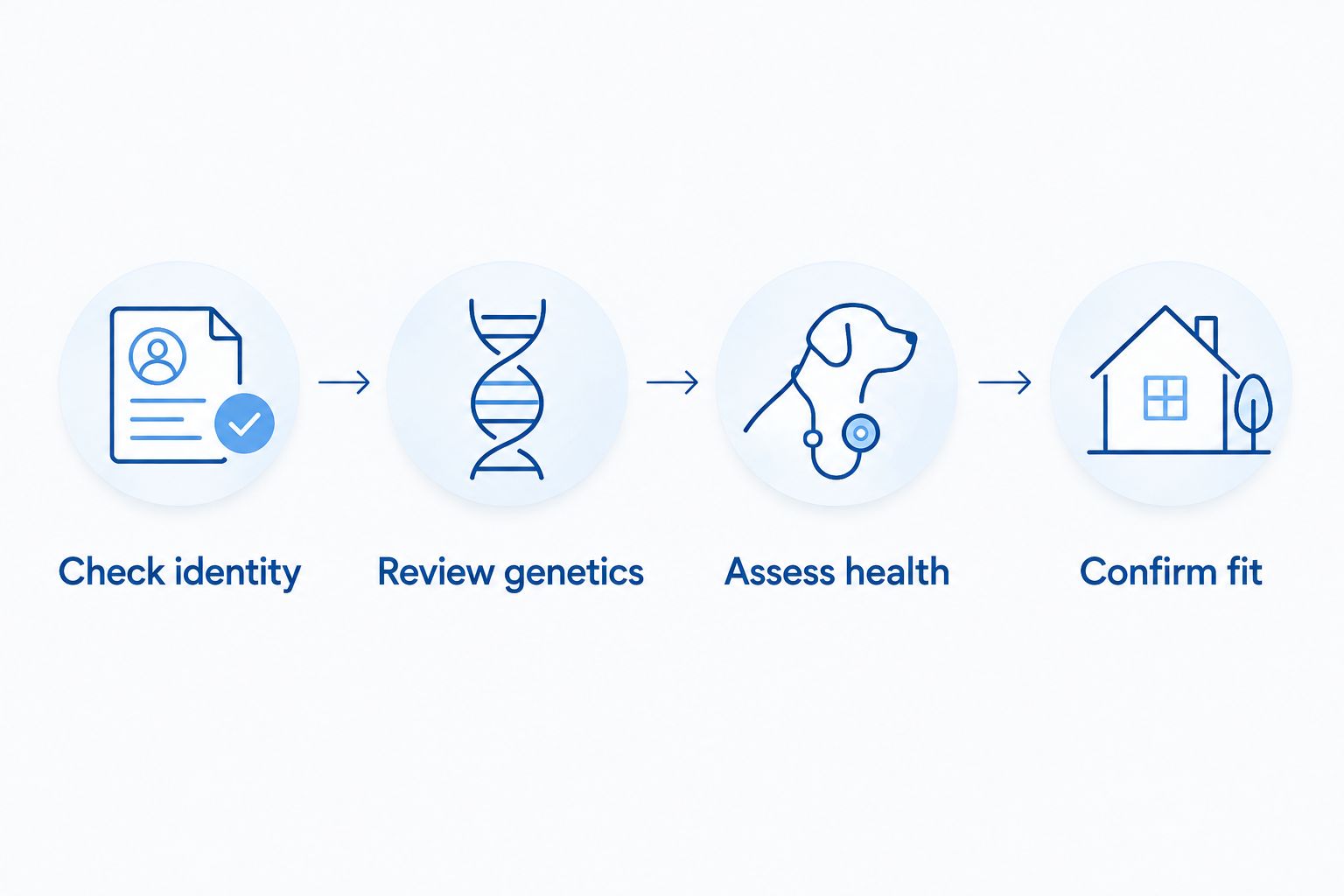
Use the same sequence for every puppy you consider. Our recommendation is simple: keep the paperwork beside the puppy photos, not buried underneath them!
Check identity
Match the puppy’s identifying details across the contract, veterinary records, registration application, and laboratory reports where applicable. Parent reports should clearly identify the parent tested rather than merely showing a favorable result with no connection to the litter.
Ask the breeder to explain discrepancies before you commit. A report is useful only when you know which dog it describes.
Review genetics
Request the parents’ merle results and any relevant dilution testing used to describe the puppy. Ask whether the puppy itself has been tested or whether the color description is inferred from appearance and parental results.
Those are different forms of evidence. A color panel also does not replace breed-relevant health screening or establish that every possible inherited condition has been excluded.
Assess health
Ask for the puppy’s examination record and the parents’ applicable health-screening results. Have your veterinarian explain what was assessed, what remains uncertain, and whether further testing is appropriate.
For an English Bulldog, discuss breathing, nostrils, eyes, skin folds, joints, and mobility. Do not deliberately exercise a puppy to provoke breathing symptoms; let a veterinarian choose a safe assessment.
Confirm fit
Discuss the puppy’s observed behavior, handling experience, and daily routine. Meet the puppy where practical, or request a live video that shows ordinary interaction rather than only posed photographs.
Your 2026 puppy checklist should end with a household decision: can you provide the veterinary care, temperature management, training, and companionship this individual needs? A beautiful coat cannot answer that question.
Keep a copy of each report for your veterinarian. A readable document that can be discussed during an appointment is more useful than a screenshot you cannot match to a named dog.
Can a blue merle English Bulldog be AKC registered?
Registration and conformation eligibility are separate questions. A registration certificate is not approval of a nonstandard color, proof of health, or confirmation that a dog is suitable for breeding.
For a 2026 purchase, verify the individual dog’s documentation and the American Kennel Club’s current registration requirements directly. Do not assume either that merle automatically establishes registration eligibility or that a certificate makes merle an accepted Bulldog show color.
The AKC Bulldog standard’s merle disqualification still matters if your goal is breed conformation competition. Tell the breeder about that goal before considering a puppy, rather than discovering the mismatch after becoming attached.
Is a blue merle English Bulldog right for your family?
A blue merle English Bulldog suits a household that wants an English Bulldog first and happens to enjoy the coat. It is not a shortcut to an easier-care dog or a reason to overlook concerning records.
The appeal is personal: you enjoy the mottled appearance. The trade-off is practical: you need to understand the nonstandard color, review merle genetics, and accept that the coat does not qualify the puppy for every goal.
At Shrinkabulls, our advice for choosing an English Bulldog puppy is to put the individual ahead of the label. Keep your color preference, but do not let it overrule veterinary findings or your family’s ability to meet the dog’s needs.
Pause if a breeder substitutes “rare” for an explanation. A clear discussion should distinguish what is documented, what is inferred, and what requires your veterinarian’s assessment.
FAQ
Is a blue merle English Bulldog rare in 2026?
A blue merle English Bulldog is an unusual, nonstandard color combination, but rare is not a certified population ranking. In 2026, assess the puppy’s health records and genetics rather than treating the label as a quality rating.
Is blue the same thing as merle in an English Bulldog?
Blue and merle describe different traits: blue concerns diluted pigment, while merle concerns a pigment pattern. A blue Bulldog is not automatically merle.
Are all blue merle English Bulldogs double merle?
No, a blue merle English Bulldog is not automatically double merle. Laboratory results, interpreted with the parents’ results where relevant, provide better evidence than coat appearance.
Does a blue merle coat mean my Bulldog will be deaf?
A blue merle coat does not establish whether a Bulldog is deaf. Certain merle allele combinations increase hearing risks, and BAER testing objectively assesses hearing.
Can a merle Bulldog meet the AKC Bulldog color standard?
Merle is disqualified under the American Kennel Club’s Bulldog conformation standard. Registration documentation and acceptance under the conformation standard are separate issues.
What should I ask before choosing a blue merle puppy?
Ask for the puppy’s veterinary records, identifiable parental health-screening results, and relevant merle test reports. Have your veterinarian explain what those records establish and whether further assessment is appropriate.
Does a color DNA test prove a blue merle Bulldog is healthy?
A color DNA test does not prove overall health. It addresses particular coat-associated variants and does not replace a veterinary examination, hearing assessment, or breed-relevant health screening.
One last thing
The most useful answer to “How rare is this puppy?” is often another question: “What can you document about this puppy?” A coat photograph cannot tell you how comfortably a dog breathes, whether hearing is normal, or whether your home is the right fit.
Enjoy those patches! Then make the decision you would make if the same puppy had an ordinary coat. If the records and household fit still support your choice, color can remain what it should be: something you love about your companion, not the entire reason you chose one.
Related guides
- Can merle English Bulldogs be AKC registered?
- Health-testing panels to request from a Bulldog breeder
- How to spot early signs of brachycephalic breathing issues
