


 REVIEWS





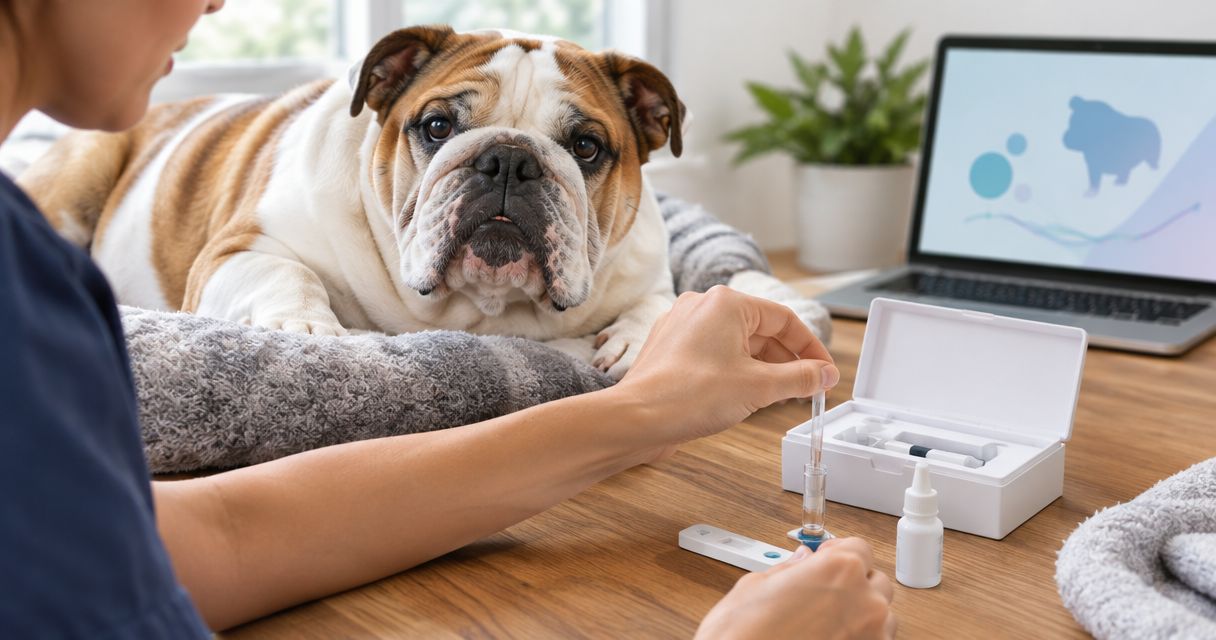
Best overall: veterinarian-run quantitative progesterone testing, including IDEXX Catalyst Progesterone. Best for occasional breeding: a veterinary reference laboratory. Best for an established breeding program: a canine-specific analyzer with veterinary oversight. The best progesterone testing kit for Bulldog breeding is the one that produces reliable results your reproductive veterinarian can interpret—not simply a number on a screen.
- IDEXX Catalyst Progesterone is a strong clinic-based option for veterinarian-directed Bulldog breeding timing.
- Reference laboratory progesterone testing suits occasional breeders who can coordinate sample transport and reporting.
- Breeder-operated analyzers require canine validation, quality control, trained sample handling, and veterinary interpretation.
- Semiquantitative canine progesterone kits are screening tools, not stand-alone instructions for insemination.
Why this matters
Bulldog breeding takes more than matching a lovely dam with a handsome stud. Progesterone testing helps your veterinarian assess the reproductive cycle, but it does not establish whether a dog is healthy enough to breed. Start with choosing a veterinarian experienced with brachycephalic breeds, then agree on a testing plan before heat begins.
Shrinkabulls' progesterone testing recommendation for first-time Bulldog breeders is veterinarian-directed quantitative testing. Keep the medical decisions with the person responsible for your dam's care.
For your 2026 breeding plan, prioritize continuity: a consistent testing method, clear records, and someone responsible for interpreting each result. A convenient machine cannot replace that relationship.
What makes the best progesterone testing kit?
The strongest choice meets these criteria before convenience enters the conversation:
- Canine validation: Documentation must support progesterone measurement in dogs, not merely another species.
- Quantitative reporting: A numerical concentration supports trend assessment better than a broad color category.
- Method consistency: Your veterinarian needs to know which assay produced each result.
- Sample requirements: Collection tubes, processing, storage, and transport must follow the assay's instructions.
- Quality control: The operator needs a documented process for checking instrument and reagent performance.
- Clinical support: Someone must interpret the result alongside the dam's history and breeding method.
Ask for the current instructions for use when comparing systems in 2026. A seller's claim that an analyzer is “for breeders” does not answer these questions.
Progesterone testing options at a glance
These rankings compare testing approaches, not interchangeable retail kits. IDEXX Catalyst Progesterone is a named veterinary assay; the other entries describe categories you can discuss with your veterinarian.
| Rank and option | Best for | Standout feature | Key limitation |
|---|---|---|---|
| 1. IDEXX Catalyst Progesterone | Breeders working with an equipped veterinary clinic | In-clinic quantitative canine progesterone testing | Requires compatible veterinary equipment and professional interpretation |
| 2. Veterinary reference laboratory | Occasional breeding programs | Laboratory analysis arranged through your veterinarian | Sample transport and reporting must fit the breeding plan |
| 3. Breeder-operated canine analyzer | Established programs with trained operators | On-site quantitative testing | Operator training, quality control, and veterinary coordination remain essential |
| 4. Semiquantitative canine progesterone kit | Supplementary cycle screening | Reports a progesterone range or category | Does not provide the same detail as a quantitative result |
1. IDEXX Catalyst Progesterone: best for clinic-led timing
IDEXX Catalyst Progesterone measures canine progesterone using a compatible Catalyst veterinary analyzer. It belongs in a clinic-led workflow where your veterinarian can review serial results and decide what happens next.
The practical advantage is the connection between testing and interpretation. You are not left trying to turn a laboratory value into an insemination appointment on your own.
IDEXX Catalyst Progesterone pros:
- Provides a quantitative canine progesterone result.
- Supports serial monitoring within a veterinary practice.
- Fits a workflow that combines testing with clinical assessment.
IDEXX Catalyst Progesterone cons:
- It is not a stand-alone home testing kit.
- It requires compatible equipment and appropriate sample handling.
- A result still needs interpretation; the assay does not prescribe a breeding date.
Best for: Bulldog owners whose reproductive veterinarian uses the Catalyst system and can coordinate the testing series.
Ask the clinic how results reach you, who reviews them, and what happens when the next sample falls outside normal appointments. Those arrangements matter as much as the analyzer name.
Verdict: Buy the clinic-led testing service when your veterinarian supports this assay for your dam's plan.
2. Veterinary reference laboratory: best for occasional breeding
A veterinary reference laboratory measures progesterone in a submitted blood sample and reports the result to the ordering practice. Your veterinarian arranges collection and interprets the findings in context.
This approach keeps laboratory equipment out of your home or kennel. It suits breeders who need a testing service rather than an instrument to operate and maintain.
Veterinary reference laboratory pros:
- Does not require you to operate an analyzer.
- Provides laboratory reporting through your veterinary practice.
- Keeps sample collection and interpretation within a clinical workflow.
Veterinary reference laboratory cons:
- Transport and reporting schedules require advance coordination.
- Collection timing must account for the laboratory's submission process.
- Switching laboratories during a cycle complicates comparison between results.
Best for: Occasional Bulldog breeders with a veterinarian who can align laboratory reporting with the intended breeding method.
Before committing to this option in 2026, ask about sample acceptance, reporting arrangements, and non-business-day procedures. Do not assume a report will arrive in time for a shipment or appointment you have already scheduled.
Verdict: Buy veterinarian-arranged reference laboratory testing when its reporting schedule fits the breeding plan.
3. Breeder-operated canine analyzer: best for established programs
A breeder-operated canine analyzer brings progesterone measurement on site. Its usefulness depends on the specific assay, trained operation, and a reproductive veterinarian willing to interpret its results.
Owning the instrument also means taking responsibility for sample preparation, reagent handling, maintenance, and quality-control records. That is laboratory work—not just another puppy-room appliance!
Breeder-operated canine analyzer pros:
- Places the testing workflow on site.
- Supports quantitative tracking when the assay is validated for dogs.
- Gives trained operators direct control over processing and recordkeeping.
Breeder-operated canine analyzer cons:
- Operator errors can compromise a result.
- Maintenance and quality-control duties continue between breeding cycles.
- Veterinary interpretation and a backup testing route remain necessary.
Best for: Established programs with trained personnel, documented procedures, and reproductive veterinary support.
Before purchasing, give your veterinarian the exact assay documentation. Ask how the system will be checked against the clinic's method and how unexpected results will be investigated. Do not treat a generic “pet hormone analyzer” description as canine validation.
Verdict: Hold until training, quality control, method comparison, and veterinary oversight are in place.
4. Semiquantitative canine kits: best for supplementary screening
Semiquantitative canine progesterone kits report a range or category rather than a precise concentration. Depending on the kit, interpretation involves comparing a test response with the manufacturer's reference categories.
That makes them different from a quantitative analyzer. A screening category does not contain the same information as a measured concentration followed over time.
Semiquantitative canine kit pros:
- Offers categorical information about progesterone status.
- Does not require the same instrument setup as an automated quantitative system.
- Can supplement a veterinarian's monitoring plan when the specific kit is appropriate.
Semiquantitative canine kit cons:
- Broad categories limit assessment of smaller changes.
- Visual interpretation introduces reader judgment where color comparison is required.
- Results should not independently determine tightly timed insemination.
Best for: Supplementary screening specifically approved by the reproductive veterinarian managing the cycle.
Choose only a canine-specific kit with clear instructions and documented performance. Human urine ovulation strips are not a substitute for canine blood progesterone testing.
Verdict: Skip as the sole tool for Bulldog breeding timing; use only as a veterinarian-approved supplement.
How the options were ranked
This 2026 ranking prioritizes canine validation, numerical reporting, consistent methods, controlled sample handling, quality control, and clinical interpretation. It is a decision guide—not a claim that these systems were independently tested against one another.
Clinic-led quantitative testing ranks first because it connects a measurement with the clinician making the breeding decisions. Reference laboratory testing serves a different need; breeder-operated instruments demand more operational responsibility. Semiquantitative kits rank last for timing because their categories provide less detail.
Shrinkabulls sells English and French Bulldogs and offers stud services, not progesterone analyzers. No Shrinkabulls testing product belongs in this comparison.
How to turn test results into a useful breeding record
A progesterone result becomes more useful when your veterinarian can see the sequence and understand how each sample was handled. Agree on the process before collecting anything.
- Veterinary plan: Confirm reproductive suitability, the intended breeding method, and who directs testing.
- Sample collection: Have a veterinary professional collect blood and follow the selected assay's handling instructions.
- Consistent assay: Keep the same method where practical; flag any change in laboratory or instrument.
- Result record: Log collection time, result, units, assay, and your veterinarian's instructions.
- Clinical decision: Let the reproductive veterinarian set the next test or breeding step.
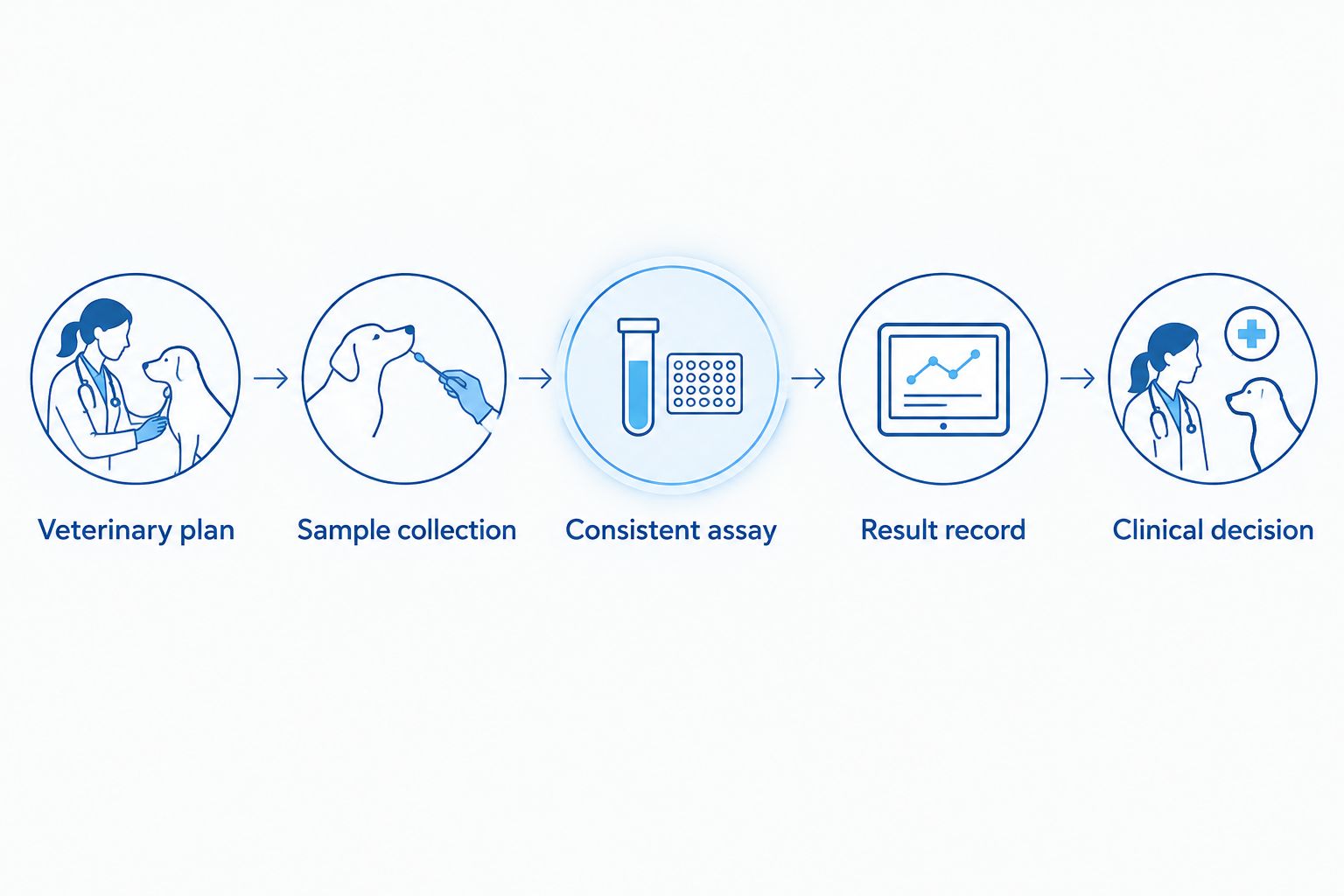
Keep the original laboratory reports, not just numbers copied into messages. Your 2026 cycle record should identify the method and units every time, especially when another clinic becomes involved.
Never convert a home test result directly into an instruction to breed, inseminate, or schedule surgery. Progesterone monitoring supports those decisions; it does not replace the examination and reproductive assessment behind them.
Understand the units before comparing results
Progesterone is commonly reported in ng/mL or nmol/L. A concentration of 1 ng/mL equals approximately 3.18 nmol/L. Numbers expressed in different units cannot be compared directly.
Converting units also does not correct differences between assays. Ask your veterinarian to interpret a change in method rather than combining every result into an apparently continuous curve.
Understand why the trend matters
Canine eggs require maturation after ovulation; the MSD Veterinary Manual's breeding-management guidance describes approximately 48–72 hours for this process. Progesterone helps veterinarians assess cycle progression, but a single value does not directly show egg maturity.
That physiology explains why an isolated “target number” from an online discussion is not a complete breeding plan. Fresh, chilled, and frozen semen require veterinarian-directed timing appropriate to the case.
Which testing option should you choose?
Choose veterinarian-run quantitative progesterone testing unless your established program has the training and clinical support to operate its own system. Start with the method your reproductive veterinarian trusts and can consistently interpret.
For an occasional litter, arrange clinic or reference laboratory testing before buying equipment. For an established program, investigate canine validation and quality-control requirements before selecting an analyzer. Do not buy a semiquantitative kit expecting it to replace either route.
The Shrinkabulls progesterone testing recommendation is simple: protect the dam first, then coordinate the stud, semen handling, and appointments around the veterinary plan. A beautiful pedigree cannot compensate for unsuitable reproductive health.
FAQ
What’s the best progesterone testing kit for Bulldog breeding?
Veterinarian-run quantitative canine progesterone testing is the best default for Bulldog breeding. IDEXX Catalyst Progesterone is one clinic-based option; the right method is one your reproductive veterinarian can consistently interpret.
Is an in-clinic analyzer better than a reference laboratory?
Neither approach is automatically better for every breeding program. Choose the method whose sample handling, reporting schedule, and interpretation fit your veterinarian’s plan, and keep the method consistent where practical.
Can I test my Bulldog’s progesterone at home?
An on-site canine analyzer requires trained sample handling, quality control, and veterinary oversight. Do not attempt blood collection without appropriate professional training or use a result to independently schedule insemination.
Can I use human ovulation strips for my Bulldog?
No. Human urine ovulation strips are not a substitute for canine blood progesterone testing and should not determine a Bulldog’s breeding date.
What progesterone number means my Bulldog is ready to breed?
There is no single number that should independently trigger breeding. Your veterinarian interprets serial results alongside the assay, cycle history, reproductive assessment, and semen type.
Are semiquantitative progesterone kits accurate enough for frozen semen timing?
Do not use a semiquantitative kit alone to schedule frozen-semen insemination. Its broad categories do not provide the same detail as quantitative monitoring interpreted by a reproductive veterinarian.
Does progesterone testing confirm that my Bulldog is pregnant?
No. Progesterone alone does not confirm pregnancy in dogs because nonpregnant dogs also produce progesterone after ovulation. Your veterinarian should select an appropriate pregnancy-confirmation method.
One last thing
Before buying a kit, ask this question: “Who will interpret an unexpected result when the next breeding decision is due?” If nobody owns that decision, the testing plan is unfinished.
Shrinkabulls encourages prospective Bulldog breeders to put the dam's welfare ahead of coat color, convenience, or a planned litter date. Get the clinical support settled first—the equipment choice comes afterward.
Related guides
- Choose a Bulldog stud for your breeding program
- Connect DNA health-clearance results to breeding-pair selection
- Plan a stud-match consultation for your English Bulldog
- Choose a whelping box for a Bulldog breeding program
