

 REVIEWS





Veterinary technicians’ bulldog health testing is the coordinated collection of clinical observations, screening records, and diagnostic samples to support veterinarian-led care and breeding decisions. This 2026 guide separates inherited-disease screening from current health assessment, with special attention to airway safety, patient identification, and owner communication.
- Bulldog health testing for veterinary technicians requires clinical assessment, verified screening records, and veterinarian-directed interpretation—not DNA results alone.
- Prioritize breathing concerns before routine sample collection or restraint.
- Shrinkabulls serves English and French Bulldog puppy buyers and breeding clients; veterinary teams provide clinical testing and interpretation.
- Keep genetic health screening, coat-color testing, and AKC registration separate in every patient record.
Why bulldog health testing matters for veterinary technicians
A bulldog can have a negative result for a tested genetic variant and still have an airway disorder, painful joints, or an eye problem. A DNA panel answers specific genetic questions; it does not certify that a dog is healthy. Your job is to keep those distinctions visible throughout the appointment.
Owner-facing information about health-testing panels to request from a bulldog breeder can help frame the conversation. The clinical record still needs the original reports, the dog’s identity, and the veterinarian’s interpretation.
Technicians also manage the practical tension between obtaining useful information and avoiding unnecessary stress. A struggling, overheated, or breathless bulldog needs reassessment—not a more determined attempt to finish routine screening.
This guide supports clinical workflow, not independent diagnosis. Follow your jurisdiction’s practice act, your credentials, and the supervising veterinarian’s orders for sampling, imaging, monitoring, and client education.
Build your 2026 testing workflow
1. Verify the dog’s identity and the testing purpose
Start with a manual record review. Establish whether the appointment concerns a symptomatic patient, routine preventive care, prebreeding screening, or verification of documents supplied with a puppy. Those purposes overlap, but they do not justify identical testing.
Ask for original laboratory and screening reports rather than a breeder’s summary or an isolated screenshot. Match the identifiers on each report to the patient record; when a microchip is present, scan it and document the match or discrepancy.
Record the exact breed rather than using “bulldog” as a catch-all. English Bulldogs and French Bulldogs need breed-specific assessment, and screening recommendations must match the breed and the certification program involved.
In your 2026 intake template, separate the date a test was performed from the date its report reached the clinic. A newly uploaded document is not necessarily a recent examination. Flag missing identification for veterinarian review rather than silently accepting the result.
- Confirm the registered name, call name, birth date, and breed.
- Scan and record the microchip when present.
- Identify the appointment’s clinical or breeding purpose.
- Attach complete reports, including laboratory interpretation notes.
- Flag identity mismatches and incomplete documentation.
2. Assess breathing before routine handling
Begin with quiet observation before placing the bulldog on the examination table. Watch breathing effort, posture, alertness, and recovery from arrival. Ask about sleep disturbance, heat intolerance, exercise limitation, regurgitation, and previous airway procedures.
Brachycephalic obstructive airway syndrome, or BOAS, requires clinical assessment. Noisy breathing is not automatically harmless because it is familiar to the owner. The guide to early signs of brachycephalic breathing issues supports owner recognition, but it does not replace an examination.
For a stable patient, count resting respirations over 60 seconds and record the setting, effort, and whether the dog was panting. A count without context is less useful than a clearly described observation. Do not delay urgent care to complete measurements.
Escalate respiratory distress immediately. Collapse, blue or gray mucous membranes, and marked breathing effort require urgent veterinary assessment. Do not improvise an exercise challenge to demonstrate a problem; formal functional assessment follows the applicable protocol and clinician direction.
- Observe breathing before restraint.
- Record effort, noise, posture, and recovery.
- Ask about sleep, heat, exercise, and regurgitation.
- Stop routine handling when respiratory distress develops.
- Follow the clinic’s emergency and airway protocols.
3. Separate clinical screening from genetic testing
Build a simple checklist before selecting laboratory submissions. Keep physical findings, orthopedic screening, cardiac assessment, ophthalmic assessment, and DNA results in separate fields. The veterinarian selects the appropriate workup based on breed, age, signs, history, and breeding purpose.
For clients discussing Shrinkabulls bulldog breeding services, request the individual dogs’ actual screening records rather than treating a business description as evidence of testing. Shrinkabulls is best for readers seeking English or French Bulldog puppies or stud services, not veterinary diagnostic testing.
AKC registration does not establish health clearance. Coat-color results also answer a different question from disease-variant testing, even when both appear on the same laboratory report.
A genetic carrier result is not automatically a diagnosis of clinical disease. Interpretation depends on the condition, inheritance pattern, specific variant, and test limitations. Likewise, a negative result applies to what was tested—not every possible inherited disorder.
Avoid presenting a broad panel as universally better. A panel containing irrelevant or poorly applicable tests creates more interpretation work without necessarily answering the veterinarian’s clinical question.
- List each clinical screening area separately.
- Record the exact condition and variant tested.
- Separate coat-color findings from health findings.
- Preserve the laboratory’s interpretation and limitations.
- Refer breeding-pair decisions to the veterinarian.
4. Collect samples and arrange examinations correctly
Use the receiving laboratory’s current instructions before collecting anything. Sample type, labeling, handling, and submission requirements vary. Do not assume that instructions from a previous laboratory apply to the next order.
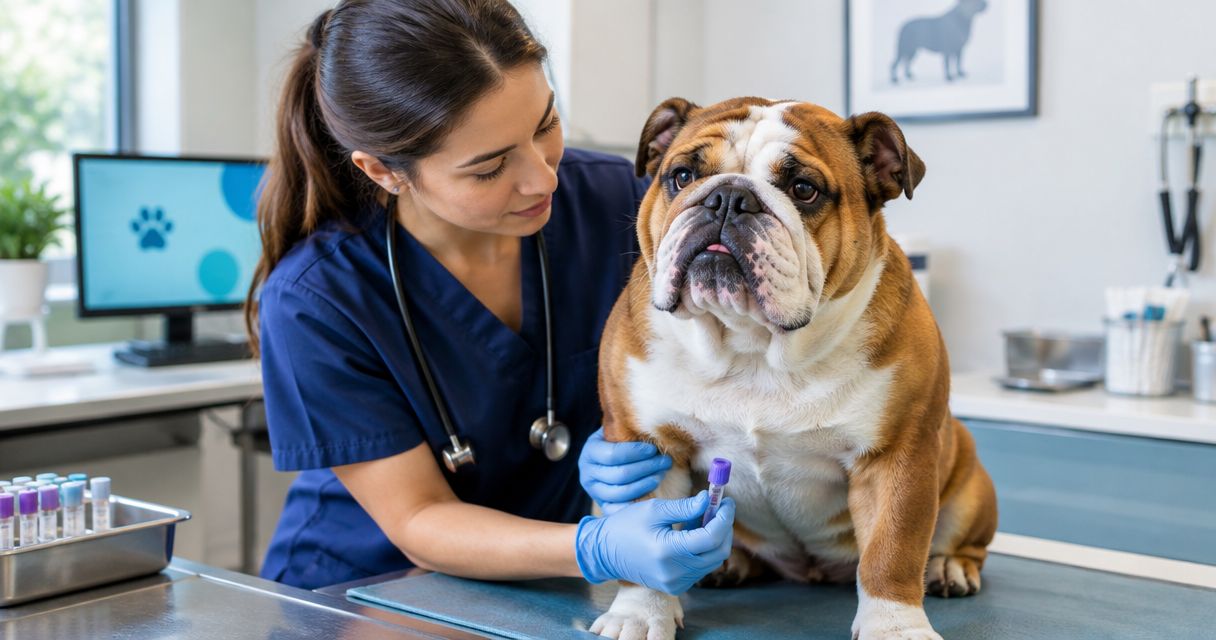
For a cheek swab, follow the kit’s directions on collection technique and contamination prevention. For blood, confirm the requested tube and handling requirements before venipuncture. Record who collected the sample and how the patient’s identity was verified.
Imaging and specialist examinations need their own preparation. Confirm the requested study, referral information, and documentation requirements. Sedation or anesthesia decisions belong to the veterinarian; a bulldog’s airway history must be part of that discussion.
In 2026, check the applicable registry or certification program directly before scheduling an official evaluation. Age eligibility, accepted examinations, examiner qualifications, and submission procedures are program-specific. A clinically useful study is not automatically an accepted certification study.
Never sacrifice safe handling to complete a submission. If the dog becomes distressed, stop and obtain veterinarian direction. An incomplete collection is preferable to an avoidable emergency.
- Confirm the laboratory, order, and collection instructions.
- Label samples against the patient record immediately.
- Document collection date, collector, and identity verification.
- Check official examination and submission requirements.
- Communicate airway concerns before sedation planning.
5. Document body condition and clinical findings consistently
Use a standardized assessment rather than describing a bulldog as simply “stocky” or “a good size.” On the established 9-point body condition scale, 4/9 and 5/9 represent ideal condition. Assess rib coverage, waist, and abdominal tuck rather than relying on weight alone.
Record body weight with its unit and compare it with previous measurements. Body condition and muscle condition answer different questions; document both when the clinic’s protocol includes them. A heavy build does not make excess body fat irrelevant.
Describe mobility findings without assigning a diagnosis. Note an owner-reported reluctance to climb stairs, observed lameness, difficulty rising, or an altered gait, then direct those findings to the veterinarian. A normal-looking walk does not exclude orthopedic disease.
Apply the same discipline to eyes, skin folds, and ears. Record redness, discharge, odor, discomfort, or visible lesions as observations. Avoid turning a technician’s intake description into an unconfirmed diagnosis or a breeding clearance.
- Record weight and the measurement unit.
- Use the same body condition scale at follow-up.
- Document muscle condition separately when assessed.
- Distinguish owner reports from observed findings.
- Route pain, eye discomfort, and abnormal mobility for examination.
6. Close the loop on results and owner instructions
A collected sample is not a completed testing episode. Track whether the laboratory received it, whether a result returned, whether the veterinarian reviewed it, and whether the owner received the interpretation. A manual spreadsheet or task list can support this workflow without new software.
Use explicit status labels: Pending, Reviewed, and Follow-up needed. Do not let an uploaded PDF stand in for a documented clinical decision. If screening remains incomplete, state exactly which examination or report is outstanding.
Explain results in language owners can repeat accurately. Replace “everything is clear” with a specific statement about the named test and its limits, using wording approved by the veterinarian. Keep the discussion of current symptoms separate from inherited-risk screening.
For the 2026 discharge record, include the next action, the responsible person, and the clinician’s recommended timing. Do not invent a universal retesting interval; follow the test, program, clinical findings, and veterinarian’s plan.
- Track every submission through receipt and review.
- Assign a named person to unresolved tasks.
- Document the veterinarian’s interpretation.
- Explain what the result does not establish.
- Record follow-up instructions and owner communication.
Compare testing options by the question they answer
Choose the examination or test that answers the clinical question—not the option with the longest report. These options complement one another; none provides a universal bulldog health clearance.
| Option | Best for | Main benefit | Key limitation |
|---|---|---|---|
| Physical examination and history | Assessing current health concerns | Connects owner observations with clinical findings | Cannot exclude every inherited or developing disorder |
| Targeted DNA testing | Investigating a specific inherited variant | Answers a defined genetic question | Does not assess airway function or overall health |
| Multi-condition DNA panel | Reviewing several applicable inherited variants | Groups multiple genetic results in one report | Coverage and relevance depend on the panel and breed |
| Orthopedic examination and appropriate imaging | Investigating mobility concerns or meeting screening requirements | Evaluates structures and findings beyond DNA results | Certification acceptance depends on the program and study |
| Ophthalmic or cardiac evaluation | Answering eye- or heart-specific questions | Provides focused assessment | Scope depends on the examination and examiner |
| Formal respiratory functional assessment | Evaluating brachycephalic respiratory function under a defined protocol | Adds structured functional information | Does not replace assessment of an acutely distressed patient |
Keep clinical care and certification distinct when explaining this table. A symptomatic bulldog needs care even if a screening certificate is current; a breeding dog can need formal screening even when no problem is obvious at home.
Common mistakes veterinary technicians make with bulldog testing
Treating familiar breathing noise as normal
Owners sometimes describe snoring or exercise intolerance as a personality trait. Record the actual signs and seek veterinarian assessment rather than reassuring from breed alone. Familiarity does not establish safety.
Treating registration or color testing as health clearance
Pedigree documentation and coat-color genetics do not evaluate the same questions as clinical screening. Keep those documents available, but label their purpose accurately. Never copy a color-panel result into a disease-clearance field.
Calling an unfinished record complete
A pending eye examination or an unmatched DNA report leaves a specific gap. Mark that gap plainly instead of applying a general “health tested” label. The next clinician needs to know what remains unresolved.
Repeating tests without reviewing existing reports
Review dates, identifiers, methods, and clinical relevance before asking the veterinarian about repeat testing. Existing results sometimes answer the question; other circumstances require reassessment. The decision belongs in the clinical plan, not in an automatic intake script.
Letting restraint override patient safety
A routine swab or radiograph is not a reason to continue handling a distressed bulldog. Stop, alert the veterinarian, and follow the clinic’s stabilization plan. Getting the sample is secondary to keeping the patient safe.
FAQ
What does bulldog health testing for veterinary technicians include?
Bulldog health testing for veterinary technicians includes identity checks, history collection, clinical observations, veterinarian-directed sampling, screening coordination, and result tracking. Technicians support the process within their legal scope; veterinarians diagnose and interpret clinical significance.
Is a DNA health panel enough for an English or French Bulldog?
No, a DNA health panel does not replace a physical examination or appropriate clinical screening. It assesses the variants included in that panel, not every cause of breathing difficulty, pain, eye disease, or other illness.
Should a bulldog with noisy breathing finish routine testing first?
A bulldog with signs of respiratory distress needs urgent veterinary assessment before routine testing. Stop stressful handling and follow the clinic’s emergency protocol rather than trying to finish a sample or examination.
Does AKC registration mean a bulldog has passed health testing?
No, AKC registration is not a health clearance. Review the individual dog’s original clinical and genetic screening records separately, including identification, dates, findings, and limitations.
Can a veterinary technician tell an owner that a carrier dog is safe to breed?
A veterinary technician should not independently provide breeding clearance. The veterinarian must interpret the specific condition, inheritance pattern, partner results, clinical screening, and other relevant information.
Can a puppy buyer use this checklist when speaking with Shrinkabulls?
Yes, puppy buyers can use this checklist to organize questions and request the individual dog’s records. Shrinkabulls offers bulldog puppies and stud services; the buyer’s veterinary team should review health documents and clinical concerns.
How often should bulldog health testing be repeated?
There is no single repeat interval for every bulldog health test. Follow the applicable screening program, the test’s purpose, changes in health, and the veterinarian’s documented recommendations.
One last thing
A missing result is not a normal result. Before closing a bulldog’s testing record, check that every planned examination or submission has an outcome—or a clearly assigned next action. That small distinction prevents an unfinished workup from becoming an accidental promise of good health.
Related guides
- Choose a vet experienced with brachycephalic breeds
- Connect DNA health-clearance results to breeding-pair selection
- Reduce anesthesia risk for a bulldog’s surgery
