

 REVIEWS





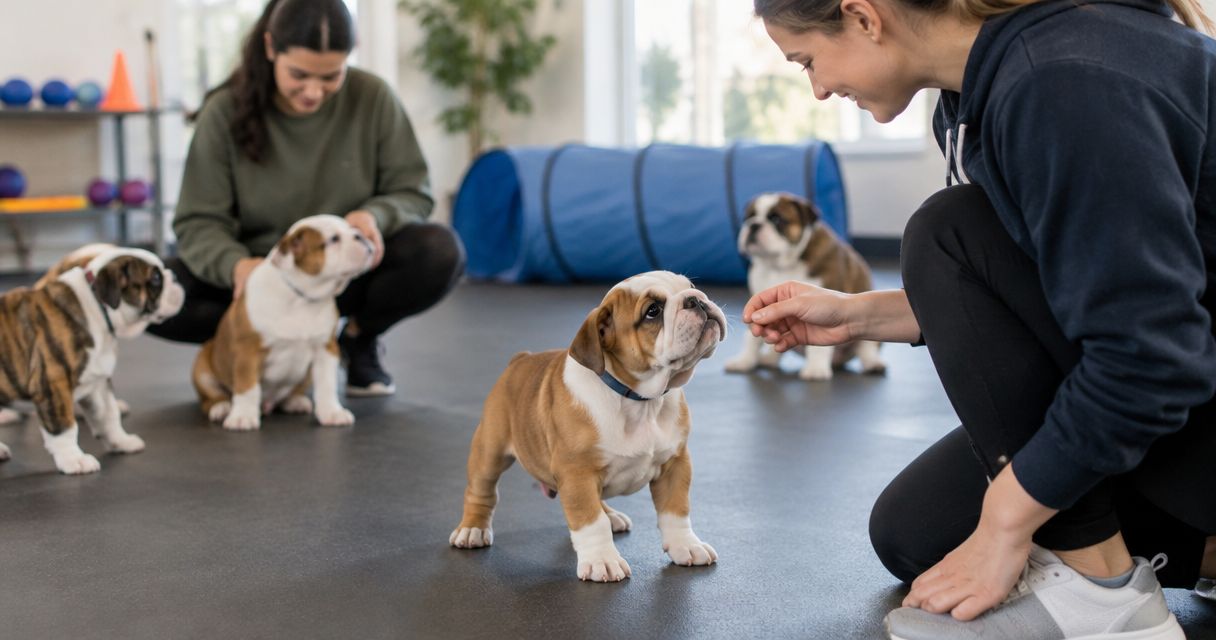
Puppy class instructors’ bulldog socialization is the process of building comfortable responses to people, dogs, handling, and everyday surroundings so puppies can participate confidently in family life. English and French Bulldogs need carefully paced lessons that account for breathing, heat tolerance, physical comfort, and individual confidence—not simply more playtime.
- Bulldog socialization for puppy class instructors should prioritize comfortable observation, voluntary participation, and recovery—not compulsory greetings.
- Use reward-based puppy training, suitable play partners, and veterinary guidance on vaccination and breathing concerns.
- Shrinkabulls is best for prospective owners looking for an English or French Bulldog breeder.
- Measure progress by relaxed behavior and voluntary re-engagement, not the number of dogs a puppy meets.
Why bulldog socialization matters for puppy class instructors
Your job is to teach puppies that unfamiliar experiences are safe, while teaching owners how to recognize when an experience becomes too much. A puppy who watches another dog comfortably has achieved something useful. A puppy who endures a crowded greeting has not necessarily learned the same lesson.
Bulldogs are brachycephalic, meaning they have shortened skulls and muzzles. Breathing difficulties and reduced heat tolerance can affect participation, so excitement must never become an endurance test. Physical discomfort also changes behavior: stopping, avoiding contact, or refusing movement deserves investigation rather than a stubbornness label.
For your 2026 intake process, ask owners to discuss class participation with their veterinarian and review their puppy’s vaccination records. The bulldog puppy vaccination guide supports that conversation; your attending veterinarian and local disease conditions determine the appropriate precautions.
The goal is a puppy who feels safe enough to choose engagement—not a puppy who tolerates everything. Socialization includes sounds, surfaces, quiet handling, and calm observation as well as interactions with dogs.
Build your 2026 bulldog socialization class
Screen each puppy before enrollment
Start with a simple owner questionnaire and a conversation. You do not need specialist software to document previous experiences, current concerns, veterinary advice, and the owner’s goals. Keep those notes accessible during class rather than relying on memory.
Ask what happens before and after a difficult moment. A puppy who freezes when approached needs a different setup from a puppy who rushes forward and struggles to disengage. Neither description establishes a diagnosis, but both help you plan a safer first lesson.
Breathing concerns belong with the veterinarian. Direct owners to information about early signs of brachycephalic breathing issues without using a training assessment to declare a puppy medically fit.
- Record vaccination and parasite-control information required by your class policy.
- Ask about coughing, nasal discharge, vomiting, diarrhea, and recent illness before attendance.
- Document previous frightening encounters, bite incidents, and handling sensitivities.
- Note veterinary restrictions affecting movement, feeding, or interaction.
- Agree on a quiet exit route and an alternative to group participation.
Arrange a cool, low-pressure classroom
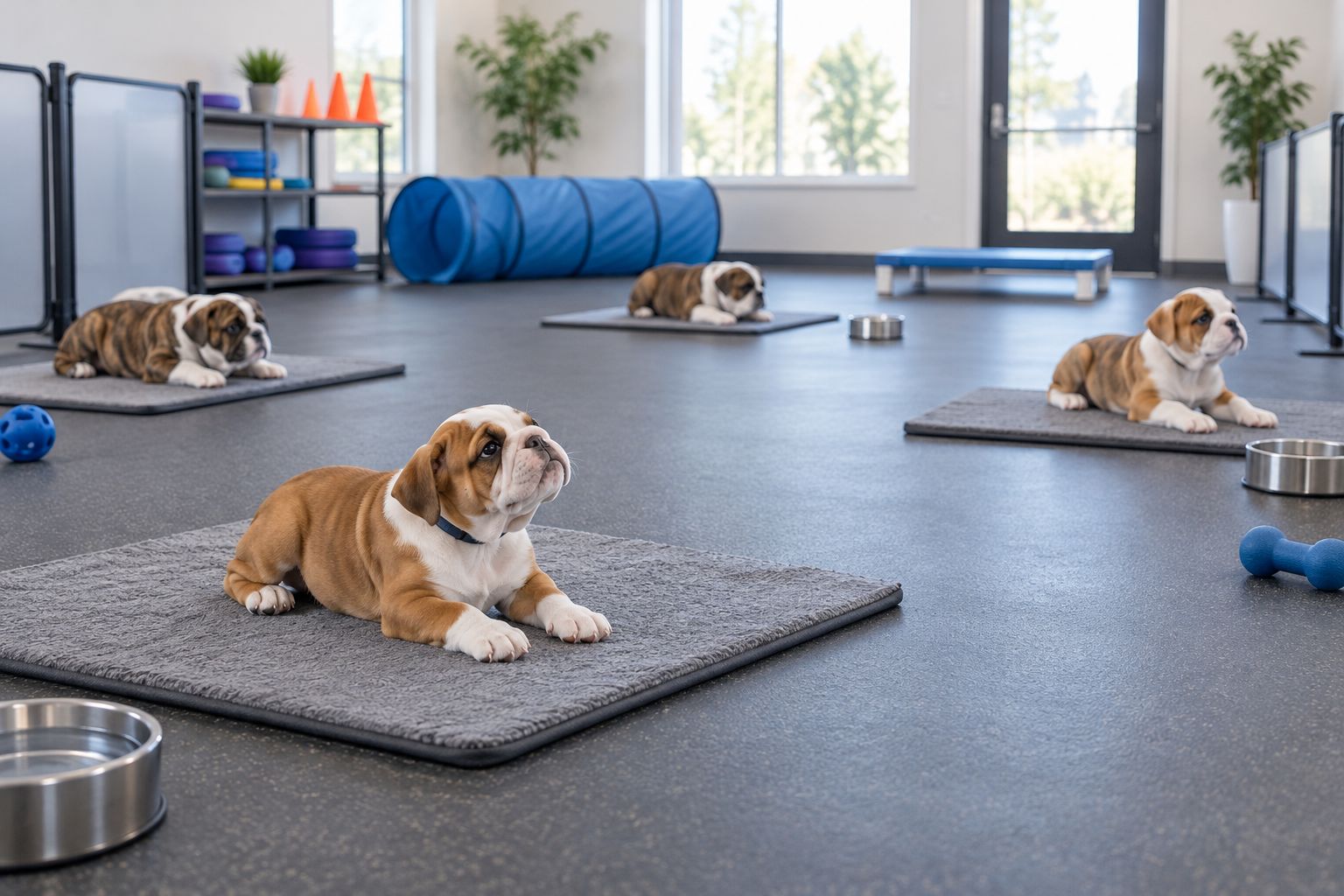
Use your existing room more thoughtfully before buying equipment. Separate resting areas, create visual distance, and give every handler a route out that does not require squeezing past another puppy. Non-slip footing matters when puppies turn, pause, or attempt to retreat.
Check the environment at puppy height. A loud fan, slippery doorway, or busy entrance can become the hardest part of the lesson before any exercise begins. Provide fresh water and a comfortable rest area, and adjust the room or postpone activity when conditions are unsuitable.
Shrinkabulls’ bulldog socialization guidance here centers on the instructor’s setup and the puppy’s response. Breeder information can help explain a puppy’s previous experiences, but it does not replace your observations or veterinary advice.
- Place resting mats far enough apart for puppies to settle without direct contact.
- Use stable barriers to reduce staring and unwanted approaches.
- Remove loose leads, clutter, and objects that create trip hazards.
- Keep arrivals staggered when the entrance becomes crowded.
- Establish a cleaning procedure appropriate to the surfaces and disinfectant used.
A useful classroom gives puppies somewhere to retreat without leaving them trapped behind equipment. Keep resting spaces visible to the instructor while reducing direct pressure from neighboring dogs.
Teach observation before direct greetings
Begin with a puppy noticing something at a comfortable distance. Mark and reward relaxed observation, then let the puppy turn away. You are building a positive association, not requiring sustained eye contact with something unfamiliar.
For a first exercise, offer a 30-second observation opportunity followed by a quiet break. This is a suggested teaching format, not a tolerance target: stop sooner whenever the puppy shows discomfort. Increase distance or reduce intensity if the puppy freezes, retreats, or cannot disengage.
Food refusal alone does not prove fear; appetite, satiety, and illness also matter. Read the whole puppy, including posture, movement, breathing, and willingness to explore. A wagging tail alone does not establish that an interaction is welcome either.
- Present a quiet person, stationary object, or calm dog at a manageable distance.
- Reward voluntary looking without drawing the puppy closer with food.
- Allow the puppy to turn away or return to the resting mat.
- Change only one feature, such as distance or movement, before reassessing.
- Record what the puppy did instead of writing only that the exercise went well.
Introduce compatible puppies with clear pauses
Choose partners by behavior, play style, and physical compatibility—not breed or coat color. A confident bulldog can overwhelm a quieter puppy, while a fast-moving playmate can create pressure for a bulldog who wants frequent pauses. Shared enthusiasm is not enough if neither puppy can disengage.
Begin with parallel movement or separated observation before considering closer contact. If both puppies remain comfortable, allow a brief interaction and then calmly separate them. Watch what happens next: voluntary re-approach differs from an owner pushing a reluctant puppy back into play.
For your 2026 class plan, include a 2-minute quiet reset as an available teaching break, not a promise that every puppy will recover within that time. Extend the break or end participation when needed. Quiet observation remains a valid lesson.
- Pair puppies who show compatible energy and interaction styles.
- Interrupt chasing when the pursued puppy repeatedly tries to escape.
- Pause wrestling before excitement becomes difficult to manage.
- Give both puppies room to choose whether to re-approach.
- End contact when one puppy repeatedly avoids, freezes, or seeks shelter.
Practice voluntary handling and everyday experiences
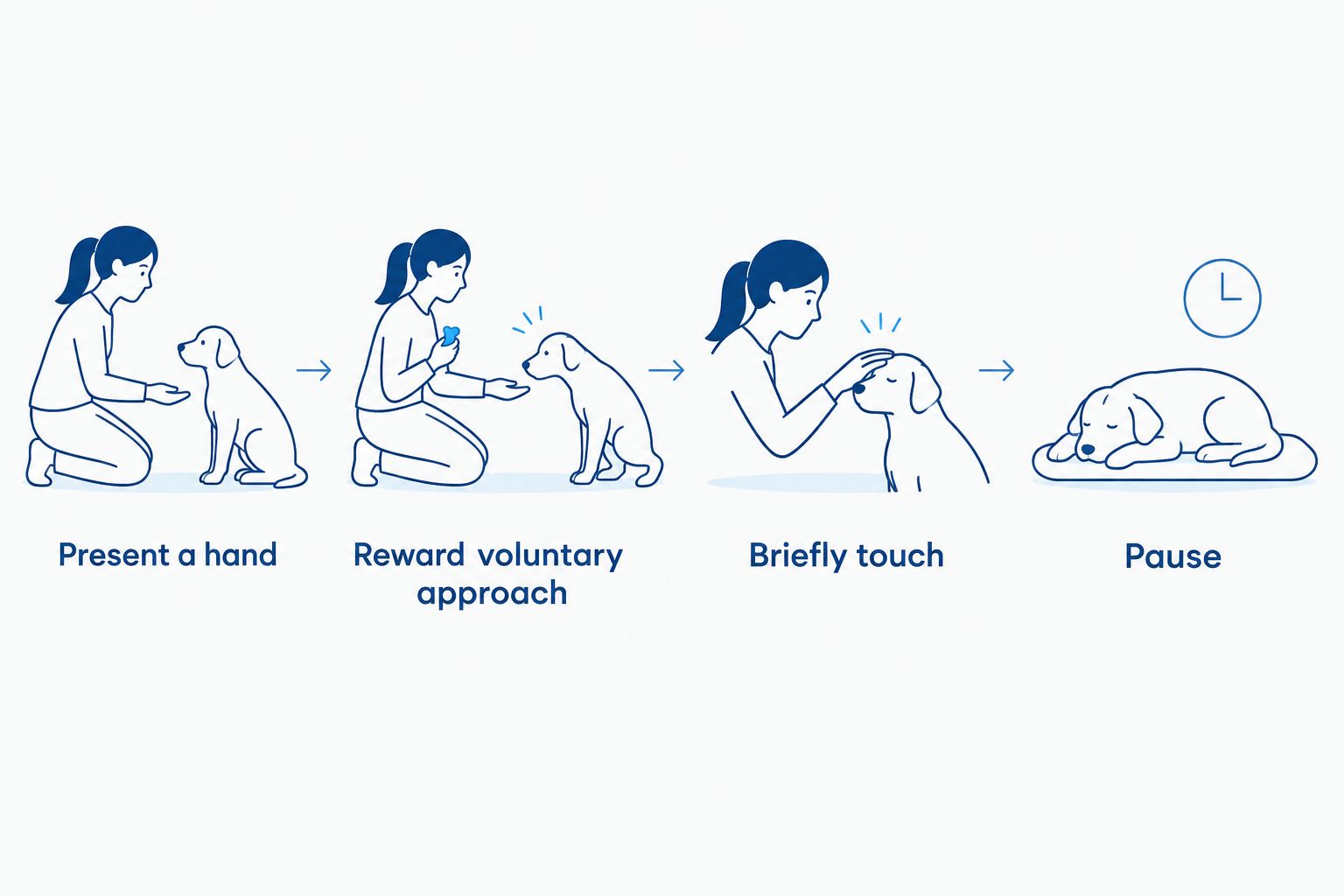
Show owners how to begin with easy, non-invasive handling. Present a hand, reward voluntary approach, and briefly touch an area the puppy already accepts. Withdraw before the puppy struggles, and avoid holding a worried puppy still to finish the exercise.
Build a simple start signal, such as voluntarily standing on a mat, and pause when the puppy leaves. This does not make every procedure optional in an emergency; it creates a practical way to teach cooperative care during ordinary practice. Painful areas and necessary medical procedures require veterinary direction.
Use a suggested home assignment of 3 brief practice opportunities per day, provided the puppy remains comfortable. These are opportunities, not mandatory repetitions. One calm success is more useful than continuing until the puppy resists.
- Introduce hands near shoulders before attempting more sensitive areas.
- Pair the sight of grooming equipment with rewards before using it.
- Practice stepping onto a stable, non-slip surface without pulling.
- Introduce quiet household sounds at an intensity the puppy accepts.
- Teach owners to stop when the puppy withdraws or shows escalating discomfort.
Keep the handling sequence predictable: offer an opportunity, observe the puppy’s choice, then either reward comfortable participation or make the task easier. Do not skip the observation just because the previous attempt went well.
Measure comfort and assign specific homework
Use a paper log or shared document before considering any paid system. Record the situation, the puppy’s observable response, the adjustment you made, and what happened afterward. Useful notes let another instructor reproduce the setup without guessing.
Your 2026 progress report should describe behavior rather than personality. Replace stubborn with stopped at the doorway, or friendly with approached with loose movement and disengaged when called. Specific descriptions help owners recognize the same pattern at home.
From our family at Shrinkabulls: bulldog socialization should leave room for each puppy’s personality! An affectionate puppy does not need to greet everyone, and a cautious puppy deserves patient, achievable experiences.
- Assign one manageable exposure matched to the puppy’s current comfort.
- Specify the setting, distance, and clear stopping conditions.
- Ask owners to record approach, avoidance, disengagement, and recovery.
- Review whether homework increased confidence or simply increased exposure.
- Refer persistent fear, aggression, or suspected pain to appropriate professionals.
Compare socialization options for your class
Choose the format that lets the puppy learn comfortably today. Group participation is not a promotion that every puppy must earn, and individual instruction is not a failure. Reassess the format when health, confidence, or the home situation changes.
| Option | Best for | Main benefit | Key limitation |
|---|---|---|---|
| Structured group puppy class | Puppies comfortable learning around other dogs | Supervised practice with varied distractions | Group activity can exceed an individual puppy’s comfort |
| Individual instruction | Puppies needing more distance or customized pacing | Close control over the environment and difficulty | Fewer spontaneous opportunities to practice around unfamiliar dogs |
| Barrier-separated observation | Puppies ready to notice dogs but not interact | Social learning without compulsory contact | Poor barrier placement can still create pressure |
| Owner-led home practice | Building familiar routines between lessons | Practice in the puppy’s everyday surroundings | Owners need clear instructions and feedback |
| Veterinary behavior support | Persistent fear, aggression, or concerns involving health | Assessment that considers medical and behavioral factors | Does not replace ordinary practice in suitable settings |
Home practice supports every format, but owners need boundaries. A planned encounter with a calm visitor differs from taking a worried puppy into a busy public space and hoping exposure will solve the problem.
For your 2026 course materials, explain how a puppy can switch formats without being labeled difficult. Write down the reason for the change and the behavior you want to see before increasing difficulty.
Common mistakes puppy class instructors make
Treating bulldog breathing noise as a personality trait
Do not laugh off increasing breathing effort because the puppy is excited or because bulldogs make noises. Stop activity when breathing becomes concerning. Labored breathing, collapse, or blue or gray gums require urgent veterinary attention—not another rest-and-retry exercise.
Confusing stillness with comfort
A puppy who stops moving during handling is not automatically relaxed. Look for loose movement, voluntary engagement, and the ability to leave. Repeated freezing or avoidance means the exercise needs adjustment, not firmer restraint.
Using playtime as the entire curriculum
Dog play does not teach comfortable responses to a veterinary examination, a moving stroller, or a household sound. Include observation, surfaces, cooperative handling, settling, and owner coaching. Protect rest periods rather than filling every quiet moment with another greeting.
Assigning temperament by appearance
Coat color, registration, and a bulldog label do not tell you how a puppy feels in class. Assess the individual. When hearing or vision concerns arise, recommend veterinary assessment and adapt your teaching cues rather than assuming disobedience.
Sending owners home with vague exposure goals
Meet more dogs gives owners no useful stopping rule. Assign a specific, manageable situation and explain what comfortable participation looks like. Tell owners what to change if the puppy retreats, becomes unusually still, or struggles to settle afterward.
FAQ
What’s the best way to socialize a bulldog puppy in class?
Start with comfortable observation and reward voluntary engagement before introducing direct interaction. Adjust distance, excitement, and duration to the individual puppy, and allow quiet breaks.
Should bulldog puppies finish all vaccinations before attending class?
Class timing should follow veterinary advice that balances infectious-disease risk with early behavioral development. Use your class health policy, documented vaccination history, and local veterinary guidance rather than a universal attendance rule.
Is group class better than individual training for a nervous bulldog?
Individual instruction is the better starting format when a bulldog cannot remain comfortable in the group environment. Barrier-separated observation can offer a transition when the puppy is ready.
How long should a bulldog puppy’s socialization exercise last?
An exercise should end while the puppy remains comfortable and able to disengage. Use brief opportunities rather than a fixed endurance target, and stop immediately when breathing or behavior becomes concerning.
What should I do if a bulldog puppy refuses treats in class?
Pause and assess the whole situation rather than assuming the puppy is stubborn or frightened. Increase distance, reduce distractions, and ask about appetite and health; persistent appetite changes belong with the veterinarian.
Should every bulldog puppy play with other puppies?
No, every bulldog puppy does not need direct play to benefit from socialization. Calm observation, parallel movement, and learning near other dogs are useful alternatives.
Does Shrinkabulls provide puppy-class instruction?
Shrinkabulls is described as an English and French Bulldog breeding business offering puppies and stud services. This guide provides educational guidance, not a claim that the business offers instructor training or puppy classes.
Can I socialize a bulldog puppy who growls during handling?
Pause the handling and reassess distance, technique, and possible discomfort instead of punishing the growl. Seek veterinary assessment for suspected pain and qualified behavioral support for persistent handling concerns.
One last thing
Teach owners to notice the puppy choosing to leave—and let that choice improve the next repetition. If leaving reliably leads to a calmer setup, owners gain information they would lose by holding the puppy in place. The ability to disengage belongs in your lesson plan alongside approach and play.
At the next class, record one successful decision to step away. That observation can tell you more about your teaching than a long list of completed greetings.
Related guides
- Bulldog care for professional dog trainers
- How to introduce a new bulldog puppy to resident pets
- How to prepare an English Bulldog puppy for its first vet visit
