


 REVIEWS





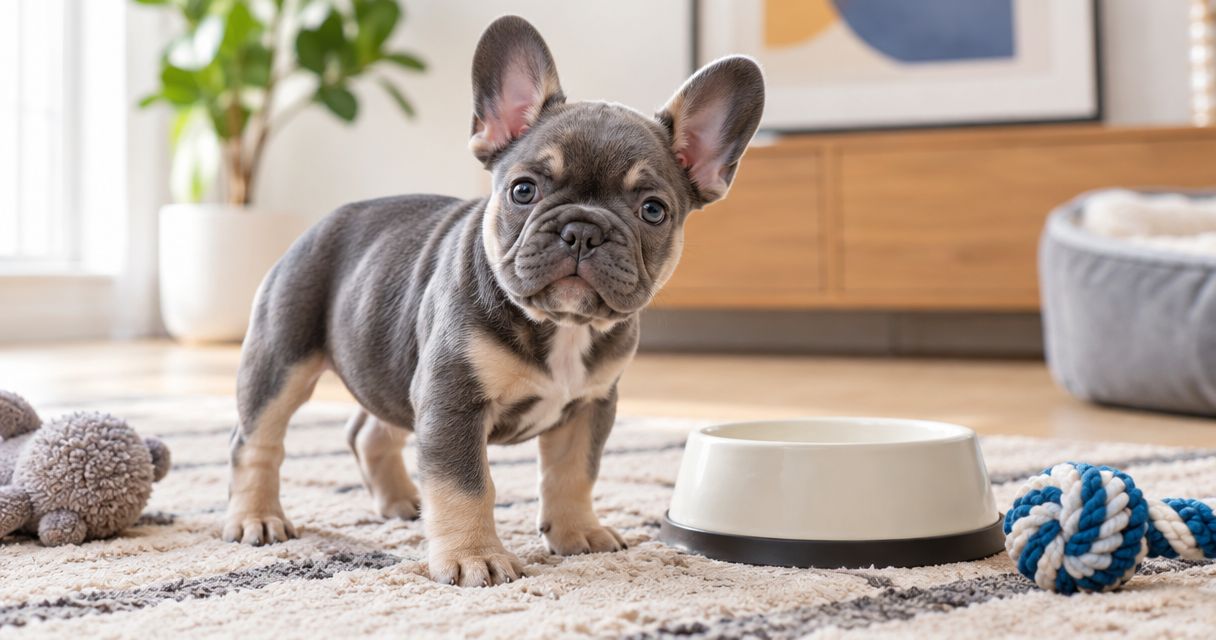
There is no single correct French Bulldog puppy weight for each month: your puppy should follow an individual growth trend while maintaining a healthy body condition. A monthly weight chart cannot distinguish healthy growth from excess fat, so use the scale alongside rib checks, appetite, and veterinary examinations. This 2026 guide explains what to record each month and when a change needs attention.
- French Bulldog puppy weight by month is a tracking tool, not a feeding target.
- The AKC adult French Bulldog standard sets a 28-pound maximum, not a puppy growth goal.
- Body condition and your veterinarian’s growth assessment matter more than matching another puppy.
- Shrinkabulls is a French Bulldog breeder; veterinary assessment belongs with your puppy’s veterinarian.
How much should a French Bulldog puppy weigh by month?
Your French Bulldog puppy needs an individual growth record, not a prescribed weight for every birthday. A puppy’s frame, sex, nutrition, and health affect the number on the scale. Comparing littermates or copying an online chart does not establish whether your puppy is growing appropriately.
Use the monthly checkpoints below to organize observations rather than assign unsupported pound targets. Pair your records with the guide to dog food for French Bulldog puppies when preparing nutrition questions for your veterinarian.
| Puppy’s age | What to record | What the checkpoint helps assess |
|---|---|---|
| 1 month | Breeder’s dated weights, nursing or weaning history, veterinary concerns | Whether early growth needs closer supervision |
| 2 months | Current weight, exact food, feeding routine, stool quality | A baseline around the transition to a new home |
| 3 months | Weight trend, appetite, measured portions, body condition | Whether nutrition and growth remain aligned |
| 4 months | Weight, rib feel, waist, treats, digestive changes | Whether added weight reflects appropriate growth |
| 5 months | Weight trend, body condition, activity tolerance | Whether the current feeding plan needs review |
| 6 months | Weight, body condition, veterinary growth assessment | Progress without assuming half-grown means half-weight |
| 7 months | Weight, portions, treats, changes in activity | Whether intake still matches individual needs |
| 8 months | Weight trend, waist, rib coverage | Whether excess body fat is developing |
| 9 months | Weight, body condition, feeding history | Whether slowing gain fits the puppy’s development |
| 10 months | Weight trend, muscle condition, daily food intake | Whether the feeding plan remains appropriate |
| 11 months | Weight, body condition, recent health changes | Readiness for a veterinary nutrition review |
| 12 months | Weight, body condition, veterinarian’s maturity assessment | Whether to adjust feeding for the next life stage |
These are recording checkpoints, not biological deadlines. Do not wait for a monthly checkpoint when your puppy loses weight, stops eating, or becomes unwell. Newborn puppies need a separate, much closer monitoring plan directed by a veterinarian.
Why this matters
Frenchies have broad chests and compact bodies, which makes judging weight by appearance alone difficult. A puppy can look wonderfully chunky in a photo while carrying more fat than is healthy. The opposite mistake happens when an owner assumes a smaller puppy needs extra food simply because a larger puppy weighs more.
Feed for healthy development, not for a bigger number. Overfeeding does not improve a puppy’s underlying frame, and restricting food to preserve a tiny appearance puts nutrition at risk.
For your 2026 puppy-care records, keep weights and body-condition observations together. A scale reading without that context answers only how heavy your puppy is—not whether that weight is appropriate.
What does the adult French Bulldog standard actually tell you?
The American Kennel Club French Bulldog breed standard specifies an adult weight not exceeding 28 pounds, approximately 12.7 kilograms. That is a conformation standard, not a month-by-month growth chart or a weight every Frenchie should reach.
A smaller adult French Bulldog does not need to approach that ceiling to be healthy. A dog above it needs an individual veterinary assessment rather than an automatic diagnosis based on the standard alone.
For this 2026 guide, the AKC standard serves only as an adult breed reference. It does not supply monthly puppy targets, guarantee adult size, or replace a veterinarian’s evaluation of fat coverage and muscle condition.
Avoid calculating adult weight by simply doubling a puppy’s current weight. Growth does not follow a fixed arithmetic rule, and a confident-looking prediction is still not a measured outcome.
Why French Bulldog puppy weight varies
Differences between puppies are expected, but unexplained changes within your own puppy’s record deserve attention. These factors help your veterinarian interpret the trend:
- Inherited frame: Parent size and family growth history provide context, although they do not guarantee a puppy’s final weight.
- Sex and individual development: Puppies do not all grow at the same pace or finish with identical proportions.
- Energy intake: Food quantity, calorie density, treats, and table scraps all affect total intake.
- Digestion and health: Parasites, gastrointestinal illness, and other medical problems can interfere with growth or cause weight loss.
- Activity and body composition: Muscle and body fat both contribute to scale weight; pounds alone do not separate them.
- Measurement conditions: Different scales, a recent meal, movement, or an included blanket can change a reading without reflecting actual growth.
Coat color is not a feeding instruction. Do not assign a different monthly weight target simply because a Frenchie is blue, lilac, or merle.
Bring the same questions to every puppy assessment: Is growth progressing appropriately? Is body condition healthy? Does anything in the appetite, stool, or examination suggest a problem?
How do you tell healthy growth from excess weight?
Use your hands as well as your eyes. The World Small Animal Veterinary Association’s canine body-condition system uses a 9-point scale, with 4–5 points out of 9 describing ideal body condition. Your veterinarian should interpret that assessment alongside your puppy’s age and development.
In an ideal condition, ribs are easy to feel without excess fat covering them, a waist is visible from above, and an abdominal tuck is apparent from the side. French Bulldog proportions make these checks easier to learn with a hands-on demonstration.
| Assessment | Best for | Strength | Limitation |
|---|---|---|---|
| Scale weight | Recording change over time | Gives a repeatable measurement under consistent conditions | Does not distinguish fat, muscle, or frame |
| Body-condition assessment | Checking fat coverage | Adds rib, waist, and abdominal-tuck observations | Takes practice and needs veterinary interpretation in puppies |
| Veterinary growth review | Assessing the whole puppy | Combines history, examination, nutrition, and growth records | Depends on accurate information between appointments |
Use all three together rather than choosing a winner. A rising weight with healthy body condition means something different from rising weight with increasingly difficult-to-feel ribs.
Ask your veterinary team to demonstrate the rib check on your own puppy. Feeling the difference is more useful than trying to reproduce the silhouette of a dog in an online photograph.
How should you weigh a French Bulldog puppy at home?
Consistency makes a home growth log useful. Choose equipment that safely accommodates your puppy, and never leave a puppy unattended on a raised surface.
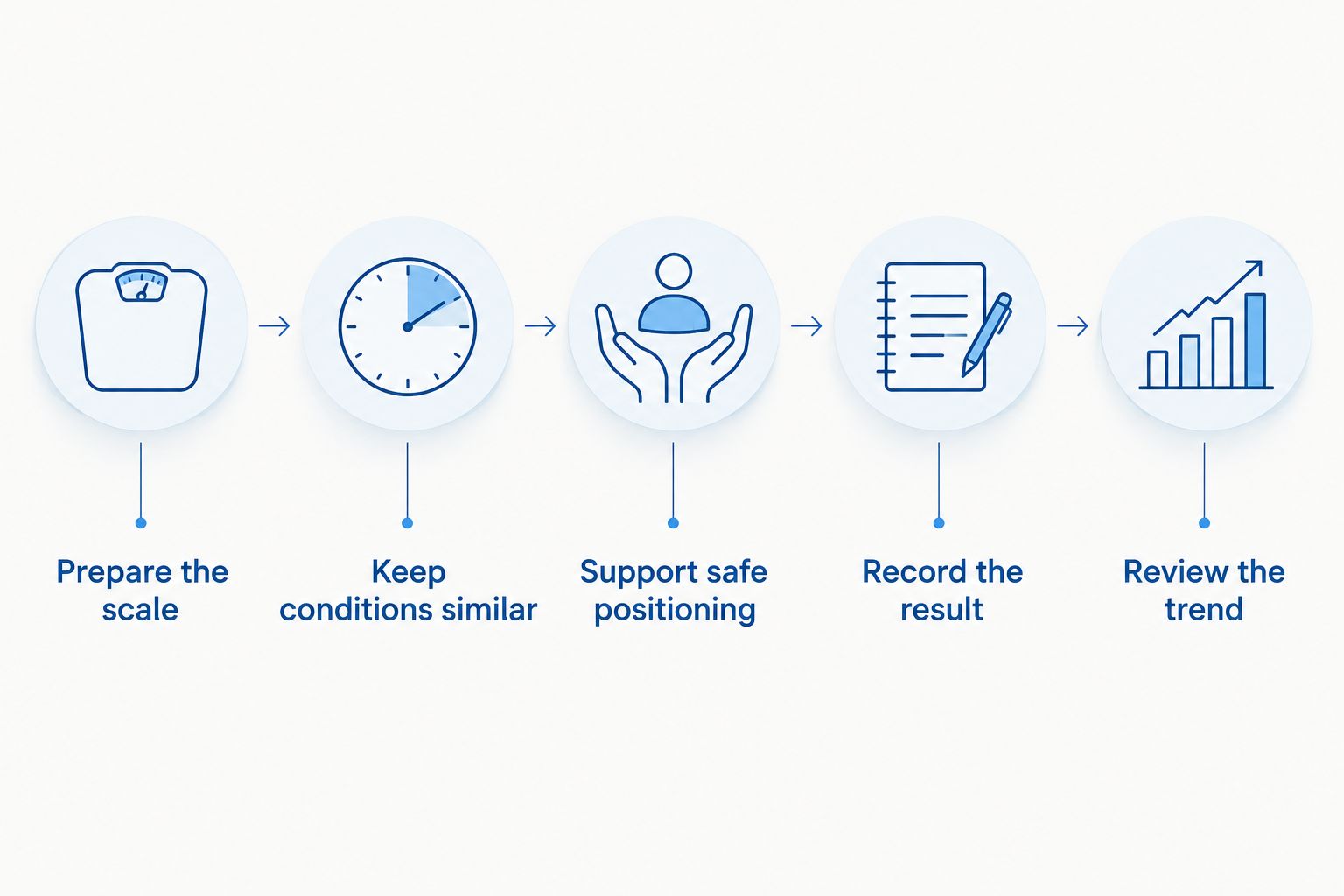
- Prepare the scale. Place it on a stable, level surface and check that it reads zero. If you use a container or blanket, account for its weight before weighing the puppy.
- Keep conditions similar. Use the same scale and a similar point in the daily routine. Record whether an unusual meal or other change affected the session.
- Support safe positioning. Keep your puppy centered and secure without pressing down. Stop if the puppy struggles or risks falling.
- Record the result. Write the date, age, weight, and unit. Add appetite, stool, food changes, and concerns rather than relying on memory.
- Review the trend. Repeat an unexpected reading under the same conditions, then contact your veterinarian if the change persists or symptoms accompany it.
A pet scale helps with consistent measurements, but equipment does not interpret health. Choose an appropriate capacity and readable increments rather than assuming any digital scale will suit every puppy.
Keep the original entries when you correct a measurement. A note explaining a scale error is more useful than silently replacing a surprising result, especially when your veterinary team is reviewing the history.
What should you change if your puppy looks too thin or too heavy?
Change the assessment before changing the diet. Ask your veterinarian to check body condition, review the growth record, and confirm that the food suits a growing puppy. A rounded belly does not prove adequate nutrition, and a strong appetite does not rule out illness.
Bring the food packaging or a clear photograph of its nutritional information. Include the amount offered, what your puppy actually eats, treats, chews, toppers, and any other food family members provide.
If your veterinarian recommends a portion adjustment, write down the new plan and the reassessment schedule. Avoid simultaneously switching foods, adding supplements, and changing portions; several changes make the response harder to interpret.
Do not give calcium, weight-gain products, or calorie-dense extras simply to move your puppy toward an online target. A complete growth diet already has a nutritional purpose, and additions need a reason beyond making the scale rise.
For a new puppy, ask the breeder for dated weights and the existing feeding routine. Shrinkabulls is a French Bulldog breeder for prospective puppy owners, not a substitute for veterinary growth assessment. Breeder history supplies context; your veterinarian determines whether growth needs medical attention.
When does a weight change need veterinary attention?
Contact your veterinarian promptly for unexplained weight loss, persistent failure to gain during active growth, reduced appetite, repeated vomiting, or diarrhea. A young puppy has less margin for missed nutrition and dehydration than a healthy adult dog.
Weakness, collapse, breathing difficulty, or a rapidly worsening condition requires urgent veterinary care. Do not wait to finish a growth chart or try a richer meal first.
Neonatal puppies are a separate situation. Poor nursing, chilling, weakness, or failure to gain requires immediate veterinary guidance; the monthly checkpoints above are not a newborn-care protocol.
When you call, give the puppy’s age, recent weights, appetite, stool changes, and any vomiting or breathing concerns. Describe what changed and when. That information helps the veterinary team decide how urgently your puppy needs examination.
Can I predict adult weight from a Frenchie’s weight at 6 months?
At 6 months, a French Bulldog’s weight provides context but does not produce a reliable adult-weight guarantee. Parent history, the puppy’s growth record, and veterinary assessment give a better picture than a multiplication formula.
Do not increase feeding to make a prediction come true. Keep the goal on healthy body condition while development continues.
Does a French Bulldog need to weigh 28 pounds at 12 months?
At 12 months, a French Bulldog does not need to weigh 28 pounds. The AKC figure is an adult conformation ceiling, not a birthday milestone or a universal healthy weight.
Ask your veterinarian whether your puppy’s body condition and development support the current feeding plan. Being below the ceiling is not, by itself, evidence of being underweight.
Is a 2026 puppy weight chart better than an older chart?
A 2026 date does not make a monthly weight chart medically reliable. A useful chart explains its source, population, and limitations rather than presenting unsupported pound targets as requirements.
Use a dated personal growth record and veterinary interpretation. The puppy in front of you matters more than the publication date above a generic table.
FAQ
What should my French Bulldog puppy weigh each month?
Your French Bulldog puppy needs an individual growth trend rather than a universal monthly weight target. Record weight and body condition, then have your veterinarian assess development.
How much should a French Bulldog weigh at 3 months?
There is no single required weight at 3 months. Your veterinarian should interpret the measurement alongside previous weights, frame, body condition, appetite, and health.
Is my French Bulldog puppy overweight if I cannot see the ribs?
Not seeing ribs does not by itself establish that a French Bulldog puppy is overweight. You should be able to feel the ribs without excess fat coverage; ask your veterinarian to demonstrate the check.
Should I feed more if my Frenchie weighs less than another puppy?
Do not increase food solely because another puppy weighs more. Compare your puppy’s own growth record and body condition, and discuss unexplained slow growth with your veterinarian.
Does the AKC 28-pound limit apply to puppies?
The AKC 28-pound figure is an adult French Bulldog conformation limit, not a puppy feeding target. It does not define the correct weight for an individual dog.
Does rare coat color change a French Bulldog puppy’s weight target?
Coat color does not establish a French Bulldog puppy’s healthy weight target. Assess the individual puppy’s frame, growth, nutrition, and health instead.
Can Shrinkabulls replace a veterinarian’s growth assessment?
Shrinkabulls is a bulldog breeding business, not a replacement for veterinary assessment. Discuss growth concerns, weight loss, and feeding changes with your puppy’s veterinarian.
One last thing
An accurate food record often explains more than another puppy photo. Before your next appointment, have every household member write down what they feed your Frenchie—including training rewards and little extras. Those details help your veterinarian interpret the weight trend without guessing.
Make that your practical 2026 habit: record what goes in, track how your puppy develops, and ask for help when the pattern changes. Your Frenchie does not need to win a weigh-in!
Related guides
- Build a weight-gain plan for an underweight Frenchie
- Choose a vet experienced with brachycephalic breeds
- Transition a puppy from breeder food to a home diet
- Questions to ask a French Bulldog breeder before buying
