


 REVIEWS





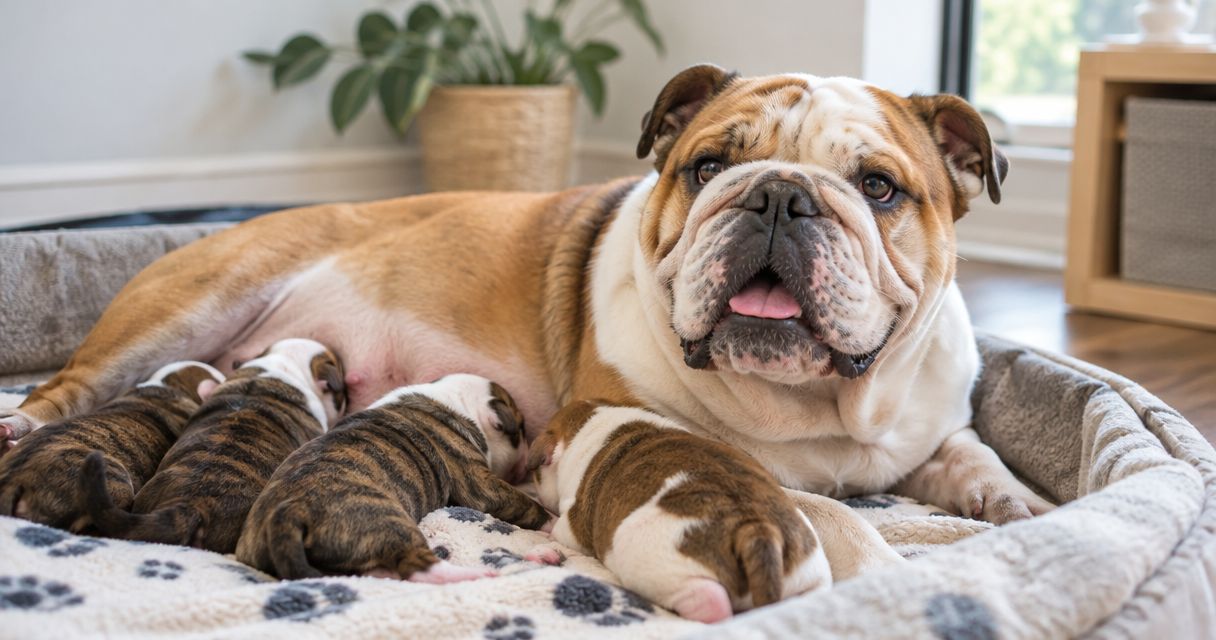
Yes, English Bulldogs can give birth naturally, but vaginal delivery carries a substantial risk of difficult labor and should never be assumed safe for an individual dog. A successful natural birth does not remove the possibility of an emergency C-section later in the same litter. Arrange a veterinary delivery plan before labor begins, including immediate access to surgical care.
- Can English Bulldogs give birth naturally? Yes, but difficult labor makes veterinary planning essential.
- A veterinarian must assess vaginal delivery versus a planned C-section for each pregnant English Bulldog.
- Shrinkabulls English Bulldog puppy buyers should ask about maternal health, delivery care, and newborn veterinary records.
- Strong straining without a puppy, collapse, or abnormal discharge requires immediate veterinary contact.
Can English Bulldogs give birth naturally?
Some English Bulldogs deliver puppies vaginally. However, their body shape, the puppies’ size relative to the birth canal, and problems with contractions can make delivery difficult. The medical term is dystocia.
The ability to conceive does not establish the ability to deliver safely. Before choosing a birth plan in 2026, discuss the mother’s health and reproductive history with a veterinarian experienced in bulldog pregnancies. Start with how to choose a vet experienced with brachycephalic breeds.
| Delivery approach | Best suited to | Potential benefit | Important limitation |
|---|---|---|---|
| Veterinarian-approved vaginal delivery | A mother whose examination and pregnancy assessment support an attempt | Avoids abdominal surgery if delivery succeeds | Obstruction, exhaustion, or fetal distress can still require emergency surgery |
| Planned C-section | A pregnancy for which the veterinarian recommends surgical delivery | Allows advance coordination of surgery, anesthesia, and newborn care | Requires accurately assessed timing, anesthesia, and postoperative recovery |
| Emergency C-section | A mother or litter needing urgent surgical intervention | Can address obstructed labor or other urgent delivery problems | Happens after a complication develops and requires immediate access to care |
A planned operation is not automatically necessary for every individual, and attempting vaginal delivery is not automatically appropriate. Your veterinarian must make that distinction for your dog.
Why this matters
Bulldogs just make us happy, and protecting the mother matters every bit as much as welcoming her puppies! Birth planning needs to cover both, rather than treating the arrival of a live puppy as proof that everything is fine.
For a 2026 litter, decide who will assess labor, where emergency surgery is available, and how you will get there before contractions start. A camera, a prepared whelping area, and previous breeding experience do not replace an examination when labor stops progressing.
If your Bulldog is already struggling, stop reading and call your veterinarian or an emergency veterinary hospital. Tell the team that she is an English Bulldog in labor.
Why natural delivery risk varies
No photograph, pedigree, or coat color can establish whether an English Bulldog will deliver safely. Your veterinarian considers the mother and the current pregnancy together.
- Maternal anatomy: The relationship between the birth canal and puppy size affects whether a puppy can pass.
- Puppy size and position: An oversized or incorrectly positioned puppy can obstruct delivery.
- Contraction strength: Weak or ineffective uterine contractions can prevent progress even without an obvious obstruction.
- Litter size: A very small litter can include relatively large puppies, while a large litter can contribute to uterine exhaustion.
- Maternal health: Breathing difficulty, poor physical condition, and other illness affect the mother’s ability to tolerate labor and treatment.
- Previous delivery problems: A history of obstruction, uterine inertia, or surgery helps the veterinarian assess the next pregnancy.
A previous uncomplicated delivery is useful history, not clearance for another unmonitored birth. Puppies, positioning, and maternal health can differ between pregnancies.
When is a planned C-section appropriate?
A planned C-section is appropriate when your veterinarian determines that surgical delivery is the safer choice for the mother and litter. The decision involves more than choosing a convenient date.
The team needs to assess fetal maturity and pregnancy timing. Breeding dates alone are an imperfect guide because mating and ovulation do not necessarily occur on the same day. Canine gestation is approximately 63 days from ovulation, but that figure is not a do-it-yourself surgery schedule.
For your 2026 delivery plan, ask who will manage anesthesia, monitor the mother’s airway, and care for the puppies immediately after birth. Brachycephalic dogs need particular attention to breathing during anesthesia and recovery.
The benefit of planning is coordination; the limitation is that surgery still carries risks. Our guide to why English Bulldogs need C-sections to give birth explains the delivery concerns behind that recommendation.
What should you arrange before labor starts?
Your birth plan should identify actions, not simply list supplies. Ask the veterinary team to write down the signs that require a phone call and the signs that require immediate travel.
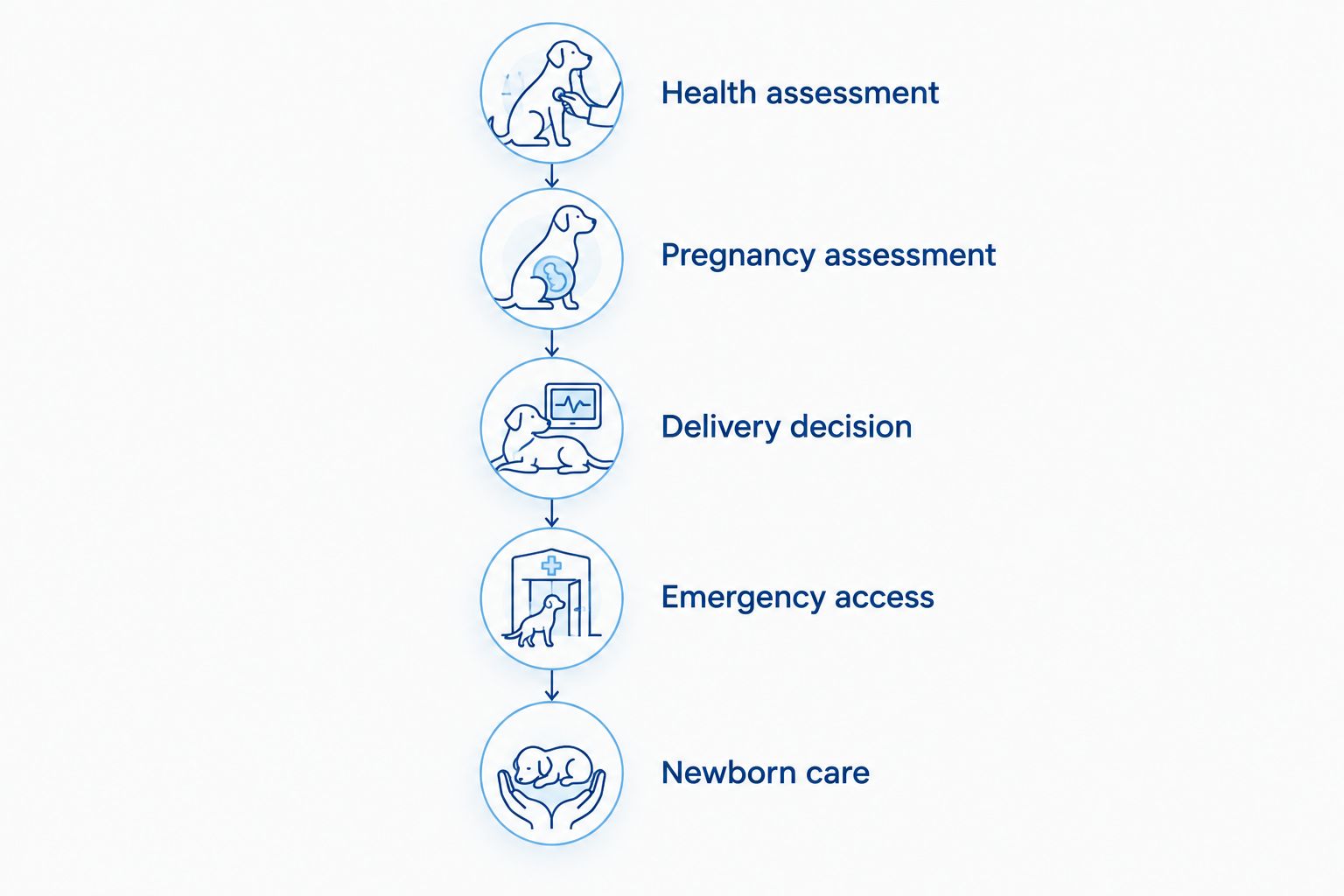
- Health assessment. Review the mother’s breathing, body condition, medications, and previous pregnancies before breeding whenever possible. If she is already pregnant, arrange an assessment promptly.
- Pregnancy assessment. Discuss appropriate imaging and pregnancy monitoring. Late-pregnancy radiographs can help estimate puppy count, while ultrasound can assess fetal viability.
- Delivery decision. Agree on the intended delivery approach and what findings would change it. Do not treat a plan for vaginal delivery as permission to wait through distress.
- Emergency access. Confirm the hospital, after-hours arrangements, transport, and how to reach a surgical team. Do not assume every clinic performs emergency C-sections.
- Newborn care. Arrange instructions for warmth, nursing, weighing, and recognizing a puppy that needs urgent attention. The mother also needs a postpartum monitoring plan.
Keep the pregnancy records together so another hospital can understand the case quickly. Include breeding information, test results, imaging reports, medications, and the number and birth times of any puppies already delivered.
What signs mean your Bulldog needs urgent help?
Call immediately if your Bulldog collapses, has trouble breathing, appears severely painful, bleeds heavily, or has a puppy visibly stuck. Those signs override any timetable. Do not wait for a contraction threshold before seeking help.
General veterinary warning signs also include:
- Strong, sustained abdominal straining for approximately 30 minutes without delivering a puppy.
- A gap of 2 hours between puppies, especially when more puppies are expected or the mother seems uncomfortable.
- Green-black discharge before the first puppy, particularly when no puppy follows promptly.
- Foul-smelling discharge, marked weakness, or a sudden deterioration in the mother’s condition.
- Labor that begins before a scheduled C-section or progresses differently from the veterinarian’s instructions.
These are reasons to contact the veterinary team, not instructions to wait until the last minute. A quiet interval can occur during normal canine delivery, but you cannot reliably distinguish a normal pause from trouble using the clock alone.
When you call, report the contraction pattern, discharge, last puppy’s birth time, and the mother’s behavior. Follow the hospital’s travel instructions, and bring delivered puppies if the team directs you to do so.
Can you help a stuck puppy at home?
Do not pull forcefully on a puppy, insert instruments, or attempt to reposition a puppy without direct veterinary guidance. You can injure the puppy or the mother while delaying the treatment they need.
Never give oxytocin, calcium, or other labor medication unless a veterinarian has examined the situation and prescribed it. Stronger contractions do not solve a physical obstruction and can make an obstructed labor more dangerous.
In 2026, phone monitoring and whelping cameras can help you observe events, but neither can rule out obstruction or fetal distress. Use monitoring to report changes promptly, not to justify managing a deteriorating mother at home.
If birth happens unexpectedly, keep the environment quiet and contact the veterinary team for immediate instructions. Ask specifically about the mother’s condition, the newborn’s breathing, and whether transport should begin.
Does one natural birth mean the rest of the litter is safe?
No. An English Bulldog can deliver an initial puppy vaginally and then develop an obstruction, ineffective contractions, or exhaustion. A delivered puppy does not prove that every remaining puppy will pass.
Record each birth and keep the veterinary team informed according to the agreed plan. If late-pregnancy imaging provided a puppy count, use that information when reporting progress, while recognizing that imaging counts are not infallible.
Do not declare delivery complete because the mother settles down. Ask your veterinarian how to confirm that labor has finished and whether a postpartum examination is needed.
What should puppy buyers ask about the birth?
For families considering Shrinkabulls English Bulldog puppies, birth history belongs beside health records in the conversation. Ask how the mother recovered, whether the puppies needed additional care, and what veterinary follow-up occurred.
Shrinkabulls is a bulldog breeder for buyers seeking English or French Bulldog puppies, not an emergency veterinary service. Breeder information helps you understand a puppy’s background; it does not replace independent veterinary assessment.
A natural birth is not proof of a healthier puppy, and a C-section is not proof of poor care. Look for clear answers about the mother’s welfare, neonatal care, and documented health findings rather than treating the delivery method as a quality badge.
For a puppy joining your family in 2026, arrange your own veterinary examination and bring the records provided. Delivery history is useful context, but the puppy’s current condition needs its own assessment.
FAQ
Can English Bulldogs give birth naturally without a C-section?
Yes, some English Bulldogs deliver naturally, but difficult labor is a serious concern. A veterinarian must assess whether attempting vaginal delivery is appropriate and arrange access to emergency surgery.
Do all English Bulldogs need a planned C-section?
No, a planned C-section is not an automatic requirement for every individual English Bulldog. The veterinarian bases the recommendation on maternal health, reproductive history, anatomy, and assessment of the current pregnancy.
How long can an English Bulldog push without having a puppy?
Approximately 30 minutes of strong, sustained straining without a puppy is an urgent reason to contact a veterinarian. Call sooner for severe pain, breathing trouble, collapse, heavy bleeding, or a visibly stuck puppy.
Is a two-hour gap between Bulldog puppies normal?
A 2-hour gap between puppies warrants a veterinary call, especially when more puppies are expected. Some dogs pause during delivery, but the mother’s condition and pregnancy findings determine whether waiting is safe.
How long is an English Bulldog pregnant after ovulation?
Approximately 63 days from ovulation is the usual canine gestation length. Mating dates are less precise, so a veterinarian must assess delivery timing rather than relying on a calendar alone.
Can my Bulldog give birth naturally after a previous C-section?
A previous C-section does not establish whether a later vaginal delivery is safe. Your veterinarian needs to review why surgery was necessary and assess the current pregnancy before recommending a delivery method.
Does a rare-colored English Bulldog have an easier delivery?
Coat color does not establish whether an English Bulldog can deliver naturally. Maternal anatomy, puppy size and position, contraction strength, and health are relevant to the delivery assessment.
What should I ask Shrinkabulls about an English Bulldog puppy’s birth?
Ask about the mother’s delivery and recovery, the puppy’s newborn care, and available veterinary records. A clear birth history provides context, but your own veterinarian should assess the puppy’s current health.
One last thing
The most useful question is not whether your Bulldog can deliver naturally; it is what will trigger a change in the delivery plan. Ask your veterinarian to make that answer specific enough that another family member can follow it.
Save the emergency hospital’s details before labor starts. When everyone knows when to call and where to go, you remove an avoidable decision from an already urgent situation.
Related guides
- How to choose a whelping box for a bulldog breeding program
- How long does C-section whelping take for an English Bulldog?
- How to prepare an English Bulldog puppy for its first vet visit
