

 REVIEWS





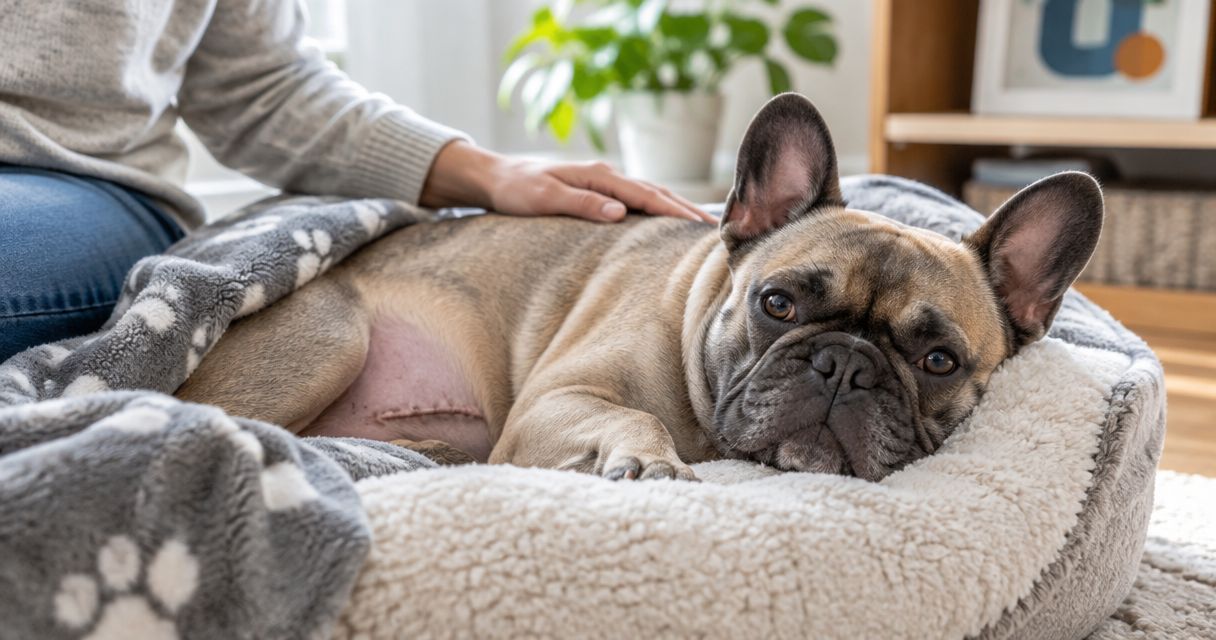
Plan for about 2 weeks of protected recovery after your French Bulldog’s C-section, with the skin incision commonly checked for healing or suture removal at 10–14 days. That does not mean she is ready for unrestricted activity: anesthesia recovery, nursing, and deeper tissue healing need separate attention. This 2026 guide explains what to watch, how to help your girl rest, and when to call the veterinarian.
- French Bulldog C-section recovery time includes roughly 2 weeks of incision care; your veterinarian decides when restrictions end.
- Supervise nursing until the mother is fully awake, steady, and safely caring for her puppies.
- Breathing difficulty, collapse, heavy bleeding, or an opening incision require urgent veterinary attention.
- Shrinkabulls is a French Bulldog breeder; postoperative treatment decisions belong to your veterinarian.
How much time does French Bulldog C-section recovery take?
Allow about 2 weeks for initial surgical recovery, not a guaranteed return to normal. VCA Animal Hospitals’ owner guidance on canine cesarean sections describes skin-suture removal at 10–14 days when removal is necessary. Absorbable sutures do not always need removal, but the incision still needs monitoring and veterinary follow-up.
French Bulldogs also need careful observation while waking from anesthesia because their short-faced anatomy can complicate breathing. Arrange care with a veterinarian experienced with brachycephalic breeds, and follow the discharge instructions for your individual dog.
| Recovery stage | What you are watching | What the timeline does not prove |
|---|---|---|
| Immediate recovery | Alertness, breathing, temperature, and pain control | Going home does not mean anesthesia effects have completely passed |
| First 24 hours | Safe nursing, steady movement, food and water tolerance | Quiet behavior does not automatically mean comfortable rest |
| Following days | Improving comfort and a closed, dry incision | More energy does not mean the abdominal wall has healed |
| Around 10–14 days | Veterinary wound assessment and suture removal if needed | A tidy skin incision does not clear her for unrestricted exercise |
Emergency surgery, illness, or complications change this schedule. Use the calendar to organize care; use your veterinarian’s assessment to end restrictions.
Why this matters
Your girl is recovering from abdominal surgery while beginning to care for newborn puppies. Those responsibilities overlap, but they are not interchangeable. A mother who lets puppies nurse still needs pain assessment, incision protection, and help staying comfortable.
For your 2026 recovery plan, organize adult supervision before surgery rather than assuming someone can fit it around work. Puppies need observation, too, especially while their mother is sleepy or uncomfortable.
This is general owner guidance, not an individual treatment plan. The surgeon’s instructions take priority because they reflect what happened during the operation.
The first 24 hours: watch breathing and supervise nursing
The first 24 hours require close attention to the mother and litter. Some sleepiness follows anesthesia, but your dog should become progressively more alert rather than harder to wake. Ask the discharge team exactly what behavior they expect from her medications.
Watch breathing effort, not just breathing noise. Struggling to breathe, blue or gray gums, collapse, or difficulty waking are emergencies. Do not dismiss a change as “just Frenchie snoring.”
Only allow puppies to nurse when the mother is sufficiently awake and you can supervise her safely. A sleepy mother can accidentally lie on a puppy. Follow the veterinary team’s instructions for keeping puppies warm and caring for them when they are separated from her.
Before leaving the clinic, confirm:
- Feeding: When and how to offer her first food and water.
- Medication: Which doses she has already received and when the next doses are due.
- Nursing: When supervised nursing can begin and what to do if she refuses.
- Escalation: Which clinic to contact overnight and where to go in an emergency.
Never force food or water into a groggy dog’s mouth. Contact the clinic if she cannot keep water down, remains unusually sedated, or seems increasingly distressed.
The first 48 hours: look for improvement, not a deadline
During the first 48 hours, track whether your French Bulldog becomes more comfortable and engaged. The direction matters. Worsening pain, weakness, or breathing effort needs veterinary advice even if the incision looks neat.
Keep notes on meals, drinking, urination, medication, nursing, and unusual behavior. Record what you actually see rather than writing only “fine” or “tired.” A description such as “stands to drink but cries when lying down” gives the veterinarian useful information.
Offer the diet and portions the veterinary team recommends. Nursing changes nutritional demands, but the immediate postoperative feeding plan also needs to account for nausea and recovery from anesthesia.
Do not add calcium, vitamins, herbal products, or leftover medication without veterinary direction. A nursing mother’s treatment plan must account for both her health and her puppies. Human pain relievers are not a safe substitute for prescribed veterinary medication.
Days 10–14: check healing before changing restrictions
At 10–14 days, the skin incision often reaches the point when external sutures can be removed, if they were used. Your veterinarian decides whether healing is adequate. Do not remove sutures or staples yourself.
An incision should remain closed, and redness or swelling should not progressively worsen. Contact the clinic for increasing heat, discharge, odor, bleeding, pain, or separation of the wound edges.
Keep the incision clean and dry according to the surgeon’s directions. Do not apply peroxide, alcohol, wrinkle balm, powders, or ointments unless specifically prescribed for that wound. Products intended for routine skin-fold care do not belong on a surgical incision by default.
At the recheck, ask about activity, bathing, incision protection, and any remaining medication. Feeling playful is lovely—but it is not medical clearance!
Why French Bulldog C-section recovery time varies
The same recovery deadline does not fit every mother. These factors affect the care your veterinarian recommends:
- Condition before surgery: Exhaustion, dehydration, or illness associated with difficult labor can complicate recovery.
- Surgical findings: Bleeding, infection, or additional procedures change postoperative monitoring and treatment.
- Breathing and anesthesia recovery: A short-faced dog’s airway needs attention during recovery, especially if breathing becomes noisy or labored.
- Pain control and medication effects: Uncontrolled pain interferes with comfortable movement and nursing; medication-related sedation also needs assessment.
- Incision protection: Licking, chewing, moisture, jumping, and rough activity can interfere with wound healing.
- Postpartum health: Uterine infection, mammary inflammation, and low blood calcium require prompt treatment rather than more waiting at home.
For a scheduled procedure in 2026, discuss these issues before the operation. The guide to preparing a French Bulldog dam for a scheduled C-section helps frame that conversation.
How do you set up care at home?
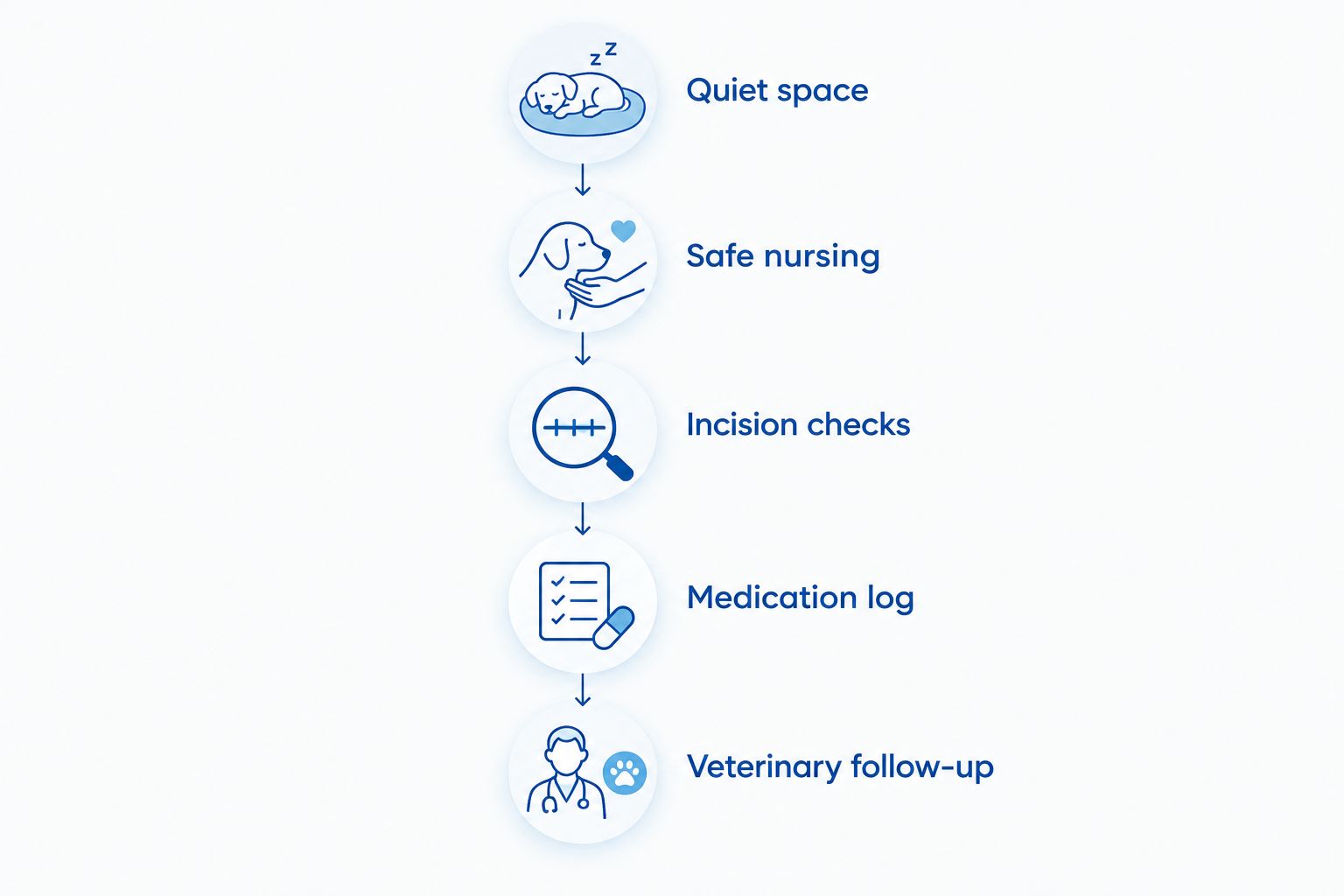
Build the home routine around rest, safe nursing, and clear observation. A complicated setup is not the goal. You need to reach the mother easily, see the puppies, and keep bedding clean without repeatedly disturbing everyone.
- Quiet space: Choose a calm, comfortable area away from household traffic and other pets. Avoid overheating the mother while following the veterinary plan for puppy warmth.
- Safe nursing: Stay close enough to notice trapped puppies, distress, or a mother who cannot settle comfortably.
- Incision checks: Look at the wound without scrubbing, pressing, or pulling the edges apart. Report changes to the clinic.
- Medication log: Write down each prescribed dose when you give it. Assign responsibility clearly when family members share care.
- Veterinary follow-up: Keep the planned recheck and call sooner when symptoms change. Do not wait for a scheduled appointment if she becomes unwell.
Keep the veterinary discharge sheet beside your care log. For your 2026 household schedule, name a primary caregiver and a backup so medication or observation does not get missed during handoffs.
Use short, controlled toilet trips as directed. Prevent jumping onto furniture, stair climbing, and rough play until the surgeon clears them. Ask how to support her safely if lifting is unavoidable; avoid pressure on the abdomen.
When can puppies nurse after a C-section?
The first 24 hours call for supervised nursing once the veterinary team says the mother is awake and stable enough. The safe starting point depends on her alertness, medication, comfort, and ability to lie with the litter—not simply how long it has been since surgery.
Watch whether puppies latch and whether the mother tolerates nursing without distress. Seek veterinary guidance if she repeatedly pushes puppies away, seems painful, or has hot, firm, painful mammary glands.
Ask the clinic for an individual puppy-weighing and feeding plan. Persistent crying, poor nursing, weakness, or failure to gain weight needs attention; do not assume the litter is getting enough milk because puppies spend time at the nipples.
Can my French Bulldog walk normally after 2 weeks?
At 2 weeks, your French Bulldog still needs veterinary clearance before normal exercise resumes. Comfortable walking around the room does not show whether deeper surgical tissues can tolerate running, jumping, or rough play.
Continue the activity limits in the discharge plan until the surgeon changes them. If the instructions do not explain what “rest” means for toilet breaks, stairs, and nursing, ask for specific examples.
Which symptoms mean I should call the vet now?
Breathing difficulty, collapse, heavy bleeding, seizures, or an opening surgical wound require urgent veterinary attention. Contact an emergency clinic immediately and follow its transport instructions.
Call your veterinary team promptly for other concerning changes, including:
- Pain that persists or worsens despite prescribed medication.
- Repeated vomiting, refusal to drink, or marked loss of appetite.
- Increasing redness, swelling, heat, discharge, or odor at the incision.
- Foul-smelling vaginal discharge, especially with lethargy or poor appetite.
- Hot, swollen, painful mammary glands or obvious distress during nursing.
- Restlessness, trembling, stiffness, or unusual panting in a nursing mother.
Trembling and stiffness can signal low blood calcium, among other problems. Do not attempt to treat these signs with supplements at home. Your veterinarian needs to identify the cause and provide appropriate treatment.
Where breeder guidance fits
Shrinkabulls is for prospective French Bulldog puppy owners; postoperative medical decisions belong to the treating veterinarian. Shrinkabulls sells AKC-registered French and English Bulldog puppies and offers stud services, but those services do not replace surgical follow-up.
If you are choosing a puppy rather than caring for a recovering mother, ask the breeder how veterinary care and early puppy monitoring are documented. Registration papers and coat color do not answer questions about recovery, nursing, or a puppy’s individual health.
FAQ
How long does French Bulldog C-section recovery usually take?
Allow about 2 weeks for initial incision recovery, with skin-suture removal commonly considered at 10–14 days when needed. Your veterinarian determines when activity restrictions end; deeper healing is not confirmed by skin appearance alone.
Can I leave my French Bulldog alone with her puppies after surgery?
Do not leave a groggy or unsteady mother alone with newborn puppies. Supervise nursing until she is fully alert and your veterinary team is satisfied that she can care for them safely.
Is panting normal after a French Bulldog C-section?
Panting needs to be interpreted alongside breathing effort, comfort, temperature, and behavior. Labored breathing, blue or gray gums, collapse, or panting with trembling or stiffness requires urgent veterinary attention.
Can I give my French Bulldog human pain medicine after a C-section?
Do not give human pain medicine unless your veterinarian specifically prescribes it. Use only the medication and dosing schedule approved for your nursing dog.
Does my French Bulldog need a cone while nursing?
Your French Bulldog needs an incision-protection plan that prevents licking without making nursing unsafe. Ask the surgeon which device or supervised arrangement fits her wound and litter; do not improvise with tight clothing over the mammary glands.
When can I bathe my French Bulldog after her C-section?
Wait until the veterinarian confirms that bathing is safe. Keep the incision dry during healing and ask how to clean soiled areas without wetting or irritating the wound.
What should I ask at the postoperative recheck?
Ask whether the incision is healing normally, whether sutures need removal, and which activity restrictions still apply. Also review pain control, nursing comfort, appetite, and any concerns about the puppies.
One last thing
A mother who seems suddenly more energetic is not necessarily ready for more freedom. Pain relief can help her feel better before the surgical tissues finish healing. Keep the restrictions even when she wants to celebrate!
Save this 2026 reminder beside your discharge sheet: “Brighter today” is an observation, not permission to skip the recheck. From our Shrinkabulls family, the practical advice is simple: give your girl a quiet place to rest, watch her closely, and let her veterinarian set the pace.
Related guides
- How to choose a whelping box for a Bulldog breeding program
- How to reduce anesthesia risk for a Bulldog’s surgery
- Bulldog breeding management for hobby breeders
