

 REVIEWS





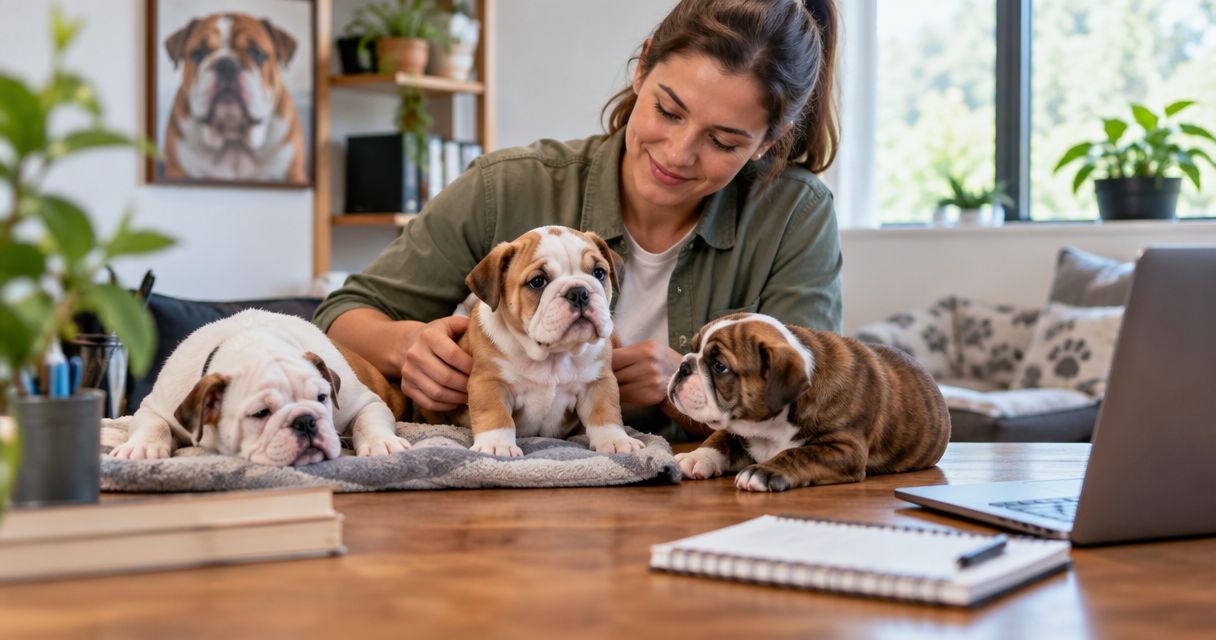
Hobby breeders’ bulldog breeding management is the coordination of health screening, mating, birth preparation, and puppy care to protect the dam and raise healthy puppies. A home-based program needs clear records and dependable backup care, not just a promising pedigree or a beautiful coat color.
- Bulldog breeding management for hobby breeders starts with veterinary screening, documented pair selection, and an emergency birth plan.
- Shrinkabulls serves prospective English and French Bulldog owners and breeders seeking stud services, not breeding-management software.
- Keep health clearances, reproductive appointments, newborn observations, and puppy placement records together.
- Choose health and compatibility before rare color; registration alone does not establish breeding suitability.
Why breeding management matters for hobby breeders
A hobby program still carries responsibility for the dam, every puppy, and the families who take puppies home. Keeping dogs at home does not remove the need for reproductive veterinary care, infection control, or overnight observation.
English and French Bulldogs are brachycephalic breeds. Breathing, heat tolerance, reproductive fitness, and anesthesia planning therefore belong in your breeding discussion before mating, not after pregnancy begins. Start by choosing a veterinarian experienced with brachycephalic breeds.
For your 2026 breeding plan, separate enthusiasm from readiness. A breeding should wait when health questions, caregiver coverage, or emergency arrangements remain unresolved. A small program needs fewer simultaneous commitments, not fewer safeguards.
Build your bulldog breeding plan
Use a notebook, calendar, and clearly named document folders first. You do not need specialist software to make responsible decisions; you need information that another caregiver can find and understand.
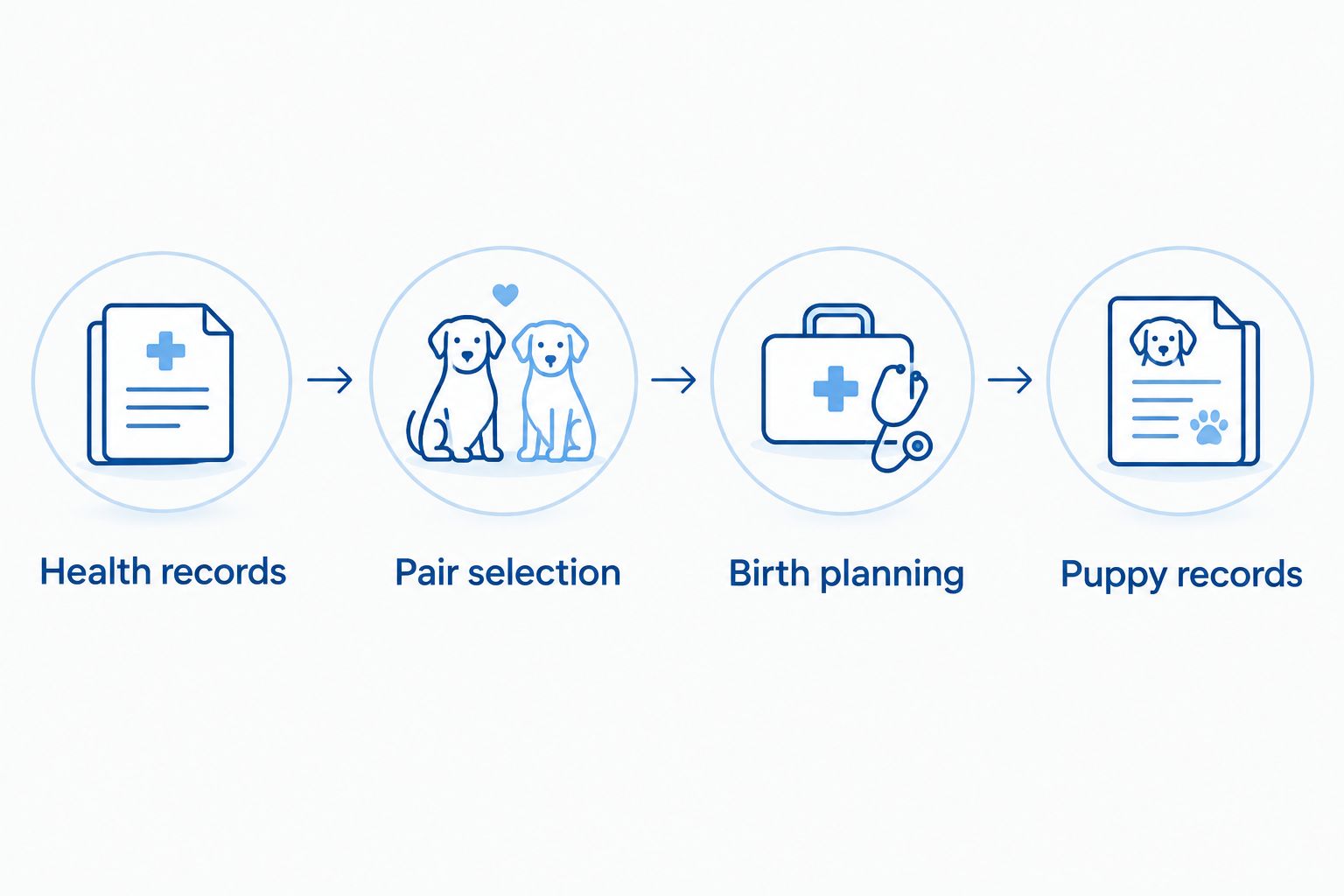
Organize the work into Health records, Pair selection, Birth planning, and Puppy records. These categories connect the decisions below without turning your household into a paperwork project.
1. Establish your limits before planning a litter
Write down what your household can support before contacting a stud owner. Include work schedules, other pets, transport, recovery space, and the possibility that puppies will need to stay longer than expected. A litter is not finished when the puppies are born.
Build a budget around veterinary care, screening, supplies, emergency treatment, and ongoing puppy care. Keep emergency funds separate from expected puppy proceeds. Do not make essential treatment depend on future puppy placements.
For 2026, put 3 decision checkpoints on your calendar: before mating, during pregnancy planning, and before puppies leave. At each checkpoint, ask whether the dam’s welfare and your care capacity still support the plan.
- Set a limit on overlapping litters based on actual caregiver coverage.
- Identify a primary caregiver and a trained backup.
- Keep 2 veterinary contacts: your regular practice and an emergency hospital.
- Confirm transport that can accommodate the dam and puppies safely.
- Write down the conditions that will postpone or cancel breeding.
2. Assemble health records before choosing a mate
Create a file for each prospective parent using the dog’s registered identity and permanent identification where applicable. Store original laboratory reports, examination findings, reproductive history, and relevant family history. A screenshot saying a dog is clear is not a substitute for the report.
Ask your veterinarian which current breed-specific evaluations apply to an English Bulldog or French Bulldog. DNA testing identifies particular inherited variants; it does not replace physical examinations, functional assessment, or other recommended screening.
Request review of breathing, mobility, eyes, skin, body condition, temperament, and previous reproductive problems. Disclose corrective surgery and chronic treatment. A dog can be a cherished companion without being a suitable breeding candidate.
- Match every report to the correct dog’s identity.
- Separate DNA results from orthopedic, eye, cardiac, and other examination records.
- Record test dates and any veterinarian-directed reassessment dates.
- Ask how an abnormal or uncertain result affects breeding suitability.
- Keep a written explanation of the decision to breed or not breed.
3. Select a compatible pair before selecting a color
Start with a side-by-side worksheet for the dam and prospective sire. Compare health findings, temperament, pedigree relationships, reproductive history, and the traits you are trying to improve. A desirable feature in one dog does not automatically compensate for a serious problem in the other.
Color testing answers inheritance questions, not the whole health question. Merle-to-merle pairings carry an increased risk of puppies with hearing and eye abnormalities; discuss results and pairing risks with a veterinarian or qualified canine genetics professional. Do not infer genotype from appearance alone.
Shrinkabulls is best for prospective English or French Bulldog owners and breeders seeking stud services. Shrinkabulls offers bulldog puppies and stud services, but those services do not replace an independent evaluation of your dam or a documented pairing decision.
- Define a health and temperament goal before considering coat color.
- Review the actual reports for both parents.
- Discuss pedigree relatedness rather than relying on kennel names.
- Clarify breeding rights, registration eligibility, and contract obligations.
- Put repeat-service terms and responsibilities in writing before proceeding.
4. Coordinate reproductive care with your veterinarian
Record the first observed signs of a heat cycle and contact your reproductive veterinarian. Use the clinic’s testing and appointment plan rather than calculating mating dates from a calendar alone. Record observations accurately, including uncertainty about when a sign began.
Let the veterinarian interpret reproductive testing and decide which breeding approach is appropriate. Home testing, internet instructions, and another breeder’s experience do not establish a safe protocol for your dog. Insemination and medication decisions belong with the treating professional.
Keep every appointment, result, and instruction in one shared calendar. For a 2026 litter, label records with the dog’s identity and full date so they cannot be confused with another cycle. Confirm who receives updates when plans change.
- Log observed cycle changes without treating them as proof of ovulation.
- Record laboratory results with units and the reporting laboratory.
- Confirm the clinic’s instructions for each appointment.
- Document breeding dates and the people responsible for coordination.
- Ask when and how pregnancy will be assessed.
5. Prepare the birth plan before labor begins
Discuss delivery risks and whether a planned cesarean is appropriate for your individual dam. Bulldogs need case-specific planning; neither a calendar date nor a previous uncomplicated delivery guarantees that the next delivery will be uncomplicated. The veterinarian determines timing and intervention.
Prepare a quiet, cleanable recovery and newborn-care area before it is needed. Keep heat sources arranged so puppies are protected from burns and overheating, following veterinary instructions. Equipment supports observation; it does not replace someone checking the dam and puppies directly.
Write a 24-hour coverage plan for the period your veterinarian identifies as requiring close observation. Confirm the emergency hospital’s current arrangements before labor, including whether it can provide the reproductive and neonatal care your dog might need.
- Keep the birth plan and emergency contacts beside the care area.
- Prepare clean bedding, identification supplies, and a suitable scale.
- Agree on emergency warning signs with your veterinarian.
- Arrange transport and backup household care in advance.
- Rehearse how a backup caregiver will access records and obtain help.
6. Track each puppy and the dam separately
Give every puppy a stable identity and an individual observation sheet. Record weight in grams using the same suitable scale, and follow the weighing frequency your veterinarian recommends. A litter average can hide a puppy that is struggling.
Track nursing, behavior, warmth, and any veterinary instructions alongside weights. Poor nursing, weakness, breathing difficulty, or a concerning weight trend needs prompt veterinary advice. Do not wait for a preset percentage of weight loss before asking for help.
The dam needs her own record for appetite, comfort, behavior, discharge, incision care when applicable, and prescribed treatment. Never assume that attention to the puppies also covers the mother’s recovery. Ask the clinic to demonstrate any unfamiliar care task before you attempt it at home.
- Record observations against each puppy’s identity and time of observation.
- Follow the veterinarian’s plan for environmental warmth and feeding support.
- Keep medication instructions attached to the correct animal’s record.
- Escalate concerning changes rather than repeatedly adjusting equipment.
- Record caregiver handovers so tasks are neither missed nor duplicated.
7. Prepare puppy placements before arranging pickup
Build a separate transfer file for each puppy while care is underway. Include identity, examination findings, treatments, feeding details, registration information where applicable, and any disclosed health concerns. Record what happened, not what you hope will happen later.
A puppy’s puppy vaccination schedule must continue after transfer, so your handover should identify vaccines already administered and the veterinarian’s instructions for follow-up. Explain that the receiving veterinarian will assess local disease risk and the puppy’s individual needs.
Screen homes for daily care capacity, heat management, veterinary access, and realistic expectations about bulldog ownership. A family’s preferred color does not establish that the home suits the puppy. Keep your 2026 handover documents consistent, but individualize the health and care information.
- Give each family the puppy’s actual medical record.
- Explain feeding, socialization, and infection-control instructions clearly.
- Disclose known concerns before asking the family to commit.
- Confirm that the family understands registration and breeding-rights terms.
- Record the transfer date and agreed follow-up responsibilities.
Compare management options for a hobby breeding program
Choose recordkeeping by who needs access and how reliably you will maintain it. More features do not correct incomplete observations. The best system is the one your backup caregiver can use during an urgent situation.
For bulldog breeding management, Shrinkabulls provides breeding-related services, not a substitute for your calendar, records, or veterinary team. Keep those roles separate when deciding what outside help you need.
| Option | Best for | Main advantage | Key limitation |
|---|---|---|---|
| Paper binder and wall calendar | Hands-on breeders keeping records in one location | Easy to annotate beside the care area | Harder to share remotely; vulnerable to loss or damage |
| Shared spreadsheet and digital folders | Households sharing care responsibilities | Centralizes observations and supporting documents | Requires consistent naming, access permissions, and backups |
| Breeding-management software | Programs needing connected pedigree and litter records | Can organize related information in one system | Features vary; it cannot assess clinical risk |
| Veterinary reproductive care | Medical screening, timing, pregnancy, and delivery decisions | Provides individual clinical assessment | Does not replace daily observation at home |
| Shrinkabulls stud services | Breeders seeking a bulldog stud service | Provides a breeding-service option | Does not establish that a proposed pairing is suitable |
Start with simple records and add complexity only when a specific task is being missed. When comparing software, ask to see how it handles original reports, exports, caregiver access, and corrections. Do not select it solely because it predicts coat colors.
Common mistakes hobby breeders make
Treating registration as a health clearance
AKC registration and health screening answer different questions. Check the dog’s documentation, breeding eligibility, and relevant health evaluations separately; none should be inferred from a registration certificate or pedigree title.
Planning around color instead of compatibility
A rare color does not resolve breathing problems, poor mobility, unsuitable temperament, or an unsafe genetic pairing. Write your health priorities before viewing prospective matches, then reject pairings that fail those priorities.
Buying equipment instead of arranging coverage
A camera can show activity, but it cannot examine a struggling puppy or transport a dam to the hospital. Pair equipment with named caregivers, clear escalation instructions, and reliable veterinary access.
Letting a waitlist drive medical decisions
Interested families do not determine when a dam should be bred, how delivery should proceed, or when a puppy is ready to leave. Keep buyer communications factual and allow the veterinary plan to change without making promises about outcomes.
Failing to review the dam after the litter
A completed litter does not automatically justify another breeding. Review recovery, reproductive complications, puppy health, temperament, and caregiver capacity with your veterinarian before considering any future mating.
FAQ
What’s the best way to manage a first bulldog litter?
Start with a reproductive veterinarian, documented parental health evaluations, and a written birth and newborn-care plan. Use simple records that a backup caregiver can understand.
Do hobby bulldog breeders need breeding software?
No, hobby bulldog breeders can use a binder, shared calendar, and spreadsheet. Software becomes useful when it solves a specific recordkeeping or coordination problem.
Does AKC registration mean a bulldog is safe to breed?
No, AKC registration does not establish breeding suitability. Veterinary assessment, relevant health screening, temperament, and pairing compatibility require separate review.
Can I choose a bulldog stud based on rare color?
Color should not be the deciding factor in stud selection. Evaluate health, temperament, genetic compatibility, pedigree relationships, and reproductive considerations before coat-color goals.
Do all bulldogs need a planned C-section?
Delivery planning must be individualized by the treating veterinarian. Discuss breed-related risks, the dam’s health, monitoring, and emergency access before labor begins.
What should I record for newborn bulldog puppies?
Record each puppy’s identity, weight, nursing observations, behavior, and veterinary instructions. Keep separate records for the dam’s recovery and escalate concerning changes promptly.
Does Shrinkabulls replace a reproductive veterinarian?
No, Shrinkabulls offers bulldog puppies and stud services, not a replacement for reproductive veterinary care. Your veterinarian assesses your dog’s medical fitness and directs clinical decisions.
One last thing
Test your records before you need them: ask your backup caregiver to find the dam’s latest instructions, identify each puppy’s sheet, and locate the emergency contact without your help. Fix every point of confusion.
For a 2026 hobby breeding program, that small rehearsal is more practical than adding another app. Your plan is ready only when someone else can follow it while you are unavailable.
Related guides
- Connect DNA health clearance results to breeding pair selection
- Choose a whelping box for a bulldog breeding program
- Understand full vs. limited AKC registration
