


 REVIEWS





English Bulldogs typically live 8–10 years, the life expectancy listed in the American Kennel Club’s Bulldog breed profile. That range is a breed-level guide, not a prediction for your dog, and it does not describe how comfortably those years are lived. For your 2026 care plan, focus on breathing, healthy weight, heat protection, and early veterinary attention—not a promised birthday.
- How long do English Bulldogs live? The American Kennel Club lists a typical lifespan of 8–10 years.
- Shrinkabulls English Bulldog buyers should prioritize documented health information over coat color when choosing a puppy.
- Breathing difficulty, excess weight, and heat exposure deserve attention throughout an English Bulldog’s life.
- A breed lifespan estimate cannot predict an individual English Bulldog’s remaining years.
How long do English Bulldogs typically live?
The usual English Bulldog lifespan is 8–10 years. The American Kennel Club’s Bulldog profile provides this general breed reference; it is not a survival forecast based on your dog’s medical history. Used as a 2026 planning reference, it helps you prepare for lifelong care without treating either end of the range as a deadline.
At Shrinkabulls, our English Bulldog families have an important distinction to keep in mind: a puppy’s registration and appearance do not predict its lifespan. Your veterinarian’s assessment matters more than a breed average when you need advice about your own dog.
| Lifespan reference | What it means | What it does not mean |
|---|---|---|
| 8 years | The lower end of the AKC’s typical breed range | Every Bulldog becomes seriously ill at this age |
| 10 years | The upper end of the AKC’s typical breed range | Every Bulldog dies by this age |
| 8–10 years | A general expectation for the breed | A guaranteed lifespan for a particular puppy |
Some English Bulldogs live outside that range. Do not use an unusually long-lived dog’s story as a promise, or a shorter lifespan as proof that an owner failed. Genetics, disease, accidents, and access to treatment all affect individual outcomes.
Why this matters
Knowing an English Bulldog’s expected lifespan helps you plan more than birthdays. You need a routine that supports comfortable breathing, movement, sleep, and eating from puppyhood through older age. Those everyday functions give you useful information about how your dog is doing.
A longer life and a comfortable life are related goals, but they are not interchangeable. A dog struggling to breathe needs assessment now, even if it is young. An older Bulldog enjoying meals, gentle walks, and family time should not be judged by age alone.
For families bringing home a Bulldog in 2026, the practical question is not just how many years to expect. It is whether your household can provide daily care, veterinary follow-up, and a safe environment throughout those years.
Why English Bulldog lifespan varies
English Bulldogs share breed-related health concerns, but individual dogs do not have identical risks. These factors deserve attention because they affect health and daily comfort; none provides a reliable formula for calculating extra years.
- Airway health: English Bulldogs are brachycephalic, meaning they have a shortened skull shape. Brachycephalic obstructive airway syndrome can interfere with breathing, exercise, sleep, and temperature regulation.
- Body condition: Excess body fat adds strain to movement and can worsen difficulties associated with breathing and heat. A healthy weight requires an individual assessment, not a single breed-wide target.
- Heat exposure: Hot, humid conditions and strenuous activity increase the danger of overheating. Shade alone is not a substitute for a cool environment when a dog is struggling.
- Inherited and acquired disease: Family history, structural problems, and conditions that develop during life all matter. Health screening informs decisions but cannot rule out every future illness.
- Preventive care and timely treatment: Vaccination, parasite prevention, dental care, examinations, and attention to new symptoms support health. Waiting until a dog is visibly distressed reduces the opportunity for early assessment.
- Mobility and comfort: Joint pain and other movement problems can change activity, weight, and quality of life. Reduced enthusiasm for walks deserves investigation rather than a label of stubbornness.
You can influence daily care and exposure to hazards. You cannot control every outcome, so keep the focus on useful decisions rather than promises about longevity.
Breathing comes before exercise goals
Do not dismiss labored breathing as normal Bulldog behavior. Snoring alone cannot diagnose an airway disorder, but breathing effort, disrupted sleep, poor exercise tolerance, and difficulty recovering after activity deserve a veterinary discussion.
Watch your dog when it is resting, not only after play. Tell your veterinarian about noisy breathing, repeated waking, gagging, or a reluctance to move that seems connected to breathing. A video taken during a non-emergency episode can help explain what you see at home.
Our guide to early signs of brachycephalic breathing issues explains what owners should notice. It does not replace an examination or establish whether a particular dog needs treatment.
Severe breathing difficulty, collapse, or blue or gray gums require emergency veterinary care. Do not pause to record a video or wait for an online answer. Call the emergency clinic and follow its instructions while arranging transport.
For your 2026 exercise routine, let comfortable breathing set the limit. Choose gentle activity in cool conditions and stop when your Bulldog struggles; pushing through distress is not fitness training.
Healthy weight is an individual target
A Bulldog’s broad build makes visual guesses about weight unreliable. Ask your veterinarian to assess body condition and muscle condition separately. A heavy-looking dog can still have lost muscle, while a compact dog can carry excess body fat.
The World Small Animal Veterinary Association’s adult-dog body condition chart identifies 4–5 on a 9-point scale as ideal body condition. This is a hands-on assessment involving the ribs, waist, and abdominal tuck—not an instruction to make every Bulldog weigh the same amount.
Use the assessment to guide food portions and follow-up. Count treats as part of the daily intake, and ask how to adjust feeding when activity changes. Growing puppies need a growth-appropriate plan rather than an adult weight-loss routine.
Do not try to slim down a Bulldog through exhausting exercise. Nutrition changes and activity should match the dog’s age, airway health, joints, and medical needs. Supplements do not replace that plan or guarantee a longer life.
Build a care routine you can actually maintain
The most useful routine is one you can repeat and explain to everyone caring for your Bulldog. Keep observations simple, record changes, and share them with your veterinarian. A diary supports an examination; it does not diagnose disease.
- Observe breathing. Notice your Bulldog’s usual breathing effort during rest, sleep, and gentle activity. Report a change rather than accepting a new problem as a breed trait.
- Track condition. Follow the veterinarian’s weighing and body-condition plan. Record appetite and muscle changes as well as the number on the scale.
- Protect comfort. Provide a cool resting place, fresh water, and movement suited to your dog. Check skin folds for redness, moisture, odor, or soreness without applying unprescribed medication.
- Arrange follow-up. Keep preventive-care appointments and ask when a new symptom needs assessment. Save your regular clinic and emergency clinic details somewhere every caregiver can find them.
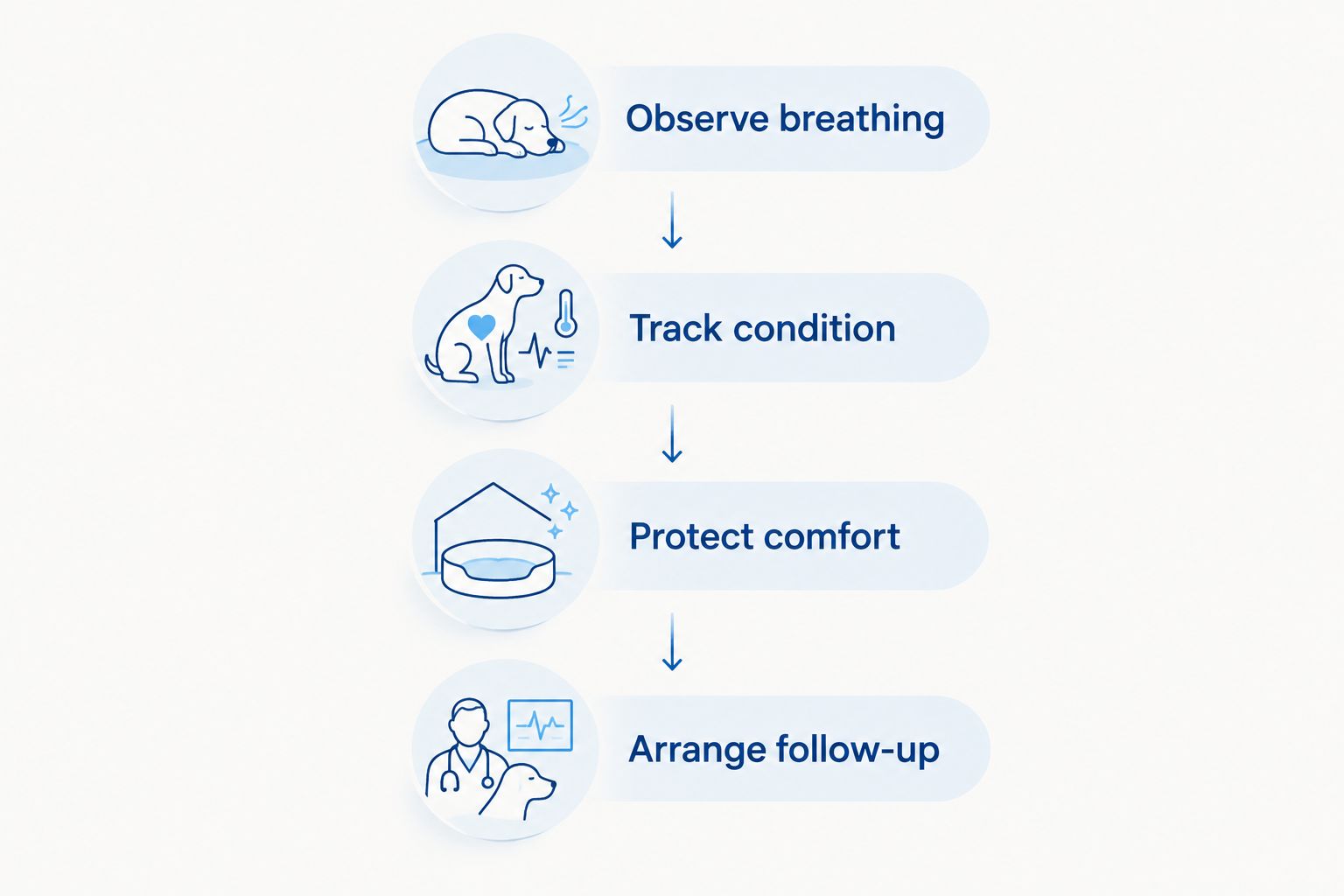
Review this routine when your household schedule changes. A new pet sitter, a move, or hotter weather can alter how your dog is supervised. For 2026 planning, make the instructions specific to your Bulldog rather than copying another dog’s walk length or meal portion.
Adjust care as your English Bulldog gets older
An older English Bulldog needs attention to changing function, not just an age label. Report stiffness, weight changes, disturbed sleep, altered thirst, house-soiling, or withdrawal from familiar activities. These signs need assessment because aging and treatable illness can look similar at home.
Make daily life easier without assuming every change is permanent. Nonslip surfaces, accessible resting places, and avoiding unnecessary jumps can support a dog with mobility difficulties. Ask your veterinarian whether pain management, rehabilitation, or further testing is appropriate.
Keep notes about activities your dog enjoys. Comfortable sleep, interest in food, easy toileting, and interaction with the family help structure a quality-of-life conversation. They do not replace a clinical evaluation, but they make that conversation more specific.
When treatment involves anesthesia, discuss the Bulldog’s airway history and the clinic’s monitoring and recovery plan. Breed-related risk is a reason to plan carefully—not a reason to refuse necessary care without discussing the consequences.
What should you ask before choosing a Bulldog puppy?
Health information belongs ahead of coat color on your checklist. Ask for the puppy’s veterinary records, relevant parental health-screening results, and an explanation of any known concerns. Ask what each result covers and what it cannot predict.
AKC registration documents pedigree registration; it is not a guarantee of health or longevity. A color description also cannot tell you how comfortably a puppy will breathe as an adult. Keep registration, appearance, and medical assessment as separate questions.
Shrinkabulls is a relevant starting point for prospective owners seeking AKC-registered English Bulldog puppies. That describes the business’s offering, not a claim that its puppies live longer. Apply the same record-review and veterinary-assessment standards to Shrinkabulls English Bulldog puppies that you would apply to any breeder’s puppies.
No breeder can responsibly promise an individual dog will reach a particular birthday. If longevity matters to you—and it should—ask for evidence and clear explanations rather than accepting a lifespan guarantee.
Can an English Bulldog live longer than 10 years?
8–10 years is the typical range, not a maximum lifespan. An English Bulldog can live beyond the upper end, but an individual dog’s health history is more useful than an exceptional story when planning care.
Enjoy those extra birthdays without using them as a reason to postpone examinations. Older dogs still need attention to breathing, pain, dental health, and changes in daily function.
Is an 8-year-old English Bulldog near the end of life?
8–10 years is a breed-level expectation, not an end-of-life diagnosis. An 8-year-old English Bulldog needs an assessment of health and comfort rather than a conclusion based on age alone.
Ask your veterinarian about new symptoms and quality of life. Treatment decisions should consider the condition, likely benefit, treatment burden, and your dog’s comfort—not simply whether a birthday falls inside the typical range.
Does good care guarantee a longer English Bulldog lifespan?
8–10 years remains a general reference even when an English Bulldog receives attentive care. Appropriate feeding, heat protection, preventive care, and timely treatment support health, but they do not eliminate inherited disease or every other cause of illness.
Avoid products or routines advertised as guaranteed life extension. Ask what a treatment is intended to improve and how your veterinarian will assess its benefit.
FAQ
How long do English Bulldogs live on average?
English Bulldogs typically live 8–10 years according to the American Kennel Club’s Bulldog breed profile. This is a typical breed range, not an exact calculated average or an individual lifespan prediction.
Can an English Bulldog live past 10 years?
Yes, an English Bulldog can live past 10 years. The typical 8–10-year range is not a maximum or a guarantee.
Does being overweight affect an English Bulldog’s health?
Yes, excess body fat adds strain to an English Bulldog’s movement and can worsen breathing and heat-related difficulties. Ask your veterinarian for an individual body-condition assessment and feeding plan.
Is loud breathing normal for an English Bulldog?
Labored breathing should not be accepted as normal just because a dog is an English Bulldog. Discuss breathing effort, poor exercise tolerance, or disrupted sleep with your veterinarian; severe distress requires emergency care.
Do rare-colored English Bulldogs live longer?
A rare coat color does not establish that an English Bulldog will live longer. Evaluate relevant health records, parental screening, and the individual dog rather than treating color as a longevity indicator.
Does AKC registration guarantee a healthy Bulldog?
No, AKC registration does not guarantee an English Bulldog’s health or lifespan. Registration and veterinary health assessment serve different purposes.
How can I help my older English Bulldog stay comfortable?
Help an older English Bulldog stay comfortable by addressing breathing, weight, pain, and changes in everyday function with your veterinarian. Provide accessible resting places and suitable activity, and report new symptoms rather than assuming they are inevitable aging.
One last thing
Know what normal looks like for your Bulldog before something changes. Record a short description of comfortable breathing, usual appetite, favorite activities, and sleep habits. Bring that baseline to your next veterinary appointment.
For your 2026 care plan, this is more useful than counting down from a breed lifespan estimate. The goal is to notice a problem early and protect the everyday moments that make life with your Bulldog special.
Related guides
- How to choose a vet experienced with brachycephalic breeds
- How to exercise an English Bulldog safely in heat
- How to spot early hip dysplasia signs in an English Bulldog
