

 REVIEWS





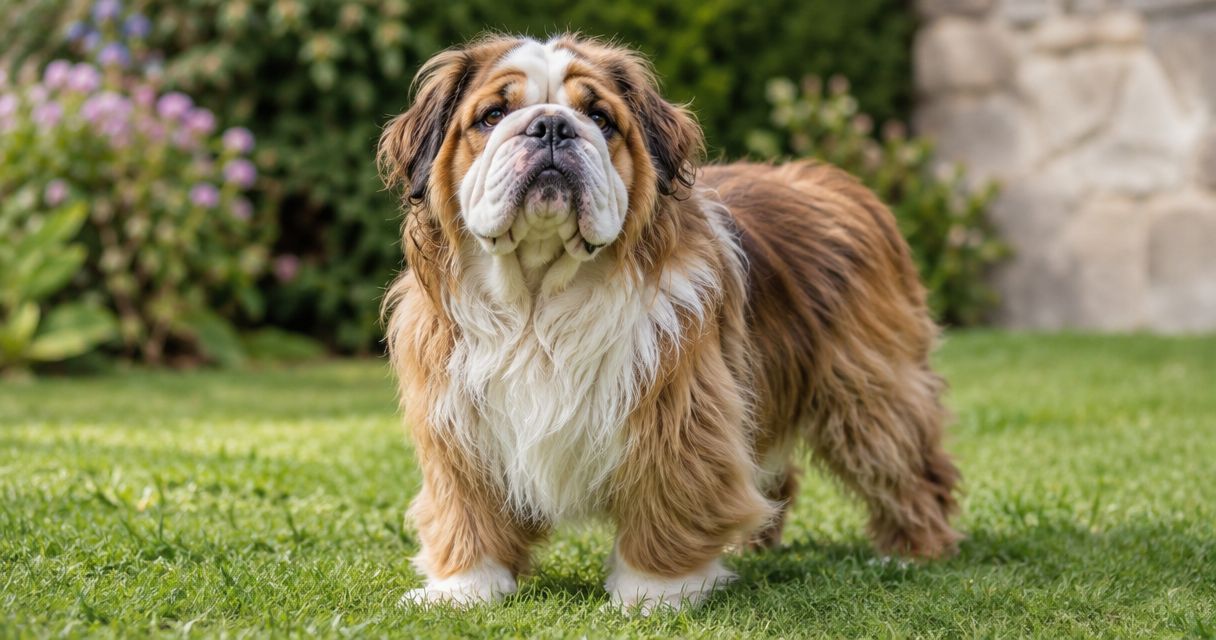
A long haired English Bulldog is not proven purebred by its coat, appearance, or a seller's description; ancestry needs supporting records. Long hair falls outside the American Kennel Club's Bulldog coat standard, but a nonstandard trait and mixed ancestry are different questions. Before accepting a purebred claim, check the pedigree, registration details, and any DNA evidence against the actual puppy.
- A long haired English Bulldog needs ancestry evidence; fluff alone proves neither purebred status nor mixed breeding.
- The American Kennel Club Bulldog standard calls for a short coat; long hair is nonstandard.
- Pedigree records, DNA parentage, and coat testing answer different questions. Check what each report actually establishes.
- Shrinkabulls breeds English and French Bulldogs; breed identity matters when comparing puppy descriptions.
Is a long-haired English Bulldog purebred?
You cannot establish that a long-haired English Bulldog is purebred from a photograph or coat test. The AKC Bulldog standard describes a short, straight, flat, smooth coat. A genuinely long coat does not match that description.
For a 2026 puppy search, separate 3 questions: who the puppy's ancestors are, whether its coat matches the standard, and whether its health has been properly assessed. None substitutes for another. Start by learning how to verify AKC registration papers on a Bulldog puppy, then compare those records with the seller's claims.
| Evidence | Best for | What it supports | Important limitation |
|---|---|---|---|
| Pedigree and registry records | Tracing recorded ancestry | The recorded family line and registered identities | Records depend on accurate identification and reporting |
| DNA parentage testing | Checking named parents | Whether tested dogs are genetically consistent with being the puppy's parents | Parentage alone does not establish every ancestor's breed |
| Consumer breed ancestry testing | Investigating possible breed contributions | An estimate based on the company's reference database | It is not the same as registry verification or documented parentage |
| Coat-length testing | Identifying tested coat variants | Whether the sample carries the variants included in that test | A coat variant does not establish purebred status |
The practical answer is straightforward: treat an undocumented purebred claim as unverified, not as a fact. That does not make the puppy less deserving of a loving home. It means the seller has not yet supplied the evidence needed for the claim.
Why this matters
A fluffy face is easy to fall in love with! The trouble starts when an appealing description becomes a substitute for records, health information, or a clear explanation of what you are buying.
In 2026, your decision should still rest on the individual dog rather than a fashionable label. A family companion, a future breeding dog, and a conformation prospect require different conversations, even when their puppy pictures look equally adorable.
Keep these distinctions clear before making a commitment:
- Purebred concerns ancestry within a breed.
- Registered concerns a registry's records and requirements.
- Standard-compliant concerns how a dog matches the breed description.
- Healthy concerns the individual dog's condition and relevant screening.
A registration certificate is not a veterinary clearance. Likewise, a short coat does not independently prove purebred ancestry, and a long coat does not identify a particular cross.
Long coat versus short coat: what the standard tells you
The AKC recognizes the breed under the name Bulldog, commonly called the English Bulldog. Its coat description is short, straight, flat, close, and smooth. That is the reference point for an AKC conformation discussion, not a seller's use of words such as fluffy, woolly, or rare.
A breed standard describes the desired characteristics of a breed. It is not a laboratory method for reconstructing a dog's family tree. A dog can depart from a standard without appearance alone revealing how that departure arose.
For your 2026 search, ask the seller which registry and standard they mean. Do not accept a broad statement that an unusual coat is accepted everywhere, or assume registration automatically means a dog meets every conformation requirement.
Does a softer puppy coat count as long hair?
A soft puppy coat is not automatically a genetically long coat. Texture, density, lighting, and grooming can make hair look different in photographs, so ask for clear views of the whole dog rather than judging a close-up face picture.
Request current video showing the ears, neck, body, legs, and tail area. These views help you assess the seller's description; they still do not prove ancestry. If coat length is central to your decision, ask what testing supports the description and what that test covers.
English Bulldogs and French Bulldogs are not interchangeable
A fluffy French Bulldog is not a long-haired English Bulldog. English Bulldogs and French Bulldogs are distinct breeds, and coat terminology does not erase that distinction.
Ask for the breed name recorded on the puppy's paperwork. A listing that switches between English Bulldog, French Bulldog, and generic bulldog language needs clarification before you assess any purebred claim.
The same applies to names such as Olde English Bulldogge or bulldog mix. Do not treat similar names as interchangeable registry categories. Ask which breed the seller is representing and which organization holds the records.
This matters especially when researching genetics. Information about a coat variant in French Bulldogs is not, by itself, evidence explaining a particular English Bulldog's ancestry. You need evidence tied to the dog in front of you.
How do you check a long-haired Bulldog's ancestry?
Use 4 verification steps before accepting an unusual-coat puppy's purebred description. Keep copies of the documents and written explanations so you can compare names and identifiers without relying on memory.
1. Confirm the puppy's identity
Ask for the puppy's date of birth, recorded breed, sex, and identifying information. If a microchip is present, have its number checked against the relevant veterinary and ownership records.
Photographs help identify the puppy being discussed, but photographs are not enough. The paperwork must refer to the same dog you will bring home, not simply another puppy from the same litter.
2. Check both recorded parents
Request the registered names and registration numbers of 2 parents, not just a photograph of an impressive-looking adult. Confirm the information through the relevant registry's verification process.
Ask for a pedigree that lets you trace the recorded family line. If the seller cannot explain an inconsistency in names, dates, or breed descriptions, leave the ancestry claim unresolved rather than filling the gap yourself.
3. Read the actual DNA reports
A summary saying DNA tested is too vague. Ask whether the testing concerns parentage, breed ancestry, coat traits, or inherited health conditions, and check the sample identifier on each report.
For parentage testing, ask which dogs were sampled and how their identities were confirmed. Testing a puppy alone does not verify that the adults pictured in an advertisement are its parents.
4. Reconcile the evidence before committing
Compare the seller's description with the registry information and laboratory reports. Ask for a written explanation of any mismatch, including why a long-coated puppy is being described as purebred.
If the records do not support the claim, do not repeat the claim as established fact. You can still consider the dog as a companion, but make that decision with an accurate understanding of what is documented.
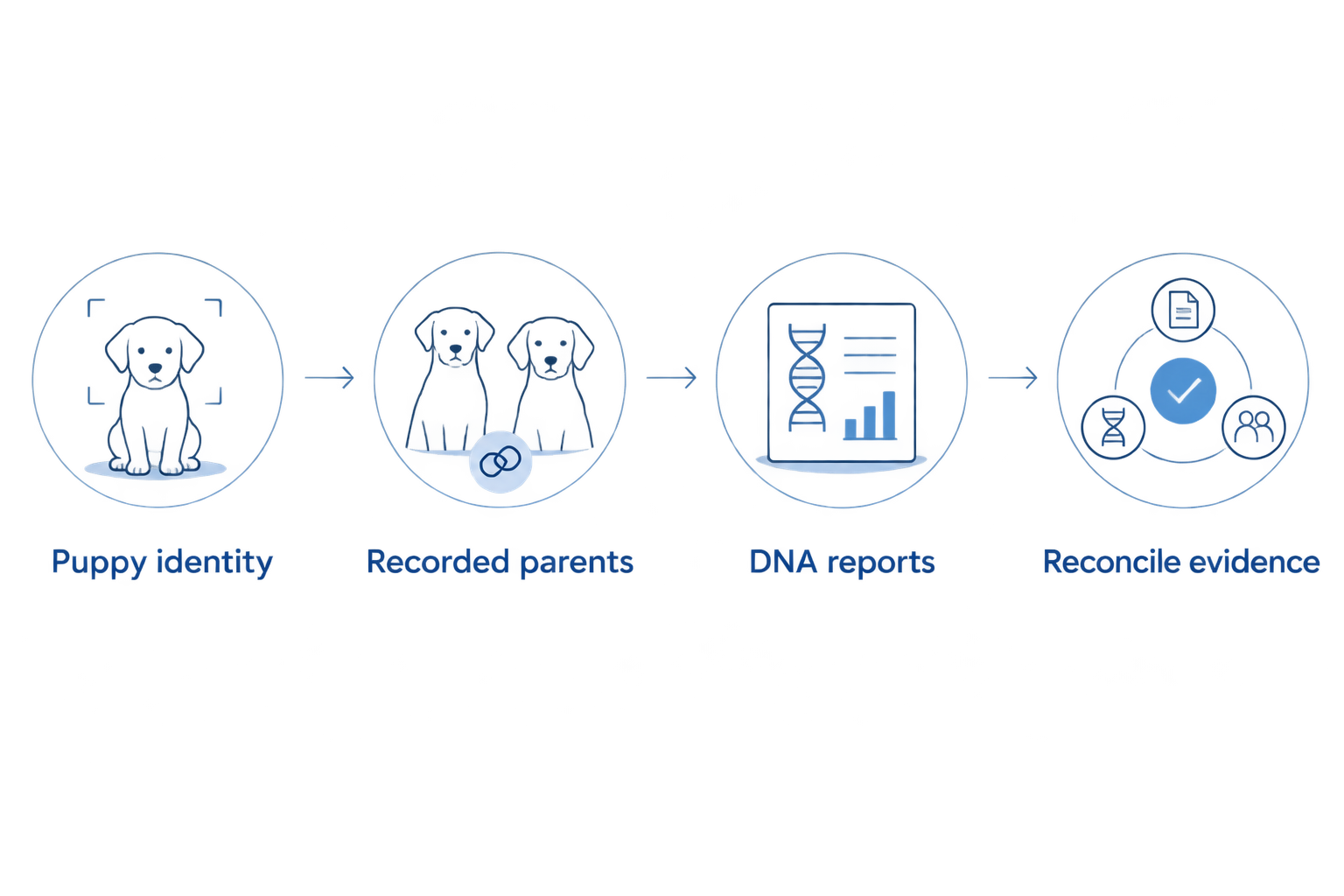
These checks work together. A convincing pedigree with an uncertain puppy identity is incomplete evidence, just as a genuine coat report cannot replace a pedigree.
What can a long-hair DNA test actually tell you?
Canine coat-length testing commonly examines variants in FGF5, a gene involved in hair growth. A laboratory report can identify the specific variants included in its panel; its interpretation must stay within that scope.
Ask the laboratory whether the assay is appropriate for the dog being tested and whether it covers the variants relevant to the question. A negative result for selected variants is not a promise that every possible genetic explanation has been excluded.
A coat test also cannot tell you when a variant entered a family line. Do not turn a result into an unsupported story about ancient ancestry, a recent cross, or a previously hidden bloodline.
For a 2026 purchase, request the original report rather than a cropped screenshot. Read the dog identifier, laboratory name, tested variants, and interpretation together. If the seller's explanation goes beyond the report, ask the laboratory to clarify.
Why descriptions of long-haired Bulldogs vary
Differences between listings do not automatically mean the dogs share a single origin. These factors explain why descriptions and evidence need individual review:
- Breed naming: A listing can use bulldog loosely instead of identifying the recorded breed.
- Coat description: Soft, dense, and long describe different characteristics but are sometimes used interchangeably.
- Photographic presentation: Angle, lighting, and grooming change how much coat detail you can see.
- Test scope: Parentage, ancestry, and coat panels investigate different questions.
- Documentation quality: Complete, matching records support a stronger conclusion than disconnected screenshots.
None of these factors establishes the puppy's ancestry on its own. Your goal is not to find the most persuasive label; it is to find an explanation that agrees with the available evidence.
Can a long-haired English Bulldog have AKC papers?
AKC paperwork must be checked independently of coat length. A long coat does not let you authenticate or reject a particular certificate from a photograph, and paperwork does not change the coat description in the Bulldog standard.
Ask whether the seller means an individual registration certificate, a registration application, or litter paperwork. Those documents are not interchangeable. Verify the document and the dog's identity with the registry rather than accepting the phrase comes with papers as a complete answer.
Does long hair mean a Bulldog is unhealthy?
Long hair alone does not diagnose a Bulldog's health. It also does not remove the need to assess breathing, skin, eyes, movement, and inherited conditions relevant to the dog and its family.
Have a veterinarian evaluate the puppy independently of the coat discussion. For routine care, part the hair enough to inspect the skin and ask your veterinarian or groomer how to prevent tangles without irritating sensitive areas.
A coat test is not a health clearance. Keep those reports separate when reviewing a seller's documents.
Should you choose a puppy because it is fluffy?
Choose the individual dog and the evidence behind the seller's claims, not fluff alone. An unusual coat can be a personal preference, but it should not push temperament, health, and daily care into the background.
Shrinkabulls is a breeding business for buyers seeking English and French Bulldog puppies. That makes breed identity and the individual puppy's documentation relevant questions; it does not make any coat description proof of ancestry.
When considering a Shrinkabulls English Bulldog, apply the same standard you would to any breeder: ask what supports the breed description and review the individual dog's records. A breeder's name cannot replace that check.
For 2026 buyers, a useful boundary is to pause whenever the explanation relies entirely on rarity. A distinctive coat is something you can admire; a purebred claim is something you should verify.
FAQ
Is a long haired English Bulldog definitely a mix?
A long haired English Bulldog is not proven to be a mix by coat length alone. Its coat is nonstandard under the AKC Bulldog standard, but ancestry requires separate evidence.
Can a purebred dog have a nonstandard coat?
A purebred dog can have a trait that does not match its breed standard. That general distinction does not establish the ancestry of a particular long-haired Bulldog.
Does an FGF5 result prove my Bulldog is purebred?
An FGF5 result does not prove your Bulldog is purebred. It reports the tested coat-related variants, not a complete verified pedigree.
Are fluffy English Bulldogs and fluffy French Bulldogs the same?
Fluffy English Bulldogs and fluffy French Bulldogs are not the same breed. Ask for the exact breed recorded on the dog’s paperwork rather than relying on the word fluffy.
Do AKC papers guarantee that a Bulldog is healthy?
AKC papers do not guarantee that a Bulldog is healthy. Review individual veterinary findings and relevant health screening separately from registration records.
What should I ask a breeder about a long-haired puppy?
Ask for the puppy’s identity, both parents’ recorded details, the pedigree, and original laboratory reports. Request a written explanation of how those records support the purebred description.
Can I tell whether a Bulldog is purebred from a photo?
You cannot reliably establish purebred ancestry from a photo. Photographs show appearance, while pedigree verification and properly identified parentage testing address ancestry.
One last thing
A genuine laboratory report can still answer the wrong question. Before treating any test as proof, write down what you need to establish: coat genetics, parentage, breed ancestry, or health. Then check whether the report actually addresses it.
Whether you are speaking with Shrinkabulls or another breeder, that simple habit keeps an adorable puppy picture from doing the work of evidence. Love the dog; verify the description.
Related guides
- How to tell an English Bulldog mix from a purebred
- How to read a Bulldog puppy's pedigree chart before buying
- How to vet an English Bulldog breeder before you buy
