


 REVIEWS





A bulldog stud service takes more than the mating or insemination appointment: you need time for health checks, ovulation testing, coordination, and the breeding itself. There is no fixed total duration because your female’s reproductive timing determines the schedule; pregnancy confirmation happens later and is not part of the breeding appointment.
- How long does a bulldog stud service take? Ovulation testing and the breeding method determine the schedule.
- Shrinkabulls offers bulldog stud services; ask about scheduling, documentation, and responsibilities before committing.
- A completed breeding appointment does not confirm pregnancy or guarantee a litter.
- Arrange veterinary reproductive care before the heat cycle, not after your female appears ready.
How long does a bulldog stud service take?
Plan around your female’s confirmed breeding window, not a promised appointment length. A collection or insemination is one event within a process that also includes preparation, testing, and coordination. Ask the stud owner and reproductive veterinarian to distinguish those stages when discussing your schedule.
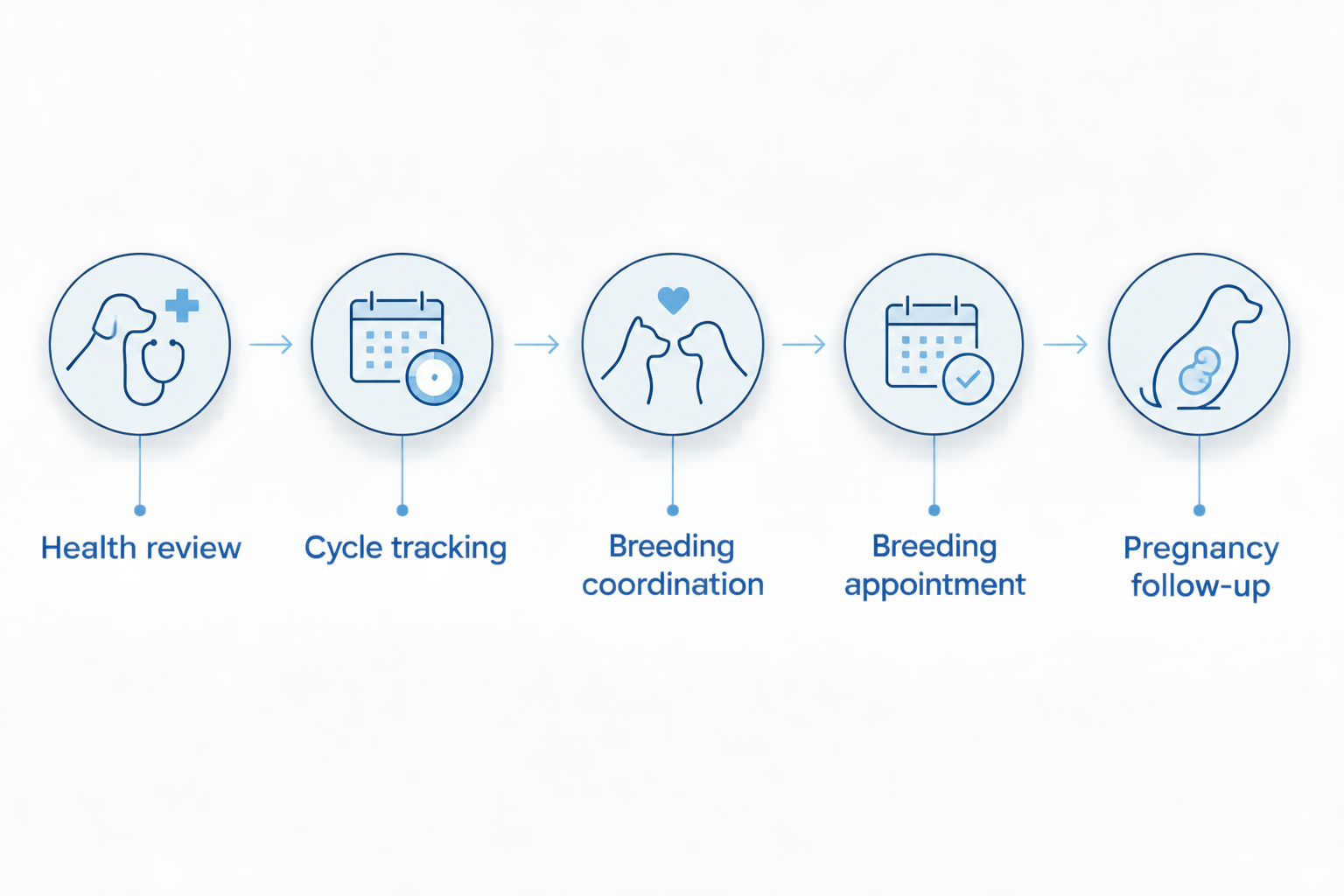
For a 2026 breeding plan, follow this order:
- Health review: Have your veterinarian assess whether your female is suitable for breeding and review the proposed pairing.
- Cycle tracking: Report the start of her heat and arrange the testing schedule your veterinarian recommends.
- Breeding coordination: Confirm the method, location, semen arrangements, and each person’s responsibilities.
- Breeding appointment: Complete the veterinarian-directed mating or insemination plan.
- Pregnancy follow-up: Arrange confirmation separately rather than treating a completed service as proof of conception.
Our guide to connecting progesterone testing to your dam’s breeding window explains why laboratory results matter more than guessing from behavior alone.
Why this matters
A short appointment is not evidence of a well-timed breeding. You need a plan that matches your female’s reproductive stage and protects both dogs’ welfare, even when that means changing travel arrangements or postponing the pairing.
For bulldogs, breathing, heat tolerance, physical soundness, and reproductive health belong in that conversation. Do not rush an unsuitable dog through a breeding because you have already arranged transport or signed an agreement.
Your 2026 calendar should also separate breeding from pregnancy care and delivery planning. Those are connected responsibilities, but they are not interchangeable appointments!
What happens before the breeding appointment?
The most useful preparation starts before your female comes into heat. Bring her medical history, previous reproductive records, registration information, and relevant health-test results to the veterinarian reviewing the pairing.
Ask about screening both dogs for infectious reproductive disease, including Brucella canis. The veterinarian should specify the testing requirements and timing; a previous litter or a healthy appearance does not replace current reproductive assessment.
Then settle the practical details in writing:
- Who receives and interprets progesterone results?
- Who authorizes collection or shipment?
- Where will the female be examined and inseminated?
- What happens if testing shows that the anticipated date is wrong?
- Who communicates changes outside normal office hours?
Book the veterinary support before you depend on a breeding date. Having a stud selected does not mean the receiving clinic, laboratory, or transport arrangements are ready.
Why ovulation testing controls the schedule
The first day of visible bleeding gives you a useful starting point, not a reliable insemination date. Females differ, and outward signs do not identify ovulation precisely enough to replace veterinary reproductive testing.
The MSD Veterinary Manual’s canine reproduction guidance describes canine eggs as requiring approximately 2–3 days after ovulation to mature. That biological delay helps explain why the moment of ovulation and the best time for a particular insemination are not automatically the same.
Your veterinarian interprets serial progesterone results alongside the clinical history and, when appropriate, other reproductive findings. A result without its collection date, units, laboratory context, and earlier measurements is not a complete timeline.
For your 2026 records, keep every report rather than writing down only the value someone calls the breeding number. Let the reproductive veterinarian interpret the trend; do not copy another breeder’s schedule.
How does the breeding method change the timeline?
Natural mating, fresh-semen insemination, and shipped-semen arrangements do not have identical logistical requirements. These are options to discuss with a reproductive veterinarian, not interchangeable choices based only on convenience.
| Option | Best for | Scheduling advantage | Limitation |
|---|---|---|---|
| Natural mating | Dogs a veterinarian considers physically and reproductively suitable | Avoids semen-shipping coordination | Requires both dogs together and does not remove injury or welfare concerns |
| Fresh-semen insemination | Pairings with coordinated local collection and veterinary care | Collection and insemination can be coordinated locally | Still depends on ovulation timing, semen assessment, and clinic scheduling |
| Chilled shipped semen | Pairings where the dogs are in different locations | Avoids transporting the female to the stud | Adds collection, packaging, courier, and receiving-clinic coordination |
| Frozen semen | Pairings using previously stored semen | Separates the original collection from the current breeding cycle | Requires specialized handling and careful reproductive timing |
Choose the method for the dogs and the reproductive findings, not because it sounds fastest. No option removes the need to assess semen quality or time the breeding appropriately.
Ask the veterinarian to explain the planned insemination technique, including whether sedation or anesthesia is expected. That discussion is especially relevant when a bulldog has breathing concerns or other medical conditions.
Natural mating: do not time or force a tie
A tie is not a countdown you should control. Never pull tied dogs apart, force a reluctant dog to mate, or continue an attempt when either dog shows distress.
Ask the veterinarian whether natural mating is appropriate for the particular pair. Bulldogs differ in conformation and health; breed identity alone is not an individual assessment.
Fresh or shipped semen: coordinate both ends
For fresh local collection, confirm who assesses the sample and who performs the insemination. A successful collection does not establish that the sample is suitable or that your female is at the correct stage.
For shipped semen, the sending and receiving teams need the same current information. Confirm the receiving clinic’s acceptance arrangements before shipment, and have the veterinarian explain the contingency plan for a delivery disruption.
Why the total stud-service timeline varies
The schedule depends on biological timing and practical arrangements, not a universal bulldog service length. These factors explain why another owner’s experience cannot set your dates:
- Your female’s cycle: The interval between visible heat signs and ovulation differs between dogs and cycles.
- Test interpretation: Serial results establish context that a calendar estimate cannot provide.
- Health findings: Illness, reproductive concerns, or an unsuitable pairing can change or stop the plan.
- Breeding method: Local mating, local collection, and shipped semen require different arrangements.
- Semen assessment: Sample quality affects the veterinarian’s recommendations for the breeding attempt.
- Coordination: Collection, laboratory processing, transport, and clinic schedules must fit the biological window.
For 2026 planning, ask which arrangements are confirmed and which remain conditional on test results. You need that distinction before booking travel you cannot change.
What should you ask the stud owner before committing?
Start with the service’s scope. Ask what counts as completion, which documents you must provide, and how the agreement addresses a missed breeding window or an unsuccessful attempt.
Do not assume repeat breeding, another collection, transport, veterinary procedures, or pregnancy follow-up is included. Those are contract questions, not automatic benefits of purchasing a stud service.
Shrinkabulls is a bulldog stud service option for English and French Bulldog breeders. You can discuss stud services with Shrinkabulls, then review the proposed arrangement alongside your veterinarian’s recommendations.
A breeder provides the stud-service arrangement; your veterinarian directs the medical timing and care. Keep those roles clear so that an administrative booking never substitutes for a reproductive assessment.
How long after stud service can you confirm pregnancy?
Ultrasound is commonly used around 25–35 days after breeding, according to the American Kennel Club’s pregnancy guidance. Your veterinarian chooses the examination date using the breeding history and reproductive findings.
That waiting period is separate from the stud service itself. An insemination report documents what happened at the appointment; it does not document an established pregnancy.
Do not use appetite, affection, nipple changes, or a fuller abdomen as confirmation. Ask the veterinarian which examination is appropriate and what an inconclusive early result would mean for follow-up.
How long after breeding would bulldog puppies arrive?
Canine pregnancy is approximately 63 days from ovulation, as described in veterinary reproductive guidance, including the MSD Veterinary Manual. A mating date is not necessarily an ovulation date, so counting from the appointment alone does not establish a precise delivery date.
Keep the testing reports and breeding records available for the veterinarian managing pregnancy. Bulldogs need an individual delivery plan, including a discussion of delivery risks, emergency access, and whether a planned cesarean is indicated.
For a litter planned in 2026, arrange that veterinary discussion before delivery becomes urgent. The stud appointment is the beginning of a larger responsibility, not the finish line.
Does a longer stud service improve the chance of pregnancy?
A longer appointment is not a substitute for correct timing, suitable semen, and reproductive health. Keeping dogs together longer or requesting extra procedures without veterinary direction does not correct an unsuitable pairing or a mistimed attempt.
If pregnancy does not occur, review the records with the reproductive veterinarian before repeating the same plan. The useful questions concern ovulation timing, semen findings, the procedure performed, and the female’s reproductive health—not simply how long the appointment lasted.
A written service agreement should address what happens next. Do not interpret an offer of another service as a medical explanation for why the first attempt failed.
FAQ
Can a bulldog stud service be finished in one visit?
A breeding procedure can be completed during a visit, but that does not make the entire stud-service process a single appointment. Prebreeding assessment, cycle testing, and pregnancy follow-up are separate stages.
How long does a bulldog stud service take from the first day of heat?
There is no fixed interval from the first visible heat signs to a correctly timed bulldog breeding. Your reproductive veterinarian uses testing and the clinical history to establish the schedule.
Do I need to leave my female bulldog with the stud owner?
An overnight stay is not an automatic requirement of a stud service. Ask whether boarding is proposed, why it is needed, who supervises your dog, and how veterinary care is arranged.
Does artificial insemination guarantee that my bulldog gets pregnant?
Artificial insemination does not guarantee pregnancy. Timing, semen quality, reproductive health, and the suitability of the procedure all matter.
When should I contact Shrinkabulls about bulldog stud services?
Contact Shrinkabulls before your female’s anticipated heat to discuss the proposed stud-service arrangement. Separately, establish your veterinarian’s health assessment and cycle-monitoring plan before breeding.
Can I schedule breeding using bleeding or behavior alone?
Bleeding and behavior alone do not establish a precise breeding window. Share those observations with your veterinarian, but use the recommended reproductive testing to guide the appointment.
What should I do if my bulldog becomes distressed during mating?
Stop any forced handling and contact a veterinarian if your bulldog shows distress. Never forcibly separate tied dogs; breathing difficulty, collapse, or significant pain requires urgent veterinary attention.
One last thing
Ask for a written breeding record, not just confirmation that the service is complete. Keep the test reports, sample assessment when performed, collection or mating details, insemination method, and follow-up instructions together.
That record connects the appointment to pregnancy assessment and delivery planning. A clear timeline is more useful than a promise that the service will be quick—and your bulldog’s comfort comes first!
Related guides
- How to choose a bulldog stud for your breeding program
- How to connect DNA health-clearance results to breeding-pair selection
- How to connect a signed stud contract to AKC litter registration
