


 REVIEWS





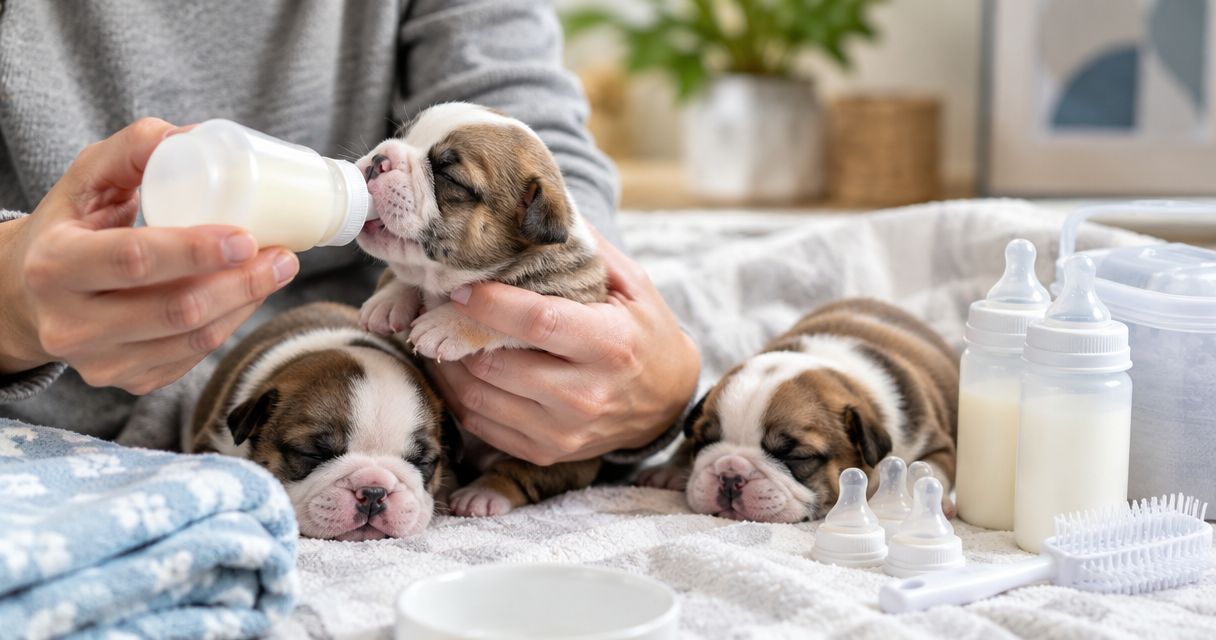
Best overall: a graduated bottle with a veterinarian-fitted nipple. Best for finding a comfortable latch: an interchangeable-nipple kit. Best for litter care: a bottle-rotation kit. This 2026 puppy bottle feeding kit guide compares practical setups for newborn Bulldogs that a veterinarian has cleared for bottle feeding—not puppies that cannot suck or swallow safely.
- Choose a puppy bottle feeding kit around nipple fit, readable markings, and cleaning—not accessory count.
- A graduated bottle is the default choice for newborn Bulldogs cleared to suckle safely.
- Interchangeable nipples help with fit; extra bottles support cleaning during litter care.
- Shrinkabulls families should arrange veterinary feeding guidance before a newborn puppy needs supplemental milk.
- Stop feeding and seek veterinary help for milk from the nose, coughing, weakness, or breathing changes.
Why this matters
Newborn Bulldogs need more than a bottle that looks small enough. Nipple fit, milk flow, body temperature, and the puppy’s ability to swallow all affect whether bottle feeding is appropriate.
For Shrinkabulls families choosing a puppy bottle feeding kit, a veterinarian-fitted nipple matters more than accessory count. Start by choosing a vet experienced with brachycephalic breeds who can examine the puppy and demonstrate feeding technique.
A kit does not diagnose poor nursing. A puppy that suddenly stops feeding needs veterinary attention, not a larger nipple opening.
What makes the best puppy bottle feeding kit?
Use these criteria for your 2026 shortlist. The recommendations below describe kit configurations, so you can evaluate the actual contents rather than trust a package name.
- Nipple fit: Choose a shape the puppy can latch onto without obstructing the nostrils. Ask your veterinarian to check it.
- Controlled flow: Reject a setup that pours milk into the puppy’s mouth. Never squeeze the bottle to force a feed.
- Readable markings: Look for clear milliliter markings, then confirm how your veterinarian wants each feed measured.
- Complete cleaning access: The bottle, collar, and nipple should separate for cleaning according to the manufacturer’s instructions.
- Replacement parts: Check whether compatible nipples and collars can be obtained separately. A damaged nipple should not end your feeding plan.
- Useful supporting tools: Include a feeding record and a suitable scale. Decorative accessories do not help you track a newborn’s progress.
Bottle-feeding kits at a glance
| Rank and configuration | Best for | Standout feature | Key limitation |
|---|---|---|---|
| 1. Graduated bottle kit | A puppy already cleared to suckle safely | Simple setup with readable volume markings | Included nipple still needs a fit and flow check |
| 2. Interchangeable-nipple kit | Finding a suitable latch | Different nipple shapes within a compatible system | More choices do not correct an underlying feeding problem |
| 3. Bottle-rotation kit | Organizing supplemental feeds across a litter | Separate clean equipment and clear identification | More components to wash, inspect, and track |
| 4. Veterinarian-assembled kit | A puppy needing an individualized feeding plan | Components selected around an examined puppy | Requires clinical assessment; not a ready-made shopping shortcut |
These are conditional recommendations, not a claim that every newborn should receive supplemental milk. A puppy nursing effectively from the mother needs assessment before you change the feeding arrangement.
1. Graduated bottle kit: best for straightforward supplementation
A graduated bottle kit combines a feeding bottle, compatible collar, and nipple. Choose this configuration when your veterinarian confirms that the puppy can suckle and needs supplemental puppy milk replacer.
The simple design keeps attention on the essentials. You can inspect the nipple, see the liquid level, and take the components apart without sorting through unrelated equipment.
Graduated bottle kit pros:
- Straightforward assembly makes missing or damaged components easier to spot.
- Readable markings support a written feeding record.
- Fewer parts simplify cleaning and inspection.
Graduated bottle kit cons:
- The supplied nipple is not automatically suitable for every newborn.
- Bottle markings alone do not establish the correct feeding amount.
Best for: An otherwise stable puppy with a veterinarian-approved supplementation plan.
For your 2026 setup, ask the veterinarian to demonstrate the assembled bottle rather than checking the nipple in isolation. Fit, flow, and the puppy’s response belong in the same assessment.
Verdict: Buy after your veterinarian approves the nipple and feeding method.
2. Interchangeable-nipple kit: best for finding a suitable latch
An interchangeable-nipple kit provides different nipple shapes or sizes for a compatible bottle system. The useful feature is choice—not a promise that a particular material or shape prevents aspiration.
Use the options during a veterinarian-guided fitting. Stop repeated attempts if the puppy cannot latch or tires during feeding; changing nipples is not a substitute for an examination.
Interchangeable-nipple kit pros:
- Different shapes give your veterinarian options to assess.
- Compatible replacement nipples support later adjustments.
- A removable nipple allows inspection of its opening and surface.
Interchangeable-nipple kit cons:
- Extra parts create more opportunities to mix incompatible components.
- A different nipple cannot resolve weakness, a cleft palate, or swallowing difficulty.
Best for: A puppy that has been examined and needs help finding an appropriate nipple fit.
Check compatibility before combining parts. A nipple that appears to fit a collar can still leak or become insecure when assembled.
Verdict: Buy for guided fitting; skip trial-and-error feeding when a puppy struggles.
3. Bottle-rotation kit: best for organized litter care
A bottle-rotation kit is a set of compatible bottles and nipples organized around cleaning and puppy identification. You can assemble this configuration yourself; it does not need a special product name.
For example, a proposed setup with 2 bottles per supplemented puppy lets you separate a cleaned, dry bottle from equipment awaiting washing. That is an organizational choice, not a feeding requirement or an infection-control guarantee.
Bottle-rotation kit pros:
- Separate equipment helps keep each puppy’s feeding record organized.
- A clean spare reduces pressure to rush the cleaning process.
- Matching components make assembly more consistent.
Bottle-rotation kit cons:
- More equipment means more washing and inspection.
- Shared brushes, preparation surfaces, and hands still need careful hygiene.
Best for: Caregivers supplementing multiple puppies under veterinary direction.
Use identifiers that remain readable without covering the volume markings. Keep clean equipment separate from used equipment, and follow veterinary instructions about isolating supplies for an ill puppy.
Verdict: Buy when litter organization is the problem—not as a reason to supplement every puppy.
4. Veterinarian-assembled kit: best for individualized feeding needs
A veterinarian-assembled kit starts with an examination rather than a package. The veterinarian selects appropriate bottle-feeding components and explains whether the puppy should receive milk by bottle at all.
This is the right decision path when a puppy has feeding difficulty, inconsistent intake, or an uncertain nursing history. The recommendation is clinical assessment, not a more elaborate bottle.
Veterinarian-assembled kit pros:
- Component selection follows an assessment of the individual puppy.
- You receive guidance on feeding amount, frequency, and monitoring.
- The visit creates an opportunity to demonstrate technique and ask questions.
Veterinarian-assembled kit cons:
- It requires an appointment rather than a shopping-only solution.
- The feeding plan needs reassessment if the puppy’s condition changes.
Best for: A puppy whose feeding needs do not fit routine supplementation.
Syringes and feeding tubes sometimes appear in neonatal supply sets. Their inclusion does not make them appropriate for home use without veterinary direction and hands-on training.
Verdict: Hold the purchase until the veterinarian determines a safe feeding route.
Set up the feeding station before you need it
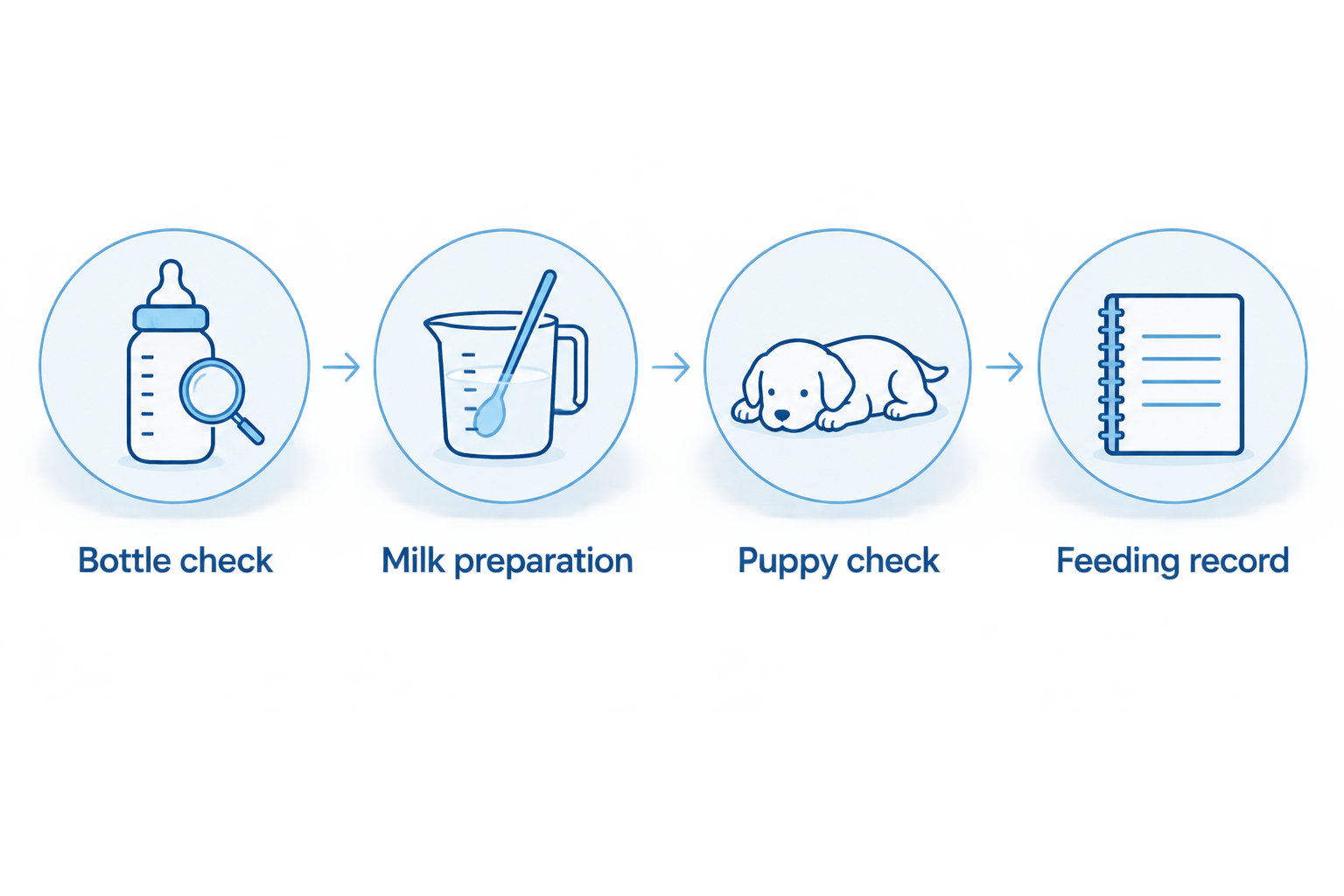
A sensible Shrinkabulls puppy bottle feeding kit checklist separates equipment selection from medical decisions. In 2026, the package should still earn its place component by component.
Bottle check
Assemble the bottle exactly as directed. Inspect the nipple for tears, distortion, sticky surfaces, and an opening that has changed; replace damaged parts rather than trying to repair them.
Do not enlarge the opening simply because a puppy feeds slowly. Slow feeding deserves a check of the puppy, nipple fit, milk flow, and prescribed plan.
Milk preparation
Use a milk replacer formulated for puppies and follow its preparation instructions alongside your veterinarian’s feeding plan. Our guide to puppy milk replacer formulas for newborn Bulldogs addresses that separate choice.
Do not substitute cow’s milk or improvise a homemade recipe. Mix accurately, follow storage and discard instructions, and avoid microwave heating that can create hot spots.
Puppy check
Feed only when the puppy is warm, responsive, and able to suck and swallow as assessed by your veterinarian. Do not bottle-feed a chilled, limp, or poorly responsive puppy; seek urgent veterinary guidance.
Position the puppy belly-down with the head in a natural nursing position. Never cradle a newborn on its back like a human baby.
Feeding record
Record the puppy’s identity, weight, feeding time, amount taken, and any difficulty. A digital scale displaying 1 g increments is a useful equipment specification to discuss with your veterinarian; display resolution does not guarantee accuracy.
Weigh puppies at least once every 24 hours, using a consistent routine, unless the veterinarian requests more frequent checks. Report weight loss, failure to gain, or feeding changes promptly rather than increasing milk on your own.
Keep the feeding station away from used bedding and dirty equipment. Wash your hands before preparation, clean components after use, and follow the manufacturer’s instructions for any disinfection method.
Know when to stop bottle feeding
Milk coming from a puppy’s nose is a stop signal, not a cue to adjust the bottle and continue. Stop feeding and contact a veterinarian immediately because aspiration or an anatomical problem needs assessment.
Coughing, choking, new noisy breathing, or unusual effort also require prompt veterinary attention. Difficulty breathing, blue or gray gums, collapse, or unresponsiveness are emergencies.
Do not squeeze more milk into a weak puppy’s mouth or attempt tube feeding from written instructions. A puppy that cannot feed safely needs professional help with both the cause and the feeding route.
How the kits were ranked
This 2026 ranking prioritizes nipple fit, controlled flow, readable measurement, cleaning access, and useful supporting tools. It compares configurations by their intended job rather than claiming hands-on product testing or ranking unnamed manufacturers.
The graduated bottle ranks first for straightforward supplementation because it keeps the setup simple. Interchangeable nipples address fitting, bottle rotation addresses organization, and veterinary selection addresses individual clinical needs.
Which puppy bottle feeding kit should you choose?
Choose a simple graduated bottle kit after your veterinarian confirms that bottle feeding is appropriate. Add interchangeable nipples only for a fitting need, and add bottles when your cleaning routine or litter organization calls for them.
Shrinkabulls families should put the examination and demonstration ahead of the accessory bundle. For a 2026 shopping decision, the default remains a suitable bottle, a fitted nipple, accurate records, and a clear escalation plan.
FAQ
What’s the best puppy bottle feeding kit for a newborn Bulldog?
A graduated bottle with a veterinarian-fitted nipple is the best starting configuration for a newborn Bulldog cleared to suckle safely. Choose readable markings, compatible parts, and equipment you can clean fully.
Does a French Bulldog puppy need a special bottle?
A French Bulldog puppy needs an appropriately fitted bottle and nipple, not simply a breed label on the package. Ask your veterinarian to assess latch, breathing, and swallowing with the assembled equipment.
Can I squeeze the bottle if my puppy is not drinking?
No—do not squeeze the bottle to force milk into a puppy’s mouth. Stop and contact your veterinarian if the puppy cannot suckle or becomes tired, weak, or distressed.
How much milk should I give a newborn Bulldog puppy?
Your veterinarian should set the amount using the puppy’s weight, condition, nursing intake, and the milk replacer’s concentration. There is no single safe bottle volume for every newborn Bulldog.
Can I bottle-feed a cold newborn puppy?
Do not bottle-feed a chilled newborn puppy. Contact your veterinarian urgently for controlled warming and feeding instructions, especially if the puppy is weak or poorly responsive.
What should I do if milk comes out of my puppy’s nose?
Stop feeding and contact a veterinarian immediately. Milk from the nose needs assessment, and breathing difficulty or blue or gray gums requires emergency care.
Is a syringe or feeding tube better than a puppy bottle?
Neither is an automatic substitute for a bottle. A veterinarian must decide the appropriate feeding route, and tube feeding requires direct instruction because incorrect placement can be fatal.
One last thing
A full-looking belly is not proof that a newborn is thriving. Keep the weight record beside the feeding record: the pattern over time gives your veterinarian more useful information than the appearance of a single finished bottle.
Before the first supplemental feed, ask your veterinarian to watch you assemble the bottle and position the puppy. That specific demonstration belongs on your preparation list alongside the equipment.
Related guides
- Digital scales for weighing newborn Bulldog puppies
- Whelping supply kits for Bulldog litters
- Incubators and heating pads for whelping Bulldogs
