


 REVIEWS





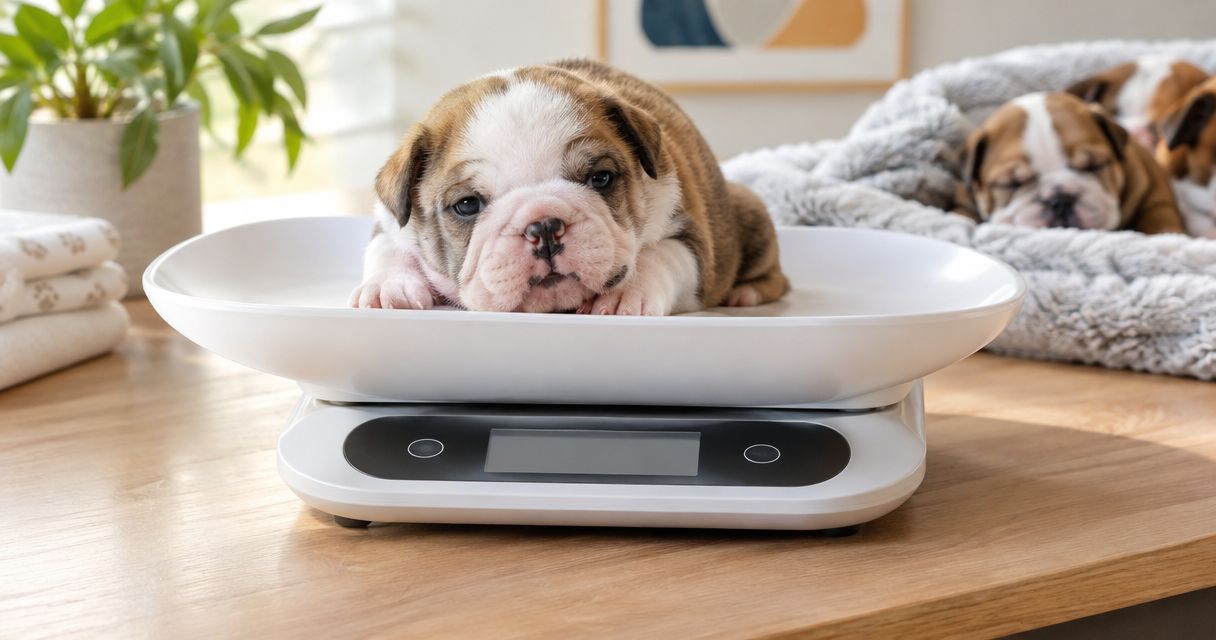
Best overall: a digital puppy tray scale with gram readings and tare. Best for a compact setup: a digital kitchen scale with a secure bowl. Best for a dedicated breeding room: a small-animal veterinary scale that reads finely enough for newborns. Shrinkabulls recommends a gram-reading puppy tray scale for families monitoring newborn Bulldog puppies.
- The best digital scale for newborn bulldog puppies combines gram readings, repeatable measurements, and a secure weighing tray.
- Choose a puppy tray scale for routine weighing; use a kitchen scale only with a stable, suitable container.
- Check resolution and accuracy separately: a display showing grams does not prove accurate measurements.
- Record each puppy’s weight consistently, and contact your veterinarian about weight loss or poor nursing.
Choosing a scale is part of preparing the whole newborn-care space. Our guide to choosing a Bulldog whelping box covers another part of that setup.
Why this matters
Newborn Bulldogs need more than a reassuring glance at the nursing box. A consistent weight record helps you spot changes that deserve veterinary attention, while a poorly chosen scale adds uncertainty to that record.
For this 2026 guide, we recommend scale types rather than individual models. The buying decision comes down to measurable features: readable increments, repeatability, safe support, and easy cleaning. A familiar brand name cannot replace those checks.
A scale also has limits. It cannot tell you why a puppy is losing weight, whether milk intake is adequate, or whether a newborn needs treatment. Keep your veterinarian involved in the monitoring plan.
What makes the best digital puppy scale?
Check these criteria before comparing extras:
- Readable increments: Prefer a display that changes in 1 g increments for newborn monitoring. Do not confuse that display resolution with verified accuracy.
- Repeatability: The same stationary object should produce consistent readings when weighed repeatedly under the same conditions.
- Secure support: Choose a tray or container that supports the puppy’s whole body without rocking, sliding, or tipping.
- Tare function: You need to subtract the weight of the liner and container before weighing the puppy.
- Cleaning access: Look for accessible surfaces and cleaning instructions suitable for repeated use between puppies.
- Usable display: You should see the reading without leaning on the scale, lifting the container, or moving the puppy.
Keep capacity in perspective. A large maximum capacity does not prove that a scale measures small weight changes well. Check the stated minimum load, measurement increment, and accuracy specification together.
Digital scales at a glance
These 2026 recommendations compare configurations, not tested models. Every option below must meet the newborn-weighing criteria before you choose it.
| Scale type | Best for | Standout feature to seek | Key limitation |
|---|---|---|---|
| Digital puppy tray scale | Routine newborn weighing | Supportive tray, gram readings, and tare | A pet label does not guarantee fine resolution |
| Digital kitchen scale with secure bowl | Compact weighing station | Small footprint and easy container taring | Bowl stability and display access need checking |
| Small-animal veterinary scale | Dedicated breeding room | Cleanable weighing surface and documented specifications | Some veterinary scales are too coarse for newborn tracking |
1. Digital puppy tray scale: best for routine newborn weighing
A digital puppy tray scale pairs a weighing platform with a tray intended to support a small animal. Choose one only after checking its actual specifications; a puppy photograph on the packaging is not a measurement standard.
The best configuration supports the puppy comfortably while keeping the display visible. A shallow curved tray helps with positioning, but it does not make an unattended puppy safe.
Puppy tray scale pros:
- An integrated tray removes the need to match a separate bowl to the platform.
- A suitable tray gives the puppy a supported resting position.
- A visible display lets you read the weight without moving the container.
Puppy tray scale cons:
- Some pet scales use increments that are too coarse for useful newborn tracking.
- Tray seams and attachments add places to inspect during cleaning.
- A hold function can preserve a moving or poorly positioned reading.
Best for: Families or breeders who want one straightforward station for repeated newborn weigh-ins.
Before choosing, read how the tray attaches and how tare works. Check whether the stated accuracy applies across the relevant weighing range, rather than assuming that every gram displayed is correct.
Verdict: Buy this configuration if the specifications and stability checks pass. It is our default choice for 2026.
2. Digital kitchen scale with bowl: best for a compact setup
A digital kitchen scale can serve as a newborn weighing station when paired with a secure, appropriately sized container. The bowl must support the puppy without wobbling, overhanging dangerously, or pressing against surrounding objects.
Tare the complete setup, including the liner. The container’s weight still counts toward the scale’s maximum capacity even after the display returns to zero.
Kitchen scale setup pros:
- A removable container can be cleaned separately from the scale.
- A compact platform fits a small, dedicated weighing station.
- A suitable gram-reading model supports consistent recordkeeping without extra features.
Kitchen scale setup cons:
- A narrow base and oversized bowl create a tipping risk.
- A wide bowl can hide the display or touch nearby surfaces.
- Auto-off behavior can interrupt a weigh-in or erase the prepared tare setting.
Best for: A compact home setup where you can verify container fit and reserve the equipment for puppy care.
Test the arrangement before placing a puppy inside. Press gently around the empty container’s edges to check for rocking, then confirm that the display remains visible from your normal position.
Do not balance a bowl on a platform that barely supports it. A finer display does not compensate for an unstable setup!
Verdict: Buy only after checking the bowl-and-scale combination; skip any arrangement that rocks or obscures the reading.
3. Small-animal veterinary scale: best for a dedicated breeding room
A small-animal veterinary scale is another option for a permanent weighing station. Select a model with documented specifications appropriate to newborn weights, not simply one marketed for veterinary use.
For a 2026 breeding-room setup, prioritize a cleanable surface, readable controls, and repeatable measurements. Features designed for larger animals do not automatically improve newborn monitoring.
Small-animal veterinary scale pros:
- A suitable weighing surface can accommodate a dedicated newborn-care workflow.
- Published accuracy and operating instructions give you concrete specifications to assess.
- Accessible controls make taring and recording easier during repeated weigh-ins.
Small-animal veterinary scale cons:
- Some models emphasize larger animals and lack suitable low-weight resolution.
- A larger platform takes up more room and still requires safe containment.
- Extra functions do not establish accuracy at a newborn puppy’s weight.
Best for: Breeders creating a permanent weighing station with a documented equipment-check routine.
Ask the supplier for the minimum load, display increment, accuracy, and instructions for checking performance. If those details are unclear, choose a better-documented alternative rather than relying on the word veterinary.
Verdict: Hold until the low-weight specifications are clear; buy when they match your newborn-monitoring needs.
How we ranked these scale types
This ranking prioritizes secure support, readable increments, repeatability, tare, and cleaning access. It does not rank brands by reputation or claim hands-on testing of individual products.
The puppy tray scale comes first because it combines support and weighing in one configuration. The kitchen setup serves a compact station, while a suitable veterinary scale fits a dedicated breeding room. In 2026, choose the setup you can use consistently—not the one with the longest feature list.
Resolution is not accuracy
Resolution describes the smallest change shown on the display. Accuracy describes how closely a measurement matches the actual weight. A scale can display fine increments while giving inconsistent or incorrect results.
A display changing in 5 g increments cannot show the same small differences as one changing in 1 g increments. Likewise, 0.001 kg equals 1 g, but a fine-looking kilogram display still tells you nothing by itself about verified accuracy.
Check repeatability with a stationary object before the puppies arrive. For an accuracy check, follow the manufacturer’s instructions and use the specified reference weight; do not assume a household package contains exactly the mass printed on its label.
If readings drift, check the surface, batteries, container position, and manufacturer’s troubleshooting guidance. Do not turn an unreliable reading into a feeding decision.
A simple newborn weighing routine
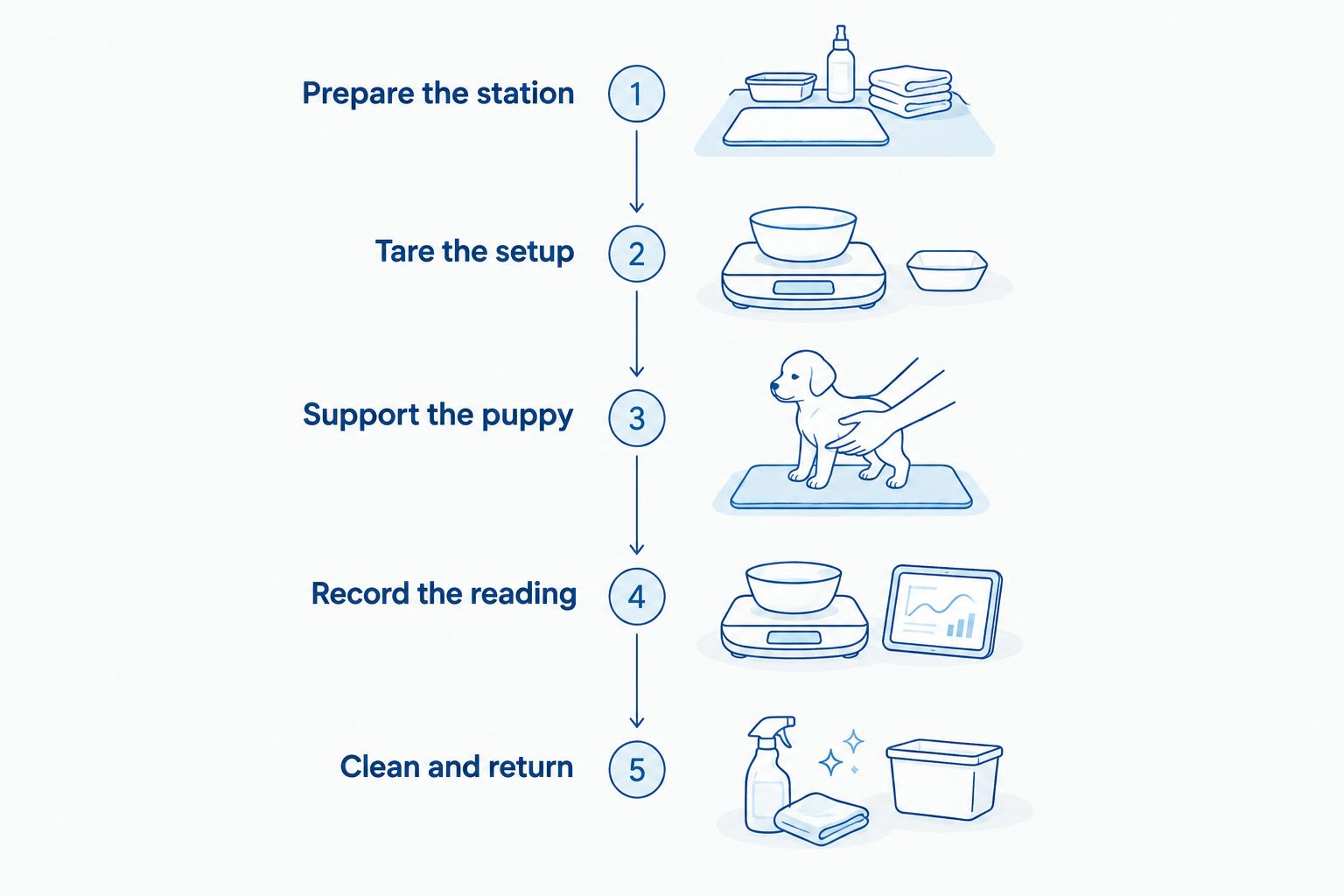
Shrinkabulls puts practical puppy care ahead of extra gadgets. Keep the process calm, brief, and consistent, with the puppy supported throughout.
Prepare the station
Set the scale on a firm, level surface in a draft-free area. Keep the weighing station close to the care area, with your record sheet ready, so the puppy spends as little time away as necessary.
Tare the setup
Place the clean container and liner on the scale, then use tare. Confirm that the display returns to zero before adding the puppy, and repeat this whenever the liner or container changes.
Support the puppy
Place the puppy gently in the supported center of the tray. Keep your hands ready to prevent a fall, but avoid pressing on the weighing surface while reading the display.
Record the reading
Write down the puppy’s identity, time, weight, units, and relevant nursing observations. Compare measurements taken under similar conditions, and follow your veterinarian’s instructions for weighing frequency.
Clean and return
Return the puppy promptly to the appropriate care environment. Clean the equipment according to its instructions, dry it as directed, and prepare it for the next puppy.
When a weight reading needs veterinary attention
A scale is a monitoring tool, not a diagnosis. Contact your veterinarian promptly about weight loss, failure to gain as expected, poor nursing, weakness, or unusual crying. Breathing difficulty or an unresponsive puppy requires immediate veterinary attention; do not delay care for another weigh-in.
If an otherwise alert puppy produces a surprising reading, check the units and tare, then repeat the measurement with the puppy safely supported. Share the record with your veterinarian rather than changing supplementation based on one uncertain number.
Our guide to choosing a veterinarian experienced with brachycephalic breeds helps you plan that care relationship before a problem develops.
Which digital puppy scale should you choose?
Choose a digital puppy tray scale with gram readings, tare, and a stable, cleanable tray as your default. Choose the kitchen-scale configuration only when its container fits securely, and choose a veterinary model only when its low-weight specifications support newborn monitoring.
Our 2026 recommendation stays simple: reliable measurements beat extra buttons. Keep the same equipment and units throughout the record whenever possible, and discuss any equipment change with your veterinarian if you are tracking a concern.
FAQ
What’s the best digital scale for newborn Bulldog puppies?
Shrinkabulls recommends a digital puppy tray scale with gram readings, tare, and a stable weighing surface. Check documented accuracy and repeatability rather than choosing by the product name alone.
Can I use a kitchen scale to weigh newborn puppies?
Yes, if the kitchen scale has suitable measurement specifications and supports a secure container. Tare the container and liner, keep the display visible, and never leave the puppy unattended.
Is a baby scale better than a puppy scale?
A baby scale is not automatically better than a puppy scale. Compare minimum load, display increments, accuracy, and the fit of the weighing surface before choosing either type.
Should I record puppy weight in grams or ounces?
Grams are a practical choice for keeping a consistent newborn weight record. Use the units your veterinarian requests, and label every entry so caregivers do not confuse units.
How often should I weigh a newborn Bulldog puppy?
Follow the weighing schedule your veterinarian sets for the litter and each puppy’s condition. Record the time and nursing observations alongside the weight so the measurements have useful context.
Does a hold button make a puppy scale accurate?
No, a hold button keeps a displayed reading but does not prove accuracy. Check how the feature works, and do not accept a held number when the puppy or container was poorly positioned.
What should I do if my newborn puppy loses weight?
Contact your veterinarian promptly about newborn weight loss. Check the measurement setup if the puppy is otherwise alert, but do not delay care when poor nursing, weakness, or breathing difficulty is present.
One last thing
A shared record prevents a good scale from producing a confusing history. If another caregiver takes over, leave the same container, units, puppy identification method, and recording format ready to use. At Shrinkabulls, our recommendation is simple: make the routine as dependable as the equipment.
Related guides
- Incubators and heating pads for whelping Bulldogs
- Puppy milk replacer formulas for newborn Bulldogs
- Preparing an English Bulldog puppy for its first vet visit
