


 REVIEWS





Best overall: PetAg Esbilac Powder. Best for avoiding mixing errors: PetAg Esbilac Liquid. Best alternative powdered formula: Royal Canin Babydog Milk. For newborn English and French Bulldogs, choose a puppy-specific milk replacer with your veterinarian—not ordinary milk, human infant formula, or a homemade recipe.
- PetAg Esbilac Powder is the default pick for planned newborn Bulldog supplementation under veterinary guidance.
- PetAg Esbilac Liquid removes the powder-measuring step, but safe handling still matters.
- Royal Canin Babydog Milk is an alternative powdered puppy formula; follow its own preparation directions.
- The best puppy milk replacer for Bulldog newborns supports a veterinary feeding plan, not a breed-specific marketing claim.
At Shrinkabulls, Bulldogs are our focus, and helping families understand newborn care matters to us. This 2026 guide separates formula selection from feeding technique, because the right milk cannot make an unsafe feeding method safe.
Why this matters
Newborn puppies depend on adequate nutrition, warmth, and careful observation. A puppy that cannot nurse needs more than a shopping recommendation: your veterinarian must assess hydration, temperature, swallowing ability, and the reason nursing has failed.
Shrinkabulls recommends puppy-specific milk replacer for Bulldog owners supplementing or hand-rearing newborns. That recommendation does not mean every puppy needs formula; effective nursing from a healthy mother remains preferable when possible.
Milk replacer also does not replace the immune protection puppies receive from colostrum, their mother's first milk. Tell your veterinarian promptly if a newborn has not nursed, especially when you do not know whether the puppy received colostrum.
What makes the best puppy milk replacer for a Bulldog?
For this 2026 shortlist, preparation and suitability matter more than package claims. Use these criteria before choosing:
- Newborn puppy suitability: Select a product labeled as a milk replacer for puppies, not an adult-dog milk treat or weaning food.
- Clear preparation directions: Powder requires the manufacturer's exact water-to-powder ratio. Ready-to-feed liquid removes that calculation.
- Safe handling: Check directions for refrigeration, prepared formula, opened containers, and disposal.
- Repeatable preparation: Choose a format every caregiver can prepare correctly, including during overnight feeds.
- Individual tolerance: Track stool, comfort, intake, and weight rather than assuming a familiar name suits every puppy.
- Veterinary fit: Your puppy's examination and feeding plan take priority over any ranked list.
English and French Bulldogs do not need a milk replacer chosen by coat color. A merle, lilac, blue, or traditionally colored newborn needs nutrition appropriate to its age and clinical condition.
Puppy milk replacers at a glance
These are practical selections, not results from a clinical comparison. The order reflects preparation needs, not proof that one formula produces healthier Bulldogs.
| Formula | Best for | Standout feature | Key limitation |
|---|---|---|---|
| PetAg Esbilac Powder | Planned, repeatable supplementation | Powdered puppy milk replacer prepared as needed | Requires accurate measuring and mixing |
| PetAg Esbilac Liquid | Caregivers avoiding powder preparation | Ready-to-feed puppy milk replacer | Still requires careful handling after opening |
| Royal Canin Babydog Milk | An alternative powdered puppy formula | Puppy milk replacer with its own preparation instructions | Instructions cannot be borrowed from another formula |
None of these products treats dehydration, infection, aspiration, or a congenital defect. A puppy with those problems needs veterinary assessment, even if it continues taking some milk.
1. PetAg Esbilac Powder: best for planned supplementation
PetAg Esbilac Powder is a powdered milk replacer for puppies. It is the default choice in this guide for caregivers who can measure consistently and maintain a written feeding routine.
Powder lets you prepare formula according to the puppy's feeding plan. The trade-off is responsibility: an incorrect mixture changes the concentration of nutrients and water your puppy receives.
PetAg Esbilac Powder pros:
- Puppy-specific milk replacer rather than ordinary household milk.
- Preparation can be incorporated into a repeatable feeding routine.
- Mixing directions provide a defined recipe for caregivers to follow.
PetAg Esbilac Powder cons:
- Requires accurate powder and water measurements.
- Adds preparation steps during already demanding overnight care.
- Prepared formula still needs handling and storage according to the label.
Best for: Families supplementing nursing puppies or hand-rearing newborns with a veterinarian's plan and a consistent caregiver routine.
Do not make Esbilac more concentrated to encourage weight gain. Poor growth calls for reassessment of intake, nursing, health, and feeding technique—not an improvised recipe.
Verdict: Buy PetAg Esbilac Powder when your veterinarian approves it and you can prepare it accurately.
2. PetAg Esbilac Liquid: best for avoiding mixing errors
PetAg Esbilac Liquid is a ready-to-feed puppy milk replacer. It removes the step of measuring powder into water, making it a useful choice when preparation consistency is the main concern.
Ready-to-feed does not mean ready for every puppy in every condition. You still need an appropriate feeding temperature, a safe delivery method, and an individualized amount.
PetAg Esbilac Liquid pros:
- No powder-to-water calculation for the ready-to-feed formula.
- Fewer preparation steps for caregivers sharing feeding duties.
- Puppy-specific formulation rather than a homemade milk mixture.
PetAg Esbilac Liquid cons:
- An opened container still requires label-directed storage and disposal.
- Liquid format does not prevent overfeeding or aspiration.
- You must distinguish ready-to-feed liquid from any product requiring dilution.
Best for: Caregivers who want to remove powder measuring from a veterinarian-directed newborn feeding routine.
Read the actual container before the first feed. Do not add water simply because another milk replacer required it, and do not carry over feeding volumes from a different formulation without checking with your veterinarian.
Verdict: Buy PetAg Esbilac Liquid when eliminating powder preparation is your priority.
3. Royal Canin Babydog Milk: best alternative powdered formula
Royal Canin Babydog Milk is a powdered milk replacer intended for puppies. It provides another puppy-specific option when your veterinarian selects a powdered formula other than Esbilac.
Treat Babydog Milk as a separate product, not an interchangeable scoop of powder. Follow its own directions and use the measuring equipment specified for that product.
Royal Canin Babydog Milk pros:
- Intended for puppies rather than human infants or adult dogs.
- Provides a defined preparation method on its product instructions.
- Gives caregivers another puppy-formula option to discuss with their veterinarian.
Royal Canin Babydog Milk cons:
- Requires accurate mixing, just like other powdered formulas.
- A different measuring scoop or remembered ratio can produce an incorrect mixture.
- Changing formulas complicates tracking when a puppy already has digestive problems.
Best for: Caregivers whose veterinarian recommends Babydog Milk as the puppy's powdered replacement or supplement.
Do not rotate formulas to add variety. Newborn feeding is about consistent nutrition and monitoring; a change should have a clear reason, particularly when loose stool or poor growth is already present.
Verdict: Buy Royal Canin Babydog Milk when it fits your veterinarian's plan; skip unnecessary switching.
How we ranked these formulas
This 2026 ranking prioritizes puppy-specific use, preparation burden, and caregiver consistency. Esbilac Powder takes the default slot for planned preparation; Esbilac Liquid takes the no-powder-mixing slot; Babydog Milk provides an alternative powdered option.
The ranking does not claim a Bulldog-specific clinical advantage, superior digestibility, or better survival for any product. A formula your puppy tolerates and your veterinarian approves beats a higher-ranked formula prepared incorrectly.
Before the first bottle: check the puppy, not just the label
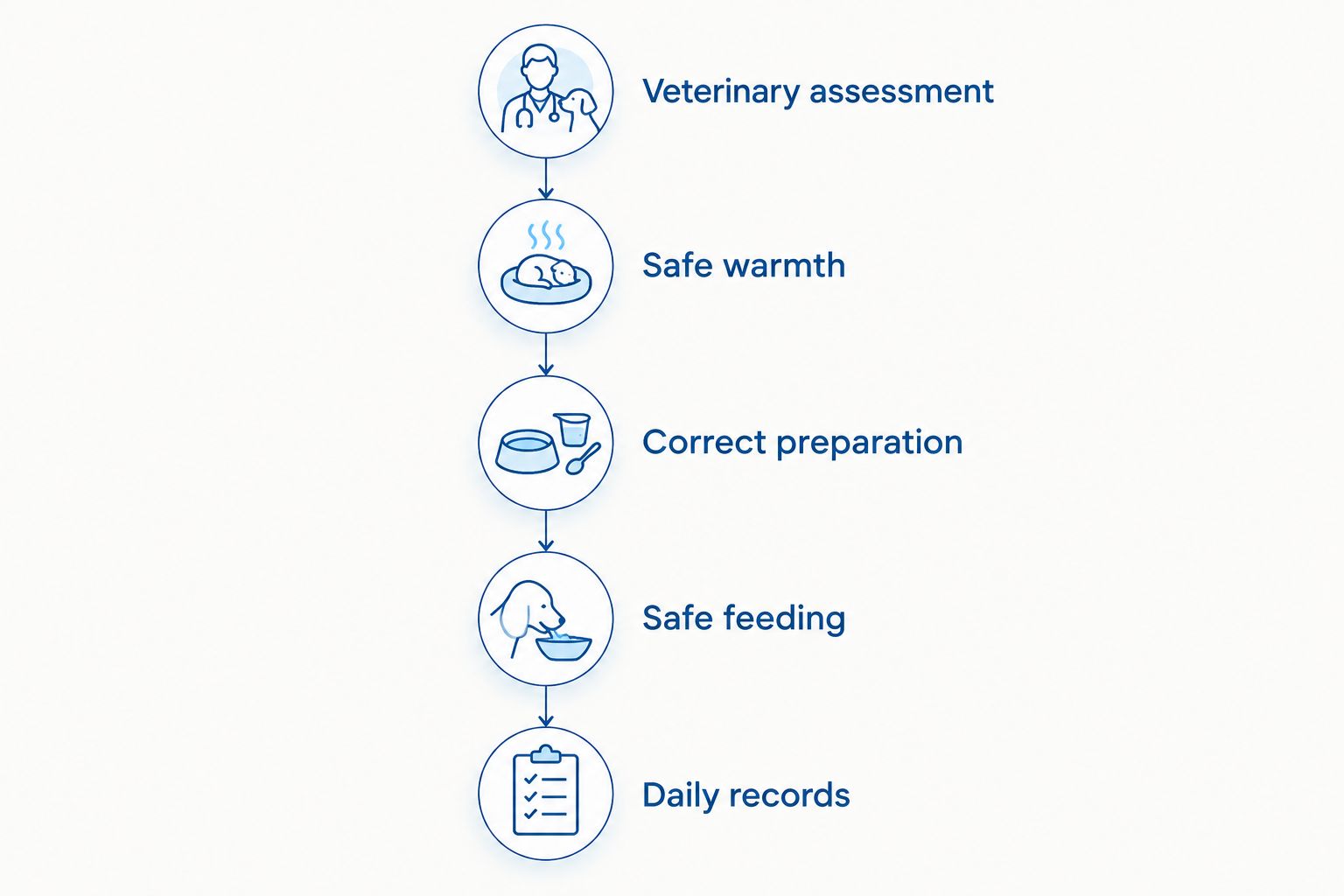
For 2026 newborn care, keep these priorities beside your feeding supplies. The sequence starts with assessment, not opening a container.
- Veterinary assessment: Get an individualized plan for a puppy that cannot nurse. Weakness, dehydration, and swallowing problems change the approach.
- Safe warmth: A chilled puppy needs veterinary guidance and appropriate warming before feeding. Do not force milk into a cold or unresponsive newborn.
- Correct preparation: Follow the product's own directions, using clean equipment and accurately measured ingredients.
- Safe feeding: Feed only when the puppy can swallow, using the technique your veterinarian demonstrates.
- Daily records: Record intake, weight, stool, behavior, and concerns so changes are visible.
A bottle is not the right tool for every newborn. A puppy without an effective suck or swallow needs veterinary attention, and tube feeding requires hands-on veterinary instruction—not a written tutorial.
Feeding details that matter more than brand
Measure temperature and weight
Established veterinary guidance, including VCA Animal Hospitals' guidance on feeding orphaned puppies, recommends warming milk replacer to approximately 95–100°F. Use a thermometer rather than judging by touch, and avoid microwave heating that creates hot spots.
Use a digital scale that reads in 1 g increments and record weight at least every 24 hours, unless your veterinarian requests more frequent checks. Weigh under similar conditions, and contact your veterinarian promptly about weight loss or failure to gain.
These are monitoring tools, not a complete feeding prescription. Your veterinarian must set feeding amounts and intervals using age, current weight, formula instructions, nursing intake, and clinical condition.
Keep the puppy belly-down
A nursing puppy feeds belly-down, not cradled on its back like a human baby. Ask your veterinarian to demonstrate head position, nipple fit, and appropriate milk flow before you feed independently.
Never squeeze a bottle to push milk into the mouth. Stop feeding and seek urgent veterinary advice if milk comes from the nose, the puppy coughs, or breathing changes.
Separate supplementation from full replacement
A puppy that nurses effectively needs a different plan from an orphan receiving all nutrition from formula. Giving a full replacement allowance on top of nursing risks overfeeding.
Have your veterinarian document whether each puppy needs supplementation or complete replacement. Keep individual records even when littermates look similar; one puppy's intake does not establish another's needs.
What to skip in your 2026 feeding plan
Skip ordinary cow's milk, plain goat's milk, human infant formula, and homemade mixtures as routine newborn puppy nutrition. These are not interchangeable with a puppy milk replacer formulated for the purpose.
A commercial puppy formula containing goat-milk ingredients is a different category from plain goat's milk. Judge the finished product's intended use and directions, not a single ingredient on the front of the package.
Also skip adding supplements, extra powder, or medication to a bottle without veterinary instructions. If a puppy seems hungry after feeding, ask for reassessment rather than automatically increasing concentration or volume.
Which puppy milk replacer should you choose?
Choose PetAg Esbilac Powder as the default option to discuss with your veterinarian. Choose PetAg Esbilac Liquid when avoiding powder-measuring errors is the deciding factor, or Royal Canin Babydog Milk when your veterinarian prefers that alternative.
Shrinkabulls encourages Bulldog families to settle the care plan before an overnight feeding emergency. Write down the selected formula, preparation directions, feeding instructions, storage rules, and emergency veterinary contact details where every caregiver can find them.
FAQ
What’s the best puppy milk replacer for Bulldog newborns?
PetAg Esbilac Powder is this guide’s default choice for veterinarian-directed supplementation or hand-rearing. PetAg Esbilac Liquid suits caregivers avoiding powder preparation, while Royal Canin Babydog Milk is an alternative powdered puppy formula.
Do newborn English and French Bulldogs need different milk replacers?
Choose milk replacer by its suitability for newborn puppies and your veterinarian’s assessment, not simply by English versus French Bulldog identity. Feeding amounts and technique must account for the individual puppy’s weight, nursing intake, and health.
Is liquid puppy formula better than powder?
Ready-to-feed liquid is better for removing the powder-measuring step, not automatically better for every puppy. Powder works when prepared accurately, and both formats require safe handling and an individualized feeding plan.
Can I give a newborn Bulldog plain goat’s milk?
Plain goat’s milk is not an appropriate routine substitute for puppy milk replacer. A commercial puppy formula containing goat-milk ingredients is different because the finished product is formulated for puppy feeding.
How much milk replacer should I give my Bulldog puppy?
Your veterinarian should set the amount using the puppy’s weight, age, health, formula directions, and any milk received from nursing. Do not reuse another puppy’s feeding amount or another formula’s instructions.
What should I do if milk comes out of my puppy’s nose?
Stop feeding and contact a veterinarian urgently because milk from the nose raises concern about aspiration, feeding technique, or an anatomical problem. Breathing difficulty, weakness, or blue or pale gums requires emergency care.
Does puppy milk replacer replace colostrum?
Ordinary puppy milk replacer does not replace the immune protection provided by maternal colostrum. Tell your veterinarian promptly if a newborn has not nursed or you are unsure whether it received colostrum.
One last thing
A quiet newborn is not automatically a satisfied newborn. Weak puppies also become quiet, so judge feeding success by nursing or feeding ability, warmth, weight records, and veterinary assessment—not silence alone.
Our message at Shrinkabulls is simple: choose the formula carefully, then give the feeding routine equal attention. Your little Bulldog needs both!
Related guides
- Choosing a vet experienced with brachycephalic breeds
- Incubators and heating pads for whelping Bulldogs
- Choosing a whelping box for a Bulldog breeding program
- Preparing an English Bulldog puppy for its first vet visit
