


 REVIEWS





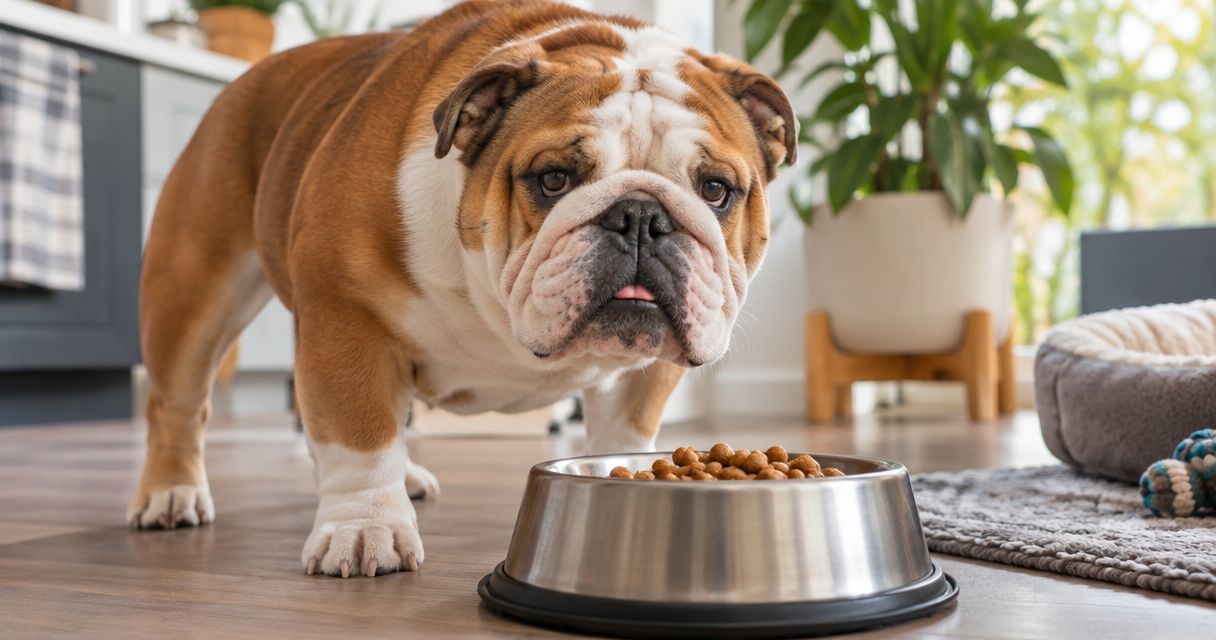
English Bulldogs need a measured daily ration based on their ideal weight, life stage, activity, and the calories in their food—not a fixed number of cups for the breed. Count treats and toppers within that daily allowance, and use your veterinarian’s calorie target plus the food label to calculate the portion. This 2026 guide explains how to measure meals and tell whether the amount suits your Bulldog.
- How much do English Bulldogs eat? Calculate daily portions from ideal weight, food calories, and veterinary advice.
- Count treats and toppers within the daily calorie allowance, not on top of it.
- Shrinkabulls English Bulldog owners should prioritize body condition over a universal cups-per-day rule.
- Use a kitchen scale and track weight trends to keep feeding consistent.
Why this matters
Bulldogs have sturdy bodies, but extra body fat is not part of the breed’s required shape. Feeding by appetite alone makes it easy to miss gradual weight gain. Those hopeful eyes are persuasive!
The right ration maintains healthy body condition; it does not simply empty the bowl. If your Bulldog already needs to lose weight, start with a veterinary assessment rather than sharply cutting meals. Our guide to diet plans for overweight English Bulldogs covers that separate feeding goal.
Keep the food package, a record of everything your dog eats, and recent weight measurements together. These details give your veterinarian something more useful than an estimate of how full the scoop looks.
How much do English Bulldogs eat per day?
There is no single correct daily cup allowance for every English Bulldog. A cup measures volume, not your dog’s energy needs, and different foods supply different calories in the same volume.
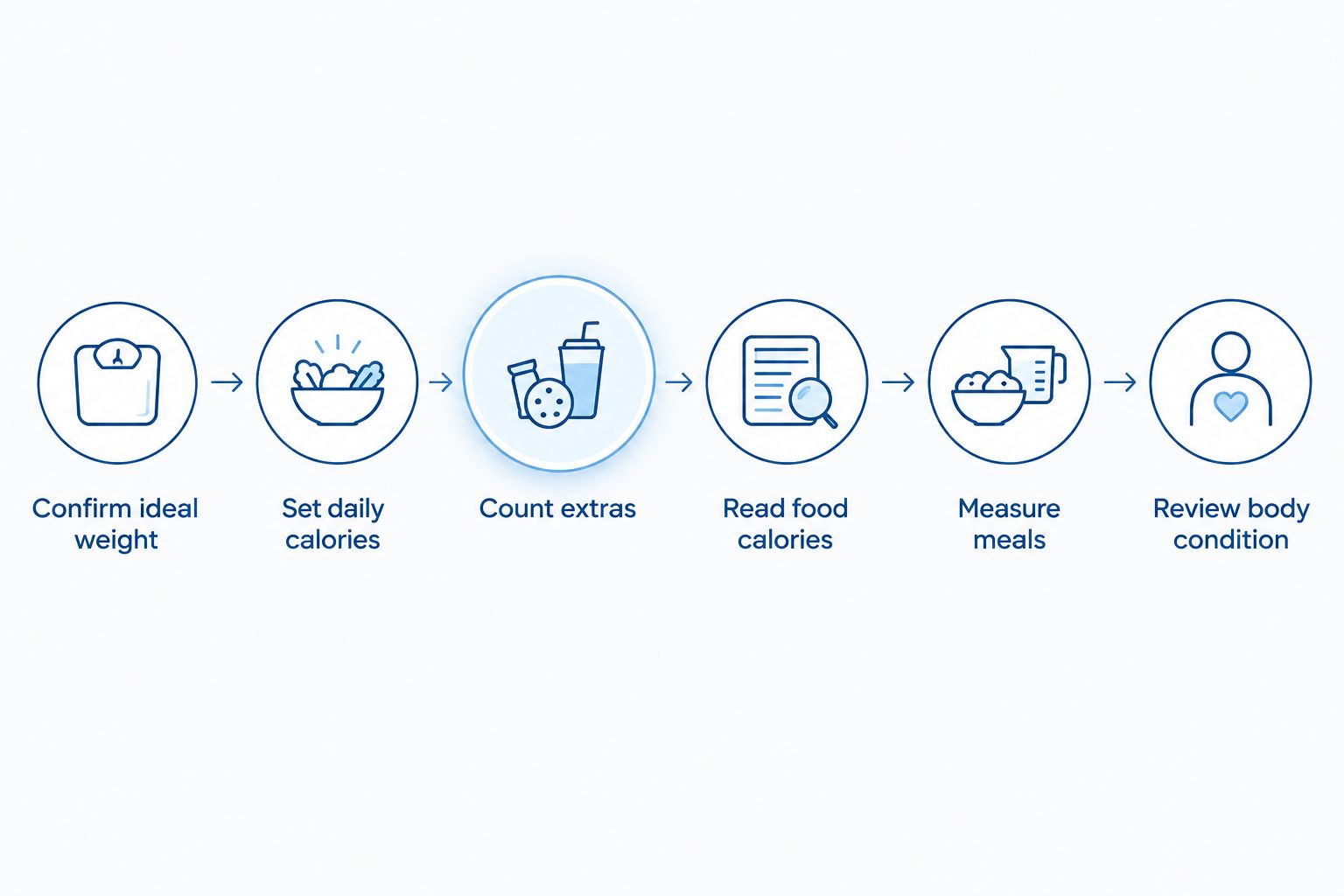
Use this process to establish the daily amount:
- Confirm ideal weight. Ask your veterinarian to assess body condition and muscle condition, not just the number on the scale.
- Set daily calories. Get a starting calorie target appropriate for maintenance, growth, or a supervised weight-management plan.
- Count extras. Include treats, dental chews, toppers, table food, and anything used to give medication.
- Read food calories. Find the label’s kilocalories per cup, can, pouch, or kilogram. Nutritional Calories and kilocalories describe the same energy amount here.
- Measure meals. Convert the remaining food allowance into the appropriate weight or volume, then divide it between meals.
- Review body condition. Adjust with veterinary guidance as weight, growth, activity, or health changes.
The calculation is straightforward:
Daily food calories ÷ calories per gram = grams of food per day.
If the label lists calories per cup instead, divide daily food calories by calories per cup. Do not divide by the food’s protein percentage; protein content is not its calorie density.
A feeding chart on the package is a starting point, not a personalized prescription. Check whether its amounts refer to the whole day or each meal before filling the bowl.
Which feeding approach fits your Bulldog?
Life stage changes the feeding plan. Use this comparison to identify the right discussion with your veterinarian, not to select a portion without checking the label.
| Feeding plan | Best for | Main advantage | Limitation |
|---|---|---|---|
| Measured adult maintenance ration | Healthy adults at ideal body condition | Makes daily intake consistent | Requires adjustments when activity or weight changes |
| Growth diet with scheduled meals | Growing English Bulldog puppies | Supplies nutrition formulated for growth | Adult feeding instructions do not apply |
| Veterinary weight-management plan | Bulldogs carrying excess body fat | Sets a deliberate weight-loss target | Cutting ordinary food too far risks inadequate nutrient intake |
| Individualized senior or medical plan | Older dogs or dogs with diagnosed conditions | Accounts for health and muscle condition | Age alone does not determine the portion |
Adult English Bulldogs: divide the daily ration into meals
For many healthy adult dogs, 2 meals per day is a practical schedule. Divide the established daily allowance between breakfast and dinner rather than serving the package’s full daily amount at both meals.
Scheduled feeding also makes appetite changes easier to notice. Measure the whole day’s ration into a container, then take each meal from that container so family members do not accidentally feed twice.
Keep fresh water available. Moistening food or adding wet food does not remove the need to account for all calories served.
For your 2026 feeding record, write down the exact food formula and its calorie density. A familiar brand name does not tell you whether a different recipe needs the same portion.
English Bulldog puppies: use a growth-specific plan
English Bulldog puppies need food formulated for growth and an age-appropriate meal schedule. Do not shrink an adult dog’s ration and assume the result meets a puppy’s needs.
Ask your veterinarian how frequently your puppy should eat and when to reassess portions. Growth changes the plan, so a portion that suited pickup day is not a permanent allowance.
When you bring a puppy home, request the exact food name, daily amount, meal schedule, and recent feeding history. Keep the initial routine consistent while you arrange veterinary guidance on any changes.
We love the excitement of bringing a Bulldog puppy home! Shrinkabulls is a fit for families seeking English Bulldog puppies; individual feeding targets belong with your veterinarian. Our Shrinkabulls breeding business offers English and French Bulldog puppies, but choosing a puppy and prescribing its nutrition are different decisions.
Senior English Bulldogs: reassess rather than automatically reduce
An older Bulldog does not automatically need a smaller bowl. Activity, muscle condition, appetite, and diagnosed disease determine whether the daily ration should change.
A dog losing muscle or weight needs an assessment, not an assumption that aging explains everything. Likewise, reduced activity does not justify an abrupt food restriction without checking overall body condition.
Add weight and muscle-condition questions to your Bulldog’s 2026 wellness visit. Ask whether the current diet still fits before changing to a food simply because its label says senior.
Why an English Bulldog’s daily food amount varies
These factors explain why another Bulldog’s portion is not a reliable target for yours:
- Ideal body size: A dog’s healthy target weight matters more than matching another dog’s bowl.
- Life stage: Growth, adult maintenance, pregnancy, and lactation have different nutritional requirements.
- Activity and reproductive status: Daily movement and whether a dog is spayed or neutered affect energy needs.
- Food calorie density: Dry food, canned food, and mixed diets supply different calories by weight and volume.
- Body condition and health: Excess body fat, muscle loss, and medical conditions change the feeding goal.
- Extras: Treats, chews, and toppers use part of the same daily calorie budget.
Coat color is not a basis for prescribing portions. Choose the ration around the individual dog rather than a rare-color label or a description such as miniature.
How do you know whether your Bulldog eats too much?
Look at body condition and weight trends together. You should be able to feel the ribs beneath a light fat covering, see a waist from above, and assess the abdominal tuck from the side.
Veterinary body-condition systems commonly use a 9-point scale, with 4–5 out of 9 representing ideal condition. The World Small Animal Veterinary Association’s dog body-condition chart illustrates these features; ask your veterinarian to demonstrate the assessment on your Bulldog.
A thick neck, broad chest, and loose skin complicate visual judgment. Hands-on assessment matters, and weight alone cannot distinguish body fat from muscle.
If weight is rising, review actual intake before blaming the food. Check heaped scoops, unrecorded snacks, shared bowls, and whether somebody is refilling an apparently empty bowl between meals.
How should you measure dry food, wet food, and mixed meals?
Use a kitchen scale for repeatable portions, especially when managing weight. Weigh the food without including the bowl, and use the same unit each time.
A measuring cup is convenient, but inconsistent filling changes the amount served. If you use cups, level the portion rather than rounding it above the rim.
For mixed feeding, calculate the calories from each component separately and add them together. Do not serve a full dry-food ration plus a full wet-food ration unless that combined amount matches the prescribed daily target.
The same rule applies when choosing a dog food subscription: delivery portions still need to match your Bulldog’s calorie target, treats, and weight trend. A delivery schedule does not replace portion assessment.
When changing food in 2026, compare the old and new calorie labels before carrying over the same scoop size. Recalculate even when the packaging looks familiar.
How many treats can an English Bulldog have each day?
Keep treats and other nutritionally incomplete extras to no more than 10% of daily calories, unless your veterinarian gives different instructions. At least 90% of daily calories should come from the appropriate complete and balanced diet under this general veterinary guideline.
That allowance includes more than training rewards. Dental chews, cheese used for pills, food dropped from the table, and toppers all count.
Set aside part of the measured daily kibble ration for training if your Bulldog enjoys it. This lets you reward good behavior without automatically adding more food to the day.
Prescription diets and diagnostic food trials need stricter instructions. During a food trial, even a small unapproved treat can interfere with the plan, so ask your veterinarian exactly what rewards are permitted.
What should you do if your Bulldog still seems hungry?
An empty bowl does not prove the ration is too small. Some dogs continue seeking food after meeting their calorie needs, so assess weight, body condition, and health before increasing portions.
Try making the existing allowance last longer through supervised food puzzles or training rewards taken from the daily ration. Choose equipment your Bulldog can use comfortably, and stop if feeding causes frustration or breathing difficulty.
Do not assume that hunger paired with weight loss is ordinary begging. Contact your veterinarian about unexplained weight changes, increased thirst, vomiting, diarrhea, or a persistent appetite change.
Refusing food also deserves attention, especially in a puppy or a dog showing other symptoms. Seek prompt veterinary advice rather than repeatedly adding richer toppers to persuade your dog to eat.
FAQ
How much do English Bulldogs eat in cups each day?
English Bulldogs do not share a single correct cups-per-day allowance. Divide your dog’s daily food-calorie target by the food’s calories per cup, after accounting for treats and toppers.
Should I feed my English Bulldog once or twice a day?
For many healthy adult English Bulldogs, 2 meals per day is a practical schedule. Split the total daily ration between those meals; puppies and dogs with medical needs require individualized schedules.
How much should an English Bulldog puppy eat?
An English Bulldog puppy needs an individualized amount of growth-appropriate food based on age, weight, body condition, and calorie density. Ask your veterinarian for a starting amount and reassess it as the puppy grows.
Can I leave food out all day for my English Bulldog?
Measured meals make your English Bulldog’s intake easier to track than a continually refilled bowl. If food remains accessible, measure the entire daily allowance and prevent other pets from sharing it.
Do treats count toward my Bulldog’s daily food allowance?
Yes, treats and other extras count toward your Bulldog’s daily calorie allowance. Keep nutritionally incomplete extras to no more than 10% of daily calories unless your veterinarian directs otherwise.
Does a rare-colored English Bulldog need more food?
Coat color does not determine an English Bulldog’s food allowance. Base portions on ideal weight, life stage, activity, health, and the food’s calorie density.
Should I give my Bulldog more food if the bowl is empty?
An empty bowl alone is not a reason to increase your Bulldog’s food. Review body condition and weight trends, and ask your veterinarian about persistent hunger or unexplained weight loss.
One last thing
Record the food, not just the scoop. A note saying breakfast is a scoop becomes unreliable when somebody changes the scoop, heaps it higher, or opens a different formula.
For a more useful 2026 routine, keep the food name, calorie density, measured daily amount, treat allowance, and veterinary target together. Make sure everyone feeding your Bulldog follows that same record. Consistency is kinder than guessing at every meal.
Related guides
- How big English Bulldogs get when full grown
- How to transition a Bulldog puppy from breeder food to a home diet
- How to identify food allergies in an English Bulldog
